14 min read
—



Casimir Rajnerowicz
Content Creator
V7 Go
A smarter way to manage due diligence and underwriting
An operations director at a registered investment adviser books two demos in the same week. Addepar on Tuesday, Orion on Thursday. Tuesday is about entity rollups, held-away assets and performance attribution across a family's trusts. Thursday is about pipeline management, rebalancing across four hundred households, and generating an investment policy statement. Both call themselves wealth management software. Neither can be scored against the other.
That is not a failure of the demos. Two genuinely different products are sold under the same name, and the search results for the term cannot tell them apart either. One is the advisor stack, built to run an advisory practice. The other is the wealth-owner stack, built to answer what a family owns and how it is doing. They share a category label and almost nothing else.
You can measure the gap. Three guides currently rank for this term. The first uses the word wealth nineteen times and the words CRM and trading not once. The second is built around Orion and mentions trading eleven times. The third sits between them. Three pages answering one query in three vocabularies that barely overlap, and none of them mentions that the category has two halves.
This article names the split and gives you a way to work out which half you are shopping in. It then compares the serious platforms within each, and covers the part every vendor guide skips: where the data comes from before any platform can report on it. A disclosure belongs up front. V7 Go publishes this and does not sell either kind of platform. We build AI infrastructure for private markets, the document layer that feeds them, which shapes what we know well and what we do not.
Why wealth management software describes two different products
Wealth management software falls into two categories that share a name. Advisor platforms run an advisory business: client relationship management, proposals, billing, trading and rebalancing. Wealth-owner platforms answer a different question: what does this family own, across every custodian and entity, and how is it performing. The second group buys data aggregation and consolidated reporting; the first buys workflow.
The advisor stack is bought by registered investment advisers, broker-dealers and bank wealth divisions, the firms that file a Form ADV. Orion, Envestnet Tamarac, Advyzon, Wealthbox and Nitrogen sit here. The work it exists to do is practice operations. Onboard a client, assess risk tolerance, produce a proposal, generate an investment policy statement, rebalance a book of four hundred households against a model, bill correctly, and stay ready for an examination. Assets sit at two or three custodians the firm has a relationship with.
The wealth-owner stack is bought by single and multi-family offices, private banks and ultra-high-net-worth households. Addepar, Masttro, Altoo, Landytech and Asset Vantage sit here. The work is different in kind. Assets sit at eight or twelve custodians in several countries, held through trusts, limited liability companies and partnerships with irregular ownership. A material share of the portfolio is private funds and property that no custodian reports on at all.
SS&C Black Diamond is the interesting exception, serving both sides, which is why it appears on every comparison and why it is hard to place.
The distinction matters commercially because the two stacks are priced, implemented and staffed differently. Advisor platforms increasingly publish pricing: Advyzon from about 6,500 dollars a year for 150 accounts, Wealthbox from 49 dollars per user per month, Nitrogen from 99 dollars a month. Wealth-owner platforms are almost all quote-driven, with Addepar estimated in the industry press at 75,000 to 250,000 dollars a year and up. Implementation runs days to weeks at the light end and three to nine months at the heavy end. Choosing the wrong category does not cost you a feature. It costs you a year.
Which one are you shopping for
Four questions settle it faster than any feature grid.
Who reads the output? If it is a client receiving a quarterly statement from you, you want the advisor stack. If it is a principal or an investment committee asking what we own, you want the wealth-owner stack.
Who owns the client relationship? If you are the adviser and the client is external, and your firm appears in the SEC's register of registered investment advisers, the software has to support prospecting, proposals and compliance. If the family is the owner and you work for them, none of that applies and the money should go into aggregation depth instead.
Where do the assets sit? Two or three custodians you have a relationship with points to the advisor stack. Eight or more across multiple jurisdictions, plus private funds and property, points the other way.
What is the bottleneck? If the constraint is running the practice, buy for workflow. If the constraint is knowing the position, buy for data.
Two answers route you off this page entirely, and that is the correct outcome. If you are an investment firm or a general partner managing a fund rather than client wealth, our guide to portfolio management software covers your category. If you are a family office, family office reporting software covers yours in the same depth, and family office accounting software covers the ledger underneath it.
The advisor stack: what to compare
Six platforms come up in most shortlists. The comparison below reflects published capability and public documentation. Pricing and implementation figures are drawn from vendor materials and from X1 Wealth's platform research, which is the most rigorous public comparison of this half of the market.
Platform | Firm size | CRM | Trading | Pricing | Implementation |
|---|---|---|---|---|---|
Orion | $200M to $10B+ | Redtail, included | Eclipse, strongest on this list | Quote-driven, modular | 3 to 6 months |
Envestnet Tamarac | $500M to $10B+ | Integrated | Integrated, UMA-oriented | Quote-driven | 3 to 6 months |
Advyzon | $50M to $2B | Integrated | Quantum rebalancer | From $6,500/yr, published | Weeks to 2 months |
SS&C Black Diamond | $500M to $10B+ | Integrated | IMS suite, added 2025 | Quote-driven, AUM-based | 3 to 9 months |
Wealthbox | Any | Core product | None, integrates | From $49/user/mo, published | Days to weeks |
Nitrogen | Any | None | None, integrates | From $99/mo, published | Days to weeks |
Three things are worth noticing in that table rather than in any feature list.
Published pricing correlates with scope. The platforms that publish rates solve one problem well. The platforms that quote solve many and want to scope you first. Neither is a criticism, but it does mean early budgeting is impossible for the enterprise tier unless you ask for implementation, migration, training and recurring costs broken out separately.
Trading is the real dividing line. Orion's Eclipse is the reference implementation for household-level trading and tax-loss harvesting at scale. If rebalancing several hundred households against models is the daily work, that capability dominates the decision and everything else is secondary.
Assume you will run more than one. Wealthbox plus a reporting platform, or Nitrogen for proposals alongside whichever system holds positions. The best-of-breed route is normal here, and the question becomes which system is the record for positions, performance and billing.
The wealth-owner stack: what to compare
Different platforms, different criteria. Nobody in this half of the market is asking about proposal generation. They are asking a harder question. Can the platform hold a position that arrives as a PDF once a quarter, and attribute it correctly to the trust that owns 40 per cent of the partnership that holds it?
Platform | Best for | Aggregation breadth | Entity and ownership | Alternatives | Pricing |
|---|---|---|---|---|---|
Addepar | Large family offices, private banks, institutions | Deepest, including held-away and private assets | Financial Graph models fund hierarchies and waterfalls | Strong, some via add-on modules | Quote-driven, est. $75K to $250K+/yr |
Masttro | Wealth owners and family offices wanting fixed pricing | 650 to 700 custodian connections, 35 countries | Built for multi-entity from family office origins | Strong, incl. real estate and private equity | Fixed, not AUM-based |
Altoo | Single family offices and individual wealth owners | Moderate, Swiss and European focus | Moderate | Moderate, document-management emphasis | Fixed, not AUM-based |
Landytech | Asset owners and wealth managers, UK and Europe | 400+ direct custodians | Single family office focus | Moderate | Variable by custodians and entities |
SS&C Black Diamond | Firms needing both halves, plus trust accounting | Hundreds of sources, 99%+ reconciled pre-open | Strong on complex structures | Strongest operational alternatives servicing | Quote-driven, AUM-based |
Asset Vantage | Accounting-forward family offices | Moderate | Strong, entity-level visibility | Moderate | Quote-driven |
The pricing column deserves more weight than it usually gets. An AUM-based fee means the software bill rises with a good year in the markets, which has nothing to do with how much software you are using. Masttro and Altoo both market fixed pricing against exactly that objection. Over a decade of compounding, the difference is not marginal.
Wealth management reporting software, specifically
Reporting is frequently bought as its own thing, and it is worth separating from the platform question. Data aggregation gets the positions into one place; consolidated reporting is what turns them into something a person reads. A consolidated report has to reconcile to custodian statements, roll up correctly through the ownership structure, handle several base currencies, and present performance on a basis the reader can defend.
That last point causes more arguments than any other. Time-weighted return removes the effect of cash flow timing, which makes it correct for judging a manager, since the investor controls the contributions. Internal rate of return accounts for timing and size of cash flows, which makes it correct for private funds, where the manager decides when capital is called and returned. A portfolio holding both needs both figures. Applying the wrong one to a private position produces a number that looks authoritative and means nothing. The GIPS standards set out the reporting basis in detail and are the reference to settle it against before implementation rather than after.
Lock the methodology, the benchmark selection and the valuation frequency for illiquid assets before the build starts. Disagreements about these surface months into an implementation otherwise. Our guides to portfolio performance reporting and portfolio reconciliation cover the mechanics downstream of that decision.
What supports multiple custodians actually means
The single most useful idea in the public literature on this category comes from X1 Wealth's platform research, and it is worth restating with credit. The phrase supports multiple custodians can describe four separate jobs: receiving data, reconciling accounts, creating trades, and routing those trades to a custodian. A platform can do the first two and none of the last two, and still make the claim honestly.
Ask each finalist to answer five things in writing. The exact custodians and account types supported. Whether the data path is a direct feed, an aggregator, a file import or manual entry. Where an order is created, approved, routed and confirmed. Who owns sleeve accounting and execution if unified managed accounts are involved. And the reconciliation frequency, exception owner and export format. A completed sheet tells you more than any feature score, because it shows exactly where the advertised platform stops and another vendor or a person with a spreadsheet begins.











What to do when you need both
A registered investment adviser serving ultra-high-net-worth families needs advisor workflow and wealth-owner reporting at once. Every guide on this topic treats the choice as one decision. In practice it is usually two systems and an integration, and the guides that avoid saying so leave the reader to discover it during implementation.
Three routes exist, and each has a real cost.

One platform that covers both, accepting compromises. Black Diamond is the usual answer, and it is a reasonable one. The trade is analytical depth: firms with genuinely institutional attribution and factor-modelling needs tend to end up wanting Addepar eventually.
Two systems with a defined boundary. The advisor platform is the record for households, billing and trading. The reporting platform is the record for positions and performance on the complex accounts. This works when the boundary is drawn by client segment rather than by data type, so a given household lives entirely in one system.
Two systems with an overlap. The most common outcome and the most expensive. Both systems hold positions, neither is authoritative, and somebody reconciles them monthly. If this is where you are heading, price the reconciliation as a permanent role rather than a temporary inconvenience.
Whichever route you take, name the system of record for each data type in writing before signing anything. The question is boring during evaluation and decisive eighteen months later.
Where the data comes from
Both stacks assume the data is already inside them. That assumption is where the work actually is, and it is the part no comparison guide covers.
An honest starting point: the platforms have moved on this in 2026, and more than they had a year ago. Addepar launched Addison in March 2026, a natural-language assistant that answers portfolio questions with traceable citations back to source data. It builds on Addepar's Alts Data Management and Intelligent Statements features, which turn unstructured statements into review-ready files. Orion launched Denali AI Enterprise in February 2026, with plain-English data queries and drafted client reports. Wealthbox shipped an AI note-taker. Anyone telling you this category has no AI in it has not looked since last year.
The limitation is structural rather than a matter of quality. Each of those features reads what is already inside the platform that ships it. Addison answers questions about data in Addepar. Denali answers questions about data in Orion. A firm running Orion for reporting while a third of its clients hold private funds that never reach Orion gets nothing from either, because the documents carrying those positions are sitting in an inbox.
That is why Masttro lists Canoe and Arch alongside the platforms in its own comparison, describing them as complementary tools integrating with wealth platforms rather than competitors. The document layer is a separate job from the reporting layer, and the market has started to treat it as one.
The documents the reporting depends on
For any firm holding meaningful private assets, the same inventory arrives every quarter on somebody else's schedule. Capital account statements carrying net asset value, contributions, distributions and unfunded commitment. Capital call and distribution notices, irregular, each with a due date. Schedule K-1s, annually and late. Manager letters. Brokerage statements for held-away accounts with no feed. Where a manager follows the ILPA reporting template the fields are at least predictable; plenty do not.
For a firm with forty or more private positions across several client households, that is several hundred documents a year. Each carries between one and a dozen figures that somebody reads off a PDF and types into a platform. Reporting is exactly as current as the last document someone got to.
What a document layer adds
Three properties matter here, and they are not the ones usually advertised.
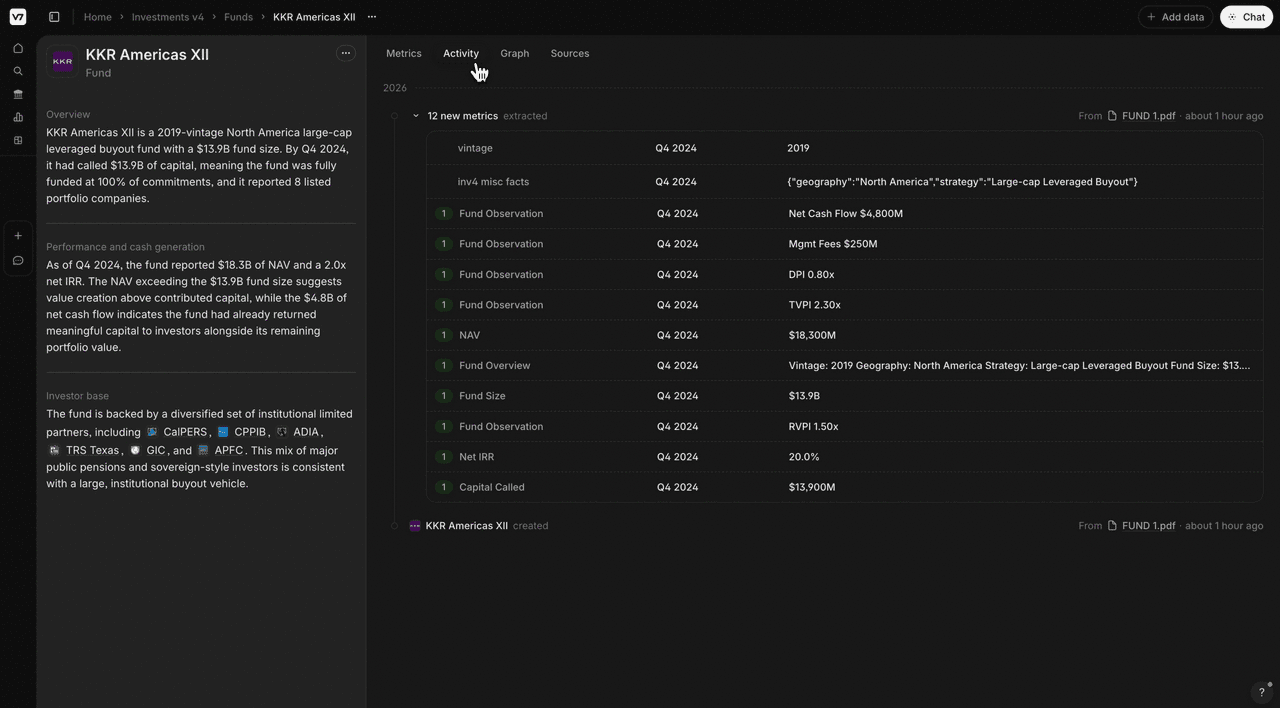
Typed output. A capital account statement returns the same fields whether it came from a mega-fund's template or a lower-middle-market manager's Word document, so whatever consumes it on the other side never changes shape.
Deterministic workflows. The steps are defined once and the five hundredth run takes the same route as the first. An assistant that re-plans its approach each time cannot give you a reporting process an auditor will accept.
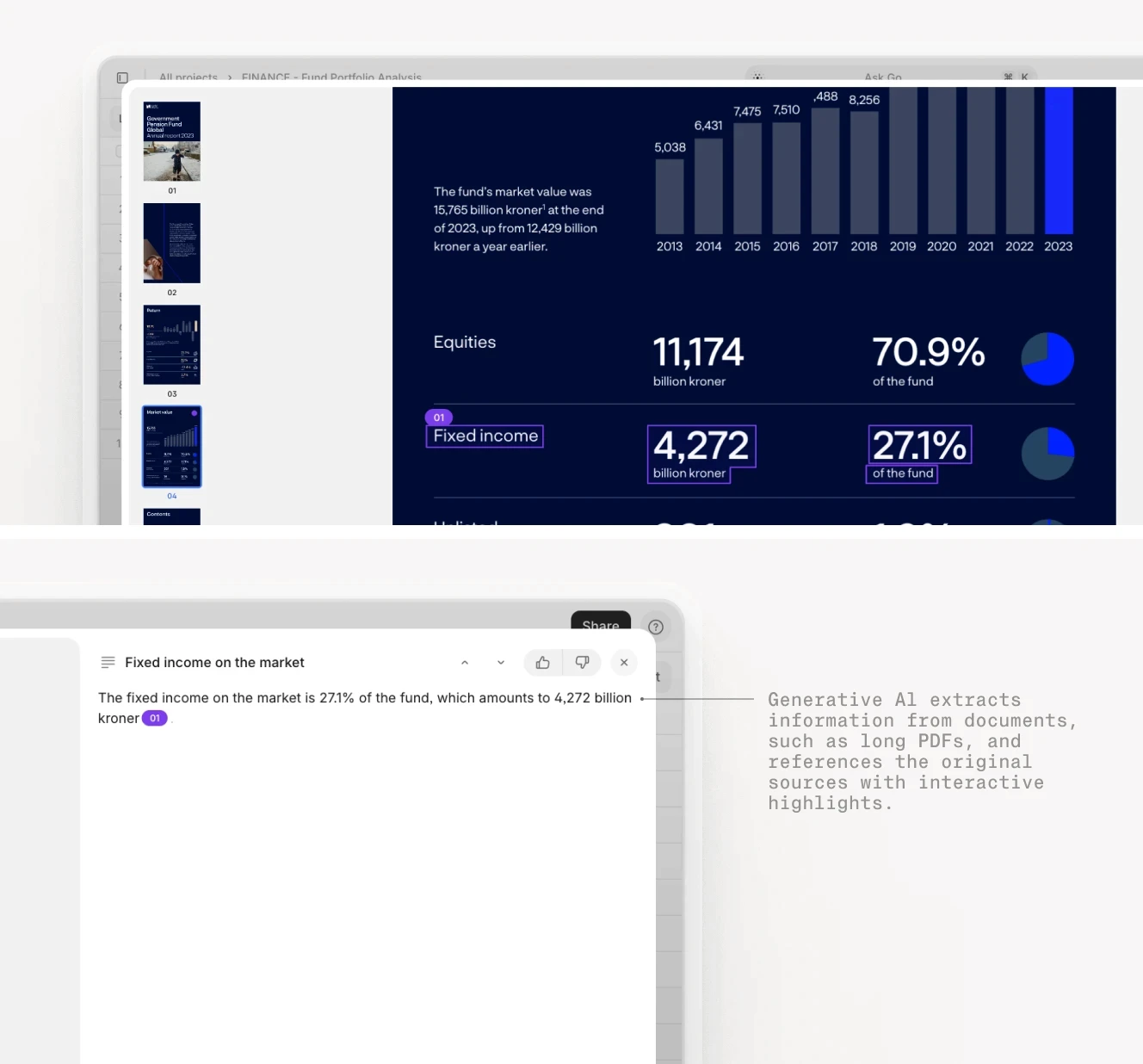
Citations to source. Every extracted figure links back to the sentence in the PDF it came from, so the question of where a number came from takes seconds rather than an afternoon.
None of this calculates performance or holds positions. Your platform keeps doing that. What changes is that an analyst reviews structured figures against a highlighted source instead of transcribing them. Our guide to AI in wealth management covers the wider set of workflows this applies to.
Why entity resolution needs a graph
A second problem sits underneath the first, and it is specific to complex portfolios. The documents do not agree on names.
One fund position appears as a full legal name on the capital account statement and an abbreviation on the wire confirmation. Then as a fund family name in the manager letter, and a different registered entity on the K-1. Multiply that across the trusts and limited liability companies holding them. Answering which entities hold a given fund means resolving all of it, and doing that by searching a document store degrades as the store grows.
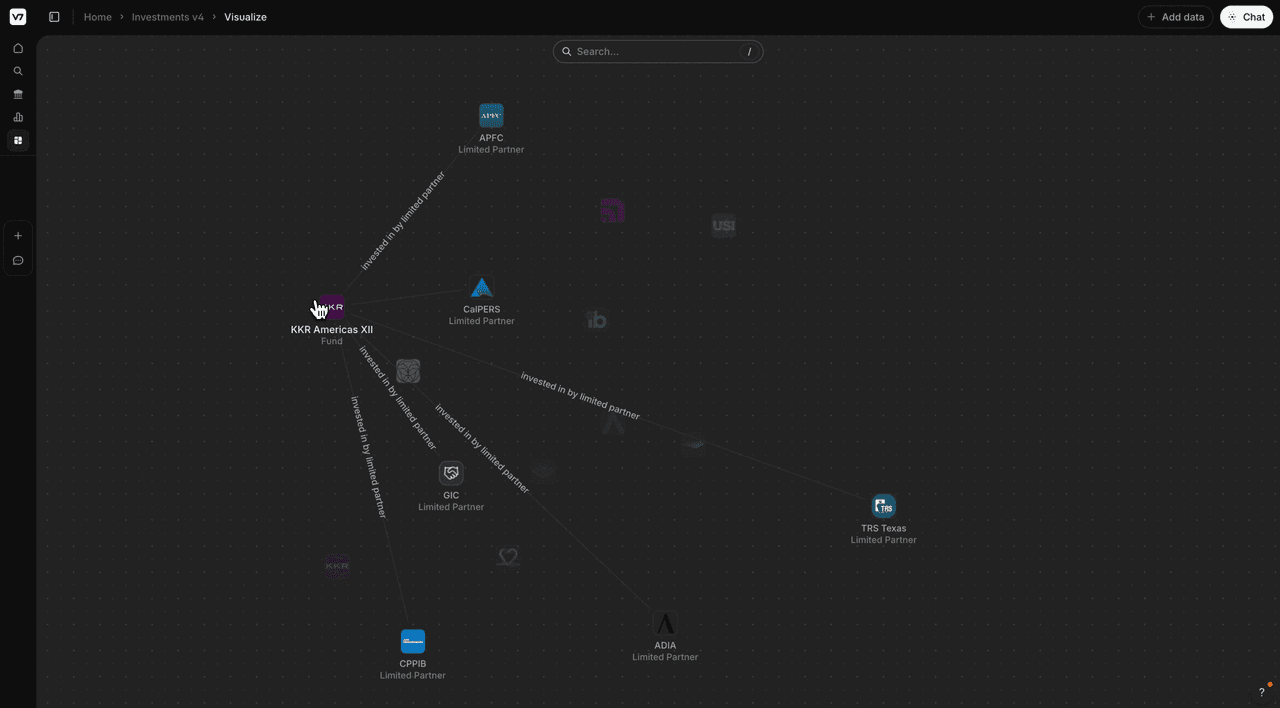
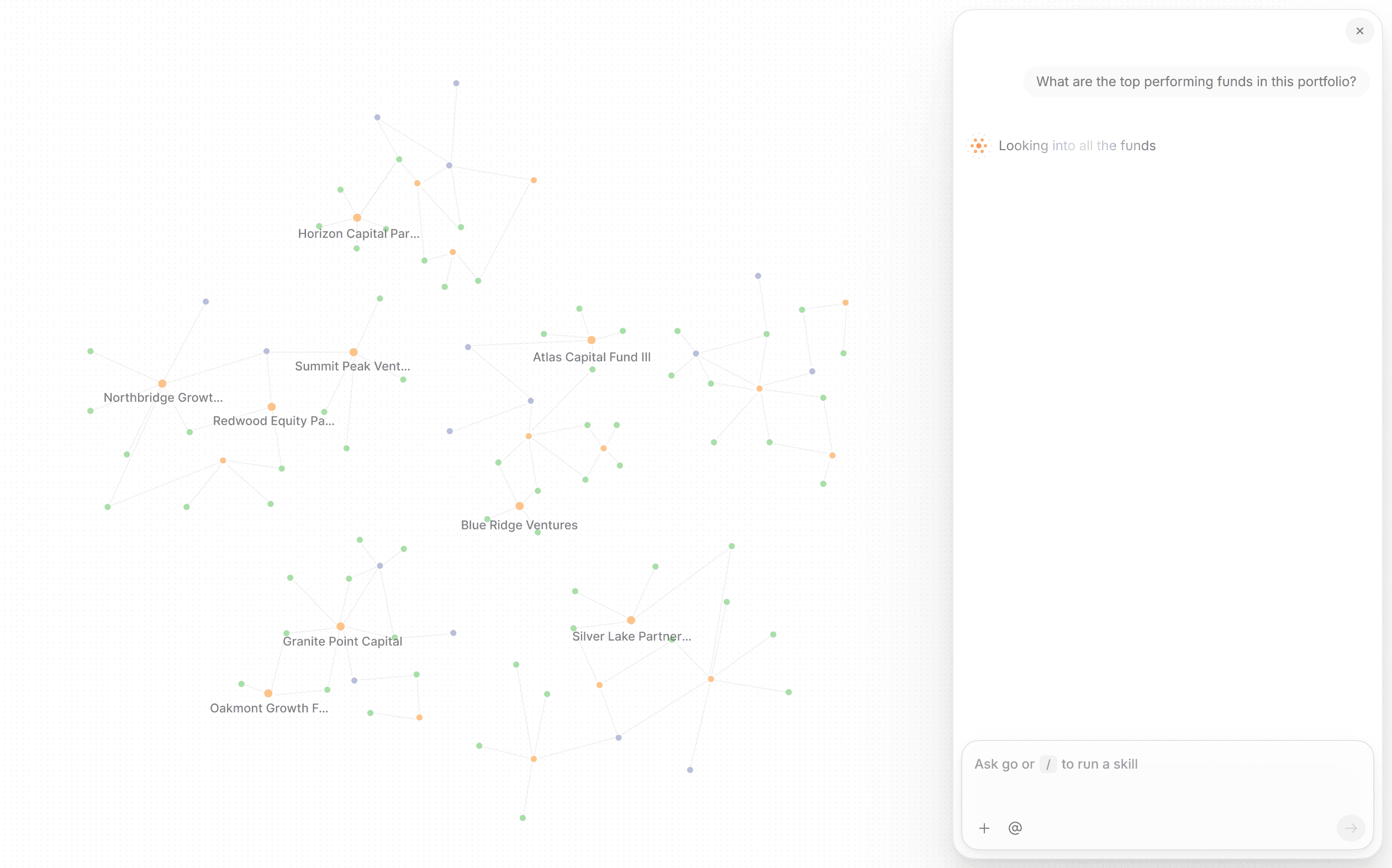
The Context Graph resolves entities and relationships when a document is ingested rather than when somebody asks. Holdings, ownership links and the documents evidencing them are stored as a structure, so the question becomes a traversal rather than a search. Our benchmark on a private markets corpus found the gap widens with scale. Accuracy held from ten documents to a thousand where retrieval-based approaches fell away, and on multi-step questions, which is what an entity question is, the difference was substantial.
Before you book a demo
Three pieces of preparation change every conversation that follows.
Decide which category you are in. Use the four questions above. Arriving at a demo without having done this is how firms end up comparing Addepar to Orion and concluding that one of them is bad at something it was never built to do.
Inventory your data sources. Every custodian, every alternatives administrator, every private holding, and how each currently arrives. Take the list to the demo and ask the vendor to point at the ones they cover with a direct feed, the ones they cover through an aggregator, and the ones somebody keys in. That third column is the one that decides whether the platform solves your problem.
Count the documents. How many capital account statements, K-1s, calls and distributions arrived last year, and roughly how many hours went into entering them. Most firms have never counted. The number decides whether the document layer is worth addressing separately or whether it is a rounding error, and in our experience the answer surprises the team that produces it. Below about fifteen private positions it usually is a rounding error. Above forty it usually is not.
All three exercises produce the same thing: a clear picture of which half of this category you are actually buying from, and what the platform will and will not do once it is in. That picture is worth more than any comparison table, including the two above.
What is wealth management software?
Wealth management software is a category covering two distinct product types that share a name. Advisor platforms such as Orion, Envestnet Tamarac, Advyzon and Wealthbox run an advisory practice, handling client relationship management, proposals, investment policy statements, billing, trading and rebalancing. Wealth-owner platforms such as Addepar, Masttro, Altoo and Landytech answer what a household or family owns, aggregating positions across custodians, modelling ownership through trusts and partnerships, and producing consolidated performance reporting. A few platforms, notably SS&C Black Diamond, serve both. Deciding which category applies is the first and most consequential step, because the two are priced, implemented and staffed differently.
+
What is the best wealth management platform?
There is no single answer, and it depends first on which category you need. On the advisor side, Orion leads on trading and integration breadth for mid-to-large firms, Advyzon rates highest for satisfaction among smaller firms and publishes its pricing, and Envestnet Tamarac leads where unified managed accounts matter. On the wealth-owner side, Addepar has the deepest aggregation and analytics and the highest cost. Masttro competes on custodian breadth with fixed rather than assets-under-management pricing. Black Diamond is the strongest option for firms needing both halves plus trust accounting. Shortlist by category, then by whether the platform handles your specific custodians and entity structures.
+
What is the difference between wealth management software and portfolio management software?
The terms overlap and vendors use them loosely, but the buyer differs. Portfolio management software is generally bought by investment firms and general partners managing a fund: the emphasis is position management, valuation, and reporting to limited partners. Wealth management software is bought by firms managing client or family wealth: the emphasis is either practice operations, on the advisor side, or consolidated household reporting, on the wealth-owner side. Several platforms appear in both conversations, Addepar and Black Diamond among them, which is why the categories blur. If you manage a fund rather than client wealth, the portfolio management category is the better starting point.
+
How much does wealth management software cost?
Pricing splits along the same line as the products. Advisor platforms increasingly publish rates: Advyzon from around 6,500 dollars a year for up to 150 accounts, Wealthbox from 49 dollars per user per month, Nitrogen from 99 dollars a month. Enterprise advisor platforms including Orion and Envestnet Tamarac are quote-driven and scale with assets or headcount. Wealth-owner platforms are almost entirely quote-driven, with Addepar estimated in industry coverage at 75,000 to 250,000 dollars a year and above for a full implementation. Whichever tier you are in, ask for implementation, data migration, training and recurring licence costs broken out separately, and ask what a data export costs if you leave.
+
What is wealth management reporting software?
Not the advice, and not the judgement an adviser is licensed and paid for. Asset allocation, manager selection, suitability and anything a regulator will examine stay with qualified people. What has changed in 2026 is the operational layer around that. Addepar launched Addison in March 2026 for natural-language portfolio queries with traceable sources, and Orion launched Denali AI Enterprise in February 2026 for plain-English data queries and drafted reports. Both read data already inside their own platform, which leaves a gap: the private fund documents that never reach the platform in the first place. Extracting those into structured, cited data is a separate job, and for firms with meaningful alternative allocations it is the larger one.
+
Can AI do wealth management?
Go is more accurate and robust than calling a model provider directly. By breaking down complex tasks into reasoning steps with Index Knowledge, Go enables LLMs to query your data more accurately than an out of the box API call. Combining this with conditional logic, which can route high sensitivity data to a human review, Go builds robustness into your AI powered workflows.
