17 min read
—



Casimir Rajnerowicz
Content Creator
V7 Go
A smarter way to manage due diligence and underwriting
A typical single family office holds positions at eight to twelve custodians. None of them speak to each other. Quarterly reporting means downloading statements from each one, normalising the formats, reconciling the net asset values, and then keying in the alternative asset data by hand from PDFs, before a single chart reaches the principal.
Family office reporting software is the category of platform built to solve that: it aggregates holdings data across custodians and asset classes, normalises it into a single set of books, and produces consolidated performance and net worth reporting across the entities a family actually owns things through. The good ones also handle the part nobody enjoys, which is everything that arrives as a document rather than a data feed.
That second half is where the category is currently weakest, and it is where the gap has widened fastest.
Custodian aggregation is a solved problem. Most platforms connect to a hundred or more custodians and pull public market positions automatically. Alternatives do not work that way. A private equity commitment does not sit at Schwab. It generates capital call notices, distribution notices, quarterly capital account statements, K-1s, and manager letters, all as PDFs, on the fund's schedule rather than yours. With alternatives now a substantial share of most family office portfolios, the manual half of reporting has been growing while the automated half has been getting better.
This guide covers what to evaluate when selecting family office reporting software, how the main platforms compare, what changes when AI handles the document side, and how the requirements differ between single and multi-family offices.
In this article:
Five criteria for evaluating family office reporting software, in order of how much they differentiate.
A comparison of the main platforms, with what each is genuinely best at.
Multi-family office requirements that single family office platforms do not cover.
What AI document processing does to the alternatives reporting workload, document type by document type.
IRR and TWR, and why a mixed public and private portfolio needs both.
What to look for in family office reporting software
Five criteria separate platforms in practice. They are ordered here by how much they actually differentiate, which is not the order most vendor comparison pages use.
1. Multi-custodian data aggregation
Positions sit at Fidelity, Schwab, UBS, Morgan Stanley, Goldman and a handful of specialist custodians, arriving in different formats on different timescales. Data aggregation across custodians is the baseline capability, and most established platforms do it well: automated feeds, normalised valuation, reconciliation alerts, coverage running past a hundred custodians.
The useful test question is narrower than coverage count. Does the platform handle custodian-held securities and directly held alternatives in the same set of books, or does it aggregate the first and leave the second to a spreadsheet that someone maintains alongside it? A large number of family offices run exactly that arrangement without describing it as a workaround.
2. Alternative and private asset document processing
This is where platforms diverge most and where evaluation is usually thinnest.
Private assets do not arrive through an application programming interface. They arrive as capital call notices, distribution notices, quarterly capital account statements, K-1s and manager letters. Someone reads each one and enters the numbers. For a family office with 30 to 50 fund positions across private equity, venture, real estate and hedge funds, that is a recurring quarterly exercise measured in tens of hours.
The capability test: can the platform ingest these documents and produce structured data from them, or does it provide a form for someone to type into? Several platforms now market document processing. The functional question to ask a vendor is which specific document types they handle, and what happens to a document type they do not recognise.
Standardisation helps at the margin but does not solve this. The ILPA templates and reporting standards have made limited partner reporting more consistent than it was a decade ago, and a family office receiving statements from managers who follow them will find the same fields in roughly the same places. Adoption is uneven, though, and a portfolio of 40 managers will include several who report in their own format for reasons of their own.
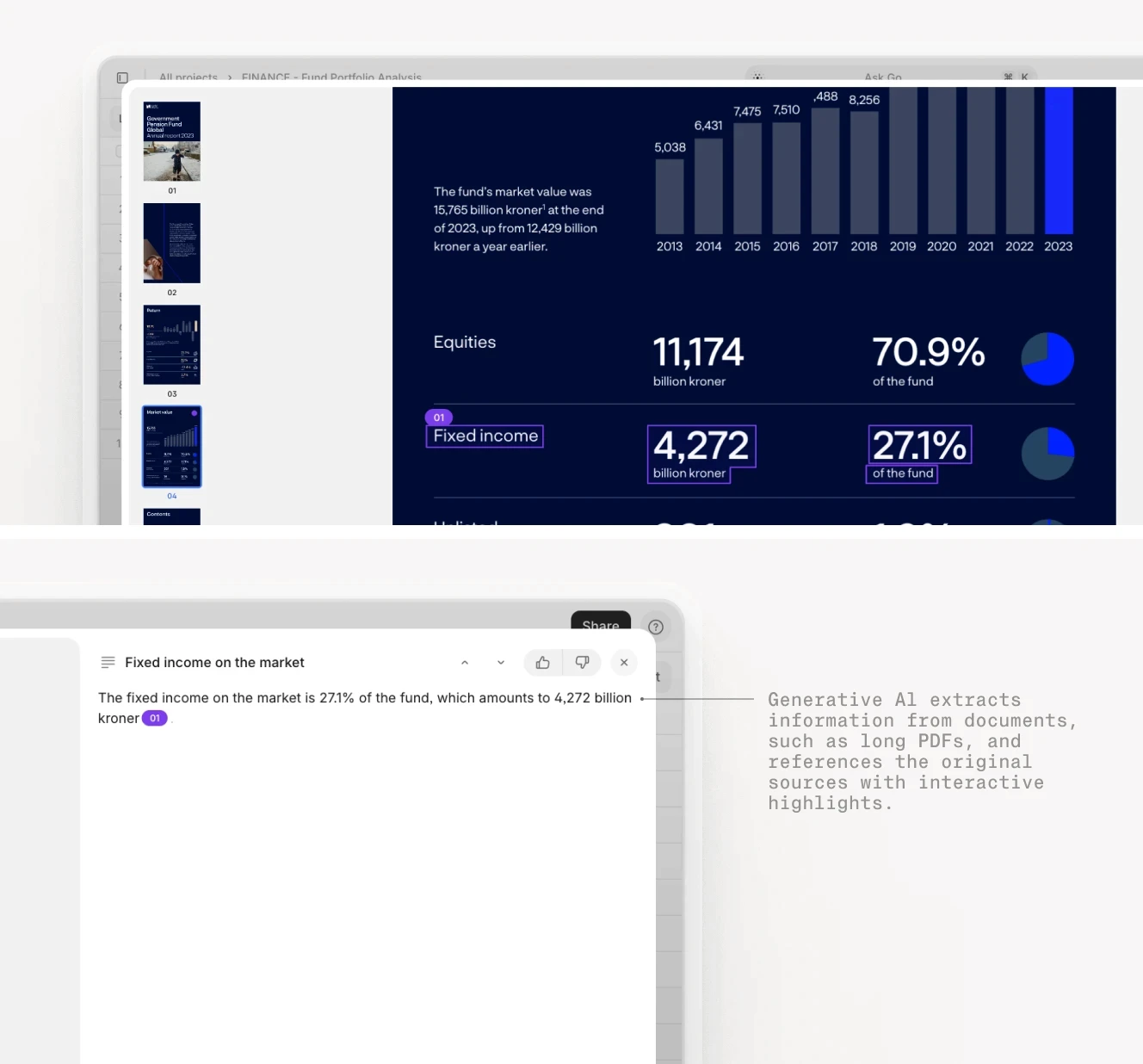
The extracted figure on the right, the source passage highlighted on the left. Provenance is what separates an extraction from an assertion.
3. Multi-entity ownership mapping
Families rarely own things through one legal person. A single family office typically operates across operating companies, limited liability companies, trusts, foundations and special purpose vehicles, each with its own tax position and its own set of beneficiaries.
Reporting across entities is therefore not a presentation layer problem. The same underlying holding may need to appear in a consolidated total wealth view for the principal, a per-entity investment performance report for a trustee, and a tax exposure summary that respects the ownership percentages between them. Platforms that model hierarchical ownership structures natively handle this. Platforms that treat entities as tags on a flat position list do not, and the difference only becomes obvious after implementation.
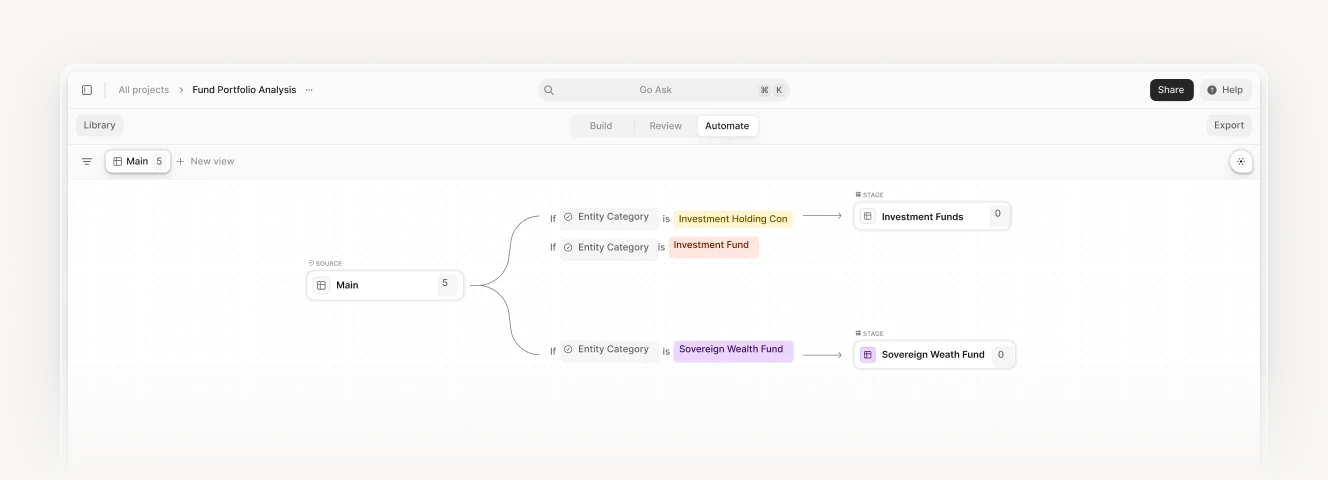
Entity categories feeding a defined sequence. The structural problem in family office reporting is that the same holding belongs to several views at once.
4. Performance methodology: IRR and TWR
Internal rate of return (IRR) and time-weighted return (TWR) answer different questions, and a portfolio holding both public and private assets needs both.
IRR accounts for the timing and size of cash flows, which is why it is the standard for private equity and venture, where the manager controls when capital is called and returned. TWR strips out the effect of cash flows entirely, which is what makes it the right basis for comparing one public markets manager against another or against a benchmark.
Using one where the other belongs produces answers that are quietly wrong. A TWR figure on a private equity position flatters or penalises the manager depending on when capital happened to be drawn. Some platforms calculate both across a combined portfolio; some offer only one and expect the family office to reconcile the gap in a spreadsheet.
5. Principal reporting and delivery
Dashboards and reports are different outputs, and platforms are rarely equally good at both. A dashboard is live, exploratory and built for the investment team. A report is scheduled, presentation-grade and built for a principal or a board, often with entities and asset classes rolled up differently from how the team views them.
What to check: customisable templates, white-labelling where relevant, scheduled delivery, and export quality that survives being printed and put in front of a family council.
Family office reporting software compared
The platforms below serve overlapping but distinct segments. None is the best across all five criteria, which is why the evaluation framework matters more than the ranking.
Platform | Best for | Document processing | Multi-entity | IRR and TWR |
|---|---|---|---|---|
Addepar | Large, institutional family offices | Partial | Strong | Both |
Masttro | Mid to large single family offices | Yes, DocAI | Strong | Both |
AssetVantage | Accounting-forward offices | Limited | Strong | Both |
Aleta | Technology-forward, API-first offices | Yes | Moderate | Both |
Eton Solutions | Administration-heavy offices | Yes, EtonAI | Strong | Partial |
Asora | Lean single family offices | Limited | Moderate | Partial |
Asseta AI | Offices wanting AI-native accounting | Yes, native | Moderate | Partial |
V7 Go | Offices keeping their reporting platform and fixing the document load | Yes, schema defined by the office | Entity resolution across documents | Feeds both, calculates neither |
Addepar is the default for large family offices and the platform most institutional allocators recognise. Its strengths are aggregation breadth, entity modelling and reporting flexibility. It is enterprise-priced and enterprise-paced: implementations are measured in months and it rewards offices with the internal capacity to configure it properly. Document processing is present but is not the reason anyone buys it.
Masttro targets the same segment with a sharper focus on data consolidation and a document processing layer, DocAI, covering a wide range of document types. The trade-off is ecosystem: the document capability is strongest when Masttro is also the system of record, which makes it a platform decision rather than a component decision.
AssetVantage takes the position that the general ledger should be the foundation of reporting rather than a downstream consumer of it, and builds accounting and multi-entity ownership depth accordingly. For families with genuinely complicated legal structures and a controller in-house, that architecture is a real advantage. Document automation is the weaker end.
Aleta is the API-first option, built more recently and more openly than the incumbents. That suits offices with technical capacity who want to compose their stack rather than buy it whole.
Eton Solutions approaches the problem from family office administration rather than portfolio reporting, which shows in the breadth of back-office workflow it covers and in EtonAI's document handling. Best fit where the bottleneck is administrative rather than analytical.
Asora is the lean option, aimed at smaller single family offices that need consolidated visibility without an enterprise implementation. Asseta AI is the newest entrant, built around document processing rather than adding it later.
V7 Go is on the list for a different reason from the other six, and the difference is worth being explicit about because it changes what you are comparing. The others are systems of record: you move your books into them. V7 Go is the layer that fills them. It reads the documents private assets arrive as, produces structured fields against a schema the office defines, and writes them into whichever platform above the office already runs. For an office that likes its reporting and hates the fortnight of typing in front of it, that is the cheaper half of the problem to fix, and the half that recurs every quarter.
Multi-family office reporting: what changes
Multi-family offices need everything above plus four things single family office platforms rarely handle well.
Per-family data isolation comes first, and it is a control requirement rather than a preference. Staff serving one family should not see another family's positions, and the platform should enforce that rather than rely on convention. Second, white-labelled client portals, since the families are clients rather than owners. Third, multi-currency consolidated views across families with different reporting currencies. Fourth, billing and fee reporting per client relationship, which single family offices have no equivalent for.
Addepar, Masttro and AssetVantage all have credible multi-family office deployments. Pricing structure differs from the single family office market in a way worth understanding early: multi-family office platforms usually price per client family served rather than by assets under management, so a small office serving three or four families sometimes finds a single family office platform more economical, at the cost of the isolation controls.











How AI is changing family office reporting
Every platform above now markets AI. Almost none of the editorial coverage of this category evaluates what those features actually do, which makes the claims difficult to compare. This section attempts that, and a disclosure belongs at the top of it: V7 Go publishes this article. Our own capability is assessed below on the same functional criteria applied to everyone else.
Start with the workload rather than the technology.
The alternatives reporting problem, quantified
A fund manager sends a quarterly capital account statement as a PDF. An analyst opens it, reads the net asset value, the unfunded commitment, the period contributions and distributions, and the internal rate of return since inception, and enters those figures into the reporting system. Someone reviews it. Then the next fund's statement arrives.
At 30 to 50 fund positions, that cycle runs to somewhere between 60 and 100 hours per quarter, and it lands in the same two weeks every time because managers report on similar schedules. The work is not difficult. It is voluminous, deadline-compressed, and almost entirely transcription.
The allocation trend makes this worse rather than better. The J.P. Morgan Global Family Office Report and the equivalent UBS survey both document substantial and broadly stable alternatives exposure across the segment, and UBS reported this year that 60% of family offices plan changes to strategic asset allocation, the highest reading it has recorded. Portfolios that move around generate more documents, not fewer. Preqin's 2026 private equity outlook describes a market where distributions have been slower to arrive than commitments, which for an allocator means positions stay on the books longer and keep reporting for more quarters than the original underwriting assumed.
What extraction handles, document by document
Document | Fields extracted | Manual time replaced |
|---|---|---|
Capital call notice | Amount called, due date, fund, wire instructions, remaining commitment | 15 to 30 minutes per notice |
Distribution notice | Proceeds, character of the distribution, fund, recallable portion | 15 to 30 minutes per notice |
Capital account statement | NAV, unfunded commitment, contributions, distributions, since-inception IRR | 20 to 40 minutes per fund per quarter |
K-1 | Partnership income and loss by category, basis, per-entity allocation | 2 to 4 hours across a K-1 season |
Manager quarterly letter | Performance commentary, attribution, portfolio company updates | 30 to 60 minutes per fund |
Fund financial statements | LP capital account roll-forward, fees, carried interest | 1 to 3 hours per fund per quarter |
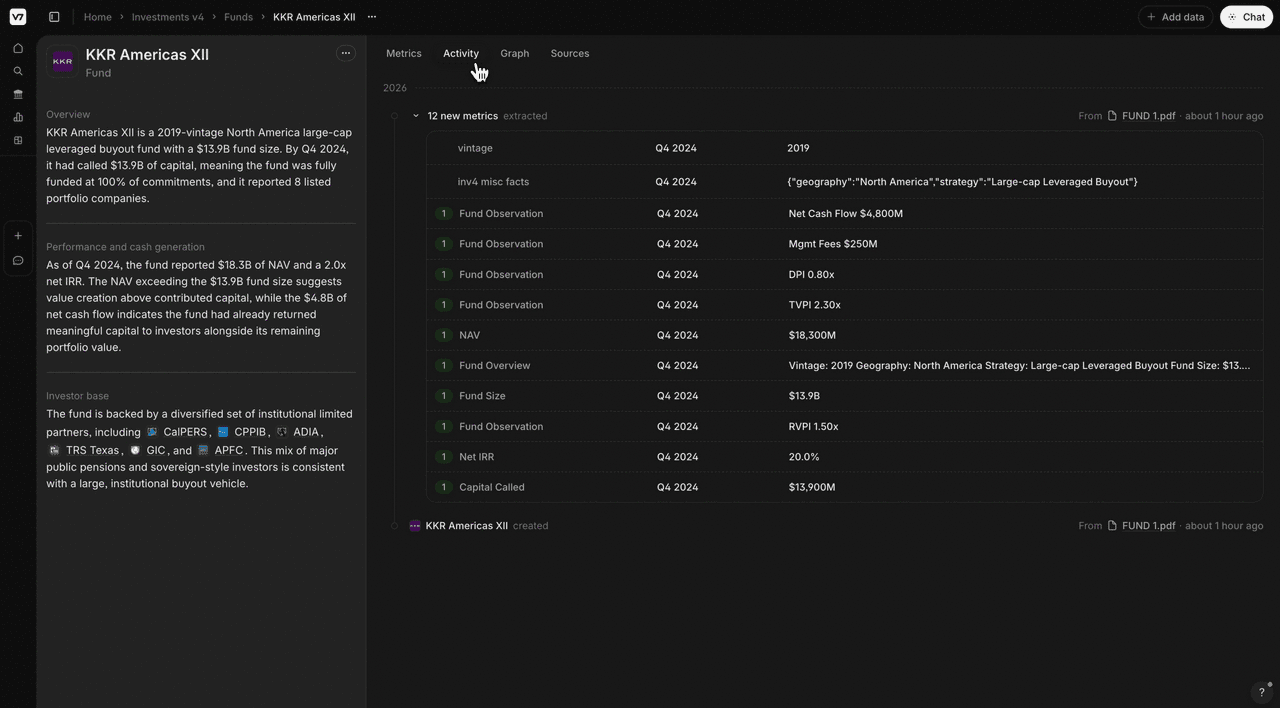
NAV, IRR, DPI and TVPI read off a quarterly statement and held as fields rather than as a paragraph in a PDF. The figures shown are from historical reporting data.
Two properties matter more than the extraction itself.
The first is provenance. An extracted NAV that links back to the page and line of the statement it came from can be checked in seconds. One that does not is a number somebody has to trust, and family office reporting eventually gets read by a principal, an accountant, or a tax adviser who will ask where it came from.
The second is what happens on failure. A well-configured workflow returns an empty field with a flag when a document does not contain the expected figure. A poorly configured one returns a plausible number. The second failure mode is considerably more expensive because nobody notices it.
Where the platforms actually stand
Masttro DocAI covers a broad set of document types and is tightly integrated with Masttro's own system of record, which is both its strength and its constraint. Eton Solutions EtonAI offers comparable breadth oriented toward administrative workflow rather than portfolio analytics. Asseta AI is built around document processing from the ground up rather than layering it onto an existing platform. Aleta takes an API-first approach that suits offices wanting to connect their own components.
V7 Go answers the same document problem from the other direction, and for most offices it is the shorter path. Rather than moving to a platform whose document layer is better, the office keeps the platform it has and adds the layer underneath it. V7 Go reads capital call notices, capital account statements, K-1s, manager letters and fund financial statements, produces structured fields against a schema the office defines, and pushes them into Addepar, Masttro, AssetVantage or a general ledger through an API. Migration is a project measured in months. Replacing the transcription step is measured in weeks, and it is the part that recurs every quarter.
Three properties decide whether that layer is worth having, and they are the same three to demand of any option in the table above. Every extracted value opens the page and line of the statement it came from, so a figure can be checked in seconds rather than trusted. Each step in the workflow uses the tool the work requires, so a net asset value is read by a model and a capital account roll-forward is cross-footed by code that returns the same answer every run. And the output is typed before the run rather than after it, so the same fields land in the same template whether it is the first statement or the four hundredth.
A quarterly statement read into typed fields with the source attached. The figures shown are from historical reporting data.
The honest limitation is the same one that applies to every option here: none of this removes review. Extraction produces a populated, cited draft that someone signs off. What changes is that the review is a review rather than a re-entry.
The part that outlives the reporting cycle
There is a second problem underneath the quarterly one, and it is less discussed because it never appears as a deadline.
A family office accumulates decades of institutional knowledge: which managers it has backed and why, which it passed on and on what grounds, how a given general partner behaved in 2008 and again in 2020, which co-investment turned out to concentrate an exposure the family already held elsewhere. Almost none of that lives in the reporting platform. It lives in the memory of two or three long-serving people and in a shared drive nobody has indexed.
This is what the Context Graph addresses. Rather than treating each quarterly statement as a row to be filed, it builds a persistent, entity-resolved layer over the documents the office already receives: funds, managers, entities, commitments, and the relationships between them, with every claim traceable to the document it came from.
The entity types are configured rather than fixed, which is the part that matters for a family office. The same layer that a private equity firm points at portfolio companies, board packs and covenant tests, a family office points at funds, managers, trusts, special purpose vehicles and the ownership percentages between them. The mechanism does not change. What changes is the ontology: which objects the office cares about, which relationships hold between them, and which figures get tracked from one reporting period to the next. An office running fourteen entities with cross-holdings is describing a graph whether or not anyone has drawn it.
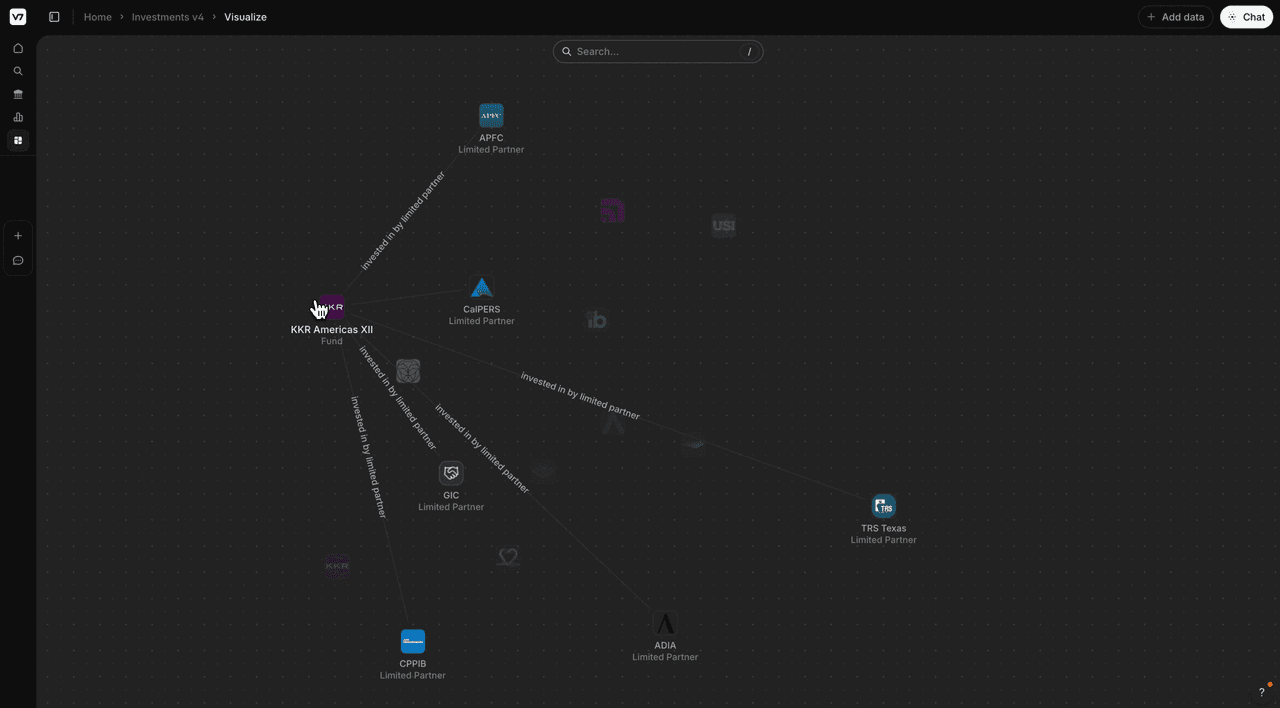
A fund resolved as an entity with its limited partners attached, rather than as a folder of quarterly PDFs. Built here from public historical fund data.
The distinction is between filing and structuring. A statement filed in a folder is retrievable if you know it exists and remember which quarter it was. The same statement parsed into entities, with the fund, the manager, the commitment and the reporting period each held as a resolved object, is queryable by anyone who was not on the deal.
The practical value shows up in questions that are currently expensive to answer. What is the family's aggregate exposure to a single portfolio company held through three different funds. Which managers have breached their stated concentration limits. Whether the office has seen this general partner's previous fund and what it concluded. Each of those is answerable today by someone spending a day in the archive, which means in practice they are answered by recollection or not at all.
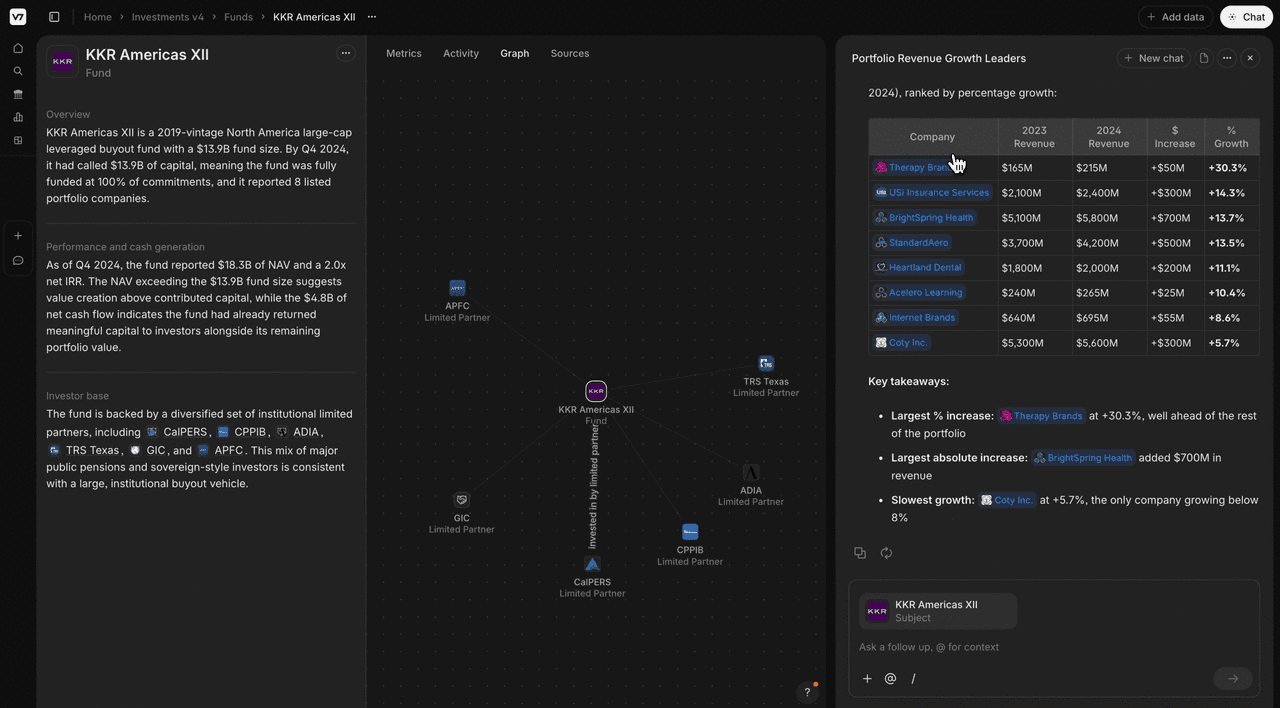
The look-through question answered against the office's own holdings. Output is a ranked table with the underlying figures attached, not a summary paragraph.
One further point, because it is the objection a sceptical chief operating officer raises immediately. None of this requires the office to hand judgment to a system. The graph records what the documents said and who decided what, with the source attached. It does not form views. A partner asking why the office passed on a manager in 2021 gets the memo and the committee note that recorded the decision, not a generated opinion about it.
For families that are themselves limited partners in private funds, this connects directly to the diligence workflow on new commitments. Our guide to private equity fund due diligence covers that side, and LP reporting in private equity covers what happens to the data downstream.
Choosing, in practice
Three questions resolve most of the decision.
How much of the portfolio is illiquid? Below roughly 20% in alternatives, custodian aggregation is the dominant requirement and most established platforms handle it. Above 30%, document processing capability becomes the constraint and should be weighted accordingly.
How complicated is the ownership structure? A single trust with a handful of accounts is a different problem from fourteen entities with cross-holdings and different beneficiary classes. Entity modelling is the criterion most often discovered late.
Is the current platform the problem, or is the data entry? This distinction is worth being honest about before starting a procurement. If the reporting output is acceptable and the pain is the fortnight of manual entry that precedes it, replacing the platform is an expensive way to fix a workflow. If the reporting itself does not answer the principal's questions, no amount of document automation upstream will fix that.
If the answer is the data entry, the fix sits upstream of the platform decision entirely. V7's portfolio monitoring workflows and the portfolio reporting agent run the same configured extraction an institutional investor uses on portfolio company reporting, pointed at manager statements instead, and quarterly fund report analysis covers the recurring cycle. The workflow is the same one either way. Only the document set and the field list differ, which is why an office does not need a family-office-specific vendor to solve a document problem that is not specific to family offices.
What to do before you talk to a vendor
Two pieces of preparation change the quality of every demo that follows, and both take less than a day.
Write down the reporting outputs the office actually produces, and who reads each one. The consolidated net worth statement for the principal. The per-entity performance report a trustee receives. The tax exposure summary the accountant needs in March. The investment committee pack. Most offices discover during this exercise that two of these are produced from the same underlying data by different people using different conventions, which is a reconciliation problem no platform will solve on its own.
Then count the documents. Not the positions, the documents: how many capital call notices, capital account statements, K-1s and manager letters arrived last year. The number is usually larger than the team expects, and it is the number that determines whether document processing is a convenience or the deciding criterion.
Take both to the demo and ask the vendor to run your own documents rather than theirs. A demo document has been chosen because it processes cleanly. A capital account statement from the one manager who reports in a bespoke format is a better test, and any vendor confident in their extraction will agree to it.
The reporting cycle is the wrong thing to optimise
Family office reporting is usually framed as a quarterly deadline problem, because that is when it hurts. The framing is slightly wrong and it leads to the wrong purchase.
The deadline is a symptom. The underlying condition is that a family office receives most of what it knows in the form of documents, and treats each one as a task to be cleared rather than as information to be kept. The statement gets read, the figure gets typed, the PDF gets filed, and the knowledge in it evaporates on contact with the spreadsheet.
An office that fixes only the deadline gets its two weeks back. An office that treats every incoming document as something to be structured, cited and retained gets the two weeks and, over a few years, the ability to answer questions about its own history without archaeology. The second is worth considerably more, and it is available from the same work.
If you want to see extraction run against your own capital account statements and K-1s rather than a demo pack, V7's solutions engineers configure a working version before any commitment. Book a working session and bring last quarter's manager reports, including the awkward one.
What is family office reporting software?
Family office reporting software aggregates holdings data across custodians and asset classes, normalises it into a single set of books, and produces consolidated performance and net worth reporting across the legal entities a family owns assets through. The category covers three distinct jobs that are often conflated. Data aggregation pulls public market positions automatically from custodians. Entity and ownership modelling maps holdings to the trusts, limited liability companies, foundations and special purpose vehicles that actually own them. Performance reporting calculates returns and presents them for different audiences, from the investment team to the principal. Platforms differ most in how they handle private assets, which do not arrive through custodian feeds and instead come as capital call notices, capital account statements and K-1s that historically required manual entry.
+
What is the best family office reporting software?
There is no single answer, and the honest response depends on three variables. The share of the portfolio held in alternatives determines how much document processing capability matters relative to custodian aggregation. The complexity of the ownership structure determines how much entity modelling depth is required. And whether the office is a single or multi-family operation determines whether per-family data isolation and client billing are requirements at all. Addepar is the default for large institutional family offices. Masttro and Eton Solutions lead on document processing breadth. AssetVantage is strongest where general ledger accounting is the foundation. Asora suits lean single family offices. Aleta and Asseta AI are the more recent, API-first and AI-native options. Evaluate against your own criteria rather than a ranking.
+
How do family offices manage portfolio reporting for alternative assets?
Most still do it by hand, and this is the least automated part of family office operations. Private fund positions do not feed through custodian connections. Instead the office receives capital call notices, distribution notices, quarterly capital account statements, K-1s and manager letters as PDFs, on each fund's own schedule. An analyst reads each document, extracts the net asset value, unfunded commitment, contributions, distributions and since-inception return, and enters those figures into the reporting system. For an office with 30 to 50 fund positions this runs to roughly 60 to 100 hours per quarter, concentrated into the two weeks when most managers report. AI document extraction addresses this specific step by producing structured fields from those documents with a source reference on each value.
+
What is the difference between IRR and TWR in family office reporting?
Internal rate of return accounts for the timing and size of cash flows, which makes it the standard measure for private equity, venture and real estate, where the manager decides when capital is called and returned. Time-weighted return removes the effect of cash flow timing entirely, which is what makes it the correct basis for comparing public markets managers against each other or against a benchmark, since the investor rather than the manager controls contributions. A portfolio holding both public and private assets needs both figures. Applying time-weighted return to a private fund position produces a number that flatters or penalises the manager depending on drawdown timing rather than performance. Check whether a platform calculates both across a combined portfolio, because several offer only one.
+
Can AI help with family office reporting?
Single family office software optimises for depth: complex entity structures, bespoke reporting for one principal or family council, and full consolidation across every asset the family owns. Multi-family office software optimises for separation. It needs per-family data isolation enforced by the platform rather than by convention, white-labelled client portals since the families are clients rather than owners, multi-currency consolidated views across families reporting in different base currencies, and billing and fee reporting per client relationship. Most enterprise platforms serve both markets, but the pricing model differs: multi-family office deployments are typically priced per client family served rather than by assets under management. Smaller multi-family offices serving three or four families sometimes find single family office platforms more economical.
+
What is the difference between single and multi-family office software?
Go is more accurate and robust than calling a model provider directly. By breaking down complex tasks into reasoning steps with Index Knowledge, Go enables LLMs to query your data more accurately than an out of the box API call. Combining this with conditional logic, which can route high sensitivity data to a human review, Go builds robustness into your AI powered workflows.
