15 min read
—



Casimir Rajnerowicz
Content Creator
V7 Go
A smarter way to manage due diligence and underwriting
A share purchase agreement (SPA) is the contract under which a buyer agrees to acquire existing shares from a seller. It identifies the shares being sold, sets the price and payment terms, allocates contractual risk, and specifies what must happen for the acquisition to complete.
For a private equity deal team, the hard part is connecting those provisions to the business it has underwritten. A headline enterprise value can change materially once cash, debt and working capital enter the calculation. A warranty that looks reassuring on its own may offer narrower protection when read alongside the disclosure letter and liability schedule.
The agreement therefore deserves a review that moves between legal drafting, financial evidence and the investment case. Counsel interprets and negotiates the contract. The deal team needs to understand where the commercial position has moved, which assumptions remain unresolved and who owns each decision before signing.
This guide uses English-law private-company acquisition conventions. Other jurisdictions differ, and US transactions commonly use the term stock purchase agreement. The examples are hypothetical. Treat the review framework as a way to prepare informed questions for your advisers; transaction counsel must adapt the agreement to the parties, governing law and deal structure.
Start with four questions:
What exactly are we buying, and how does the agreement calculate what we will pay?
How have the findings from diligence been reflected in the price, contractual protection or completion requirements?
Which disclosures, thresholds, exclusions and deadlines affect the protection we expect to receive?
Can another reviewer trace each open issue to the current clause, supporting evidence and recorded commercial decision?
Those questions connect the SPA to M&A due diligence, the financial model and the investment committee's approval. They also provide a useful boundary for AI-assisted review: prepare a cited issues list, check the arithmetic and surface inconsistencies for the people authorised to resolve them.
A productive first review ends with a short list of decisions, each supported by a source. Assign legal interpretation to counsel, financial reconciliation to the appropriate adviser and commercial acceptance to the deal owner. The sections below show how to build that list, starting with the transaction itself.
What a share purchase agreement covers
A share purchase agreement connects the ownership transfer to the commercial terms and protections agreed between buyer and seller. Read it first for the transaction it describes: the parties, the class and number of shares, the target group and the consideration.
In a share acquisition, the target company continues to own its assets and owe its liabilities. Buying its shares gives the buyer an ownership interest in that company, rather than transferring every underlying asset directly to the buyer. The SPA's allocation of risk between the parties does not, by itself, erase the target's obligations to third parties.
An asset purchase agreement covers an agreed set of assets and liabilities instead. A shareholders agreement governs the relationship between shareholders, including governance, transfers and exit arrangements. A minority investment or management rollover may need both an SPA and a shareholders agreement. The two documents should describe a consistent ownership and governance outcome.
For example, if a sponsor acquires 80% of a company and management retains 20%, the SPA review should reconcile the shares sold with the capitalisation table. The associated governance documents must then explain the rights attached to the continuing holdings. A correct purchase-price total cannot fix an incorrect ownership schedule.
Use a clause map to orient the reviewers before assigning specialist questions:
Agreement component | Commercial question | Supporting material |
|---|---|---|
Parties and sale shares | Who sells what, and who has authority? | Ownership records and capitalisation table |
Consideration | How is the amount calculated and paid? | Price bridge and payment schedule |
Warranties and indemnities | Which risks have contractual treatment? | Diligence reports and disclosure letter |
Limitations | What restricts a claim or recovery? | Liability schedule and relevant insurance |
Conditions and completion | What must happen before ownership transfers? | Consents and completion documents |
Compare that map with the agreed heads of terms or letter of intent. The earlier document may leave substantial detail open; term sheet review helps establish which commercial positions were actually agreed. Record intentional changes as well as discrepancies. A negotiated concession should survive the transition from a call or email into the current draft and the team's approval record.
Reconcile the price mechanism before signing
Reconcile the SPA's consideration provisions to a worked price bridge before approving the commercial terms. Enterprise value, equity value and cash paid at completion can be different amounts, and the agreement must explain the path between them.
The headline price is only the starting point.
Consider a hypothetical acquisition with an agreed enterprise value of GBP 60 million. Under the parties' assumed definitions, it has GBP 4 million of cash, GBP 12 million of debt and working capital GBP 1.5 million below the agreed target.
Illustrative bridge | GBP million |
|---|---|
Enterprise value | 60.0 |
Add defined cash | 4.0 |
Subtract defined debt | (12.0) |
Subtract working capital shortfall | (1.5) |
Illustrative equity consideration | 50.5 |
This example assumes those are the only adjustments. Deferred consideration, an earn-out, escrow or management rollover would require additional reconciliation. Keep each item visible so the team can distinguish the equity price from the amount paid to each seller on completion.
Completion accounts
A completion accounts mechanism typically uses an initial payment followed by an adjustment based on accounts prepared for completion. Review the definitions of cash, debt and working capital alongside the accounting policies, preparation process and dispute procedure. BDO's explanation of completion mechanisms highlights why the agreed hierarchy between specific policies, past practice and accounting standards matters.
Test an actual balance-sheet item against the drafting. If transaction bonuses sit in accrued expenses, ask which defined category captures them and whether the model counts them twice. Write down the answer with the relevant schedule reference. A mathematically correct model can still implement the wrong contractual definition.
Locked box and contingent consideration
A locked box usually fixes the equity price using agreed historical accounts, with protection against prohibited value leakage during the subsequent period. The allocation of economic benefit from the locked box date should be distinguished from legal ownership transferring at completion. Lewis Silkin's locked-box guide explains the role of reference accounts, leakage and any agreed value-accrual payment.
Ask which payments count as permitted leakage and how the parties will identify other payments to sellers or connected persons. Then inspect any earn-out separately: the performance measure, measurement period, permitted adjustments, information rights and dispute route all need to work together.
Use the quality of earnings analysis to challenge the assumptions feeding the model. If an earn-out uses adjusted EBITDA, reconcile that definition to the diligence team's adjustments. The same label in two documents does not establish that both calculations include the same costs.
Read warranties with disclosures and claim limits
Assess a warranty together with the disclosures, limitations and recovery arrangements that affect it. The sentence containing the assurance is one part of the protection the buyer is negotiating.
In an English-law SPA, a warranty is a contractual assurance about a stated matter. An indemnity can allocate responsibility for a specified loss or liability, subject to its wording. Neither label establishes a complete recovery outcome. Counsel must assess the actual promise, the loss covered and the restrictions that apply.
Suppose diligence identifies a disputed historical tax position. A general tax warranty, a disclosure describing the dispute and a specific tax indemnity could interact in several ways. The deal team needs a clear answer about the intended treatment, rather than assuming the presence of all three provisions means the exposure has been resolved.
The disclosure letter can qualify warranties. Read each relevant disclosure against the warranty it affects, the supporting documents and the SPA's agreed disclosure standard. A data-room reference deserves enough attention to establish what information the parties intend it to disclose. Record unresolved gaps for counsel rather than treating a populated folder as a completed review.
Pinsent Masons' guide to warranty claims explains the importance of disclosure, financial and time limits, compliant notification and the separate deadline for starting proceedings. Those provisions deserve review while protection is being negotiated, when the parties can still change them.
Build a short protection summary for material exposures. Capture the relevant warranty or indemnity, any qualification, the applicable liability cap, claim threshold and deadlines. For thresholds, distinguish a minimum individual claim from an aggregate basket, and check whether the basket works as a deductible or becomes recoverable once crossed. The agreement determines the result.
Suppose a hypothetical GBP 100,000 claim is fully recoverable apart from a GBP 75,000 basket. A pure deductible would leave GBP 25,000 above the threshold. A tipping basket could allow recovery of the full GBP 100,000 once the threshold is crossed. These calculations assume no other limits apply.
Confirm the actual drafting before using either calculation. A summary that records only "basket: GBP 75,000" leaves the central commercial question unanswered.
Also identify the party expected to pay and the practical recovery arrangements. Where warranty and indemnity insurance forms part of the transaction, compare the policy with the SPA for the relevant exposure. The existence of a policy does not answer whether that particular matter is covered.
Keep the review specific. "Seller protection too broad" is difficult to resolve. "This disclosure appears to qualify the warranty covering the identified customer dispute; confirm the intended treatment and remaining recourse" gives counsel and the commercial owner a defined question. The eventual answer belongs in the issues list and the approval record.











Translate diligence findings into negotiated treatment
Give each material diligence finding an explicit commercial treatment before treating the SPA review as complete. A finding can affect price, contractual protection, a condition, further investigation or the decision to proceed. The appropriate response depends on the exposure and the parties' negotiating position.
Axial's Dead Deal Report: Unpacking 2025's Broken LOIs, published in January 2026, examined 75 unsuccessful transactions sourced through its platform. Non-QoE diligence findings accounted for 25.3% of that sample, and QoE/EBITDA discrepancies for 21.3%. The sample covered eight buyer types. These figures describe reported reasons among failed transactions; they do not measure the probability that any signed LOI will fail.
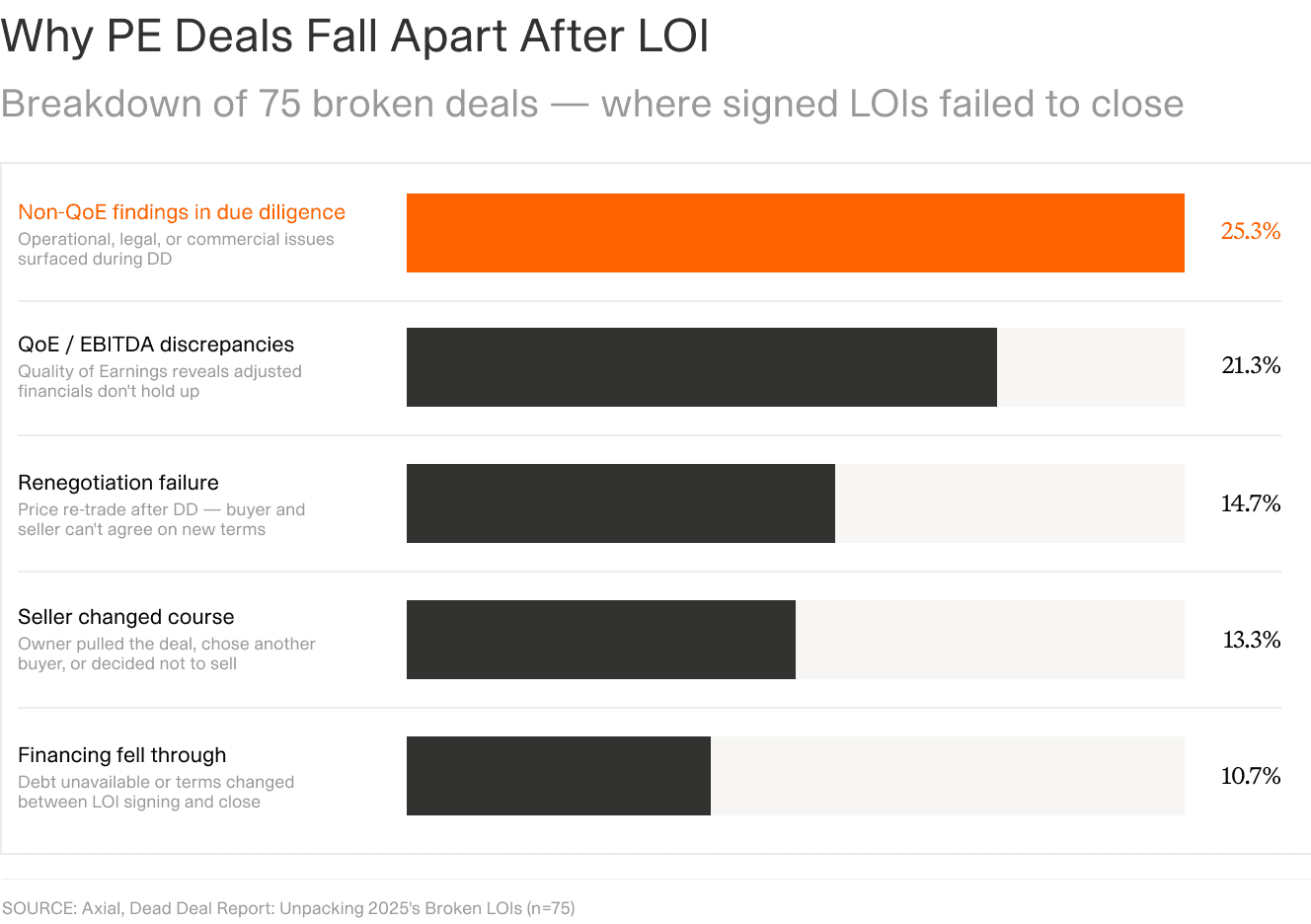
Source: Axial, Dead Deal Report: Unpacking 2025's Broken LOIs (2026), n=75 unsuccessful transactions. Despite the graphic's PE shorthand, the sample spans eight buyer types. Selected reasons are shown; this is not a PE-wide failure rate.
The chart is a useful reminder to retain the connection between diligence and negotiation. It does not show that drafting a stronger SPA would have saved the deals. Sometimes a finding warrants walking away.
For a continuing transaction, use an issue-treatment table such as this hypothetical example:
Finding | Question for the deal team | Possible treatment to evaluate |
|---|---|---|
Key customer contract contains a change-of-control clause | What consent is required, and what happens without it? | Consent process, condition or reassessment of the investment case |
Historical tax exposure remains unresolved | How is the amount bounded and allocated? | Further diligence, price discussion or specific contractual protection |
Working capital definition differs from the model | Which items and measurement basis were agreed? | Revised definitions and a reconciled price bridge |
Add the source document, relevant clause, owner and decision to each row. The entries above are options for discussion, not default legal remedies. A customer consent might be essential in one transaction and unnecessary under the actual contract in another.
Keep unresolved findings visible through successive drafts. If an issue is marked closed, retain the reason: additional evidence resolved it, revised wording addressed it, or the authorised decision-maker accepted the exposure. That record helps the next reviewer distinguish a conscious decision from an omission.
Review the SPA as a connected set of documents
Review the current SPA alongside the documents that define its economics and qualify its protections. A clause summary becomes more useful when the reviewer can follow each point into the disclosure letter, financial model or diligence evidence.
Assemble a dated review packet containing the SPA, schedules, disclosure letter, relevant diligence reports, price bridge and material ancillary agreements. Identify the version of each file. For contract review, document identity matters as much as clause extraction: a correct observation about a superseded draft can still send the negotiation in the wrong direction.
Suppose the latest SPA changes the working capital definition while the model retains the earlier treatment of deferred revenue. Record the changed wording, the affected model line and the question for the financial adviser. The useful output is a reconciliation request with sources, rather than two independent document summaries.
The lifecycle map below places data-room analysis and legal document review within diligence, followed by source attribution for investment committee materials. That sequence explains why SPA review evidence should remain connected to the final approval pack.
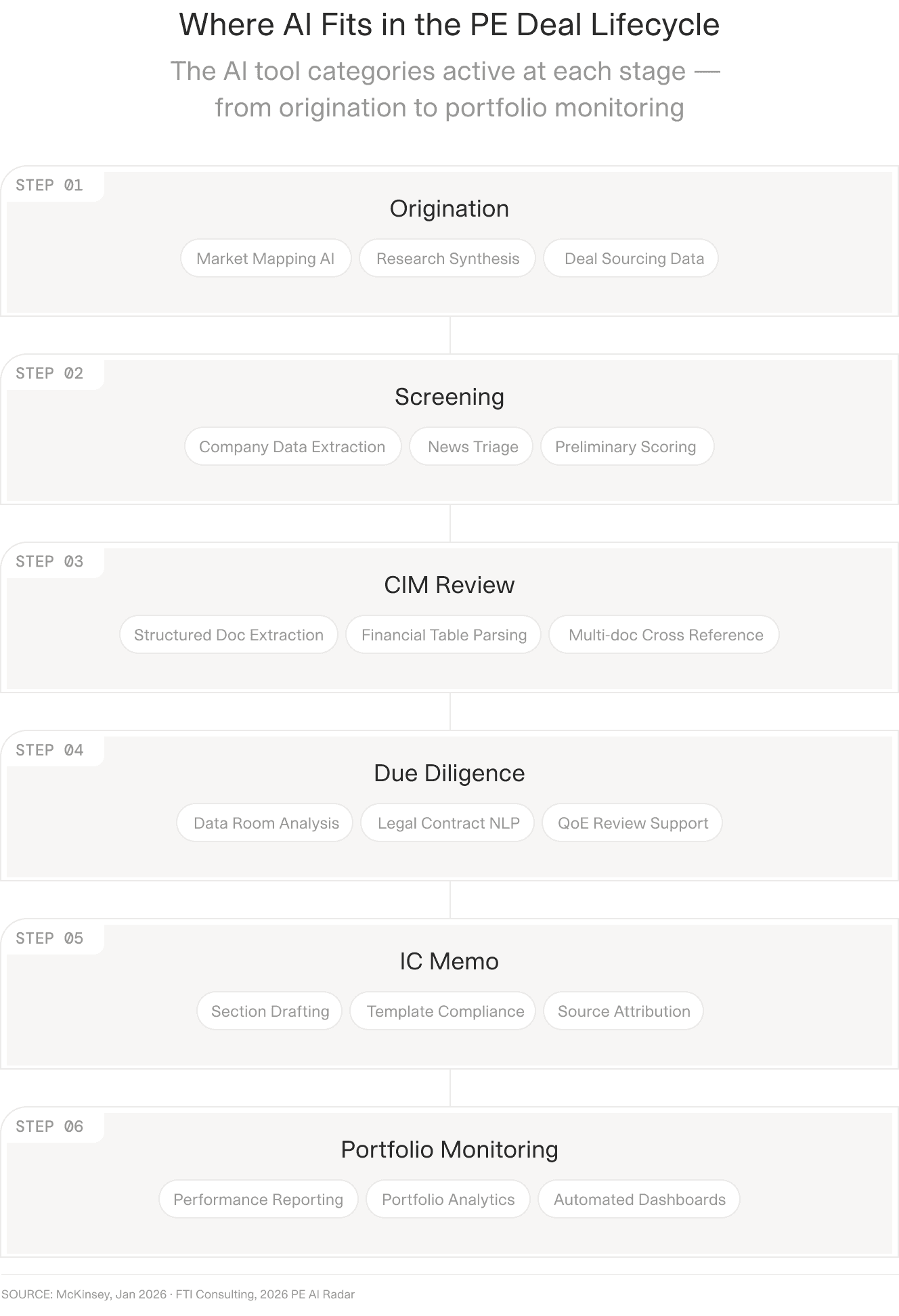
V7 editorial lifecycle map, drawing on McKinsey's January 2026 M&A research and FTI Consulting's 2026 Private Equity AI Radar. The diagram maps workflow categories; it does not measure adoption or performance at each stage.
A practical review entry contains five things: the issue, the current clause reference, the supporting source, the open question and the decision owner. For a numerical issue, add the calculation and input definitions. For a changed clause, identify which version introduced the change. Keep the source passage available so the reviewer can assess the observation in context.
Carry material decisions into the data room to IC memo process. If the committee approved the acquisition on the assumption that a particular exposure had contractual protection, the final summary should show the negotiated outcome. A changed cap, exclusion or disclosure may require the commercial owner to revisit that assumption.
The remaining risks deserve the same traceability as the negotiated protections. An approval pack should let a partner see what the team learned, what changed in the agreement and what exposure it ultimately accepted.
Separate signing, completion and continuing obligations
Distinguish the obligations created at signing from the steps required for completion and the duties that continue afterwards. Signing and completion may happen together, or the agreement may provide an interval while specified conditions are addressed.
Where they are separate, identify the conditions, the party responsible for satisfying them and the contractual consequences if they remain unmet. Read any waiver and termination provisions with counsel. The mere appearance of a condition in a summary does not establish who can waive it or whether waiver is legally available.
For example, if the agreement requires a specified third-party consent before completion, record the exact requirement and the evidence counsel expects to see. A seller email saying the counterparty is comfortable with the acquisition may not be the document the clause requires. The distinction can affect whether the parties are ready to complete.
During a signing-to-completion period, check the provisions governing the target's conduct, information access and any required buyer consent. Read their exceptions as carefully as their headline restrictions. A deal team needs to know which proposed business decisions require escalation and how the agreement handles that process.
After completion, assign responsibility for price adjustments, earn-out reporting, claim notifications and other continuing obligations that actually appear in the signed documents. Record each trigger, required action, source clause and owner. Avoid copying a generic deadline from an earlier transaction into the new register.
This part of the SPA review should produce a clear handoff to the execution team. Keep the full closing checklist in its own working document, while preserving the contractual references that justify each entry. When the agreement changes, those references tell the team which downstream tasks need review.
Use AI to prepare a cited SPA issues list
Use AI to prepare evidence for SPA review: organise the documents, extract relevant terms, compare versions and assemble questions with citations. Counsel and the authorised deal team still determine legal meaning, negotiating positions and whether the remaining exposure is acceptable.
V7 Go provides AI infrastructure for private markets. Its Context Graph connects documents, entities, relationships and source evidence so workflows can use firm context. For an SPA review, that context could include the firm's review questions, prior approved positions and the current transaction's supporting materials, subject to the workflow's scope and access permissions.
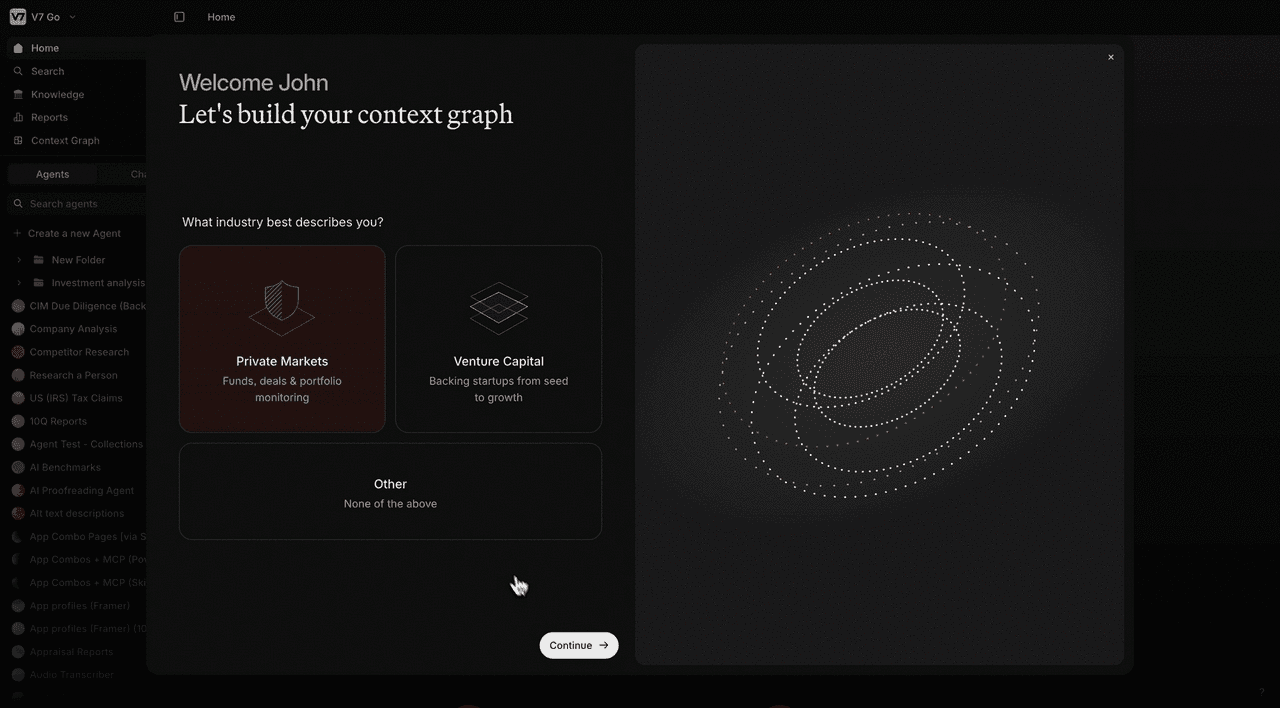
V7 Go's industry-selection onboarding introduces Context Graph setup. This screen shows context configuration, not a completed SPA analysis.
A proposed review workflow can divide the work into defined steps. First, identify document versions and build an inventory. Next, use a model to extract the consideration mechanism, relevant warranties and limitations with their source passages. Compare those provisions with the review questions and evidence supplied for the transaction.
Use Python for a defined arithmetic check, such as recalculating the hypothetical GBP 50.5 million equity bridge, once the relevant inputs and classifications have been approved. A correct sum does not establish whether an item belongs in debt or working capital. That classification needs its own source and review.
Then produce an issues list containing the observation, clause reference, supporting evidence and proposed question for the reviewer. An absent schedule should appear as missing evidence. Conflicting definitions should remain visible as conflicts until someone resolves them. Preserve the distinction between an extracted fact, a model's interpretation and an approved decision.
Evaluate the workflow on a completed transaction whose issues and outcomes the team already understands. Check whether cited passages support the observations, material changes are found and numerical outputs reproduce the agreed model. Include an intentionally missing document to test whether the workflow flags the gap.
V7's purchase agreement analysis page provides a starting point for scoping. Work with solutions engineers to build the review steps around your documents, evidence requirements and approval process. The useful deliverable is an issues list that reviewers can verify and use in the negotiation.
A thorough share purchase agreement review connects the investment case to the price mechanism, the negotiated protections and the evidence behind each material decision. Start with one open issue and trace it through those connections. If the team cannot explain its treatment from the current documents, the issue needs another pass.
Bring one completed transaction, its agreed model and its final issues list to scope a V7 Go review workflow. That gives your team a concrete way to assess document coverage, citation quality and the usefulness of the questions prepared for counsel.
What is a share purchase agreement?
A share purchase agreement is the contract governing the sale of existing shares from a seller to a buyer. It identifies the parties and shares, sets the consideration and payment mechanism, and records contractual protections and completion requirements. It can cover all or part of a company's share capital. In a share acquisition, the target company continues to own its assets and owe its liabilities; ownership of its shares changes. The agreement should therefore reflect the diligence findings and the intended allocation of risk between buyer and seller. This article uses English-law private-company acquisition conventions. The required documents and their legal effect depend on the jurisdiction, transaction structure and agreed terms.
+
How does a share purchase agreement differ from a shareholders agreement?
A share purchase agreement governs a transaction in existing shares. A shareholders agreement governs the relationship between shareholders, including matters such as decision-making, transfer restrictions and exit rights. The documents can be needed together. For example, a sponsor buying a majority stake while management retains shares may use the SPA for the acquisition and a shareholders agreement for the ongoing relationship. Review the sale-share schedule, capitalisation table, articles and governance documents together so they describe the intended outcome. Neither document should be treated as a substitute for the other. Counsel should confirm which rights belong in each document and how conflicts or changes will be handled under the applicable law.
+
What is the difference between a share purchase and an asset purchase?
A share purchase changes ownership of shares in a company. The company continues to hold its assets and liabilities. An asset purchase transfers the assets and liabilities agreed between the parties, subject to the applicable legal requirements. This difference affects diligence, documentation, consents and the commercial analysis of the transaction. A buyer should not assume that a share acquisition eliminates consent requirements: a target's customer or financing contracts may contain change-of-control provisions. Equally, selecting assets in an asset transaction does not by itself settle every question about liabilities or transfer requirements. The appropriate structure depends on the business, the parties' objectives and legal and tax advice for the relevant jurisdictions.
+
Who drafts and reviews the share purchase agreement?
Transaction counsel normally leads the legal drafting and negotiation, with the starting draft depending on the sale process and the parties' arrangements. A seller-led auction may provide a seller's draft; other processes may begin with buyer counsel's document. The deal team, financial advisers, tax advisers and other specialists contribute to provisions within their areas. For example, the financial adviser should reconcile the price mechanism and accounting definitions with the agreed model, while the commercial owner confirms whether negotiated concessions remain acceptable. A useful review process assigns owners to issues and retains current source references. Legal drafting, financial reconciliation and investment approval are related responsibilities, but each requires a clear decision-maker.
+
Does signing a share purchase agreement mean the acquisition has completed?
AI can assist with preparing a review by extracting provisions, comparing drafts, organising supporting documents and producing an issues list with source references. Its output needs verification against the current agreement and related materials. Separate tasks that require interpretation from arithmetic checks that can be performed with defined inputs and code. For example, recalculating a price bridge does not determine whether an item should be classified as debt under the SPA. That requires review of the definition and evidence. Evaluate a proposed workflow on a completed transaction, checking citation accuracy, missing-document handling and the usefulness of identified issues. Counsel and authorised commercial reviewers retain responsibility for legal conclusions and transaction decisions.
+
Can AI review a share purchase agreement?
Go is more accurate and robust than calling a model provider directly. By breaking down complex tasks into reasoning steps with Index Knowledge, Go enables LLMs to query your data more accurately than an out of the box API call. Combining this with conditional logic, which can route high sensitivity data to a human review, Go builds robustness into your AI powered workflows.
