9 min read
—



V7 Go
A smarter way to manage due diligence and underwriting
Eighty-five percent of private capital dealmakers say they now use AI to automate daily tasks, up from 76% a year earlier. Ask the same firms how AI performs on the two jobs that actually decide fund returns, deal sourcing and portfolio monitoring, and the number flips: 64% call it ineffective for sourcing, 75% call it ineffective for monitoring, according to S&P Global Market Intelligence's 2026 survey of private equity and venture capital general partners.
That is not a small gap. That is nearly every firm using AI constantly, on nearly everything, and most of them saying it does not work where it counts. The instinct is to wait for a better model. Wrong. GPT-5 and the next Claude will not close this gap, because the gap has nothing to do with model quality. It has to do with memory. A general-purpose model knows a great deal about the world and nothing about your firm's last decade of deals, your limited partners, or the three times you already looked at this exact target and passed. Every new chat starts at zero.
A context graph is the fix for that specific problem, and it is worth understanding properly, because most of what gets called a "knowledge graph" in private markets right now either undersells what the technology does or oversells how hard it is to set up. This piece covers what a context graph actually is, how one gets built from documents your firm already has, and what changes for private equity and venture capital once a firm's own history becomes something you can ask a question, rather than something you have to remember.
In this article:
Why deal teams use AI constantly and still call it ineffective for sourcing and portfolio monitoring.
What a context graph is, and how it differs from a chatbot with a good memory.
How a context graph gets built, from raw fund documents to a queryable map.
What changes for private equity and venture capital once a firm's own deal history is searchable.
The adoption number that doesn't add up
Start with what the S&P Global data actually shows, because the headline number hides the real story. Sixty percent of general partners are dissatisfied with the quality of their limited partner allocation data, and fragmented or unstructured data is the reason they name most often. Model accuracy sits well down the list of stated barriers, behind a lack of internal expertise (49%) and data privacy concerns (43%). Firms are not struggling because the AI gives wrong answers. They are struggling because the AI has nothing reliable to work from.
This tracks with what deal teams have quietly known for a while. Ask ChatGPT or Claude to summarize a confidential information memorandum and it will do a competent job in seconds. Ask it whether the target's largest customer also supplies one of your existing portfolio companies, and it cannot answer, not because the model is weak, but because that fact lives in a due diligence file from three years ago the model has never seen and will never see, because nobody gave it access.
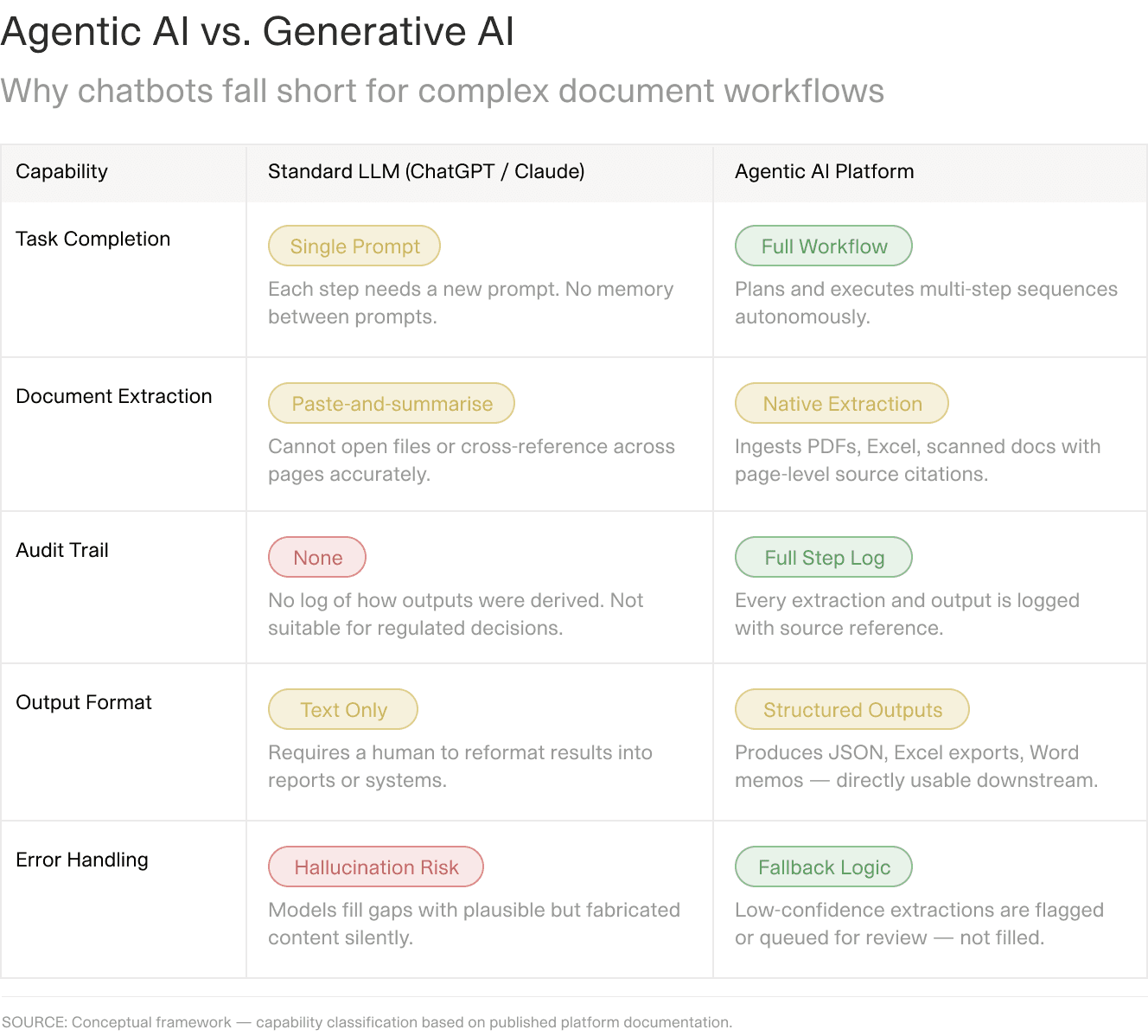
A single prompt can summarize a document. It cannot hold a workflow, keep an audit trail, or remember what it answered about the same fund last week.
This is the practical difference between a chatbot and a platform built around a firm's own data: one answers the question you happened to ask in this session, the other keeps a working memory of every document, deal, and relationship the firm has touched. Retrieval-augmented generation narrows the gap by letting a model search a document library before answering, but standard retrieval still searches for text that resembles your question. Ask which of the firm's advisors has worked with a founder who previously sold to a strategic buyer in this exact sub-sector, and the answer is spread across a dozen documents and stated outright in none of them. A context graph closes that specific hole.
What a context graph actually is
A context graph is a persistent map of the entities a firm cares about, funds, companies, people, deals, documents, and the relationships between them, built from the firm's own files rather than the public internet. Where a document search returns the passage that looks most similar to your question, a context graph returns the entity and everything connected to it: which fund it sits in, who its limited partners are, which analyst last reviewed it, and what the firm concluded the last time it came up.
The distinction that matters is entity resolution. The same fund shows up as "Americas Fund XII," "Americas XII," and a shorthand ticker across a memorandum, a filing, and last quarter's portfolio report. A plain document search treats those as three different things. A context graph resolves them to one, which is the only reason a question about that fund can pull from everything the firm has ever written about it, instead of just the one document that happened to match the search terms.
Private markets have three characteristics that make this more useful here than almost anywhere else. Almost none of the source material arrives structured: a CIM is a 150-page PDF, a cap table is a spreadsheet somebody else built, board minutes are a Word document. The relationships that matter, who ran what, who invested alongside whom, who passed on this exact deal two years ago, live in people's heads and leave the firm the day that person does. And every conclusion has to survive an audit, whether that is an LP due diligence questionnaire or an investment committee memo, which means an answer without a source is not useful no matter how confident it sounds.











How a context graph gets built
The honest answer used to be: badly, or not at all. Building a real knowledge graph meant standing up a graph database, designing an ontology, and hiring engineers who understand both graph theory and a fund's specific structures. That is a data-engineering project measured in quarters, and most funds do not have a data-engineering team, let alone a quarter to spare. The more common approach now skips the graph database and builds the relationship map directly from the documents a firm already has.
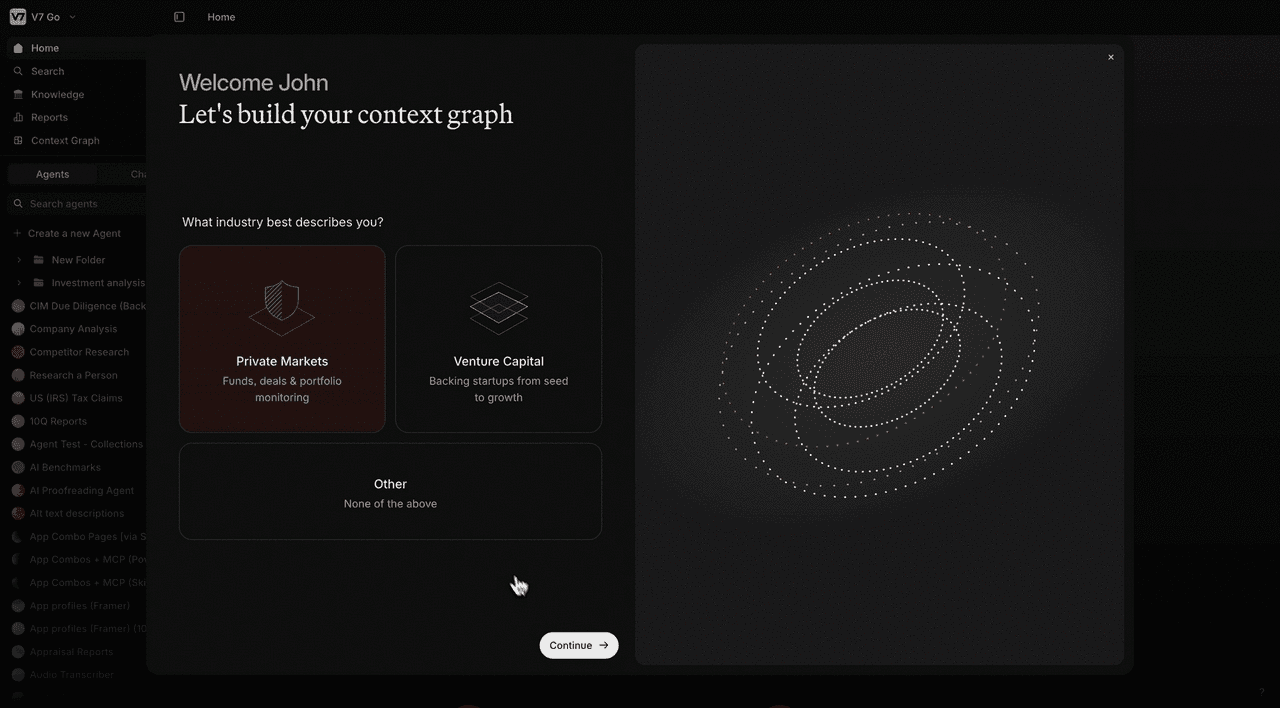
Setup looks closer to a questionnaire than a data migration: pick private markets, venture, or both, then point the system at the documents that already exist.
Upload what already sits in the data room and the shared drives, fund reports, cap tables, LPAs, board decks, and the platform handles the entity resolution and relationship extraction that used to require a team. Every document processed makes the graph more complete, so the first useful answer is measured in hours, not quarters, and it keeps improving as more of the firm's history gets pulled in.
The output is a relationship map you can actually see and query.
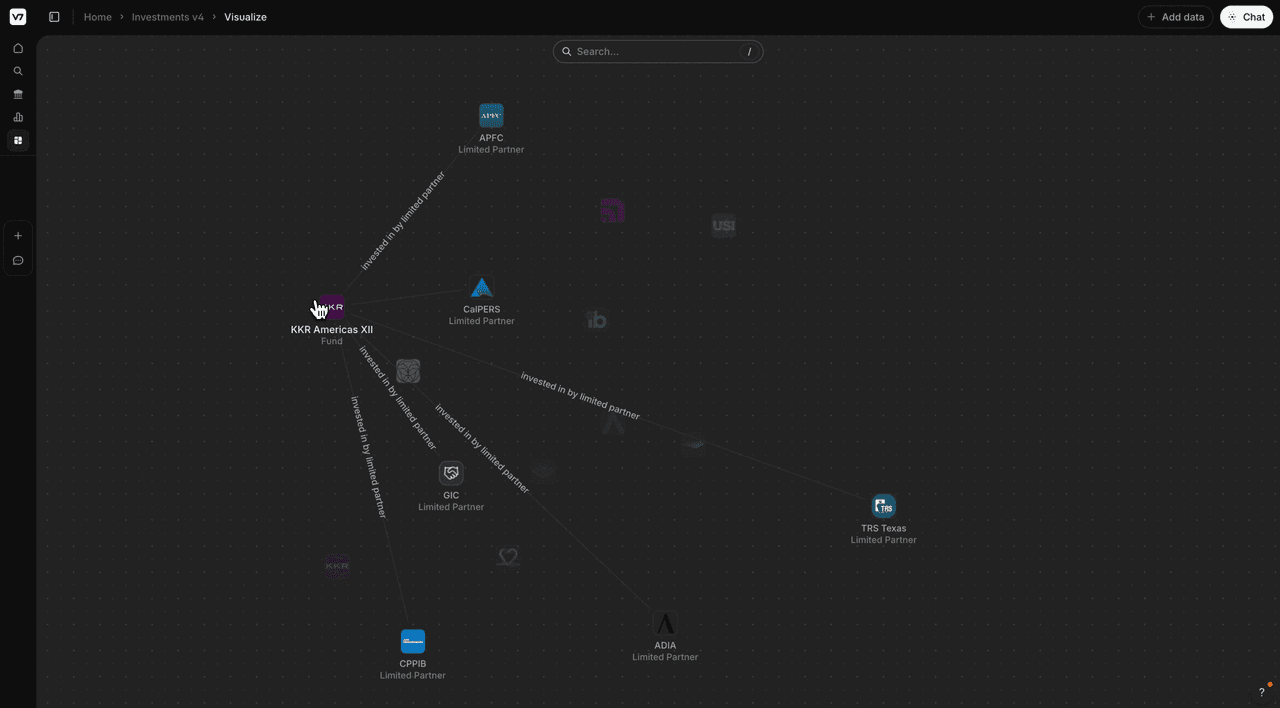
One fund, its limited partners, and the edges between them, drawn from documents an analyst would otherwise have cross-referenced by hand.
Nothing in that graph is a guess. Each edge, a fund invested by a limited partner, a company supplied by a vendor, a founder who previously ran a business the firm passed on, traces back to the document it came from. That traceability is what separates a context graph from a chatbot that sounds confident: the citation opens to the exact sentence in the PDF or the exact cell in the spreadsheet, which is the standard an investment committee memo or an LP due diligence response actually has to meet.
Grounded answers are the payoff. Ask which portfolio companies had the largest revenue growth last year and the system does not guess from a general sense of the market. It pulls the figures from the fund's own reports, builds the table, and writes the takeaway.
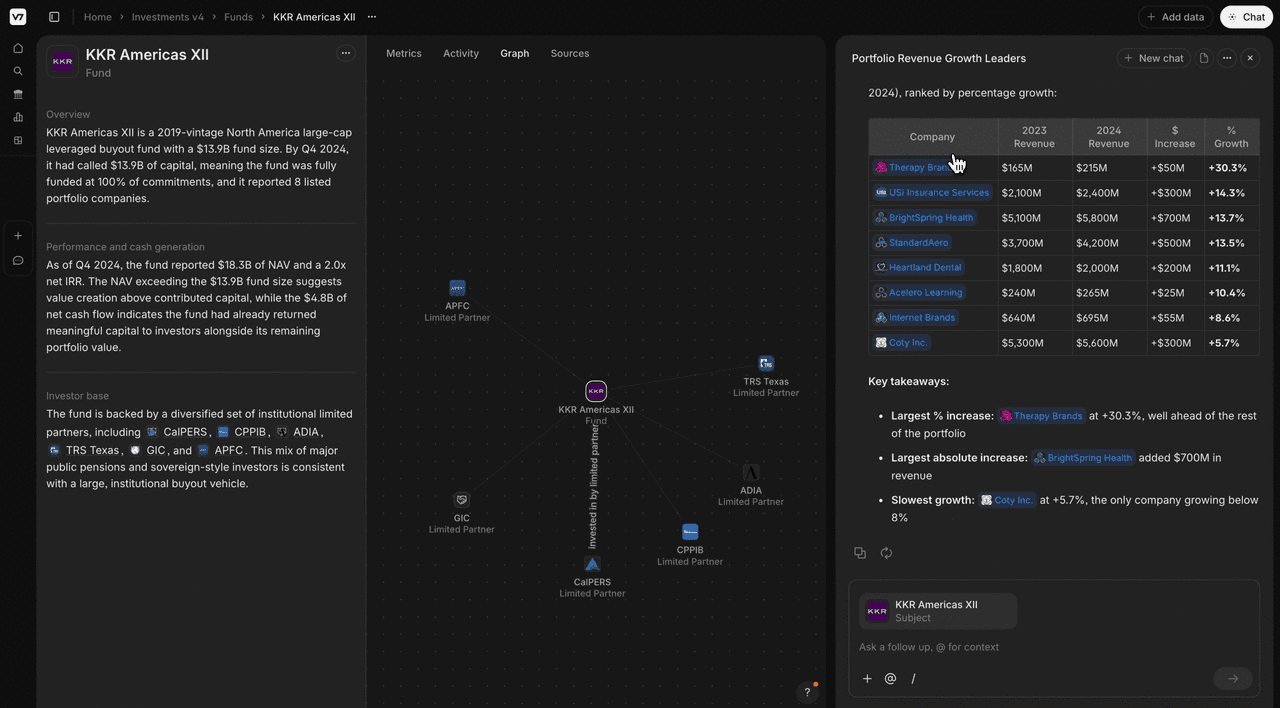
An ad hoc question answered with a structured table and a written takeaway, not a chatbot paragraph that has to be double-checked against the source.
What makes this stick with deal teams, rather than becoming one more tool nobody opens, is where the answers show up. The firms getting the most out of this are not routing everyone into a new chat window. Notable Capital runs more than 500 business-development introductions a year through a two-person team by connecting Claude directly to its own deal data. That connection runs on the Model Context Protocol, the same standard that lets a context graph plug into Claude, ChatGPT, or whatever tool an analyst already has open, instead of asking the whole firm to change how it works. The graph becomes the memory. The analyst keeps the interface.
This is exactly the kind of infrastructure V7 Go's Context Graph is built to be: a persistent, entity-resolved layer built from a firm's own documents, queryable in plain language, with every answer traced back to its source. Worth being precise about the terms, since the industry uses them loosely. A knowledge graph is the general concept this article has been describing. Context Graph is V7's own implementation of it, built specifically for private markets rather than a generic graph database a firm has to configure and feed itself.
What changes for private equity and venture capital
For private equity, the clearest change is in due diligence and LP reporting, the two functions where fragmented or unstructured data showed up as the top complaint in the S&P Global survey. A context graph turns a data room into something an associate can question directly: which of the target's customers overlap with an existing portfolio company, which advisor has run three deals in this sub-sector, whether the firm has seen this exact business before and, if so, why it passed. None of that requires new headcount. It requires the documents the firm already has to be connected instead of filed.
For venture capital, the shape of the problem is different but the fix is the same. A VC partner does not manage 400 companies a year. They track a portfolio of fifteen to twenty and a pipeline of thousands of founders, and the signal that matters is pattern, not volume: which founders have scaled a comparable business before, which of the firm's existing portfolio companies are quietly competing for the same senior hires, which co-investors keep showing up around a specific thesis. A context graph makes that pattern visible instead of something a partner has to reconstruct from memory before every Monday meeting.
The common thread across both is simple. AI for private equity and venture capital only gets genuinely useful once it stops treating every question as if the firm has no history. The industry has already proven it will use AI constantly: 85% of dealmakers do. What most firms have not yet given that AI is a memory of their own deals. That is the part a context graph actually fixes, and it is a smaller project than most partners assume.
Casimir is a seasoned tech journalist and content creator specializing in AI implementation and new technologies. His expertise lies in LLM orchestration, chatbots, generative AI applications, and computer vision.