16 min read
—


Test every prior answer for scope, date window, reader and source before it goes out again, then triage the form by status and route each answer to the role that signs it.

Casimir Rajnerowicz
Content Creator
V7 Go
A smarter way to manage due diligence and underwriting
The LP due diligence questionnaire arrived on Monday with 180 questions and a Friday deadline. Three of the people who sign answers are out until Thursday: the general counsel, the head of valuation and the CISO. The investor relations lead has five business days and a library of past submissions. The form is a real estate due diligence questionnaire built on the ILPA template, with a long real estate supplement. (The firm, the form and every figure in this scenario are hypothetical.)
Question 47 asks for the fund’s borrowing policy. The library holds a polished answer on that subject, approved by the CFO in March. It was written for a lender refinancing one multifamily asset. It reports the loan-to-value ratio on that single loan, and its figures are as of December 31. A copy and paste would take ten seconds. The LP would read a single-loan LTV from nine months ago as the fund’s debt policy, on a basis the PPM never uses.
Nothing in the text of that answer warns anyone. It reads well, it was approved and it sits under the right heading. The real workload is deciding which of the 180 prior answers are still valid for this reader on this date. That decision comes before anyone drafts a word. Four checks make it, applied to every candidate answer in the same order: same scope, same date window, same reader and source still current.
LP, lender, transaction and vendor questionnaires ask the same debt question four ways
A real estate firm answers at least four kinds of questionnaire, and each one defines a correct answer differently. Our explainer on what a DDQ covers in general handles the basics of the format. What changes is who reads the answer, what it commits the firm to and which event makes it out of date. The table puts the same debt question into each reader’s words.
Questionnaire | Who sends it | What the answer governs | Reference standard | How the debt question reads | What makes the answer stale |
|---|---|---|---|---|---|
LP / investor DDQ | Pension plans, endowments, consultants, fund-of-funds | The investor’s commitment decision and the firm’s statements to that investor | ILPA DDQ 2.0, INREV DDQs, NCREIF PREA Reporting Standards | What is the fund’s maximum borrowing, how is it measured and does it include the subscription line? | Quarter close, PPM or LPA amendment, a new fund |
Lender / borrower questionnaire | Banks, debt funds, life companies | One loan on one asset or portfolio | The lender’s credit policy and supervisory guidance | What are the LTV and DSCR on this loan as of the appraisal date? | Refinancing, new appraisal, change of guarantor or borrowing entity |
Transaction DDQ | The buyer of an asset | Facts about one property under a PSA | The PSA’s diligence schedule | What debt encumbers the property, and can the buyer assume it? | Closing, PSA amendment, a new estoppel |
Vendor / security questionnaire | LPs, lenders and counterparties reviewing the firm | The firm’s own controls and its service providers | SIG, CAIQ | Who can reach the loan servicer and bank portals that hold the fund’s debt records? | Vendor renewal, a new SOC report period, a change of provider |
LP and investor DDQs: ILPA, INREV and NCREIF PREA
The usual starting point for a US manager’s LP questionnaire is ILPA’s Due Diligence Questionnaire, version 2.0. ILPA last updated it in 2021, and it covers firm information, track record, fund terms, legal, data security and ESG, among other topics. ILPA says it is developing asset-class modules, real estate among them. The ILPA DDQ 2.0 User Guide states that the template used private equity managers as its reference point. Real estate, private credit, venture and infrastructure were outside its scope. Real estate managers adapt it question by question, and each adapted answer drifts from the form it was written for.
An ILPA-shaped form, in our judgment rather than ILPA’s, under-asks five things a real estate LP will add.
Property-level debt by asset, reported next to fund-level borrowing and the subscription line.
The valuation cycle, including who appraises, how often and which values are internal.
Joint venture and operating partner structures, with promote terms and control rights.
Concentration by property type, metro area and largest tenants.
Development and capex exposure as a share of gross asset value.
European investors bring INREV’s questionnaires. INREV publishes three of them: non-listed real estate vehicles, fund of funds and multi-managers, and real estate debt vehicles. A manager running an equity fund and a credit vehicle keeps two answer sets on the same subject. Suppose the debt vehicle quotes a 65% maximum LTV at origination. The equity fund caps borrowing at 60% of gross asset value. Each figure is correct inside its own set and wrong in the other.
Our piece on LP due diligence and GP evaluation covers how allocators score these answers.
Lender and borrower questionnaires
The published templates leave out lender questionnaires, yet these are the most likely to seed a library with the wrong scope. A bank or debt fund underwriting a refinance asks about one loan, one borrowing entity and its collateral, as of the appraisal or loan date. The OCC Comptroller’s Handbook on commercial real estate lending sets out what examiners expect at underwriting, tenant leases among them. Its appendix on supervisory limits sets 85% as the maximum loan-to-value for improved commercial and multifamily property.
Written out as fields, the scope of the March answer looks like this.
Field | The March lender answer |
|---|---|
Reader | Senior lender on a refinancing |
Borrower | Single-asset property entity owned by Fund II |
Collateral | One 212-unit multifamily property |
Metric definition | Loan balance divided by appraised value |
Figures | $41.0 million loan on a $66.0 million appraisal, 62.1% LTV, 1.45x DSCR |
Fact as-of date | December 31, 2025 |
Approved | March 18, 2026, by the CFO |
Every field in that record is accurate. Only the topic matches question 47, and every other field describes a different object on a different date.
Transaction DDQs
A transaction DDQ runs from buyer to seller on one asset, on a clock set by the PSA’s diligence period. The answers come from the deal file, meaning the estoppels, title commitment, service contracts and any assumed loan documents. They describe a building at closing, so few belong in a reusable library. The exception is the sponsor block (organizational chart, litigation disclosure, key-person biographies), which every buyer and lender asks for. The document inventory behind transaction answers is set out in our commercial real estate due diligence checklist, and the way to grade what a seller actually posts is covered in the real estate data room analysis guide.
Vendor and security questionnaires: SIG and CAIQ
LPs and lenders also send questionnaires about the firm itself, covering its IT, cyber controls and the providers that hold investor and loan data. Bitsight describes the SIG questionnaire as spanning 21 risk areas for any type of vendor. The CAIQ is a set of yes/no questions for cloud providers, and the Cloud Security Alliance cut it to 261 questions in version 4, from 310 in v3.1. The owner of these answers is the CISO or IT lead with compliance, and IR assembles the package.
The answers here expire on other people’s calendars. A SOC report covers a stated period. A fund administrator’s contract renews on its own date, and a property management software vendor can add subprocessors mid-year. Each of those answers should carry the report period or renewal date it depends on.
The reuse test for a real estate due diligence questionnaire answer
A prior answer can go into a new questionnaire only after it passes four tests in order. The first failure decides what happens to it. The table is the decision tree in compact form.
Order | Test | The answer passes when | If it fails |
|---|---|---|---|
1 | Same scope? | It describes the same fund, entity, asset or loan, at the same aggregation level, with the same metric definition | Redraft from the governing document |
2 | Same date window? | Its fact as-of date falls inside the window the form asks for, usually the latest quarter close | Re-date from the latest quarterly report, and route to the owner if a figure moved |
3 | Same reader? | It was written for the same questionnaire type, with the same use and disclosure weight | Redraft for this reader, and the owner approves |
4 | Source still current? | The passage it cites reads the same in the latest version of that document | Route to the owner |
All pass |
|
| Reuse, with a fresh citation to the current version of the source |
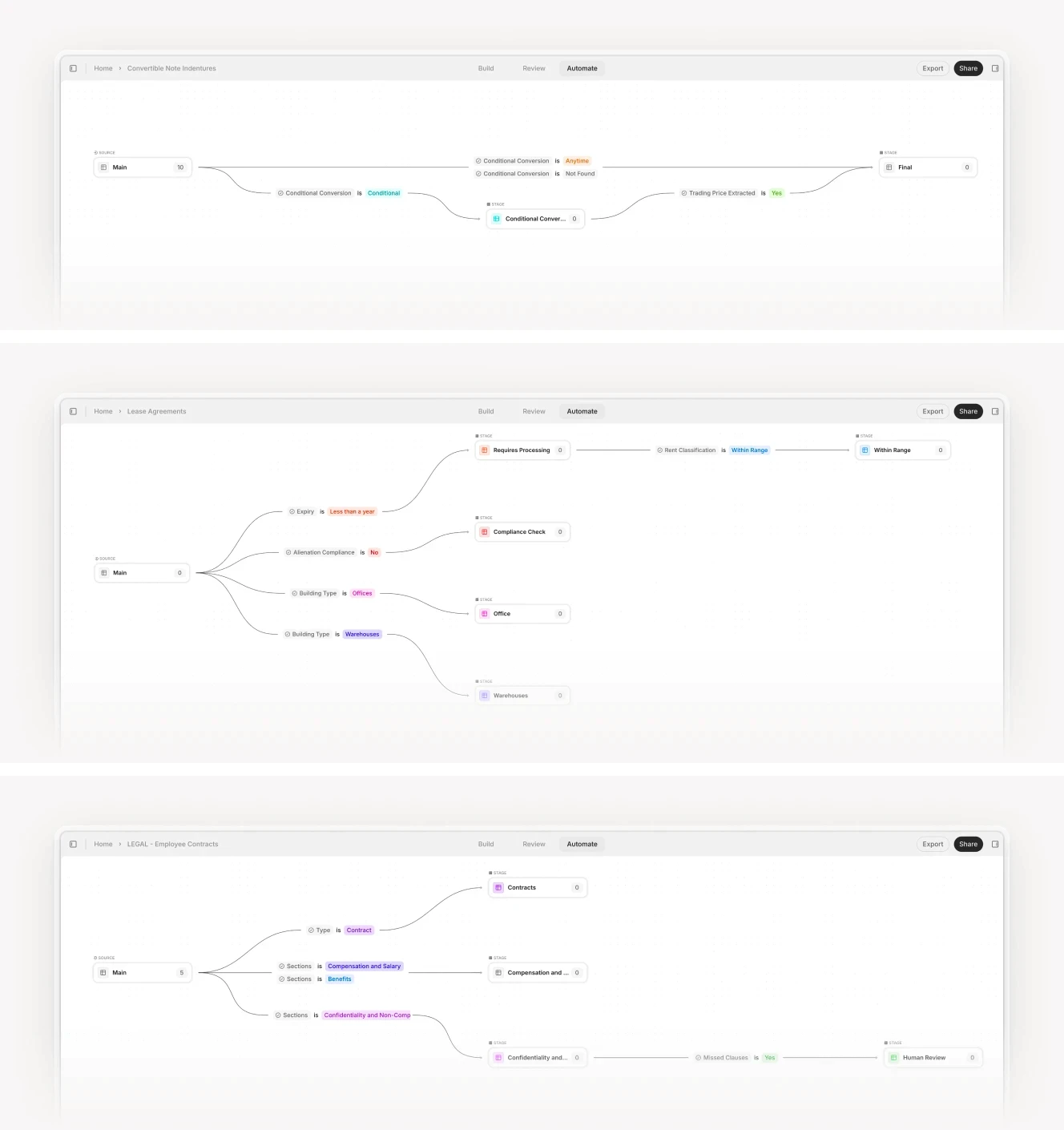
Generic decision-flow diagrams, included because each of the four reuse tests needs a defined exit before an answer moves.
Three dates sit on every approved answer, and only one of them sets the window. The approval date records when an owner signed, and the submission date records when the answer left the firm. The fact date records when the numbers were true, and it is the one date the second test reads. An answer approved last week can still carry figures from two quarters ago.
Standards bodies already apply a scope test. The NCREIF PREA Reporting Standards guidance on ESG matters places firm-level topics in DDQs and vehicle-level topics in formation documents and ongoing reporting. The Reporting Standards exist to keep that industry information consistent. A borrowing answer splits the same way. The March answer reports 62.1% LTV on one loan. Question 47 asks about a fund whose property-level debt is 51.5% of gross asset value, or 57.9% once the drawn subscription line is counted.
Run through the tree, the March answer stops at the first test, and the other three show why it could never have been patched.
Same scope fails, because the answer measures one loan against one appraisal and the LP asks about aggregate fund borrowing under the PPM’s definition.
Same date window fails, because the facts are as of December 31, 2025, and the latest quarter close is June 30, 2026, 181 days later.
Same reader fails. A lender uses the figure to size a loan, while an LP reads it as the fund’s stated policy and checks it against the PPM.
Source still current passes, since the PPM has not been amended since March. The first failure has already sent the answer to redraft.
The outcome is a new answer drafted from the PPM and the Q2 quarterly report. It routes to the CFO, who also decides whether the subscription line belongs in the number. The 6.4-point gap between 51.5% and 57.9% is a definitional choice that the PPM settles, and the drafter has no authority to make it.
The 180-question run in V7 Go: classify, retrieve, date-check, draft, route
Done by hand across 180 questions, the four tests consume the week. In V7 Go they run as defined workflow steps, each with its own instructions, tool and output type. The route is the same for every questionnaire. The DDQ completion workflow runs these steps.
A classification step tags each question as fund, property, entity, legal, operational, financial or security, then assigns an owner queue from the sign-off matrix.
Retrieval pulls candidate answers and current sources from the firm’s approved records, which tie each approved answer to the vehicle, borrowing entity, asset and loan it describes.
A Python step runs the date-window and source-currency tests. It compares each fact date with the latest quarter close and each cited version with the newest file.
A drafting step writes the answer and cites the exact sentence in the PPM, LPA or quarterly report that supports it.
A check step flags any answer whose evidence is stale, conflicting or missing.
The routing step sends each item to its named owner and records who approved it, on what date and against which source version.

The DDQ steps sit in the middle layer of this general V7 Go architecture, between the incoming form and the PPM and reports they cite.
The IR lead can work in an app built on the same workflow for their role. It shows each question with its status, owner and citation. Apps are currently in preview. The same workflow also runs headless. When a DDQ arrives as an ILPA Excel file, an INREV Word document or a custom PDF, an integration or API call starts the run. The classified, pre-drafted questions reach the owner queues before anyone opens the file. A named person approves every answer before it is sent.
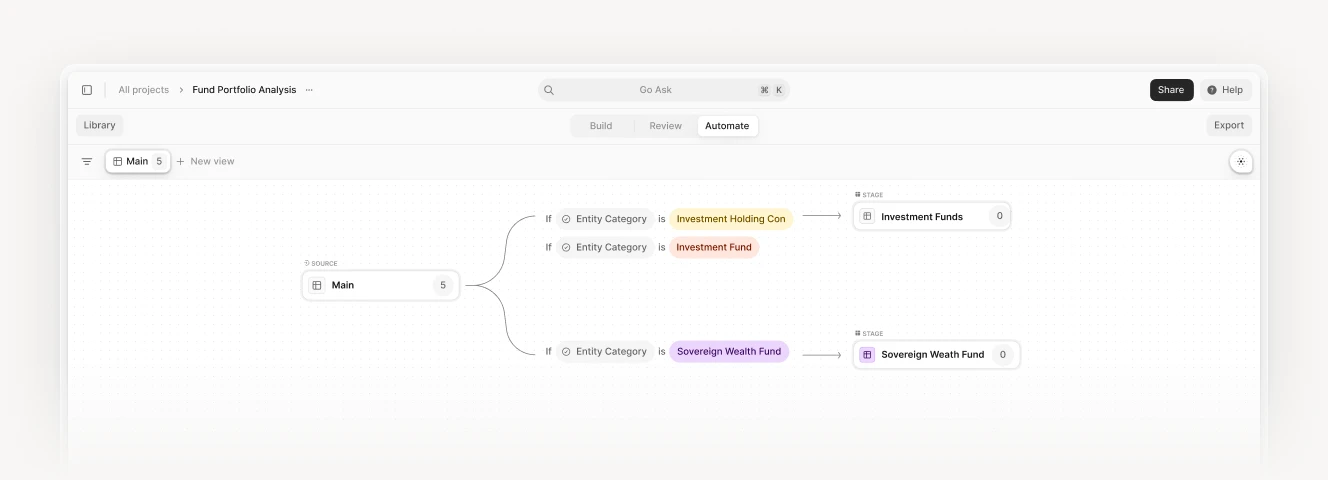
The categorization shown here on fund documents is the same step that sorts the 180 questions into owner queues.
Once the CFO approves the new answer to question 47, it joins the approved records that the firm’s other real estate workflows in V7 Go retrieve from. Its scope and fact date travel with it.











Triage by answer status, 180 questions in six piles
After the four tests, each of the 180 questions sits in one of six piles. The pile sizes show where Friday is at risk. The split below belongs to the hypothetical form from the opening.
Status | Questions | Share | Next action | Who acts |
|---|---|---|---|---|
Current | 71 | 39.4% | Reuse with a fresh citation | IR |
Stale date | 43 | 23.9% | Re-date from the Q2 quarterly report | Finance, with the CFO checking moved figures |
Scope mismatch | 27 | 15.0% | Redraft from the governing document | Analyst drafts, owner approves |
Conflicting evidence | 8 | 4.4% | Hold until the owners resolve it | CFO and general counsel |
No approved answer | 19 | 10.6% | Route to the owner with the evidence found | Owner |
Owner-only | 12 | 6.7% | Owner writes or approves from scratch | Named owner |
Total | 180 | 100% |
|
|
The first two piles, 114 questions, need only IR and finance and can clear by Wednesday. The other 66 need a named owner. Of those, 31 belong to the three people who are away, with 14 for legal, 9 for valuation and 8 for IT and cyber. If they return on Thursday morning, that is 31 decisions in two working days, and the general counsel alone faces seven a day. The remaining 35 sit with the CFO, the CCO and the portfolio manager. That is seven items a day between them across five days.
Current: reuse, but cite the source again
An answer that passes all four tests still gets a new citation. Suppose the answer on the valuation committee cites the 2024 valuation policy, and the 2026 version repeats the paragraph word for word. The answer goes out citing the 2026 version, the document in force on the submission date. For 71 answers that is one check each, and each output is a citation with a version and a date.
Stale: same answer, new as-of date
Stale answers fail only the date window, so the narrative stays and the numbers change. Track-record exhibits, NAV, gross and net IRR, occupancy and debt ratios each carry their own as-of date. They expire at quarter close even when the surrounding paragraph is still right. Re-date from the latest quarterly report, with each figure cited directly to it. Never copy figures forward from the prior DDQ.

Each fund metric shows its source report, so a track-record exhibit is re-dated from the Q2 report instead of copied forward.
A re-dated figure can also break the narrative around it. If portfolio occupancy falls from 94% to 89% while the narrative still says the portfolio is above 90% leased, the answer is wrong. It routes to the portfolio manager.
Scope mismatch, or the lender answer in an LP form
The March answer belongs here, and the fields that have to change fit in four rows.
Field | March lender answer | LP question 47 |
|---|---|---|
Metric definition | Loan balance divided by appraised value | Fund borrowing divided by gross asset value, as the PPM defines it |
Aggregation level | One loan on one asset | All property-level debt, plus the subscription line if the PPM counts it |
As-of date | December 31, 2025 | June 30, 2026 |
Figure | 62.1% | 51.5% or 57.9% |
The other 26 questions in this pile follow the same pattern. Each keeps its topic and loses its fields. The drafting step starts from the governing document and uses the old answer only as a guide to length and tone.
Conflicting: two approved documents disagree
The PPM caps fund borrowing at 60% of gross asset value, and an LP DDQ approved last year said 65%. The likely cause is a drafter who pulled the debt vehicle’s origination limit from the other answer set. Both documents are approved. Neither number goes out until the CFO and counsel decide which governs and whether the earlier investor needs a correction. With counsel away until Thursday, these 8 items sit in the slowest queue of the week. The workflow keeps a conflict record for each one.
The question number in the current form, with the draft held.
Citation A, the PPM section on borrowing limits, stating 60% of gross asset value.
Citation B, the prior LP DDQ answer approved in 2025, stating 65%.
The owners, here the CFO and the general counsel.
The resolution, covering which source governs, the corrected wording and whether the earlier recipient is told.

Fund terms taken from the LPA are the governing source when a prior DDQ answer quotes a different number.
Missing: questions the library has never seen
Nineteen questions, 10.6% of the form, have no approved answer in the library, partly because the forms keep moving. INREV’s guidelines consultation, which ran from 7 September to 30 October 2026, covers a revamp of its DDQ that adds emerging topics such as operational real estate and AI. Final outputs are expected in Q1 2027. Questions on AML procedures and on the firm’s own use of AI are typical of this pile.
These items go straight to the owner with whatever evidence the workflow found, marked as unapproved, and nobody drafts from thin evidence. A fluent paragraph on AI governance that nobody approved would be a policy statement the firm never made.
What a reusable DDQ answer record has to store
An answer library supports reuse only when each record carries the data the four tests need.
Field | What it holds | Test it feeds |
|---|---|---|
Answer text | The approved wording, verbatim | None, it is the payload |
Questionnaire type | LP, lender, transaction or vendor | Same reader |
Reader | The investor, lender or counterparty type it was written for | Same reader |
Entity or vehicle | The fund, borrowing entity, asset or loan it describes | Same scope |
Metric definition | How any figure is calculated, quoted from the governing document | Same scope |
Fact as-of date | The date the facts were true | Same date window |
Cited source and version | The document, its version date and the exact sentence | Source still current |
Approver and approval date | The named role and the date of sign-off | Audit trail |
Expiry trigger | The event that retires the record | All four |
Each expiry trigger retires a defined set of records. A quarter close retires every figure-bearing record for the vehicle, and a PPM or LPA amendment retires every record citing the amended section. A refinancing retires the loan’s lender answers. A key-person change retires the team answers, and a new SOC report period retires the security answers. A retired record stays in the library as history and drops out of retrieval for new drafts.
Our overview of DDQ automation covers the wider software question. Whether DDQ response should be a firm’s first automated process depends on volume, error cost and review time. Our guide to real estate workflow automation covers how to measure those before any pilot.
A sign-off matrix for every DDQ question category
Approvals should follow a fixed map of who signs what, so an answer never depends on whoever happens to be in the office. The workflow routes against this matrix.
Question category | Example question | Drafts | Approves | Second reviewer | Re-review trigger |
|---|---|---|---|---|---|
Strategy and track record | Gross and net returns by vintage | Workflow, IR analyst | Portfolio manager | CFO | Quarter close |
Debt and financing | Fund borrowing limit and subscription line use | Workflow, finance analyst | CFO | General counsel | Refinancing, PPM amendment, quarter close |
Fees and fund terms | Management fee basis and offsets | Workflow, from the LPA | CFO | General counsel | LPA amendment, new side letter |
Valuation | Appraisal cycle and share of external values | Workflow, valuation analyst | Head of valuation | CFO | Valuation policy change, appraisal cycle |
Legal, regulatory and litigation | Pending claims against sponsor entities | Counsel’s team | General counsel | CCO | New claim, regulatory exam |
AML and KYC | Investor onboarding and screening procedures | Compliance analyst | CCO | General counsel | Policy update |
ESG | Firm-level ESG policy | Workflow, ESG lead | Head of ESG | CCO | Annual policy review, standards update |
IT, cyber and vendor | SOC report coverage for the fund administrator | IT lead | CISO | CCO | Vendor renewal, new SOC period |
Property-level facts (lender and transaction) | LTV and DSCR as of the loan date | Workflow, from the deal file | Asset manager or deal lead | CFO | New appraisal, closing, refinancing |
Entity and fund operations | Organizational chart, administrator and auditor | Workflow, fund controller | CFO | CCO | Entity or administrator change |
IR approves none of these rows on its own authority. In this week’s form, the valuation, legal and IT rows belong to the three approvers who are out until Thursday.
How is a lender or borrower questionnaire different from an LP DDQ in commercial real estate?
A lender or borrower questionnaire is about one loan. The bank or debt fund wants facts on a single borrowing entity, the collateral, the guarantor, litigation and the property's income, all as of the appraisal or loan date, because those facts feed its own credit decision. An LP DDQ is about the manager and the fund. The investor wants strategy, track record, fund terms, governance, valuation policy and borrowing limits for the vehicle as a whole, and it reads the answers as statements of policy that it will later compare with the PPM and LPA. The same topic can appear on both forms with different scope. A loan-level LTV answers the lender, while the LP wants fund-level borrowing as the PPM defines it, sometimes including the subscription line. That is why a lender answer should almost never pass the reuse test for an LP form without a redraft.
+
How often should a real estate DDQ answer library be re-dated?
Re-date on events as well as on the calendar. Every record that carries a figure, such as NAV, IRR, occupancy or a debt ratio, should be re-dated after each quarter close from the latest quarterly report, because that is the window most LP forms ask for. Narrative answers last longer, but they should retire when their source changes, for example after a PPM or LPA amendment, a refinancing, a key-person change, a new valuation policy or a vendor renewal. A practical rule is to store an expiry trigger on every record when it is approved, so the library retires answers automatically instead of relying on someone to remember. A full review once a year catches records whose triggers were never set. Answers about specific transactions usually should not sit in the library at all, since the facts belong to one closing.
+
Can AI approve a DDQ answer?
No. In a well-run DDQ process, AI does the preparation and named people do the approving. A workflow can classify questions, retrieve prior answers and current sources, run the date and version checks in code, draft text with a citation to the exact sentence it relies on and flag answers whose evidence is stale, conflicting or missing. What it should not do is decide what the firm represents to an investor or a lender. Answers on fund terms, borrowing limits, valuation, litigation, regulatory matters, AML and security commit the firm, and they belong to the CFO, general counsel, CCO, head of valuation or CISO under the firm's sign-off matrix. The workflow records who approved each answer, on what date and against which source version. That record is what lets the next questionnaire reuse the answer safely.
+
Does a US real estate manager need to care about the INREV DDQ?
Only if it raises capital from European investors or works with consultants who use INREV's forms, but for those managers it matters. INREV publishes three questionnaires, covering non-listed real estate vehicles, fund of funds and multi-managers, and real estate debt vehicles. A US manager with both an equity fund and a credit vehicle may need answer sets for two of them, and those sets should be kept apart so that figures from one never leak into the other. INREV consulted in autumn 2026 on a simpler DDQ that adds operational real estate and AI topics, with final outputs expected in the first quarter of 2027. A manager that never sees INREV forms can still borrow the structure, since the debt-vehicle questions are a useful checklist for any real estate credit strategy.
+
Which date belongs on a DDQ answer, the approval, submission or fact date?
Route them to the owner first and draft second. When the library has no approved answer, a fluent draft built from scattered internal material is the riskiest output in the whole questionnaire, because it reads like policy and nobody has approved it. The better route is to send the question to the named owner, such as the CCO for AML or the CTO and CCO for AI use, together with whatever evidence the workflow found, clearly marked as unapproved. Once the owner writes or approves the answer, it enters the library with its scope, reader, fact date, source and expiry trigger, so the next form starts from an approved record. New topics will keep arriving, since standard questionnaires such as INREV's are being updated to cover operational real estate and AI.
+
How should a firm handle questions it has never answered before, such as AI use or AML?
Go is more accurate and robust than calling a model provider directly. By breaking down complex tasks into reasoning steps with Index Knowledge, Go enables LLMs to query your data more accurately than an out of the box API call. Combining this with conditional logic, which can route high sensitivity data to a human review, Go builds robustness into your AI powered workflows.
