15 min read
—


How lenders and buyers find the one test that limits a CRE deal, with formulas, a rate-by-NOI grid and a sign-off sheet for every input.

Casimir Rajnerowicz
Content Creator
V7 Go
A smarter way to manage due diligence and underwriting
Real estate underwriting, on the commercial lending side, is the work of finding which of three tests caps the loan. The tests are debt service coverage, debt yield and loan-to-value, and each one produces its own maximum loan. The smallest becomes the loan, and the memo has to name the test that produced it and the document that set the number behind it. An equity buyer runs the same exercise on price. The question there is which assumption decides what the building is worth, and the answer is usually the pair of NOI and cap rate.
Picture the first loan memo a junior credit analyst sends up. LTV sits exactly at the 70% policy limit, DSCR clears 1.25x, and the recommendation reads approve. The credit officer’s margin note says debt yield fails on corrected NOI, so the loan as sized cannot go to committee.
Every ratio in the memo was calculated correctly. The analyst skipped two things. One is the step that turns each ratio into a dollar ceiling and compares the three ceilings. The other is three expense corrections that moved NOI between the seller’s statement and the credit file.
The figures throughout come from one hypothetical deal, an 80,000-square-foot multi-tenant flex industrial building. The purchase price is $19.5 million, the appraisal $19.0 million, and the requested loan $13.3 million on 30-year amortization. The subject is commercial property lending and equity investment, where the building’s net operating income repays the debt. Residential mortgage underwriting rests on a household’s income and credit, and insurance underwriting prices the transfer of risk, so both run on different rules.
The lender's question in real estate underwriting: which test caps the loan
A lender converts each policy test into a maximum loan amount and lends the smallest of the three. Each ratio answers a different question, and only the comparison shows which one decides the deal.
All three tests start from net operating income, which is effective gross income minus operating expenses, before debt service. Lenders also count replacement reserves as an expense. Our walkthrough of NOI calculation for commercial property covers the line-by-line build. Because both the lender and the buyer inherit NOI, one error in it travels into every test.
Metric | Ratio | Solved for maximum loan | What moves it | Classic error |
|---|---|---|---|---|
DSCR | NOI ÷ annual debt service | (NOI ÷ DSCR floor) ÷ annual loan constant | NOI, rate, amortization, interest-only period | Testing only the interest-only payment |
Debt yield | NOI ÷ loan amount at origination | NOI ÷ debt yield floor | NOI only | Expecting a lower rate to help |
LTV | Loan ÷ value | LTV limit × lower of cost or appraised value | Appraisal, purchase price | Using the contract price when the appraisal is lower |
Three caveats keep the table honest. When a loan has an IO period, test DSCR on both the interest-only and the amortizing payment, since policy usually binds on the amortizing figure. The CREFC Underwriting Principles define debt yield as NOI over the loan amount at origination, so a cheaper rate does nothing for it. LTV uses the lower of purchase price and appraised value, which here means the $19.0 million appraisal.
Floors come from each lender’s credit policy and differ by product and property type. The OCC Comptroller’s Handbook on commercial real estate lending expects a bank’s policy to set minimum DSCR and LTV limits by property type. It also expects a sensitivity analysis of projected income. The interagency supervisory LTV limits are 85% for improved property, 80% for commercial construction, 75% for land development and 65% for raw land. Those are supervisory ceilings, and bank policy usually sits below them.
This deal’s policy caps LTV at 70%, with DSCR of at least 1.25x and debt yield of at least 10.0%.
Now run those floors against corrected NOI of $1,302,000 at a 6.5% rate. Annual debt service on $13.3 million is $1,008,781, a loan constant of 7.58%. The ceilings are $13.30 million under LTV, $13.73 million under DSCR and $13.02 million under debt yield. Debt yield sets the loan, and the requested $13.3 million is $280,000 too large.
The equity question: what corrected NOI is worth at your cap rate
For the buyer, the binding variable is the pair of NOI and cap rate. Value is NOI divided by the cap rate, so a small move in either shifts the price by millions. The seller’s T-12 shows NOI of $1,450,000, and the corrected figure is $1,302,000.
Cap rate | Value on seller NOI ($1,450,000) | Value on corrected NOI ($1,302,000) | Gap |
|---|---|---|---|
6.75% | $21.48M | $19.29M | $2.19M |
7.00% | $20.71M | $18.60M | $2.11M |
7.25% | $20.00M | $17.96M | $2.04M |
At the $19.5 million contract price, the buyer is paying a 7.44% cap rate on the seller’s NOI and 6.68% on corrected NOI. The $19.0 million appraisal implies 6.85% on corrected NOI. Appraiser and buyer are $500,000 apart, and the lender sizes off the lower figure.
The cap rate and the NOI must describe the same period. A stabilized cap rate belongs on stabilized NOI, and a trailing cap rate on T-12 NOI. A stabilized cap applied to the T-12 of a building in lease-up overstates value. Cap rate support comes from dated comparable sales with NOI at sale, which the real estate comps analysis guide in this series covers.
The equity investor then models unlevered IRR, plus levered IRR and equity multiple after debt. The lender’s sizing decides how much equity those levered returns have to carry.
Three corrections between the seller’s T-12 and underwritten NOI, and the document behind each
Underwritten NOI is $148,000 below the seller’s figure. Each dollar of the gap traces to a document produced outside the deal team.
The CRE underwriting process runs through four handoffs. The seller or broker delivers the package, the analyst builds the credit file, the appraiser and consultants deliver their reports, and credit reviews the result.
Document | Field it supplies | Period or effective date | Handoff | Correction it drives |
|---|---|---|---|---|
Rent roll | In-place rent, lease dates, vacancy | As-of date | Seller to analyst | Income base and vacancy assumption |
T-12 operating statement | Revenue and expense lines | 12-month period end | Seller to analyst | Starting point for all three expense adjustments |
Leases and estoppels | Rent, escalations, termination and renewal options | Execution, amendment and estoppel dates | Seller and tenants to analyst | Confirms rent roll income, flags termination risk |
FIRREA appraisal | Market value, appraiser’s NOI and cap rate | Effective date of value | Appraiser to credit | LTV denominator of $19.0M |
Property condition report | Capital needs, reserve recommendation | Site visit date | Consultant to analyst | Reserves of $8,000 ($0.10/sf) |
Assessor record and tax estimate | Current assessment, post-sale estimate | Tax year and estimate date | Analyst to credit | Tax reset of +$80,000 |
Management agreement, or its absence | Fee terms | Agreement date | Seller to analyst | Market fee of $60,000 (3% of EGI) |
The tax reset is the largest correction. A sale triggers reassessment in many states, so the seller’s bill reflects an old assessment. The credit file carries a post-sale estimate based on the $19.5 million price, which adds $80,000 of expense.
The seller self-manages and books no fee, but a lender assumes someone will be paid to run the building after a default. The file adds 3% of the $2.0 million EGI, or $60,000. The property condition report supports reserves of $0.10 per square foot, or $8,000 a year.
Under FDIC Financial Institution Letter 18-014, federally regulated lenders need an appraisal for commercial real estate transactions above $500,000. On a $13.3 million loan, the LTV denominator therefore comes from a certified appraiser with a stated effective date of value. If that date is months older than the rent roll, the credit file should say so.
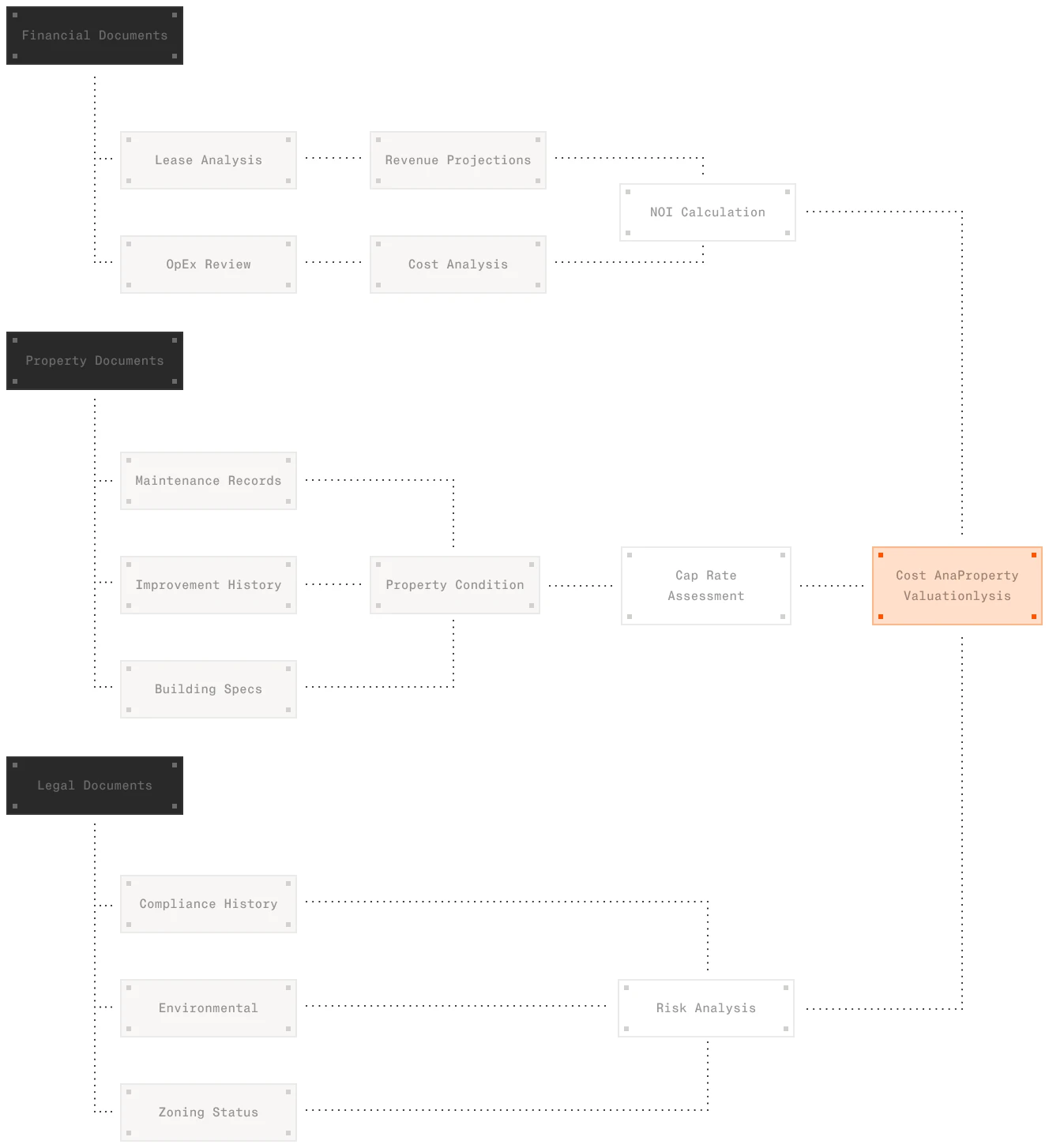
Leases, condition reports and operating statements in a flow like this one are the same documents that drive the tax, fee and reserve corrections.
Leases and estoppels need their own pass. A termination option in a large tenant’s lease, or an estoppel that discloses a rent dispute, changes the income an underwriter can count on. The rent roll may still show that suite as occupied and paying. The rent roll analysis guide and the T-12 analysis guide in this series cover those two documents line by line. Our CRE due diligence checklist holds the full document list.

An illustrative lease-clause question, since a termination right can remove income the rent roll still counts as secure.
Where the deal turns: a rate-by-NOI grid for one flex building
The grid runs the flex building through four NOI levels and four rates. This CRE underwriting example holds the policy constant (70% LTV, 1.25x DSCR, 10.0% debt yield) and uses the $19.0 million appraisal throughout. Each cell shows the binding test, the maximum loan and, in brackets, DSCR on the requested $13.3 million.
NOI | 6.0% | 6.5% | 7.0% | 7.5% |
|---|---|---|---|---|
$1,450,000 seller T-12 | LTV $13.30M (1.52x) | LTV $13.30M (1.44x) | LTV $13.30M (1.37x) | LTV $13.30M (1.30x) |
$1,370,000 tax reset only | LTV $13.30M (1.43x) | LTV $13.30M (1.36x) | LTV $13.30M (1.29x) | DSCR $13.06M (1.23x) |
$1,302,000 fully corrected | Debt yield $13.02M (1.36x) | Debt yield $13.02M (1.29x) | Debt yield $13.02M (1.23x) | DSCR $12.41M (1.17x) |
$1,240,000 corrected plus vacancy stress | Debt yield $12.40M (1.30x) | Debt yield $12.40M (1.23x) | Debt yield $12.40M (1.17x) | DSCR $11.82M (1.11x) |
On the seller’s NOI, LTV binds in every column, and debt yield on the requested loan is 10.90%. That is the memo the junior analyst wrote. With only the $80,000 tax reset removed, LTV still binds through 7.0%. At 7.5%, DSCR drops to 1.23x and cuts the loan to $13.06 million.
On fully corrected NOI, debt yield on $13.3 million falls to 9.79%, 21 basis points short of the floor. It reads 9.79% in every column because the test contains no rate. At 6.5%, DSCR is 1.29x and passes, LTV is exactly 70.0%, and debt yield limits the loan to $13.02 million. Those three numbers are the credit officer’s margin note.
Debt yield hands over to DSCR at about 7.02%, whatever the NOI. That is where the annual loan constant reaches 8.0%, the ratio of the 10.0% debt yield floor to the 1.25x DSCR floor. A 30-year amortizing loan hits that constant at 7.02%. Below that rate debt yield gives the smaller loan; above it, DSCR does, unless LTV is tighter still.
LTV binds only while NOI stays high. Debt yield matches the $13.3 million LTV ceiling at NOI of $1,330,000. Any correction that takes NOI below that figure hands the deal to debt yield or DSCR.
Floors move too, sometimes between term sheet and committee. In the Federal Reserve’s October 2026 Senior Loan Officer Opinion Survey, banks on net reported tighter standards for all three CRE loan categories (construction and land development, nonfarm nonresidential, and multifamily), alongside weaker demand. A lender that lifts its DSCR floor from 1.25x to 1.30x moves the crossover to a lower rate. The binding test then shifts with no change to the building.











Running the grid on every deal in V7 Go: cited inputs, tests in code, a credit officer's stop
In V7 Go the grid is the last step of a defined workflow that follows the same route on every deal. The credit officer is the stop before anything reaches the memo. The inputs are the documents from the correction table, meaning the rent roll, T-12, leases and estoppels, appraisal, property condition report and tax estimate. The workflow has five steps, each with its own instructions, tool and output type.
Extraction into typed fields. Each value lands with its source document, its period or as-of date and its effective date. The T-12 period end and the rent roll as-of date sit beside the numbers they qualify. V7 Go’s property operating statement extraction follows the same pattern.
Reconciliation. Annualized rent roll income is compared with T-12 revenue. Any gap above the tolerance the credit team sets becomes a flagged item with both sources attached.
Calculation in code. NOI adjustments, DSCR on IO and amortizing payments, debt yield, LTV and the three maximum loans run in a Python step inside the workflow. The same step builds the full rate-by-NOI grid, so the 9.79% is arithmetic a reviewer can rerun.
Policy comparison. Floors are configured values owned by credit for each product. V7 Go keeps the firm’s product policies and prior deal records as reference that every run reads. The next flex building is then checked against the policy version in force for its product.
Exception routing. Any test below its floor goes to the named credit officer with each input’s citation. The officer decides whether to resize, restructure or approve an exception. Memo inputs stay on hold until the officer clears or signs each one. If a corrected rent roll arrives mid-review, the workflow reruns the same steps and the grid updates from the new as-of date.

The workflow layer sits between the rent roll, T-12 and appraisal and the cited figures a credit officer reviews.
Citations make the routing useful. When the officer opens the debt yield exception, the $80,000 tax reset opens the assessor’s post-sale estimate. The $60,000 management fee points to the T-12 lines where no fee was booked. The output is a set of cited, reviewed inputs for the loan memo and the model, which the team sends onward. V7 Go’s real estate underwriting and diligence workflows follow the same pattern for other asset types and document sets.

The screenshot shows fund metrics, and the same source link applies to every T-12 line and rent roll field in an underwriting workflow.
Assumptions behind the binding test, each with a source, a period and a date
Six assumptions decide which test binds on this deal. Credit will ask for the source, period and effective date of each before it reads the grid. Vacancy and credit loss, the management fee, the tax reset and reserves move NOI, which moves all three tests.
The rate at origination moves only DSCR. The exit cap rate and the rate at refinance decide whether the loan can be repaid at maturity, a question the origination tests leave open.
Assumption | Value | Source document | Period | Effective date | Owner |
|---|---|---|---|---|---|
Vacancy and credit loss | In place per rent roll, stress adds 3.1 pts of EGI ($62,000) | Rent roll, broker submarket report | Rent roll as of Aug 31, 2026 | Report dated Sep 2026 | Analyst |
Real estate taxes | +$80,000 post-sale reset | Assessor record, estimate on $19.5M price | 2026 tax year | Estimate date | Analyst, reviewed by credit |
Management fee | 3% of $2.0M EGI = $60,000 | T-12 (no fee booked), market fee support | T-12 ending Aug 2026 | T-12 delivery date | Analyst |
Replacement reserves | $0.10/sf = $8,000 | Property condition report | Annual | PCR site visit date | Analyst |
Interest rate | 6.5% base, 7.5% stress | Term sheet | At origination | Term sheet date | Credit officer |
Exit cap rate | 7.25% stress | Appraisal, comp set | At maturity | Appraisal effective date | Credit officer |
Each effective date matters as much as the value beside it. A vacancy assumption taken from a broker report dated before a large tenant gave notice is stale on the day it enters the file.
Credit usually asks for three stresses on top of the base case. A 100-basis-point rate shock moves the corrected row from 6.5% to 7.5%. There, DSCR on $13.3 million is 1.17x and the DSCR ceiling is $12.41 million. The vacancy shock is the $1,240,000 row, where debt yield on the requested loan is 9.32% and the ceiling falls to $12.40 million. Cap rate expansion bears on repayment. At a 7.25% exit cap, corrected NOI supports a value of $17.96 million, which puts the original $13.3 million balance at 74.1% before amortization.
Credit runs those stresses because a ratio measured on underwriting day says nothing about NOI three years later. Trepp’s September 2026 figures, as reported by Multi-Housing News, put the CMBS delinquency rate at 8.02%, the highest since November 2020, with office loans at 12.16%. A delinquency rate measures loans long after they were sized, so it reflects income and refinancing conditions that changed after origination. The OCC’s Bulletin 2024-29 on refinance risk in commercial lending asks banks to manage that same exposure.
The register covers only the inputs that move the binding test. Full input-tab design, with source, period and effective date on every model assumption, belongs to the real estate financial modeling guide in this series.
A 21-basis-point shortfall: resize, restructure or log an exception
When debt yield fails by 21 basis points, the credit officer has three options, and each one moves money or accountability to a different person.
Resize the loan to $13.02 million. The buyer’s equity rises by $280,000 and LTV falls to 68.5%. The lender question becomes an equity question. Does the deal still clear the buyer’s return hurdle with a $280,000 larger check?
Restructure the loan around NOI evidence. The lender funds $13.02 million at closing and holds back $280,000 until trailing NOI reaches $1,330,000. That NOI supports a 10.0% debt yield on the full $13.3 million, and additional reserves are the other route. The earn-out converts a disputed number into a test the borrower passes with evidence.
Approve a documented policy exception. The loan closes at $13.3 million with a named approver and a written rationale. One example is a documented case that the post-sale tax estimate overstates the likely assessment. The rationale has to cite a document, and the exception stays in the log for the life of the loan.
Exception logs get read by internal audit and by examiners. OCC Bulletin 2006-46 flags banks for closer supervisory analysis when construction loans reach 100% or more of total capital. The same flag applies when total CRE loans reach 300% or more of capital after growing 50% or more over the prior 36 months. A bank near those levels should expect its CRE policy exceptions to be examined one by one, so each record needs the fields below.
Field | Entry for the flex building |
|---|---|
Test | Debt yield |
Policy value | 10.0% minimum |
Actual value | 9.79% on $13.3M |
Gap | 21 bp, or $280,000 of loan |
Cited inputs | Corrected NOI of $1,302,000 with T-12, assessor estimate and PCR citations, loan amount from the term sheet |
Approver | Named credit officer, plus committee if above the officer’s authority |
Rationale | Written, tied to a cited document |
Date | Decision date, plus effective dates of the inputs used |
The same record is what an automated workflow should hand the approver. Our piece on AI in commercial loan underwriting covers that step from the lender’s side. V7’s page for real estate credit and lending teams covers it too.
The sign-off sheet behind a 9.79% debt yield
Every input that moved the binding test needs a preparer, a reviewer and a sign-off condition, recorded before the memo goes to committee. The roles below are a hypothetical allocation for a small-to-mid-market lender. Teams choosing tools for this work can start with our comparison of real estate underwriting software.
Input | Source document | Period or effective date | Preparer | Reviewer | Signs off when |
|---|---|---|---|---|---|
Rent roll income | Rent roll, leases, estoppels | Rent roll as-of date | Analyst | Credit officer | Annualized income ties to T-12 revenue within tolerance |
T-12 operating expenses | T-12 operating statement | 12-month period end | Analyst | Credit officer | Every line mapped, non-recurring items removed |
Tax reset | Assessor record, post-sale estimate | Tax year, estimate date | Analyst | Credit officer | Estimate is based on the contract price |
Management fee | T-12, market fee support | T-12 period | Analyst | Credit officer | Fee at market even when the seller self-manages |
Reserves | Property condition report | Site visit date | Analyst | Credit officer | Amount matches the PCR recommendation |
Appraised value | FIRREA appraisal | Effective date of value | Appraiser | Appraisal reviewer | Appraiser’s NOI reconciled to credit file NOI |
Rate and term | Term sheet | Term sheet date | Analyst | Credit officer | DSCR tested on IO and amortizing payments |
Policy floors | Credit policy for the product | Policy version date | Credit administration | Credit committee | Floors match the product the loan is booked under |
Two rows deserve a second look on any deal like this one. The tax reset rests on an estimate. The reviewer should see the assessor’s current record and the method behind the post-sale number side by side. The policy floors row is easy to skip because floors feel fixed. They change by product and over time, as the Fed’s loan officer surveys keep showing. A memo tested against an old policy version can pass a test the committee would fail.
The tax reset, management fee and reserves rows would have caught the junior analyst’s memo. Together those three corrections removed $148,000 of NOI. At a 10.0% debt yield floor, that is $1.48 million of loan capacity. The debt yield ceiling falls from $14.50 million on the seller’s figure to $13.02 million on the corrected one.
What is underwriting in real estate, and how does commercial underwriting differ from a residential mortgage?
Underwriting in real estate is the analysis a lender or investor runs before committing money, to decide how much to lend or pay and on what terms. In commercial real estate, the repayment source is the property's net operating income. The lender tests NOI against debt service, against the loan amount and against appraised value, then lends the smallest amount that passes all three. An equity buyer asks the related question of what that NOI is worth at a supportable cap rate. Residential mortgage underwriting focuses on the borrower's household income, credit history, existing debts and the home's value. A residential borrower's paycheck repays the loan, while a commercial borrower's tenants do. That difference is why commercial files are built from rent rolls, operating statements, leases, estoppels and appraisals. It is also why a correction to one expense line can change the size of the loan.
+
What is the difference between debt yield and DSCR?
DSCR divides NOI by annual debt service, so it depends on the interest rate, the amortization period and any interest-only term. Debt yield divides NOI by the loan amount at origination, as the CREFC Underwriting Principles define it, so it ignores the rate entirely. Debt yield therefore measures how much income the lender would earn on its money if it had to take the property back. In practice the two tests trade places as rates move. When the annual loan constant is below the debt yield floor divided by the DSCR floor, debt yield gives the smaller loan, and above it DSCR does. With a 10.0% debt yield floor and a 1.25x DSCR floor, the dividing constant is 8.0%, which a 30-year amortizing loan reaches at about a 7.02% rate. A lender that runs only DSCR when rates are low can oversize a loan that debt yield would have caught.
+
What minimum DSCR and debt yield do CRE lenders require?
There is no single minimum. Each lender sets floors in its credit policy by product and property type. The OCC Comptroller's Handbook expects a bank's policy to address minimum DSCR along with LTV limits and sensitivity analysis. Typical market ranges cited by practitioners put minimum DSCR for stabilized commercial property around 1.20x to 1.25x. Some programs go lower, such as SBA 504 at 1.15x, and some lenders ask for more on transitional deals. Practitioner ranges for debt yield on stabilized assets commonly run from 8% to 10%, with CMBS lenders often near the top of that range and agency multifamily lenders lower. Use these as reference points for a conversation with a specific lender. The binding number is the one in the term sheet and in the credit policy for the product the loan will be booked under. It can change between term sheet and committee.
+
Is the 85% interagency LTV limit the LTV a lender will actually lend at?
Usually not. The Interagency Guidelines for Real Estate Lending Policies are codified for FDIC-supervised banks at 12 CFR Part 365. They set supervisory LTV limits of 85% for improved property, 80% for commercial construction, 75% for land development and 65% for raw land. They are ceilings that frame a bank's own policy, and banks set internal limits at or below them. Most lender policies for stabilized commercial property sit well under 85%, and the hypothetical policy in the flex building example caps LTV at 70%. LTV is also only one of three sizing tests. In that example the loan sat exactly at the 70% limit and still failed, because debt yield on corrected NOI capped the loan $280,000 lower. The LTV denominator matters too, since lenders use the lower of the purchase price and the appraised value, which was $19.0 million against a $19.5 million price.
+
How do rising interest rates change which underwriting test binds?
For federally regulated lenders, a commercial real estate transaction above $500,000 requires an appraisal by a state certified or licensed appraiser. FDIC Financial Institution Letter 18-014 announced the increase from the previous $250,000 threshold in 2018. The agencies' final rule allows an evaluation for commercial transactions at or below $500,000. An evaluation estimates market value but does not have to meet the appraisal standards that apply to a full appraisal. For underwriting, the appraisal supplies the LTV denominator, and lenders use the lower of the appraised value and the purchase price. The credit file should record the appraisal's effective date of value. An internal appraisal reviewer should reconcile the appraiser's NOI to the credit file's NOI before anyone relies on the value. Non-bank lenders follow their own policies and investor requirements, so confirm the rules for the specific program.
+
When does a commercial real estate loan need a FIRREA appraisal?
Go is more accurate and robust than calling a model provider directly. By breaking down complex tasks into reasoning steps with Index Knowledge, Go enables LLMs to query your data more accurately than an out of the box API call. Combining this with conditional logic, which can route high sensitivity data to a human review, Go builds robustness into your AI powered workflows.
