18 min read
—



Casimir Rajnerowicz
Content Creator
V7 Go
A smarter way to manage due diligence and underwriting
A 200-unit multifamily rent roll takes three to four hours to abstract by hand. The offering memorandum (OM) takes another hour. Normalising the trailing 12-month operating statement (T12) against your chart of accounts takes two to three more. By the time an analyst opens the model, most of a working day is gone, and not one assumption has been tested.
Software now does that extraction step in minutes. The best commercial real estate (CRE) underwriting platforms in 2026 fall into three groups: document intelligence tools such as V7 Go, Primer, RealQuant and Clik.ai, which pull structured data out of rent rolls, OMs and T12s and write it into your existing model; DCF modeling platforms such as ARGUS Enterprise and Radix Underwriting, which run the discounted cash flow (DCF) projections once the data is in; and deal management systems such as Dealpath, which track the pipeline around both.
Almost every roundup on this topic mixes those three groups into one list. That is why the lists are useless. A tool that extracts a rent roll and a tool that models 10 years of cash flow are not competing products, and choosing between them is not a decision anyone should have to make.
This guide covers 12 platforms across all three categories, with five evaluation criteria, honest limitations for each tool, and asset-class guidance for multifamily, office, retail and industrial deals. It is written for acquisition teams, asset managers and underwriters who model in Excel today and want to know which parts of that workflow are safely automatable in 2026, and which are not.
The three categories of CRE underwriting software, what each one actually replaces, and why the distinction changes your shortlist.
Five evaluation criteria that matter to acquisition teams, with a scored comparison of the leading platforms.
Twelve tool profiles covering document intelligence, DCF modeling and deal management, including what each one does badly.
Which tools suit multifamily, which suit office and retail, and what to do when your portfolio spans several asset classes.
What document intelligence does that optical character recognition (OCR) cannot, and where the remaining 22% adoption gap in underwriting actually comes from.
What CRE Underwriting Software Actually Does
Commercial real estate underwriting software automates the data extraction, financial modeling and deal review work that acquisition teams perform before committing to a property. That single sentence hides a category problem, because those three jobs are done by three unrelated kinds of software, and most buyers do not find out until they have signed an annual contract.
Document intelligence tools read the deal documents. DCF modeling platforms run the projections. Deal management systems track the pipeline. A platform that claims to do all three usually does one of them well.
Document intelligence tools
These read rent rolls, operating statements and offering memoranda, and convert them into structured data your model can consume. The category includes V7 Go, Primer, RealQuant, Clik.ai, Kolena, Docsumo and SpaceQuant. They do not model anything. They remove the manual data entry that happens before modeling starts.
The distinction that matters inside this category is what the tool writes to. Some populate a proprietary interface you then export from. Others write directly into the Excel model your team already uses, cell by cell. For a team with a model refined over 15 years and a lender who expects to see it, that difference decides the purchase.
CRE DCF modeling platforms
These run discounted cash flow projections, net operating income (NOI) analysis, cap rate sensitivity and return scenarios. ARGUS Enterprise is the institutional standard, and Radix Underwriting holds the equivalent position in multifamily. Excel is still the most widely used platform in this category, which vendors find inconvenient and buyers do not.
That last point deserves more respect than it usually gets. An acquisition team's Excel model is not a spreadsheet. It is a decade of accumulated assumptions about how that team underwrites, which expense categories they trust, how they treat concessions, what they do with a below-market lease rolling in year three. Replacing it means relitigating every one of those decisions with a committee. Most vendors in this category learned that lesson the expensive way, which is why the strongest recent products write into the existing model rather than around it.
Deal management platforms
These handle pipeline tracking, document storage, approvals and investor reporting. Dealpath and RealINSIGHT are the established names. They organise the deal around the underwriting without performing any of it, which is why teams that buy one expecting to stop doing manual data entry are disappointed within a quarter.
Most sophisticated acquisition teams run a tool from category one alongside a tool from category two. The extraction tool feeds the model. The model produces the return profile. Category three sits around both and is genuinely optional for teams under about 20 deals a year.
How to Evaluate Real Estate Underwriting Software
Vendor demos in this category are unusually good, because the demo always uses a clean rent roll. Your deals do not arrive clean. These six criteria are the ones that separate tools in production from tools in a sales deck.
1. Document type support
Does it handle rent rolls, offering memoranda, T12 and T3 statements, operating statements and lease abstracts, or only structured templates in a predefined format? CRE documents are broker-generated PDFs, property management system exports and scanned addenda, often in the same package. A multifamily rent roll from AppFolio does not resemble one from Entrata or Yardi. Non-standard formats are not the exception in this asset class. They are the entire population.
2. Output accuracy and audit trail
Ask what happens to a handwritten annotation in the margin, a multi-tab rent roll with unit mix on one sheet and charges on another, or a column labelled "Mkt Rent" in one file and "Market" in the next. Then ask the question that actually matters: when the platform reports $1,847 as in-place rent for unit 4B, can the underwriter click that figure and see the source page it came from?
RealQuant and AcquiOS both cite every extracted value back to its source document and page. V7 Go links each extracted field to its location in the original file. This is the single feature most correlated with a tool surviving its first quarter, because an analyst who cannot verify a number will re-key the whole file rather than sign off on it.
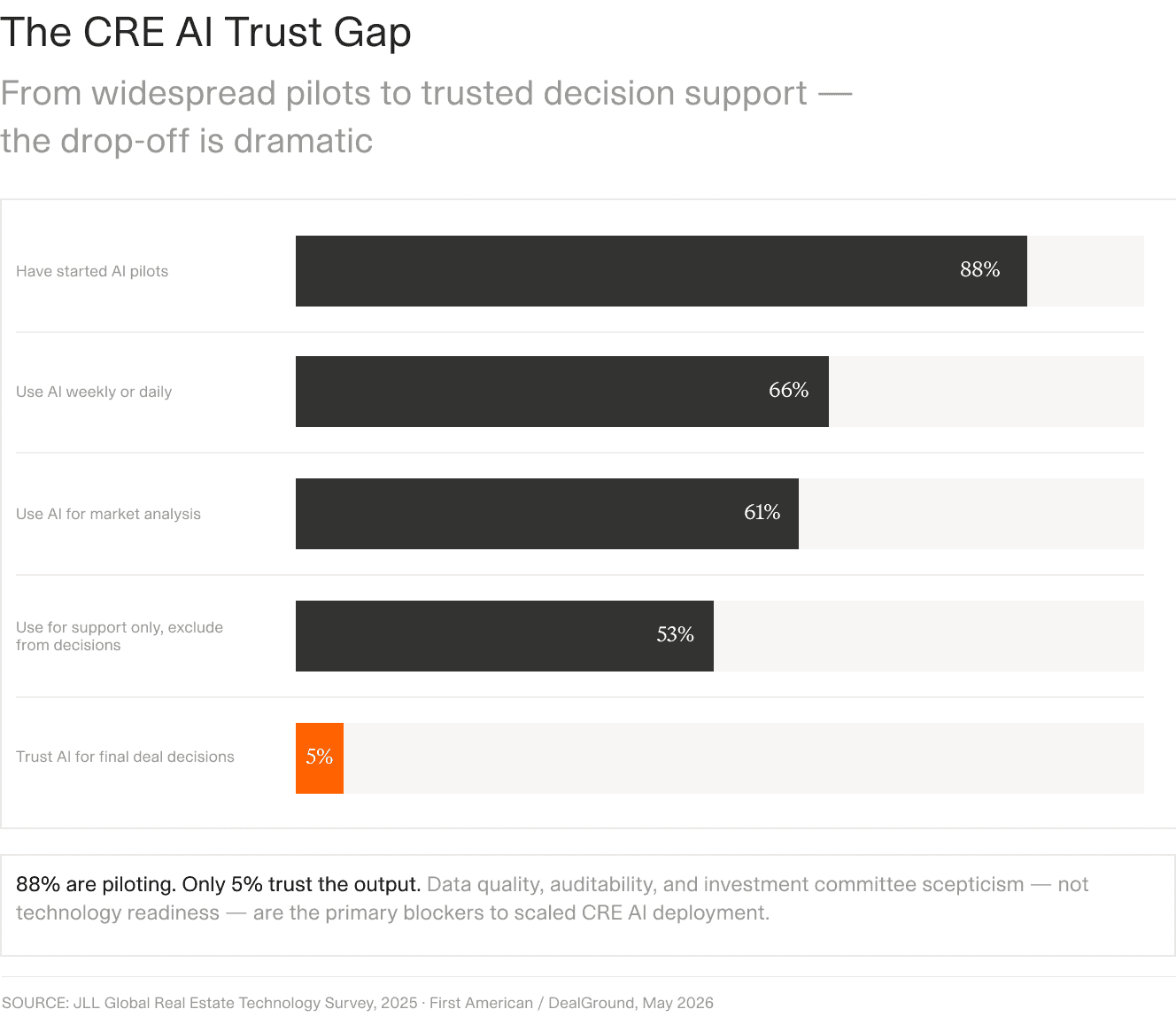
The gap in that chart is the entire commercial argument in this category. Per the JLL Global Real Estate Technology Survey and First American Data & Analytics, 88% of CRE firms have started AI pilots and 5% trust AI output for final deal decisions. The 83 points in between are not a technology problem. They are a verification problem, and tools that solve verification are the ones that make it out of pilot.
3. Model compatibility
Does it export to Excel, to ARGUS, or into the model the team already runs? Or does it require adopting a proprietary model and abandoning 15 years of accumulated assumptions? RealQuant is an Excel add-in specifically because of this. Primer maps extracted data into your existing Excel underwriting model for the same reason. Tools that require you to underwrite inside their interface have a much steeper adoption curve, and in acquisition teams the adoption curve is the product.
4. What the vendor means by "integration"
Every platform on this list claims integration with Excel, ARGUS and Yardi. The word is doing an enormous amount of work, and it covers at least four different things.
The weakest version is file export: the tool produces a CSV or XLSX that you download and paste in. That is not integration, it is a download button, and it still leaves a copy-paste step where errors enter. The next level is templated export, where the file arrives pre-shaped to match a specific model layout. Better, but it breaks the moment someone inserts a row.
Direct cell mapping is the version acquisition teams actually want. The tool writes extracted values into named cells in your workbook, so the model updates in place and the audit trail survives. RealQuant does this as an Excel add-in; Primer and AcquiOS map into an existing template. The strongest version is API output into a downstream system, which matters when extraction feeds a data warehouse or an internal deal platform rather than a spreadsheet.
Ask which of those four a vendor means. The demo will not tell you unprompted.
5. Workflow and team access
Multi-user workflows, deal-level permissions, version control, and the ability for an analyst to hand a partially reviewed extraction to an associate. Software that assumes one person underwrites one deal alone does not describe how mid-market acquisition teams work.
6. Configurability
Can the tool be configured for your chart of accounts, your expense categories, your underwriting assumptions and your output structure? Radix Underwriting standardises rent rolls and T12s against a custom chart of accounts. V7 Go lets teams build a separate agent per document type with the output schema defined by the team. The alternative is a fixed schema that fits most deals and quietly mangles the rest.
Platform | Category | Doc types | Source citations | Writes to your Excel model | Configurable schema |
|---|---|---|---|---|---|
V7 Go | Document intelligence | Broad, any asset class | Yes | Yes | Yes |
Primer | Document intelligence | CRE deal documents | Yes | Yes | Partial |
RealQuant | Document intelligence | Rent rolls, OMs | Yes, cell level | Yes, Excel add-in | Partial |
AcquiOS | Document intelligence | OM, T12, rent roll | Yes | Yes | Partial |
Cactus | Hybrid | Financials, rent rolls, OMs | Partial | No, own interface | Partial |
Radix Underwriting | DCF modeling | Multifamily rent rolls, T12s | Partial | No, own proforma | Yes, chart of accounts |
ARGUS Enterprise | DCF modeling | Structured inputs only | No | No | Yes |
Dealpath | Deal management | Storage, not extraction | No | No | Yes |











The Best CRE Underwriting Software Platforms in 2026
Twelve platforms, grouped by what they actually do. Pricing in this category is almost entirely quote-based, so where a public figure does not exist, the profile says so rather than inventing a range.
Document intelligence and data extraction tools
1. V7 Go. A document automation platform that runs configurable agents against unstructured deal documents. Teams build one agent per document type, a rent roll extraction agent, an offering memorandum summariser, a T12 normaliser, and define the output schema themselves so extracted data lands in the format the existing model expects.
Best for: acquisition teams handling non-standard document formats, or diversified firms underwriting CRE alongside other asset classes. Key features: agent configuration per document type; every extracted field traceable to its source location; Excel-compatible and API output; the same platform processes infrastructure, private credit and fund documents. Limitations: it does not model anything, so it sits upstream of ARGUS or Excel rather than replacing either, and it is not a CRE point solution, so teams wanting prebuilt multifamily proformas out of the box will need to configure them. Pricing: contact for pricing.
2. Primer (by PropRise). AI document intelligence built specifically for CRE acquisition teams. Ingests OMs, rent rolls, T12s, operating statements and Yardi and RealPage exports, and maps extracted data into an existing Excel underwriting model.
Best for: institutional acquisition teams that want extraction into their own Excel model without changing it. Key features: broad CRE document coverage; property management system export handling; Excel model mapping. Limitations: CRE-only, so it will not help a team that also underwrites other asset classes; its published comparison content is written by the vendor, which is worth remembering when reading it. Pricing: contact for pricing.
3. RealQuant. An Excel add-in that extracts data from rent rolls and offering memoranda and populates a proprietary Excel model in place. Every value it writes is cited back to its source document and page number.
Best for: mid-market teams that live in Excel and refuse to leave it. Key features: cell-level source citation; native Excel workflow with no separate interface to learn; strong multifamily document coverage. Limitations: narrower document range than the broader platforms; the Excel-add-in architecture that makes adoption easy also caps what it can do across a team. Pricing: published subscription tiers.
4. AcquiOS. Converts a broker OM, T12 and rent roll into a citation-sourced model in your own Excel template, validates assumptions against market comparables, flags conflicts between documents and drafts investment committee memos.
Best for: teams that want document extraction and comparable validation in one pass. Key features: conflict detection across documents; market comparable validation; IC memo generation. Limitations: newer entrant with a shorter deployment track record than ARGUS or Radix; memo output still needs an analyst pass before it goes to committee. Pricing: contact for pricing.
5. Clik.ai. Document automation focused on CRE lending and acquisition workflows, with rent roll and operating statement digitisation as the core product.
Best for: debt teams and lenders processing high volumes of borrower-supplied financials. Key features: rent roll and T12 digitisation; lender-oriented workflows. Limitations: equity acquisition workflows are less developed than the lending side. Pricing: contact for pricing.
6. Kolena. Document intelligence with an unusually precise account of what its extraction does and where it fails. Of the vendors publishing in this category, it draws the clearest line between OCR and structured extraction.
Best for: technical evaluators who want to understand extraction quality before buying. Limitations: less CRE-specific tooling than the point solutions. Pricing: contact for pricing.
7. Docsumo. A general document processing platform with CRE templates layered on top. Handles rent rolls and operating statements alongside invoices and contracts.
Best for: teams with document processing needs beyond CRE deal documents. Limitations: CRE templates are one vertical among many, and the depth reflects that. Pricing: published tiers.
8. SpaceQuant. AI analysis for retail and office assets, with unit mix analysis and lease abstraction.
Best for: retail and office specialists. Limitations: narrow asset-class focus; not a fit for diversified portfolios. Pricing: contact for pricing.
CRE DCF modeling platforms
9. ARGUS Enterprise. The institutional standard for property-level valuation and cash flow forecasting across office, retail and industrial. Altus Group has since built ARGUS Intelligence around it, adding a connected workflow layer and ARGUS Assist, a conversational interface inside the platform. A valuation assistant trained on 30 years of proprietary CRE data became commercially available in Q3 2026.
Best for: institutional portfolios where lenders and investors expect ARGUS output. Key features: the deepest lease-level modeling in the category; industry-standard outputs. Limitations: expensive; a genuinely steep learning curve; and it expects structured inputs, which is precisely why the document intelligence category exists. Pricing: enterprise licensing, contact for pricing.
10. Radix Underwriting. The multifamily equivalent of ARGUS. Formerly redIQ, acquired by Radix in August 2024 and rebranded through 2026. Its extraction module standardises rent rolls and T12s against a custom chart of accounts before feeding a structured multifamily proforma. Roughly 30% of all multifamily transactions pass through the platform, and it processed more than 500,000 rent rolls in 2023.
Best for: multifamily-only teams that want extraction and proforma in one system. Key features: custom chart of accounts standardisation; multifamily-specific proforma; market data from the wider Radix ecosystem. Limitations: multifamily only; you underwrite in its proforma rather than yours. Pricing: contact for pricing.
11. Cactus. An AI-native CRE underwriting platform positioned around speed. Upload financials, rent rolls and OM packages, parse them, benchmark against comparables and generate DCF analyses and investor reports inside the platform. The company reports more than 1,500 real estate professionals on the platform and claims a reduction of 92% in manual data entry.
Best for: teams willing to underwrite inside a vendor interface in exchange for speed. Key features: end-to-end parse-to-report flow; live comparable benchmarking. Limitations: you adopt its model rather than keeping yours, which is the main objection from teams with established Excel templates; a seven-person company, which matters if your procurement process weights vendor stability. Pricing: contact for pricing.
Deal management platforms
12. Dealpath. Pipeline management, document storage, task workflow and reporting for CRE investment teams. It organises the deal process around underwriting rather than performing it.
Best for: teams above roughly 30 deals a year with several people touching each one. Limitations: no extraction, no modeling; buying it to solve manual data entry is the most common mis-purchase in this category. Pricing: contact for pricing.
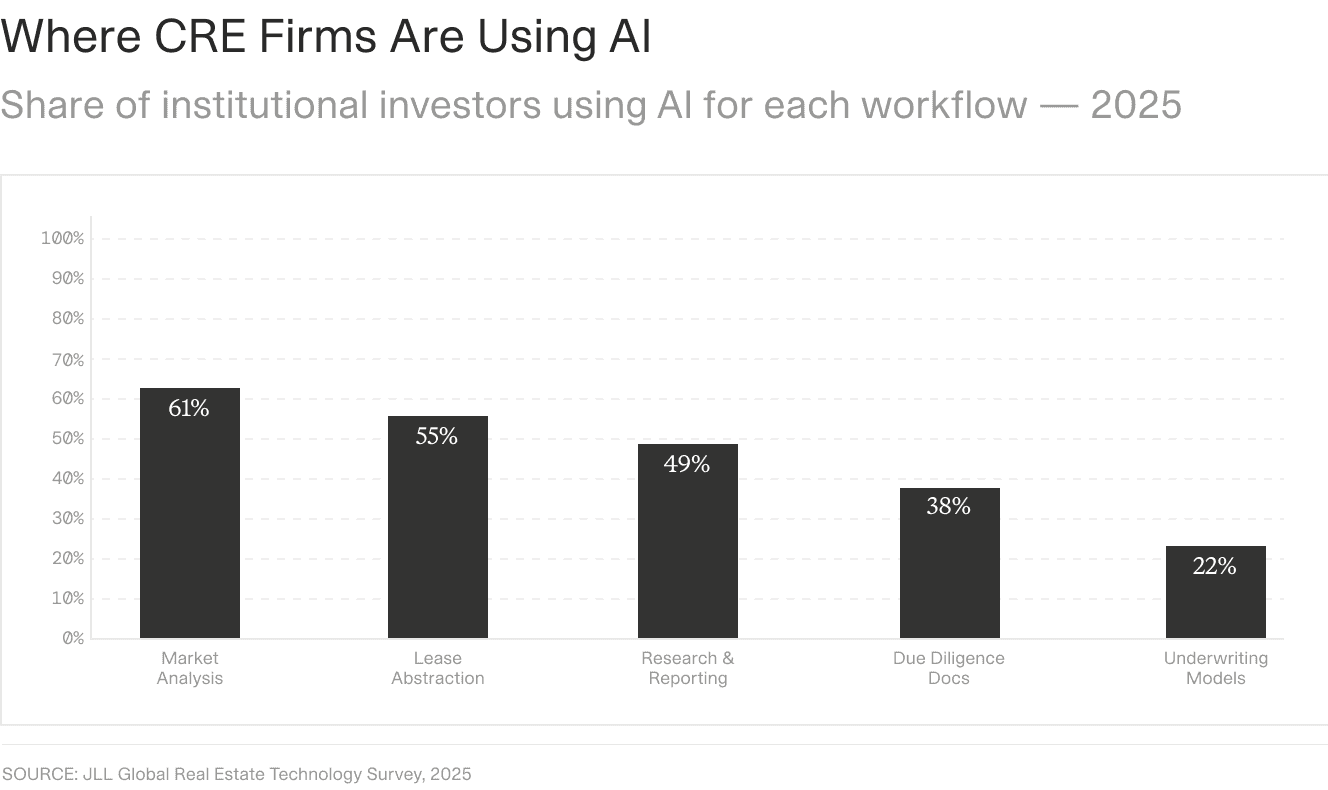
That chart is the most useful thing on this page. CRE firms have adopted AI for market analysis at 61%, according to the JLL Global Real Estate Technology Survey. For underwriting models, the figure is 22%.
So the obvious read is that underwriting is harder to automate than market analysis, and the technology is not ready.
Wrong again.
Market analysis tolerates approximate answers. If a comparable set is 90% right, the analyst adjusts and moves on. An underwriting model does not work that way: one misread in-place rent propagates through the rent roll, the NOI, the valuation and the offer. The barrier is not extraction capability. It is that a number nobody can trace back to a source document cannot be defended to an investment committee, and every experienced underwriter knows it.
What CRE Underwriting Software Costs
Almost nobody in this category publishes pricing, which makes budgeting difficult and comparison worse. What follows is the shape of the market rather than a price list, because quoted figures move and vendor-specific numbers go stale within a quarter.
Three pricing models dominate. Per-seat subscriptions are the norm for Excel add-ins and lighter extraction tools, and they scale with headcount rather than deal volume, which suits teams where two or three analysts do all the underwriting. Per-document or per-deal pricing appears in document intelligence platforms and tracks usage directly, which is honest but produces a variable bill that procurement teams dislike. Enterprise licensing is standard for ARGUS Enterprise and the larger platforms, negotiated annually, usually with a floor.
The comparison that actually matters is not between vendors. It is against the cost of the analyst hours the tool removes.
Take the figures from earlier in this article. A multifamily acquisition analysis runs 12 to 16 hours of analyst time, of which the rent roll abstraction is three to four hours and the T12 normalisation two to three. A team underwriting 60 deals a year is therefore spending somewhere between 300 and 420 analyst hours annually on extraction alone. At a fully loaded mid-market analyst cost, that is a substantial line item, and it is being spent disproportionately on deals that get killed before investment committee.
Screening volume makes the arithmetic sharper still. At 10 to 15 offering memoranda a week, four to six hours goes into manual data entry for opportunities that will not proceed. That is the cleanest possible case for automation, because nobody is defending the analytical value of retyping a rent roll for a deal the team is about to pass on.
Whether the numbers work at your deal volume is something you can calculate in about five minutes. Most teams under 20 deals a year find they cannot justify a platform and are better served by an Excel add-in. Most teams above 50 find the question answers itself.
The hidden cost nobody quotes
Implementation. A document intelligence platform configured against your document formats and your chart of accounts requires setup time from someone who understands both, and that person is usually your best analyst. Budget for it. Tools that ship with fixed schemas skip this cost and pay for it later in the deals where the schema does not fit, which is the trade the whole category turns on.
Best CRE Underwriting Software by Asset Class
Multifamily underwriting software
The work is unit mix analysis, rent roll extraction, loss-to-lease, occupancy modeling and lease abstraction. The difficulty is format variation: rent rolls arrive from AppFolio, Entrata, Yardi and RealPage, and no two use the same column labels, the same charge categories or the same tab structure.
Radix Underwriting is the deepest multifamily-specific option, with chart of accounts standardisation built for exactly this problem. RealQuant and Primer both handle multifamily documents well and write into Excel. V7 Go suits teams whose rent rolls arrive in formats the point solutions have not seen, because the extraction agent is configured against your documents rather than a fixed template. For a broader view of the operator-side tooling, see our guide to AI tools for multifamily real estate operators.
Office, retail and industrial
Here the document is the lease, and leases are long, negotiated and full of clauses that were typed by a lawyer rather than generated by a system. Base rent, commencement and expiration, renewal options, common area maintenance (CAM) recovery structures, exclusivity clauses in retail. Pure OCR fails on these because the difficulty is not reading the characters, it is understanding a negotiated term written differently in every document.
ARGUS Enterprise remains the modeling standard for institutional office and retail. SpaceQuant is retail-specific. For the extraction layer, V7 Go and Primer both handle multi-page lease documents. Our guide to AI in real estate lease abstraction covers the failure modes in more depth, and the NOI calculation walkthrough covers what happens once the lease data is out.
Mixed portfolios and cross-asset-class deals
This is where point solutions stop being viable. A firm underwriting multifamily, industrial and a private credit position in the same quarter would need three separate tools, three procurement cycles and three sets of extraction logic that do not share a schema.
V7 Go is the only platform in this comparison built for that case, because it is not a CRE product. It is a document automation platform that happens to handle rent rolls as competently as it handles credit agreements and fund reports. For diversified firms, that is the difference between one vendor relationship and four.
How AI Is Transforming CRE Document Underwriting
Deal volume rises. Acquisition teams do not. A team screening 10 to 15 offering memoranda a week spends four to six hours on manual data entry for deals that will be killed before they reach investment committee, and a full multifamily acquisition analysis runs 12 to 16 hours of analyst time before anyone argues about an assumption.
Most of that is not analysis. It is retyping.
Document intelligence is not OCR
The distinction gets glossed over in vendor copy, and it is the whole ballgame. OCR recognises characters in an image of a document. Point it at a rent roll and it will return the text on the page, accurately, in reading order, with no idea which number is in-place rent and which is market rent.
Document intelligence extracts structured data from unstructured documents. It handles a column labelled "Mkt Rent" in one file and "Market Rate" in the next, merged cells, footnotes that redefine a charge category, unit mix on one tab and charges on another, and a handwritten note in the margin that changes a lease expiry. It returns a schema, not a page.
A CRE document is close to the hardest possible case for this. It is a PDF generated by a property management system, exported by a broker, annotated by a seller and merged into a package with 40 other files, none of which agree on formatting.
Consider one concrete failure that OCR cannot solve. A rent roll lists 200 units with in-place rent in one column and market rent in another. On page four, a footnote states that units 4A through 4F are subject to a rent concession expiring in November, and the in-place figures shown for those units are pre-concession. An OCR pass returns every number on the page correctly and loses the footnote's relationship to those six rows entirely. The extraction looks clean. The effective revenue is overstated, and it stays overstated all the way through NOI into the offer price.
That is not an edge case. It is Tuesday.
Handling it requires a system that reads the footnote, understands which rows it governs and either adjusts the values or flags the conflict for a human. Adjusting silently would be worse than useless, which is why the flag matters more than the adjustment.
What V7 Go does with those documents
V7 Go is a document automation platform. It is not an underwriting tool and it does not model deals. It handles the extraction step that runs before the model, and it is built around four things that matter for CRE work.
Configurable agents per document type. A rent roll extraction agent, an offering memorandum summariser, a financial statement parser and a T12 normaliser are separate agents, each configured against the formats your deals actually arrive in, with an output schema your team defines.
Source traceability on every field. Each extracted value links back to its location in the original document. An analyst checking in-place rent for a specific unit opens the source page rather than trusting a number in a table.
Output in your format. Excel-compatible tables that match your existing model, or direct API output into downstream systems. The model does not change.
Review points inside the workflow. Extraction runs automatically; confirmation stays with the underwriter. Cross-model checks flag fields where two passes disagree, which is where the errors concentrate.
That last point is the one worth dwelling on, because it is where most AI underwriting projects go wrong. Teams that try to automate the judgment fail. Teams that automate the retyping and keep the judgment succeed, and they succeed quickly, because the retyping was never the part that required a person with a CFA.
Beyond CRE: document automation across deal types
Every other tool on this page is a CRE product. That is a reasonable choice for a firm that only underwrites CRE, and a constraint for everyone else.
A diversified investment firm processes rent rolls in one deal, a credit agreement in the next and a fund quarterly report in the one after. Those are different documents but the same problem: structured data trapped in an unstructured file. V7 Go handles all three in one platform, with the same review workflow and the same audit trail, which is why the buyers who move fastest on it tend to be firms that had already started assembling a separate point solution per asset class and stopped.
If you want to see how the same extraction workflow applies further up the deal process, our guides to AI offering memorandum review and commercial real estate due diligence cover adjacent stages, and the lease analysis product page shows the CRE workflow end to end.
What to do with this
If you underwrite multifamily only and are happy to work inside a vendor proforma, Radix Underwriting is the shortest path. If you model in Excel and will not move, RealQuant or Primer write into what you already have. If your portfolio spans asset classes, or your rent rolls keep arriving in formats that break the point solutions, the extraction layer needs to be configurable rather than templated, and that is a different category of tool.
Whatever you pick, apply one test before signing. Take the ugliest document package from your last closed deal, the one with the scanned addendum and the rent roll where somebody merged two tabs by hand. Run it through the demo. Then ask the underwriter who originally keyed it whether they would sign off on the output.
That answer is the whole evaluation.
What is the best software for commercial real estate underwriting?
There is no single best platform, because the category contains three unrelated types of software. For extracting data from rent rolls, offering memoranda and T12 statements, the leading options are V7 Go, Primer and RealQuant. For discounted cash flow modeling, ARGUS Enterprise is the institutional standard across office, retail and industrial, and Radix Underwriting holds the equivalent position in multifamily. For pipeline tracking, Dealpath is the established choice. Most acquisition teams end up running an extraction tool alongside a modeling platform rather than choosing between them. The right shortlist depends on whether your bottleneck is manual data entry, modeling capability, or deal coordination.
+
What does CRE underwriting software do?
It automates parts of the work an acquisition team performs between receiving a deal package and reaching an investment decision. Document intelligence tools read rent rolls, operating statements and offering memoranda and convert them into structured data your model can use, which removes the manual data entry stage. DCF modeling platforms take that structured data and run cash flow projections, net operating income analysis and return scenarios. Deal management systems track the pipeline, store documents and manage approvals around both. No current platform does all three well, so the practical question is which stage of your process is slowest. If analysts are losing hours to retyping rent rolls, the answer is a document intelligence tool rather than a modeling platform or a pipeline tracker.
+
Is ARGUS Enterprise still the standard for CRE underwriting?
For modeling, yes. ARGUS Enterprise remains the institutional standard for property-level valuation and cash flow forecasting across office, retail and industrial assets, and lenders and investors still expect to see its output. Altus Group has extended it with ARGUS Intelligence, a connected workflow layer, and a valuation assistant trained on 30 years of proprietary CRE data that became commercially available in Q3 2026. What has changed is the stage before modeling. ARGUS expects structured inputs, and getting deal documents into that structured form is now handled by document intelligence tools. Most sophisticated teams use both: an extraction tool to prepare the data, ARGUS to model it.
+
What is the difference between underwriting software and deal management software?
Underwriting software performs analytical work: extracting data from deal documents, or running the financial model that produces a return profile. Deal management software organises the process around that work, covering pipeline tracking, document storage, task assignment, approvals and investor reporting. Dealpath and RealINSIGHT are deal management platforms. They will not reduce the hours an analyst spends keying a rent roll into Excel, which is the most common reason teams are disappointed after buying one. If manual data entry is the bottleneck, the tool you need is a document intelligence platform, not a deal management system. The two categories are complementary rather than competing, and larger teams commonly run both alongside a modeling platform.
+
Can AI replace manual spreadsheet-based CRE underwriting?
Multifamily underwriting software handles the analysis specific to apartment assets: unit mix, in-place versus market rent, loss to lease, occupancy modeling and rent roll standardisation. The defining difficulty is format variation, because rent rolls exported from AppFolio, Entrata, Yardi and RealPage use different column labels, charge categories and tab structures for the same underlying data. Radix Underwriting, formerly redIQ, is the deepest multifamily-specific platform and standardises rent rolls against a custom chart of accounts. RealQuant and Primer write extracted multifamily data into an existing Excel model, and V7 Go suits teams whose documents arrive in formats the point solutions have not been trained on.
+
What is multifamily underwriting software?
Go is more accurate and robust than calling a model provider directly. By breaking down complex tasks into reasoning steps with Index Knowledge, Go enables LLMs to query your data more accurately than an out of the box API call. Combining this with conditional logic, which can route high sensitivity data to a human review, Go builds robustness into your AI powered workflows.
