17 min read
—



V7 Go
A smarter way to manage due diligence and underwriting
A 500-unit multifamily portfolio generates roughly 500 lease documents at acquisition, and that number grows with every renewal, amendment, and new tenancy. Add the monthly rent rolls, trailing 12-month financial statements, tenant notices, and compliance records, and a mid-sized operator is processing hundreds of documents per month before a single data point reaches Yardi or AppFolio.
Here is the part that trips up most operators: your property management software does not solve this problem. AppFolio, Yardi, Buildium, and their peers are systems of record. They store and report on structured data. They do not extract that data from the lease PDFs, rent roll spreadsheets, and T-12 statements that arrive in every format imaginable from sellers, accountants, and attorneys.
The extraction step covers reading source documents, pulling out the right fields, catching the discrepancies, and flagging the exceptions. It happens manually. An analyst abstracts each lease. A team member cross-checks rent roll figures against the underlying leases. Someone reformats the T-12 into a normalised chart of accounts before underwriting can begin. At 50 units, this is a Tuesday afternoon. At 500 units, it is a full-time job. At 5,000 units, it is a structural constraint on how fast the portfolio can grow.
AI tools now exist specifically to address this layer. They sit between source documents and the PMS, handling the extraction, verification, and normalisation work no property management platform was built to do. This is a practical guide to those tools: what they are, where they differ, and how to match the right one to your portfolio.
In this article:
Why the document processing bottleneck sits outside your PMS, and what sits inside it
What lease automation software is and how it differs from property management software
The four document automation use cases every multifamily operator encounters
A practical comparison of the tools available today
Five evaluation questions to ask before selecting a document automation tool
Why your PMS cannot solve the document extraction problem
Property management software does one thing well: it stores and reports on structured data that someone has already entered. Yardi tracks rent payments because a payment was posted. AppFolio shows lease expiration dates because someone typed them in. Buildium generates a rent roll because the unit data has been maintained. None of these systems read the source documents those data points come from.
The manual workflow at most multifamily operators looks like this. A new lease arrives as a PDF. An analyst opens it, identifies the key terms: rent amount, start and end dates, security deposit, renewal options, parking and pet addenda, and enters them into the PMS one field at a time. The rent roll is then cross-checked against source leases in a spreadsheet. When a T-12 arrives from accounting, it comes in a custom export format that does not match the underwriting chart of accounts, so someone reformats it before analysis can begin.
The extraction step is not inside your PMS. It never was.
At 50 units, one person handles it. At 500 units, you need a dedicated analyst to keep the lease register current and accurate. At 5,000 units, the volume of leases, amendments, and financial statements arriving each month exceeds what any team can reliably review without gaps or errors.
Real estate automation at this scale is an operational requirement.
The category of software designed to address this operates upstream of the PMS. Property management workflow automation tools, also called document automation platforms or, specifically for leases, lease automation software, handle the extraction layer. They read source documents, identify and extract the relevant fields, flag anomalies, and output structured data that the PMS can receive. This is not a competition with Yardi or AppFolio. It is what happens before data reaches them.
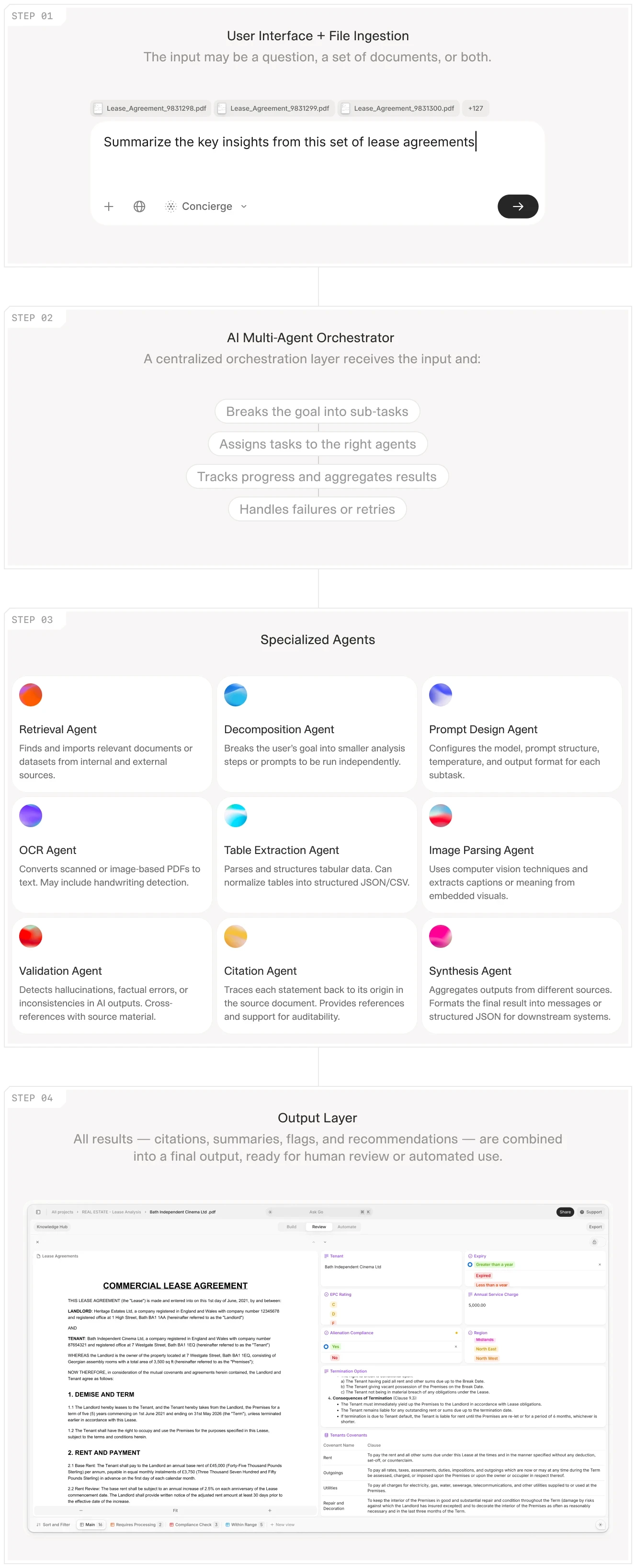
V7 Go processes lease agreements through a structured extraction pipeline — ingestion, OCR, validation, and output — so operators receive structured data rather than PDFs requiring manual abstraction.
What is lease automation software, and how is it different from your PMS?
Lease automation software uses AI to extract, standardise, and process lease data from documents automatically, replacing the manual abstraction step that currently sits between a lease PDF and your property management platform.
The core capability is document extraction: the software reads a lease, identifies key commercial terms, and outputs structured data. In multifamily, that means unit number, tenant name, lease start and end dates, monthly rent, security deposit, renewal options, pet and parking addenda, and utility responsibilities. More sophisticated tools also flag anomalies such as rents that do not match the agreed schedule, missing signatures, or unusual clause structures, before passing data downstream.
The distinction from a PMS is clean: a PMS manages tenants and payments; lease automation software processes the source documents. The two are complementary, not competing. Most lease automation tools connect to a PMS via export or API, so extracted data flows directly into the system of record without manual re-entry.
The market spans a spectrum. Narrow specialist tools handle one document type: leases only, or leases plus basic audit functions. Configurable platforms handle any document type the operator defines, which matters when the same portfolio needs lease abstraction, rent roll verification, and T-12 normalisation from a single platform rather than three separate tools.
One clarification that matters for operators researching this space: lease automation software is not lease accounting software. Lease accounting software handles ASC 842 and IFRS 16 compliance, the balance-sheet treatment of leases for corporate real estate tenants. That is an accounting function for occupiers. The tools covered in this article address operational document processing for property operators: extracting commercial terms from residential and commercial leases and routing that data into the management workflow.
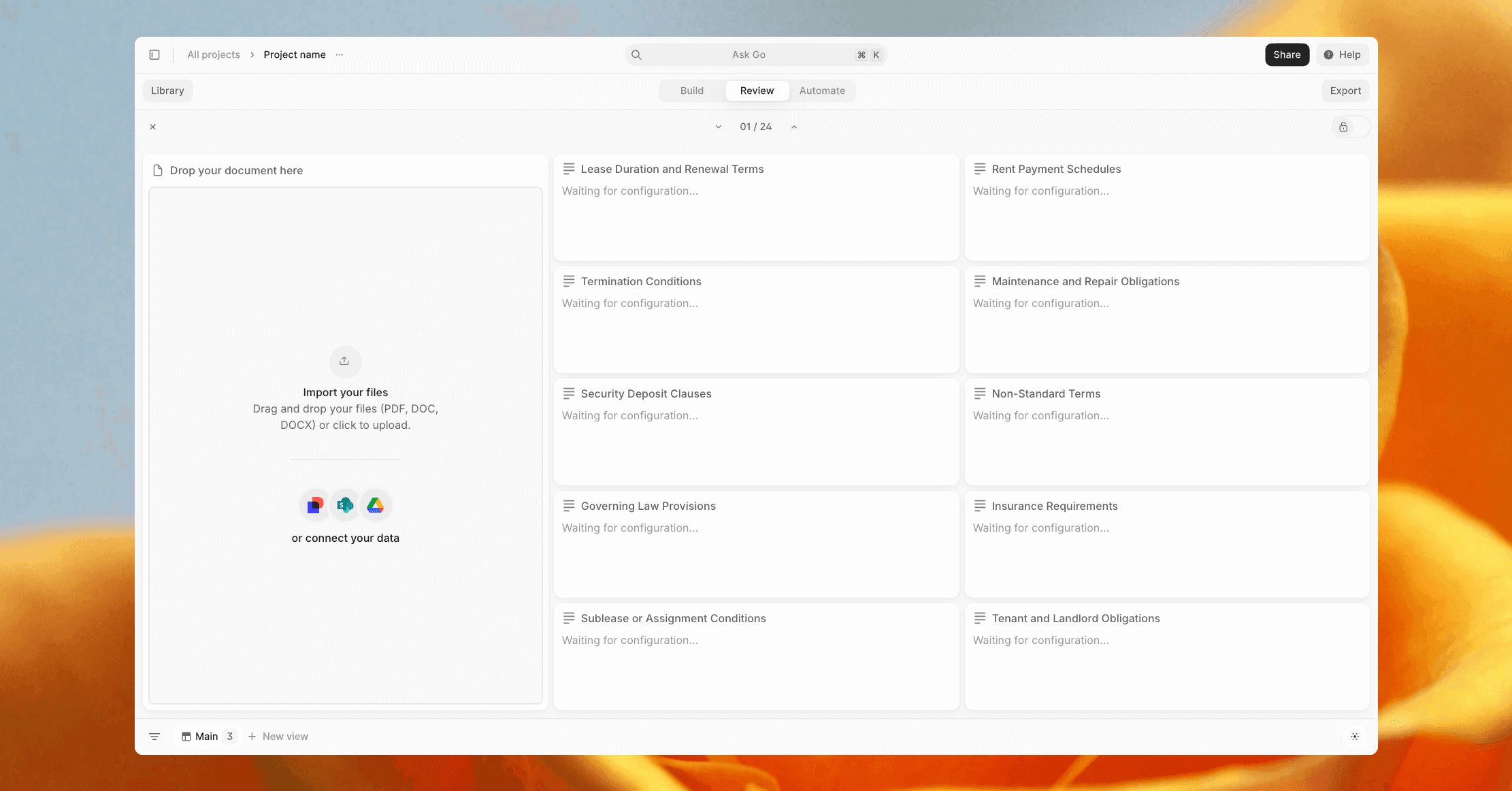
Structured lease abstraction: the source PDF on the left, the extracted and labelled fields on the right. Every field is traceable back to the clause that generated it.
Document automation use cases for multifamily operators
The document bottleneck in multifamily appears at different points across the asset lifecycle: at acquisition, during ongoing operations, and in portfolio-level financial reporting. Each context has different data requirements and different consequences for getting it wrong. Four use cases represent where most operators encounter the extraction gap most acutely.
Lease abstraction at acquisition and beyond
Abstracting a lease means extracting its key commercial terms into a structured format: unit number, tenant name, lease start and end dates, monthly rent, security deposit, renewal options, pet and parking addenda, utility responsibilities. It is standard industry language for a step that every property manager performs, manually, hundreds of times a year.
At acquisition, the volume problem is most acute. Buying a 200-unit portfolio means abstracting 200 leases. Done manually, that work takes several analyst-days and happens simultaneously with the rest of due diligence, under time pressure, with deal economics depending on accuracy. An AI-assisted approach to real estate lease abstraction processes the same volume in minutes, with exceptions flagged for human review rather than buried in a spreadsheet.
During ongoing operations, the need for accurate abstraction does not stop. Every renewal, amendment, or new tenancy requires updating the lease register. Rent escalation provisions tied to CPI adjustments need to be tracked and applied on schedule. A lease accurately abstracted at acquisition but not updated after a mid-term amendment creates discrepancies that compound over time.
Tools in this category include SurfaceAI (built specifically for multifamily lease audit and automation), Prophia (strong for complex commercial leases but less suited to residential field requirements), and configurable platforms like V7 Go's Lease Abstraction Agent, which handles any lease type and field structure the operator defines.
Rent roll verification
A rent roll is a monthly snapshot of every unit in the portfolio: tenant name, lease term, current rent, scheduled rent, vacancy status, outstanding balance. At acquisition, the seller provides a rent roll as part of the offering package. The buyer must verify every line against the actual lease documents before closing, checking that reported rent matches the lease agreement, that lease end dates are accurate, and that scheduled rent escalations are reflected correctly.
Discrepancies between a seller-provided rent roll and the underlying leases are common. Most are innocent formatting differences. Some are not. Doing this verification manually on a 100-unit portfolio takes days. AI-assisted verification cross-references rent roll figures against extracted lease terms automatically, surfacing discrepancies in a flagged exception report rather than requiring side-by-side manual comparison. RedIQ is the specialist tool in this category, purpose-built for multifamily acquisition teams. Configurable platforms like V7 Go support the same workflow across any rent roll format, which matters when dealing with sellers whose financial reporting does not use standard templates.
T-12 financial statement normalisation
The trailing 12 months, referred to throughout the industry as the T-12, is the primary operating history document in any multifamily acquisition: income and expense by line item for the previous 12 months, forming the foundation of every underwriting model.
The problem is format variability. Every seller delivers a T-12 differently. Some come as clean Excel exports from Yardi. Others arrive as PDFs from accounting software with line items that correspond to no standard chart of accounts. A fund reviewing 20 assets per quarter handles 20 different T-12 formats. Each one requires reformatting before underwriting can begin. At two to four hours per normalisation, that is 40 to 80 analyst-hours per quarter spent on work that adds no analytical value.
AI document processing reads a T-12 in any format, maps each line item to a standardised chart of accounts, and flags unusual items: below-market management fees, one-time expenses buried in recurring operating costs, income categories that obscure vacancy loss. There is no specialist T-12 normalisation tool for multifamily. This is an area where configurable document automation platforms hold a clear advantage over single-purpose products.
Tenant notice processing and tracking
For large operators, tenant notices are a compliance function. Eviction notices, rent increase notices, lease renewal offers, and maintenance request responses can number in the thousands per month across a several-thousand-unit portfolio. Missed deadlines on statutory notices, particularly around eviction procedures and rent increase requirements, create legal exposure that can cost far more than the underlying rent dispute.
AI tools in this space handle two directions. Outbound notice drafting pulls property-specific data from the lease register and populates a legally compliant template, eliminating manual data entry and reducing the risk of sending a notice with incorrect figures. Inbound notice processing extracts key data from received notices and logs them to the relevant lease record with a compliance deadline alert. This is the least mature AI category in multifamily. Most solutions require workflow configuration rather than providing a turnkey product, and for operators with complex notice requirements across multiple jurisdictions, a configurable platform is currently the most practical approach.











AI tools for multifamily real estate operators: a practical comparison
Before comparing tools, one distinction that frequently causes confusion: AI leasing agents and document automation tools are entirely separate categories. EliseAI, Knock, and their competitors are conversation platforms. They answer prospect inquiries, schedule tours, handle rent collection reminders, and manage routine tenant communication. They do not process lease documents. A multifamily operator can use both categories simultaneously because they solve different problems. The tools below process documents. They read, extract, flag, and route.
Tool | Primary use case | Document types | Multifamily-specific | Type |
|---|---|---|---|---|
SurfaceAI | Lease audit and automation | Leases | Yes, built for multifamily | Standalone product |
RedIQ | Rent roll and T-12 extraction | Rent rolls, T-12 financials | Yes, multifamily-native | Standalone product |
Prophia | Commercial lease abstraction | Commercial leases | Partial (CRE, not residential) | Standalone product |
Docsumo | Document data extraction | Any PDF or document format | No, general purpose | Configurable API |
V7 Go | Custom document workflows | Any document type | Fully configurable | Configurable platform |
SurfaceAI
SurfaceAI is built for multifamily property management teams that need lease audit and automation. The product covers lease data extraction and ongoing audit workflows: detecting rent discrepancies, tracking lease expirations, and flagging documents where data does not match what the PMS holds. For teams whose primary bottleneck is the lease layer and who want a turnkey product rather than a platform to configure, SurfaceAI is a natural fit. Its scope is narrow by design. It does not cover rent roll cross-checking, T-12 normalisation, or tenant notice processing, so teams running due diligence workflows or managing complex financial reporting will find its limits quickly. It is a small vendor with a Domain Rating of 18 as of 2025, which is worth factoring into any long-term procurement decision.
RedIQ
RedIQ is the most widely used specialist tool for multifamily acquisitions. Its core product reads rent rolls and T-12 statements, extracts the underlying data, and presents it in a standardised format that acquisition teams can use directly in underwriting. For deal due diligence, it removes the manual reformatting step that typically adds several hours per asset to the review process. Its limitation is scope: RedIQ is built for acquisitions, not ongoing asset management. Teams that need monthly rent roll verification, lease amendment processing, or notice tracking will find that the product does not extend to those workflows.
Prophia
Prophia is designed for commercial real estate: office, retail, and industrial leases with complex CAM reconciliation, co-tenancy clauses, and intricate escalation provisions. Its AI is well-calibrated for that environment. For multifamily operators, the fit is limited. Residential leases have different field requirements, including unit numbers, pet deposits, parking addenda, and utility responsibilities, that fall outside Prophia's primary model training. Operators managing a portfolio that includes commercial ground-floor retail alongside residential units might find partial use for it, but it was not designed for the multifamily context.
Docsumo
Docsumo is a general-purpose document data extraction API. It can be configured for leases, rent rolls, and financial statements by defining the fields to extract and the document types to process. The platform is more flexible than specialist tools but less turnkey. Setup requires field definition, document template configuration, and integration work to route output to the right destination. For multifamily teams with technical resources who need flexibility across document types, it is a viable option. For asset managers or acquisitions teams without a technical implementation partner, the configuration overhead is a real constraint.
V7 Go
V7 Go is a configurable document workflow platform. No code required, and it handles any document type (leases, rent rolls, T-12 statements, tenant notices) within a single platform rather than a separate tool for each. An operator defines the fields to extract, sets the exception rules, connects to existing file storage (SharePoint, Dropbox, Google Drive), and routes structured output directly to the PMS or to a review queue. The workflow runs on any format the portfolio generates.
The key distinction from specialist tools is breadth. SurfaceAI handles leases; RedIQ handles acquisition financials. V7 Go handles any document type the portfolio generates. For operators managing multiple document workflows, or for firms reviewing properties across different asset classes, a single configurable platform avoids the fragmentation of maintaining separate tools for each document type. See how intelligent document processing works end-to-end, including how extraction workflows connect to existing systems.
Five questions to evaluate document automation tools for your portfolio
The right tool depends on your portfolio stage, document mix, and whether you are buying for acquisitions or ongoing operations. Before requesting demos or evaluating pricing, answer these five questions. The answers determine which category of tool makes sense and which specific products to shortlist.
1. What is your primary document bottleneck?
Most operators face one acute bottleneck before any others. If it is lease abstraction, getting commercial terms out of lease PDFs and into the PMS, a specialist lease abstraction tool may be sufficient. If it is acquisition due diligence across rent rolls and T-12s, RedIQ is built for that context. If the bottleneck spans multiple document types, a configurable platform will serve you better than a collection of single-purpose tools that each require separate setup and maintenance.
2. Is this for acquisitions or ongoing operations?
These are different workflows with different requirements. Acquisition due diligence is episodic: high volume, high time pressure, typically 30 to 90 days, with a clear deliverable. Ongoing operations is continuous: a constant stream of renewals, amendments, notices, and monthly reconciliations. Some tools are built specifically for acquisition workflows and do not extend to ongoing operations. Confirm which context the tool was designed for before buying.
3. What PMS do you use, and does the tool connect to it?
The output of any document automation tool is only as useful as its integration with your system of record. Ask specifically: does this tool export structured data in a format your PMS can receive? Can it push extracted data directly to Yardi, AppFolio, or Buildium, or does the output require manual re-entry? A tool that produces clean extractions but requires a human to copy data into the PMS has only partially solved the problem.
4. What is your portfolio size and document complexity?
Turnkey specialist tools are typically designed for a particular scale and document structure. A 50-unit operator with straightforward gross leases has different requirements than a 3,000-unit operator managing furnished, student, and institutional residential leases across multiple markets and jurisdictions. Complexity in lease structures, particularly rent escalations tied to indices and variable lease terms, tends to expose the limits of simpler extraction tools faster than raw unit count does.
5. Do you need custom field extraction?
Standard lease abstraction tools extract a predefined set of fields. If your underwriting model, lease register, or compliance process requires fields not in the standard set, a configurable platform is the only option. Attempting to make a fixed-field tool work for non-standard requirements typically produces significant manual workaround effort that negates much of the automation benefit.
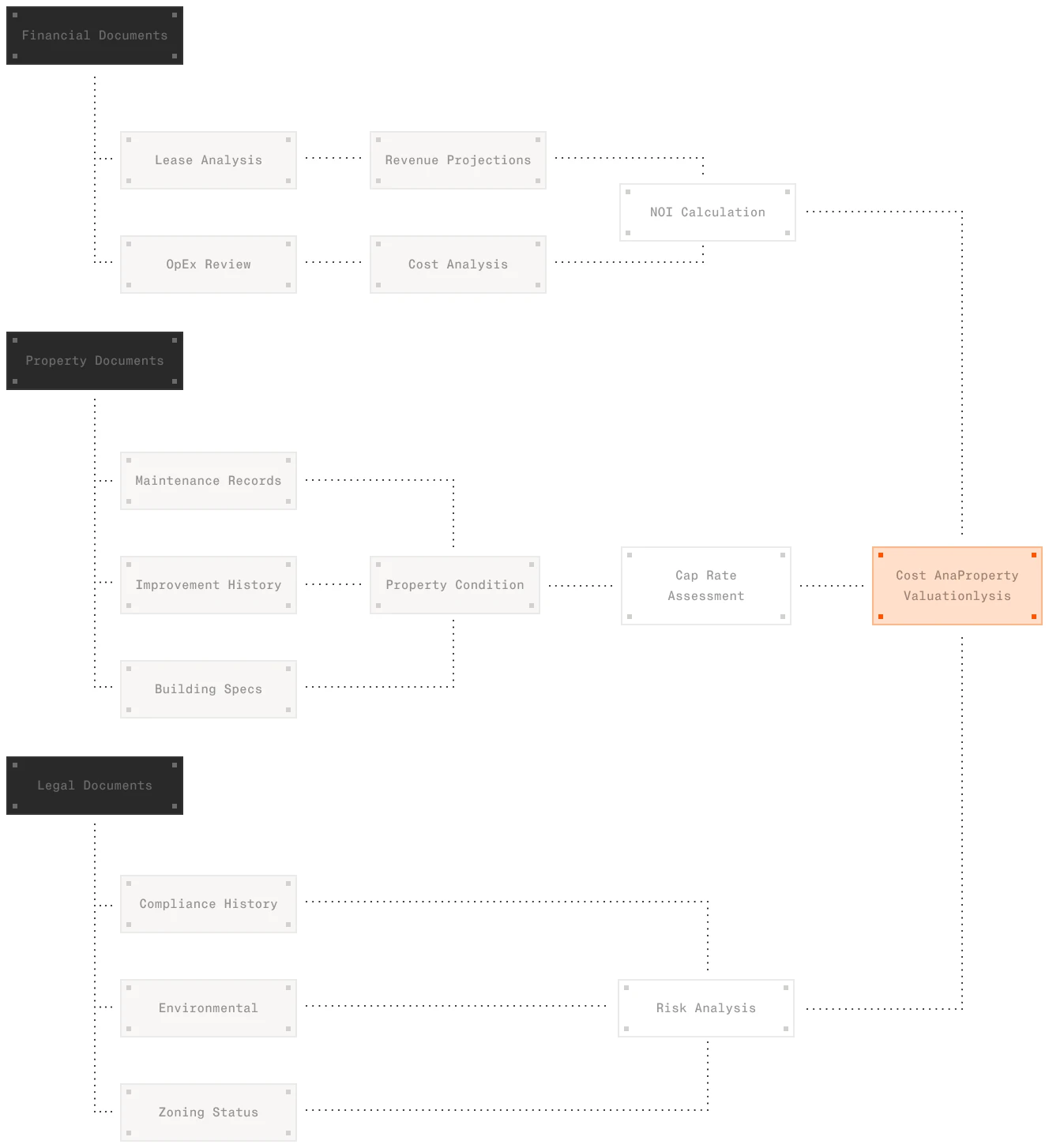
Document automation in real estate covers four parallel workflows: financial statements, lease analysis, property condition reports, and compliance reviews — all feeding into a unified data layer.
How AI changes lease operations: what moves faster and why
Manual document review does not scale. That is the central operational fact driving adoption of document automation in multifamily, not AI hype, and not a technology trend. At 1,000 units, an operator processing leases, rent rolls, and financial statements manually is running a headcount problem disguised as a document problem. The documents are not the constraint. The time required to read, extract, and verify them is.
AI changes the equation in three ways. First, parallel processing: a document workflow processes 200 leases in the time it takes an analyst to read five. Second, automatic discrepancy detection: the system cross-references extracted data against defined rules — rent against the lease agreement, end dates against the rent roll, T-12 figures against line-item detail — without a manual comparison spreadsheet. Third, standardised output regardless of input format: a T-12 from AppFolio, a T-12 from a custom accounting system, and a T-12 from a PDF printout all produce the same structured output for underwriting.
V7 Go's approach to document automation for multifamily is to provide a configurable workflow layer that sits on top of existing PMS platforms rather than replacing them. An operator configures the fields they need extracted from each document type, sets the exception rules for their specific portfolio, connects to their file storage, and defines where output should route: directly to the PMS, to a review queue, or to an Excel export for underwriting. The workflow runs on any document format the portfolio generates, and no code is required to set it up.
Specific multifamily workflows that operators have configured on V7 Go include lease abstraction with structured export to Yardi or AppFolio, rent roll cross-checking against extracted lease terms, T-12 normalisation to a standardised chart of accounts, due diligence package review for acquisitions, and tenant notice drafting from lease register data. For a broader view of how AI applies across real estate asset types, including the document categories and extraction requirements for each, see the full overview.
For operators evaluating where to start, the highest-ROI entry point is typically the acquisition workflow. The document volume is concentrated, the time pressure is acute, and the cost of errors is immediately visible. An operator who processes two to three acquisitions per year and currently spends three to four days on document normalisation per deal recovers that time in weeks.
The document processing layer is not a technology problem. It is an operational design question: where does data entry happen, who does it, and how much review is required before that data is trusted in a lease register or underwriting model?
Operators who answer that question with "we will add headcount as the portfolio grows" eventually reach a scale where the answer stops working. The structural economics of multifamily, thin margins, high document volume, and tight acquisition timelines, make the case for automation on its own terms. The question is not whether to automate the document layer, but which tool handles your specific document mix and connects to your existing stack.
V7 Go offers a no-code starting point for operators who need flexibility across document types and want to configure the workflow to their exact field requirements rather than adapting their process to a fixed-field specialist tool. See how multifamily software stacks fit together and where document automation sits in the broader technology layer.
What software do multifamily operators use to manage leases and documents?
Most multifamily operators use a property management system as their system of record: AppFolio, Yardi, Buildium, or Entrata are the most common. These platforms store and manage structured lease data once it has been entered, but they do not extract data from source documents — lease PDFs, rent roll spreadsheets, or T-12 statements. For that extraction layer, operators use specialist tools like SurfaceAI or RedIQ for specific document types, or configurable platforms like V7 Go for portfolios with mixed document workflows. The most common setup: a PMS for records and reporting, plus a document automation tool for the extraction layer.
+
Is lease automation software different from property management software?
Yes. These are different categories that address different parts of the lease workflow. Property management software, such as Yardi, AppFolio, and Buildium, is a system of record. It stores tenant data, tracks rent payments, generates reports, and manages maintenance workflows. It assumes data has already been entered. Lease automation software sits upstream of the property management system. It reads source documents, including lease PDFs, amendments, and addenda, extracts the relevant commercial terms, and outputs structured data for the PMS to receive. The two tools are complementary: lease automation software handles the extraction and the PMS handles the record-keeping and reporting. Lease automation software is also distinct from lease accounting software, which handles the financial reporting treatment of leases under ASC 842 and IFRS 16 for corporate occupiers rather than the operational processing of lease documents for property operators.
+
How does AI help with rent roll analysis in multifamily?
AI helps with rent roll analysis in two distinct ways. At acquisition, AI tools cross-reference a seller-provided rent roll against extracted lease documents automatically, checking that reported rent figures match actual lease agreements, that lease end dates are accurate, and that any scheduled rent escalations are reflected correctly. Discrepancies that would take an analyst hours to find manually appear in a flagged exception report within minutes. During ongoing operations, AI tools reconcile monthly rent roll data against the lease register, detecting cases where rent escalations have not been applied, where concessions are no longer reflected, or where occupancy figures have drifted from actual lease data. The result is a maintained, accurate rent roll rather than one that accumulates discrepancies between manual review cycles. RedIQ is the primary specialist tool for acquisition rent roll analysis. Configurable platforms like V7 Go support both acquisition and ongoing operational workflows.
+
What is lease abstraction and can it be automated?
Lease abstraction is the process of reading a lease document and extracting its key commercial terms into a structured format: unit number, tenant name, lease start and end dates, monthly rent, security deposit, renewal options, pet and parking addenda, and utility responsibilities. It is standard industry language for a step that property managers and acquisition analysts perform manually every time a new lease is signed, renewed, or amended. Yes, it can be automated. AI document extraction tools read the source lease PDF, identify each relevant field, and output structured data, typically to a spreadsheet or directly to a property management system, with exceptions flagged for human review. Accuracy depends on the quality of the AI model, the variability of the lease format, and how clearly the extraction rules have been defined. For standard residential leases, AI abstraction tools achieve high accuracy with minimal human review. For leases with unusual clause structures or non-standard addenda, some human verification of flagged exceptions remains appropriate.
+
How can multifamily operators use AI without replacing their existing PMS?
AI leasing agents and document automation tools are entirely separate categories that serve different functions. AI leasing agents, such as EliseAI or Knock, are conversation platforms. They handle prospect inquiries through chat or email, schedule tours, collect application information, and manage routine tenant communication. Their function is relationship-facing: they interact with prospective and current tenants on behalf of the property. Document automation tools, including lease abstraction software, rent roll verification tools, and T-12 processors, are data-facing. They read internal documents, extract structured data, and route that data to the appropriate system. An operator could use an AI leasing agent to handle prospect communication and V7 Go to process lease documents simultaneously. The two tools do not overlap. The confusion arises because both categories use AI and both touch the leasing process. The distinction is what they process: AI leasing agents process conversations, document automation tools process documents.
+
What is the difference between AI leasing agents and document automation tools?
Go is more accurate and robust than calling a model provider directly. By breaking down complex tasks into reasoning steps with Index Knowledge, Go enables LLMs to query your data more accurately than an out of the box API call. Combining this with conditional logic, which can route high sensitivity data to a human review, Go builds robustness into your AI powered workflows.
+
Casimir is a seasoned tech journalist and content creator specializing in AI implementation and new technologies. His expertise lies in LLM orchestration, chatbots, generative AI applications, and computer vision.