12 min read
—



V7 Go
A smarter way to manage due diligence and underwriting
Every input a real estate DCF model needs already exists, and almost none of it is in a form you can use. The rent roll, the trailing operating statement, the lease expiry schedule, the broker's market comps: all of it sits somewhere inside a thirty to eighty page offering memorandum, in tables that do not add up the same way twice and assumptions the seller would rather you did not check too closely. Building the model is the fast part. Getting the numbers out of the document is where a CRE acquisitions analyst loses an afternoon per deal.
Discounted cash flow is the most widely used valuation method in commercial real estate and the most data-hungry. A cap rate needs one number and a price. A real estate DCF model needs a decade of projected cash flows, a discount rate, a terminal value, and a defensible view on every assumption underneath them, and the quality of the output depends entirely on the quality of inputs that a person has to find, transcribe, and sanity-check by hand. That manual extraction is the bottleneck, and it is the part AI has started to remove.
This guide does two things. First it explains how DCF analysis actually works in real estate, from the components of the model to the step-by-step method and the cap-rate confusion that trips up half the people who use it. Then it shows where the inputs come from, why the offering memorandum is both the source and the problem, and how AI extraction changes the workflow. If you already build DCF models in your sleep, skip to where the inputs come from. Our guide to AI in commercial real estate investment sets the wider context, and our roundup of software for real estate investors covers the broader tooling.
In this article:
What discounted cash flow analysis is, and when a cap rate is enough instead.
The components of a real estate DCF model, and the method step by step.
Where the inputs come from: the offering memorandum, mapped to each DCF field.
How AI extracts and validates those inputs, and what it flags.
What discounted cash flow analysis is in real estate
Discounted cash flow (DCF) analysis values a property by projecting its future cash flows over a holding period and discounting them back to what they are worth today, using a required rate of return. It answers one question: given what this asset will earn over the years you hold it, and given the return you need, what should you pay for it now? The output is three related figures, present value (PV), net present value (NPV), and the internal rate of return (IRR), and together they tell an investor whether a deal clears their bar at the asking price.
DCF earns its place when cash flows move. A value-add repositioning, a lease-up, a development, anything where income in year one looks nothing like income in year seven, is exactly what the method is built for. But it is not always the right tool, and pretending otherwise is how junior analysts waste a day. For a stabilised asset with steady income and plenty of recent sales comps, a cap rate gives you the answer in a line, and a full DCF adds precision nobody is paying for. The honest rule is that DCF is for uncertainty; when there is little, reach for the simpler tool.
DCF versus cap rate: when to use each
The two get confused constantly, so it is worth being precise. A capitalisation (cap) rate is net operating income divided by price, a single-period snapshot that tells you today's value for an income stream assumed to be stable. A discount rate is an investor's required return, applied across many periods and adjusted for risk. Put simply, the cap rate tells you what a property is worth today; the DCF tells you what today's value should be given what the property will do over time. They are not rivals. In fact the DCF depends on a cap rate to finish: the exit, or terminal, cap rate is what converts the final year's income into a sale value. And while the discount rate is the return you require going in, the IRR is the return the deal actually delivers, the rate that makes NPV zero, which is why the two are related but not the same.
The core components of a real estate DCF model
A DCF model is only ever as good as four inputs, and most disagreements between two buyers on the same building come down to different views on one of them. The mechanics are standard; the judgement is not.
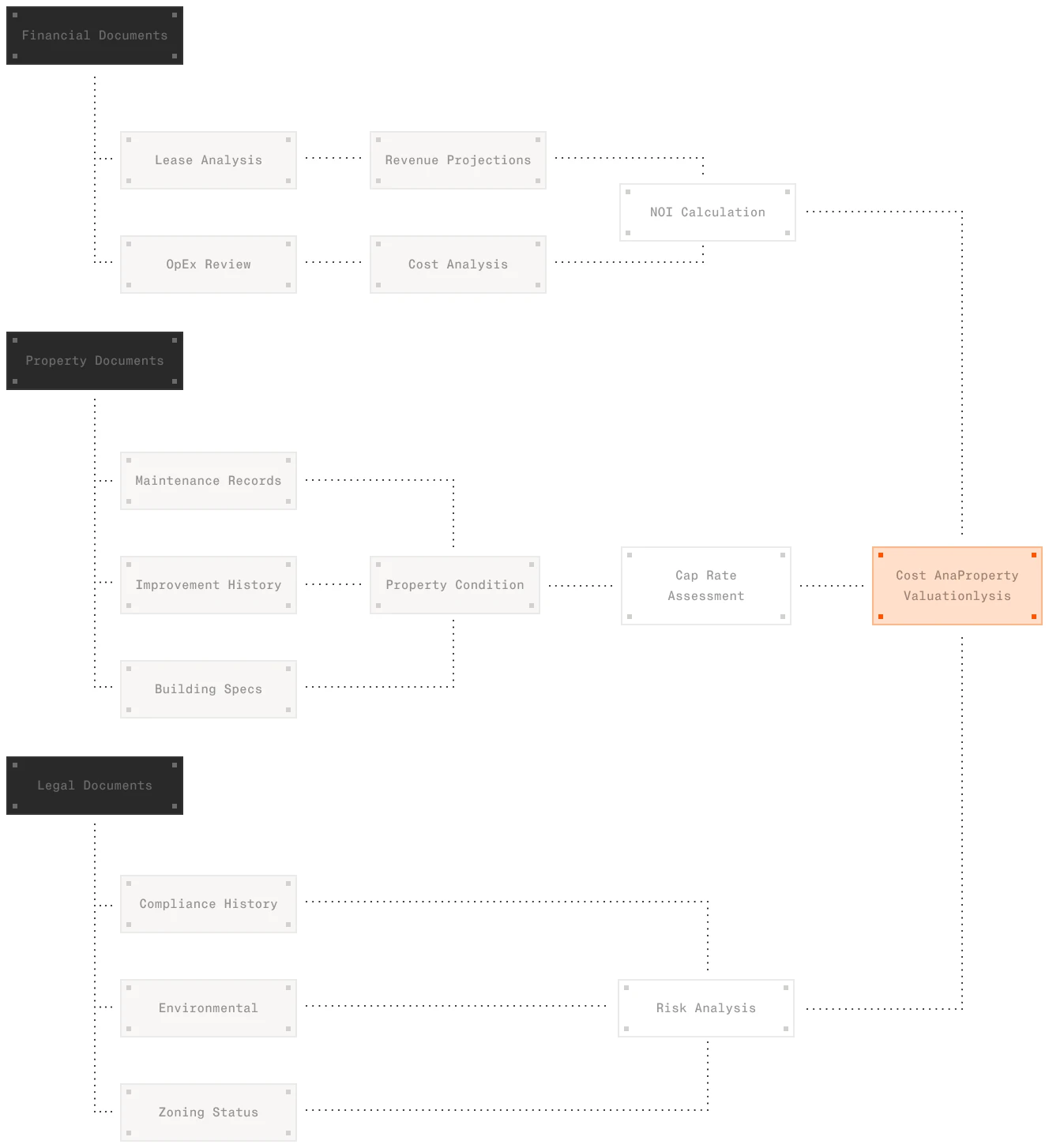
A DCF sits at the end of a chain of real estate documents. The model is the visible part; the inputs come from the leases, statements, and comps behind it.
Projected cash flows and the holding period
The heart of the model is a year-by-year forecast of net operating income (NOI), revenue less operating expenses, across a holding period that in commercial real estate usually runs five to fifteen years. An unlevered model works from NOI less capital expenditure; a levered one also deducts debt service to show the return to equity, and most practitioners run levered while appraisers tend to work unlevered. These projected cash flows are the most assumption-heavy part of the whole exercise, which is precisely why two credible analysts can look at the same rent roll and build models that value the asset millions apart.
The discount rate
The discount rate converts those future cash flows into present value, and in real estate investment analysis it is usually set to the investor's target IRR rather than a formal cost of capital. This is where DCF and corporate finance part ways: in a corporate model the discount rate is often the weighted average cost of capital (WACC), but a real estate investor more often uses the equity return they require given the asset's risk. The rate is adjusted for asset class, market conditions, leverage, and the interest-rate environment, and the mechanism is unforgiving. A higher discount rate produces a lower present value, which is the arithmetic behind the valuation compression that followed rising rates after 2022.
Terminal value and the exit cap rate
Most of a DCF's value often sits in a single assumption made about a year a decade away. Terminal value is the projected sale price at the end of the hold, and it is calculated by dividing the final year's NOI by an exit capitalisation rate: Terminal Value = Year N NOI divided by the exit cap rate. If year five NOI is 500,000 dollars and the exit cap rate is 5.5%, the terminal value is roughly 9.09 million dollars, and a shift of half a point in that rate moves the number by close to a million. Exit cap rates are usually set a little above the going-in rate, often twenty-five to fifty basis points, to reflect an older asset and an unknown future market, and an offering memorandum that assumes an exit cap rate below its going-in rate is flying an optimistic flag worth checking. The income approach behind all of this is the same one that professional appraisers, through bodies such as the Appraisal Institute, have formalised for decades.











Where DCF inputs come from: the offering memorandum
Every input a DCF model needs traces back to the offering memorandum (OM), the seller's marketing document for the asset, and that single fact is the source of most of the pain. The OM carries the projected financials, the rent roll, the operating statement, the market context, and the lease schedules, which is to say it carries the whole model in raw form. The catch is that it carries them as prose and tables across dozens of pages, written to sell, and turning them into clean, validated inputs is slow, manual, and easy to get wrong.
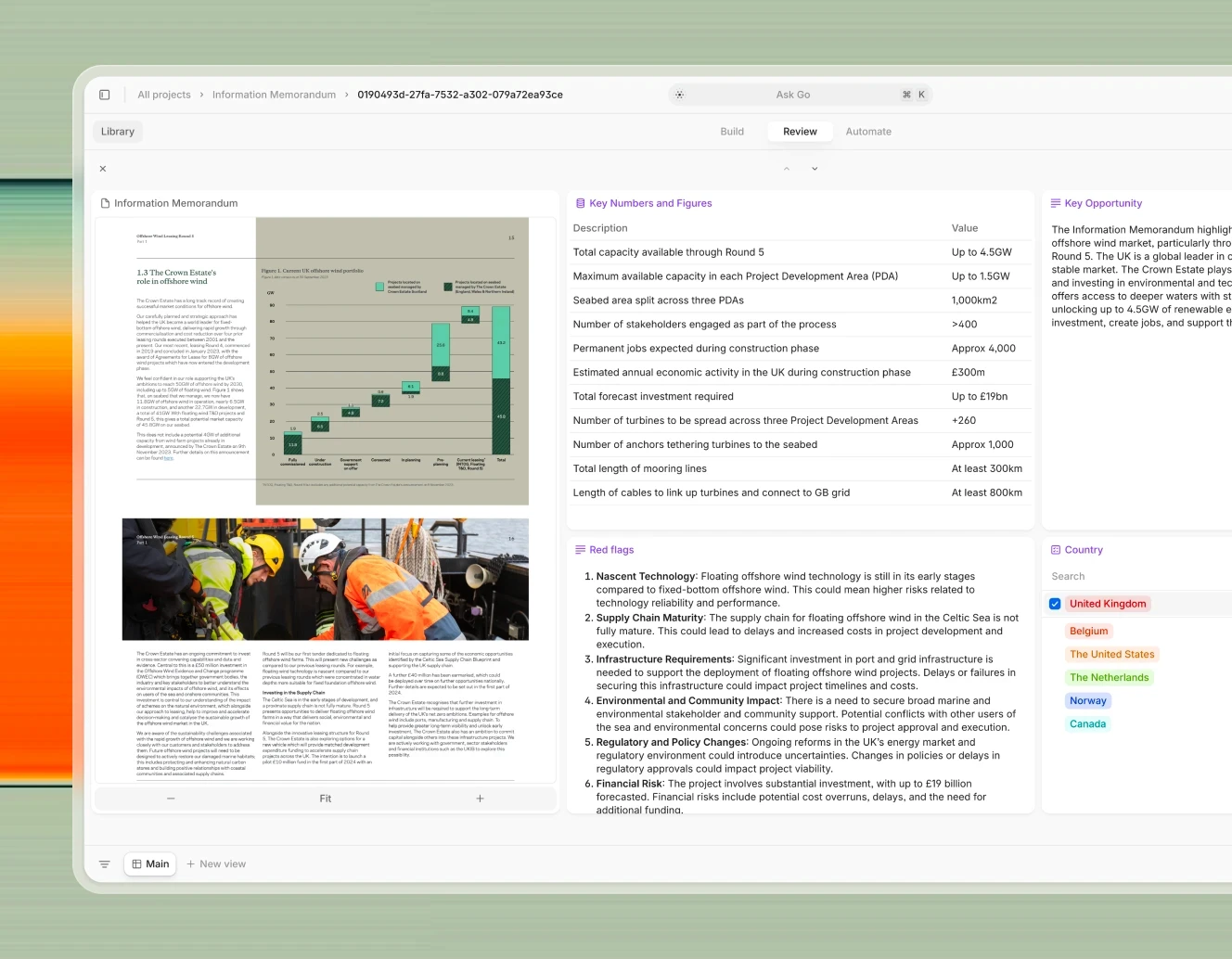
The offering memorandum is where the deal is sold and where every DCF input is buried. Reading it well is the difference between a model built on the seller's assumptions and one built on tested ones.
It helps to map the document to the model directly, because the connection is what no educational guide spells out.
Offering memorandum section | DCF input | What to extract |
|---|---|---|
Trailing 12-month operating statement (T-12) | Stabilised NOI | Twelve months of income and expense detail |
Rent roll | Projected income and vacancy | In-place rents, lease expiry dates, current vacancy |
Lease schedules | Cash flow timing | Rent commencement dates and tenant improvement allowances |
Broker market comps | Exit cap rate | Comparable transaction cap rates for terminal value |
Operating expense detail | Expense growth | Taxes, insurance, management fees, maintenance |
Seller's pro forma | Rent growth assumptions | Projected growth, to test against market benchmarks |
The reason this matters beyond convenience is that offering memoranda are internally inconsistent more often than anyone admits. A stated cap rate that does not reconcile with the stated NOI and asking price is common, and it is caught only when an analyst reads the whole document carefully enough to notice, which under a deal deadline does not always happen.
How to perform a real estate DCF analysis
With the inputs in hand, the method itself is a fixed sequence, and the discipline is in the assumptions rather than the arithmetic. There are five core steps, plus the scenario work that separates a screen from an underwrite.
First, forecast the projected cash flows: build the year-by-year NOI and expense schedule from the T-12 and rent roll. Second, set the discount rate, aligned to your target IRR and adjusted for the asset and the market. Third, determine terminal value by applying an exit cap rate to the final year's NOI, and validate that rate against submarket comps rather than accepting the OM's. Fourth, discount every cash flow, including the terminal value, back to present value at the discount rate. Fifth, calculate NPV and IRR: NPV tells you whether the deal beats your required return at the asking price, and IRR tells you the return you would actually earn. Then, and this is where good analysts spend their time, build base, upside, and downside scenarios by flexing vacancy, rent growth, and the exit cap rate, because a single-point DCF is a guess wearing a suit.
Excel note: use the built-in functions to do the discounting, but mind the timing. The NPV function discounts from period one, so the period-zero outlay, the initial investment, is added outside the function, not inside it; the IRR function then takes the full cash-flow series including that period-zero figure. Getting this wrong is the single most common error in a home-built model.
How AI extracts DCF inputs from offering memoranda
AI does not build the DCF for you, and it should not; it takes the two to four hours of manual extraction that sit in front of the model and turns them into minutes of review. An active acquisitions team sees twenty to fifty offering memoranda a month, each thirty to eighty pages, and at a few hours of extraction apiece that is the better part of a full-time analyst spent transcribing tables rather than underwriting deals. That is the work worth automating, because none of it is the judgement the analyst is paid for.
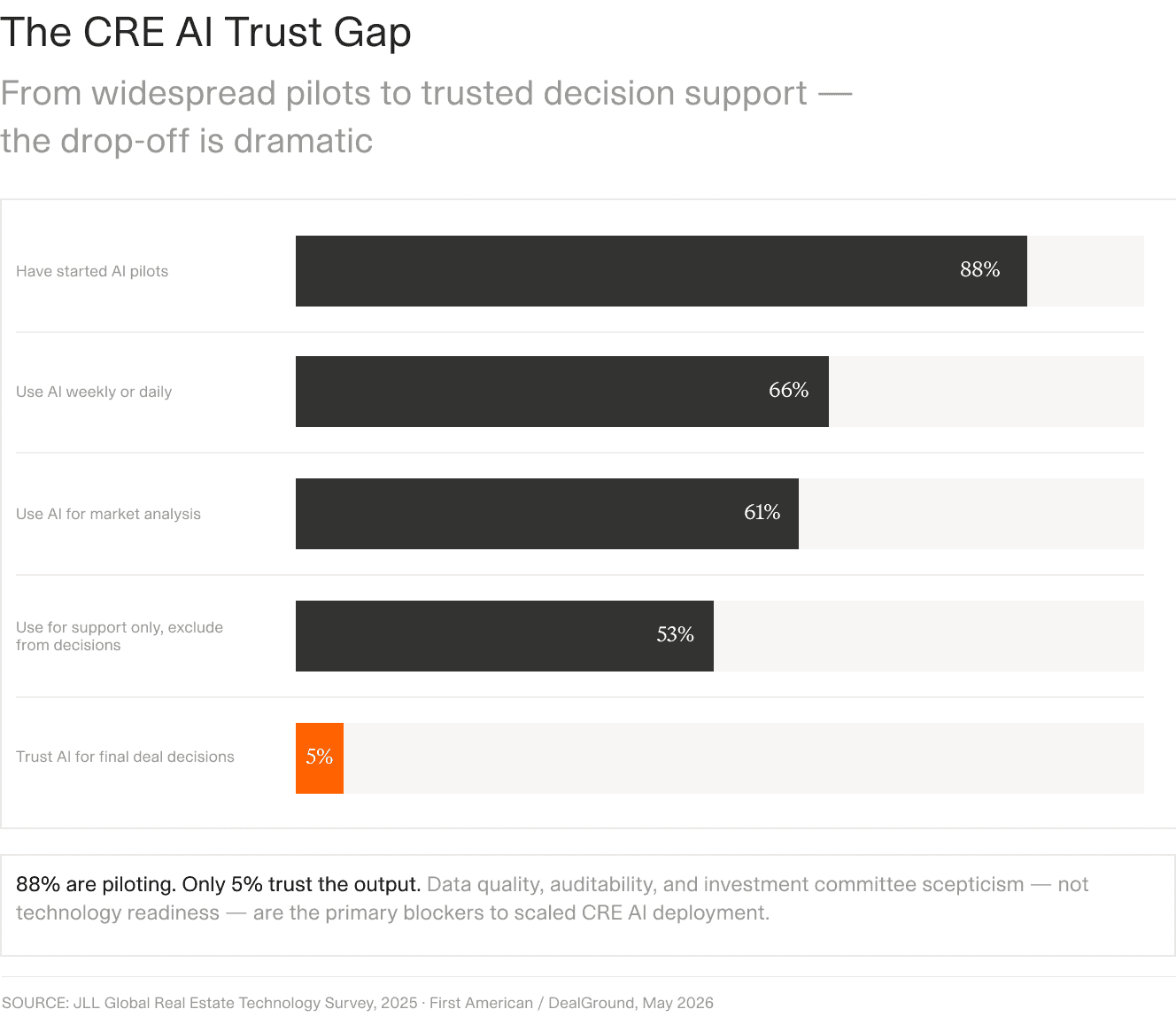
The gap this chart shows is exactly why extraction has to come with a citation. Investors already use AI for market analysis at scale; almost none of them trust it enough to decide on. Source: JLL Global Real Estate Technology Survey, 2025; First American / DealGround, May 2026.
The workflow is specific. The OM goes in as a PDF, a scan, or a forwarded broker email. The system extracts the financial tables that matter, the T-12 line items, the rent roll by tenant, the lease expiry schedule, the capital expenditure detail, and maps them to the DCF inputs they feed. It checks the document against itself, flagging where the stated cap rate, NOI, and asking price do not reconcile. And it compares the OM's assumptions against market benchmarks: vacancy against submarket averages, rent growth against the historical trend, the exit cap rate against recent comparable transactions. Crucially, it extracts and flags for an analyst to review rather than deciding anything; the human still validates every number, but starts from a checked draft instead of a blank sheet.

The first two steps of this manual chain, data collection and extraction, are the ones that consume the hours. They are also the ones AI removes, leaving the analysis and the judgement to the analyst.
The red flags are where the value lands, because they are the assumptions a seller has an incentive to bury: vacancy set below the submarket's own history, rent growth projected above the five-year trend, an exit cap rate held below the going-in rate with no market justification, and a loss-to-lease story where in-place rents sit well below market and the whole projection leans on turning that gap into growth. An analyst catches these on a careful read; the point of AI is that the careful read happens on every deal, rather than the subset there was time for. This is the workflow behind V7's offering memorandum analysis agent, and it sits alongside the broader AI offering memorandum review and the document work in our guide to the best AI tools for real estate.
The value compounds across deals too. Run enough offering memoranda through the same workflow and the extracted rent rolls, T-12s, and market comps accumulate into a Context Graph, a relationship graph connecting submarkets, deal terms, and the assumptions sellers have made across every OM the team has reviewed. Ask what exit cap rate comparable properties in a submarket have actually cleared at over the last two years, or how many recent OMs projected rent growth above the trailing five-year average, and the answer comes back grounded in the specific memoranda it was pulled from, not a benchmark an analyst half remembers from a deal last spring. That is what turns validating against market benchmarks from a manual lookup into a standing view the whole team shares.
The uncomfortable truth about a DCF is that its precision is mostly theatre if the inputs behind it went unchecked. A model to two decimal places built on an exit cap rate copied straight from the OM and a rent-growth figure nobody benchmarked is not analysis, it is transcription with a discount rate applied. The value in a DCF was never the arithmetic. It is in whether the assumptions survive scrutiny.
Which is why the input work matters more than the model work, and why it is the input work worth changing. Extract the numbers reliably, flag the assumptions that fight the market, and the analyst's time moves from finding and typing figures to the judgement that actually prices risk. Start with the deals you screen most, prove the extraction on a month of real offering memoranda, and widen from there.
If you want to see DCF inputs pulled and validated from your own offering memoranda, V7 runs a working session built around your documents and your model template. That is the concrete next step, and it takes about as long as underwriting a single deal by hand.
What is a DCF for real estate?
A discounted cash flow, or DCF, analysis for real estate is a valuation method that estimates what a property is worth today by projecting its future cash flows over a holding period and discounting them back to their present value using a required rate of return. In practice, an analyst forecasts the property's net operating income year by year, decides on a discount rate that reflects the return they need for the risk, estimates a sale value at the end of the hold, and then converts all of those future amounts into today's money. The results are the present value, the net present value, and the internal rate of return, which together tell an investor whether a deal meets their return requirements at the asking price. DCF is most useful for assets whose income changes over time, such as value-add or development deals, where a simple cap rate would miss the shape of the cash flows. For a stabilised property with steady income, a cap rate is often sufficient on its own.
+
What are the five steps of a DCF?
A real estate DCF follows five core steps. First, forecast the projected cash flows: build a year-by-year schedule of net operating income and expenses across the holding period, using the trailing operating statement and rent roll as the starting point. Second, set the discount rate, which in real estate is usually aligned with the investor's target internal rate of return and adjusted for the asset class and market conditions. Third, determine the terminal value by applying an exit cap rate to the final year's net operating income, which estimates the sale price at the end of the hold. Fourth, discount every cash flow, including the terminal value, back to its present value at the discount rate. Fifth, calculate the net present value and internal rate of return to judge whether the investment clears your required return at the asking price. Most analysts then add a sixth step in practice, building upside and downside scenarios by flexing the key assumptions to stress-test the deal.
+
What is the difference between WACC and DCF?
DCF and WACC are not alternatives; one is a method and the other is an input to it. A discounted cash flow analysis is the valuation method itself, the process of projecting future cash flows and discounting them to present value. The weighted average cost of capital, or WACC, is one possible discount rate that can be used within a DCF, representing the blended cost of a company's debt and equity financing. In corporate finance, WACC is the standard discount rate applied in a DCF. In real estate investment analysis, however, investors more commonly use their target internal rate of return as the discount rate rather than WACC, because they are pricing the equity return they require for a specific property's risk rather than valuing a whole company's capital structure. So the honest answer is that WACC is a way of choosing the discount rate, and DCF is what you do with whatever discount rate you choose.
+
Is DCF or cap rate better for valuing real estate?
Neither is better in the abstract; they answer different questions and the right choice depends on the asset. A cap rate, net operating income divided by price, gives a fast, single-period estimate of value and works well for stabilised assets with predictable income and plenty of recent comparable sales. A discounted cash flow analysis projects income across many years and discounts it, which is what you need when cash flows change over time: value-add repositioning, lease-up, development, or complex financing where a single snapshot would mislead. The two are also linked rather than opposed, because a DCF uses an exit cap rate to estimate the sale value at the end of the hold. In practice, most commercial real estate professionals use both: a cap rate for quick screening to decide whether a deal is worth a closer look, and a full DCF for the underwriting that supports an actual offer. Using a DCF on a simple stabilised asset adds precision no one is paying for, and using only a cap rate on a value-add deal hides the risk in the projections.
+
How does AI help with real estate DCF analysis?
The exit cap rate is used to estimate a property's sale value at the end of the holding period, which is the terminal value in a DCF. The calculation is simple: divide the projected net operating income in the final year of the hold by the exit capitalisation rate, and the result is the assumed sale price. Because that terminal value is often the single largest cash flow in the model, the exit cap rate is one of the most influential assumptions in the whole analysis, and a change of even a quarter or half a percentage point can move the valuation substantially. Exit cap rates are usually set somewhat higher than the going-in cap rate, often by twenty-five to fifty basis points, to account for the asset being older at sale and for uncertainty about future market conditions. An offering memorandum that assumes an exit cap rate at or below the going-in rate is making an optimistic bet that the market will be at least as strong on exit as on entry, which is exactly the kind of assumption worth validating against current submarket data before relying on it.
+
How is the exit cap rate used in a DCF?
Go is more accurate and robust than calling a model provider directly. By breaking down complex tasks into reasoning steps with Index Knowledge, Go enables LLMs to query your data more accurately than an out of the box API call. Combining this with conditional logic, which can route high sensitivity data to a human review, Go builds robustness into your AI powered workflows.
+
Casimir is a seasoned tech journalist and content creator specializing in AI implementation and new technologies. His expertise lies in LLM orchestration, chatbots, generative AI applications, and computer vision.