17 min read
—


Date the roll against the T-12 and AR aging, test each suite against its lease, amendments and estoppel, and hand underwriting a versioned tenant record with every variance priced and sourced.

Casimir Rajnerowicz
Content Creator
V7 Go
A smarter way to manage due diligence and underwriting
The seller's rent roll for a 14-suite suburban office building puts contract rent at $116,527.50 a month. The property manager's August AR aging shows $94,087.50 billed to the same tenants for the same month. The $22,440 gap is 19% of the roll. Either one document is wrong or a third document explains the difference. The building and every figure here are hypothetical.
Rent roll analysis on an acquisition decides which, suite by suite, before anyone prices the rent. The roll is dated August 16 and the T-12 runs to September 30, 45 days later. The LOI review with your VP is tomorrow at nine, and $1.40 million of annual rent sits behind the price you will recommend.
The roll is a statement the seller signed, so it gets tested like any other representation. Test it against the documents that can contradict it, in order of authority. The lease and its amendments say what the tenant agreed to pay. The estoppel says what the tenant believes it owes. The AR aging shows what the manager billed, and the T-12 shows what the books recorded. By morning you need figures you can defend, written questions for the seller and a first version of the tenant record.
How to analyze a rent roll when the roll, the AR aging and the T-12 carry three different dates
Three cut-offs create gaps that look like errors and are sometimes only timing. Put the dates in a table before comparing any rent.
Date | Document | Covers | Gap risk | Request tonight |
|---|---|---|---|---|
Aug 16, 2026 | Seller rent roll | Leases and rent on one day | Changes signed after the 16th | Seller’s list of lease changes since August 16 |
Aug 1-31, 2026 | AR aging | Charges, receipts and balances by tenant | Mid-month moves, late credits | Tenant ledgers for August and September |
Sep 30, 2026 | T-12 cut-off | Income, Oct 2025 to Sep 2026 | 45 days the roll cannot see | Rental income ledger detail, August and September |
Oct 15, 2026 | LOI review | Price recommendation | Roll is 60 days old | Updated roll, if the manager has one |
A move-out or a rent relief letter between August 17 and September 30 reaches the T-12 and the September ledger. It never reaches the roll. The ledger and lease-change requests in the last column close that window before the morning meeting.
Lenders treat the roll as a signed claim. In agency multifamily lending, Fannie Mae’s Form 4243, Certification to Project Rent Roll, is co-signed by the borrower and the management agent. Chapter 40 of the Freddie Mac Multifamily Guide requires tenant name, unit ID, contract rent and lease start date on a certified roll. It also caps the roll’s age at six months for annual financial submissions. Fannie Mae wants the roll dated within 60 days of the appraiser’s inspection.
These rules govern apartment loans, and an office purchase answers to its PSA. By the Fannie Mae yardstick, the August 16 roll turns 60 days old on LOI day, with a $22,440 gap already showing.
Six tests the roll has to pass on its own figures
The roll gets tested against itself first. A footing or date failure found here costs one formula, while the same failure found after lease review costs a second pass through the file.
Test | Condition | Failure usually means |
|---|---|---|
Footing (test 1) | Rows sum to the summary tab and the stated GPR | Hidden row or stale summary tab |
Suite count (test 2) | Rows match the appraisal suite count, vacancies included | An omitted vacant suite inflates occupancy |
Date order (test 3) | Commencement precedes expiration | Keying error or a renewal typed over the lease |
Expired leases (test 4) | Expiration falls after the as-of date | Holdover carried as term income |
Rent step (test 5) | Rent equals base rent stepped by the stated escalation | Step skipped or applied early |
Rent per sq ft (test 6) | Within two standard deviations of the building mean (our working band) | Transposed digits or a concession folded into rent |
The step test computes base rent × (1 + step rate) raised to the full lease years elapsed. A 3% step on a $24.00 base should read $25.46 after two years. A roll showing $24.00 or $26.23 has a skipped or early step.
On the example, 14 rows foot to $116,527.50 and match the summary tab, and vacant suite 330 is listed. Test 4 fails at suite 320. Its lease expired June 30, 47 days before the roll date, yet the roll carries its $5,200 a month as term income. Rent runs from $23.40 a foot at suite 300 to $28.00 at suite 410, inside the band. None of the six tests touches the $22,440, because the roll agrees with itself.
Rent roll analysis against the five documents that can contradict the roll
Each outside document answers one question per suite, and the answers go in one row so each variance sits beside its proof. The variance column is AR billed less roll rent, so it sums to the opening gap. The lease and estoppel columns catch two failures that billing never shows.
Suite | Lease rent (Aug) | Roll rent | Estoppel rent | AR billed (Aug) | Variance (AR less roll) | Source | Owner |
|---|---|---|---|---|---|---|---|
100 | $9,100 | $9,100 | $9,100 | $9,100 | $0 | Lease p. 4, estoppel p. 1 | Associate |
150 | $11,600 | $13,340 | $11,600 | $11,600 | -$1,740 | First Amendment §2, p. 2 | Associate |
200 | $0 free (face $7,500) | $7,500 | $0 through Aug 31 | $0 | -$7,500 | Lease §4.3, p. 6 | Associate |
240 | $5,800 | $5,800 | $4,300 ($1,500 credit claimed) | $5,800 | $0 | Estoppel ¶5, p. 2 (lease silent) | Counsel |
300 | $12,480 | $12,480 | Not returned | $0 | -$12,480 | AR aging p. 3 | VP Acquisitions |
320 | $7,800 holdover | $5,200 | Not returned | $5,200 | $0 | Lease §22, p. 18 | Asset manager |
410 | $11,200 gross | $11,200 | $11,200 | $12,320 | +$1,120 | Lease §6, p. 7 and AR aging p. 4 | Asset manager |
430 | $7,000 | $7,000 | Not returned | $5,160 | -$1,840 | None found | Associate |
Other 6 (330 vacant) | $44,907.50 | $44,907.50 | $44,907.50 | $44,907.50 | $0 | Leases and estoppels | Associate |
Total |
| $116,527.50 |
| $94,087.50 | -$22,440 |
|
|
The owner column says who acts next. Counsel takes the estoppel conflict at suite 240, and the VP takes suite 300, where the tenant may be gone. Suite 430 has no document behind its $1,840, so it becomes a question for the seller.
The executed lease: rent at the as-of date, term and tenant entity
The executed lease is the first authority on the rent step in force on August 16, commencement, expiration and the tenant’s legal entity. A roll that shows a trade name where the lease names an LLC raises a credit question, because only the signing entity can be pursued. Suite 320’s lease ended June 30. Section 22 sets holdover rent at 150%, or $7,800, while the roll and the AR aging carry $5,200.

Commencement and expiration on the roll get tested against terms read from the executed lease, shown here as an illustration of lease-term extraction.
Agency lenders sample instead of reading everything. Fannie Mae’s multifamily lease audit has the lender review the greater of 5 leases or 10% of leases at 10 to 100 units. The sampling table sets 40 leases at 301 to 900 units and 50 above 900, each reconciled to the roll before commitment. A buyer of a 14-suite building reads all 13 occupied leases, since one tenant here carries 13% of roll rent. Tool choice for the abstract itself is covered in our guide to choosing a lease abstraction tool.
Amendments: the last rent the tenant signed
The roll should carry rent from the latest effective amendment, with the source column citing its section and page. Suite 150’s First Amendment is dated March 1, 2026. It cut rent from $27.60 to $24.00 a foot from April 1 and extended the term to March 31, 2032. The roll still shows the base-lease figures. It overstates rent by $1,740 a month, or $20,880 a year, and understates remaining term by five years.
The AR aging and the estoppel both match the amendment, which marks the roll as the outlier. When an estoppel or a later document refers to an amendment the data room lacks, log it as missing. An unseen amendment can change rent, term or options.
Estoppels: the tenant’s own version of the lease
An estoppel is the tenant’s signed account of its lease, and the one document in the file written from the tenant’s side. Compare rent and steps, commencement and expiration, prepaid rent or credits, claimed landlord defaults, options and co-tenancy rights against the lease.
Suite 240’s estoppel agrees on $5,800 of rent but claims a $1,500 monthly credit through December for unfinished landlord work. The lease is silent and the AR aging bills the full amount. Counsel and the seller get that conflict, since $7,500 of rent through year-end and a possible landlord default depend on the answer.
Suites 300, 320 and 430 returned no estoppel. They carry $24,680 of monthly roll rent, so returned estoppels cover 78.8% of roll rent. Office and retail lenders commonly look for 80% to 90%, which is market practice and appears in no published rule. The three missing certificates are a data room job, covered in our real estate data room analysis guide. Our estoppel certificate review automation handles field extraction. Multifamily deals replace per-unit estoppels with a certified roll and a lease audit.
AR aging: what the property manager actually billed in August
The AR aging shows charges billed, receipts applied and balances by age bucket for each tenant. Differences from the roll fall into four categories, and two of them change underwriting.
A timing difference starts or ends inside the month. Suite 200’s three free months ended August 31, so its $7,500 returns in September.
Unapplied cash is a receipt not yet posted to a tenant. It makes a payer look late but leaves billed rent alone, so none of the $22,440 sits here.
A billing error is a charge the lease does not allow. Suite 410’s gross lease recovers no operating expenses, yet August shows $1,120 of CAM, a $13,440 refund claim if it ran all year.
True delinquency is rent owed and unpaid. Suite 300 was billed nothing in August, carries a balance past 60 days and returned no estoppel.
Suite 150’s $1,740 is a roll error the aging exposed, and suite 200’s $7,500 is an undisclosed concession that ends as timing. Suite 300’s $12,480 is delinquency or vacancy, and suite 410’s $1,120 runs the other way as a billing error. The last $1,840, at suite 430, has no explanation. Pass-through tests against each lease’s recovery clause are covered in our guide to CAM reconciliation.
The T-12: contract rent annualized against booked income
The T-12 comes last because it sits furthest from any single suite. Annualize the reconciled contract rent, set it beside booked rental income and bridge the difference through vacancy, free rent, bad debt and collection loss. Here, suite 200’s free months remove $22,500 from booked income, and suite 300’s balance moves to bad debt once the tenant’s departure is confirmed. Our T-12 analysis guide carries the full income tie-out and the adjustment register.
The five source tests as a V7 Go workflow, with Python for the math and a lease page behind every variance
In V7 Go for commercial real estate teams, the five tests run as a defined workflow in the same order on every deal. Each step returns a declared output type. One property workspace holds the seller roll (xlsx), the 13 leases and amendments (PDF), the returned estoppels, the August AR aging and the T-12.
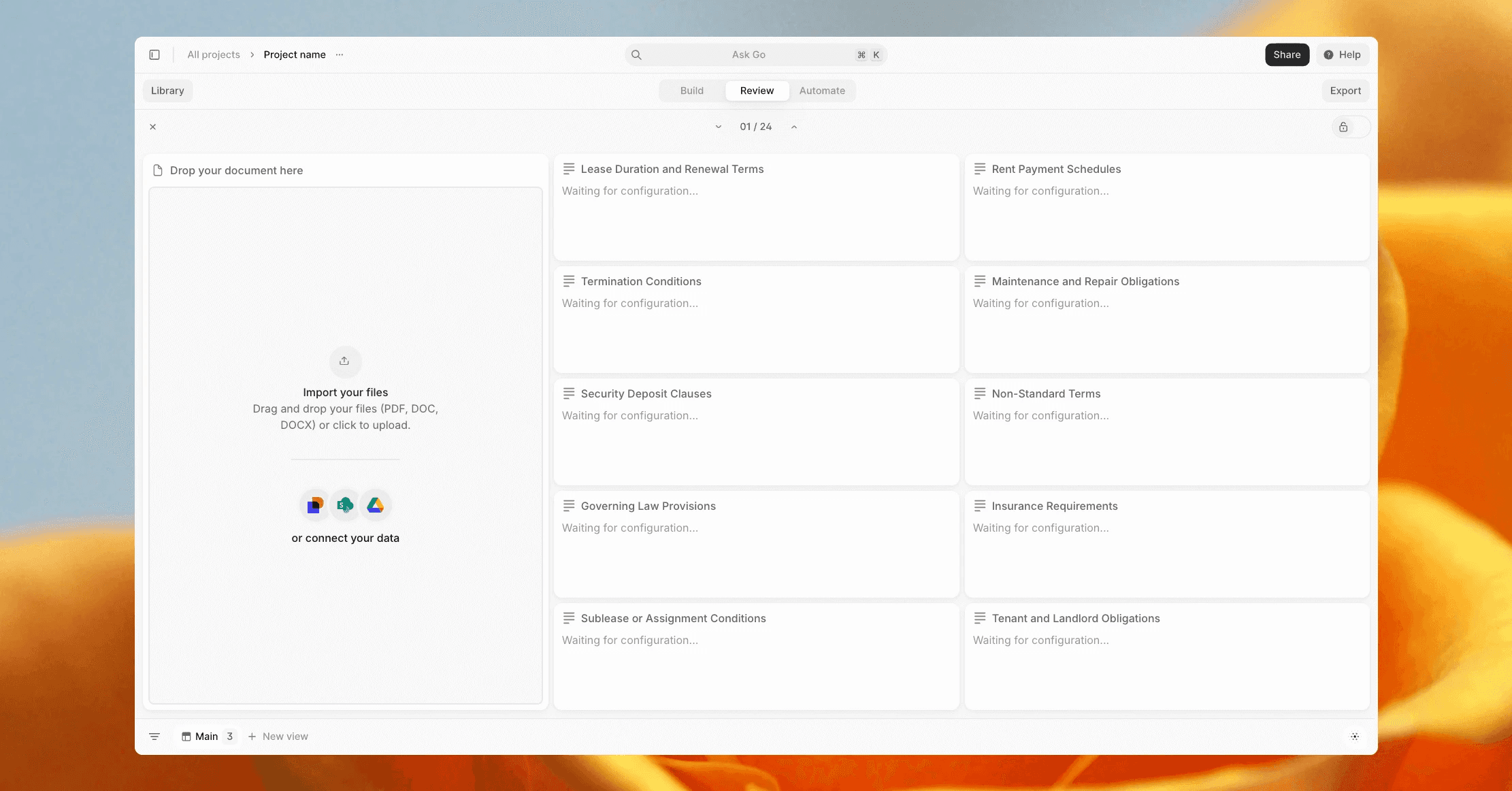
Leases, amendments and estoppels sit in the same property workspace as the seller roll, so each variance can point to the page that supports it.
The workflow for this building has five steps.
A Python step reads the roll and runs the six internal tests, returning pass or fail for each suite.
A model step reads every lease and amendment and returns the rent schedule, dates, holdover terms and tenant entity as typed fields.
A second Python step computes rent in force on August 16 and its variance against the roll, the estoppel and the AR aging.
A model step compares each estoppel with its lease on rent, credits, defaults and options, citing both pages for any conflict.
Every variance lands in an exceptions queue with its type, monthly dollar value, severity and owner.

Each source test runs as a fixed step with a typed output, so the August reconciliation has the same shape on every deal.
Arithmetic and dates stay in Python steps, so a rent step or a day count comes out the same on every run. The model reads language, and each figure it returns opens the sentence that states it. An associate who clicks suite 150’s $11,600 lands on page 2 of the First Amendment.
The associate works the queue and corrects or assigns each item, and the VP signs off before v1 is released. The reviewed dataset exports as Excel or CSV, or reaches a property system through the API, the V7 Go MCP server or a scoped integration. Built once with the deal team on a live file, the same rent roll extraction and checks run on the next acquisition.











What the corrected roll says about occupancy, WALT and the top three tenants
Every metric gets recomputed on v1, and the move from the seller’s v0 is what a VP reads first. Two metrics fall sharply, one rises and the top-three list changes.
Metric | Seller roll (v0) | Reconciled (v1) | What moved it |
|---|---|---|---|
Physical occupancy (by NRA) | 94.3% | 83.3% | Suite 300 treated as vacant |
Economic occupancy (August) | 94.4% | 76.4% | Suites 300 and 200 billed nothing |
Rent-weighted WALT | 2.29 years | 2.99 years | Suite 150’s amendment adds five years |
Top-3 share of rent | 35.4% | 37.3% | Suite 410 replaces suite 300 |
Top-3 share of NRA | 33.1% | 30.3% | Same change, smaller suite |
Rent expiring in 12 months | 24.7% | 20.1% | Suite 150 leaves, holdover suite 320 enters |
The economic figure follows the Wall Street Prep definition, rent collected divided by gross potential rent. August billed rent stands in until receipts post. GPR is $123,402.50 on v0 and $121,662.50 on v1, with vacant suite 330 at an assumed $25.00 a foot. When suite 200’s free rent ends, v1 reaches 82.6%, still 11.8 points below the seller’s figure.
WALT uses the rent-weighted formula from PropertyMetrics. Multiply each lease’s annual rent by its remaining term in months, sum the products, divide by total annual rent and convert to years. It rises from 2.29 to 2.99 years because suite 150’s amendment cut its rent 13% and pushed expiration to 2032. Report the 0.70-year lift in the IC memo with the same First Amendment citation as the $1,740 rent cut.
CREFC’s IRP Servicer Watchlist code 4D looks at the top three tenants with leases expiring within six months. It flags the loan when each holds at least 5% of NRA and together they exceed 30%. On v1, the largest expiring tenant holds 12.1% of NRA, with a lease ending January 31, 2027. Holdover suite 320 holds 4.3%, below the per-tenant 5% floor. The building stays off the list, and the servicer of any new loan will rerun that test after closing.
The 12-month expiry figure falls from 24.7% to 20.1%, which reads as good news until you check what moved. Suite 150 left the window because its amendment extended the term. Suite 320 entered as a holdover that can leave on short notice. The v1 figure is smaller and less certain, so the memo should name both suites.

In V7 Go, rollover and termination questions like this one return usable figures only once they run against the reconciled v1 leases.
Loss-to-lease runs next, on v1 rents. Our piece on loss-to-lease and concessions in multifamily covers that analysis for apartment deals.
An exception log with one row per variance, priced in monthly rent and closed by a named person
Each exception becomes a record that a VP, an asset manager and outside counsel can work from without asking what a row means. Three rows from the reconciliation show the fields.
Field | Suite 150 | Suite 240 | Suite 300 | Filled by |
|---|---|---|---|---|
Property | Office, 58,000 sq ft | Same | Same | Workflow |
Exception type | Amendment supersedes roll | Estoppel credit not in lease | Billing stopped, tenant may be gone | Workflow, associate confirms |
Roll value | $13,340, expires 3/31/2027 | $5,800 | $12,480, occupied | Workflow |
Source value | $11,600, expires 3/31/2032 | $4,300 net of credit | $0 billed, balance past 60 days | Workflow |
Source document and page | First Amendment §2, p. 2 | Estoppel ¶5, p. 2 | AR aging p. 3 | Workflow |
Monthly rent impact | -$1,740 | -$1,500 | -$12,480 | Python step |
Severity | Price or PSA item | Blocks underwriting | Blocks underwriting | Associate, VP confirms |
Owner | Associate | Counsel | VP Acquisitions | VP Acquisitions |
Status | Corrected in v1 | Open, seller asked | Open, site visit set | Owner |
Sign-off and date | VP, Oct 14, 2026 | Pending | Pending | VP Acquisitions |
Impact is always computed against the roll value, so rows add up and the total checks against the reconciliation. Status changes only when the owner attaches the closing document. For suite 300 that means a surrender agreement, a default notice or a site visit report. The associate proposes severity and the VP confirms it.
What underwriting, the lender and asset management receive in version 1 of the tenant record
Tonight’s deliverable is a normalized, reconciled and versioned dataset with one row per suite. The seller’s file is v0. The reconciled dataset, with its as-of date, reviewer and exception log attached, is v1. A seller update becomes v2, and the workflow reports its deltas against v1 suite by suite.
Suppose the seller’s update shows suite 430 at $5,160 with a rent relief letter attached. v2 records the new rent, the letter and the closed exception, and the IC memo cites v2. Without the version trail, the same $1,840 would reach the memo as a fresh number with no history.
Each row carries the fields that underwriting and downstream systems use.
Suite, area, tenant legal entity and trade name, with status as occupied, vacant or holdover.
Commencement, expiration, rent in force, next step date and amount, and recovery structure.
Estoppel status, security deposit and renewal, expansion and termination options.
Source document and page for every value, plus the exception IDs that touch the row.
Those fields are shaped like the tenant and unit records a Yardi or MRI setup expects. The dataset goes in by export or through a scoped integration. The IC memo and the lender package cite “rent roll v1, as of August 16, 2026” and never a filename. The underwriting team takes the rent, term and recovery fields into its input tab, where the three sizing tests in our real estate underwriting guide read them. The lender package takes the as-of date and top-tenant rows. Asset management takes the whole file as its opening tenant history.
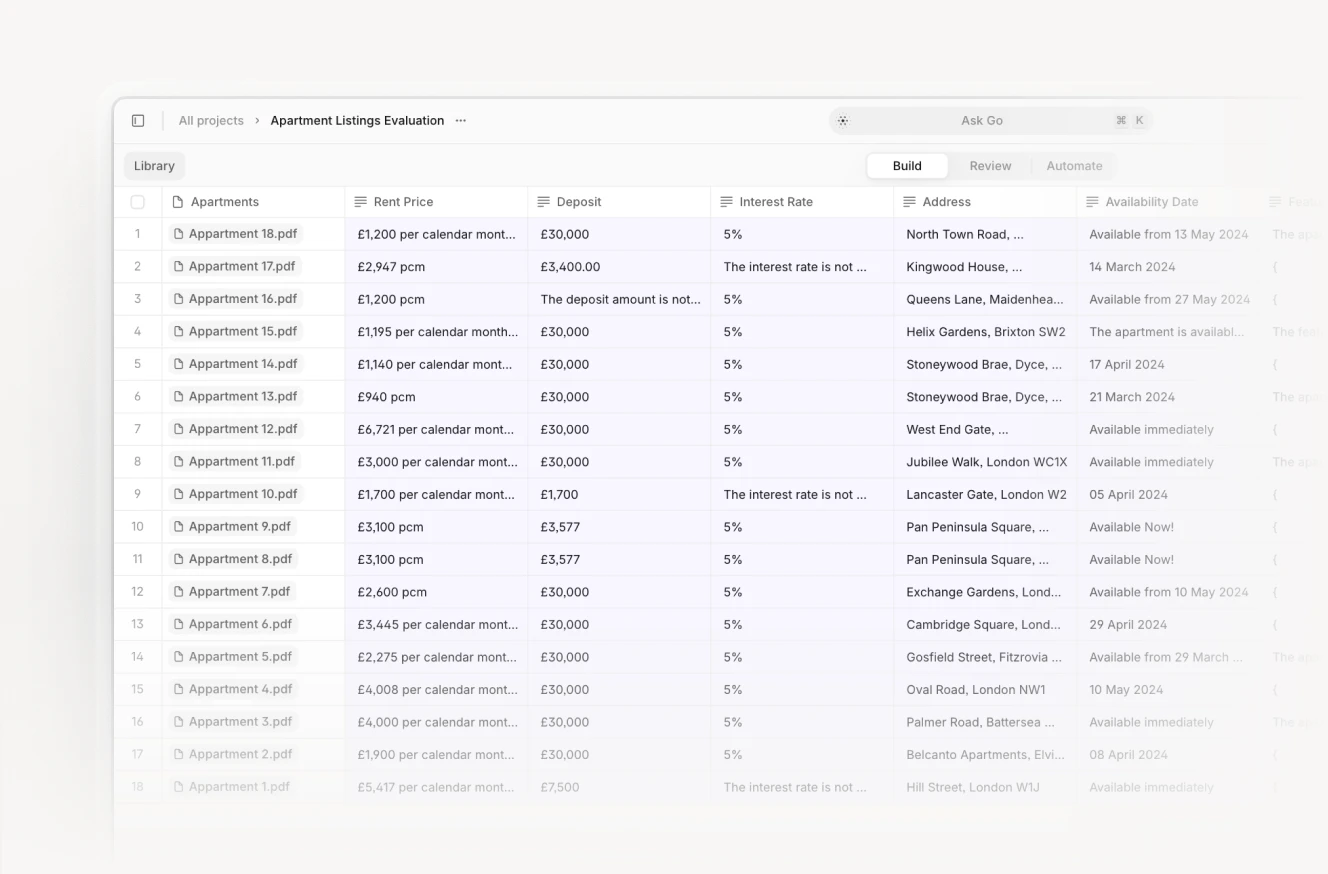
A typed table with one row per unit and rent and deposit fields is the shape v1 takes, shown here in V7 Go on a sample apartment-listings project.
Lenders already work in dated versions. The CREFC Investor Reporting Package records the effective date of the roll it uses in a field called “Date Lease Rollover Review”. Its property file reports only the top 5 tenants plus 4 years of rollover. Fannie Mae requires unit-level rent roll data on a template developed with the MBA and aligned to C-MISMO within 5 business days of origination.
After closing, v1 is the baseline the asset manager tests the first post-acquisition roll against. In V7 Go the suites, tenant entities, leases, amendments and approved values stay linked as the firm’s approved property record. The next stage of this deal, and the next deal with a shared tenant, retrieves records the team already approved. None of them trains a model. A question such as which tenants across three buildings hold 2027 termination options then runs on reviewed data.
Which exceptions stop the model and which go back to the seller
Severity decides what happens before the LOI. These thresholds are our suggested starting points, to be calibrated by asset type and deal size, and they carry no industry standing.
Severity | Trigger | Effect on underwriting | Owner | Deadline |
|---|---|---|---|---|
Blocks underwriting | Unexplained variance above 2% of monthly GPR, an estoppel that contradicts the lease on rent or term, a missing amendment, or a top-3 tenant with unresolved status | Figure stays out of the model and the LOI states the assumption | VP Acquisitions, with counsel on estoppel conflicts | Before LOI |
Price or PSA item | Confirmed rent shortfall, undisclosed concession, pass-through billed against the lease | Model uses the source value, and price, a PSA representation or a credit covers the difference | VP Acquisitions | Before PSA |
Seller question | Timing difference, unapplied cash, holdover status, unexplained variance under 2% of GPR | Model carries the documented value with a flag | Associate | Before PSA, escalated if unanswered |
Recorded only | Rounding under $25 per suite, suite ID formatting | None | Associate | Before close |
Items with a PSA deadline then join the deal’s wider CRE due diligence checklist.
On the August numbers, suites 240 and 300 block underwriting, and $12,480 a month stays out of the model until the VP has an answer. Suites 150, 200 and 410 become price or PSA items. Suites 320 and 430 go to the seller as written questions. Suite 430’s $1,840 is the one figure in the $22,440 gap that nobody can yet explain.
What fields does a Fannie Mae or Freddie Mac multifamily lender expect on a rent roll?
Freddie Mac's Multifamily Guide defines a borrower-certified rent roll as including, at minimum, the tenant name, the unit number or physical ID, the contract rent and the lease start date. Fannie Mae asks for the roll to be certified on Form 4243, which the borrower and the management agent both sign, and it requires unit-level rent roll data on a template developed with the MBA and aligned to C-MISMO within five business days of origination. Those are the floors for agency apartment loans. An acquisitions team usually carries more columns than the lender minimum, because the reconciliation needs lease expiration, rent steps, concessions, security deposits and vacancy status to test each unit against its lease. Adding the source document and page for each value costs little at intake and saves a second pass when the lender's lease audit asks where a figure came from.
+
How old can a rent roll be before you request an updated one?
For agency multifamily loans there are two published limits. Freddie Mac caps a certified roll at six months old for annual financial submissions, and Fannie Mae wants the roll dated within 60 days of the appraiser's inspection. Commercial acquisitions have no equivalent rule, so the practical test is what could have changed since the as-of date. A roll dated in mid-August and used for an October decision misses every move-out, new lease, amendment and rent relief letter from the intervening weeks. Many deal teams ask for an update once a roll passes 30 days at the decision date. Whatever the age, ask the property manager for tenant ledgers covering the gap period and ask the seller for a written list of lease changes since the roll date. Those two documents usually explain more than a fresh roll would on its own.
+
What do you do when a tenant estoppel contradicts the executed lease?
Record the conflict as an exception with both sources cited, the estoppel paragraph and the lease section, and price it in monthly rent. Then route it to counsel and the seller, because which document governs and what remedy follows is a legal question that the deal team should not settle on its own. Common explanations include a side letter or amendment that never reached the data room, a tenant misreading its own lease, or a genuine landlord default such as unfinished tenant improvements. Until the conflict is resolved, keep the disputed amount out of the underwriting model and state the assumption in the LOI or the IC memo. If the estoppel claims a rent credit, compute the total exposure through the credit's end date so the VP sees a dollar figure. Keep the exception open until a document closes it, whether a corrected estoppel, a produced amendment or a negotiated PSA credit.
+
Why would the rent roll and the AR aging show different rent for the same month?
The difference usually falls into a handful of causes. Timing items come from move-ins, move-outs or free-rent periods that start or end within the month. Unapplied cash affects balances, so it explains a tenant that looks late but leaves billed rent unchanged. Billing errors include pass-through charges a lease does not permit, such as CAM billed on a gross lease. True delinquency or vacancy shows up when the manager stops billing a tenant who has left while the roll still lists the suite as occupied. A fifth cause is a roll error that the AR aging exposes, typically an amendment that changed rent while the roll kept the base-lease figure. Decompose the gap suite by suite until every dollar sits in one category, and treat anything left over as a written question for the seller, with the property manager's tenant ledger requested as support.
+
What is the difference between physical and economic occupancy on a rent roll?
Rent-weighted WALT multiplies each lease's annual rent by its remaining term, sums the results across all leases and divides by total annual rent. Area-weighted WALT uses square feet in place of rent and is useful for comparing physical exposure. Measure remaining term from the roll's as-of date, and run the calculation on the reconciled roll, because the inputs that most often move it are exactly the ones reconciliation corrects. An amendment that extended a lease will raise WALT, while a holdover tenant should count as zero remaining term and a vacated suite should drop out entirely. Report the top three tenants separately so the VP can see whether a single expiration drives the number. A building can show a comfortable WALT while one large tenant expires within months, which is why lenders also look at near-term expirations by tenant share of rentable area.
+
How do you calculate WALT from a rent roll?
Go is more accurate and robust than calling a model provider directly. By breaking down complex tasks into reasoning steps with Index Knowledge, Go enables LLMs to query your data more accurately than an out of the box API call. Combining this with conditional logic, which can route high sensitivity data to a human review, Go builds robustness into your AI powered workflows.
