13 min read
—



V7 Go
A smarter way to manage due diligence and underwriting
A single commercial real estate (CRE) acquisition can arrive with two hundred leases attached, and every one has to be read before the deal closes. AI lease abstraction is the technology that reads them for you, pulling rent, term, break clauses, escalation formulas, options, and the side letter nobody mentioned that quietly resets the whole economics out of a fifty-page PDF and into a structured record an analyst can act on. Done by hand, each lease takes a few hours and costs a few hundred dollars in senior time, and it happens inside a due diligence window that does not move. That is the problem it was built to solve, and it is why asset managers are now shopping for tools rather than temps.
The catch is that the category has crowded fast, and the comparison articles that rank for it mostly count features and accuracy percentages. That is the least useful way to choose. On a standard retail lease every credible tool clears the low nineties for accuracy, so the score barely separates them. What separates them is whether the extracted data is defensible, whether the tool copes with a whole portfolio rather than one clean lease, and whether it survives an auditor asking where a number came from.
This guide covers all of it: what AI lease abstraction actually is, how the software works, where managed services still win, the tools worth a shortlist, how to evaluate them for your own portfolio, and what IFRS 16 and ASC 842 compliance genuinely require. If you want the broader category first, our overview of AI in real estate lease abstraction sets the scene; this article is the buyer's comparison that sits on top of it.
In this article:
What AI lease abstraction is, and the data it pulls from a commercial lease.
How the software works, and where managed services still make sense.
The tools worth shortlisting, and how to evaluate them for your portfolio.
What IFRS 16 and ASC 842 compliance actually require from an abstraction workflow.
What AI lease abstraction is
AI lease abstraction uses machine learning to read a commercial lease and pull its key terms into structured data, replacing a manual review that runs hours per document. Lease abstraction itself is the old discipline of turning a long lease into a short, usable summary of what matters. The AI version does the same job automatically, and at portfolio scale that shift is the difference between a task and a bottleneck.
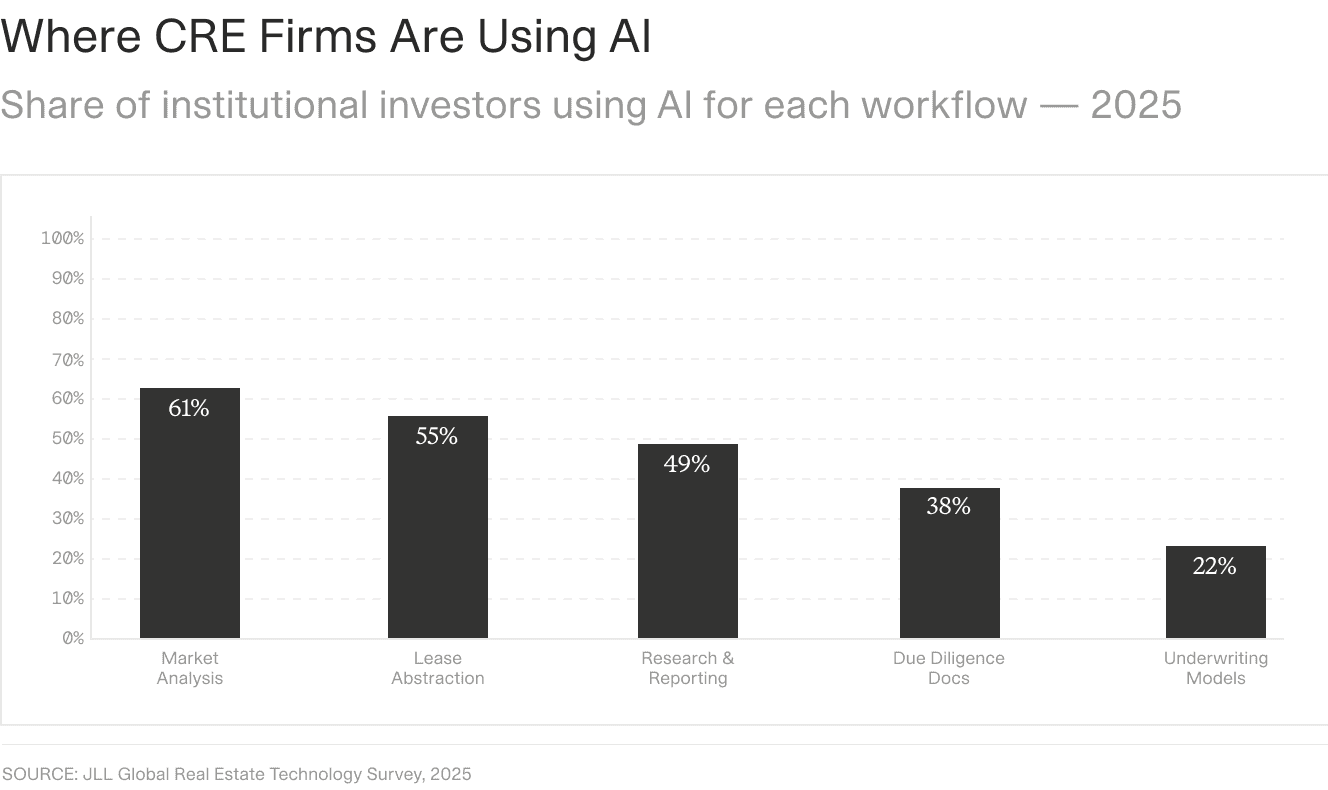
Lease abstraction is already the second most common AI use case among institutional CRE investors, behind only market analysis. Source: JLL Global Real Estate Technology Survey, 2025.
What a good tool extracts goes well beyond rent and dates. The basic terms cover rent, commencement and expiry, renewal options, and break clauses. The financial terms cover escalation formulas, common area maintenance charges, and operating expense caps. The legal terms cover assignment and subletting rights, co-tenancy, and exclusive use. The operational terms cover parking, signage, and repair responsibilities. And then there are amendments and side letters, which is where the real liability hides, because a single side letter can override a clause in the main lease and a tool that reads only the main body will miss it entirely.
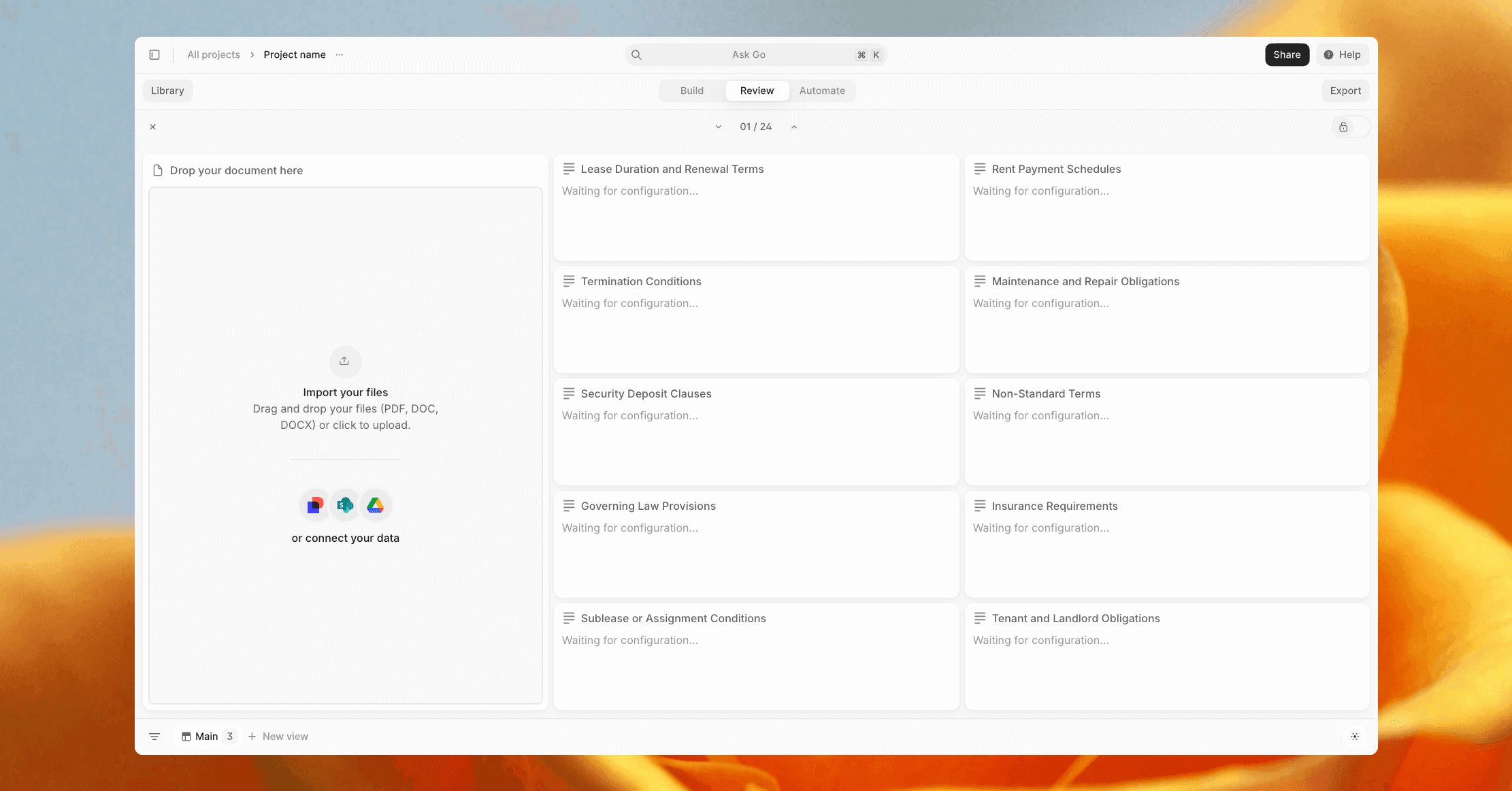
Abstraction turns a fifty-page lease into a structured record of the terms that drive value. The interface is the easy part; getting every field right, including the ones buried in amendments, is the hard part.
On accuracy, be sceptical of the headline. Platforms typically report the low-to-mid nineties on standard commercial leases, and a lease read in minutes rather than hours is a real gain. But those numbers describe clean, standard documents. A ground lease, a heavily amended anchor-tenant lease, or a scanned lease with a handwritten rider will pull the number down, which is exactly why human review stays in the loop.
Amendments deserve their own attention, because they are where portfolios spring leaks. A lease signed in 2016, amended in 2019, and side-lettered in 2022 has an effective set of terms that exists in none of the three documents on its own. A tool that abstracts the original and stops has produced a confident, wrong summary. The ones worth buying track the chain of changes and resolve the current position, which is the difference between a neat table and an accurate one.
Why manual lease abstraction fails at scale
Manual abstraction does not fail on a single lease. It fails on two hundred of them inside a thirty-day due diligence window. The arithmetic is unforgiving: a few hours and a few hundred dollars per lease, multiplied across a portfolio, against a clock set by the transaction rather than the team. Under that pressure the risk is not slowness, it is the missed clause, the co-tenancy trigger or the early-termination right that nobody caught, which turns into a liability the buyer owns after close. Speed is the visible benefit of automation. Catching the clause a tired reviewer would have skimmed at 11pm is the valuable one.
How AI lease abstraction software works
Under the marketing, every AI lease abstraction platform runs roughly the same five steps, and the quality differences live inside them. First, ingestion: the lease goes in as a PDF or a scanned image, with optical character recognition handling the scans. Second, parsing: the system works out the document's structure, separating the main lease body from exhibits, riders, and amendments. Third, extraction: models locate and pull each predefined field. Fourth, confidence scoring: every extracted value gets a score, and the low-confidence ones are flagged for a human rather than passed on as fact. Fifth, structured output: the data lands in a spreadsheet, a property management system such as Yardi and MRI, or a compliance report. In effect it is a specialised form of intelligent document processing tuned to the structure of a lease.
One capability in that chain does most of the real work, and most tools skip it. Visual grounding means every extracted field is linked back to the exact clause it came from, with the page and the text highlighted. The alternative is black-box extraction: a clean table of values with no way to check any of them. For a productivity tool that might be acceptable. For anything that reaches an auditor, it is not, because an unverifiable number is a number you cannot defend. Our guide to the best AI tools for real estate covers where this fits in the wider CRE stack.
Lease abstraction services versus software
Before shortlisting software, it is worth asking whether you want software at all. Managed lease abstraction services, where a provider's team does the work for you, still make sense in specific cases, and pretending AI wins every time costs you credibility. The honest split is about volume and complexity.
Factor | Managed services | AI software |
|---|---|---|
Turnaround | Days per batch | Minutes per lease |
Standard leases | Strong, human expertise | Strong, with human review |
Complex or non-standard leases | Strong | Needs human review |
Audit trail | Varies by provider | Built in, with per-field citations on the best platforms |
Scaling | Limited by headcount | Immediate on volume |
Best for | One-off complex transactions | Ongoing portfolio work |
The rule of thumb: if you process leases in any volume through the year, software pays for itself and gives you a repeatable, auditable workflow. If you face a single, unusually complex transaction and nothing after it, a managed service can be the cheaper answer. Most institutional teams do enough volume that the question answers itself.











The best AI lease abstraction tools for CRE teams
A shortlist is only useful if it is honest about what each tool is for, so this is organised by lane rather than ranked, and every entry carries a real limitation. The differences that matter are audience and architecture, not a percentage point of accuracy.
Tool | Best for | Where it is strongest | Honest limitation |
|---|---|---|---|
V7 Go | Institutional teams processing a full acquisition data room | Field-level source citations and multi-document workflows across leases, rent rolls, and OMs | A workflow platform, not a single-purpose lease tool; needs initial configuration |
Kira Systems | Enterprises and law firms with complex portfolios | Very broad provision coverage and mature bulk processing | Enterprise pricing and specialist onboarding |
Leverton | International portfolios with compliance needs | Multilingual extraction and compliance output | European heritage; US teams may find the fit less native |
MRI and Yardi lease tools | Teams already on those platforms | Native data sync into the property management system | Locked to that ecosystem |
Dealpath AI Extract | Acquisition teams on Dealpath | Lease and offering-memorandum data in one deal workflow | Tied to the Dealpath platform |
LeaseWizard | Smaller teams new to AI abstraction | Accessible, broad data-point coverage | Lighter on portfolio-scale and enterprise features |
Lextract | Teams that prefer per-lease pricing | Transparent transactional pricing and red-flag checks | A narrower feature set than enterprise platforms |
Two honest notes the table cannot carry. The category leaders in pure lease extraction are deep and reliable, and if abstracting leases is the only job, they do it well. The reason V7 Go sits at the top of this list for institutional teams is not a higher accuracy score; it is that a lease rarely travels alone. It arrives with a rent roll to reconcile against and an offering memorandum to cross-check, and a tool that reads all three together catches the discrepancy a single-document tool never sees. That is a different job, which is why the honest limitation is real: it is a platform to configure, not an app to open.
How to evaluate lease abstraction software for your portfolio
Once you know your lane, six tests separate the tool that demos well from the one that survives a real portfolio. Run each against your own documents, not the vendor's sample.
First, accuracy on your lease types, not theirs: a tool that hits the mid-nineties on a standard retail lease can fall apart on a ground lease or a scanned rider, so test the messy ones. Second, audit-trail depth: can you click any extracted field and see the exact source clause, and if not, treat every figure as unverified. Third, amendment and side-letter handling: the most material changes live in the documents around the main lease, and a tool that reads only the body will miss them. Fourth, bulk capacity: due diligence needs dozens of leases inside a day, so test throughput, not single-document speed. Fifth, property management integration: does the output map cleanly into Yardi and MRI, or does someone re-key it. Sixth, compliance output: does it produce data you can feed straight into a right-of-use asset schedule, or do you still run it through a separate accounting model afterwards.

The audit-trail test in one picture: every figure the AI returns stays tied to the highlighted passage it came from, so a reviewer or an auditor can check it rather than trust it.
Scale changes the question entirely. At ten leases in a single deal, any competent tool plus a manual check works fine. At a hundred a quarter, you need structured validation and clean integration into your property management systems, or the saved time reappears as re-keying. At five hundred or more a year, the bottleneck stops being extraction and becomes validation and exception handling, and the tool has to be built as a workflow rather than a document reader. Most comparison articles miss this because they test a single lease, while institutional teams live at that third tier. Our overview of AI in commercial real estate investment sets out where this fits in the wider operating model.
IFRS 16 and ASC 842: what compliance actually requires
Lease abstraction stopped being a purely operational task when the accounting standards changed. Under IFRS 16 and its US counterpart ASC 842, lessees have to bring most leases onto the balance sheet as a right-of-use asset and a lease liability, which means the numbers pulled during abstraction now flow directly into financial statements. That raises the stakes on getting them right and being able to prove it.
Compliance needs specific fields, cleanly and consistently: the commencement date, the lease term including options reasonably certain to be exercised, the fixed and variable payments, and the discount rate applied. A summary paragraph does not cut it; the standards, as the practitioner guides at IAS Plus lay out, expect structured, supportable data. This is where the audit trail moves from nice-to-have to requirement. When an auditor asks how a lease liability was derived, "the AI extracted it" is not an answer. Visual grounding, every field tied to the page and clause it came from, is what turns an abstraction output into documentation an auditor will accept.
How V7 Go handles the full CRE acquisition document stack
V7 Go is built for the case where a lease never arrives alone, which is the reality of an institutional acquisition. It is an AI agent platform, and for a CRE team that means it reads the whole data room, leases, rent rolls, offering memoranda, and side letters, rather than treating lease abstraction as a task in isolation.
The differentiator is what happens across those documents. The agent extracts the fields from each, and because it holds them together it can cross-check them: a rent roll figure that does not match the underlying lease term is flagged rather than quietly carried forward, which is the kind of discrepancy that a single-document tool, however accurate on its own lease, will never catch. Every extracted field carries visual grounding, linked to the exact page and clause, so an analyst reviews rather than re-reads and a fund manager has an audit trail that holds up in a compliance review. At portfolio scale the work shifts from extraction to validation, and the workflow reflects that: one agent extracts, another checks the output against a master template, and exceptions route to a human queue instead of a person eyeballing every lease.
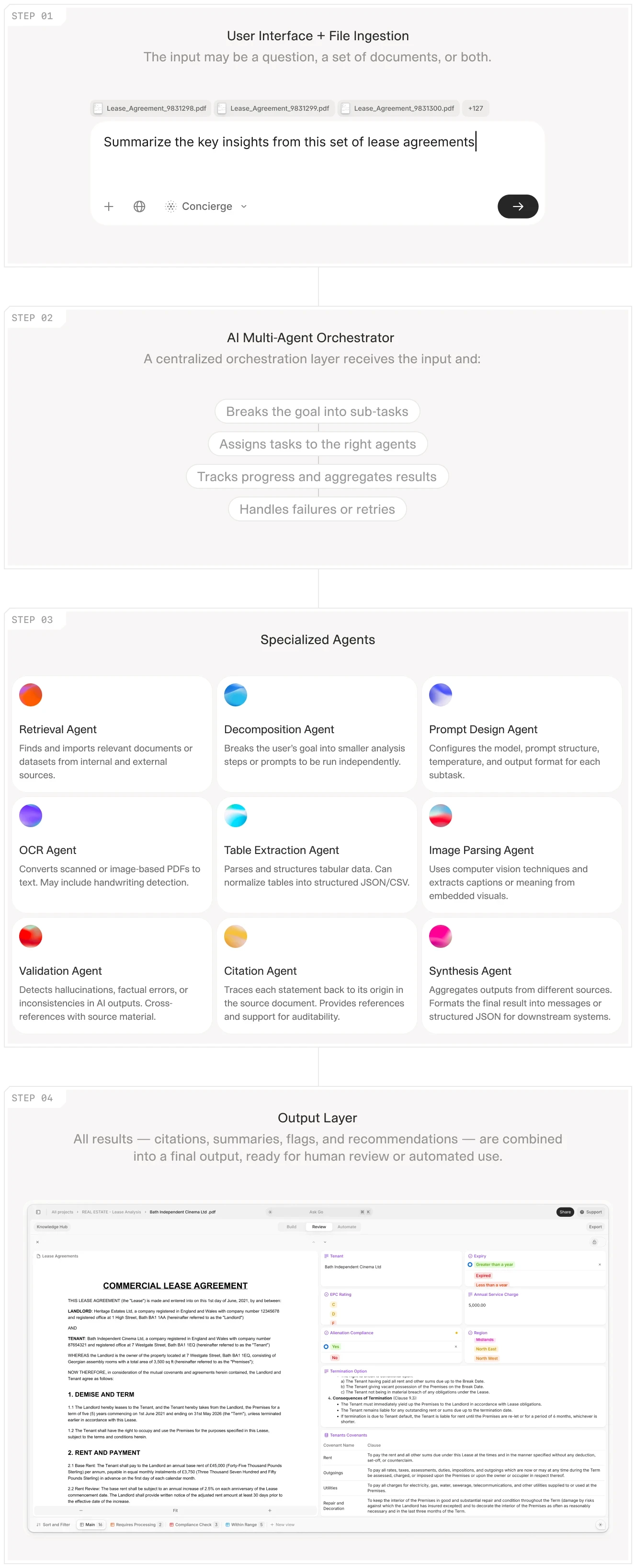
At portfolio scale the design matters more than the model: extraction, validation against a template, and an exception queue, rather than one reviewer reading every lease.
The output is not a spreadsheet the team then has to reconcile by hand. Structured, cited data exports into Yardi and MRI, or into a compliance schedule, through the same workflow. You can see the extraction side in V7's lease abstraction agent, and the same platform reads the rest of the acquisition stack alongside it.
That record does not reset at the next acquisition either. Run enough deals through the same workflow and the extracted leases, amendments, and side letters accumulate into a Context Graph, a relationship graph connecting tenants, properties, and the clauses that govern them across the whole portfolio rather than one data room at a time. Ask which tenants across the portfolio carry a co-tenancy trigger tied to a specific anchor, or how a landlord's standard escalation formula has shifted across leases signed in the last three years, and the answer comes back tied to the clause it was pulled from, not a search through a shared drive of old PDFs. That is what turns lease abstraction from a per-deal task into a standing asset the acquisitions team gets faster with every close.
The honest summary is that accuracy is table stakes and the real decision is about trust and scale. Every serious tool reads a clean lease well. Fewer let you prove where each figure came from, and fewer still cope with a portfolio and the messy documents around every lease rather than the tidy one in the demo.
So evaluate for your reality, not the sample. Test the ground lease and the scanned rider, click into the audit trail, and check whether the rent roll gets reconciled against the leases or just sits beside them. For a team processing leases in any volume, the tool that pays off is the one that turns a due diligence scramble into a repeatable, auditable workflow.
If you want to see that run against your own acquisition documents, V7 runs a working session built around your lease types and your property management setup. That is the concrete next step, and it takes about the length of a diligence kickoff call.
What is AI lease abstraction?
AI lease abstraction uses machine learning to read commercial lease documents and automatically extract their key terms, such as rent, commencement and expiry dates, break clauses, renewal options, and escalation formulas, into structured data. It replaces a manual process in which an analyst reads a lease of fifty pages or more and records the important terms by hand, which typically takes a few hours per document. The AI version does the same job in minutes and at far greater volume, which matters most during due diligence, when a single acquisition can involve hundreds of leases inside a fixed timeframe. The best implementations pair extraction with a confidence score on each field and a link back to the exact clause the data came from, so a human reviews the uncertain items rather than re-reading everything. Human review stays part of the process, because accuracy falls on complex or non-standard leases.
+
How accurate is AI lease abstraction software?
On standard commercial leases, AI lease abstraction platforms typically report accuracy in the low-to-mid nineties, and for clean, well-structured documents that is a fair reflection of what they achieve. The important caveat is that the headline number describes standard leases. Accuracy drops on non-standard documents: heavily amended anchor-tenant leases, ground leases with unusual structures, scanned leases with handwritten riders, and clauses that cross-reference exhibits. For that reason, accuracy should never be treated as a single figure, and no responsible workflow runs without human review. The most reliable setups flag low-confidence extractions for a person to check, so review effort concentrates where the model is uncertain rather than spreading evenly across every field. When evaluating a tool, the right test is its accuracy on your own difficult leases, not the vendor's clean sample, because that is where the differences between platforms actually show up.
+
What data points can AI extract from a commercial lease?
A capable AI lease abstraction tool extracts far more than rent and dates. The basic commercial terms include base rent, commencement and expiry dates, renewal options, and break or early-termination clauses. The financial terms include rent escalation formulas, common area maintenance charges, and operating expense caps or stops. The legal terms include assignment and subletting rights, co-tenancy provisions, and exclusive-use clauses. The operational terms include parking allocations, signage rights, and repair and maintenance responsibilities. Crucially, a strong tool also handles amendments, riders, and side letters, which is where the most material modifications frequently sit and where weaker tools fail, because a side letter can override a term in the main lease body. The output is a structured record of these fields, ideally with each one linked back to the clause it came from, so the extracted summary can be verified against the source rather than taken on trust.
+
How long does AI lease abstraction take compared to manual review?
Manual lease abstraction typically takes a few hours per lease, depending on length and complexity, because an analyst has to read the whole document and record each relevant term by hand. AI abstraction reduces that to minutes per lease, and for shorter, simpler documents to well under that. The more meaningful comparison, though, is at volume. During due diligence a team might face a few hundred leases inside a fixed window, and the manual approach scales only by adding people, which is expensive and slow to organise. AI processes the batch in parallel and presents the results for review, so the human effort shifts from reading every lease to checking the flagged, low-confidence extractions. The practical effect is that a task which used to define the due diligence timeline stops being the constraint, provided the workflow keeps a human review step for the complex and non-standard documents where the model is less certain.
+
Is AI lease abstraction suitable for IFRS 16 and ASC 842 compliance?
Lease abstraction services are managed offerings where an external provider's team reads your leases and returns the abstracts, whereas AI software automates the extraction so your own team runs the process. The trade-off is about volume, speed, and control. Managed services bring human expertise and handle unusual, complex leases well, but they are limited by the provider's headcount and turn work around in days rather than minutes. AI software processes leases in minutes, scales immediately with volume, and, on the better platforms, gives you a built-in audit trail with per-field source citations, though it still needs human review on non-standard documents. As a rule, teams processing leases in any regular volume are better served by software, because it delivers a repeatable, auditable workflow they control. A managed service can be the more sensible choice for a one-off, unusually complex transaction with no ongoing abstraction need behind it.
+
What is the difference between lease abstraction services and AI software?
Go is more accurate and robust than calling a model provider directly. By breaking down complex tasks into reasoning steps with Index Knowledge, Go enables LLMs to query your data more accurately than an out of the box API call. Combining this with conditional logic, which can route high sensitivity data to a human review, Go builds robustness into your AI powered workflows.
+
Casimir is a seasoned tech journalist and content creator specializing in AI implementation and new technologies. His expertise lies in LLM orchestration, chatbots, generative AI applications, and computer vision.