18 min read
—


Count what is clean, then give every missing and incomplete item an owner, a date and a PSA section before the diligence period closes.

Casimir Rajnerowicz
Content Creator
V7 Go
A smarter way to manage due diligence and underwriting
The diligence period in the purchase and sale agreement expires on Friday, October 30, at 5 p.m. On Tuesday, October 20, the real estate data room analysis for the deal shows 70% of expected documents received. The three items that matter most this week are still missing. Nobody has seen the title commitment or the Phase I environmental site assessment, and three of the center's 18 tenants have not returned estoppels.
The deal is an 18-tenant neighborhood retail center with a 30-day diligence period and a 40-row list of what the seller owes the buyer. It is hypothetical, as are the PSA section numbers, tenants and dates throughout. Eight business days remain. The VP Acquisitions or the investment committee owns the extend, reprice or walk call, and deal counsel owns every reading of the PSA.
Every expected document sits in one of four states, which are not provided, incomplete, clean and adverse. The 70% figure counts uploads and nothing else. It says nothing about how many uploads would survive a credit officer’s questions, and it invites a worse habit. A tracker that writes “no issues” beside a document nobody has received turns a blank into a clean result. On this deal, that habit makes a room that is 42.5% clean read as 90% issue-free.
Real estate data room analysis at day 20: 70% received, 42.5% clean
The denominator comes from the PSA. Count every item in the seller deliverables exhibit and every covenant that obliges the seller to deliver something during the diligence period. Ignore the folder structure the seller’s broker built. On this deal that list runs to 40 rows. A folder called “Third Party Reports” can hold a 2019 survey and a property condition report and still lack the required Phase I.
A 30-day period sits at the short end of market practice. Baker Donelson describes standard diligence periods of 30 to 60 days for typical acquisitions and 90 days or more for complex assets. A buyer who accepted 30 has spent 67% of the clock by day 20. The full list of documents a buyer might expect sits in the commercial real estate due diligence checklist. This deal’s 40 rows come from reading the purchase and sale agreement itself.
Each state is a decision rule with a test, a next action and an owner.
State | Test | Next action | Owner |
|---|---|---|---|
Not provided | No document matching the row is in the room | Dated request citing the PSA section | Diligence coordinator |
Incomplete | Present, but missing a page, exhibit, signature, date or schedule | Request the specific missing part | Coordinator |
Clean | Complete, consistent with related documents and current | Sign-off, with a stale-on date | Reviewer for that document family |
Adverse | Present, readable and showing a problem | Issue log entry to a decision owner | Counsel, consultant, engineer, VP Acquisitions or credit |
A not-provided row is a question with a date attached. It records that the buyer asked, under which section and when an answer is due, and it records nothing about the property. Missing evidence never becomes adverse by default, and it never becomes clean through silence. Eight of the 40 rows show the states side by side.
Expected document | PSA section (hypothetical) | Received | State | Reason |
|---|---|---|---|---|
Title commitment | 5.1(a) | No | Not provided | Requested on day 0, not yet issued |
ALTA/NSPS survey | 5.1(b) | Yes | Incomplete | 2019 survey, certified to the seller’s lender only |
Phase I ESA | 4.2(c) | No | Not provided | Seller silent on whether a prior report exists |
T-12, Oct 2025 to Sep 2026 | Exh. D-3 | Yes | Clean | 12 months present and footed, receipts tied by tenant |
Leases, Tenants 3 and 9 | Exh. D-2 | Yes | Incomplete | Base leases only, current rents match neither schedule |
Estoppel, Tenant 12 | 9.1(d) | Yes | Adverse | Confirms $3,900 monthly rent against $4,200 on the rent roll |
Estoppels, Tenants 4, 15 and 17 | 9.1(d) | No | Not provided | Sent to tenants by the seller, not returned |
Property condition report | 4.2(d) | Yes | Adverse | Roof immediate needs far above the seller’s capex schedule |
Count all 40 rows by state and the status report changes shape.
Measure | Rows | Share of 40 |
|---|---|---|
Received | 28 | 70% |
Clean | 17 | 42.5% |
Incomplete | 7 | 17.5% |
Adverse | 4 | 10% |
Not provided | 12 | 30% |
No adverse finding (everything except adverse) | 36 | 90% |
The 90% line is the one that gets forwarded, and it is the wrong one. It adds the 12 rows nobody has read and the 7 rows that cannot be relied on to the 17 that were reviewed and agree. The number the VP needs on day 20 is 42.5%, together with a dated plan for the 19 rows that are neither clean nor adverse.
V7 Go grades each upload against the PSA and keeps the register current
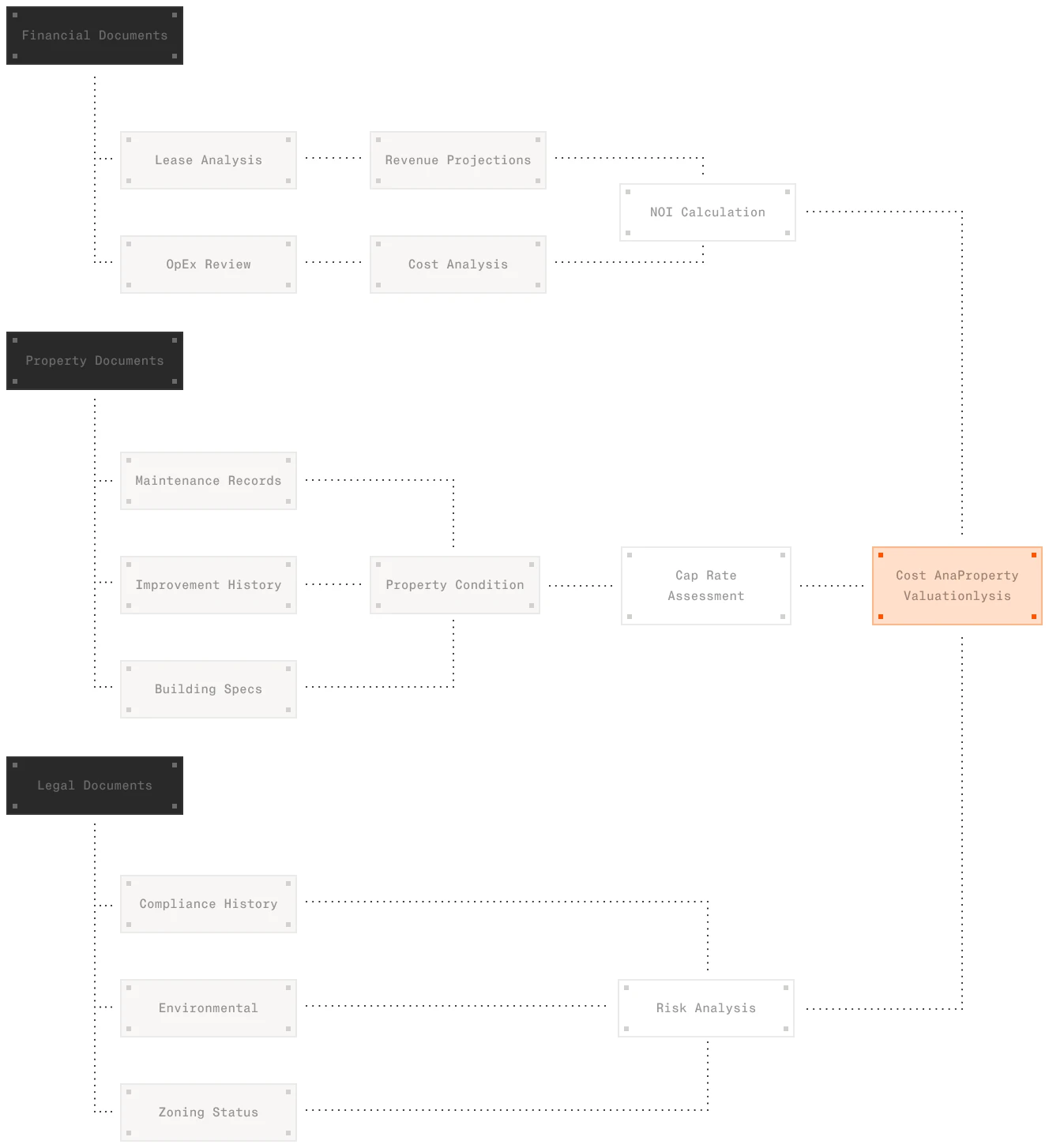
Sellers post to the room throughout the diligence period (choosing the room itself is a separate decision, covered in our guide to AI data rooms for due diligence), so a grading done on day 12 is out of date by day 20. In V7 Go the review is a defined workflow that reruns the same steps, in the same order, against the 40 rows on every upload. The inputs are the PSA and its deliverables exhibit, plus whatever the seller posts. On this deal that means the rent roll, leases and amendments, estoppels, title commitment, survey, Phase I, PCA and T-12.

The diagram shows CIMs as inputs. A property room runs through the same layer with the PSA, leases, estoppels and title documents in their place.
Step | Tool | Typed output | Reviewer |
|---|---|---|---|
Match each file to an expected-document row | Model, given the PSA’s 40 rows | Row ID, document date, match reason | Coordinator resolves unmatched files |
Assign a state with a reason | Model, applying the state tests | State, reason, cited passage | Confirms every clean or adverse |
Extract facts with page, period and effective date | Model | Rent, expiry, deposit, B-II item text, PCR costs | Spot checks by family |
Compute dates and deltas | Python | Days to expiry, estoppel age, rent deltas | Sees the inputs behind each number |
Cross-check rent roll, leases and estoppels | Model plus Python | Mismatch records with both citations | Acquisitions analyst |
Route each gap or issue | Integration to the owner’s queue | Owner, due date, PSA section | Owner accepts or reassigns |
Each extracted fact carries its source. Tenant 12’s confirmed rent opens paragraph 3 of the signed certificate, and a title exception opens its Schedule B-II item. The reviewer reads that sentence before changing a state. A person confirms every move to adverse and every clean sign-off. The citation shows where a fact came from, and the judgment stays with that person. The typed outputs are a gap register, a fact table, an issue log and memo inputs. They land in the owners’ queues and feed the data room to IC memo workflow. Related property workflows sit under AI for real estate operations.

A fund document is shown here. The same mapping turns one estoppel into rent, deposit, expiry and claimed defaults, each with its source.
Not provided: the title commitment and the Phase I that cannot arrive in time
A not-provided row needs two answers. Who produces it, and can it arrive before expiry on October 30? The first answer splits the 12 not-provided rows into items the seller must deliver and items the buyer commissions. Each group escalates through different people.
The title commitment comes from the title company, requested under hypothetical section 5.1(a) on day 0. Without it, nobody can read the Schedule B-I requirements due at closing or the Schedule B-II exceptions the policy will not cover. The survey also has nothing to be compared against. Line-by-line reading belongs to Schedule B and survey review. On day 20 the row goes to the title company’s escrow officer with a firm issue date. Counsel needs working days to object to exceptions before the period ends.
The Phase I is harder because the calendar does the arithmetic. LightBox’s 2023 benchmark survey of more than 300 US environmental professionals put the average Phase I at 16 business days and $3,083. Those averages cover AAI-compliant reports on conventional properties without non-scope issues. Ordered today, a report at that average lands on Wednesday, November 11, which is 12 days after the diligence period ends. At $3,083, the fee is the smallest number in the decision.
Item | Ordered or requested | Expected arrival | Against Oct 30 expiry |
|---|---|---|---|
New Phase I | Tue Oct 20 (day 20) | Wed Nov 11, at the 16-business-day average | 12 days after |
Seller’s prior Phase I, if one exists | Tue Oct 20 | Thu Oct 22, as promised by the seller | 8 days before |
Title commitment | Wed Sep 30 (day 0) | Fri Oct 23, as quoted by the title company | 7 days before |
Estoppels, Tenants 4, 15 and 17 | Re-request Thu Oct 22 | Nov 1 to Nov 21, inside a 10 to 30 day response window | 2 to 22 days after |
That leaves two routes. The first is the seller’s prior report, with a reliance letter and a currency check against the deal timeline. The second is a written extension request sized to the November 11 arrival plus review time. What each route requires from the lender belongs to Phase I environmental site assessment review. Neither route reads the absent row as evidence the site is clean.
Incomplete: unsigned estoppels, missing amendments and the survey the commitment points to
An incomplete document is in the room and still cannot be used as evidence. A page, signature, date, exhibit or schedule that gives it force is missing, and the fix is a request for that specific part. On this deal 7 of the 28 received rows are incomplete, and each has a field that proves the gap.
Document family | Incompleteness signal | Field that proves it |
|---|---|---|
Estoppel | Landlord’s form returned with rent or deposit left blank | Monthly rent and security deposit lines |
Estoppel | No tenant signature, or signed but undated | Signature block and date line |
Lease | Base lease only, while the rent roll shows a rent the base schedule cannot produce | Base lease rent schedule against the rent roll |
Title commitment | A Schedule B-II exception for survey matters, with no current survey | B-II item text and survey reference |
Survey | Not certified to buyer and lender, or missing Table A items the buyer needs | Certification block and Table A list |
Phase I | Report discloses significant data gaps | Data gaps section |
Estoppels go incomplete in a predictable way. The seller circulates its own form, the tenant signs without filling the blanks, and the certificate confirms a lease it never describes. A blank rent line cannot be checked against the rent roll. Any estoppel certificate review holds the row at incomplete until the tenant completes, signs and dates it.
A base lease arriving alone is the most common incomplete row in a retail room. Tenants 3 and 9 carry rents on the rent roll that neither base lease schedule produces. Either an amendment exists somewhere or the rent roll is wrong. The request names the missing amendment chain and quotes both rent figures.
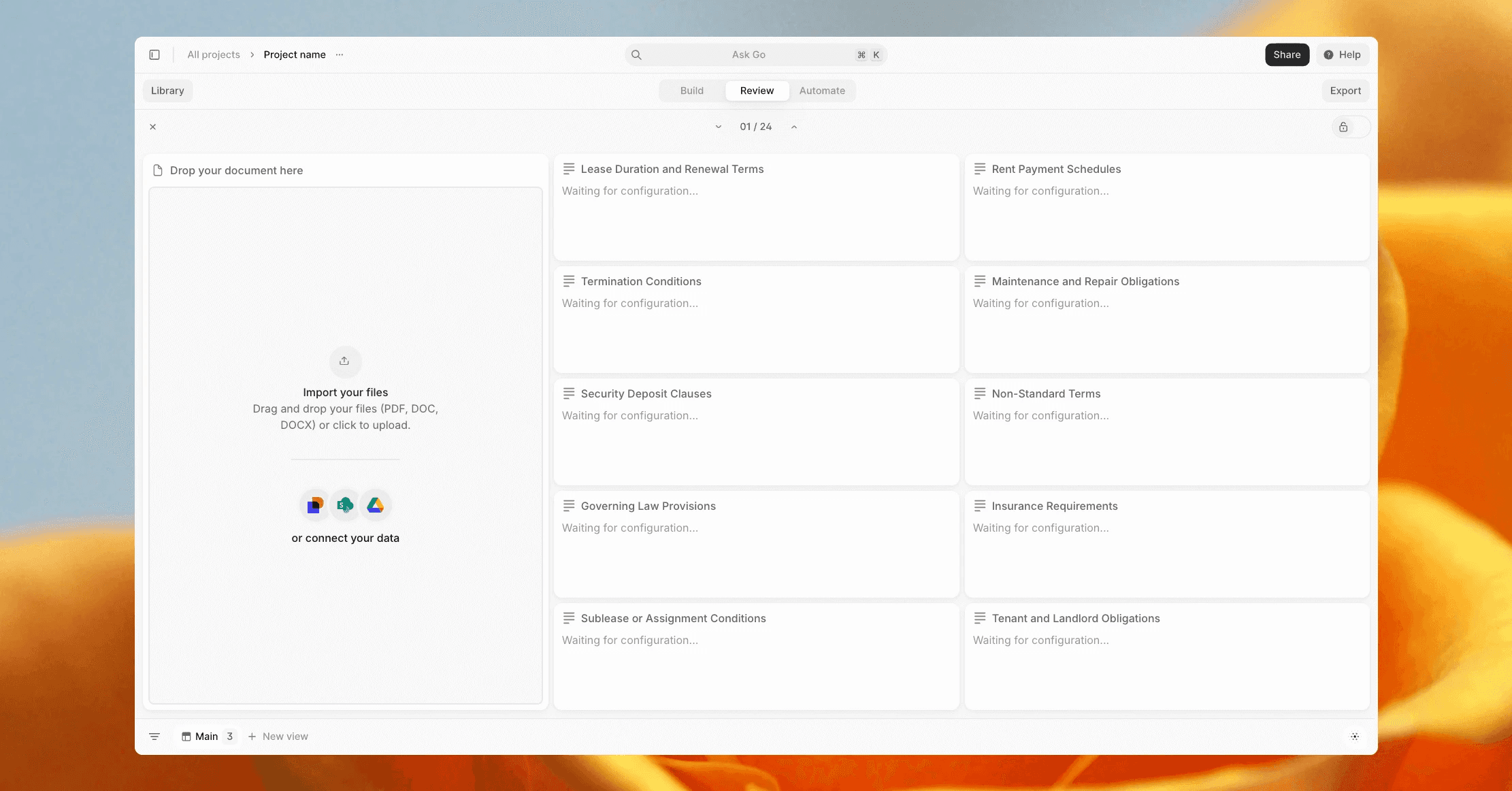
Leases and amendments load as one set per tenant, so a base lease that arrives without its amendments shows up as an incomplete row.
The survey row shows how one gap spreads to another, because counsel cannot narrow a B-II exception without a current survey. The 2026 ALTA/NSPS standards took effect February 23, 2026. As McGuireWoods notes, they added optional Table A Item 20, an encroachment summary table, and renumbered the items after it, so Item 21 is now the catch-all for negotiated requests. A survey ordered without Item 20 meets the standards and is still incomplete for a buyer who needs that encroachment table. The seller’s 2019 survey is also certified to someone else, so the row stays open until the buyer’s surveyor delivers.











Clean: complete, cross-checked and still inside its shelf life
A clean document passes three tests at once. It is complete, it agrees with every document that describes the same facts, and it is current. Tenant 7 shows what agreement looks like across four sources.
Field, Tenant 7 | Rent roll (Oct 1) | Lease or Amendment 1 | Estoppel (Oct 2) | T-12 receipts | Result |
|---|---|---|---|---|---|
Monthly base rent | $5,150 | $5,150 from Jan 1, 2026 (Amend. 1, Sec. 2) | $5,150 (para. 3) | $5,150 each month, Jan to Sep 2026 | Agrees |
Lease expiry | Dec 31, 2030 | Dec 31, 2030 (Amend. 1, Sec. 1) | Dec 31, 2030 (para. 2) | n/a | Agrees |
Security deposit | $10,300 | $10,300 (Lease Sec. 5) | $10,300 (para. 5) | n/a | Agrees |
Free rent or concessions | None | None after Mar 2025 (Lease Sec. 4.3) | None claimed (para. 7) | No abated months | Agrees |
Every cell carries a section or paragraph reference and an effective date. A credit officer can re-perform the tie-out without asking where a number came from. The full unit-by-unit method, including AR aging and tenants in a free-rent month, belongs to the rent roll analysis guide.

This fund report shows the source file beside each extracted value. A clean tenant row depends on the same link for every cell.
Clean also expires. Williams Mullen notes that estoppels should generally be dated no more than 30 days before closing and are still needed when an SNDA exists. Under ASTM E1527-21, certain Phase I components must be completed within 180 days of the acquisition date. With a hypothetical closing on Monday, November 30, both rules bite on this deal.
Document | Currency rule | Date it goes stale on this deal |
|---|---|---|
Tenant 7 estoppel, dated Oct 2 | No more than 30 days before closing (lender practice) | Stale after Nov 1, and 59 days old at a Nov 30 closing |
Seller’s prior Phase I, site visit May 12 (if it arrives) | Certain components within 180 days of acquisition | Stale after Nov 8, and 202 days old at closing |
The register records a stale-on date beside every clean row, so the clean count for closing can fall below the clean count for diligence. All 15 returned estoppels on this deal are dated in early October. Each one needs a bring-down or a fresh certificate before November 30.
Adverse: the finding goes to the person who can price it or walk
Adverse means the document is in the room, readable and showing a problem. Each row goes to one named person who can price it, cure it or recommend termination. Every document family produces its own kind of finding.
An estoppel claims a landlord default, or describes a side agreement missing from the lease file.
A Schedule B-II exception conflicts with the buyer’s intended use, or a recorded easement lines up with an encroachment on the survey.
A Phase I reports a recognized environmental condition. The question becomes whether a Phase II can be scoped, sampled and reported before the deadline.
A property condition report puts immediate needs well above the seller’s capital expenditure schedule.
Lease findings and property condition findings land with different reviewers, which is why every adverse row carries one named owner.
ASTM E2018-24 describes the baseline PCA as a walk-through survey, document review and interviews. Its output is a property condition report with opinions of cost for observed deficiencies. On this deal the report puts roof immediate needs at $186,000, against $40,000 in the seller’s capex schedule. The engineer confirms the $146,000 gap and the VP Acquisitions decides what it does to the price.
Document and location | Fact | Conflicting source | Delta | Owner | Decide by |
|---|---|---|---|---|---|
Estoppel, Tenant 12, para. 3 | Monthly rent $3,900 | Rent roll shows $4,200 (T-12 receipts show $3,900) | $300 a month, $3,600 a year, $11,400 over 38 remaining months | Acquisitions analyst, then VP Acquisitions | Mon Oct 26 |
PCR, immediate needs table, roof | $186,000 roof replacement | Seller capex schedule, roof line $40,000 | $146,000 | Engineer, then VP Acquisitions | Mon Oct 26 |
Estoppel, Tenant 14, para. 8 | Tenant claims an HVAC replacement promised by letter | No letter agreement in the lease file | Unquantified until the letter is produced | Deal counsel | Tue Oct 27 |
Seller’s existing owner’s policy, Schedule B, item 7 | Recorded restriction bars a pharmacy in the center | Business plan re-leases Tenant 4’s space to a pharmacy | Use conflict | Deal counsel | Tue Oct 27 |
Missing evidence stays out of this log. The three unreturned estoppels are a scheduling problem until a tenant signs something that contradicts the rent roll. Logging them as adverse would send a VP to price a risk nobody has seen.
Ten days to expiry: the escalation countdown
The register becomes a plan once every open row has an owner, an action, an escalation path and a fallback. This deal’s hypothetical PSA allows one 15-day extension by written notice at least three business days before expiry. That makes October 27 the working deadline for the Phase I call. Baker Donelson notes that the buyer’s right to walk sits inside the diligence period, so the October 30 cutoff is hard.
T-minus | Date | Item | State | Owner | Action | Escalates to | Fallback if missed |
|---|---|---|---|---|---|---|---|
T-10 | Tue Oct 20 | All 19 open rows | Not provided or incomplete | Diligence coordinator | One consolidated request letter to seller’s counsel | Deal counsel, if no reply by T-8 | Counsel calls seller’s counsel |
T-10 | Tue Oct 20 | Phase I | Not provided | VP Acquisitions | Order a new report, ask for any prior one | Environmental consultant, for reliance | Extension notice on T-3 |
T-9 | Wed Oct 21 | Title commitment | Not provided | Deal counsel | Press the title company for issue by Oct 23 | Title company’s underwriting counsel | Objections on known exceptions, extension request |
T-8 | Thu Oct 22 | Estoppels, Tenants 4, 15 and 17 | Not provided | Coordinator, via seller’s counsel | Re-request under each lease | VP Acquisitions, if a diligence item | Move to closing timeline or extension request |
T-7 | Fri Oct 23 | Title commitment and survey | Arrival expected | Deal counsel | Read B-I and B-II, order buyer’s survey with Table A Item 20 | VP Acquisitions | Exceptions listed as open in the memo |
T-4 | Mon Oct 26 | Four adverse rows | Adverse | VP Acquisitions | Open-items memo to IC: go, renegotiate, extend or terminate | Investment committee | Extension request on T-3 |
T-3 | Tue Oct 27 | Phase I | Not provided | Deal counsel | Extension notice unless a reliance-ready report is in hand | VP Acquisitions signs | Oct 30 expiry stands |
T-1 | Thu Oct 29 | All open rows | Mixed | Deal counsel | Draft the approval, waiver or termination notice | VP Acquisitions | PSA default for silence applies |
T-0 | Fri Oct 30, 5 p.m. | Diligence period | Expiry | VP Acquisitions | Notice delivered under the PSA | n/a | PSA default applies |
A 15-day extension moves expiry to November 14, which leaves the new Phase I three days of review after its November 11 average arrival. That margin is thin, so the T-3 notice should ask for the full 15 days even if the seller’s prior report turns up.
Estoppels need two treatments because PSAs handle them differently. Where they are a diligence deliverable, the three missing certificates cannot arrive before T-0. Cook Keith & Davis note that commercial leases give tenants 10 to 30 days to respond. A re-request on October 22 therefore lands between November 1 and November 21, after expiry in every case. Where estoppels are a closing condition, the row moves to the closing timeline. A certificate signed November 1 is then 29 days old at a November 30 closing, inside the 30-day norm Williams Mullen describes.
The Monday memo carries the 42.5% figure, the 19 open rows with expected dates, the four adverse rows with deltas and one recommendation per row. The VP Acquisitions or the committee makes the call, and counsel drafts whatever notice follows from it.
What the register cannot settle
Some diligence questions have no document in the room that answers them, so the register can log them but cannot close them.
Limit | Who resolves it, and with what |
|---|---|
Poor scans and handwritten estoppel edits | A reviewer reads the original, and the tenant confirms initialed changes in writing |
Evidence that arrives after expiry | Counsel and the VP Acquisitions, because a late adverse document changes bargaining position |
Tenant credit | Credit or acquisitions, with financial statements, guaranties and payment history from outside the room |
Market rent and re-leasing assumptions | Acquisitions, with broker opinions and comps |
Physical condition | An engineer on site, since a PCR describes a walk-through and some systems need invasive testing |
Jurisdiction | Local counsel and the title company, because title, survey and PSA conventions vary by state |
An estoppel claiming a landlord default that arrives on November 2 reaches a buyer whose deposit may already be at risk. On October 29 the same document would have carried more weight in a price conversation.
After closing, the register becomes the property file
At closing, V7 Go adds the reviewed records to the firm’s shared knowledge of the property with their sources intact. Asset management and the next deal team retrieve those approved records instead of reopening the seller’s room. Five groups of facts carry forward.
Tenant records with legal name, guarantor, expiry and options, from the lease and latest amendment.
The lease chain, with each amendment and its effective date, from the lease file.
Estoppel-confirmed rent, deposit, claimed defaults and signing date, from each certificate.
Title exceptions accepted and endorsements obtained, from the final commitment and pro forma policy.
PCA reserves and completed repairs, from the property condition report and closing statement.
Every carried fact keeps its effective date, so an estoppel-confirmed rent from October 2026 is never quoted as current in 2028. The real estate due diligence questionnaire guide covers the same date test for reused LP and lender answers.
A request letter for every not-provided and incomplete item
Send one letter on day 20 covering all 19 open rows, each tied to the PSA section that requires delivery. Counsel adapts the wording to the PSA before it goes out.
To [seller’s counsel], with copies to [seller contact] and [buyer’s deal counsel].
Regarding the Purchase and Sale Agreement dated [date] for [property], with the diligence period expiring at [time] on [date] under Section [x].
Under Section [x] of the Agreement, Buyer requests delivery of each item in the schedule below by the due date shown, in the form described.
[Reservation of rights. Buyer reserves all of its rights under the Agreement, including under Section [x]. Counsel to confirm wording.]
[Extension. Buyer may request an extension of the diligence period under Section [x]. Counsel to tailor or delete this paragraph.]
[Buyer contact name, role and email.]
Document | PSA section | State | What exactly is missing | Due date | Buyer owner | Seller contact |
|---|---|---|---|---|---|---|
Title commitment | [5.1(a)] | Not provided | Commitment with copies of all Schedule B-I and B-II documents | [Oct 23] | Deal counsel | [Title company, seller’s counsel] |
Prior Phase I ESA | [4.2(c)] | Not provided | Any prior report, plus the consultant’s contact for a reliance letter | [Oct 22] | VP Acquisitions | [Seller asset manager] |
Estoppels, Tenants 4, 15 and 17 | [9.1(d)] | Not provided | Tenant-signed, dated certificates on the agreed form | [Date per PSA] | Diligence coordinator | [Seller property manager] |
Leases, Tenants 3 and 9 | [Exh. D-2] | Incomplete | All amendments, side letters and rent schedules after the base lease | [Oct 23] | Acquisitions analyst | [Seller property manager] |
Estoppels with blank fields | [9.1(d)] | Incomplete | Completed rent and deposit lines, tenant signature and date | [Oct 26] | Diligence coordinator | [Seller property manager] |
Survey | [5.1(b)] | Incomplete | Certification to Buyer and lender, [Table A items] | [Date] | Deal counsel | [Seller’s counsel] |
[Next open row] | [Section] | [State] | [Page, exhibit, signature or schedule] | [Date] | [Name] | [Name] |
Is "not provided" in a data room the same as the seller saying the document does not exist?
The two are different facts. A not-provided row records only that the buyer asked for a document the PSA obliges the seller to deliver and has not received it by the date in the request. A written statement from the seller that the document does not exist is a separate fact, and it changes how the row is handled. If the seller confirms that no Phase I has ever been prepared, the row stops being a seller deliverable and becomes an item the buyer commissions, with its own arrival date and cost. If the seller says no amendments exist for a tenant whose rent roll figure cannot be produced by the base lease schedule, the statement conflicts with another document, and that conflict is a finding for the issue log. Either way, the statement belongs in the register with its date and author, and counsel decides whether it should also be covered by a representation in the PSA or a closing certificate.
+
Can a buyer rely on the seller's existing Phase I ESA, and when is it too old?
A buyer can often use a seller's prior Phase I as a starting point, but reliance usually needs a letter from the consultant who wrote it, and the lender may set its own conditions. Age is the second test. Under ASTM E1527-21, certain components of the report must be completed within 180 days of the acquisition date, so a report whose site visit and record searches took place on May 12 goes stale for those components after November 8. On a deal closing November 30, those components would be 202 days old and would need an update even with a reliance letter in hand. The practical sequence is to ask the seller on day one whether a prior report exists, check its dates against the expected closing, and order an update or a new report early enough that the 16-business-day average turnaround LightBox reported does not land after the diligence period.
+
Do estoppel certificates belong to the diligence period or to closing?
That depends on the PSA, and the register should show which one this deal uses. Some PSAs make estoppels a diligence deliverable, so a missing certificate at expiry is a reason to extend, reprice or terminate. Others make them a closing condition, which moves the row to the closing timeline and gives the seller until closing to deliver. The two rules then interact. Commercial leases typically give tenants 10 to 30 days to return an estoppel, and lenders generally want certificates dated no more than 30 days before closing. A certificate collected early in diligence can therefore be clean during diligence and stale at closing. Estoppels are also needed when an SNDA is in place, because the SNDA governs priority and the estoppel confirms facts such as rent, deposit, term and claimed defaults. Deal counsel confirms which treatment the PSA uses before the countdown is built.
+
What happens to a document that lands in the room after the diligence period expires?
The register still grades it, and the state is assigned the same way as before expiry. What changes is what the buyer can do with it. During the diligence period the buyer can usually terminate under the PSA's free walk-away right, and after expiry that right has typically ended, so a late adverse finding has to be handled through whatever remedies the PSA still provides, such as closing conditions, representations or specific objection rights. Some PSAs give the buyer a separate right to object to new title matters that appear after the commitment date, and counsel reads the agreement to see what applies. For the coordinator, the practical consequence is that every row expected to arrive after expiry should be flagged in the T-4 memo, so the VP Acquisitions can decide whether to request an extension while the buyer still has its strongest position.
+
Who should own each row of a CRE data room gap register?
A chat assistant answers the question in front of it, and each new question starts the reasoning again over whatever files it is given. That suits a quick look at one lease or one estoppel. A defined workflow starts from the PSA's list of expected documents and runs the same steps on every upload, so a new file is matched to a row, graded with a stated reason, cross-checked against the documents it should agree with and routed to an owner. Date arithmetic and rent deltas run in Python, so days to expiry and estoppel age are calculated the same way each time. The outputs are typed records with citations, which means a reviewer can open the estoppel paragraph or Schedule B-II item behind every state. Judgment stays with the reviewer in both cases, and the workflow makes it clear which rows still need that judgment.
+
How does a defined review workflow differ from asking a chat assistant about a data room folder?
Go is more accurate and robust than calling a model provider directly. By breaking down complex tasks into reasoning steps with Index Knowledge, Go enables LLMs to query your data more accurately than an out of the box API call. Combining this with conditional logic, which can route high sensitivity data to a human review, Go builds robustness into your AI powered workflows.
