15 min read
—



Casimir Rajnerowicz
Content Creator
V7 Go
A smarter way to manage due diligence and underwriting
The Phase I report is in the data room. The investment memo still needs an answer: what must happen before the property can close? For a commercial real-estate acquisition team, a Phase I environmental site assessment is both a technical investigation and an input to that decision. Receiving the PDF does not finish the work.
A consultant may identify a former industrial use, a missing regulatory file or a recommendation for further investigation. The deal team needs to preserve the meaning of that finding while deciding who will obtain the evidence, whether the timetable changes and what the investment committee should see. A short summary can lose the qualification that makes the conclusion useful.
The same problem appears in quieter reports. The address on the cover may omit an adjoining parcel included in the acquisition. An appendix may contain a records-review date much earlier than the report date. A seller's response may describe a tank as removed without supplying the closure records the consultant requested.
Those are questions for the relevant professional and transaction owner. They should not disappear when an investment analyst turns a long report into a paragraph.
This guide is for US commercial-property acquisitions, including real-estate private-equity teams and their diligence advisers. It explains the assessment's scope, how to read the resulting evidence and how to carry unresolved issues into the closing process. Our commercial real-estate due diligence checklist covers the wider acquisition workstreams.
AI can help prepare that review by extracting findings, comparing documents and attaching source references. It does not inspect the site, exercise the environmental professional's judgement or determine whether a buyer qualifies for liability protection. The useful output is a sourced review pack that the team can check and act on.
The date example below is hypothetical. Its purpose is to show why the team should track assessment components against the intended closing date, then ask the consultant to confirm the work required.
In this article:
Assessment scope, findings and the buyer's responsibilities.
Closing-date checks and a practical register of open questions.
Document comparison, AI-supported review and a pilot the team can evaluate.
What a Phase I environmental site assessment covers
A Phase I environmental site assessment investigates a property's environmental history and current conditions to identify potential contamination concerns. It combines documentary research with interviews, site reconnaissance and professional interpretation.
For US acquisitions, EPA's All Appropriate Inquiries guidance recognises ASTM E1527-21 as a way to satisfy the federal AAI requirements. Much of the inquiry must be conducted by, or under the responsible charge of, an environmental professional. A buyer also has information-gathering responsibilities; commissioning a report does not transfer every task to the consultant.
The familiar inputs include historical land-use records, government records, interviews and observations of the property and adjoining land. The environmental professional connects those sources to the conditions at the subject property. A database listing becomes useful through that interpretation, rather than simply because it appears in an appendix.
Confirm the assignment before comparing reports
Start with the property boundary, parcel identifiers, intended transaction and report user. Ask which buildings and parcels the assessment covers. A report for one parcel cannot silently become the assessment for an acquisition that includes three.
Record the agreed standard, consultant, scope limitations and any additional services. Make access arrangements early and identify who can answer questions about past operations. Give the consultant the buyer's relevant knowledge and available prior reports rather than expecting the same facts to emerge independently.
Assign the buyer-side inquiries explicitly. These include environmental-cleanup-lien information, relevant specialised knowledge and consideration of whether the purchase price reflects contamination. The engagement should show who obtains the information and how it reaches the assessment record. A blank response should remain an unanswered question until someone supplies or verifies the answer.
Keep the environmental inquiry distinct from other property investigations. A building-condition survey, asbestos survey or flood assessment answers different questions. Sampling soil or groundwater is normally associated with a separately scoped investigation, often called Phase II, rather than the standard Phase I process. Confirm any added services in the engagement.
For the acquisition lead, the first useful deliverable is a scope record: what property is covered, what work was commissioned, who supplied information and which questions remain outside the assignment. That record prevents a broad statement such as "environmental diligence complete" from concealing unfinished work elsewhere.
Read findings before writing the investment memo
Preserve the environmental professional's finding, reasoning and limitations before translating it into an investment question. The conclusion and the evidence supporting it belong together.
ASTM E1527-21 uses the term recognized environmental condition, or REC, for specified circumstances involving hazardous substances or petroleum products: a release, likely release or material threat of a future release. A REC is a professional classification, not a quotation for clean-up work. The standard also distinguishes de minimis conditions from RECs.
Keep the report's exact classification in the review record. If it uses historical or controlled-condition terminology, retain the consultant's explanation and any restrictions described. An analyst should not collapse every category into a single red or green rating or upgrade an ambiguous observation into a confirmed release.
Separate three things that often get merged
The finding: what the professional concluded about the property.
The limitation: what could not be established and whether it affects that conclusion.
The next step: what further information or investigation the professional recommends.
Consider a hypothetical warehouse report that identifies a concern associated with former solvent use and recommends further investigation. The investment memo should identify that concern and recommendation, with the relevant pages. It should not convert them into "minor contamination, covered by contingency" when no investigation or cost basis supports those words.
A missing record needs the same discipline. The absence of a tank-closure document is not proof that a tank remains in place, and it is not proof that closure was completed properly. Ask what evidence the consultant needs and how the missing information affects the opinion.
Use a compact finding record: property, consultant classification, source page, material qualification, recommended follow-up and open question. Keep the original wording available even when the memo uses a shorter paraphrase. A reviewer should be able to move from the investment statement to the evidence without searching the entire report.
Where the executive summary and a later addendum differ, flag the difference. Ask the consultant which conclusion governs and retain both versions. The acquisition team needs a current answer and a record of why it changed.
Read significant data gaps in that context. The important question is how the gap affects the professional's ability to reach an opinion. A missing historical source is not automatically a reason to abandon the acquisition, but removing the qualification from the committee summary prevents the committee from understanding the evidence it actually has.
Check assessment dates against the closing date
Check the dates of the underlying assessment components against the planned acquisition date. The date printed on the report cover is not enough.
40 CFR 312.20 requires AAI within one year before acquisition, with five components conducted or updated within 180 days: interviews, environmental-cleanup-lien searches, government-record reviews, visual inspections and the environmental professional's declaration. The regulation also addresses reuse of prior information and changes that require updating.
Maintain a separate date for each relevant component. If a date is missing, ask for it rather than substituting the PDF's creation date. Use calendar days in the calculation; six calendar months is not always 180 days.
A hypothetical closing delay
Assume a report was issued on 20 May 2026, with its government-record review completed on 10 January. The initial acquisition date is 1 July. The records review is then 172 days old. This checks one component only; the team still needs the dates and requirements for the rest of the inquiry.
Now closing moves to 1 August. The same records review is 203 days old, although the report's issue date is only 73 days earlier. A spreadsheet that watches only the cover date could miss the component requiring attention.
The workflow should flag the January date, identify its source and ask the environmental professional to confirm the necessary update. It should not silently change the assessment date to the addendum date or declare the report acceptable because another component was completed more recently.
Assign ownership of this check. The transaction lead maintains the expected acquisition date; the consultant confirms assessment components and update requirements; counsel and the lender address their respective reliance and transaction requirements. Recheck the record whenever the closing timetable changes.
Keep the calculation auditable: component name, completion or update date, source page, intended acquisition date and calculated age. Preserve the prior calculation when the timetable changes. If the team cannot find a component date, label it missing and assign a question; do not allow an empty field to pass a date check.
A prior seller report also raises questions beyond age. Confirm the report user, permitted reliance, current site conditions and additional buyer inquiries. A recent PDF is useful evidence, but its existence alone does not establish that the buyer has completed the required work.
Turn recommendations into deal conditions
Give every unresolved environmental question an owner, required evidence and decision date. The acquisition team needs to know what happens next and which decision depends on the answer.
Use an action register alongside the investment memo. For each item, retain the affected parcel, finding reference, requested information, responsible person, target date and current status. Add a separate field for the decision it informs, such as consultant follow-up, lender acceptance or an investment-committee condition.
Keep investigation and negotiation separate
A Phase II recommendation may require a scope, site access, a proposal and time for results. The environmental professional determines the investigation needed. The deal team works out how that programme fits the transaction and who can authorise it.
Do not enter an unsupported remediation allowance merely to complete the model. Record whether a number is a consultant's estimate, a contractor's proposal or a provisional investment assumption. Include its scope and exclusions. Those are different levels of evidence and should remain visible in committee materials.
Counsel may consider contractual protections while the investment team evaluates price or timing. Those negotiations do not resolve a technical uncertainty by themselves. Keep the professional's finding open until the relevant evidence or decision actually changes it.
For example, a seller's agreement to provide historic records closes the negotiation about who will obtain them. It does not close the underlying environmental question. The register should show that the documents are still due and that the consultant must review them.
Write completion criteria that another team member could apply. "Environmental issue resolved" is difficult to verify. "Consultant has reviewed the supplied closure records and issued an addendum addressing the recommendation on page 18" identifies a document and a decision. The precise requirement should come from the adviser, then remain attached to the action until it is satisfied.
Carry obligations beyond acquisition
AAI is one part of the analysis of potential liability protection. EPA's landowner-liability guidance explains that protection depends on meeting statutory conditions. The buyer's legal review should address the relevant prerequisites and continuing obligations, not assume that ordering a Phase I supplies a complete defence.
When the transaction proceeds, hand any applicable restrictions, monitoring requirements and agreed actions to the asset-management owner. Retain their source documents and responsible advisers. An item marked complete for the acquisition team may still require action during ownership.











Compare evidence across the property data room
Connect the environmental report to the correct property, document versions and transaction records. A summary based on the wrong parcel or a superseded opinion can be fluent and still mislead the deal team.
Start with a small, defined source pack: the current Phase I, appendices, addenda, available prior environmental reports, site plan, parcel schedule and relevant seller responses. Include additional material because it answers a question, not simply because it is available in the room.
Environmental report parsing appears in the due-diligence row of the CRE workflow map below, alongside title and survey review. Connecting these records helps the acquisition team keep property identity and open questions consistent across workstreams.

V7's CRE workflow map places environmental report parsing alongside title and survey review during diligence. Sources: JLL Global Real Estate Technology Survey, 2025; First American / DealGround, 2026.
Preserve who said what
A seller disclosure may say there have been no known spills. A lease may permit activities involving hazardous materials. The consultant may identify evidence that needs further investigation. These statements come from different sources and answer different questions.
Keep the attribution with every extracted claim. The property-disclosure review should preserve the seller's representation separately from the professional's conclusion. Agreement between documents can support review; disagreement should create a question with both references attached.
Resolve identity before comparison. Match parcel identifiers and boundaries before comparing addresses. A neighbouring facility's record must not become a confirmed condition at the target property merely because it appears in the same database search.
Store the source filename, version, page and relevant passage. For scanned reports, check extraction on the conclusion pages and tables before relying on a generated summary. Poor OCR can change a date, omit a qualifier or attach a statement to the wrong heading.
When an addendum arrives, identify the findings it changes and refresh the affected memo passages and actions. Retain the earlier record as superseded. A change to one parcel should not erase unresolved items for another parcel in the same acquisition.
Track missing attachments at intake. A report may refer to an agency letter, historical map or table that was excluded from the uploaded PDF. The review pack should distinguish a reference to an attachment from possession of that attachment. Request the missing file before asking a system or an analyst to explain evidence they cannot inspect.
The practical output is a short list of supported conclusions and explicit uncertainties. A larger summary that merges every source into one confident narrative makes review harder, even when every individual sentence sounds plausible.
Use AI to prepare a reviewable report summary
AI can extract report content, connect supporting evidence and prepare questions for review. The environmental professional remains responsible for the assessment and opinion; the buyer retains the investment decision.
V7 Go provides AI infrastructure for private markets. Its Context Graph gives a workflow access to approved firm context, such as property identities, earlier diligence decisions and the team's review criteria. The implementation should distinguish reusable firm knowledge from the current consultant's report and transaction-specific evidence.
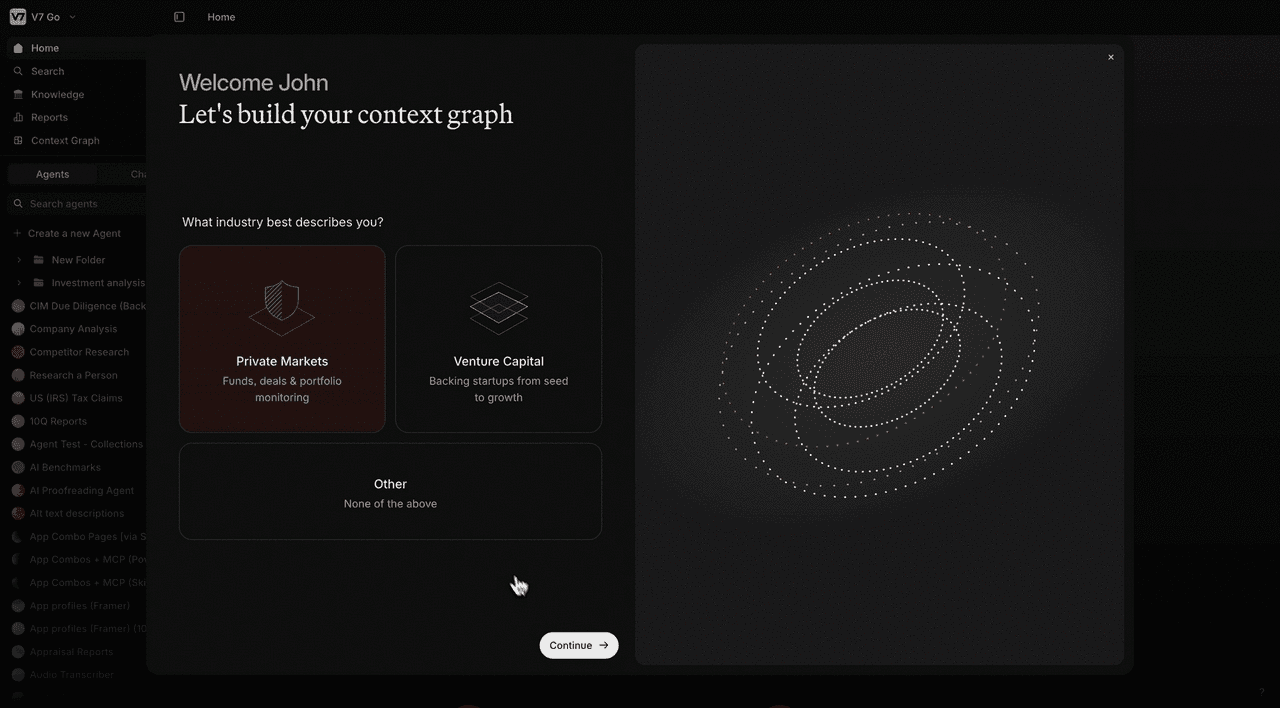
V7 Go's onboarding introduces industry-specific Context Graph setup. The report-review workflow is then scoped around the transaction's documents and review criteria.
Define the steps and outputs
A proposed Phase I report-review workflow can identify the document version, extract the professional's conclusions, attach source passages, compare parcel references and prepare the open-item register. Give each step a defined output so a missing source produces an unresolved field rather than a guessed answer.
V7 Go's source citations support that inspection. A Python calculation step can calculate calendar-day intervals once the dates are verified. Keep date extraction and date arithmetic separate: a correct subtraction cannot repair a misread year.
Require the output to distinguish the consultant's conclusion, a seller's claim and the workflow's proposed question. A proposed question must not appear in the investment memo as a new professional finding. Likewise, an empty recommendation field must not become "no further action" without supporting text.
Solutions engineers can configure the sequence around the firm's documents, systems and review criteria, then test it with the team. Define where findings go, who can correct them and how an approved correction updates the memo. The workflow should prepare the review consistently without implying that every model-generated interpretation is correct.
Start with one bounded deliverable: a sourced findings sheet with dates and open questions. Add downstream memo preparation once the reviewers trust that record. This makes errors easier to locate and gives the consultant a clear set of questions to resolve.
Define failure behaviour as part of the sequence. An incomplete upload, unavailable source system or unrecognised report structure should stop the affected step and show the reason. A partially completed review pack needs a visible status so the next person does not mistake missing outputs for a completed review with no findings.
Test the workflow on completed acquisitions
Test missed findings and unsupported conclusions before measuring time saved. A shorter review is useful only if the resulting record preserves the issues that matter.
Select completed acquisitions with their actual reports, addenda and resolved questions. Have the environmental adviser and deal team agree what a correct review pack should contain. Keep a separate set for evaluation after configuration so the final check includes documents that did not shape the workflow.
Include cases that are easy to summarise incorrectly: a report with no identified RECs but a material limitation; an addendum changing a conclusion; several parcels with different findings; an old component date inside a recent report; and a poor scan with an unreadable number.
Measure whether each material finding and recommendation survives extraction, whether its citation supports it and whether uncertainty stays visible. Count unsupported statements separately from missing statements. A summary can contain every expected finding and still add a false assurance that the source never gave.
Record reviewer corrections and time per case. Distinguish time spent finding evidence from time waiting for the seller or consultant. Faster document handling cannot guarantee faster completion of an investigation or a closing decision.
Set access by transaction and role, check retention and model-provider arrangements, and test whether users can retrieve documents outside their permitted deal. Keep a history of corrections and approvals. The person editing an extracted field should not automatically gain authority to approve the environmental position.
Run the pilot alongside the existing review process. Expand only when the team can explain the errors, verify the sources and reproduce the handoff on the evaluation set.
Agree acceptance criteria before testing. For example, every material recommendation in the evaluation set must reach the action register, and every memo statement must have supporting evidence. Record both the result and the size of the set. A clean pilot provides evidence about those cases; ongoing sampling checks how the workflow performs on new reports.
Bring one redacted Phase I report, its supporting files and the investment memo it informed to the workflow discussion. Add the questions that took the most effort to resolve. Those materials define a useful starting point for a V7 Go pilot.
The goal is a review pack that lets the acquisition lead see the finding, inspect the evidence and identify the next decision. The report arriving in the data room should start that handoff, not stand in for it.
What is included in a Phase I environmental site assessment?
A Phase I environmental site assessment typically brings together historical records, government records, interviews, site reconnaissance and the environmental professional's findings and conclusions. The report should identify its property, scope, limitations and significant data gaps. The precise engagement matters: a building-condition survey, asbestos survey or sampling programme is not automatically included because the documents all concern the same property. Ask the consultant to explain additional services and the buyer's own information responsibilities. For acquisition review, retain the appendices and any addenda with the report. A summary without the supporting records can conceal qualifications or references that the deal team needs to understand before deciding what to do next.
+
Who can perform a Phase I environmental site assessment?
For an assessment intended to satisfy All Appropriate Inquiries, relevant work must be performed by, or under the supervision or responsible charge of, a person meeting the rule's definition of an environmental professional. The definition combines relevant education, licensing or certification, and experience through specified qualification routes. Do not assume that a property inspector, an investment analyst or a software provider meets that definition. Confirm the consultant's qualifications and the person responsible for the final opinion when commissioning the work. The buyer also has additional information-gathering responsibilities. An AI system can help organise documents and prepare a review, but it does not become the environmental professional or sign the assessment on that person's behalf.
+
How long is a Phase I environmental site assessment valid?
For US acquisition-related AAI, the inquiry must be conducted or updated within one year before acquisition, and five specified components must be conducted or updated within 180 days. Those components concern interviews, environmental-cleanup-lien searches, government-record reviews, visual inspections and the environmental professional's declaration. Check the underlying dates rather than treating the report-cover date as the only clock. Reuse also depends on the applicable requirements, current conditions and buyer inquiries, so age alone does not settle whether a prior report is suitable. When closing moves, recalculate component ages and ask the environmental professional to confirm the required update. The lender's requirements and the buyer's right to rely on a report also need separate confirmation.
+
What is the difference between Phase I and Phase II?
Phase I investigates environmental conditions through research, interviews, observations and professional interpretation. Phase II is a separately scoped investigation that may use sampling and laboratory analysis to evaluate suspected contamination. The appropriate scope depends on the concern being investigated; it should not be inferred from the report's length or a generic checklist. A Phase I recommendation for further investigation is therefore an action for the environmental professional and transaction team to resolve. It does not automatically establish the extent of contamination, the cost of remediation or whether the acquisition should proceed. Record the recommended work, access requirements, expected evidence and decision owner so the next step remains visible in the closing process.
+
How much does a Phase I environmental site assessment cost?
AI can assist with document handling and review, but it cannot replace the environmental professional's inquiry, site work or judgement. A useful application is to extract the report's findings and dates, attach source references, compare parcel details and prepare an open-question register for the acquisition team. The workflow should preserve limitations, missing information and the distinction between a consultant's opinion and a seller's statement. Test it on reports that were not used during configuration, and inspect both missed findings and unsupported conclusions. A generated summary is not an environmental clearance or a determination of liability protection. The professional confirms the assessment, while the buyer and its advisers make the transaction decisions.
+
Can AI perform a Phase I environmental site assessment?
Go is more accurate and robust than calling a model provider directly. By breaking down complex tasks into reasoning steps with Index Knowledge, Go enables LLMs to query your data more accurately than an out of the box API call. Combining this with conditional logic, which can route high sensitivity data to a human review, Go builds robustness into your AI powered workflows.
