13 min read
—



V7 Go
A smarter way to manage due diligence and underwriting
On a commercial lease, common area maintenance charges are rarely a rounding error. They routinely run 20 to 30 percent of a tenant's base rent, and they move every year. Which means the one document that decides whether a tenant owes another few thousand dollars, or gets money back, is the CAM reconciliation. Get it wrong in the landlord's favor and you invite an audit. Get it wrong in the tenant's favor and you eat the difference across a whole portfolio.
CAM reconciliation is the annual process of comparing the estimated common area maintenance (CAM) charges a landlord billed tenants during the year against the actual costs the property incurred. If actual costs came in higher than the estimates collected, each tenant owes a true-up payment; if they came in lower, each tenant is due a credit or refund.
That sounds simple. In a single-tenant building it nearly is. Across a portfolio of twenty properties with a dozen tenants each, every one on a slightly different lease, it becomes hundreds of invoices, dozens of exclusion clauses, and weeks of spreadsheet work against a contractual deadline. This guide covers what CAM reconciliation is, how the math actually works, how to keep it out of dispute, and where AI now removes most of the manual load.
In this article:
What CAM reconciliation is, and how the estimate-and-true-up cycle works.
Controllable versus non-controllable expenses, and the seven-step process.
Pro-rata shares, gross-ups, and exclusions, with worked numbers.
How disputes start, and how AI automates the document-heavy parts.
What CAM reconciliation is
Common area maintenance (CAM) is the set of shared costs a landlord incurs to run the parts of a property that every tenant uses: lobbies, elevators, parking lots, landscaping, security, and the utilities and management that keep them running. In a net lease, tenants reimburse these costs in proportion to the space they occupy. CAM reconciliation is how that reimbursement gets trued up once a year against what the property actually spent.
The cycle has two halves that people often confuse. Throughout the year, the landlord collects estimated CAM as a monthly charge, based on a budget set at the start of the year. That ongoing collection is sometimes called CAM recovery. Then, after the year closes, the landlord tallies the actual costs, recalculates each tenant's share, and compares it to what that tenant already paid. That annual true-up is the reconciliation. Recovery is the monthly estimate; reconciliation is the yearly correction.
The result lands one of two ways. In most years, actual costs exceed the estimate and the tenant owes a true-up payment. In a mild year, estimates ran high and the tenant is owed a credit against future charges or a refund. Either way, the reconciliation statement is the document that has to defend the number.
CAM reconciliation applies to leases where tenants carry operating costs: triple net (NNN), double net, and modified gross leases. It does not apply to full-service gross leases, where the landlord absorbs operating costs and charges a single all-in rent. The timing is contractual, not statutory: most leases require the landlord to deliver a reconciliation statement within 30 to 90 days after the December 31 close, and give the tenant a defined window to review the books and raise questions. The specific lease governs, always.
What a CAM reconciliation statement includes
A complete statement itemizes the property's operating costs by category, typically utilities for common areas, real property taxes, insurance, janitorial, landscaping, snow and trash removal, security, and a management fee, minus any items the lease excludes. It then shows the tenant's pro-rata share of each eligible category, the total the tenant owes, the total already paid in estimates, and the resulting balance. The categories are where most of the argument lives, because whether a given cost belongs in CAM at all depends on the lease.
Controllable versus non-controllable CAM expenses
Before you can allocate an expense, you have to classify it, and the classification that matters most is controllable versus non-controllable. A controllable expense is one the landlord can shop, negotiate, or manage: landscaping, janitorial, security, administrative labor, and the management fee. A non-controllable expense is one the market or the government sets: electricity, gas, water, real property taxes, and insurance premiums. The landlord has no meaningful lever on those.
The distinction is not academic. Leases frequently cap the year-over-year increase a tenant absorbs on controllable expenses, often at 3 to 5 percent, while leaving non-controllable expenses uncapped. Misclassify an uncapped cost as capped, or the reverse, and the tenant's number is wrong before you have divided anything.
Type | Examples | Typically capped? |
|---|---|---|
Controllable | Landscaping, janitorial, security, management fees, administrative labor, parking upkeep | Often yes, via an annual increase cap |
Non-controllable | Electricity, gas, water, real property taxes, insurance premiums, snow removal | Usually no, passed through in full |

Reconciliation starts as a classification problem: every line item on every invoice has to be sorted against the lease before a single share is calculated. Capital improvements are the perennial gray area, usually excluded unless the lease allows amortization of an item that reduces operating cost.
The CAM reconciliation process, in seven steps
Every property runs the same sequence. The difficulty is not any single step; it is doing all seven for every tenant, against every lease, before the delivery deadline.
Collect the year's operating expense records. Pull every utility bill, vendor invoice, tax bill, and insurance statement for the reconciliation period into one place.
Classify each expense as CAM-eligible or excluded. Check each line item against the lease's definition of allowable CAM, and remove anything the lease excludes.
Establish the denominator. Confirm the property's total gross leasable area (GLA), and apply a gross-up if occupancy is below the lease threshold.
Calculate each tenant's pro-rata share. Divide the tenant's leased square footage by the total area, adjusting for any mid-year move-ins, move-outs, or expansions.
Apply caps and exclusions. Reduce controllable expenses to each tenant's negotiated cap before allocating, and honor any tenant-specific exclusions.
Prepare the reconciliation statement. Itemize expenses by category, show the allocation method, and compute the difference between estimated payments and the actual share.
Deliver and settle. Send each statement within the lease-required window with backup documentation, then collect the true-up or issue the credit.
In a portfolio with dozens of tenants across several properties, running steps one through seven by hand routinely takes 40 or more hours per reconciliation cycle, most of it spent not on judgment but on opening invoices and keying numbers.
Pro-rata shares, gross-ups, and exclusions
Three calculation mechanics decide the final number, and each is a common source of error. Understanding them is the difference between a statement that survives an audit and one that starts a dispute.
The pro-rata share calculation
A tenant's pro-rata share is their leased area divided by the property's total area, applied to eligible CAM costs. The formula is: (tenant's leased square footage / total rentable area) x total CAM expenses = the tenant's CAM share. The trap is the denominator. Leases variously specify total leasable area, occupied area, or a fixed figure, and using the wrong one shifts every tenant's number.
Input | Value |
|---|---|
Total building GLA | 50,000 sq ft |
Tenant A leased space | 5,000 sq ft |
Tenant A pro-rata share | 10% |
Total actual CAM expenses | $120,000 |
Tenant A's CAM share (10% of $120,000) | $12,000 |
Tenant A's estimated payments already collected | $10,500 |
True-up owed by Tenant A | $1,500 |
Gross-up provisions
A gross-up provision handles vacancy. When a building is not fully occupied, some variable costs (janitorial in leased suites, for instance) come in lower than they would at full occupancy. A gross-up lets the landlord inflate those variable expenses to what they would have been at full occupancy before dividing them, so occupied tenants cover the cost of running the shared space rather than benefiting from empty units. The math is straightforward once you see it.
A building has five equal spaces; only four are occupied, so occupancy is 80 percent. Actual variable CAM expenses are $800. Without a gross-up, each tenant pays 20 percent of $800, or $160, and the four tenants together cover only $640, leaving the landlord to absorb the rest. With a gross-up to 100 percent occupancy, expenses are inflated to $1,000. Each tenant pays 20 percent of $1,000, or $200, and the four together cover the full $800.
Gross-ups are legitimate and common, but they are also negotiated. Leases often cap the gross-up assumption, and they usually restrict it to genuinely variable costs, not fixed ones like property taxes. A gross-up applied to the wrong expense type is a frequent and expensive mistake.
Exclusions and expense caps
Exclusions are the items a specific lease bars from CAM: capital improvements, costs reimbursed by insurance, expenses attributable to a single other tenant, and often the landlord's financing or leasing costs. Caps are the ceiling on how much a controllable expense can rise year over year before the tenant stops absorbing the increase. And running underneath both is the prohibition on double-dipping: if the landlord recovers a cost through insurance proceeds or bills it directly to one tenant, that same cost cannot also appear in the pooled CAM. Every one of these is lease-specific, which is exactly why reconciliation resists a single template.











Common CAM disputes, and how to prevent them
Most CAM disputes trace to a handful of causes: a pro-rata share calculated on the wrong denominator, an excluded expense that slipped into the pool, a gross-up applied to a fixed cost, or a capital expenditure dressed up as a repair. None of these is exotic. They are the predictable result of doing a lease-specific calculation at portfolio scale with a spreadsheet.
Tenants are not powerless here. Most commercial leases grant audit rights: within a defined window, usually 12 months from the statement, the tenant can inspect the landlord's books and records behind the reconciliation. A tenant who requests backup and finds an excluded cost in the pool has grounds to claw it back, and a pattern of them sours the relationship well beyond the dollars. This is what a CAM audit is for, and it is why the statement has to be defensible line by line.
Prevention is mostly discipline. Negotiate clear CAM definitions and exclusions before signing, so there is less to argue about later. Deliver the statement with itemized backup documentation attached, not on request. Track each expense category year over year, because a sudden spike in one line is the thing an auditor will find first. And reconcile promptly, since a statement delivered late and defended from memory is a statement you are likely to lose.
How AI automates CAM reconciliation
Here is the honest read on where the hours actually go. The judgment in a reconciliation, deciding whether an ambiguous capital cost qualifies, or how aggressively to defend a gross-up, is a small fraction of the work. The rest is document labor: opening hundreds of invoices, reading each lease to find its cap and exclusion language, keying figures into a spreadsheet, and assembling a statement per tenant. That is the part AI removes, and it is why AI in commercial real estate has moved from pilot to production on exactly this kind of workflow.
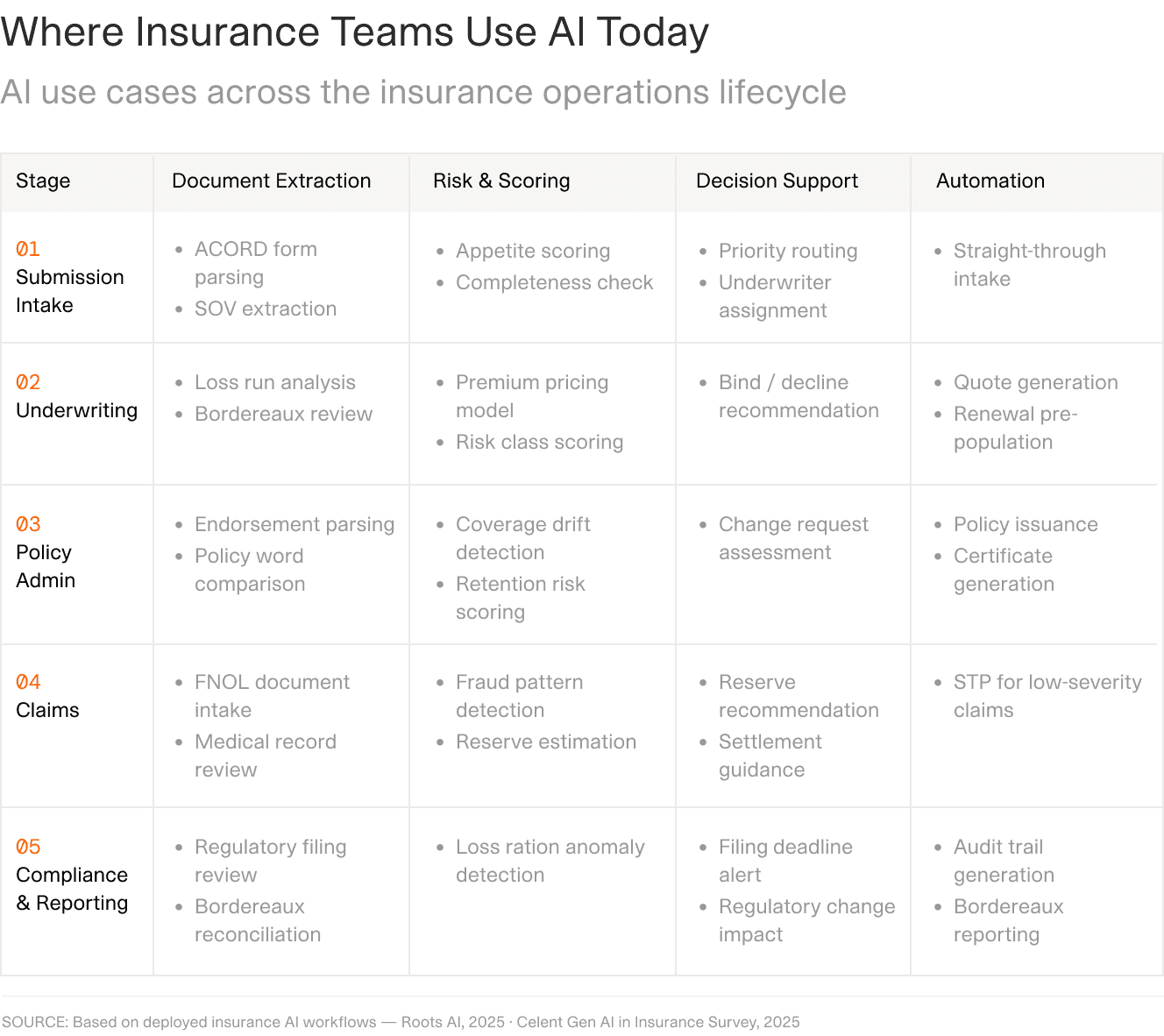
CAM reconciliation shows up by name in the asset management row of this use-case matrix, alongside lease renewal review and budget variance, the same document-extraction work this section walks through step by step. Source: JLL Global Real Estate Technology Survey, 2025; First American / DealGround, 2026.
A useful way to see it is to walk the same seven steps, and mark where the tool takes over from the analyst.
Reading the invoices and expense records
The reconciliation starts with a stack of documents in every format a vendor might send: PDF utility bills, scanned paper invoices, emailed statements, tax bills. AI reads them and extracts the vendor, the expense category, the amount, and the period, without manual keying, the same class of intelligent document processing that underpins the broader category of data extraction tools. The most time-consuming step becomes the fastest.
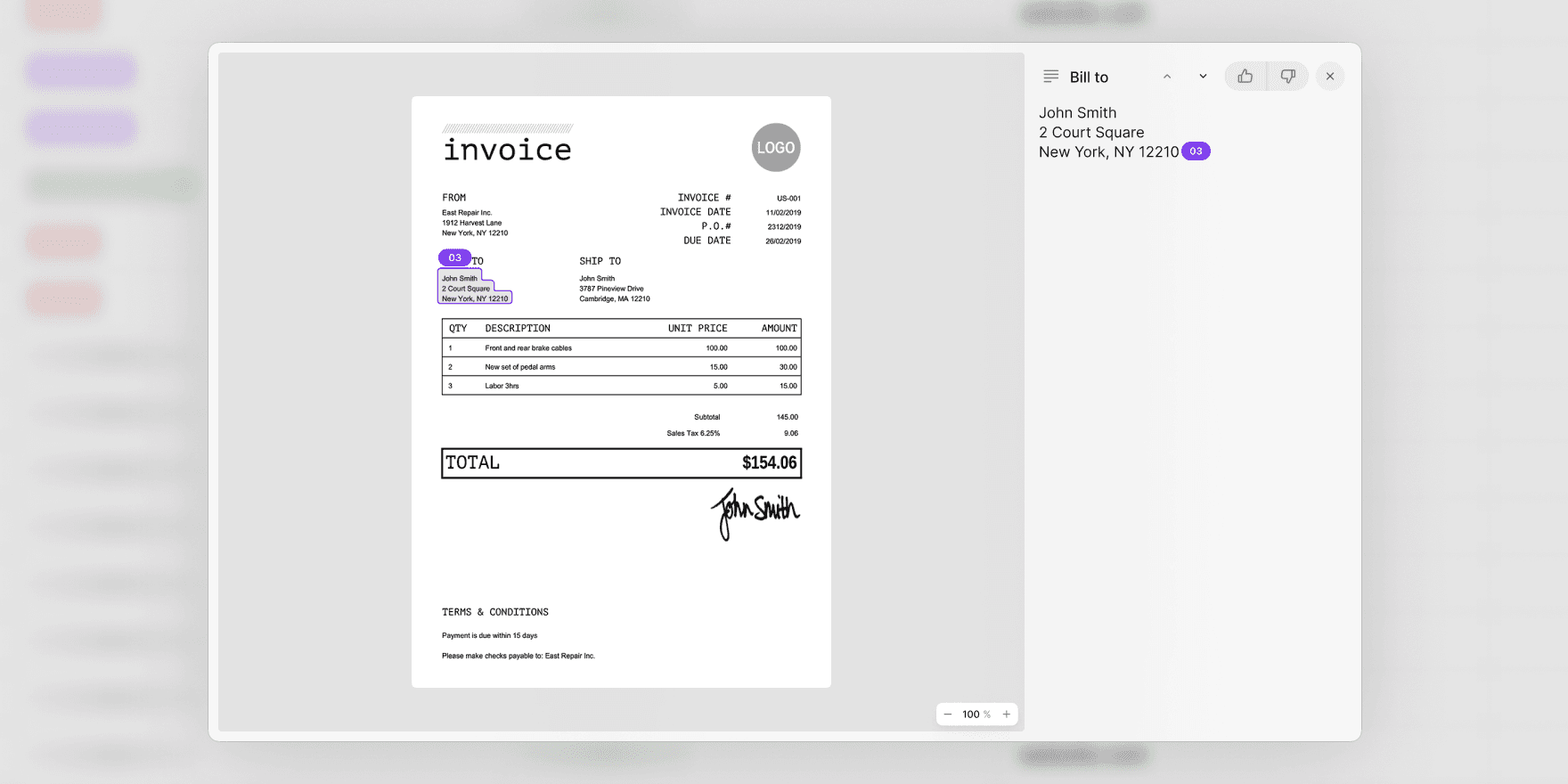
Every extracted figure stays linked to the invoice it came from. When a tenant asks where a number originated, the answer is one click to the source line, not an afternoon in a filing cabinet.
Applying each lease's own terms
This is the step that defeats a generic spreadsheet, because there is no single rule; there is a rule per lease. Before it can allocate anything, the system reads the lease and abstracts the terms that govern CAM: the cap percentages, the exclusion list, the gross-up language, and the square footage. This is lease abstraction, and it is the upstream input that makes the rest possible; V7 Go's lease analysis pulls those clauses out of each agreement so the classification runs against the tenant's actual terms rather than a default. Ambiguous items get flagged for a person; the mechanical ones do not.
Calculating shares, gross-ups, and the statement
With expenses classified and lease terms in hand, the pro-rata math is deterministic. The system tracks square-footage changes, mid-year move-ins and move-outs, and expansions, applies the gross-up where the lease calls for it, and produces each tenant's share, then assembles the reconciliation statement itself, itemized by category with the allocation method shown and the backup attached.
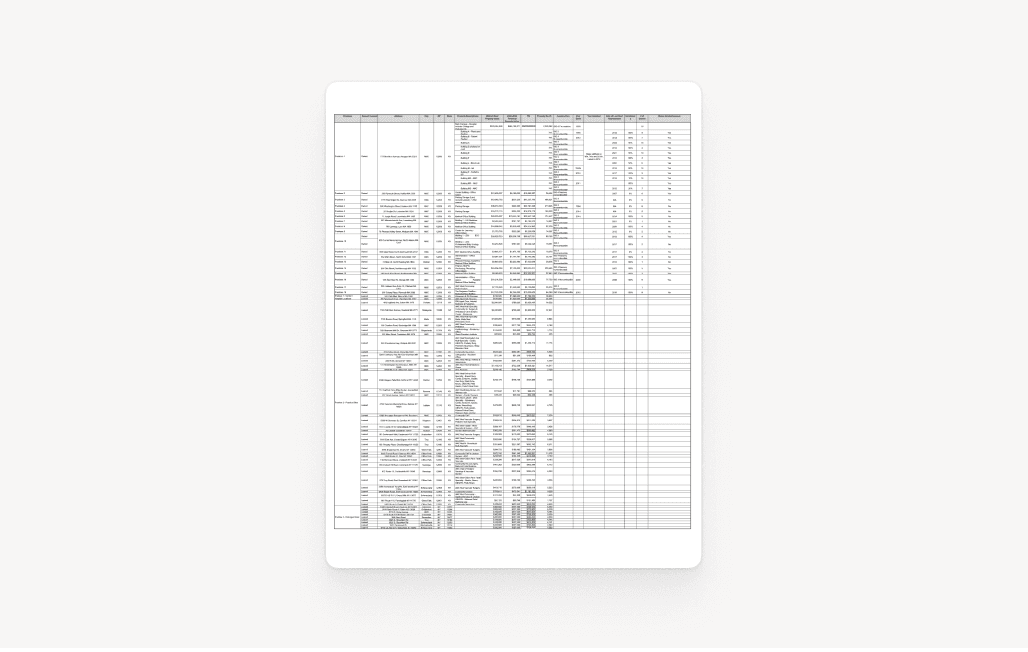
What took 40 hours of collecting and keying becomes a review task: the analyst checks the flagged items and the edge cases, and signs off on the rest.
When a tenant disputes, and what to look for in software
When a dispute does come, the case assembles itself. The relevant invoices, the calculation record, and the governing lease clauses sit in one view, each figure traceable to its source, so the conversation is about the substance rather than about finding the paperwork. Across a portfolio, that same structured record becomes institutional memory: with a Context Graph holding every property's leases, expenses, and prior reconciliations, next year's cycle does not start from a blank spreadsheet, and the knowledge does not leave when a lease administrator does. Knowledge graph is the general term for that kind of structure, entities such as properties, tenants, and expense categories held as connected records instead of a folder of spreadsheets, and Context Graph is V7's own implementation of it: point it at a portfolio's leases and statements and it resolves the same tenant or the same expense category across every property it appears in, so a question like which tenants have disputed a gross-up in the last two reconciliation cycles comes back tied to the specific statements it was drawn from.
If you are evaluating a tool for this, the criteria are narrow and worth holding to. It should read your specific lease language and apply it, rather than run the arithmetic alone. It should ingest documents in whatever format vendors send. It should keep a complete audit trail of every classification decision. It should scale across multiple properties and tenants at once, and it should trace every number back to a source document. Those are the same capabilities that make AI useful across real estate more broadly, from lease administration to cash-flow modeling.
CAM reconciliation is not hard because the math is hard. It is hard because it is a lease-specific calculation repeated across every tenant and every property, on a deadline, using documents that arrive in a dozen formats. The math is the easy part. The document handling is the job.
That is also why it responds so well to automation. Move the reading, classifying, and keying to AI, and the analyst is left with the part that actually needs a person: the ambiguous exclusion, the aggressive gross-up, the tenant relationship. The statement still gets a human sign-off. It just no longer takes a week to produce.
If you want to see what that looks like on your own leases and operating statements, V7 runs a working session built around a real property's documents, ending in a reconciliation statement you can check line by line. It takes about the length of one manual reconciliation, for one tenant.
What is CAM reconciliation?
CAM reconciliation is the annual process in which a commercial landlord compares the estimated common area maintenance (CAM) charges billed to tenants during the year against the actual costs the property incurred. Throughout the year, tenants pay an estimated CAM charge each month based on the landlord's budget. After the year closes, the landlord tallies actual costs, recalculates each tenant's share, and compares it to what that tenant already paid. If actual costs exceeded the estimates, the tenant owes a true-up payment; if the estimates were higher than actual costs, the tenant receives a credit or refund. The reconciliation statement is the document that itemizes those costs and shows how each tenant's balance was calculated, and it applies to net and modified gross leases rather than full-service gross leases.
+
How is CAM reconciliation calculated?
Each tenant's share of actual CAM expenses is calculated by multiplying the total allowable CAM costs by that tenant's pro-rata share. The pro-rata share is the tenant's leased square footage divided by the property's total rentable area, so a tenant occupying 5,000 square feet of a 50,000 square foot building carries 10 percent. Before that multiplication, the landlord classifies every expense as CAM-eligible or excluded under the lease, applies any negotiated caps on controllable expenses, and applies a gross-up to variable costs if occupancy is below the lease threshold. The tenant's calculated share is then compared against the estimated payments already collected during the year, and the difference is either billed as a true-up or issued as a credit. Because caps, exclusions, and the denominator vary by lease, the same building can allocate the same dollar differently to two tenants.
+
What is a pro-rata share in commercial real estate?
A pro-rata share is the percentage of a property's shared costs that an individual tenant is responsible for. It is most commonly calculated as the tenant's leased square footage divided by the building's total gross leasable area (GLA), though some leases use occupied area or a fixed negotiated figure instead. If a tenant leases 8,000 square feet in a 40,000 square foot building, their pro-rata share is 20 percent, so they would carry 20 percent of the eligible CAM expenses for that period. The pro-rata share is the single most important input in a CAM reconciliation, because it is applied to every expense category, and using the wrong denominator or failing to adjust for a mid-year move-in or move-out shifts the final number for every tenant in the building.
+
What is a gross-up provision in a lease?
A gross-up provision lets a landlord increase certain variable operating expenses to what they would have been at full occupancy, typically 100 percent, before dividing those expenses among tenants. Its purpose is to keep occupied tenants from benefiting from vacancy. When a building is partly empty, some variable costs, such as janitorial service in leased suites, come in lower than they would at full occupancy; without a gross-up, the occupied tenants would only cover their share of the reduced cost and the landlord would absorb the rest. With a gross-up, those variable expenses are inflated to a full-occupancy figure, so the occupied tenants together cover the full cost of operating the shared space. Gross-ups are legitimate and common, but they are usually negotiated: leases often cap the assumption and restrict it to genuinely variable costs, not fixed expenses like real property taxes.
+
What is the difference between controllable and non-controllable CAM expenses?
The deadline is set by the lease, not by statute, but most commercial leases require the landlord to deliver the CAM reconciliation statement within 30 to 90 days after the end of the reconciliation period, which is usually December 31. Some leases are stricter and some are silent, so the governing lease always controls. Tenants typically have their own defined window after receiving the statement, often 30 to 90 days, to review the backup documentation and raise questions, and a separate audit-rights window, commonly up to 12 months, to inspect the landlord's books. Landlords have a practical incentive to deliver on time beyond the contract: a statement delivered late is harder to defend, and in some leases a landlord who misses the delivery deadline can forfeit the right to collect the true-up for that year entirely.
+
How long does a landlord have to deliver a CAM reconciliation statement?
Go is more accurate and robust than calling a model provider directly. By breaking down complex tasks into reasoning steps with Index Knowledge, Go enables LLMs to query your data more accurately than an out of the box API call. Combining this with conditional logic, which can route high sensitivity data to a human review, Go builds robustness into your AI powered workflows.
+
Casimir is a seasoned tech journalist and content creator specializing in AI implementation and new technologies. His expertise lies in LLM orchestration, chatbots, generative AI applications, and computer vision.