14 min read
—



Casimir Rajnerowicz
Content Creator
V7 Go
A smarter way to manage due diligence and underwriting
Most private equity firms run between six and ten separate systems across a single deal, and almost nobody chose them as a set. The CRM arrived with a founding partner who had used it somewhere else. The data room came from the sell-side adviser on the first transaction. The portfolio monitoring tool was bought after an LP asked a question nobody could answer quickly enough.
The result is that private equity software gets evaluated one purchase at a time, usually under deadline, and usually against a vendor demo rather than against the rest of the stack. Most published guides to private equity technology are themselves written by vendors, each leading with its own category, which makes the landscape harder to read rather than easier.
What follows is a map of the whole thing: seven categories, the platforms private equity firms actually run in each, what separates the options inside a category, and which purchases a firm can reasonably defer. It is written for someone who already uses three or four of these tools and is trying to work out whether the set makes sense together.
One of those seven categories is absent from almost every other guide, which is the reason for writing this one. Six of them manage structured data that a person has already entered somewhere. The seventh reads the documents.
How private equity firms think about their tech stack
Seven categories cover almost everything a firm buys. Six of them are well established and have a settled vendor set. The seventh is still forming.
Category | What it holds | Typical owner |
|---|---|---|
CRM and relationship intelligence | Companies, contacts, deal pipeline, interaction history | Deal team |
Deal sourcing and market intelligence | Company and market data, screening criteria | Deal team |
Virtual data room | Diligence documents, permissions, counterparty questions | Deal team and advisers |
Portfolio monitoring | Operational KPIs, budget variance, covenant headroom | Operating team |
Fund administration | NAV, capital accounts, waterfalls, tax reporting | Finance or third-party administrator |
LP and investor relations portal | Capital statements, notices, performance reporting | Investor relations |
Document automation | Structured data read out of unstructured documents | Whoever owns the process |
The first question most firms ask is whether purpose-built private equity software is worth the premium over a general platform, and the honest answer depends on which category. For data rooms and fund accounting the general alternatives are weak. For CRM the debate is real and worth setting out properly.
Purpose-built versus general. Salesforce is designed around a sales cycle: a lead, a set of stages, a close date, a quota. Private equity does not work that way. A relationship with a founder can run for four years before a process begins, involve six people at the firm and three advisers, and produce nothing. Purpose-built private equity CRMs are built for that shape, with long relationship histories, multi-party deal tracking, and investment committee governance built in rather than configured on top.
That said, plenty of large firms do run Salesforce, usually because it was already there. Industry consultants describe firms still working through Salesforce implementations while simultaneously planning AI programmes, which is a useful reminder that stack decisions are rarely made cleanly.
The 2026 context. Private equity has moved fast on AI ambition and more slowly on AI operations. FTI Consulting's 2026 Private Equity AI Radar, drawn from 200 fund and operating leaders, found 95% of funds reporting that AI initiatives met or exceeded their original business case, while only 7% of portfolio companies had reached enterprise-scale deployment. Talent, cited by 35% of respondents, is the binding constraint rather than budget or technology.
The more useful finding for anyone assembling a stack comes from practitioners rather than surveys. Reporting on how firms are institutionalising internal AI capabilities quotes consultants who see pilots fail on data quality rather than on model capability: files scattered across personal drives, no standard formats, and knowledge held in people's heads rather than in any system. That is a stack problem before it is an AI problem.
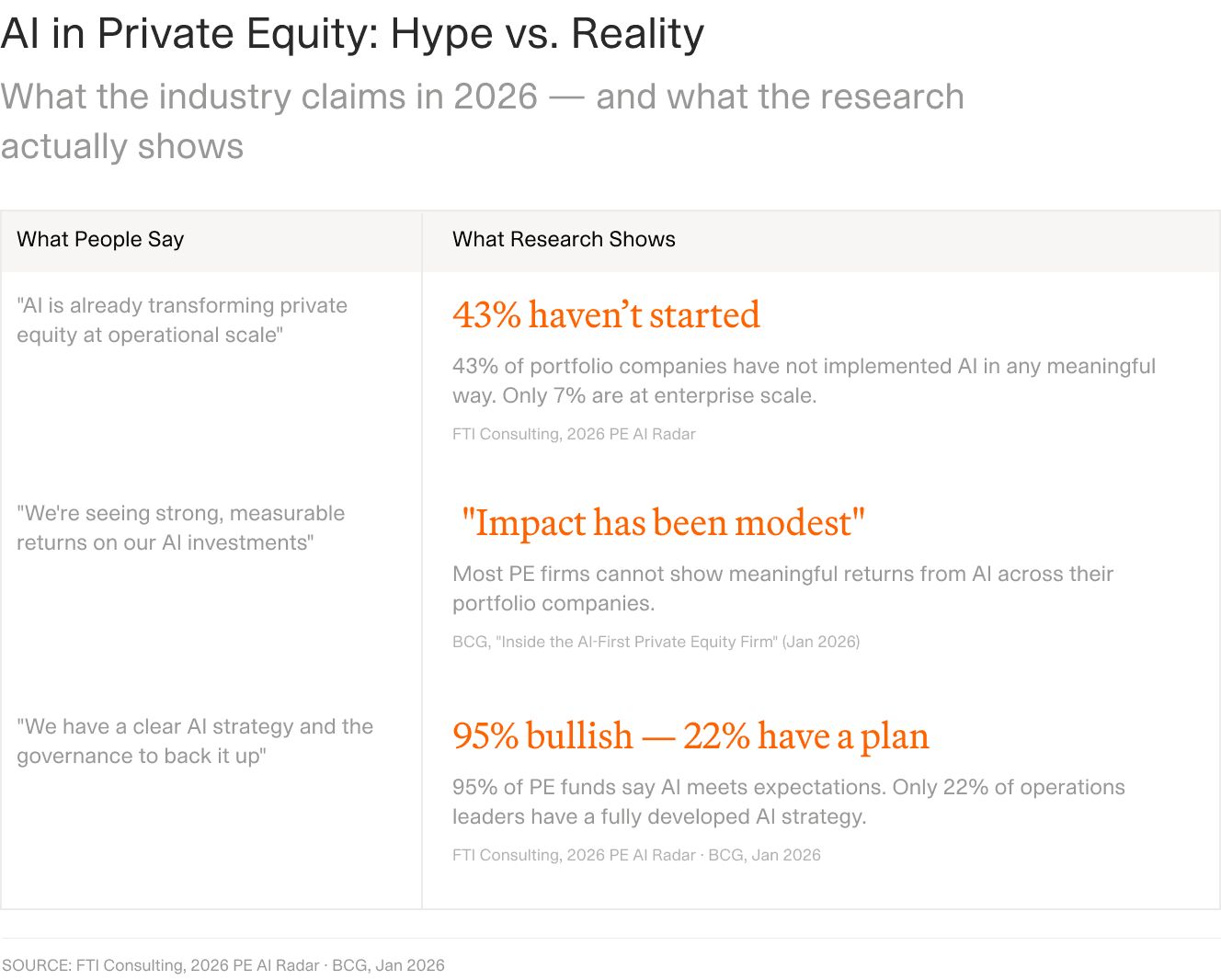
The gap between conviction and execution is the reason a tools guide is worth reading carefully rather than quickly.
CRM and relationship intelligence software
The CRM is the system of record for deal and relationship data, and it is the one purchase that constrains every other purchase. Get it wrong and every subsequent integration is built against a foundation the firm does not trust.
What private equity firms need from a CRM is different from what a sales team needs. Four things: a company and contact record that survives a decade of intermittent contact, deal flow tracking that copes with a deal restarting three years after it died, permission control fine enough that a live process is visible to four people, and investment committee workflow that produces a defensible record of what was decided when.
The dividing line inside the category is between relationship intelligence and deal workflow.
Platform | Built around | Typical firm size | Where it differs |
|---|---|---|---|
DealCloud (Intapp) | Deal workflow and compliance | Mid-market to large-cap | Deep configurability and IC governance; the heaviest to implement |
Affinity | Relationship intelligence | Emerging to mid-market | Scores relationship strength from email and calendar metadata |
4Degrees | Relationship intelligence | Emerging managers | Comparable model to Affinity with a lighter footprint |
Dynamo | Deal, IR and accounting together | Mid-market | Modules extend past CRM into fund administration and LP reporting |
Navatar | Salesforce-native PE layer | Firms already on Salesforce | Adds deal and fund structure to an existing Salesforce estate |
Relationship intelligence is the established term for a specific capability: reading email and calendar metadata to work out who at the firm knows whom and how warm each connection is, without asking anyone to log an interaction. Affinity and 4Degrees are built around it. This matters more than it sounds, because deal teams do not reliably log contact activity, and a CRM that depends on them doing so degrades within two quarters.
Deal workflow and compliance is the other pole. DealCloud is the standard here, particularly at firms with formal IC processes and regulatory obligations. It configures further than the relationship intelligence tools and takes correspondingly longer to stand up.
The gap nobody in this category fills is getting deal data out of documents and into the record. Every CRM assumes a person types in the revenue figure. See CIM to CRM extraction for how that step is handled elsewhere in the stack.
Deal sourcing and market intelligence tools
Two different tool types get grouped under deal sourcing, and firms regularly buy one expecting the other.
Market data platforms hold transaction, valuation and fund data. PitchBook and S&P Capital IQ are the standard subscriptions. They answer questions about what has already happened: comparable multiples, who owns what, which sponsors are active in a sector.
Proprietary company search is a different job. Grata and SourceScrub index private companies that do not appear in transaction databases because they have never transacted, using web presence and filings to build a searchable universe. This is where the search for companies not yet in a process happens, and it is the more direct answer to proprietary deal flow.
AI is already inside this category rather than sitting alongside it, and it is rarely labelled as such. Company similarity search, thesis-based screening and relationship scoring all run on models. The category term some vendors use for the sourcing side is AI deal sourcing, though the underlying capability is closer to search than to reasoning.
The analytical layer that sits on top of these subscriptions is a separate question, covered in our comparison of private equity analysis tools. The integration requirement at this stage is narrow and worth stating: company data has to reach the CRM without an analyst retyping it. Native connectors exist between the major data providers and the major CRMs. Where they do not, the coverage universe stops being current within a quarter.











Virtual data room software
A virtual data room is the due diligence workspace, and describing it as secure storage undersells what firms use it for. The working parts are the category structure that organises thousands of documents, the counterparty question-and-answer module, granular permissions that let a buyer see one folder and not another, and the audit trail that records who opened what.
Datasite, Intralinks, Ansarada and iDeals are the established options. The differences between them are less about capability than about who is on the other side of the table: sell-side advisers often specify the platform, and a firm that buys frequently ends up working inside several. Enterprise file platforms such as Box appear at firms that have standardised on them elsewhere, and they work adequately for smaller processes without the diligence-specific workflow.
The limitation worth stating plainly, because it defines the last category in this guide: a VDR stores and controls documents. It does not read them. The 400-page confidential information memorandum sitting in the data room is as opaque to the platform as it is to anyone who has not opened it. Our review of AI virtual data rooms covers how that boundary is starting to move.
Portfolio monitoring and analytics software
Portfolio monitoring collects operating data from portfolio companies and turns it into something a deal partner, an operating partner and an LP can each read. Chronograph, Allvue and Juniper Square are the common choices, alongside MSCI Private Capital Solutions, the business formerly known as Burgiss and still referred to that way in most conversations. Cobalt now sits inside Preqin on the data side.
What these platforms track is consistent across firms: revenue and earnings against budget, working capital, debt covenants and headroom, cash runway, and whatever three to eight company-specific KPIs the investment thesis rests on. The reporting cadence is usually monthly for financials and quarterly for the full pack.
The recurring problem in this category is not the platform. It is getting the data in. Portfolio companies submit reporting in whatever format their finance director prefers, which means a board pack as a PDF, management accounts as a spreadsheet with a layout that changes when someone adds a row, and a covering email containing half the commentary. Past roughly ten companies, chasing and re-keying that becomes somebody's job. Our guide to portfolio monitoring in private equity goes deeper on the category.
Fund administration and accounting software
Fund administration produces the official books, and it is a genuinely different function from portfolio monitoring even though several vendors sell both. Fund accounting covers net asset value, capital accounts, capital calls and distributions, waterfall and carried interest calculations, and tax reporting. It is what the auditor examines. Portfolio monitoring covers operational analytics and its audience is internal.
Firms that treat the two as one system discover the distinction at quarter end, when operational performance data and official NAV disagree because they are produced on different bases, and somebody reconciles the difference by hand.
Allvue, eFront, FundCount and Carta are the named platforms. The more consequential decision in this category, though, is whether to buy software at all. Most private equity firms below a certain size outsource fund accounting to a third-party administrator and never license a system directly. The administrator runs one of these platforms on the firm's behalf, and what the firm actually evaluates is the administrator's service quality and reporting turnaround. Buying the software in-house becomes worth considering when fund count, structure complexity or reporting deadlines outgrow what an outsourced relationship can absorb.
Three signals tend to appear together when that point arrives. Quarter-end close starts slipping past the date the LP agreement specifies. The finance team begins keeping a parallel spreadsheet because the administrator's reporting does not answer the questions the partners ask. And a new fund structure, a continuation vehicle or a co-investment sleeve, takes longer to onboard than the deal took to close. Any one of those has a workaround. All three together usually mean the firm has outgrown the arrangement rather than chosen the wrong administrator.
LP and investor relations portals
The investor relations portal is the outward face of the stack. It publishes capital account statements, capital call and distribution notices, tax documents and performance reporting, and gives investors self-service access to their own history rather than an inbox request and a two-day wait.
Juniper Square, Allvue, Dynamo and Carta all offer one. LP expectations have converged on a short list: statements accessible without a support request, a clean audit trail when an investor queries a capital account, and reporting that separates fund-level and co-investment positions.
Format has converged too. The ILPA reporting templates are now the default expectation for quarterly fee, expense and performance reporting, which has made LP reporting more consistent to receive and no easier to produce. Assembly is still the bottleneck: fund-level numbers from accounting, company performance from monitoring, narrative from the deal team, all written into a template. Three to four days a quarter is normal. Our guide to LP reporting in private equity covers that process.
Document automation and AI workflows
This is the category the other guides omit, and the case for treating it as a category rather than a feature is straightforward. Everything above manages structured data. A CRM stores fields a person typed. A monitoring platform charts figures somebody imported. A fund accounting system calculates from ledger entries. None of them reads a document.
Yet private equity runs on documents. Teasers, confidential information memoranda, management accounts, quality of earnings reports, limited partnership agreements, side letters, DDQ responses, board packs, GP quarterly reports. Each one arrives as a PDF, gets read by a person, and has its content re-typed into one of the six systems above.
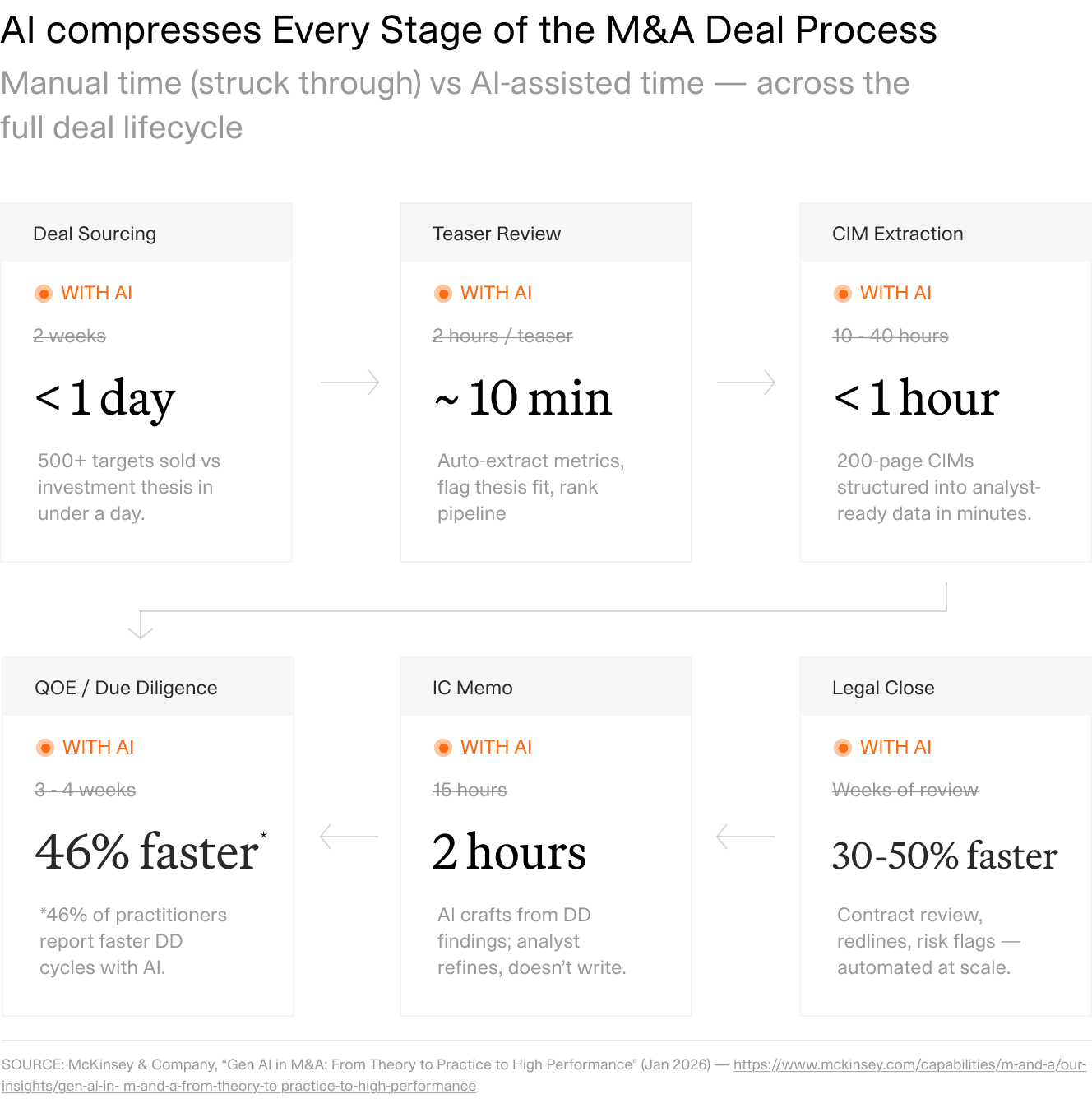
Where the hours sit in a deal process. Note that the largest reductions cluster around document reading rather than analysis or judgement.
The workflows that this category addresses are specific rather than general:
CIM and teaser extraction. Revenue, earnings, growth, customer concentration, management detail and stated thesis pulled from a memorandum into structured fields, ready for the deal record or a screening memo.
Investment memo drafting. A first draft assembled from extracted deal data and analyst notes against the firm's own template, for a human to edit rather than to write from nothing.
Side letter and LPA review. Most favoured nation provisions, fee offsets, co-investment rights and transfer restrictions identified across a set of LP-specific documents, where the work is mechanical and the cost of missing a clause is measured in years.
Portfolio company report extraction. Board packs and management accounts submitted in inconsistent formats read into a consistent KPI set for the monitoring platform.
LP report assembly. Quarterly reporting drafted from structured performance data rather than assembled by hand from three systems.
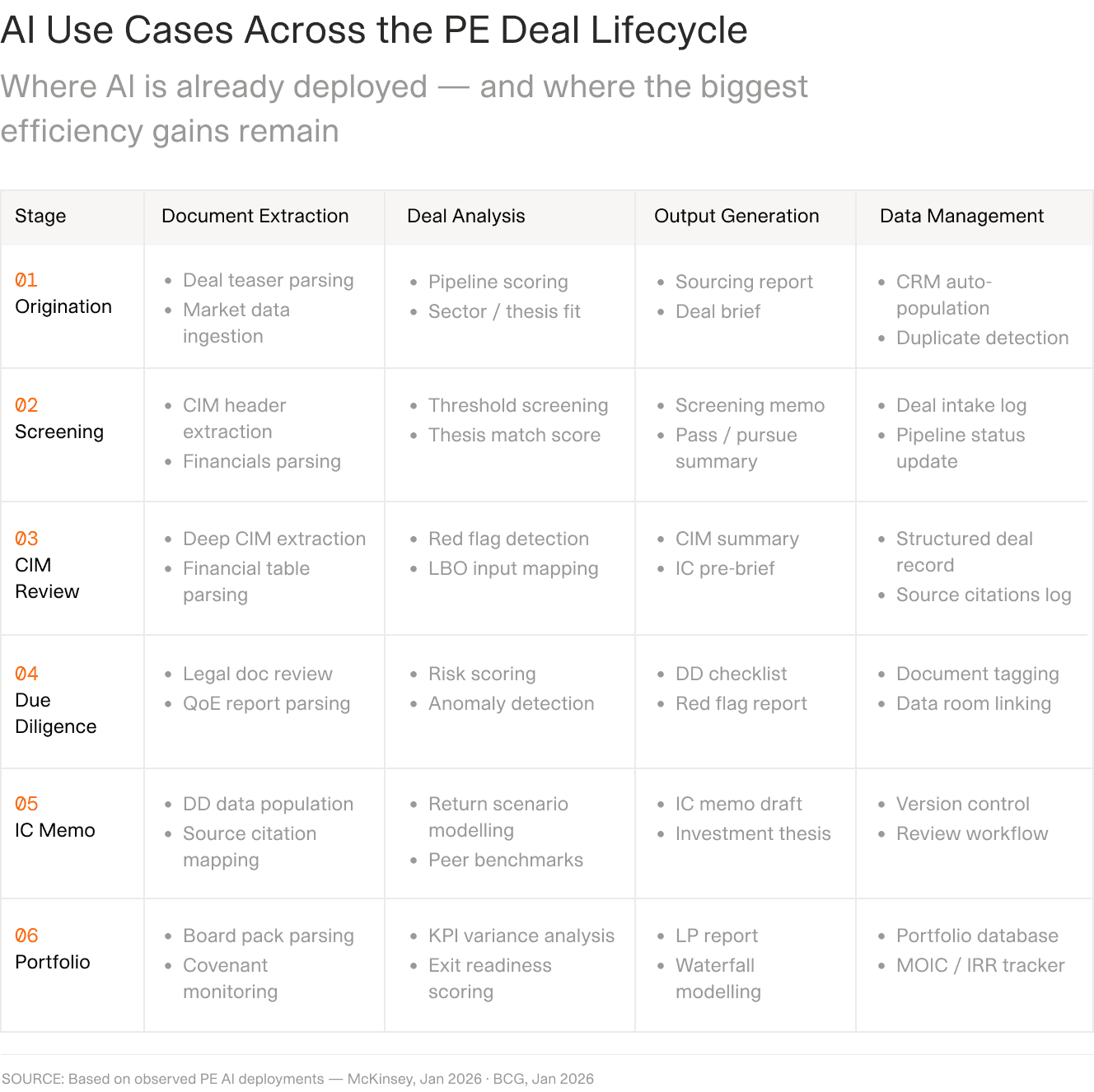
Read across a row rather than down a column. Most firms adopt one stage at a time, and screening is where nearly everyone starts.
Why this is a category and not a feature. The distinction comes down to what each type of system does with data it has never seen. A CRM tracks relationships and deal progress, and every field in it was entered by a person or imported from another structured source. A monitoring platform charts financial performance, and every figure in it came from a spreadsheet or an API. Both are excellent at holding and presenting structured data, and neither has any mechanism for producing it. Document automation converts unstructured documents into structured, checkable outputs, which is the one operation the rest of the stack assumes has already happened. That is why bolting an assistant onto an existing tool does not cover it, and why firms that treat AI as a feature of their CRM tend to end up back at manual entry.
The named tools in this category are few, because it is young. V7 Go reads deal and fund documents, produces structured fields against a schema the firm defines, attaches a source reference to every extracted value, and pushes the result into the CRM, the monitoring platform or a data store. Blueflame AI focuses on memo and summary generation from a firm's internal document set. Dasseti works on the diligence questionnaire side, particularly for allocators reviewing managers.
Two properties separate tools in this category, and both are worth testing in an evaluation rather than taking from a demo. The first is whether every extracted value carries a link back to the page and passage it came from, so a reviewer can check a number in two seconds instead of reopening the source. The second is whether the same document processed twice produces the same output, which is the difference between an assistant and a system a workflow can depend on. Our comparison of AI tools for investment memo generation tests both across the platforms in this space.
One capability here belongs in a stack conversation rather than a feature list. Documents processed this way accumulate rather than being read and discarded, forming a queryable layer over the firm's own history: every company screened, every fund reviewed, every relationship between them. V7's Context Graph maintains that layer. No individual system elsewhere in the stack holds it, because each one sees only its own slice.
What to buy, and in what order
Nobody buys seven categories at once. The sequence that holds up across firm sizes is CRM and data room first, portfolio monitoring at first close, fund administration when the outsourced relationship stops keeping up, an LP portal once investor count passes the point where email stops scaling, and document automation at whichever stage the manual reading is costing the most.
Firm profile | Buy first | Can wait |
|---|---|---|
Emerging manager, below $500m | CRM with relationship intelligence, a data room, outsourced fund administration | Dedicated portfolio monitoring, an LP portal, multiple market data subscriptions |
Mid-market, $500m to $3bn | Deal workflow CRM, enterprise data room, portfolio monitoring, LP portal | In-house fund accounting, a second market intelligence subscription |
Large-cap, above $3bn | All seven categories, with integration owned internally rather than by vendors | Little. The question shifts from what to add to what to consolidate |
Three questions are worth asking of any tool already in the stack, and they surface more than a vendor demo will.
Does it reduce manual data entry or create it? Some tools are net negative on this measure and survive because nobody has counted.
Is it used by everyone or by the two people who championed it? Partial adoption is worse than none, because the data is neither complete nor trusted, and the firm pays for both.
Does it connect to the tools on either side of it, or does a person carry data across? That person is the real integration layer in most stacks, and their time is the cost that never appears in the software budget.
The last point is where category thinking stops being enough. A firm can own the best platform in all seven categories and still lose a week a month to moving data between them, because a tech stack is defined as much by its connections as by its components. Software choice determines what each system can do. What determines how much work the firm actually gets back is whether anything connects.
If document reading is the handoff costing you most, V7's solutions engineers configure the extraction schema and the destination system against your own files before any commitment. Book a working session and bring a real CIM rather than a sample.
What software do private equity firms use?
Private equity firms run software across seven categories. For sourcing and relationships, purpose-built CRMs such as DealCloud, Affinity, 4Degrees, Dynamo and Navatar. For market intelligence and company search, PitchBook, S&P Capital IQ, Grata and SourceScrub. For diligence, virtual data rooms including Datasite, Intralinks, Ansarada and iDeals. For portfolio management, monitoring platforms such as Chronograph, Allvue, Juniper Square and MSCI Private Capital Solutions. For fund accounting, Allvue, eFront, FundCount and Carta, though many firms outsource this to a third-party administrator instead. For investor relations, LP portals from Juniper Square, Allvue, Dynamo and Carta. The seventh category, document automation, is newer and thinner: V7 Go, Blueflame AI and Dasseti. A typical mid-market firm runs eight to twelve tools in total.
+
Do private equity firms use Salesforce?
Some do, though most specialist firms prefer a purpose-built platform. Salesforce is designed around a sales cycle with leads, stages, close dates and quotas, which does not describe how private equity works. A relationship with a founder can run for years before any process begins, involve several people at the firm and multiple advisers, and produce nothing. Private equity CRMs such as DealCloud, Affinity and 4Degrees are built for that shape, with long relationship histories, multi-party deal tracking and investment committee governance included rather than configured on top. Where Salesforce does appear, it is usually because the firm already ran it, sometimes with a private equity layer such as Navatar added. Consultants working with larger managers report firms still completing Salesforce implementations while planning AI programmes alongside them.
+
What is the best CRM for private equity?
There is no single answer, because the category splits along a line that matters more than any feature comparison. Relationship intelligence platforms, principally Affinity and 4Degrees, read email and calendar metadata to work out who at the firm knows whom and how warm each connection is, without asking anyone to log an interaction. Deal workflow platforms, principally DealCloud, configure further and handle formal investment committee and compliance processes, at the cost of a longer implementation. Dynamo sits between the two and extends into fund administration and LP reporting. The practical test is adoption rather than capability. Deal teams do not reliably log contact activity, so a system that depends on manual logging tends to degrade within two quarters of going live.
+
What is a virtual data room in private equity?
A virtual data room, usually shortened to VDR, is the secure workspace where confidential deal documents are shared during due diligence. Describing it as storage undersells what firms use it for. The working parts are the category structure that organises thousands of documents, the counterparty question-and-answer module, granular permissions that let one party see one folder and not another, and the audit trail recording who opened what and when. Datasite, Intralinks, Ansarada and iDeals are the established platforms, and sell-side advisers often specify which one a process runs on. One limitation defines the boundary of the category: a VDR stores and controls documents but does not read them. A memorandum sitting in the data room is as opaque to the platform as to anyone who has not opened it.
+
How do private equity firms manage their portfolio companies?
AI appears in two distinct places in a private equity stack, and conflating them causes confusion. The first is inside tools firms already own: company similarity search in sourcing platforms, relationship strength scoring in CRMs, and anomaly detection in monitoring systems, none of which is usually presented as an AI feature. The second is document automation, which is a category of its own because none of the established systems reads documents. Tools here include V7 Go, which extracts structured fields from deal and fund documents against a firm-defined schema and pushes them into existing systems, Blueflame AI for memo and summary generation, and Dasseti for diligence questionnaires. Two properties are worth testing directly: whether every extracted value links back to its source passage, and whether the same document processed twice returns the same output.
+
What AI tools do private equity firms use?
Go is more accurate and robust than calling a model provider directly. By breaking down complex tasks into reasoning steps with Index Knowledge, Go enables LLMs to query your data more accurately than an out of the box API call. Combining this with conditional logic, which can route high sensitivity data to a human review, Go builds robustness into your AI powered workflows.
