14 min read
—



V7 Go
A smarter way to manage due diligence and underwriting
AI investment memo generation has moved from experiment to workflow for many private equity deal teams. The bottleneck is not the drafting. It is the 200-page confidential information memorandum (CIM), the five years of management accounts, the market research stack, and the management call transcript — all of which have to be read, extracted, and organised before an analyst types a single word.
Most guides to AI for private equity cover the research phase: meeting notes, data room search, AlphaSense summaries. The investment memo itself, the document that goes to the investment committee, gets one paragraph. This article fills that gap.
Below is a review of the AI tools PE deal teams are evaluating specifically for investment memo generation in 2026: purpose-built PE platforms, general-purpose large language models, and workflow automation tools. For each, the question is not whether it uses AI. The question is whether it handles the document depth, source attribution, and data governance that IC-level work requires.
In this article:
What an investment memo is and why writing one takes so long
The seven AI tools PE deal teams are evaluating for memo generation in 2026
How to choose between PE-specific platforms and general-purpose AI
How V7 Go automates the full investment memo generation workflow
What Is an Investment Memo? (And Why Writing One Takes So Long)
An investment memo is the document a PE firm's deal team produces for its investment committee (IC) before committing capital to a deal. It covers the investment thesis, market analysis, management assessment, financial projections, risk factors, and proposed deal structure. Unlike a confidential information memorandum (CIM), which the target company or its bankers produce to market the deal, the investment memo is the buy-side firm's analysis. The CIM is the input; the investment memo is what the deal team makes of it.
The time cost is in the inputs. A credible IC memo requires reading a data room with hundreds of files, reconciling management projections against historical financials, cross-checking market size claims against independent research, and identifying risks that the CIM underweights. None of that work is technically difficult. All of it takes time. A senior associate at a mid-market PE fund typically spends 15 to 25 hours on data-gathering and structuring before drafting begins.
According to McKinsey's State of AI report, 65% of organisations now regularly use generative AI, nearly double the rate from the prior year. PE deal teams are no exception. What differs in PE is the consequence of a wrong output: a memo that fabricates a revenue figure or misattributes a market sizing claim goes to an investment committee making a nine-figure capital decision.
The 7 Best AI Tools for Investment Memo Generation
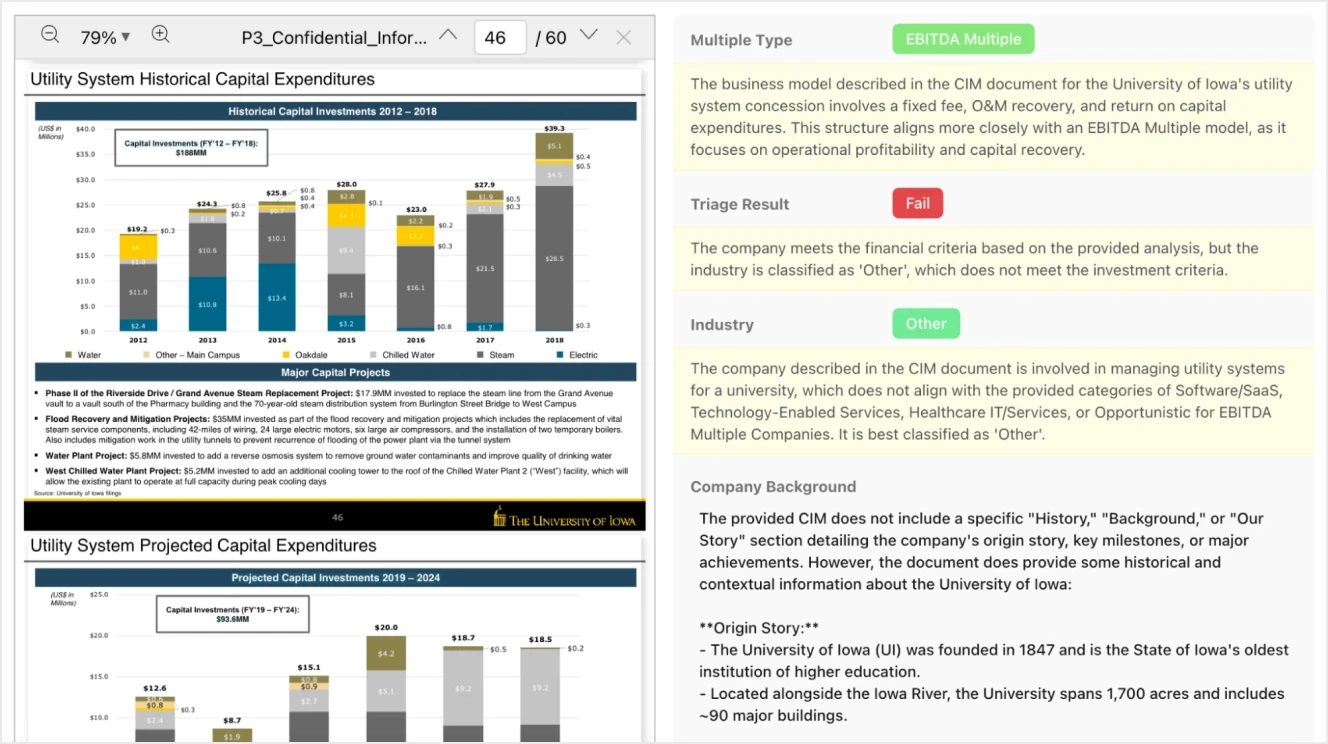
No single tool generates a publication-ready IC memo from a data room upload. What the tools below do is automate specific parts of the memo workflow: extracting data, synthesising research, or drafting structured prose from organised inputs. For each tool, the right question is which step it actually handles, and where the gap is.
Tool | Best for | PE-specific | Pricing |
|---|---|---|---|
Rogo | PE research and memo drafting | Yes | Enterprise |
Hebbia | Multi-document research synthesis | Yes | Enterprise |
Blueflame AI | PE-native workflow platform | Yes | Enterprise |
Claude / ChatGPT Enterprise | Structured drafting from analyst inputs | No | From $20/user/month |
Energent.ai | Private markets deal lifecycle | Yes | Enterprise |
Stack AI | Custom memo generation pipelines | No | From $49/month |
AlphaSense | Research intelligence for memo inputs | Partial | ~$10,000–$20,000/seat/year |
Rogo: Purpose-Built PE Research and Memo Drafting
Rogo is an AI assistant built for financial services workflows, with a product line focused on private equity and investment banking. Its core function is research synthesis: Rogo reads financial documents, earnings calls, and SEC filings and produces structured outputs suitable for direct use in memo sections.
Where Rogo adds clear value is in the market analysis and comparable transactions sections. An analyst can ask Rogo to pull comparable transactions in a target sector, summarise public company multiples, and structure that output into a comps table. That work typically takes hours manually; Rogo compresses it to a fraction of the time.
The constraint is proprietary document coverage. Rogo's strength is public market data; its handling of a firm's internal data room documents (the 200-page CIM, management accounts, and internal financial model) is less mature than its public markets research capability. Test Rogo against a real data room pack, not a vendor demo document, before committing.
Rogo's PE-native financial vocabulary sets it apart from adapted general-purpose AI: it recognises deal structures, management account formats, and cap table conventions without requiring explicit prompting. The tradeoff is narrower coverage for niche sectors or non-standard deal types that sit outside its training focus. Rogo is priced as an enterprise annual contract, typically following a proof-of-concept phase.
Best for: Sector research-intensive memo workflows where public market context is a major input.
Hebbia: Multi-Document Research and Synthesis
Hebbia's core product is Matrix: a research interface that processes large document collections and answers structured queries across all of them at once. In a PE context, this means loading an entire data room and running systematic questions (revenue by segment, customer concentration, management tenure) across every document simultaneously.
For investment memo work, Hebbia handles the extraction phase: transforming hundreds of pages into structured data points, each linked back to its source document and page number. That source attribution matters for IC memos, where a committee member who challenges a revenue figure needs to know exactly where it came from.
Hebbia does not generate a memo draft. It generates the evidence base from which a draft is written. Teams using Hebbia typically pair it with Claude or ChatGPT to convert extracted data points into prose.
Hebbia is priced per workspace rather than per seat, which suits deal teams where multiple analysts share a common research environment. A practical constraint is ingestion time: loading a large data room requires setup ahead of use, and teams working to tight signing timelines need to account for that lead time. Document parsing handles most standard CIM formats but can reduce accuracy on scanned exhibits saved as image-only PDFs.
Best for: Data rooms with high document volume where systematic cross-document extraction reduces manual reading time.
Blueflame AI: PE-Specific AI Platform
Blueflame AI is built for the PE workflow from the ground up, covering deal research, due diligence, investment memo drafting, and portfolio monitoring in a single platform. Its integration with data rooms, CRM systems, and portfolio company reporting reduces the manual assembly step that precedes drafting.
For investment memos specifically, Blueflame's value is its PE-specific template library and its awareness of deal vocabulary, material non-public information (MNPI) exposure risk, and the typical structure of an IC-ready document. An analyst points Blueflame to the relevant sources and the platform produces a structured draft.
Blueflame is an enterprise product with enterprise pricing. Teams at smaller funds may find the cost-to-benefit ratio less clear unless investment memo generation is a high-frequency workflow.
Blueflame's data governance is built to institutional standards: SOC 2 Type II certified, with deal-level data separation between active files. For GPs whose LPs conduct operational due diligence on the technology stack, Blueflame's compliance documentation simplifies that review. The onboarding process includes template configuration to match the firm's existing IC memo format, which reduces the gap between what the platform produces and what the investment committee expects to see.
Best for: Mid-market and large-cap PE funds running 20 or more deal processes per year who need a PE-native platform rather than adapting general AI.
Claude / ChatGPT Enterprise: General AI for Memo Drafting
Most PE deal teams already have access to Claude Enterprise or ChatGPT Enterprise. With a 200K token context window, these models can process a full CIM in a single pass. For structured prose drafting from organised inputs, they remain the fastest available option at a fraction of the cost of PE-specific platforms.
The workflow that works: extract key facts from the CIM (revenue, EBITDA, growth drivers, management track record, key risks) into a structured document, then pass that document to Claude or ChatGPT Enterprise alongside the firm's memo template. The AI fills the template with coherent prose; the analyst edits for accuracy and tone. Simple, auditable, and meaningfully faster than drafting from a blank page.
What they cannot do on their own: connect to data rooms, apply PE-specific templates, or verify figures against source documents. Output quality is a direct function of input quality. An analyst who has already extracted and organised key data points from a CIM and financial model can pass those into Claude or ChatGPT and get a structured draft in minutes. Without organised inputs, the output reflects that disorganisation.
One requirement is non-negotiable. Consumer-tier access (free Claude, free ChatGPT) is never appropriate for deal-sensitive content. Enterprise tier only, with a contractual guarantee that your data is not used for model training.
Best for: Deal teams with strong analytical discipline who can produce organised research inputs and want fast prose drafting without purchasing a PE-specific platform.
Energent.ai: AI for Private Markets
Energent is built for private markets workflows end-to-end, covering deal sourcing, due diligence, investment memo generation, and portfolio monitoring. Its investment memo capability is a workflow product: the platform guides users through memo sections, pulls relevant data from ingested documents, and generates a structured draft.
Energent is a newer entrant than Rogo or Hebbia, and its document coverage varies more across non-standard formats, particularly older CIMs with unconventional layouts or scanned exhibits. Evaluate Energent on a real deal from your pipeline, not on a curated vendor demo.
Energent's guided workflow structure makes it easier to deploy than more modular platforms requiring significant configuration. For funds earlier in their AI adoption journey, this reduces time-to-value compared to building workflows in a general-purpose tool. The company has been responsive to enterprise customer feedback in shaping its product roadmap, which matters more than it might appear for firms whose IC memo templates are highly idiosyncratic.
Best for: Funds looking for a full-stack private markets AI platform and willing to invest in vendor configuration to match their memo template.
Stack AI: AI Workflow Automation for Document Creation
Stack AI is not PE-specific. It is a no-code workflow automation platform that can be configured to build investment memo pipelines: deal documents in, structured memo draft out. The appeal is flexibility: a firm can configure a Stack AI workflow to match its exact memo template, run specific extraction steps, and automate the handoffs between research and drafting.
A reliable memo generation workflow in Stack AI takes time, internal AI expertise, and ongoing maintenance to build and keep current. For a fund with an in-house AI lead, Stack AI offers the most configurable memo automation at a non-enterprise price point. For a fund without that capacity, the configuration burden is real and ongoing.
Stack AI pipelines can incorporate any combination of external AI models, extraction steps, and output templates. A firm that builds a memo workflow in Stack AI effectively owns the full process: a meaningful advantage when the fund requires complete control over how deal-sensitive data is routed, processed, stored, and retained.
Best for: Funds with internal technical capacity who want to build and maintain their own memo automation pipeline rather than purchasing a prebuilt product.
AlphaSense: Research Intelligence That Feeds the Memo
AlphaSense is not a memo generator. It is the research intelligence platform that produces inputs for a memo's market analysis and competitive context sections: expert call transcripts from the target's sector, earnings call analysis across relevant public comps, broker research on industry trends, and regulatory filing search.
The market sizing section of an investment memo written from a weak research base is wrong regardless of how well the drafting AI structures the prose. AlphaSense aggregates the right inputs in one place, with AI-assisted summarisation and search. The workflow pattern is: AlphaSense for research, structured notes or exports as inputs to Claude or V7 Go for memo drafting.
PE teams use AlphaSense primarily for the market and competitive analysis sections of the memo, where independent research quality matters most. The Wall Street Transcript Library and earnings call database are particularly useful for identifying comparable companies and understanding sector dynamics before a deal progresses to IC. The per-seat cost reflects institutional-grade data access, not a general research add-on.
Best for: Funds that already use AlphaSense for deal research and want to formalise the connection between research outputs and memo inputs.











How to Choose an AI Memo Tool for Your PE Team
The question is not PE-specific or general AI. The question is which step in your memo workflow is the actual bottleneck.
If the bottleneck is document extraction, reading and synthesising a 200-page data room, tools like Hebbia and V7 Go solve that. If the bottleneck is drafting, converting well-organised research into coherent prose, Claude Enterprise solves that at a fraction of the cost. If the bottleneck is both, a PE-specific platform like Rogo or Blueflame addresses the full workflow. Buy a tool for the step that costs you the most time, not for the step you find most interesting.
Four criteria that separate tools worth evaluating from tools worth ignoring:
Source attribution. For any memo going to an investment committee, every material figure must trace back to a source document. A committee member who challenges a revenue projection will ask which page it came from. Evaluate tools on how they cite their outputs, not just on output quality.
Data governance. Any AI tool used on deal-sensitive material must provide SOC 2 Type II certification, a contractual guarantee that your data is not used for model training, and clear data residency controls. The ILPA's Responsible AI Quick Guide for Asset Owners frames this plainly: MNPI exposure is a regulatory risk in private equity, and poorly governed AI deployments create liability that extends beyond the deal team. Free-tier AI tools are never appropriate for deal work.
Integration with your existing research stack. Tools that connect to your data room (Datasite, Intralinks), your CRM, and your research platforms reduce the manual assembly step. Tools without native integrations require the analyst to paste inputs manually, which limits how much of the workflow AI actually covers.
Workflow repeatability. For a fund running three deals per year, enterprise Claude with a well-built prompt template is sufficient. For a fund running 30, that approach does not scale. The right tool depends on memo volume, not memo quality alone.
How V7 Go Automates Investment Memo Generation End-to-End
According to Bain & Company's 2025 Global Private Equity Report, nearly 20% of PE portfolio companies have operationalized generative AI use cases and are seeing concrete results. The investment memo workflow — document processing, structured extraction, and natural language generation in sequence — is where that operationalization produces the clearest return.
V7 Go handles the step that determines whether AI investment memo generation is usable or not: structured extraction from source documents before drafting begins.
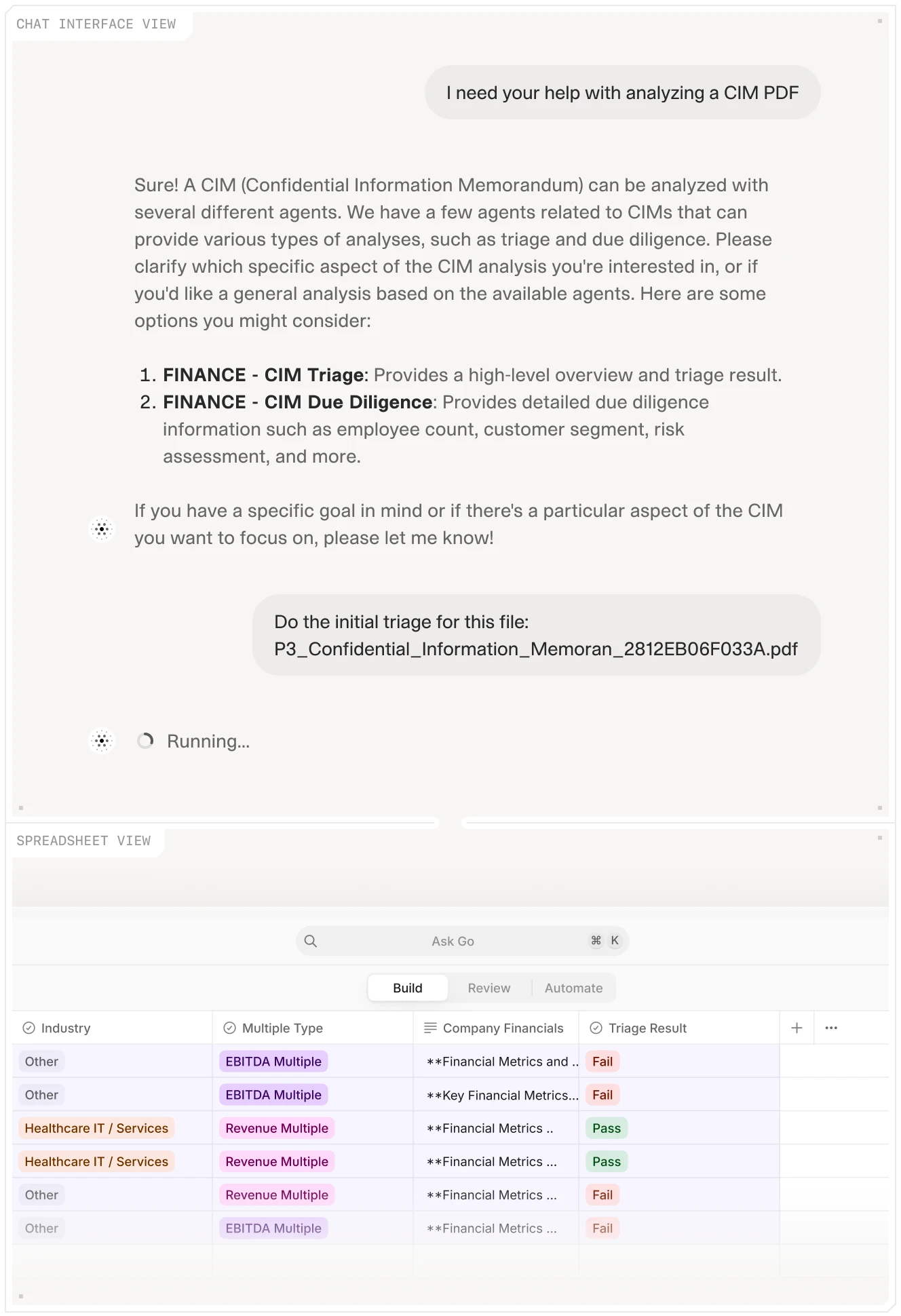
A V7 Go agent for investment memo generation ingests the deal's document set (the CIM, financial model, management call transcripts, and market research) and runs structured extraction across all of them in parallel. Each extracted data point — revenue, EBITDA, market sizing assumption, management track record, identified risk factor — is linked back to its source document and page number. The extraction runs against a consistent framework on every deal, so memo structure is uniform across the pipeline regardless of which analyst runs the process.
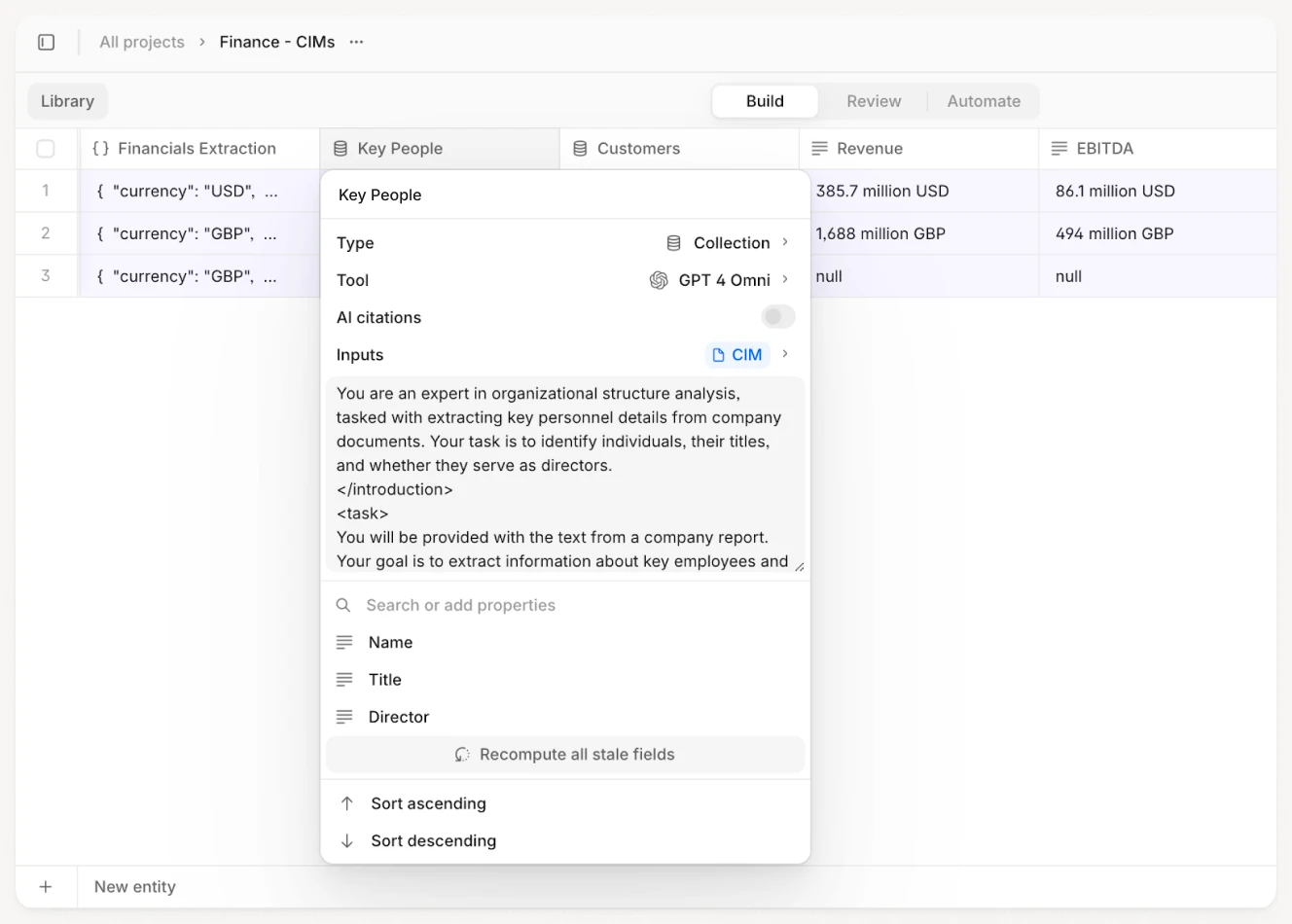
The output feeds directly into the memo drafting step: through V7 Go's generation capability, Claude, or the firm's preferred template. Because the extraction is structured and attributed, the resulting draft can be fact-checked against source documents without re-reading the full data room. The AI due diligence agent and the CIM review automation handle upstream steps in the same framework, so the process from data room to draft operates as one auditable workflow.
A deal team that spends 20 hours extracting and structuring data before drafting can run the same extraction in under two hours. The analyst reviews the output, corrects edge cases, and starts drafting from a verified data set. The memo does not get written faster. The analyst has time to write a better one.
For AI in private equity to move from pilot to production, the extraction step has to be reliable across deal types, document formats, and analyst experience levels. That is what a structured agent framework provides that one-off prompting does not.
Private equity deal teams are deciding which AI tools fit their process now, not waiting for the market to mature. The tools reviewed above solve different parts of the memo workflow. Buying one without identifying your actual bottleneck means buying the wrong tool for the wrong problem.
Audit your current memo process: where does time go, where do errors appear, where does quality depend on one person's knowledge? That answer tells you which tool to evaluate first: whether a PE-specific platform, a general AI drafting layer, or a structured automation workflow is the right starting point for your team.
What is an investment memo in private equity?
An investment memo is the document a private equity firm's deal team prepares for its investment committee before committing capital to a deal. It covers the investment thesis, market opportunity, management assessment, financial analysis, risk factors, and proposed deal structure. Unlike a confidential information memorandum (CIM), which the target company or its bankers produce to market the business, an investment memo is the PE firm's internal analysis. The CIM is the seller's pitch; the investment memo is the buyer's independent assessment of whether the deal makes sense at the proposed valuation. Investment committee memos vary in format across firms but typically run 15 to 40 pages. Some firms call them deal memos, IC memos, or investment committee presentations. The function is the same.
+
What should an investment memo include?
A standard private equity investment memo covers: company overview and history; investment thesis explaining why this deal at this valuation and at this time; market analysis covering addressable market, growth drivers, and competitive position; management assessment; financial analysis covering historical performance, projections, and key assumptions with their basis; deal structure and returns analysis with IRR and MOIC under base and downside scenarios; risk factors with identified mitigants; and comparable transactions supporting the valuation. The financial analysis and risk factors sections require the most careful sourcing. Every figure should trace directly to a document in the data room or a named external source. Investment committees challenge specific numbers rather than conclusions, so traceability is as important as accuracy.
+
How long does it take to write an investment memo?
A complete investment committee memo for a mid-market deal typically takes a senior associate 15 to 30 hours from blank page to a draft ready for partner review. The data-gathering and structuring phase (reading the CIM, extracting financial data, reviewing management call notes, and organising market research) accounts for 60 to 70 percent of that time. The actual drafting is faster, but only once the inputs are assembled and verified. When deal teams compress this timeline due to process deadlines, the most common quality trade-off is less depth in the market analysis and risk factor sections. AI tools that automate the data extraction phase add the most value here: the analyst starts drafting sooner with better-organised inputs rather than spending the majority of available time assembling raw materials.
+
Can AI write an investment memo?
AI can produce a structured investment memo draft. Whether that draft is usable depends on what went into it. General-purpose AI such as Claude or ChatGPT produces coherent prose from well-organised research inputs. PE-specific platforms like Rogo, Hebbia, and Blueflame add deal-vocabulary awareness and data room integration. What none of these tools do automatically is verify that every figure in the memo matches the source document, flag conflicts between the CIM and management accounts, or apply the judgment that comes from reviewing comparable deals. AI-generated investment memos require analyst review not because the technology is immature, but because IC-level work carries accountability. The analyst's assessment is a judgment call that AI does not make. AI handles the assembly; the analyst handles the judgment.
+
What is the difference between an investment memo and a CIM?
Any AI tool used on PE deal material must meet four minimum requirements. First, SOC 2 Type II certification: an independent audit confirming that the platform's security controls operate effectively over time. Second, a contractual guarantee that customer data is not used to train AI models; this is standard in enterprise tiers of Claude and ChatGPT but absent from free-tier access. Third, data residency controls specifying where deal data is stored and processed, relevant to firms with cross-border regulatory obligations. Fourth, deal-level data separation: a user working on one deal should not be able to query documents from another. Consumer-tier AI tools that route queries through shared infrastructure without strict data isolation are not appropriate for deal work, regardless of convenience.
+
What data security requirements should AI tools meet for PE investment memos?
Go is more accurate and robust than calling a model provider directly. By breaking down complex tasks into reasoning steps with Index Knowledge, Go enables LLMs to query your data more accurately than an out of the box API call. Combining this with conditional logic, which can route high sensitivity data to a human review, Go builds robustness into your AI powered workflows.
+
Casimir is a seasoned tech journalist and content creator specializing in AI implementation and new technologies. His expertise lies in LLM orchestration, chatbots, generative AI applications, and computer vision.