6 min read
—


How investment teams review, extract, and evaluate CIMs at scale, and where automation is changing the process.

V7 Go
A smarter way to manage due diligence and underwriting
Before a team enters a data room or builds a model, there is the CIM. Anywhere from 40-120 pages, every deal starts here. And for most firms, this is where time starts slipping.
Manual CIM review works at low volume, but breaks under pressure. When deal flow increases, CIM analysis becomes the first real bottleneck in the pipeline. Analysts spend hours extracting basic information before anyone can form a view on the opportunity.
This slows everything that follows. Screening takes longer, good deals sit untouched, and weak deals consume time they don't deserve.
This guide focuses on how experienced deal teams approach CIM review, where time is lost, and how AI-based analysis cam change the speed and consistency of early-stage screening.
We cover:
What a CIM is
Why review remains manual
How AI processes CIMs
How AI agents handle screening workflows
Tools used by deal teams today
What Is a Confidential Information Memorandum (CIM)?
A Confidential Information Memorandum (CIM) is the core document used to present a company in a sale process. It’s also known as the Offering Memorandum (OM) and Information Memorandum (IM).
Investment banks and sell-side advisors put CIMs together on behalf of sellers. The goal is straightforward: give prospective buyers enough information to form a view on the business and decide whether to keep pursuing it. A well-constructed CIM covers the narrative (what makes this company worth buying), the financials (proof that the narrative holds up), and the context (market dynamics, competitive position, growth opportunities).
Most CIMs follow a familiar structure:
Executive Summary: A high-level overview of the company and the specific investment thesis.
Company Overview: Historical background, leadership structure, and ownership details.
Market and Industry Analysis: A breakdown of market size, growth drivers, and the competitive environment.
Products and Services: Detailed descriptions of offerings and revenue segmentation.
Financial Performance: Historical data including revenue, EBITDA, margins, and capital expenditures.
Operational Infrastructure: Information regarding supply chains, technology stacks, and facilities.
Growth Opportunities: Strategic initiatives and white-space analysis for future expansion.
Every investment bank uses its own template. Key data points appear in different sections, labelled differently, formatted differently. One CIM will show revenue by geography; another will show it by product line. EBITDA adjustments might be buried in a footnote or front and centre in the executive summary. Charts and tables are embedded as images, not structured data.
This creates a specific kind of friction for deal teams. The information is there. Getting to it, and making sense of it, takes real work. Even basic questions require digging:
What is the true revenue growth rate?
How does EBITDA reconcile across sections?
Are adjustments recurring or one-off?
Does the narrative match the numbers?
None of this is particularly difficult in isolation, but it becomes challenging when repeated across dozens of opportunities.
That combination (long, inconsistent, unstructured, high-stakes) is precisely what makes CIM review such a stubborn bottleneck. The standard tooling that works fine for other document types has struggled to make a dent here, until recently.
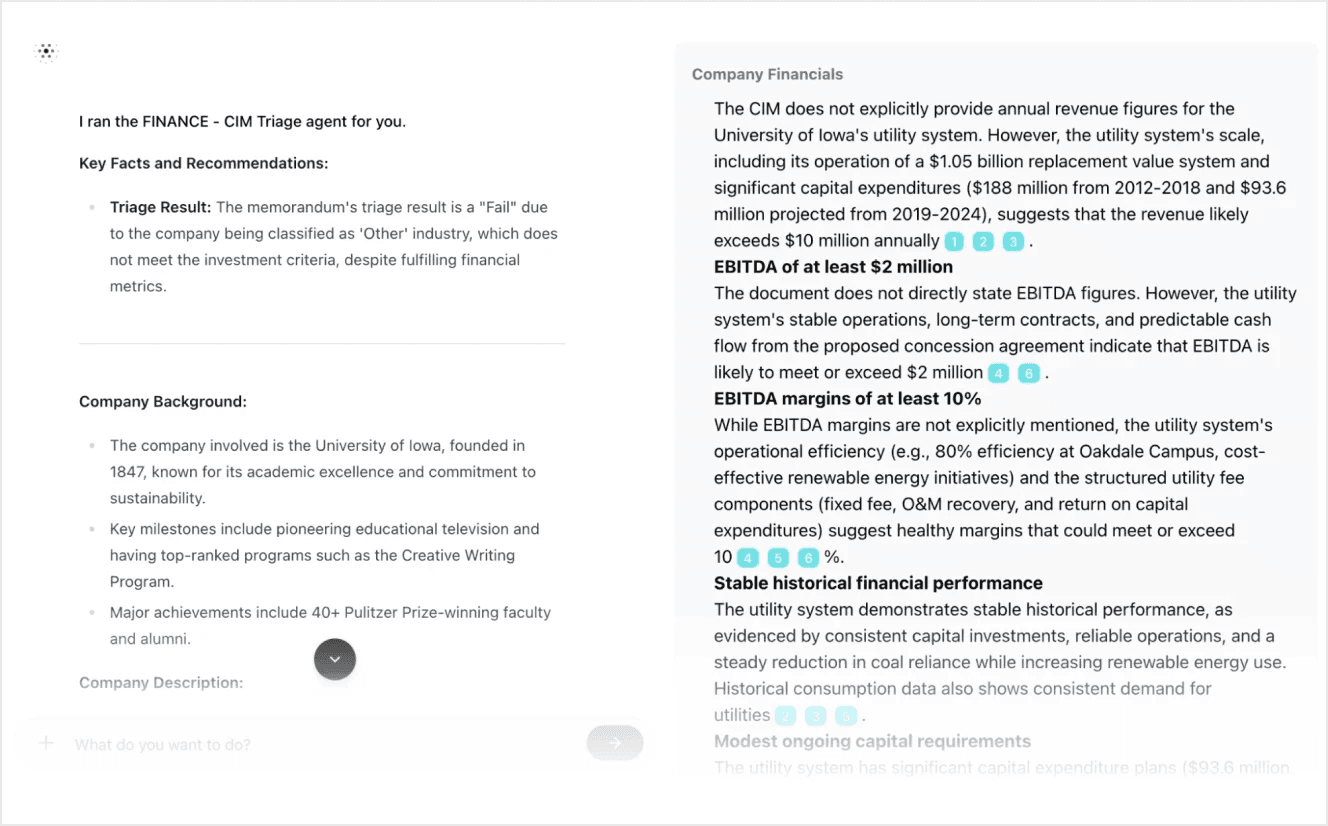











The CIM Manual Review Bottleneck
Despite their importance, most CIMs are still reviewed almost the same way they were twenty years ago.
An analyst downloads a PDF, works through the document page by page, identifies the relevant figures and narratives, and enters that information into a spreadsheet, screening template, or CRM. Then they move to the next one.
A standard CIM review workflow looks like this:
Download the CIM from a data room or email
Read through the document to locate key sections
Pull revenue, EBITDA, growth figures, and market data
Extract customer and competitive information
Enter data into internal deal screening tools
Write an internal summary for the deal team
For a single document, this takes hours. For a firm reviewing dozens or hundreds of CIMs per year, it becomes one of the most time-consuming recurring tasks in the pipeline.
In a competitive market, speed is a differentiator. If an investment team takes three days to screen a deal that a competitor screens in three hours, they are already behind. Slower screening means missed signals, delayed decisions, and analysts spending the majority of their time on data extraction rather than analysis.
AI for CIM Analysis
Recent progress in document intelligence has changed how firms handle complex financial documents. Modern AI systems go beyond simple keyword searches; they understand the context of the information within a PDF.
AI can now identify and extract structured data from unstructured pages. Instead of an analyst hunting for "Adjusted EBITDA" on page 74, an AI system can locate the correct table, understand the headers, and pull the values for the last three fiscal years. This includes parsing complex tables where data is split across pages, presented in non-standard formats, or embedded within narrative text rather than a clean table.
The output is structured data, with a consistent schema that maps to however a deal team wants to consume it, whether that's a spreadsheet, a CRM field, or an internal screening template.
Extraction is only part of the problem. CIMs are full of claims that require interpretation, not just identification.
Modern AI models can distinguish between historical performance and forward-looking projections, flag where adjustments are being applied, and identify when numbers presented in different sections don't reconcile. They can also process qualitative content, such as identifying a company's stated competitive advantages, summarising customer concentration risk, or flagging language that warrants closer scrutiny.
This is meaningfully different from early document AI, which was largely pattern-matching on keywords. Current systems understand what the text is saying, not just where certain words appear.
By converting PDF content into structured data (JSON, CSV, or direct CRM inputs) AI removes the manual handoff between document review and deal tracking. Information flows directly into whatever systems a team already uses. No copy-paste, no re-entry, no version control issues from analysts working off different document drafts.
Deploying AI Agents for Deal Screening
Beyond individual document extraction, investment firms are beginning to deploy AI agents that automate the large chunks of the CIM screening workflow.
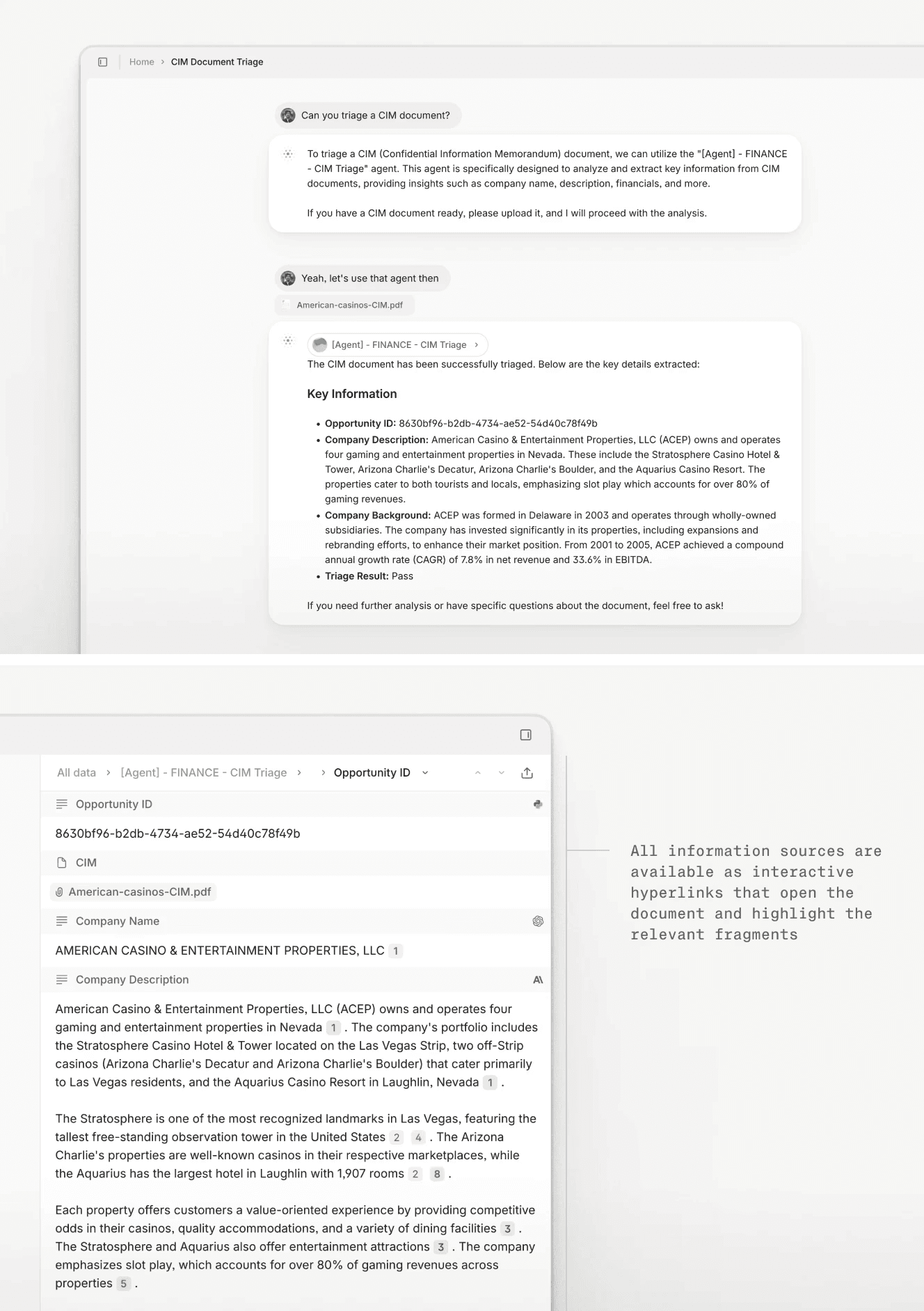
An AI agent is a system that can ingest a document, perform a series of tasks autonomously, and produce structured outputs, without requiring human intervention at each step. Applied to CIM review, an agent can:
Ingest a newly received CIM from email or a data room
Extract financial and operational data points
Classify the company by industry, geography, and stage
Populate a deal screening template or CRM record
Generate an internal summary with flagged risks or red flags
Rank the opportunity against predefined investment criteria
Trigger a notification or next step in the deal pipeline
These agents allow investment teams to process a much higher volume of deals. Instead of choosing which CIMs to read, the team can screen every inbound opportunity, ensuring no high-quality deals are overlooked. This is one of the many applications of AI in Venture Capital and Private Equity currently being adopted by market leaders.
Click here to see a V7 CIM agent in action.
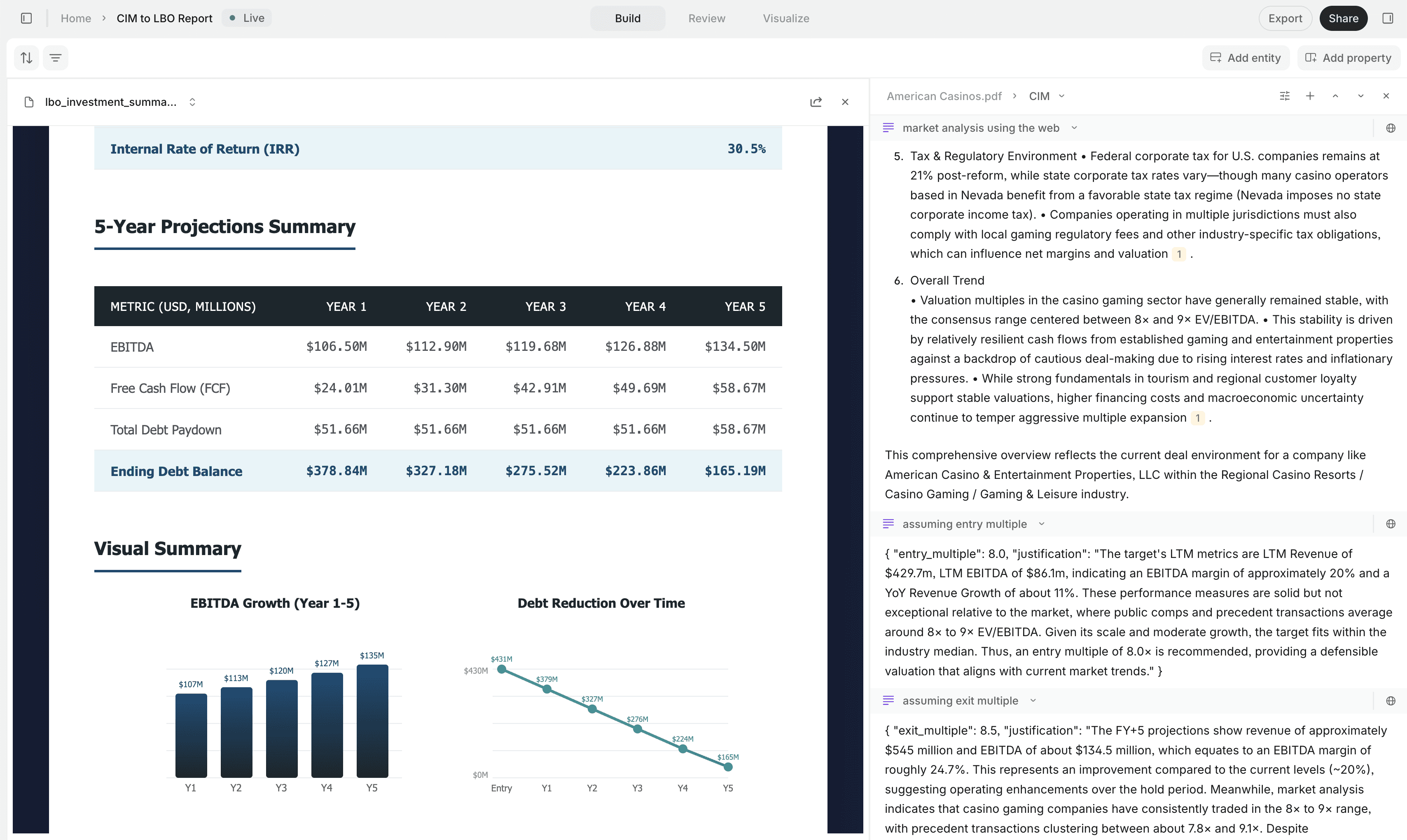
CIM to LBO output in V7 Go
Leading AI Platforms for CIM Analysis
No single tool fits every investment team. The right choice depends on deal volume, how much customisation your team can support, and whether you need a standalone document tool or something that plugs into your broader pipeline. Here's how the main options stack up.
V7 Go for CIM Analysis
Website: https://www.v7labs.com
V7 Go automates Confidential Information Memorandum analysis by extracting key financial metrics, market data, and investment risks from complex presentations.
AI agents process dense CIM content with precision, and all answers are presented with linked citations to the source material, for results that can be trusted.
With V7 Go, it's easy to save up to 85% of standard CIM review time. AI agents can:
Analyze market positioning and growth drivers
Extract financials (revenue, EBITDA, margins) from CIMs automatically
Identify operational and financial risks
Standardize data across multiple CIMs for comparison
Generate structured investment summaries
See the AI CIM Analysis page for more information.
Hebbia for CIM Analysis
Website: https://www.hebbia.com/
Headquartered in New York, Hebbia was founded in 2020 by George Sivulka and has quickly gained traction among investment banks, private equity firms, and credit funds.
Its flagship product, Matrix, ingests CIMs and allows analysts to generate structured outputs through direct queries. Instead of scanning page by page, teams can ask questions like "break out revenue, EBITDA, and margin trends over the past three years," or "summarize customer concentration and identify the top ten accounts by revenue.”
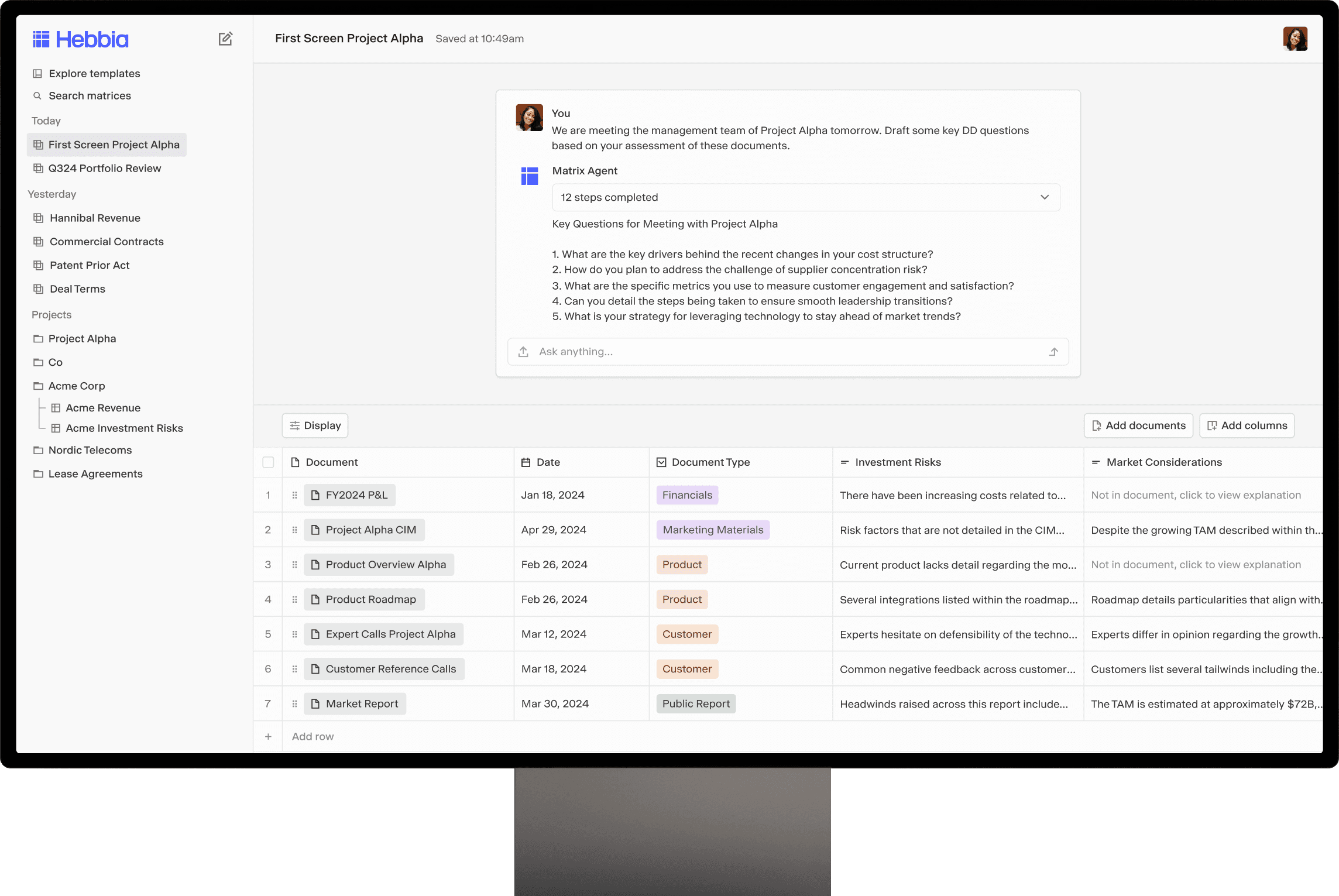
Learn more about V7 Go compared to Hebbia here: V7 Go vs Hebbia
AlphaSense for CIM Analysis
Website: www.alpha-sense.com
AlphaSense is a market intelligence platform that uses AI to search across a large corpus of external data, including earnings calls, broker research, filings, expert transcripts, and news.
It’s not designed to analyze CIMs directly, but it’s often used alongside them. While a CIM presents the company’s narrative, AlphaSense helps teams cross-check that narrative against external sources.
In practice, it’s useful for:
validating market size, growth rates, and positioning
comparing performance against public peers
building out competitive landscape sections
identifying risks or trends not covered in the CIM
Learn more in our guide: 10 Best AI Tools for Investment Banking: The Complete Guide
LLMs for CIM Analysis
Some firms build their own CIM workflows using OpenAI, Anthropic, etc. It’s relatively quick to get started, doesn’t require committing to a vendor, and can be more affordable upfront, especially for teams experimenting with AI before rolling it out more broadly.
This gives full control. You can design exactly how documents are processed, summarized, and integrated.
But in practice, most teams run into the same issues:
Inconsistent extraction from tables and charts
Weak numerical reliability (especially across formats)
No built-in validation or traceability
Ongoing maintenance burden
Without strong guardrails, you end up recreating problems you were trying to solve in the first place. As deal volume grows, most firms either formalize these workflows significantly or move toward more structured, purpose-built systems.
The Future of AI CIM Analysis for Deal Screening
The industry is moving toward a model of autonomous deal intake. In this environment, the first review of a deal is not performed by a human, but by a system trained on the firm’s specific investment criteria.
These systems will rank deals as they arrive, providing investment committees with a prioritized list of opportunities accompanied by instant summaries. This shift allows deal teams to focus on relationship building, complex negotiation, and post-acquisition value creation.
To learn more about how automation could accelerate your deal screening, book a call with our expert team.
Who reads a CIM?
Private equity firms, strategic acquirers, family offices, and other prospective buyers. In practice, the first person to read it is usually a junior analyst or associate at the interested firm, who extracts the key information and prepares an internal summary for the deal team.
+
How long does a typical M&A process take from CIM to close?
For a mid-market deal running a formal process, the typical timeline is four to six months from CIM distribution to signing, with another one to two months to close after that. CIM review and initial screening happen in the first two to three weeks. Speed at this stage matters — firms that move slowly often miss the first-round bid deadline entirely.
+
Can AI detect red flags in a CIM?
Yes, to a meaningful degree. AI systems can be configured to flag specific patterns: customer concentration above a defined threshold, revenue growth that doesn't reconcile with EBITDA expansion, forward projections that assume a sharp inflection with no supporting rationale, or qualitative language that contradicts the financial narrative. These aren't substitutes for analyst judgment, but they ensure red flags get surfaced consistently, not just when an analyst happens to catch them.
+
What's the difference between a CIM and a pitch deck?
A pitch deck is a high-level overview, usually 10 to 20 slides, designed to generate interest. A CIM is the full package (detailed financials, operational depth, market analysis) that comes after a buyer has expressed initial interest and signed an NDA. A pitch deck gets you in the room. The CIM is what you read once you're there.
+
Can AI read and analyse a CIM?
It depends on what you're screening for, but most deal teams prioritise the financial performance section (revenue, EBITDA, margins, and the quality of adjustments), the customer and revenue breakdown, and the market analysis. The executive summary sets the framing, but experienced reviewers treat it as the bank's best case — the financials are where you test whether it holds up.
+
What are the most important sections of a CIM?
Go is more accurate and robust than calling a model provider directly. By breaking down complex tasks into reasoning steps with Index Knowledge, Go enables LLMs to query your data more accurately than an out of the box API call. Combining this with conditional logic, which can route high sensitivity data to a human review, Go builds robustness into your AI powered workflows.
+
Imogen is an experienced content writer and marketer, specializing in B2B SaaS. She particularly enjoys writing about the impact of technology on sectors like law, finance, and insurance.