21 min read
—


A complete guide to the AI tools reshaping investment banking workflows, from deal screening to due diligence automation.

V7 Go
A smarter way to manage due diligence and underwriting
Ask a Vice President at a mid-market investment bank where their deal data lives, and they will point to a CRM. Ask where the actual data lives—the data used to answer a Managing Director's question at 9:00 PM on a Thursday—and they will point to a spreadsheet buried in someone's email.
This is the reality of investment banking in 2025. Despite $45 billion in AI investment across financial services, most deal teams still rely on manual data entry, copy-paste workflows, and offshore BPO teams to extract key metrics from confidential information memorandums, appraisal reports, and term sheets.
The bottleneck is ingestion, not analysis. A typical deal screening requires reading 200-300 pages of PDFs to extract interest coverage ratios, loan-to-value data, and comparable valuations. This process takes days because documents are unstandardized and data is trapped in tables, charts, and scanned images.
In this article:
Why investment banks struggle with document-heavy workflows and what AI can actually fix.
Deep dives into V7 Go, Hebbia, AlphaSense, MindBridge, and more.
How AI handles CIM triage, due diligence automation, and memo generation with step-by-step workflows.
Pilot design, acceptance criteria, QA sampling, and change management for live deal environments.
The Core Challenge: Why Investment Banking Workflows Break
“It sure is a hell of a lot easier to just be first.” That’s one of many memorable lines from Margin Call, a 2011 movie about Wall Street. And it’s a good summary of wholesale banking’s stance on AI and its subset machine learning. Corporate and investment banks (CIB) first adopted AI and machine learning decades ago, well before other industries caught on.
— McKinsey
Investment banking is a document-intensive business. Every deal generates hundreds of pages: confidential information memorandums, financial statements, appraisal reports, legal opinions, and management presentations. The problem is not volume. The problem is that every document arrives in a different format, and the data you need is buried in tables, charts, and footnotes that do not follow any standard template.
A typical deal screening workflow looks like this:
Receive an email from a broker with a CIM attached (usually a 50-100 page PDF).
Open the PDF and manually scan for key metrics: revenue, EBITDA, debt levels, management team, competitive positioning.
Copy-paste the data into an Excel template or a CRM field.
Cross-check the data against other documents (financial statements, appraisal reports, term sheets).
Flag inconsistencies and send follow-up questions to the broker.
Repeat for every deal in the pipeline.
This process is slow, error-prone, and does not scale. According to industry research, 78% of financial services organizations now use AI in at least one function, but most implementations focus on back-office automation (compliance, risk management) rather than front-office deal workflows where the bottleneck actually sits.
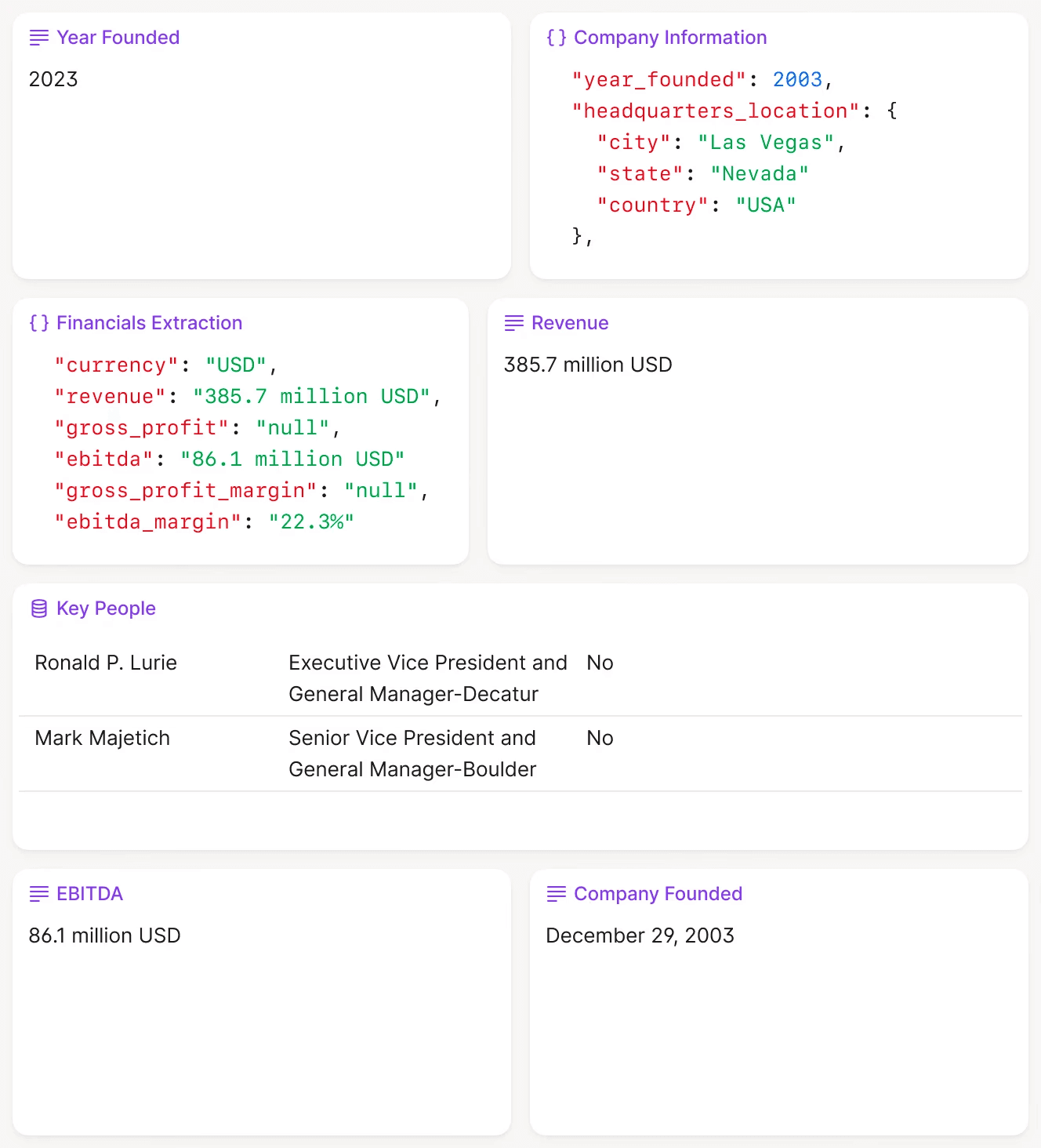
V7 Go extracting company data from CIMs and structuring it into actionable fields.
What AI Can Actually Solve
AI tools for investment banking fall into three categories:
Document Intelligence: Tools that extract structured data from unstructured documents (PDFs, emails, scanned images). This is where the biggest time savings come from. A tool that can read a 75-page CIM and extract the 12 fields you actually care about—EBITDA, revenue growth, customer concentration, debt covenants—saves 2-3 hours per document.
Market Research and Analysis: Tools that aggregate external data (news, filings, earnings calls) and surface insights faster than manual research. These help with comparable company analysis, industry benchmarking, and competitive intelligence.
Risk and Anomaly Detection: Tools that flag inconsistencies, fraud signals, or compliance issues in transaction data. These are most relevant for larger deal volumes where manual review of every line item is impractical.
Document intelligence delivers the most immediate ROI for most investment banks. A platform like V7 Go can read a CIM, extract the key metrics, and populate a structured output (Excel, CRM, or internal database) in minutes instead of hours. The agent does not just run OCR on the text. It understands the context: which table contains the revenue breakdown, which paragraph describes the competitive moat, which footnote explains the debt structure.
CIM due diligence workflow showing Cases interface with extracted fields and entity analysis.
The workflow looks like this: an analyst drags a batch of CIMs into V7 Go, selects the Deal Screening Agent, and the platform returns a structured table with extracted fields. Every extracted value includes a citation—click on any number and the platform highlights the exact page and paragraph where it came from.
Here is what a typical morning looks like for an analyst at a middle-market investment bank:
15 new deal emails in the inbox, each with a CIM or broker summary attached.
A Managing Director asking for a quick summary of three deals by end of day.
A live deal that needs updated financials because the target company restated its Q2 EBITDA.
A pitch deck due Wednesday that requires comparable company analysis for five targets.
The analyst can build a DCF model in an hour. But extracting the inputs from a 100-page CIM takes three hours. Multiply that by 15 deals, and the week is gone before any real analysis begins. This is where AI tools make the difference—not by replacing judgment, but by handling the extraction so analysts can focus on what actually matters: evaluating the investment thesis.
The 10 Best AI Tools for Investment Banking
We evaluated tools based on three criteria: (1) ability to handle unstructured documents, (2) integration with existing workflows, and (3) real-world adoption by investment banks. The list includes both modern AI challengers and legacy incumbents. After reviewing each tool, we map them to three core workflows you run every week: CIM triage, data room diligence, and memo generation.
1. V7 Go
Website: v7labs.com

Built specifically for high-document-volume workflows, V7 Go deploys customizable AI agents (e.g., AI Due Diligence Agent, AI Investment Analysis Agent) that process entire data rooms autonomously — extracting, structuring, and cross-referencing financial data across hundreds of documents at once. A leading PE firm cut average deal evaluation from three weeks to five days using it.
Key Features
Multimodal ingestion handles PDFs, scanned images, tables, charts, handwritten notes, and Excel files — including multi-year financials in inconsistent formats, scanned K-1s, and complex cap tables.
Page-by-page document scanning, linking every extracted figure directly back to its exact source location. Unlike standard RAG approaches, nothing is lost to summarization — critical for IC memo defense and audit trails.
Hybrid processing engine that dynamically switches from LLM reasoning to a deterministic calculation engine for financial math, eliminating the transposition errors that plague pure-language-model extraction.
Model-agnostic architecture supporting GPT, Claude, and Gemini, with model selection optimized per task type.
Extensive agent library built for finance: AI Due Diligence Agent, AI Investment Analysis Agent, AI Data Room Analysis Agent, AI Legal Due Diligence Agent, among others.
Where It Struggles: Steep initial learning curve for teams without technical resources. The first agent deployment requires meaningful setup effort — either internal technical ownership or vendor support. Niche workflows need customization rather than out-of-the-box configuration.
Best Document Task: Extracting interest coverage ratios, debt covenants, and customer concentration data from a batch of 50 broker CIMs and populating a deal pipeline spreadsheet.
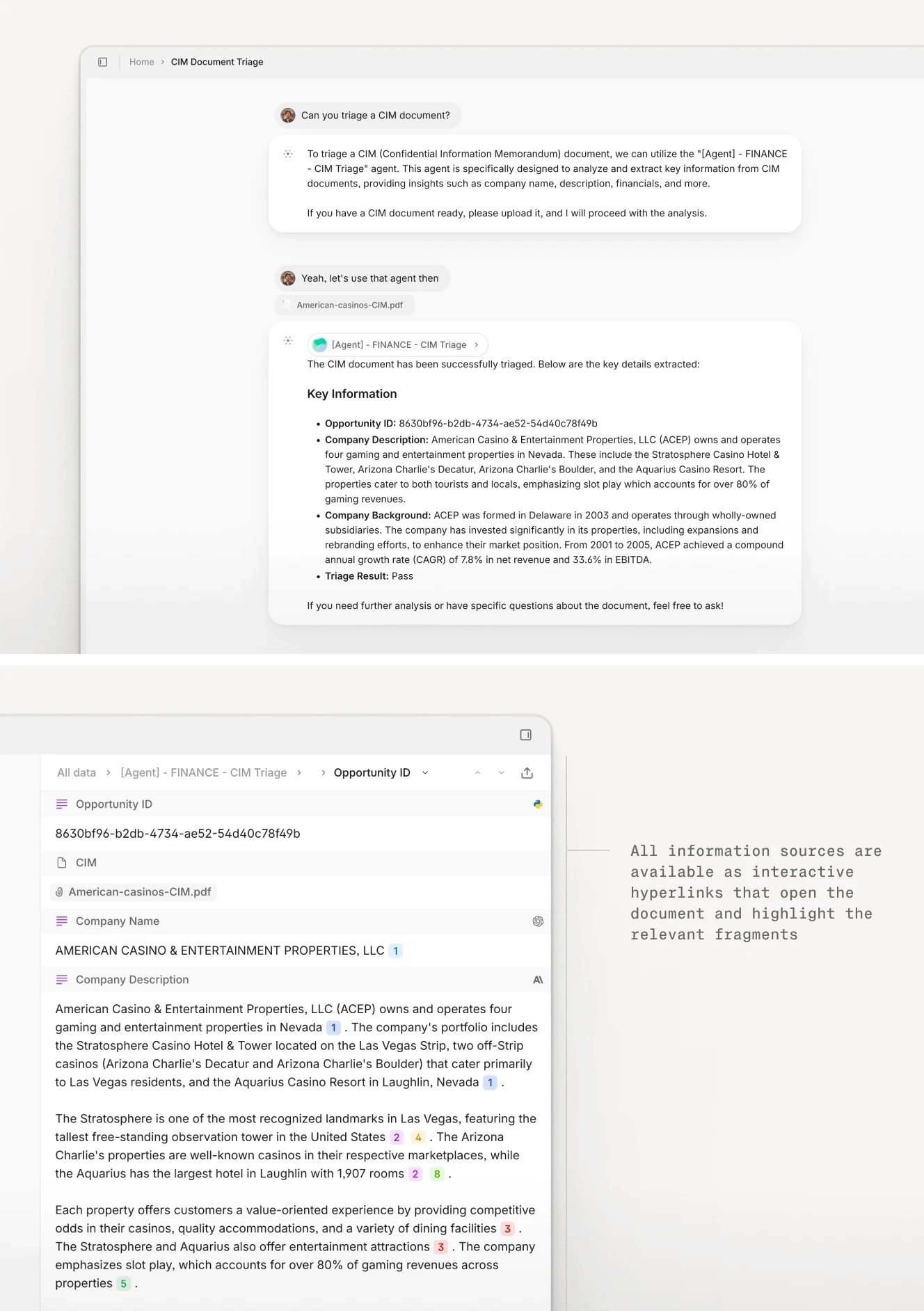
CIM triage interface showing extracted company info and classification.
2. Hebbia
Website: hebbia.ai
Core Positioning: Specializes in deep analysis of unstructured data in due diligence and investment memos.
Top 3 Features:
Multi-agent reasoning that can answer complex questions across multiple documents simultaneously.
Chat-style query interface that feels like talking to an analyst who has read every document in your data room.
Transparent source attribution for every data point returned.
Pricing Model: Custom/Enterprise pricing. Reportedly higher than category average, reflecting positioning as a premium solution.
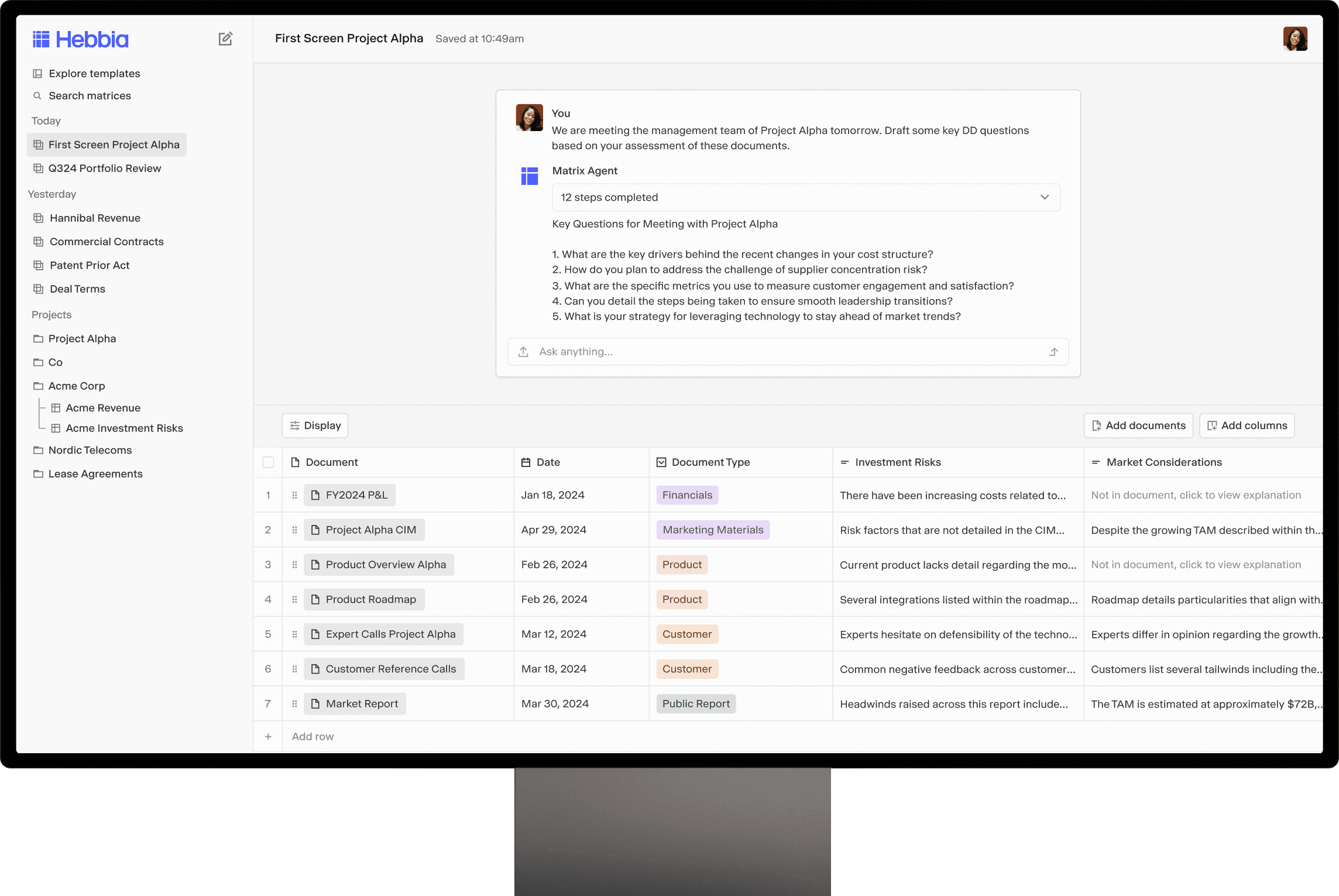
What Works Well: Effective at sifting through lengthy SEC filings and contracts. Users report that Hebbia can answer questions like "What are the top three risks mentioned in the last five 10-Ks?" in seconds. Strong adoption at large PE firms for due diligence acceleration.
Where It Struggles: Limited out-of-the-box documentation. Requires user training. Integration with legacy systems can be challenging.
Best Document Task: Answering complex cross-document questions during M&A due diligence (e.g., "What are all the change of control provisions across the customer contracts in this data room?").
Known Limitation: Works best with text-heavy documents. Tables and charts sometimes require manual verification.
Learn more: Compare Hebbia vs V7 Go: Hebbia Alternative
3. AlphaSense
Website: alpha-sense.com
Core Positioning: Best for comprehensive market research combining premium external content with internal data analysis.
Top 3 Features:
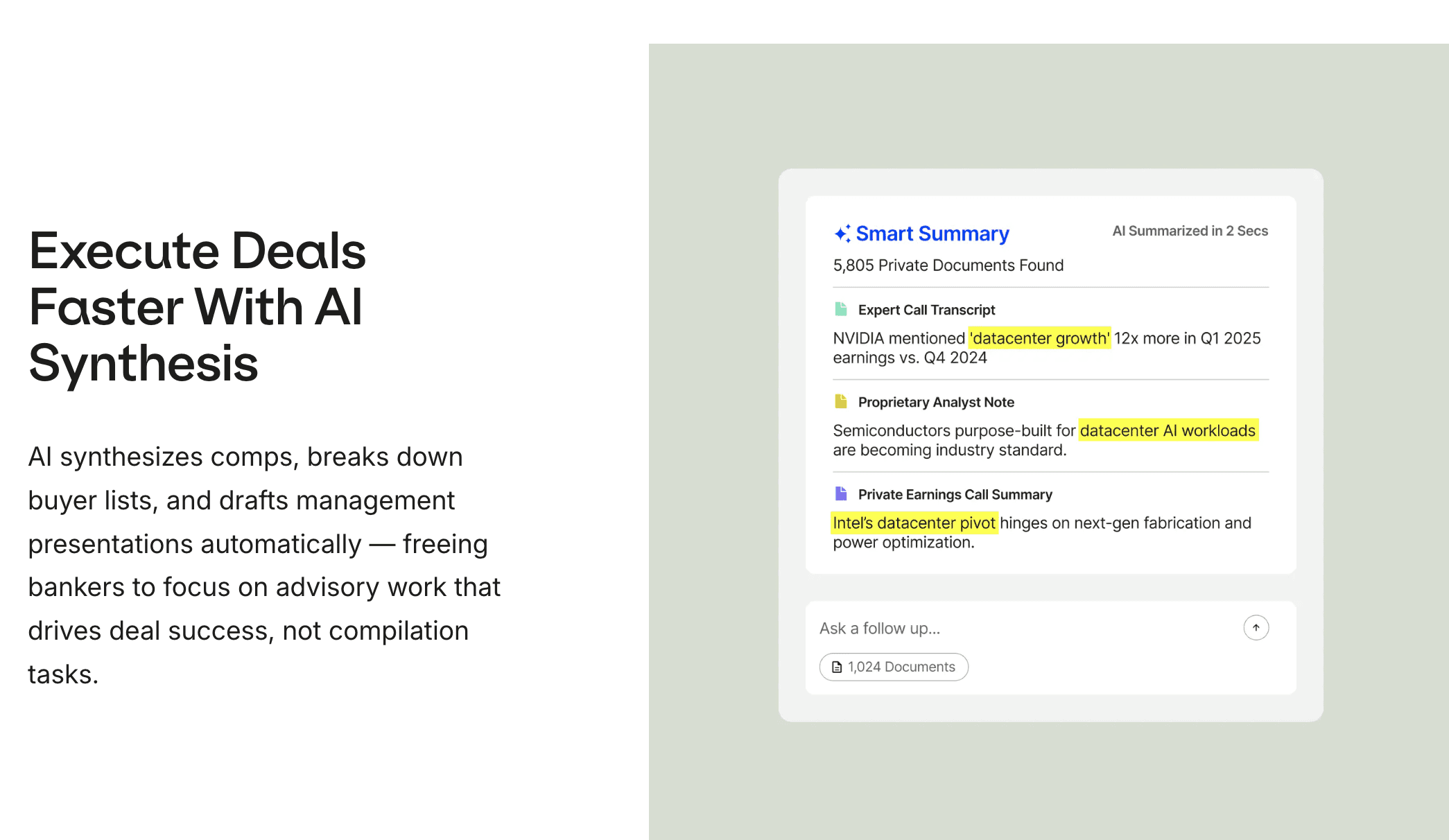
NLP-powered financial search across earnings calls, filings, news, and broker research.
Real-time alerts for market-moving events relevant to your coverage universe.
Integration with extensive data sources (FactSet, Bloomberg, proprietary research).
Pricing Model: Custom/Enterprise pricing. Premium tier given content access.
What Works Well: Extensive content coverage. Praised for accurate financial insights. Trusted by top firms for sector research and competitive intelligence. Particularly strong for public company research and earnings analysis.
Where It Struggles: Expensive. Steep learning curve. Integration can be complex for smaller teams. Less effective for private company research where public filings do not exist.
Best Document Task: Building a competitive landscape section for a pitch deck by synthesizing earnings calls, analyst reports, and news coverage across five public company comparables.
Known Limitation: Limited utility for private company due diligence where external data is scarce.
Learn more: Searching for a good AlphaSense alternative?
4. MindBridge
Website: mindbridge.ai
Core Positioning: Leading anomaly detection and risk scoring platform for transaction-level analysis.
Top 3 Features:
AI-driven risk dashboards that flag unusual transactions based on statistical patterns.
Real-time anomaly detection across 100% of transactions (not just samples).
Fraud identification and audit support with exportable evidence trails.
Pricing Model: Custom pricing. Implementation costs can be significant for legacy system integration.
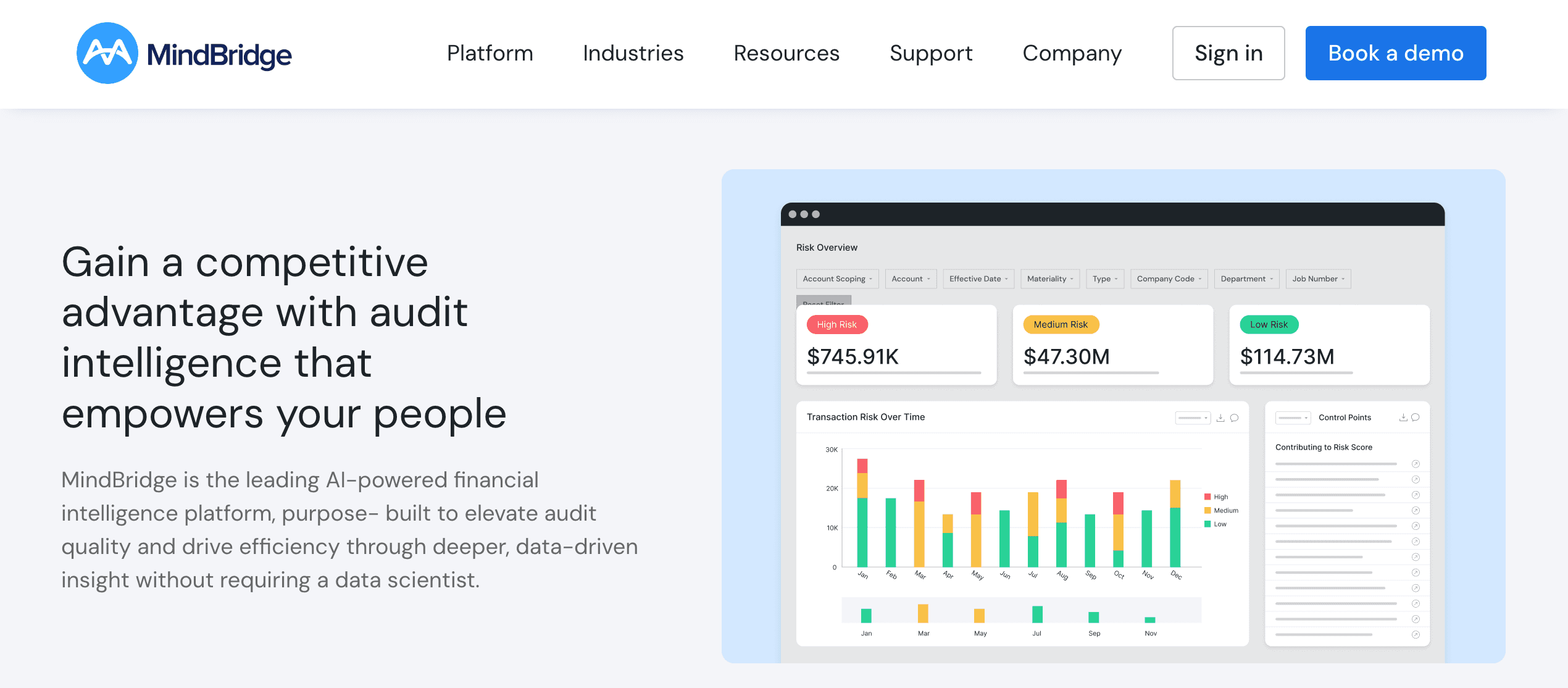
What Works Well: Excellent at detecting fraud and errors in financial data. Dashboard visualization is highly rated. Solid audit support. Used by Big Four accounting firms for financial statement audits and transaction testing.
Where It Struggles: Integration challenges with older systems. Customization can be lengthy. High implementation cost for complex deployments.
Best Document Task: Scanning 50,000 journal entries in a target company's general ledger to identify unusual patterns (round-dollar transactions, weekend entries, duplicate vendors) before signing an LOI.
Known Limitation: Requires clean, structured transaction data. Does not help with unstructured document extraction.
5. FinChat.io (by Fiscal.ai)
Website: finchat.ai
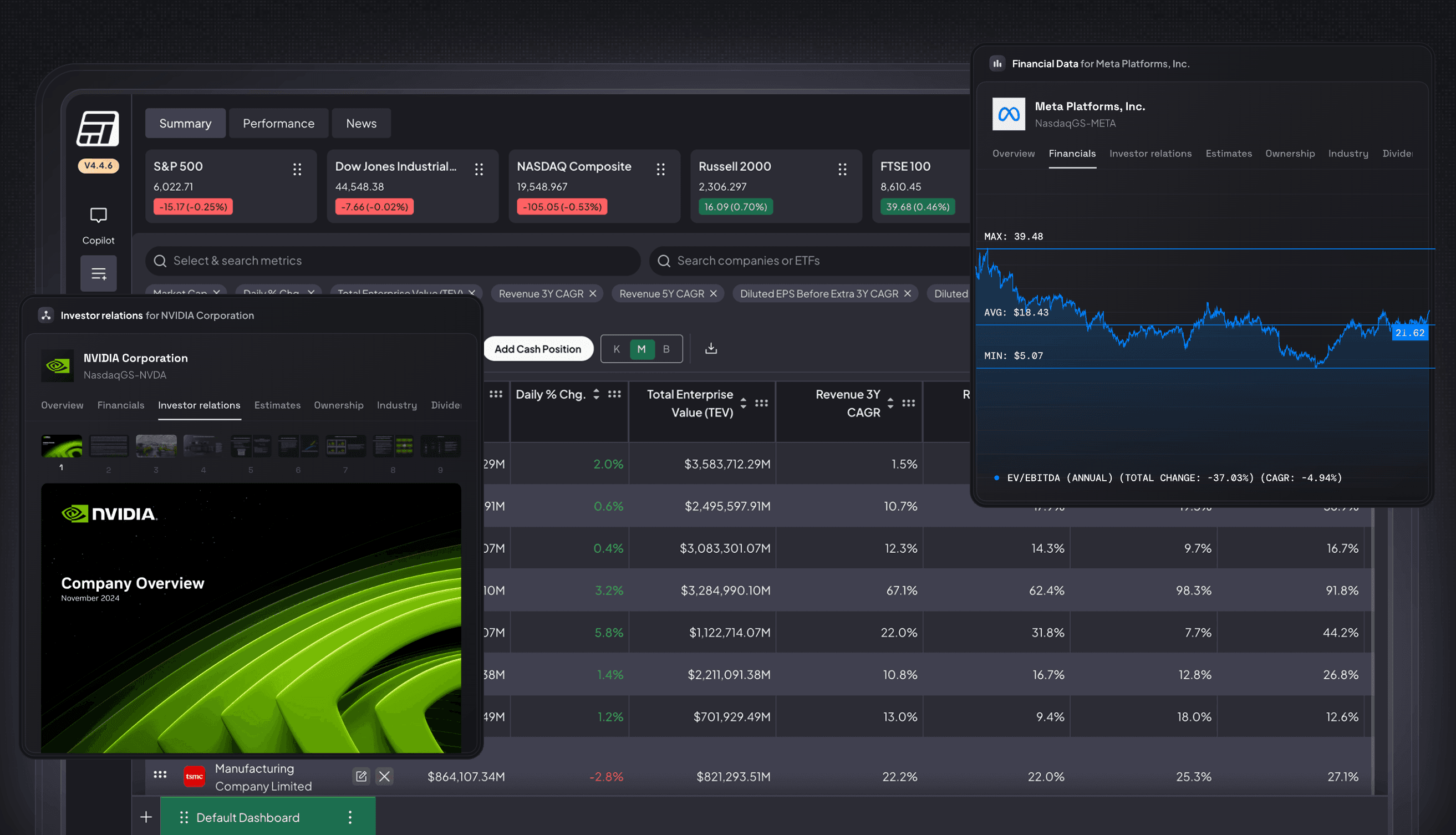
Core Positioning: AI-powered conversational research tool for generating charts, models, and investment insights.
Top 3 Features:
Conversational analytics interface (ask questions in natural language).
Automated chart and model generation from financial filings.
Seamless data synthesis from 10-Ks, 10-Qs, and earnings transcripts.
Pricing Model: Subscription-based / Custom pricing. More accessible than enterprise-only competitors.
What Works Well: User-friendly. Cost-effective for in-depth investment research. Responsive support. Popular with smaller funds and independent analysts who need quick access to public company data without Bloomberg-level pricing.
Where It Struggles: Limited dataset coverage compared to legacy systems. Evolving feature set. Occasional data lags on recent filings.
Best Document Task: Generating a revenue bridge chart from a company's last four 10-Qs to include in a client presentation.
Known Limitation: Coverage gaps for small-cap international companies.
6. Rogo

Website: rogo.ai
Core Positioning: Tailored for automating deal data extraction and integration with CRM and workflow systems in investment banking.
Top 3 Features:
Automated extraction from varied document formats (PDFs, emails, scanned images).
API-based integration with internal systems (Salesforce, custom CRMs).
Customizable workflow triggers (e.g., auto-populate CRM when a new CIM arrives).
Pricing Model: Custom pricing.
What Works Well: Quick deployment for specific deal workflows. Highly customizable. Reduces manual data entry delays.
Where It Struggles: Requires significant customization. Limited pre-built templates. Potential integration challenges with legacy systems.
Best Document Task: Auto-populating Salesforce deal records from broker emails containing CIM attachments.
Known Limitation: Works best when document formats are relatively consistent within your deal flow.
7. Bloomberg Terminal

Website: bloomberg.com/professional
Core Positioning: The industry-standard comprehensive financial analytics and trading platform.
Top 3 Features:
Real-time market data across all asset classes.
Advanced financial modeling and analytics.
Integrated communication and trading functionalities.
Pricing Model: Approximately $2,000+ per month per seat.
What Works Well: Extensive, reliable data coverage. Trusted global brand. Powerful analytics and real-time insights. The default choice for market data.
Where It Struggles: Expensive. Steep learning curve for new users. Less agile in integrating modern AI features compared to newer platforms. Does not solve the document extraction problem—Bloomberg gives you market data, not CIM parsing.
Best Document Task: Not a document extraction tool. Best for real-time market data, company financials, and transaction comps.
Known Limitation: Zero ability to ingest and extract from your proprietary deal documents.
8. SAP Financial Management
Website: sap.com/products/financial-management
Core Positioning: Enterprise resource planning for financial data and compliance management.
Top 3 Features:
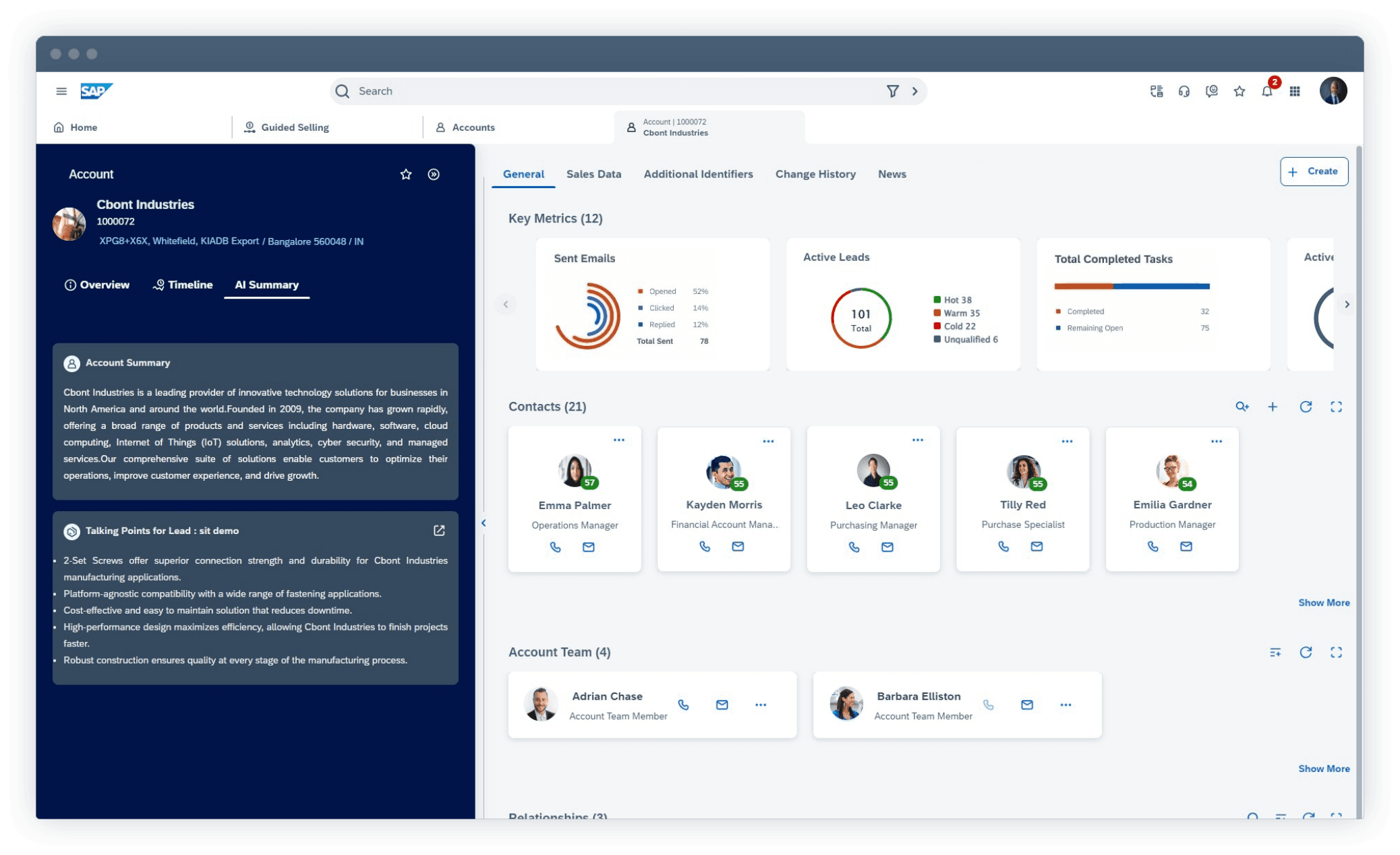
Cross-system data integration (connects to multiple data sources).
Comprehensive financial reporting and dashboards.
Strong compliance and audit controls.
Pricing Model: Enterprise-level custom pricing.
What Works Well: Highly scalable. Excellent integration with broader ERP systems. Trusted by large enterprises.
Where It Struggles: Complex implementation. High total cost of ownership. Requires lengthy customization cycles. Overkill for pure investment banking workflows.
Best Document Task: Not a document extraction tool. Best for enterprise financial consolidation and reporting.
Known Limitation: Implementation timelines measured in quarters or years, not weeks.
9. Oracle Financial Services
Website: oracle.com/industries/financial-services
Core Positioning: End-to-end enterprise financial solution with a focus on risk management and regulatory compliance.
Top 3 Features:
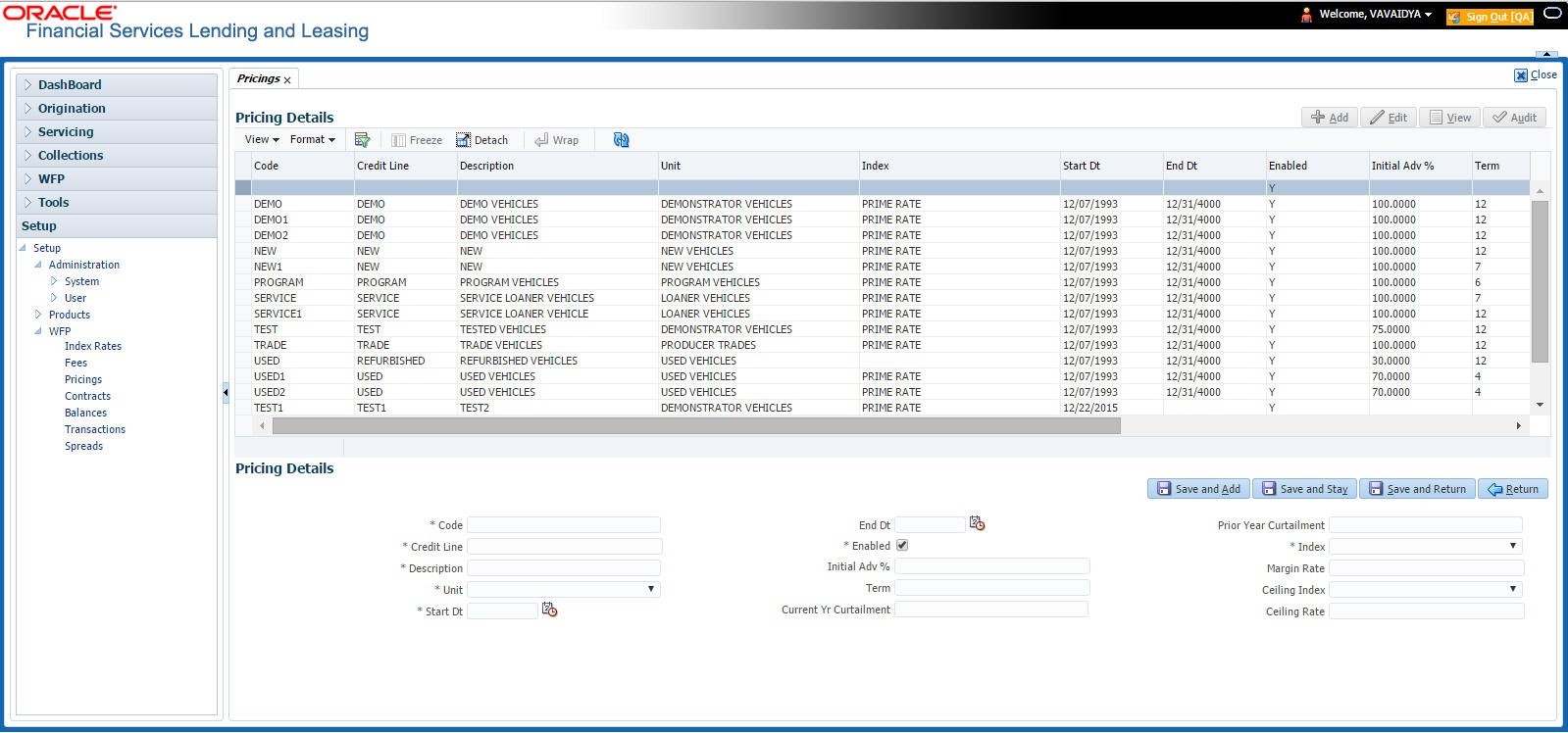
Comprehensive workflow automation for financial processes.
Strong risk management and stress testing capabilities.
Integrated regulatory reporting tools.
Pricing Model: Custom enterprise pricing.
What Works Well: Strong support and integration capabilities. Proven in large-scale deployments. Reliable compliance features.
Where It Struggles: Often rigid in customization. Lengthy deployment times. High overall cost.
Best Document Task: Not a document extraction tool. Best for regulatory reporting and risk management at scale.
Known Limitation: Designed for bank-wide infrastructure, not deal team workflows.
10. FactSet
Website: factset.com
Core Positioning: Essential providers of financial data aggregation and analytic tools for high-stakes market research.
Top 3 Features:
Extensive financial databases (company financials, ownership data, estimates).
Advanced modeling tools (comps, DCF, LBO models).
Real-time market analysis and analytics.
Pricing Model: Custom/Enterprise pricing.
What Works Well: Incredibly detailed data. Highly trusted analytics in the industry. Strong customer support.
Where It Struggles: Expensive relative to niche AI tools. Less flexible for rapid innovation. Occasional interface complexity.
Best Document Task: Pulling comparable company data and building comps tables for valuation analysis.
Known Limitation: Data coverage, not document extraction. You still need to manually input data from your deal documents.











Deep Dive: How AI Handles Investment Banking Workflows
With the tool landscape in mind, let us walk through three workflows where these tools change your week: CIM triage, data room diligence, and memo generation. For each, we will cover the manual process, where AI helps, and what the output looks like.
1. CIM Triage and Deal Screening
A typical investment bank receives 50-100 deal opportunities per month. Most are not a fit. The challenge is figuring out which deals are worth pursuing without spending hours reading every CIM.
The Manual Process:
Analyst receives email from broker with CIM attached.
Opens PDF, scans for executive summary (usually pages 2-5).
Hunts for key metrics: revenue, EBITDA, growth rate, customer concentration.
Checks investment criteria: Does EBITDA exceed $10M? Is revenue growing above 15%? Is customer concentration below 30%?
If criteria pass, forwards to VP with brief summary.
If criteria fail, sends polite decline to broker.
Time per CIM: 30-60 minutes.
CIMs with AI:
An AI agent reads the CIM, extracts the key metrics (revenue, EBITDA, growth rate, management team, competitive positioning), and flags deals that meet your investment criteria. The AI Deal Screening and Triage Agent can process a batch of CIMs and populate a structured output (Excel, CRM, or internal database) with the key metrics.
The agent doesn't just extract text. It understands context: which table contains the revenue breakdown, which paragraph describes the competitive moat, which footnote explains the debt structure. Each extracted value includes a source citation—click on "EBITDA: $12.4M" and the platform highlights page 17, paragraph 3 of the CIM.
Batch CIM triage showing Table View processing multiple deals, extracting summaries and risk flags.
2. Due Diligence Automation
Once a deal passes the initial screening, the due diligence phase begins. This involves reading hundreds of documents: financial statements, legal opinions, customer contracts, environmental reports, and management presentations.
The Manual Process:
Data room access granted. Analyst downloads 500-1,000 documents.
Creates folder structure to organize documents by category.
Opens each document and hunts for relevant clauses (change of control, non-compete, warranty terms).
Logs findings in a due diligence checklist spreadsheet.
Flags issues for legal review.
Writes summary memos for Investment Committee.
Time for full due diligence: 2-4 weeks.
Due Diligence with AI:
AI tools like V7 Go can search across the entire data room and surface relevant clauses in seconds. For example, if you ask "What are the change of control provisions in the customer contracts?" the agent will scan all the contracts, extract the relevant clauses, and provide a summary with source citations.
The AI Data Room Analysis Agent can also flag inconsistencies. For example, if the CIM says the company has 50 employees but the payroll records show 45, the agent will flag the discrepancy for human review. If the appraisal values a property at $15M but the lender commitment letter references $12M, that gets flagged too.
3. Investment Memo Generation
Investment banks spend significant time creating pitch decks and investment memos. These documents require synthesizing data from multiple sources: financial models, market research, competitive analysis, and management interviews.
The Manual Process:
Analyst builds financial model in Excel.
Pulls comparable company data from FactSet/Capital IQ.
Copies key metrics into PowerPoint template.
Writes investment thesis, risk factors, and management assessment sections.
Sends to VP for redlines.
Incorporates feedback and sends to MD for final review.
Time per memo: 15-25 hours.
The AI-Assisted Process:
AI can automate parts of this process. The AI Investment Memo Generation Agent can take a CIM, financial model, and market research report and generate a first draft of an investment memo. The agent extracts the key metrics, summarizes the investment thesis, and flags risks.
The output is not perfect. It requires human review and editing. But it saves 5-10 hours of manual work. An analyst can focus on refining the investment thesis instead of copying data from the CIM into a Word document.
Implementation Playbook: What to Expect
Deploying AI tools in a live deal environment is not plug-and-play. Here is what to expect based on real-world implementations, including the acceptance criteria, QA processes, and change management steps that separate successful rollouts from shelf-ware.
Phase 1: Pilot Design (2-4 Weeks)
Start with a narrow use case. For example, automate the extraction of key metrics from CIMs. Choose 10-20 recent deals and run them through the AI tool. Compare the output to the manual extractions.
Acceptance Criteria:
Before starting, define what success looks like:
Field accuracy threshold: 90%+ accuracy on core fields (EBITDA, revenue, customer count). 80%+ on secondary fields (management bios, competitive positioning).
Coverage requirement: Agent must extract values from 95% of documents. The remaining 5% should be flagged as "unable to extract" rather than returning garbage data.
Processing time: Batch of 20 CIMs processed in under 2 hours (including human review).
Citation accuracy: 100% of extracted values must link to correct source page and paragraph.
Pilot Execution:
Select 20 recent CIMs from your pipeline (mix of clean and messy formats).
Run each through the AI tool.
Compare extracted values against manual extractions (ground truth).
Calculate accuracy per field.
Document edge cases: which document types caused errors? which fields had lowest accuracy?
Most investment banks see 70-85% accuracy on the first pass. The remaining 15-30% requires human review, but the time savings are still significant because the human is reviewing and correcting, not extracting from scratch.

Radar chart comparing AI models (GPT-4, Claude) in financial tasks.
Phase 2: Integration (4-8 Weeks)
Once the pilot is successful, integrate the AI tool with your existing workflows. This usually involves API connections to your CRM, email system, and document management platform.
For example, V7 Go can connect to your email system and automatically process CIMs as they arrive. The extracted data flows directly into your CRM, eliminating manual data entry. When a broker sends a new CIM, the workflow triggers automatically: extract fields, run pass/fail criteria, update CRM, notify analyst of flagged deals.
Integration Checklist:
Email trigger: Forward rule or API connection to ingest attachments.
CRM connection: API to write extracted fields to deal records (Salesforce, HubSpot, or custom CRM).
Export format: Structured output to Excel, JSON, or direct database write.
Error handling: What happens when extraction fails? Alert analyst? Queue for manual review?
The integration phase requires technical resources. Most investment banks work with the AI vendor's implementation team to set up the connections and customize the workflows. Budget 4-8 weeks for integration, longer if you have legacy systems with limited API support.
Phase 3: QA and Calibration (Ongoing)
After the integration is complete, the AI tool becomes part of the daily workflow. But AI tools are not set-and-forget. They require ongoing QA to maintain accuracy.
QA Sampling Strategy:
Week 1-4: Review 100% of extractions. Flag errors. Identify patterns.
Week 5-8: Review 50% of extractions (random sample). Track accuracy trends.
Week 9+: Review 10-20% of extractions. Focus on edge cases and new document formats.
Error Tracking:
Maintain a log of extraction errors with the following fields:
Document name and type
Field that was incorrect
Expected value vs. extracted value
Root cause (poor scan quality, unusual table format, missing data, ambiguous language)
Review the error log weekly. If a pattern emerges (e.g., all errors on scanned documents from a specific broker), work with the vendor to adjust the extraction logic or add pre-processing steps.
Data room analysis with Concierge auto-selecting Cap Table Analysis agent.
Phase 4: Change Management
The key to successful scaling is change management. Analysts need training on how to use the tool and when to trust the output.
Define when to escalate vs. when to trust the AI:
Green: All fields extracted with citations. Proceed with AI output.
Yellow: One or more fields missing or flagged as low confidence. Analyst verifies manually.
Red: Document type not supported or extraction failed. Escalate to manual processing.
The V7 Go Advantage
The concerns above—accuracy, edge cases, and integration—are precisely where V7 Go's citations, visual grounding, and agent configuration show their value.
Multi-Modal OCR and Labeling
V7 Go can process any document format: PDFs, scanned images, tables, charts, and handwritten notes. The platform uses advanced OCR to extract text and visual grounding to understand the context. For example, if a CIM contains a table with revenue data, V7 Go can identify the table, extract the numbers, and label them correctly (revenue, EBITDA, net income).
This is critical for investment banking, where documents are rarely standardized. A CIM from one broker might have the revenue data in a table on page 5. A CIM from another broker might have the same data in a paragraph on page 12. V7 Go handles both formats without manual configuration.
AI Citations Engine
One of the biggest risks with AI tools is hallucination—when the AI invents data that does not exist in the source document. V7 Go mitigates this risk with an AI citations engine. Every extracted data point includes a source citation: the page number, paragraph, and exact text where the data was found.
This is essential for audit trails and compliance. When a Managing Director asks "Where did this EBITDA number come from?" you can click on the data point and see the exact source in the CIM. No more hunting through 100 pages to verify a single figure.
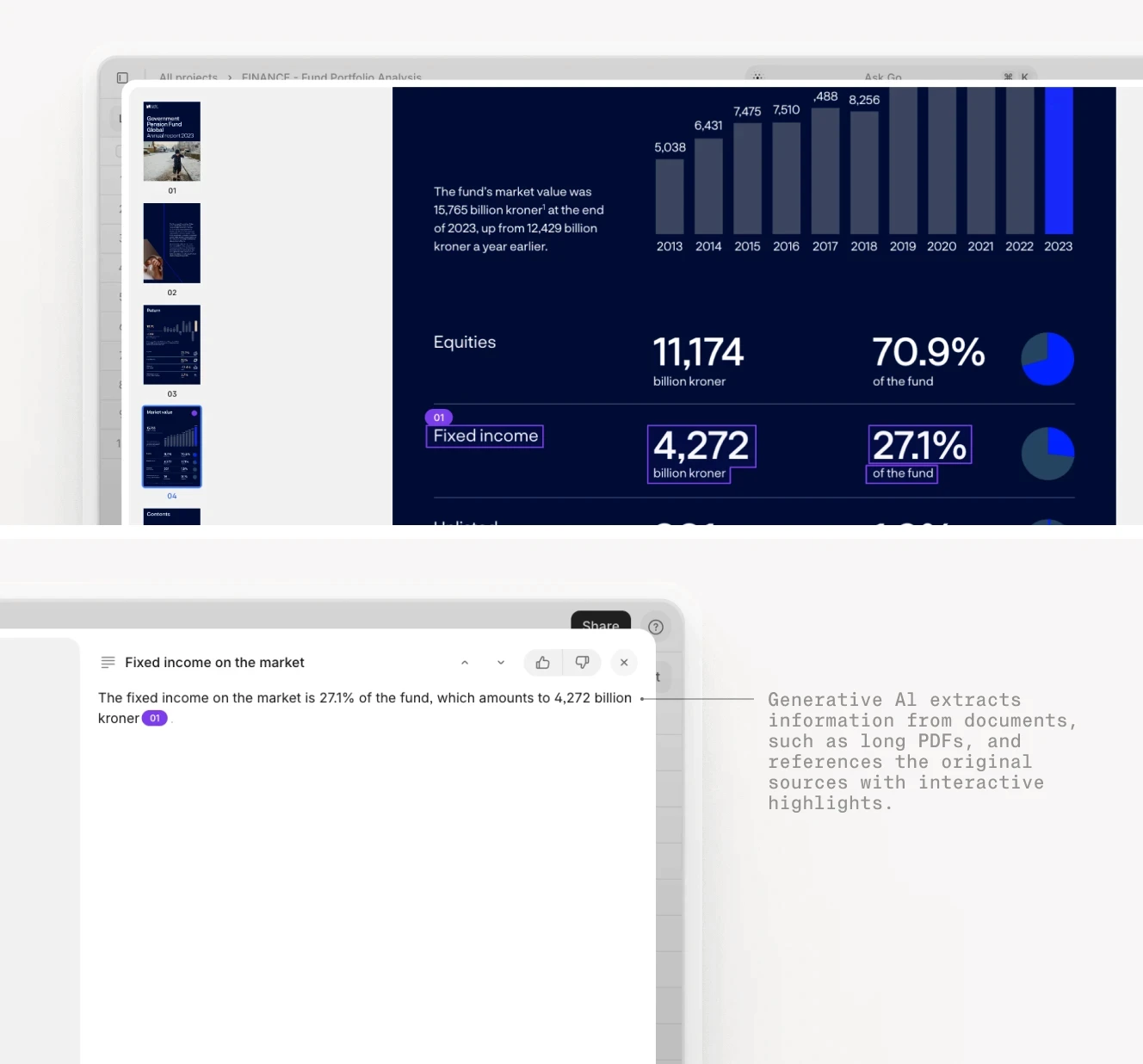
AI highlighting financial metrics from fund PDF with source links.
Customizable Agent Workflows
V7 Go allows you to build custom agents for specific workflows. For example, you can create a Valuation Analysis Agent that extracts comparable company data from CIMs and populates a valuation model. Or you can create a Pitch Deck Automation Agent that generates slides from a financial model and market research report.
The agents are configurable without code. You define the inputs (CIM, financial model, market research), the outputs (Excel, PowerPoint, CRM), and the logic (extract revenue, calculate multiples, flag risks). V7 Go handles the rest.
Real-Time Integration Capabilities
V7 Go integrates with your existing systems via API. You can connect V7 Go to your email system and automatically process CIMs as they arrive. The extracted data flows directly into your CRM, eliminating manual data entry.
You can also connect V7 Go to your document management platform (SharePoint, Google Drive) and automatically classify and tag documents. For example, all CIMs are tagged as "CIM" and all appraisal reports are tagged as "Appraisal". This makes it easier to search and retrieve documents later.
The Future of AI in Investment Banking
The investment banking industry is at an inflection point. According to BCG research, 74% of companies struggle to achieve and scale value from AI. The reason is not the technology. The reason is that most firms treat AI as a science project instead of a business tool.
The firms that succeed with AI are the ones that focus on narrow, high-value workflows. They do not try to automate everything at once. They start with one use case (CIM triage, due diligence automation, memo generation), prove ROI, and then scale to other workflows.
The competitive advantage in investment banking will not come from having the same AI tools as everyone else. It will come from using those tools to process information faster and more accurately than the competition. The firms that can screen 100 deals in the time it takes their competitors to screen 10 will win more mandates and close more deals.
To see how V7 Go can automate your deal workflows, from CIM triage to due diligence automation, book a demo.
What is the difference between AI document extraction and traditional OCR?
Traditional OCR (Optical Character Recognition) converts images of text into machine-readable text. It works well for clean, typed documents but struggles with tables, charts, handwritten notes, and poor-quality scans. AI document extraction goes further. It uses large language models to understand the context and structure of the document. For example, an AI tool can identify that a table on page 5 contains revenue data, extract the numbers, and label them correctly (revenue, EBITDA, net income). It can also handle ambiguous language and missing data by inferring the correct values from context. The key difference: OCR gives you text; AI extraction gives you structured, labeled data.
+
Can AI fully automate investment banking workflows?
No, and you should be skeptical of anyone claiming it can. AI automates the data gathering, reconciliation, and reporting components. It removes the manual friction of getting data into the system. However, the strategic decisions—buy/sell, valuation, thesis building—remain human tasks. The value of AI is in freeing up analysts to focus on high-value work instead of manual data entry. Think of AI as handling the 70% of work that is extraction and formatting, so humans can focus on the 30% that requires judgment.
+
Is it safe to put sensitive deal data into cloud-based AI software?
Yes, provided the vendor meets strict enterprise security standards. The industry standard is SOC 2 Type II certification. You should also look for ISO 27001 certification, GDPR/CCPA compliance, and encryption in transit and at rest. Enterprise-grade platforms like V7 Go include these protections by default. Additionally, many platforms offer on-premise deployment options for firms with strict data residency requirements. Ask about data retention policies, access controls, and audit logging before signing a contract.
+
How long does it take to implement AI tools in investment banking?
It varies by complexity. A pilot on a narrow use case (CIM triage, due diligence automation) can be live in 4-8 weeks. Full integration with existing systems (CRM, email, document management) typically takes 8-12 weeks. The key is to start small, prove ROI, and then scale. Most investment banks run a pilot on 10-20 recent deals before rolling out to the entire team. Budget for a 3-6 month ramp to full productivity, including training and workflow refinement.
+
What is the ROI of AI tools in investment banking?
AI tools are not perfect. They struggle with edge cases: unusual document formats, ambiguous language, missing data, and poor-quality scans. The solution is to treat AI tools as assistants, not replacements. Use them to automate the repetitive tasks (data extraction, document classification) and reserve human judgment for the edge cases. Most investment banks set up a review workflow where the AI tool processes the documents and flags edge cases for human review. Expect 15-30% of documents to require manual verification in the first month, dropping to 5-10% as the tool is calibrated to your document types. Over time, the AI tool learns from feedback and the accuracy improves.
+
How do AI tools handle edge cases and unusual document formats?
Go is more accurate and robust than calling a model provider directly. By breaking down complex tasks into reasoning steps with Index Knowledge, Go enables LLMs to query your data more accurately than an out of the box API call. Combining this with conditional logic, which can route high sensitivity data to a human review, Go builds robustness into your AI powered workflows.
+
Imogen is an experienced content writer and marketer, specializing in B2B SaaS. She particularly enjoys writing about the impact of technology on sectors like law, finance, and insurance.