10 min read
—



Casimir Rajnerowicz
Content Creator
V7 Go
A smarter way to manage due diligence and underwriting
Bain surveyed 250 senior executives about the deals they had done and found that more than 40% of them had no investment thesis at all. Only 29% started with one that stood the test of time. Among those who did write a thesis, half discovered within three years that it was wrong.
So the interesting question is not what an investment thesis is, or how to structure the argument. Those are well covered and not difficult. The interesting question is why so many theses turn out to be wrong, and what separates the ones that survive contact with a data room from the ones that die in week three of diligence.
The short answer: most theses fail on evidence, not on logic. The reasoning is usually sound. The claim underneath it was never checked at the depth the claim required, because the evidence was buried in four hundred documents and nobody had time to read more than a fraction of them.
This guide covers what a thesis is and the five parts of one that holds up. Then it spends most of its length on the part nobody writes about: where the evidence comes from, how to organise it so the thesis can be tested rather than admired, and what diligence actually breaks when it breaks a deal.
What an investment thesis actually is
An investment thesis is a falsifiable claim about why an asset will be worth more later, and what has to be true for that to happen. That is the whole of it, and the definition does more work than it looks like it does.
The test is not whether the thesis sounds right. It is whether you could describe, in advance, the specific finding that would prove it wrong.
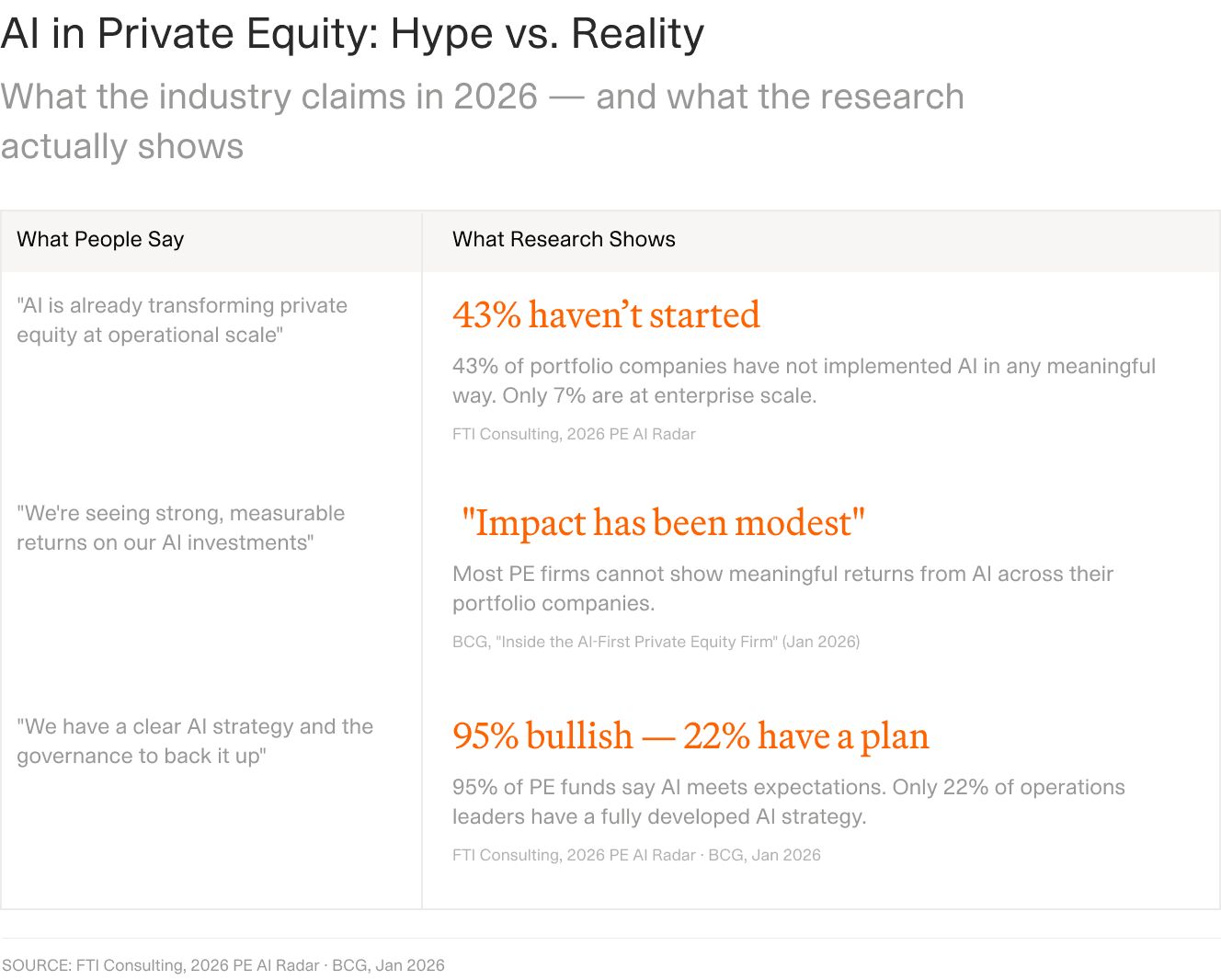
A thesis compressed to its load-bearing claims. Anything on this list that cannot be checked against a document is an opinion, not a thesis.
That word, falsifiable, is doing most of the work. "This is a good business in a growing market" is not a thesis, because no finding could contradict it. Now try this one. "This business will grow revenue at 12% a year for five years because 70% of revenue is contracted with a 95% renewal rate, and the two largest customers have just signed three-year extensions." That is a thesis, because it contains at least four things a data room can confirm or destroy.
The investment thesis meaning that matters in practice is closer to a hypothesis than to a recommendation. It is written before the evidence is complete, precisely so that the diligence process has something to aim at. A team that writes its thesis after diligence has written a justification, and a justification cannot be wrong, which is why it is worthless.
Bain's finding about vague strategic language is the same point from the other direction. Describing a deal as "strategic" is not good enough: a credible thesis has to describe a concrete benefit rather than a vaguely stated strategic value. The Accenture figure Bain cites is the consequence. Eighty-three percent of surveyed executives admitted they could not distinguish between the value levers of their own deals.
Three things often get called the same name. A fund thesis is the strategy a GP raises capital against: sector, stage, cheque size, hold period. A deal thesis is the claim about one specific asset. A portfolio thesis is the argument for how the assets fit together. This article is about the deal thesis, which is the one that gets tested hardest and written worst.
There is a fourth thing worth separating out, because conflating it with the thesis causes real damage: the screening criteria. Criteria are the filter that decides what gets looked at, and they are properties of the fund. Revenue between £20m and £100m, EBITDA margin above 15%, founder-owned, UK or Nordics. A target either passes or it does not. The thesis is what you write once a target has passed, and it is specific to that asset. Teams that treat a strong criteria match as a thesis end up with a memo arguing that the company fits the fund. That is an argument about the fund, not about whether the business will be worth more later.
The five parts of a thesis that holds up
Almost every durable thesis contains the same five components. An investment thesis template is useful mostly as a reminder that a missing component is a hole, not a stylistic choice. Most advice on how to write an investment thesis stops at the first three, which is why the fourth is the one that separates a test from a pitch.
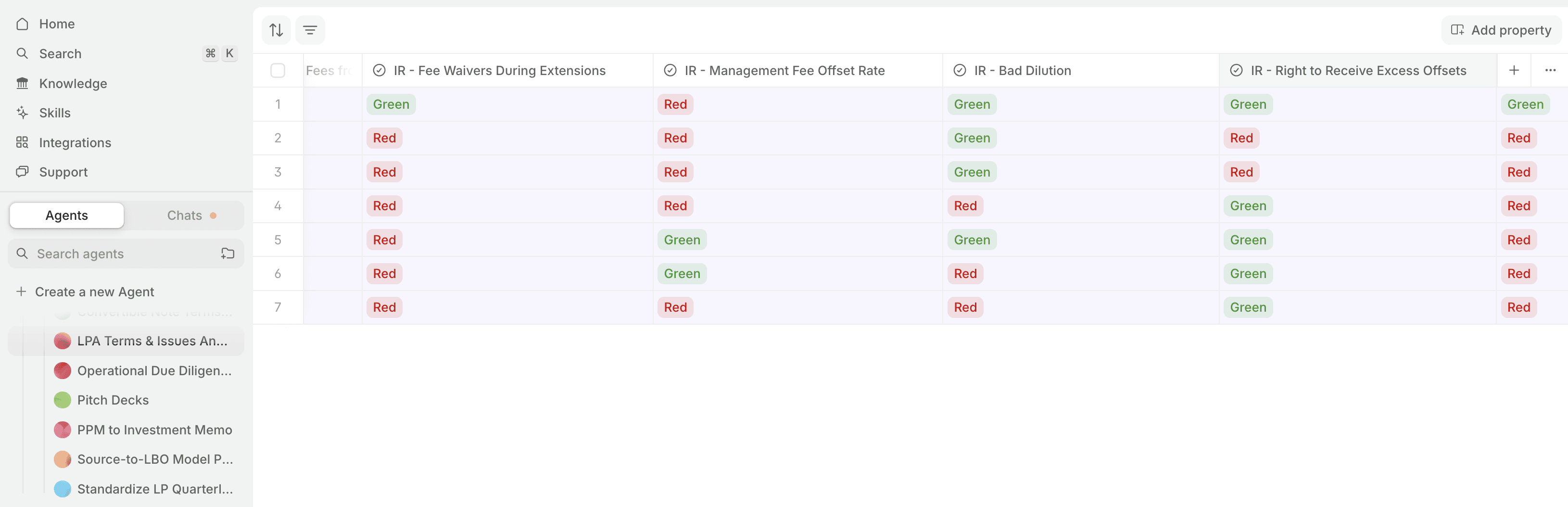
Each claim weighed against the evidence that supports it. The structure matters less than whether every line has something underneath it.
Component | The question it answers | What makes it weak |
|---|---|---|
The claim | Why will this be worth more in five years than it costs today? | Stated as a category rather than a mechanism. "Consolidation play" is not a mechanism |
The mechanism | Through what specific action does the value arrive? Pricing, volume, margin, multiple, or leverage | More than two mechanisms. A thesis resting on four things going right is four theses |
The conditions | What must be true about the market, the asset and the team? | Conditions nobody has assigned a document to. Each one needs a place the evidence lives |
The disconfirmers | What finding would kill this? | Missing entirely. This is the most commonly absent component and the most valuable one |
The price discipline | At what price does the thesis stop working? | Set after the auction rather than before it |
The disconfirmers row is the one worth dwelling on. Writing down, before diligence starts, the three findings that would make you walk away is the single cheapest improvement available to most deal teams. It converts diligence from an exercise in confirming a decision already made into a test with a pass condition, and it makes the walk-away conversation a matter of record rather than a matter of nerve.
It also changes what the diligence workplan looks like. If the thesis says renewal rates hold above 90%, then the customer contracts, the churn cohort data and the top-twenty customer concentration analysis are not general diligence items. They are the test. Everything else is secondary and can be scoped accordingly.











Where the evidence actually comes from
This is the part the guides skip. A thesis is a claim about evidence, and in private markets that evidence is scattered across document types that arrive at different times, in different formats, from parties with different incentives.
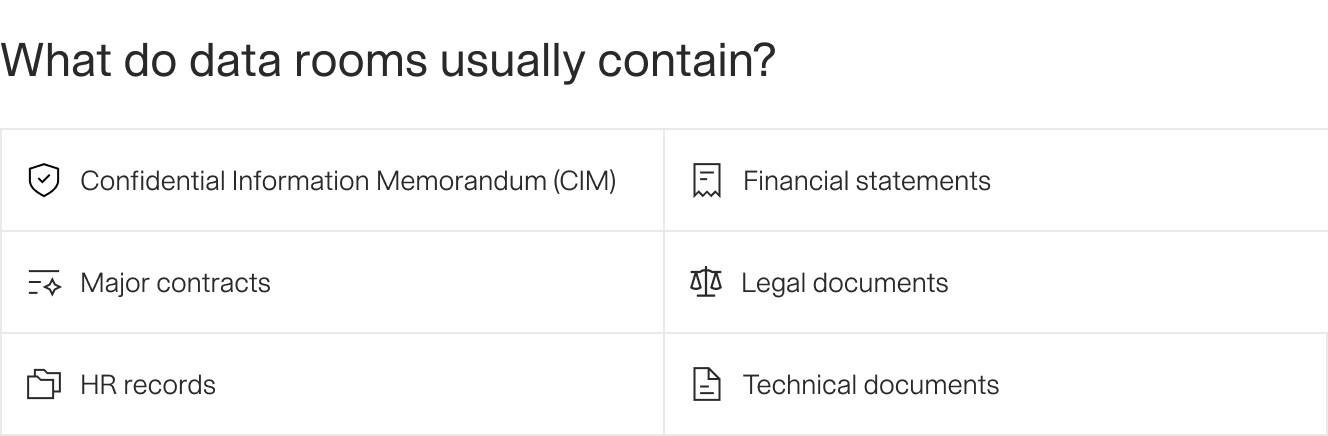
The evidence, as it actually arrives. Categories rather than answers.
The sequence matters because the thesis has to be written early, on thin evidence, and then revised as thicker evidence arrives. Teams that wait for the data room before forming a view have already spent the option value of forming one.
Stage | What you have | What it can support | What it cannot |
|---|---|---|---|
Teaser | Two pages, seller-written | A sector view and a rough size test | Anything about quality of earnings |
CIM or information pack | 50 to 200 pages, seller-written | The first real draft of the thesis, and the list of things to test | Independent verification of any of it |
Management presentation | Narrative plus forecast | The management-quality condition | The base case. This is a sales document |
Data room | Hundreds to thousands of documents | Contract-level confirmation of the mechanism | Anything nobody reads |
QoE report | Third-party, adjusted EBITDA | The price discipline | Forward-looking claims |
Management accounts and audited financials | Historic, verifiable | Trend and margin claims | Explanation. Numbers do not say why |
Terminology varies by desk. Venture teams say pitch deck and data room, credit teams say information pack, allocators say GP report and DDQ. The shape of the problem is identical: a seller-written narrative arrives first, independent evidence arrives later, and the thesis has to be written against the first and defended against the second. Our guide to reviewing a CIM covers the first document in that chain in more depth.
Offering memoranda queued for review. The constraint is rarely finding the documents. It is reading all of them at the same depth.
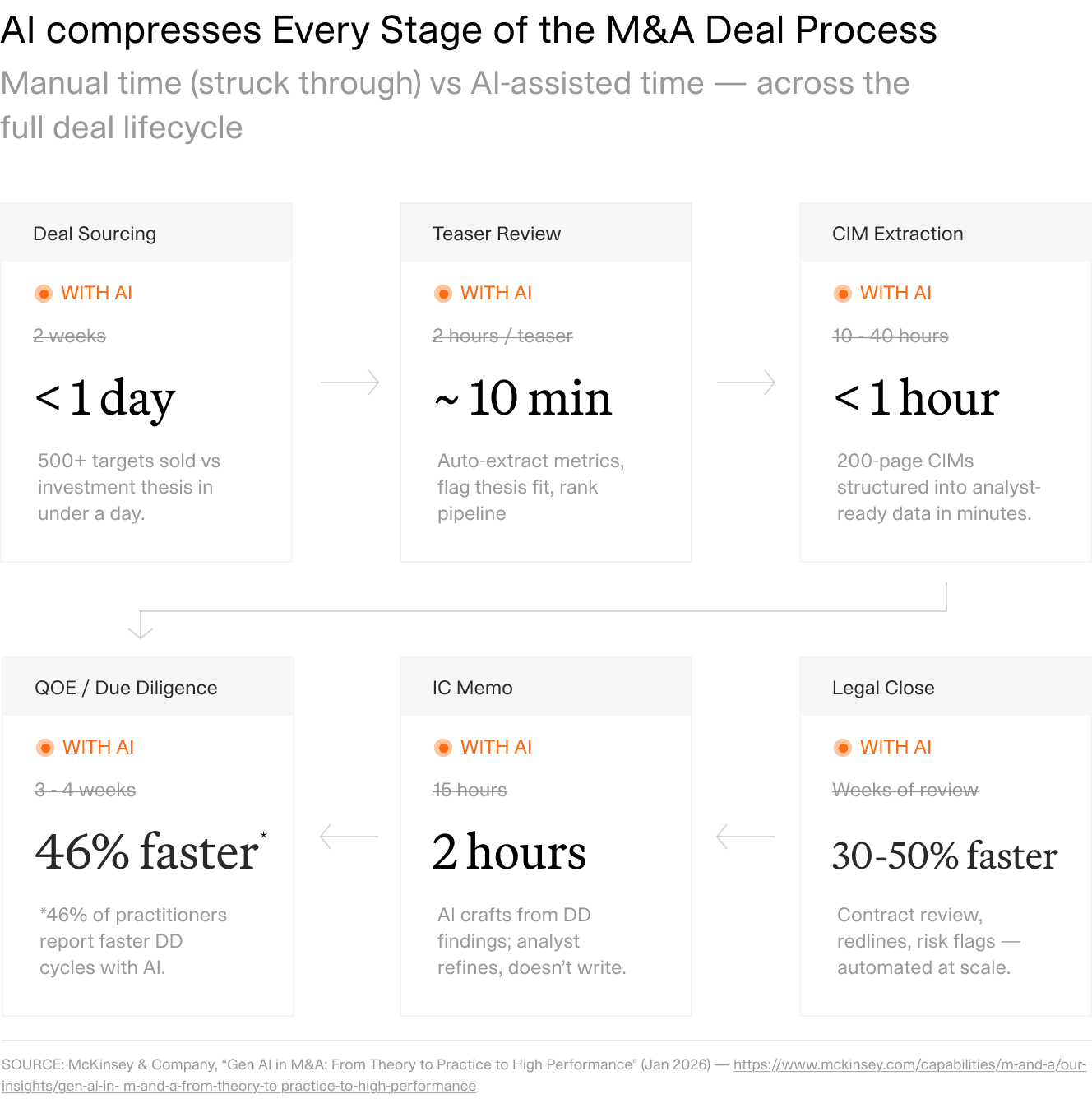
The practical failure is coverage. A mid-market team reviewing eighty to a hundred targets in detail cannot read every page of every data room, so it reads the sections it expects to matter. That is a reasonable adaptation to a real constraint, and it is also exactly how a thesis-killing fact stays undiscovered until the confirmatory phase, when walking away is expensive and slow.
The discipline that helps is mapping each condition in the thesis to the specific document that would confirm it, before the data room opens. Not "we will look at customer quality", but "the top-twenty customer contracts, the churn cohorts by vintage, and the three largest renewals in the last eighteen months." A condition with no document assigned to it is a condition nobody is going to check.
Ownership matters as much as the mapping. On most deals the evidence work is split across an associate, an external QoE provider, a legal team and whoever happens to have relevant sector experience. The seams between them are where conditions get lost. The associate assumes the QoE covers revenue recognition, the QoE scope excludes it, and nobody notices until the committee asks. Assigning every condition a named owner and a date, on the same page as the thesis, costs ten minutes and removes an entire category of failure.
Writing an investment thesis in private equity
A private equity investment thesis has to clear a bar that a public-markets thesis does not: you cannot change your mind on Tuesday. Illiquidity, a five-year hold and control mean the thesis has to survive not just diligence but the whole ownership period, and it has to name who does the work.
That constraint changes what counts as evidence. A public-markets analyst who is wrong sells the position and moves on, so the thesis only has to be right about direction over a period they choose. A control investor is committing to execute a plan inside the business. That thesis has to be right about the mechanism, the sequence and the people, and it has to stay right through a recession it did not forecast.
Precedent transactions assembled as a workflow step. The comparable set is evidence for the price discipline, not decoration for the memo.
Four things separate a PE deal thesis from a generic one:
The value-creation plan is part of the thesis, not an appendix to it. If the claim is margin expansion, the thesis names the specific actions, who executes them, and how long each takes. "Operational improvement" is not a plan
The exit is in the thesis. Who buys this in five years, and what will they pay for? A thesis with no credible buyer at the end is a thesis about holding an asset
The financing structure is a condition. A leverage assumption that only works at a particular rate is a condition to be tested, not a given
Management is a variable, not a constant. Whether the team executes the plan is usually the largest single uncertainty and the least evidenced part of most memos
The last point is where operational due diligence earns its cost, and where the evidence is thinnest, because there is no document that says whether a CFO can run a business twice the size. What there is: reference calls, the accuracy of past forecasts against outcomes, and the quality of the reporting the team already produces. All three are checkable, and all three are usually skipped.
A worked investment thesis example, and the evidence behind it
Here is a deal thesis for a fictional mid-market business services company, written the way it would appear in a screening memo, followed by the evidence table that makes it testable.

The thesis as it appears at the front of a memo. The version that matters is the table underneath it.
A regional compliance-testing provider with 78% recurring revenue and a 94% logo retention rate, trading at 8.5x EBITDA against a comparable set at 11x to 13x. The discount reflects customer concentration, with the top five at 41% of revenue. We believe the concentration is structural rather than a risk: these are ten-year regulated relationships with switching costs measured in re-accreditation cycles. Our claim is that three tuck-in acquisitions over 24 months take the top five below 25% of revenue and re-rate the business toward the comparable set, with EBITDA growing from £9m to £15m on volume rather than price.
That is a thesis because it can be destroyed. Here is what would destroy it, and where the answer lives:
Condition | Evidence required | Disconfirming finding |
|---|---|---|
94% logo retention is real and durable | Churn cohorts by vintage, five years. Customer contracts for the top twenty | Retention flattered by a single multi-year contract that renews in month 14 |
Switching costs are structural | Re-accreditation requirements in the contracts. Two lost-customer references | Any customer that moved provider inside a year without a re-accreditation penalty |
The comparable set genuinely trades at 11x to 13x | Precedent transactions, adjusted for size and growth | Comparables that are twice the size or growing twice as fast |
Three tuck-ins are available at sensible prices | Named pipeline with indicative valuations. Prior deal history | A pipeline with no named targets, or prior tuck-ins bought above 8.5x |
EBITDA of £9m is the right base | QoE report. Add-back schedule. Working capital normalisation | Add-backs above roughly 10% of EBITDA, or recurring costs classified as exceptional |
Two things about that table. It was written before diligence, not after, which is what makes it a test. And every row names a document, which is what makes it a workplan. The last row is where most mid-market deals actually turn, which is why the quality of earnings analysis usually decides the price even though the thesis is about growth.
How theses die
They die on evidence, and mostly on evidence about the past rather than the future.
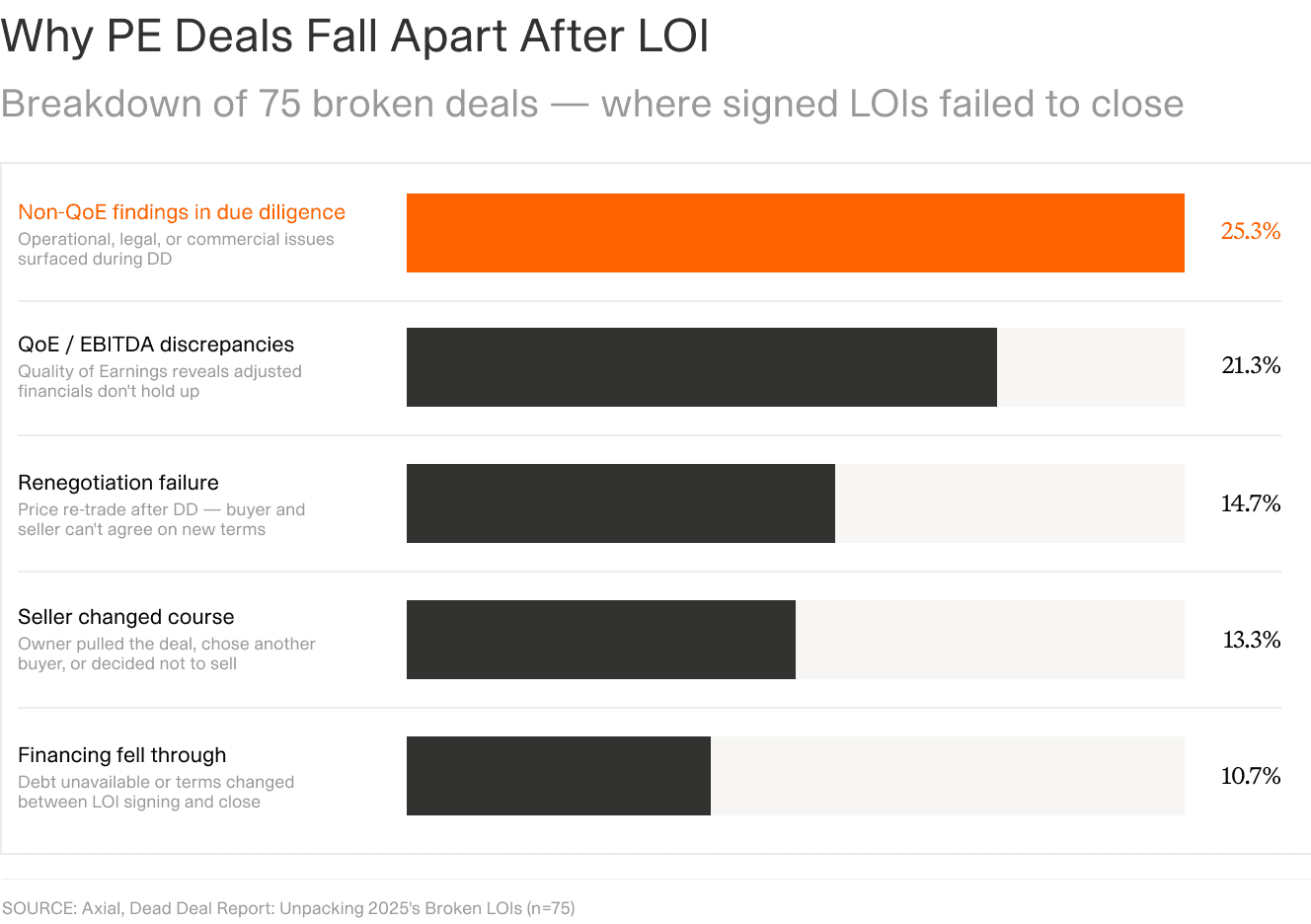
Signed letters of intent that failed to close, by cause. Two of the top three are findings that a document could have surfaced earlier.
Axial's Dead Deal Report, which examined 75 broken letters of intent, found that non-QoE diligence findings accounted for 25.3% of failures and QoE or EBITDA discrepancies for a further 21.3%. Nearly half of signed LOIs that collapsed did so because something in the documents did not match the story that had been told before the LOI was signed.
That is a diagnosis, and it is a hopeful one. These are not theses that were philosophically wrong about the market. They are theses where a checkable fact was checked late. The cost of checking it late is the diligence spend, the legal fees, the opportunity cost of the team for two months, and the reputational cost of retrading or walking.
Three patterns account for most of it:
The number that was never traced. A figure from the CIM makes it into the model, then the memo, then the committee paper, and nobody ever opened the source. When the QoE arrives it is a different number, and the thesis was built on the first one
The conflicting value nobody reconciled. The same metric appears in the CIM, the management accounts and a board pack with three different values. Finding the first occurrence is easy. Noticing that the other two disagree requires having read all three
The condition with no owner. It was in the thesis, nobody was assigned to test it, and everybody assumed somebody else had
The disconfirmer that got quietly dropped. It was written down at the start, the evidence came back ambiguous, and rather than resolving it the team moved on because the rest of the picture looked good. This is the most dangerous of the four, because the process worked right up until the moment somebody overruled it
All four are process failures rather than judgment failures, which is the useful thing about them. Judgment is hard to improve. Process is not.
The cost of finding out late is not linear either. A thesis-killing fact discovered during screening costs a few hours. The same fact discovered after an LOI is signed costs the diligence spend, the legal fees, two months of a deal team, and a conversation with the seller that makes the next approach harder. The fact was equally findable on day one in most of these cases. It was in a document nobody had read yet.
The repeatable thesis beats the brilliant one
The firms that do best are not the ones with the most original theses. They are the ones that write the same shape of thesis over and over and test it the same way every time.
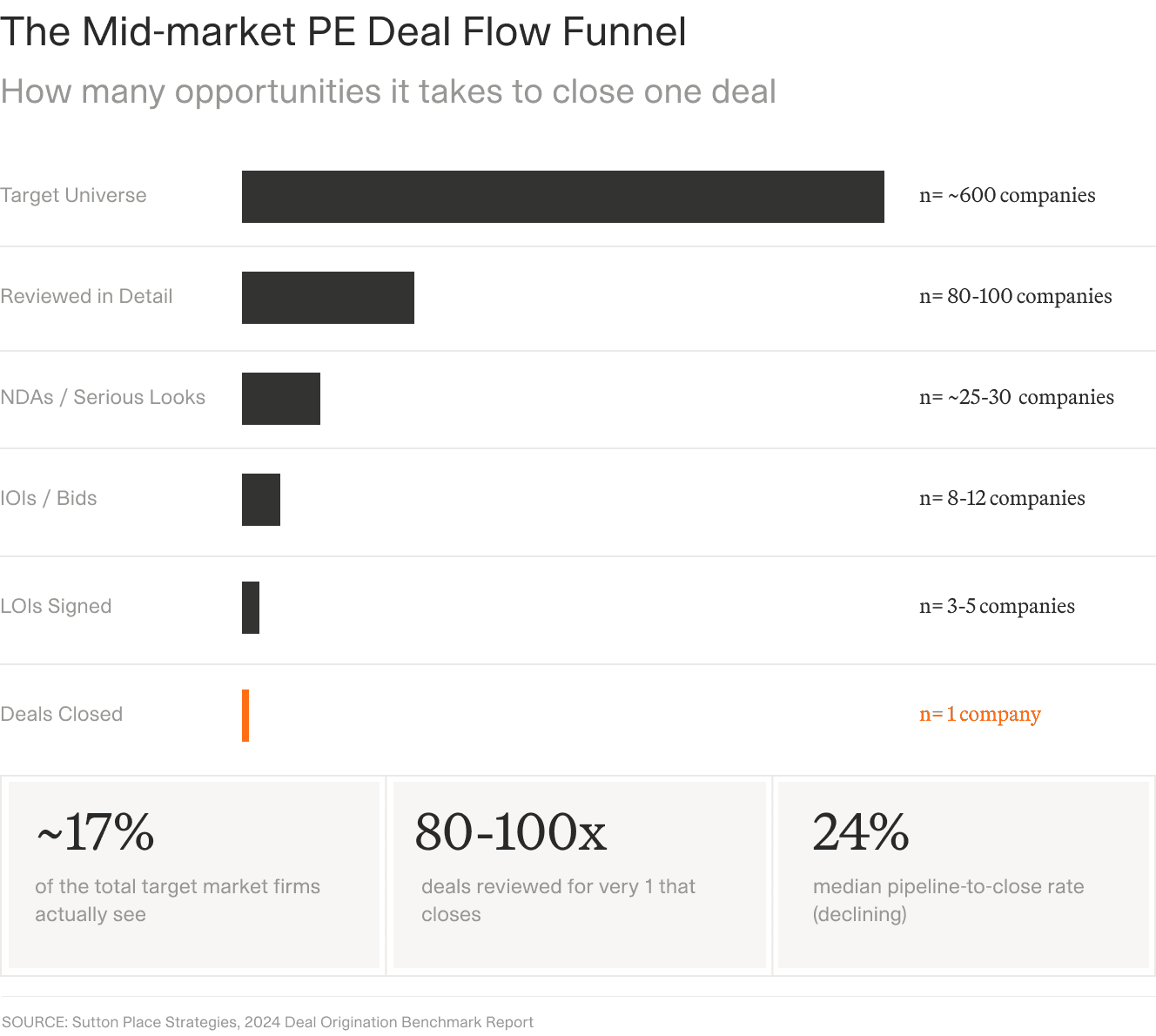
Six hundred targets to one deal. The thesis is the instrument that gets you from the first number to the second without reading everything at full depth.
McKinsey's work on programmatic M&A covers the Global 2,000 over more than twenty years. It found that programmatic acquirers delivered about 2% more in excess total shareholder return annually than their peers, and that roughly 65% of them generated positive excess returns against their industry. The large-deal approach was close to a coin flip. Bain's Global M&A Report 2026, surveying more than 300 executives, found that 75% of frequent acquirers meet or exceed their synergy targets.
Set that against Bain's other finding, that half of the executives who had a thesis were wrong within three years, and the shape of the answer appears. Repetition is what converts a thesis from a piece of writing into an instrument. The tenth time a firm asks the same eleven questions of a target, it knows what a good answer looks like. It knows what an evasive one looks like. And it knows which of the eleven has historically predicted trouble.
Which makes consistency an evidence problem rather than an intellectual one. Asking the same eleven questions of every target is easy to say and hard to do when the eleventh question requires reading a two-hundred-page data room in the four days before the bid deadline. In practice teams ask nine of the eleven, then a different nine on the next deal, and the comparison across deals quietly stops meaning anything.
This is the point where document infrastructure is genuinely relevant rather than incidentally so. V7 Go is AI infrastructure for private markets. You define the steps once, and each step uses the tool the work requires. Every target gets the same eleven questions asked of every document, rather than of the fifth of the data room there was time for. Every extracted value opens the exact line in the source PDF it came from, so a conflicting figure in a board pack surfaces as a conflict rather than being missed. The judgment stays with the team, and the review gates are the point rather than an overhead. It is not a CRM, not a data room and not a portfolio monitoring platform. It is the layer that turns a data room into the evidence table in the section above, which you can see applied to the data room to IC memo workflow.
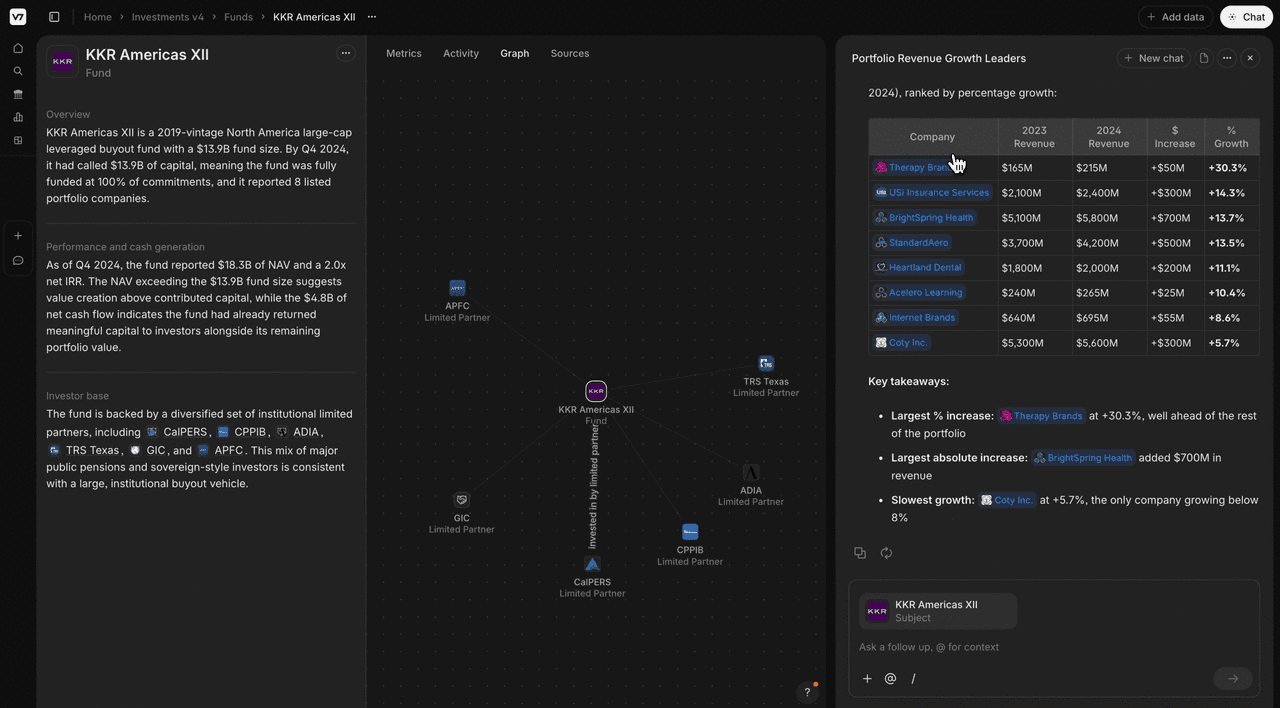
The thesis after close. The same claims, now tracked as reported numbers rather than argued ones.
The thesis does not stop mattering at close. It becomes the measurement plan: the conditions become the metrics, the disconfirmers become the early-warning indicators, and portfolio monitoring becomes the test of whether the claim is holding. Most firms rewrite their reporting pack from scratch instead, which is how a fund reaches year three unable to say whether the original thesis was right.
If the next step is comparing how tools handle this, we cover the category in AI platforms for deal screening and the mechanics of scoring targets against fixed criteria in the AI deal scorecard. For the drafting end of the process rather than the evidence end, AI investment research report generation covers turning documents into finished reports, which is the step after the one this article is about.
What is an investment thesis example?
A usable example names a mechanism, a number and a test. "A regional compliance-testing provider with 78% recurring revenue and 94% logo retention, trading at 8.5x against a comparable set at 11x to 13x, where three tuck-ins over 24 months take customer concentration below 25% and grow EBITDA from £9m to £15m on volume rather than price." That is an example because each clause can be checked: retention against churn cohorts, the comparable set against precedent transactions, the tuck-in pipeline against named targets with indicative valuations. Compare it with "a high-quality business in an attractive market with strong fundamentals," which cannot be wrong and therefore cannot be tested.
+
How do you write a good investment thesis?
Write the claim first, in one sentence, naming the mechanism by which value arrives rather than the category of deal. Then add the conditions that must hold for it to work, and assign each one to a specific document that would confirm or destroy it. Then write the disconfirmers: the two or three findings that would make you walk away. Then set the price at which the thesis stops working, before the auction rather than after it. Keep it to one page. A thesis that needs four pages is usually several theses stacked on top of each other, and each additional mechanism multiplies the number of things that have to go right.
+
What is an investment thesis in VC?
In venture the thesis carries more weight because there is less evidence to check. With little revenue history and no meaningful comparable set, the claim rests on market size, the specific insight the founders have that others do not, and evidence of early pull from customers. The conditions shift accordingly. Instead of churn cohorts and add-back schedules, you are testing whether the market is genuinely reachable at the claimed cost, whether the technical claim is real, and whether early usage reflects need or novelty. VC firms also run an explicit fund thesis, which is a different artefact: sector, stage and cheque size, set at raise and used to filter what even reaches a partner meeting.
+
What is Warren Buffett's investment thesis?
Buffett has never published a single thesis so much as a consistent method, set out across decades of Berkshire Hathaway shareholder letters. Buy businesses with durable competitive advantages, understandable economics and honest, capable management, at a price below intrinsic value, then hold them. It is a public-markets approach, and the differences from a private-markets deal thesis are instructive. He is a minority holder with no control and no value-creation plan to execute, he can wait indefinitely for a price, and his evidence comes from public filings rather than a data room. A private equity thesis has to name who does the work and when the exit happens, because both are its responsibility.
+
How long should an investment thesis be?
The thesis is the claim. The memo is the case, and it contains the thesis. A deal thesis is one page written early, on thin evidence, that says why this asset will be worth more and what would prove that wrong. An investment committee memo is written later, runs to twenty or more pages, and assembles the diligence findings, the model, the value-creation plan, the risks and the recommendation. The useful relationship between them: the memo should be readable as a verdict on the thesis. If you cannot tell from the memo whether the original claim survived, the memo has become a justification, which is the failure Bain's survey measures.
+
What is the difference between an investment thesis and an IC memo?
Go is more accurate and robust than calling a model provider directly. By breaking down complex tasks into reasoning steps with Index Knowledge, Go enables LLMs to query your data more accurately than an out of the box API call. Combining this with conditional logic, which can route high sensitivity data to a human review, Go builds robustness into your AI powered workflows.
