12 min read
—



V7 Go
A smarter way to manage due diligence and underwriting
Investment teams have more data than ever. The constraint is no longer access — it’s synthesis.
A mid-sized asset manager might receive 40 CIMs in a single quarter, alongside a continuous flow of 10-K filings, earnings transcripts, and broker research notes. Reading every document takes weeks. Extracting, cross-referencing, and drafting from those sources takes additional time that compresses against deal timelines and reporting deadlines.
AI targets the hours that precede judgment: reading, extracting, formatting, and drafting. Investment judgment stays with the analyst. AI automates the mechanical work between “documents received” and “opinion formed.” Teams focused on investor reporting workflows see this shift most clearly — the work changes from data gathering to reviewing AI-generated drafts.
This guide covers how AI handles investment research at each stage: document ingestion, financial data extraction, multi-source synthesis, structured report generation, and human review. It also covers which platforms investment teams are deploying in 2026.
In this article:
The bottleneck AI report generation targets in investment research
How AI converts financial documents into research reports, step by step
AI for specific report types: IC memos, equity research notes, due diligence summaries
Before-and-after: four investment research workflows
Accuracy, citation grounding, and audit trails for compliance
AI investment research tools and platforms in 2026
The Bottleneck AI Report Generation Targets in Investment Research
Research teams at asset managers, hedge funds, and PE firms spend more time on document processing than on investment analysis. Deloitte projected that AI could deliver a 25% productivity boost for front-office roles at top global investment banks, generating roughly $3M in additional revenue per front-office employee by 2026. The driver is reduced manual document work, not replacement of investment judgment.
The documents investment teams process include SEC filings (10-K, 10-Q, 8-K), earnings transcripts, confidential information memoranda, broker research, expert call transcripts, and proprietary internal notes. Each type has different structure, terminology, and relevant sections. The variety creates a core operational problem: teams cannot scale coverage simply by adding analysts, because the time cost of processing each document type is fixed per document.
The synthesis gap sits at the center of the research bottleneck. Moving from “I have the documents” to “I have the insight” is where the manual work concentrates. An analyst reading a 90-page 10-Q, cross-referencing it against the prior quarter’s filing, and comparing management commentary against the written disclosure is performing synthesis across three separate sources. Each operates in a different format and at a different level of abstraction. That synthesis produces the investment opinion, but it requires hours of mechanical processing before the analytical judgment can begin.
AI targets the extraction, synthesis, and drafting stages before the judgment, not the judgment itself. Teams running AI-assisted due diligence workflows report the same shift: less time on document processing, more time on evaluating what the documents reveal.
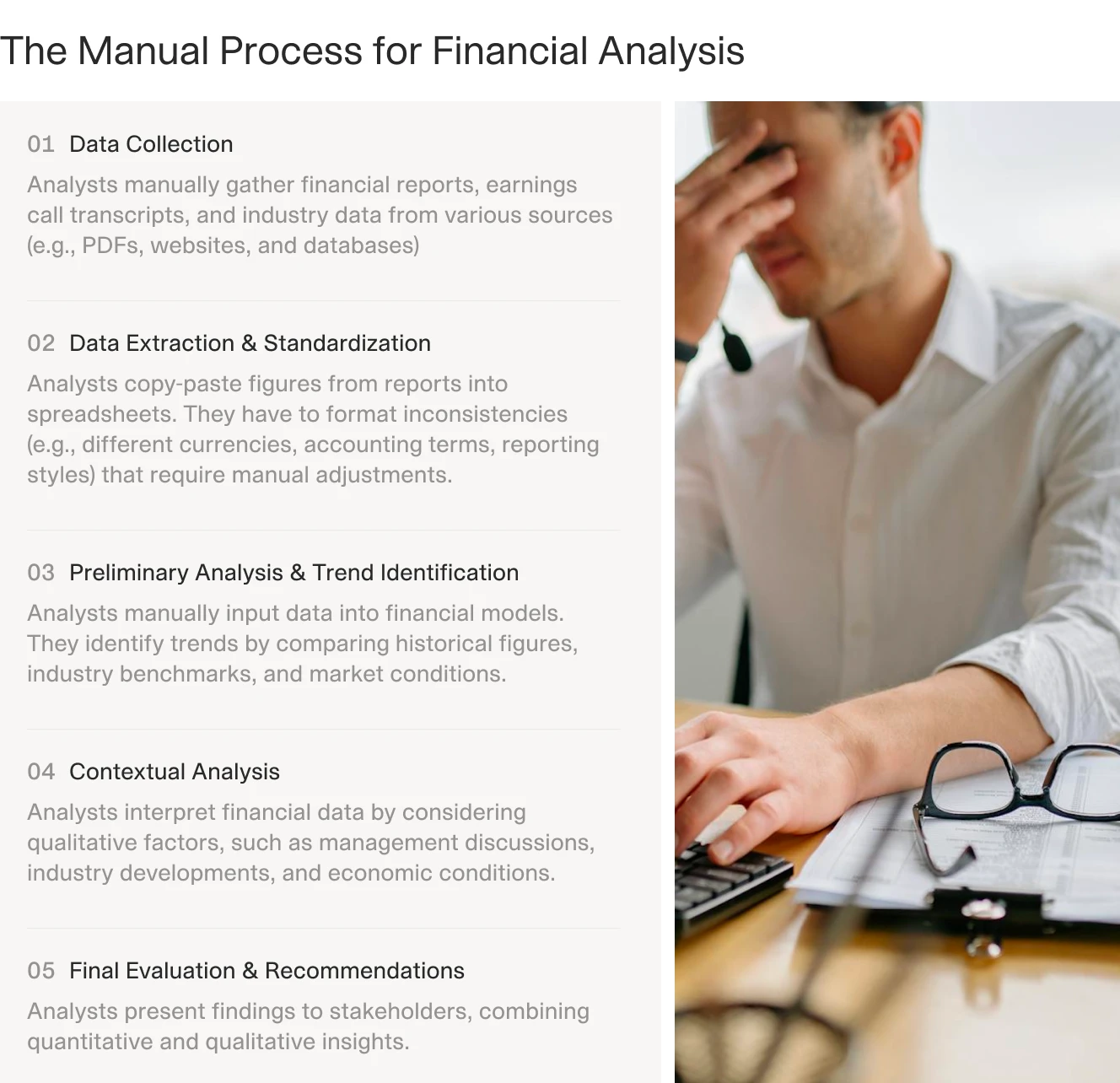
The five-stage manual research workflow. AI compresses the first three stages into a single automated pipeline, concentrating analyst time on contextual analysis and final evaluation.
How AI Converts Financial Documents into Research Reports
AI report generation for investment research runs as a structured five-stage pipeline. Each stage produces a specific output that feeds the next. Problems at one stage compound through the rest: poor extraction produces inaccurate synthesis; weak citation grounding makes human review impractical.
Stage 1: Document Ingestion
AI reads unstructured documents at scale without manual preprocessing. A CIM might arrive as a 100-page PDF with mixed tables, narrative text, and financial schedules in inconsistent formats. An earnings transcript might be a text file with speaker tags and timestamps. Ingestion standardizes structural variety so downstream stages work on clean inputs.
Stage 2: Financial Data Extraction
Natural language processing extracts key figures, dates, entities, and financial metrics from unstructured text and converts them into structured data fields. Revenue, EBITDA margins, headcount, segment breakdowns, and management guidance get pulled into a normalized structure the system can reason over. The critical requirement is citation grounding: each extracted data point must link back to the specific page and paragraph in the source document. Without that link, verification becomes impractical and errors in the chain remain invisible until they reach the final report.
Stage 3: Multi-Source Synthesis
Synthesis produces value beyond what any single-document tool can deliver. The AI reads what management said in the Q4 earnings transcript, what the 10-K discloses in writing, and what analyst notes from six months prior projected — then surfaces the gaps and contradictions across those sources. A firm’s proprietary internal notes on a company, combined with public SEC filings, produce insights unavailable from external data alone.
Stage 4: Report Narrative Generation
AI drafts the human-readable narrative that explains what the data means. Not “revenue was $2.3B” but “revenue grew 12% quarter-over-quarter, outpacing analyst consensus of 9%, driven by the APAC segment, which management guided higher in the prior earnings call.” The dataroom-to-IC-memo pipeline on V7 Go runs this stage against the firm’s own memo template, so the AI draft arrives pre-formatted for analyst review.
Stage 5: Human Review and Validation
AI-generated investment research requires analyst sign-off before distribution. Institutional-grade platforms make review efficient by surfacing confidence levels on uncertain extractions, linking every claim to its source document, and tracking changes between the AI draft and the analyst’s final version. Treating AI output as final without analyst review is the most common failure mode in AI investment research deployments.
The following walkthrough covers how V7 Go handles financial document workflows end-to-end, including CIM extraction accuracy benchmarks and multi-source synthesis across virtual data rooms.

V7 Go’s finance workflow demonstration covering CIM extraction, DDQ completion, and multi-source synthesis with live accuracy benchmarks across document types.
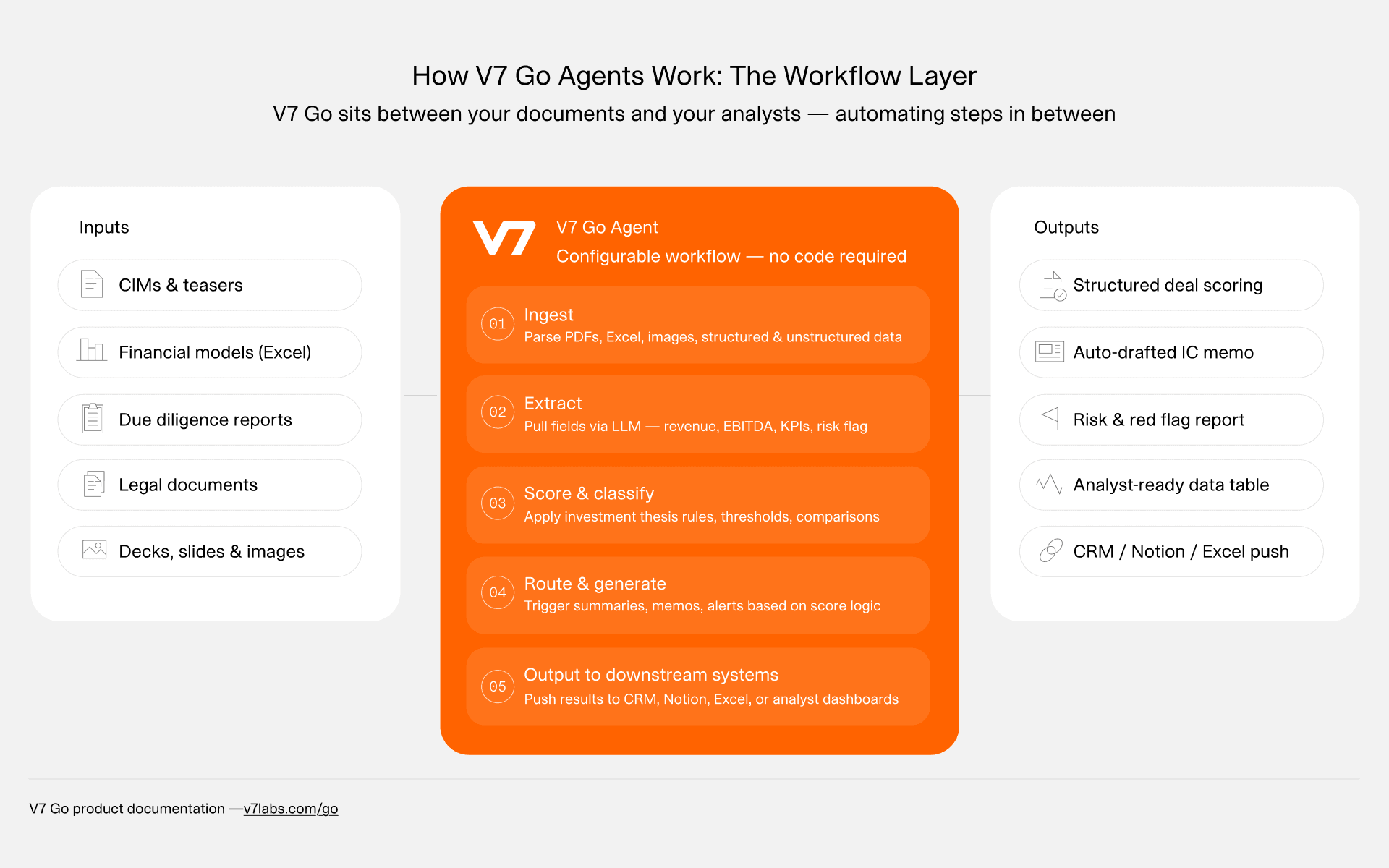
V7 Go’s agent architecture maps the five-stage AI research pipeline onto configurable workflow steps, each producing source-linked, auditable outputs the analyst can review and edit.











AI for Different Investment Research Report Types
Each report type draws on distinct inputs and calls for a different AI approach. Here is how AI handles the most common investment research reports, and where human review concentrates in each.
Investment Committee (IC) Memo
Primary inputs: CIM, management presentations, financial model, prior internal research. AI role: Extract key financials, flag risks, and draft the investment thesis narrative. Human review focus: Judgment on deal terms, risk materiality, comparables, and strategic fit with the fund’s mandate.
Equity Research Note
Primary inputs: 10-K/10-Q filings, earnings transcript, industry reports, broker estimates. AI role: Extract guidance changes, compare against prior periods, and draft analyst commentary. Human review focus: Tone revision, proprietary insight, sign-off on all published claims.
Due Diligence Summary
Primary inputs: VDR documents, contracts, regulatory filings, third-party reports. AI role: Extract red flags, summarize key terms, and flag missing documents. Human review focus: Legal and financial judgment on what the flagged items mean for deal viability and pricing.
Portfolio Monitoring Report
Primary inputs: Quarterly filings, news, management call transcripts, internal tracking data. AI role: Flag material changes versus the prior period and generate a variance narrative. Human review focus: Portfolio context and strategic implications of each variance for fund performance.
LP Update
Primary inputs: Performance data, portfolio company updates, market commentary. AI role: Draft narrative sections, extract key metrics, and structure the update. Human review focus: Tone, LP-specific relationship context, and final approval before distribution.
Sector Research Brief
Primary inputs: Industry filings, news, expert call transcripts, market data. AI role: Synthesize across sources and surface emerging trends. Human review focus: Validate the analysis and add proprietary perspective beyond what public information reveals.
The common thread: AI handles the extraction-to-draft chain; the analyst focuses on judgment about what the data reveals. Teams running CIM screening pipelines through V7 Go operate exactly this way — the agent handles extraction and first draft; the analyst reviews output and adds deal-specific context. The work shifts from data gathering to analytical judgment.
Before and After: Four Investment Research Workflows
Here are four workflows where AI changes the research materially:
Earnings Analysis
Before: an analyst reads a 90-page 10-Q, listens to the earnings transcript, and cross-references both against the prior quarter’s filing. The manual process takes four or more hours for a single covered company. With AI: the system ingests all three documents simultaneously, extracts guidance revisions against prior-period disclosures, flags where transcript language diverges from written 10-Q disclosures, and surfaces material changes. Analyst review of the AI output takes 15 to 20 minutes.
CIM Review and Initial Screening
Before: an analyst reads a 60-page CIM, manually pulls the financial highlights, and writes an initial screen note. The process takes two to three hours per document. With AI: the agent extracts financial highlights, management team background, key risks, and the company’s stated investment thesis into a structured format. The analyst validates the extraction and adds deal context. Time per CIM drops below 30 minutes, enabling teams to screen four to six times as many deals in the same period.
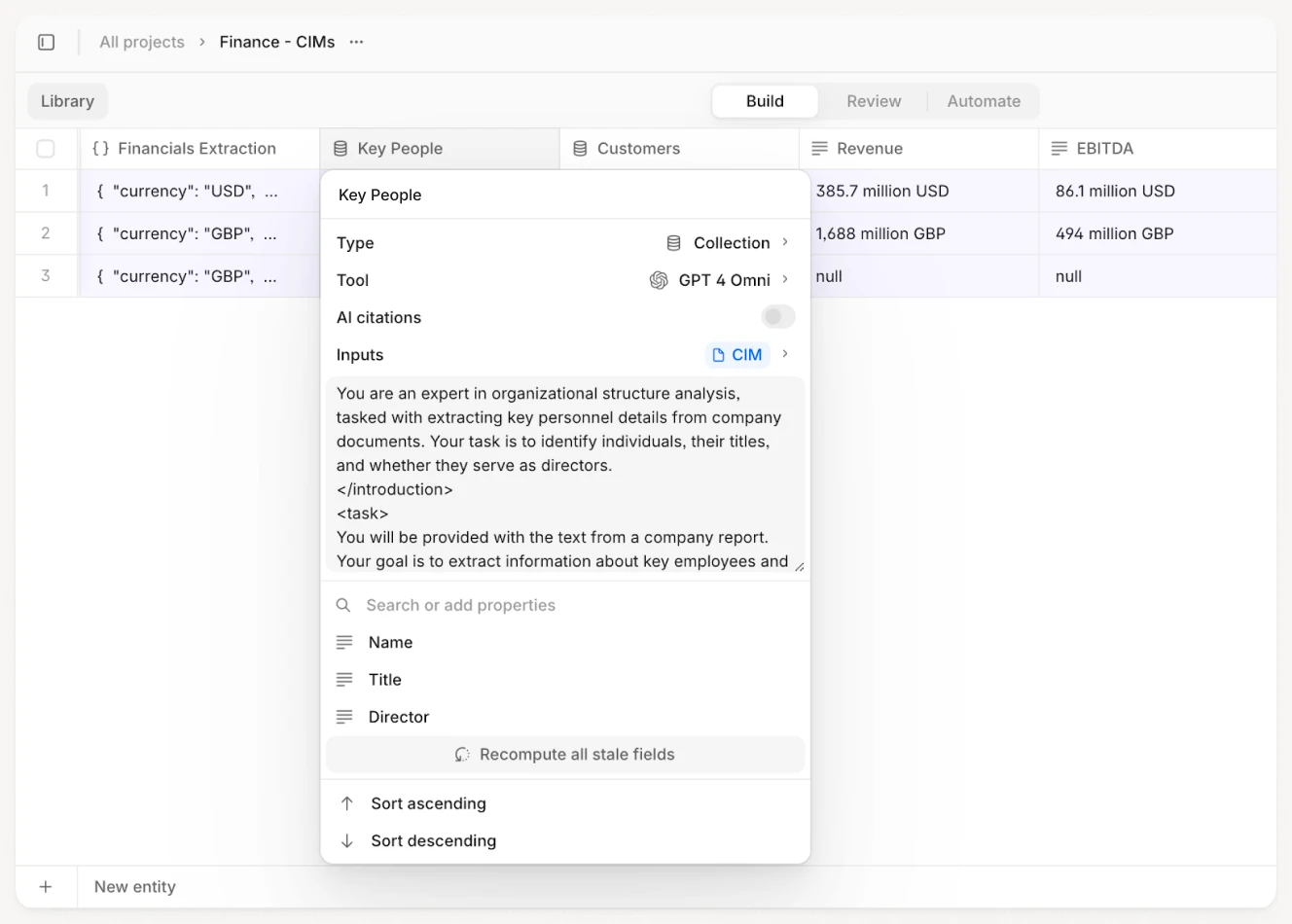
V7 Go’s CIM extraction interface: structured output tabs for financial highlights, key personnel, revenue, and EBITDA, each field linked to its source location in the original document.
Cross-Portfolio Monitoring
Before: an analyst covering eight portfolio companies reads quarterly filings manually, watching for material changes. Coverage is necessarily selective because reading time is finite. With AI: the system monitors all portfolio company filings and news feeds continuously. The analyst reviews only the flagged items. Teams managing LP quarterly reporting across 20 or more portfolio companies use this approach to achieve complete coverage rather than prioritized partial coverage.
Multi-Source Research Synthesis
Before: an analyst reads broker research from 12 sell-side firms covering the same company and manually notes where analysts agree and diverge. The mapping task alone takes a full day. With AI: the system reads all 12 reports, maps consensus positions, and identifies the specific assumptions driving divergent price targets. The analyst evaluates the disagreements rather than constructing the map of where they exist. This is the shift that private equity teams applying machine learning to research workflows report most consistently.
Accuracy, Citation Grounding, and Compliance in AI Research
Investment research errors propagate directly into capital allocation decisions. An incorrect revenue figure in an AI-generated IC memo doesn’t stay in the document — it shapes deal pricing. Accuracy requirements in investment research are stricter than in general document processing.
How Institutional Platforms Mitigate Hallucination Risk
Citation grounding. Every AI extraction links to the specific page and paragraph in the source document. The analyst can verify any claim in one click. Without this link, AI paraphrasing without attribution creates a compliance problem: there is no audit trail for where an error entered the chain, and catching errors before distribution becomes impractical.
Confidence thresholds. The platform flags extractions below a defined confidence level for mandatory human review. Rather than presenting all outputs as equally reliable, this surfaces which data points require analyst sign-off before entering the final report.
Structured input over open-ended prompts. “Extract revenue and EBITDA for fiscal year 2024 from the attached 10-K, with page citations for each figure” produces more accurate outputs than “summarize the financials.” Structured prompts with defined output fields reduce the scope for the AI to fill gaps with plausible-sounding but unverified content.
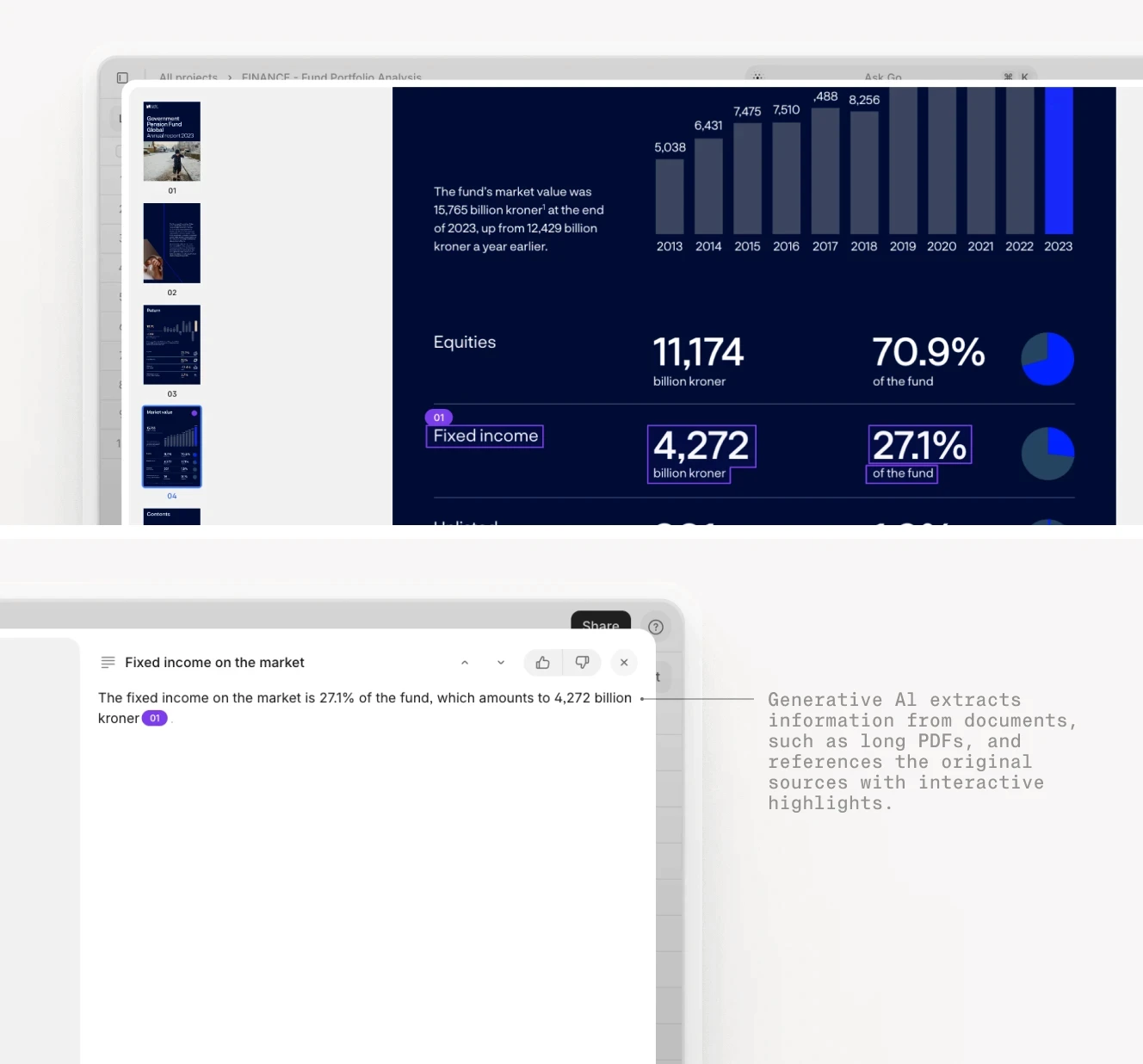
Citation grounding in practice: each extracted figure links directly to its source location, so analysts can verify any claim before it enters the final report.
The Audit Trail and Regulatory Context
The SEC’s Investor Advisory Committee approved formal AI disclosure guidance in December 2025, calling for mandatory reporting on board-level oversight mechanisms and material AI deployments at investment firms. Institutional teams need documentation of which AI tools processed which documents, by whom, and when.
An AI investment research workflow that logs every document processed, every extraction produced, and every human review action creates that audit trail as a byproduct of normal operation. The compliance record builds automatically rather than requiring a separate documentation process.
AI Investment Research Tools and Platforms in 2026
The investment research AI market has separated into four categories: market intelligence platforms, document research tools, research workflow assistants, and configurable document automation platforms. The right choice depends on whether the team needs broad market surveillance, deep document analysis, or the ability to configure workflows around its own research and reporting processes.
AlphaSense indexes over 10,000 premium content sources including broker research, regulatory filings, and news. Widely used for market surveillance and competitive intelligence across PE and VC firms. Enterprise pricing. Best for broad coverage of public sources rather than firm-specific document extraction or internal reporting formats.
Hebbia specializes in large-scale document analysis and data room research. The 2025 sub-agent architecture improves precision on multi-document queries involving hundreds of documents. Enterprise pricing. Less configurable for firms that need to define specific output fields or map AI extractions to internal report templates.
Rogo targets investment banking research workflows, combining LSEG data integration for real-time pricing with document analysis capabilities. Enterprise pricing. Most closely aligned with sell-side research; buy-side teams find it less suited to proprietary document processing and internal reporting formats.
ThirdBridge combines expert call access with AI synthesis of primary research transcripts. The platform’s proprietary expert call database distinguishes it from document-only tools. Subscription pricing. The AI layer processes transcripts into structured summaries, suited to primary research workflows rather than systematic SEC filing extraction.
V7 Go is built for investment teams that need to configure AI workflows around their own research and reporting processes rather than adopting a fixed-feature product. Agents extract data from financial documents including CIMs, 10-Ks, board decks, and VDR contents, producing structured outputs mapped to the firm’s report templates. Citation grounding links every extracted data point to its source. Confidence thresholds flag uncertain extractions for analyst review. Because V7 Go is a configurable platform rather than a point product, the same infrastructure that handles CIM screening also runs LP reporting and portfolio monitoring, without the firm managing multiple separate tools.
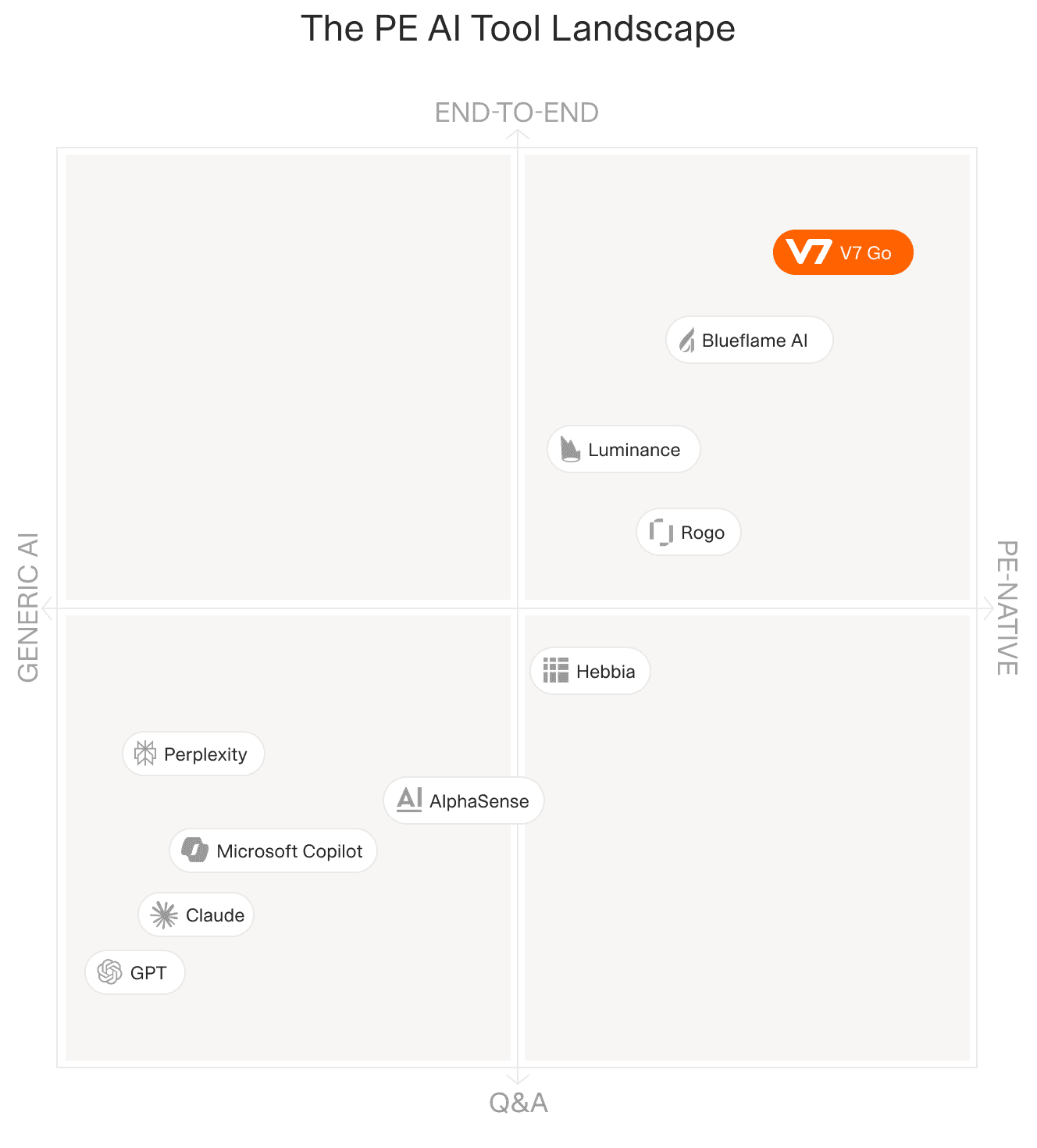
The investment research AI market mapped by workflow depth and finance specificity. A tool’s position determines which research problems it addresses and how it integrates with existing processes.
What Changes When AI Handles the Document Work
The concrete shift in investment research is where analyst time concentrates. When AI handles ingestion, extraction, and first-draft generation, the analyst spends time on the decisions that require judgment: is this management team credible? Is this margin expansion sustainable? Does this deal price reflect the comparables?
That shift does not happen by deploying a generic AI tool and hoping it maps to the research process. It happens when the workflow is configured to match how the team works: which documents arrive in which formats, which fields matter for the firm’s IC template, what confidence threshold triggers analyst review, and which sources the synthesis needs to draw from.
The most durable competitive advantage for research teams is not processing more documents in isolation. It is processing the same documents faster while directing analyst attention to the analysis those documents require. Generic AI tools address the speed component. Configurable platforms built for financial document workflows address both speed and the quality of analyst review that follows.
Teams evaluating AI for investment research can explore the IC memo generation workflow to see the full pipeline in production: document ingestion, structured extraction, narrative draft, and analyst review steps, each stage producing an auditable output the team controls.
How does AI improve investment research?
AI improves investment research through three mechanisms. First, document analysis at scale: AI ingests and processes SEC filings, earnings transcripts, CIMs, and expert call transcripts more consistently than manual review, enabling teams to cover more companies and deals without adding headcount. Second, multi-source synthesis: AI connects findings across documents that would take hours to cross-reference manually. It surfaces contradictions between what management said on an earnings call and what the 10-K discloses in writing, and maps where multiple sell-side analysts agree or diverge on the same company. Third, structured report drafting: AI generates the initial narrative that frames extracted data as investment analysis. The analyst reviews the draft rather than writing from a blank page. In practice, teams report that the first two to three hours of research work, the document-reading and initial extraction, compresses to 20 to 30 minutes with AI, concentrating analyst time on interpretation and judgment.
+
Can AI generate investment reports automatically?
AI can generate investment report drafts automatically, with a critical qualification. The draft generation stage is genuine automation: given the input documents, AI extracts financial data, synthesizes across sources, and produces a formatted narrative report without manual intervention. What requires human involvement is analyst review and sign-off before the report is distributed or used for capital allocation. Institutional-grade platforms build review into the workflow through three mechanisms: confidence thresholds flag extractions below a defined reliability level, citation grounding links every claim to its source document for quick verification, and the review process itself is tracked as part of the audit trail. The practical standard for institutional investment research is AI-generated draft plus analyst validation, not AI-generated output for direct distribution. Teams that skip analyst review treat AI output as final, which creates undetected errors that propagate into investment decisions and a compliance exposure if the process is later audited.
+
What documents does AI use to generate investment reports?
AI investment research platforms process a wide range of financial document types. SEC filings are the most common: the 10-K annual report contains audited financial statements, risk factors, and management discussion; the 10-Q quarterly report provides unaudited interim results; the 8-K current report discloses material events between scheduled filings. Earnings transcripts record the full text of earnings calls, including analyst questions and management responses. The transcript language often diverges from formal 10-K language in analytically significant ways, making transcript-to-filing comparison a core synthesis task. Confidential information memoranda are the primary input document for private equity and M&A research. Expert call transcripts from primary research providers offer proprietary insights beyond public filings. Broker research reports from sell-side analysts provide market consensus and comparative analysis. Internal analyst notes, the firm's own prior research on a sector or company, are a critical input for synthesis, because they incorporate the firm's proprietary historical judgment alongside the public record.
+
What is the difference between AI research summarization and AI report generation?
Summarization and report generation are distinct tasks that require different AI approaches. Summarization takes a single document and produces a shorter version of it: a three-paragraph summary of a 100-page CIM, for example. The output stays within the frame of the source document and does not introduce new structure or analytical framing. Report generation synthesizes multiple documents and produces a new analytical product: a due diligence summary generated from a data room containing 200 documents is not a summary of any single document. It extracts the relevant findings across all inputs, resolves contradictions between them, and frames the result in the output structure the firm uses for investment decisions. Report generation requires structured prompting, citation grounding, a defined output template, and a pipeline that handles multi-document ingestion. Summarization can work with a general-purpose language model and an open-ended prompt. For investment research, report generation is what produces an IC memo or equity research note. Summarization produces a condensed version of one filing.
+
How accurate is AI-generated investment research?
Generative AI refers to AI systems that create new content from existing data, distinct from AI that only classifies or retrieves information. In investment research, generative AI takes financial documents as inputs and produces new content: draft investment memos, research narratives, earnings summaries. These are outputs that did not exist as text in the source materials. The generative component is the narrative layer: AI produces sentences that explain what extracted data means, in the language and structure appropriate to the report type, rather than returning raw extracted fields. Investment research is a strong generative AI use case because the task follows a clear structure: defined inputs such as financial documents, a defined output template such as an IC memo or research note, and a clear accuracy standard where figures must match source documents and claims must be traceable to a source. Generative AI in this context is distinct from quantitative machine learning models trained to predict prices or classify securities. It operates on text and produces text, making it suited to research documentation, report drafting, and multi-source synthesis.
+
What is generative AI in investment research?
Go is more accurate and robust than calling a model provider directly. By breaking down complex tasks into reasoning steps with Index Knowledge, Go enables LLMs to query your data more accurately than an out of the box API call. Combining this with conditional logic, which can route high sensitivity data to a human review, Go builds robustness into your AI powered workflows.
+
Casimir is a seasoned tech journalist and content creator specializing in AI implementation and new technologies. His expertise lies in LLM orchestration, chatbots, generative AI applications, and computer vision.