8 min read
—


Five categories of private equity deal screening software, from market discovery to AI document intelligence, with evaluation criteria for each.

V7 Go
A smarter way to manage due diligence and underwriting
Private equity deal screening is the first gate every potential investment must pass — a rapid assessment that determines whether a company is worth committing analyst time to.
Get it wrong in either direction and you pay: miss a viable target buried in a 200-page CIM, or spend three weeks on diligence for a business that fails a basic margin test in section two.
The key problem is document volume. A mid-market PE fund reviewing 80 to 100 deals to close one sees an average of four to seven documents per company before a pass or follow decision: teaser, CIM, management deck, financial model, sometimes a VDD excerpt. Multiply that across a full origination cycle and you have thousands of unstructured pages that need reading, extraction, and comparison before a single IC memo is drafted.
This has produced a sprawling market of tools pitched as deal screening software that actually do very different things. Some find companies to approach. Others track your pipeline. A third group reads the documents that land in your inbox. Conflating these categories is how funds end up with five subscriptions and still bottlenecked at document review.
This guide maps the five distinct categories of PE deal screening software, identifies the specific bottleneck each one solves, and explains where AI document intelligence (the category that directly addresses document volume) fits relative to everything else.
The five categories of PE deal screening software and what each one actually does
Where AI fits in deal screening and where it does not replace human judgment
Five criteria for evaluating any AI screening platform before committing to a workflow
How V7 Go handles document-heavy screening at mid-market PE volume
What Is Deal Screening in Private Equity?
Deal screening is the process of filtering a large set of potential investments down to a shortlist of companies worth deeper diligence. In practice, this means a deal team reading incoming documents (teasers, CIMs, one-pagers) against the fund’s investment criteria and deciding, typically within 24 to 72 hours, whether to pass or proceed.
That distinction from sourcing matters. Sourcing means finding companies that exist. Screening means evaluating companies that are already in your inbox. The two problems call for different tools, and most comparisons in this space conflate them.
The document volume problem
Mid-market PE deal teams review an average of 80 to 100 opportunities to close a single investment. Data from Sutton Place Strategies’ 2024 origination benchmark shows the median pipeline-to-close rate at 24 percent and declining. More documents entering the funnel. Fewer deals resulting. More analyst time per rejected opportunity.
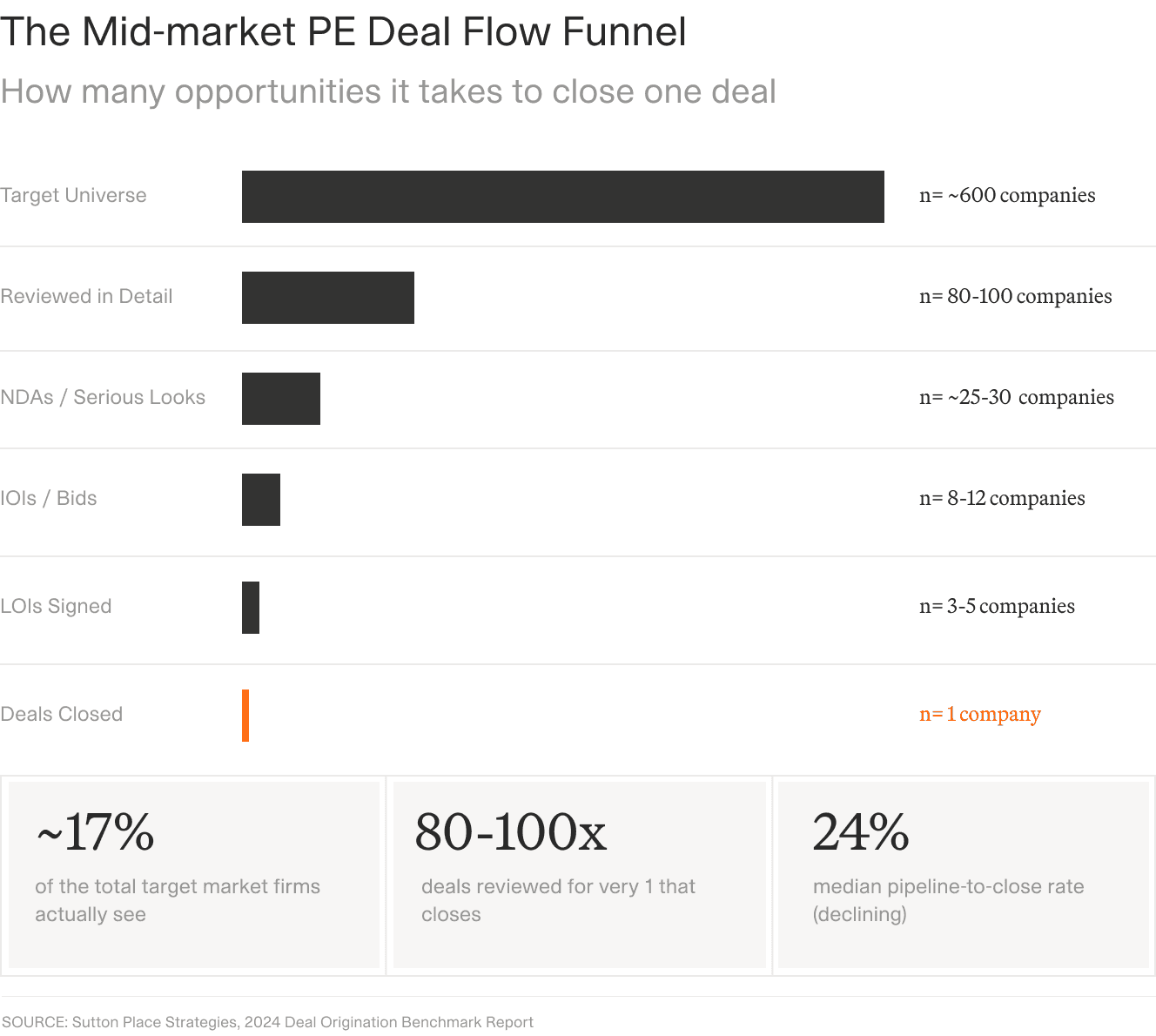
Mid-market PE deal funnel: 80 to 100 deals reviewed per close. Source: Sutton Place Strategies 2024 Deal Origination Benchmark Report.
The standard response has been to add headcount or triage earlier in the sourcing process. AI document intelligence offers a third option: screen every document to the same depth, at the same speed, without adding analysts.
The Five Categories of PE Deal Screening Software
Most tools sold as deal screening software solve for one of five distinct problems. Understanding which problem each category addresses is the starting point for evaluating any new tool — and for diagnosing why existing tools are not clearing the bottleneck you actually have.
Category 1: Market Discovery and Deal Sourcing
Tools in this category help you find companies that match your investment thesis before they surface through an intermediary. They search across company databases, signals data, and market intelligence feeds to generate prospect lists.
Representative platforms: Grata, SourceScrub, Cyndx.
What they do well: identifying lower-middle-market companies not covered by traditional data providers; setting up sector-specific alerts; reducing reliance on banker relationships for proprietary sourcing.
The limit: these tools stop at the CIM. Once a company has been identified and a document package arrives, sourcing tools have done their job. They do not read documents.
Category 2: CRM and Pipeline Management
Pipeline CRMs track the status of deals in motion: who owns the relationship, what stage each company is at, when the last contact happened, and what the next action is. Some include light document storage and activity logging.
Representative platforms: Affinity, DealCloud, Navatar.
What they do well: keeping deal teams coordinated; preventing pipeline leakage when a deal pauses for months; relationship intelligence through contact and email integration.
The limit: CRMs organise the pipeline. They do not analyse what is in it. An analyst still needs to read the CIM and enter the screening result manually.











Category 3: AI Document Intelligence
This is the category most absent from existing comparisons — and the one that directly addresses document volume. AI document intelligence tools read the documents that land in your inbox: CIMs, teasers, VDD excerpts, management decks. They extract structured data against your screening criteria, flag risks, and surface the information an analyst would pull manually from a 200-page PDF.
The key distinction: this category does not find companies. It processes the documents for companies that have already found you through bankers, networks, or your own sourcing process.
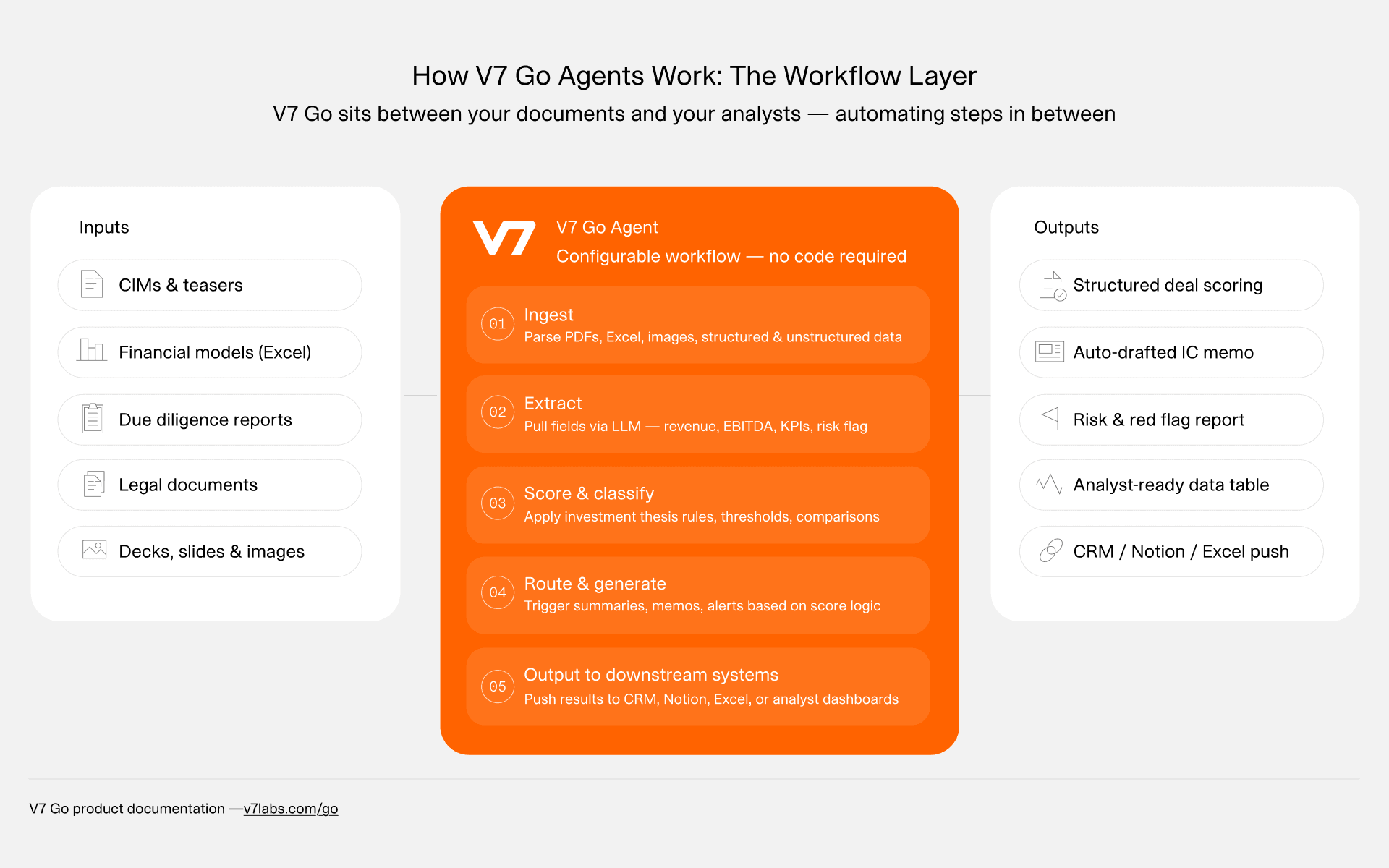
V7 Go agent architecture: document inputs flow through sequential extraction and scoring to produce structured deal outputs with full source citations.
V7 Go is built for this workflow. When a CIM arrives, a V7 Go agent reads the full document, extracts revenue, EBITDA, growth rate, management team composition, competitive position, and customer concentration against a configurable screening template, and produces a structured memo with citations linking to the exact page and sentence the data came from. If a field is not present in the document, the agent flags it as missing rather than inferring a value.
Source traceability matters here because it is a compliance requirement, not a convenience feature. Every AI-extracted figure needs an auditable path back to its source document. Accuracy benchmarks from V7 Go’s finance workflow testing show single-prompt AI extraction reaching 37 percent accuracy on CIM data points; V7 Go’s sequential workflow approach delivered full coverage with all outputs auditable. See how V7 Go handles finance workflows at scale for the full benchmark breakdown.
Category 4: Market Intelligence and Research
Market intelligence tools aggregate third-party data: earnings call transcripts, analyst reports, news feeds, SEC filings. They give deal teams sector context from public information sources before or during diligence.
Representative platforms: AlphaSense, PitchBook, FactSet, Preqin.
What they do well: rapid sector context; comparable transaction data; news monitoring; LP and GP fundraising data.
The limit: these tools work from public or aggregated data. They cannot read the confidential CIM sitting in your deal inbox, which is where the proprietary information for private market deals lives.
Category 5: Portfolio Analytics
Portfolio analytics platforms aggregate financial data from portfolio companies into dashboards that let investment teams monitor performance, run benchmarks, and prepare LP reporting.
Representative platforms: ChatFin, Standard Metrics, Visible, Cobalt.
What they do well: standardising financial reporting across portfolio companies; automating LP quarterly reports; flagging underperformers early.
The limit: portfolio analytics tools are built for companies you have already acquired. They are post-investment tools, not screening tools. Conflating them with deal screening software adds subscription cost without addressing the pre-investment bottleneck.
Five Criteria for Evaluating AI Deal Screening Platforms
If you are evaluating tools in the AI document intelligence category, five criteria separate platforms that hold up in production from those that do not.
1. Document coverage, not extraction speed. The biggest efficiency gain in AI document screening is reviewing 100 percent of documents rather than 10 to 20 percent. A tool that extracts quickly from a short summary misses information buried on page 140 of a CIM. Evaluate whether the platform processes full documents or truncated representations.
2. Source traceability. Every extracted figure needs a citation: the document name, page number, and passage it came from. Without traceability, you cannot verify an AI-extracted revenue number against the source, which means you cannot use it in an IC memo with confidence.
3. Workflow depth versus single-prompt extraction. Frontier LLMs lose coherence as context grows. A 200-page CIM will cause a single-prompt approach to degrade in accuracy by section six. Evaluate whether the platform runs sequential, step-by-step extraction, where each field gets its own agent pass, or relies on a single large-context prompt.
4. Configurability against your screening template. Every fund has its own investment criteria: EBITDA thresholds, revenue growth requirements, sector exclusions, geography filters. The platform should map its extraction outputs to your criteria, not a generic template you then have to reformat.
5. Institutional memory. Deal screening is not a one-time event. A fund reviewing 80 to 100 deals per close builds a history of pass decisions, sector assessments, and management team evaluations. A platform that captures and makes that history queryable delivers compounding value that single-document extraction cannot.
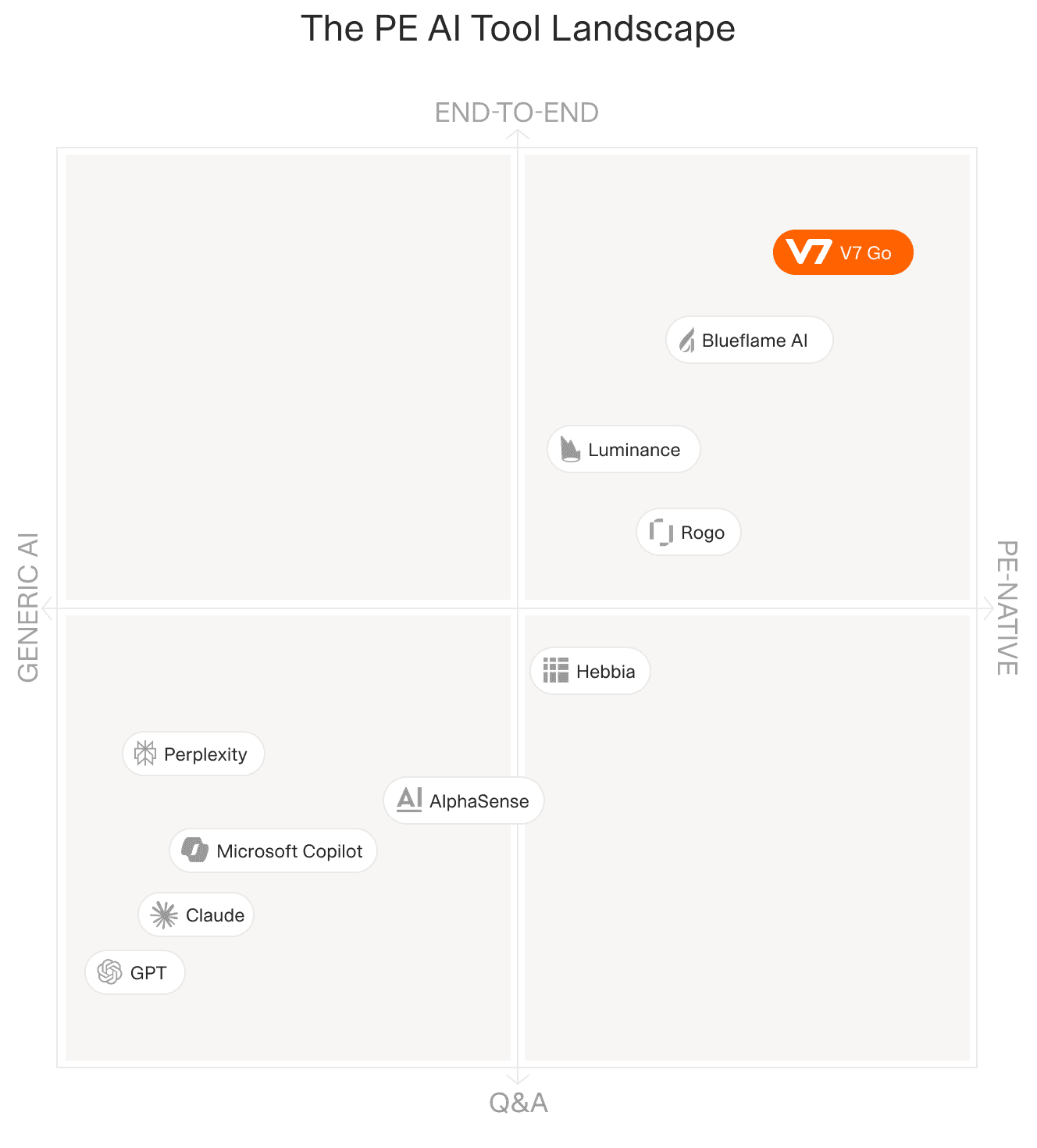
V7 Go occupies the PE-native, end-to-end quadrant that most deal screening platforms do not reach.
What AI cannot do in deal screening
AI document intelligence processes information. It does not make investment decisions. Management team credibility, sector conviction, portfolio fit, and relationship dynamics with the seller are judgment calls that current AI systems cannot reliably produce from a document alone.
The case for AI in deal screening is not that it replaces analyst judgment. It is that it handles document processing so analysts spend their time on the judgment that only they can exercise. Funds already using AI in PE diligence report the same finding: the value is in coverage, not in replacing the human decision at the end of the process.
How V7 Go Handles AI Document Screening at PE Scale
V7 Go is built around a workflow model rather than a single-prompt chat interface. For deal screening, this means each CIM that arrives triggers a configurable agent sequence: ingest, extract against the fund’s screening template, score against investment criteria, flag missing data or risk signals, and output a structured memo with full source citations.
The workflow runs the same way on document 263 as it does on document one. Accuracy does not degrade as deal volume increases because each company being screened runs its own isolated agent pass. A long origination season does not cause the system to conflate earlier deals with later ones.
Two capabilities distinguish V7 Go from adjacent tools in this category.
Source traceability at the field level. Every extracted data point links back to the exact page and sentence in the source document. PDF citations open the document at the relevant passage. Excel citations open to the exact cell. When an analyst presents an AI-extracted revenue figure in an IC discussion, they can verify the source in seconds. This is the difference between AI outputs that are usable in regulated investment processes and those that are not.
Context Graph: institutional memory that compounds. V7 Go’s Context Graph captures every screening decision, company evaluation, and sector assessment as a queryable knowledge layer. When a new CIM arrives from a business in healthcare IT and your fund has evaluated 14 comparable businesses in the past three years, the Context Graph surfaces prior pass rationale, comparable companies reviewed, and any portfolio company overlaps. The knowledge built from 80 screenings this year is available to inform screening decisions next year. Most AI knows everything about the world and nothing about your firm. Context Graph is how V7 Go fixes the second part.
V7 Go’s CIM to Screening Memo workflow covers the end-to-end process from document ingestion to structured memo output. For funds that take an opportunity through full diligence, the Dataroom to IC Memo workflow extends the same approach through the complete data room phase. For a broader comparison of AI options across the full PE toolkit, the private equity analysis tools comparison covers the wider landscape beyond screening-stage workflows.
What do we mean by deal screening in private equity?
Deal screening is the process of evaluating a potential investment against a fund’s stated criteria before committing to full diligence. In practice, a deal team reads incoming CIMs and teasers and decides, typically within 24 to 72 hours, whether the company meets minimum thresholds for EBITDA, revenue growth, sector fit, and geography. A company that passes screening enters the diligence pipeline. One that does not is logged as a pass with the rationale recorded. The screening decision is distinct from the investment decision: it determines whether the company is worth the analyst time that full diligence requires.
+
How can AI automate PE and VC deal screening?
AI can automate the document-reading component of deal screening: ingesting the CIM or teaser, extracting structured data against the fund’s screening criteria, flagging missing information, and producing a screening memo with source citations. This covers revenue, EBITDA, growth rate, customer concentration, management tenure, and sector classification, the fields that typically take an analyst two to four hours to pull manually from a 200-page document. What AI does not automate is the judgment layer: whether management is credible, whether the sector thesis holds, or whether the deal fits the portfolio. AI handles the extraction. The analyst handles the conviction.
+
What are common red flags in private equity due diligence?
Common red flags in PE due diligence include customer concentration above 20 to 30 percent in a single client, revenue growth driven by a single contract rather than the underlying business, EBITDA margins that diverge significantly from industry comparables without clear explanation, management team turnover in the 12 months before sale, deferred capital expenditure that inflates reported free cash flow, and working capital dynamics that suggest the business has been optimised for sale timing rather than underlying performance. AI document tools can flag these patterns during initial screening by extracting the relevant metrics and comparing them against configurable thresholds.
+
What is the purpose of a deal sheet in private equity?
A deal sheet is the internal document that summarises the key facts about a potential investment at the screening stage. It typically covers company overview, sector, revenue and EBITDA figures, growth trajectory, ownership structure, deal rationale, and a preliminary view on fit against the fund’s investment criteria. The purpose is to give the investment committee enough structured information to decide whether to approve full diligence. A deal sheet is the output of the screening process, and AI document intelligence tools are increasingly used to generate it automatically from the incoming CIM, with citations linking each figure back to its source.
+
What are the 4 P’s of due diligence?
Deal screening is a rapid pass or fail assessment, typically completed in 24 to 72 hours, that determines whether a company meets a fund’s minimum investment criteria. Due diligence is the detailed investigation that follows a positive screening decision, typically taking four to twelve weeks and involving financial audit, legal review, commercial analysis, and management interviews. Screening works from public or teaser-level documents. Diligence works from a full data room. The distinction matters for tool selection: AI document intelligence tools designed for screening handle high-volume, rapid extraction from CIMs, while diligence-focused platforms are optimised for deeper, structured analysis across a complete data room.
+
What is the difference between deal screening and due diligence?
Go is more accurate and robust than calling a model provider directly. By breaking down complex tasks into reasoning steps with Index Knowledge, Go enables LLMs to query your data more accurately than an out of the box API call. Combining this with conditional logic, which can route high sensitivity data to a human review, Go builds robustness into your AI powered workflows.
+
Casimir is a seasoned tech journalist and content creator specializing in AI implementation and new technologies. His expertise lies in LLM orchestration, chatbots, generative AI applications, and computer vision.