17 min read
—


Report ordering, data rooms, title, leases, lender platforms and review, with a buyer verdict and a lender verdict for every tool.

Casimir Rajnerowicz
Content Creator
V7 Go
A smarter way to manage due diligence and underwriting
Take a hypothetical $18.2 million acquisition loan set to close on the last day of a 30-day PSA diligence period. The title commitment reaches the data room on day 11, and the lender's CRE due diligence software logs it as received. On day 27, someone reads Schedule B-2 against the ALTA survey and finds an access easement the surveyor never plotted. The survey revision pushes closing back 14 days. At a 7% note rate, the lender forgoes about $48,900 of interest it would have earned over those two weeks. The borrower separately pays roughly $22,750 for a 0.125% rate-lock extension. Every deliverable had arrived on time. The commitment sat unread for 16 days because no tool and no person was responsible for reading it against the survey.
If you are the diligence lead explaining that slip to credit leadership, the useful question is which layer of software was missing. Most firms need two. A collection layer orders, stores and tracks deliverables such as the commitment, the survey and the Phase I. A review layer reads those deliverables against one another and gives every mismatch an owner and a deadline. The easement was a review-layer failure. Our pick for that layer is V7 Go, the workflow platform we build for real estate acquisitions and lending teams. A lender can write its own credit-policy checks into it and send each cited exception to counsel, credit or the deal team before the closing date.
Buy collection first if reports still arrive late or go untracked. Buy review first if reports arrive on time and problems still surface in the final week. Equity buyers and lenders read the same room for different reasons, so every tool here gets a buyer verdict and a lender verdict.
Where nine CRE due diligence software tools sit in the stack
Each tool here owns one layer of the stack, and only the two review-layer tools read across the whole data room. The last two columns split the verdict, because a buyer and a lender can reach opposite answers on the same product.
Tool | Stack layer and job | Ideal user | Source traceability | Cross-document checks | Hands off to | Buyer verdict | Lender verdict |
|---|---|---|---|---|---|---|---|
1. V7 Go | Review: configurable workflows across the room | Credit teams, mid-market buyers | Each value cited to its sentence or cell | Firm-defined (B-2 vs survey, estoppel vs rent roll, report dates vs closing) | Named owners, then integration, API or MCP | Pick for review | Pick for review |
2. DDee.ai | Review: packaged acquisition report | Small acquisitions teams | Cited report (vendor-stated) | Vendor-defined modules | Deal team | Strong for small buyers | Undocumented |
3. CREtelligent RADIUS | Collection: third-party report ordering | Buyers and lenders ordering reports | Report archive by property | None on report contents | Data room, reviewers | Buy if reports run late | Buy if reports run late |
4. Datasite | Collection: virtual data room | Sell-side and syndicated deals | Access audit trail | None | Reviewers, counsel | Default for competitive sales | Fits syndicated loans |
5. Dealpath | Collection: deal and loan pipeline | Mid-market to institutional teams | Deal and approval record | Manual | IC, credit committee | Strong for IC routing | Strong pipeline view |
6. Orbital | Specialist: title, survey, legal | Real estate counsel | Source-linked (vendor-stated) | Within the legal file | Attorney issues list, objection letters | Via counsel | Via counsel |
7. Prophia | Specialist: lease abstraction | Multi-tenant owners, asset managers | Linked to lease page | Within the lease family | Portfolio analytics, Yardi/MRI (vendor-stated) | Strong for multi-tenant | Supporting role |
8. Blooma | Lender: origination and underwriting | CRE lenders | Not publicly detailed | Not publicly detailed | Credit, portfolio monitoring | n/a | Strong underwriting core |
9. nCino | Lender: bank CRE loan platform | Banks, credit unions | Loan file and credit memo | Not its focus | Approval routing, covenant tracking | n/a | Bank system of record |

The Hands off to column matters because a cited exception only gets closed once it reaches a tool its owner already checks.
Run the opening case through the table. An ordering platform or a data room accurately records that the title commitment arrived on day 11. A pipeline tool, just as accurately, shows the loan at the closing stage with title received. A title tool in counsel’s hands can catch the missing easement if counsel has the survey and the lender’s survey requirements. None of those records says that a B-2 exception has no line on the survey.
The gap sits in the handoff between layers. Collection tools close a task when a file arrives, and review tools open a task when two files disagree. A firm that owns only the first kind learns about a disagreement when a person happens to read both documents, which in the hypothetical took 16 days. Our CRE due diligence checklist sets out which documents belong in the room.
The handoff tests every tool had to pass
Six tests separate software that would have caught the easement from software that would have filed it, and buyers and lenders pass each test in different ways. Report dates show the split most clearly. EPA recognizes ASTM E1527-21 as satisfying All Appropriate Inquiries, per the December 2022 Federal Register rule. Under that standard, the time-sensitive Phase I components must fall within 180 days of the acquisition date, as von Briesen’s summary of E1527-21 explains. A 14-day slip like the one in the opening uses up almost 8% of that window.
Extend the hypothetical by one fact. If the site reconnaissance and interviews were completed 170 days before the original closing, the 14-day slip makes them 184 days old at the new date. Software that records the Phase I as delivered passes a buyer’s checklist and misses the lender’s problem. The date that matters is the scheduled closing date, and that date moved.
Test | What passes for a buyer | What passes for a lender |
|---|---|---|
Source traceability | Every extracted rent, date and clause opens the sentence or cell behind it | The same, with citations kept in the credit file the approver signs |
CRE document coverage | Leases, amendments, estoppels, rent roll, T-12, PSA | Title commitment, ALTA survey, Phase I, PCA, appraisal, loan term sheet |
Cross-document checks | Estoppel commencement date, base rent and square footage tie to the rent roll | B-2 exceptions match plotted easements, and survey Table A items match the loan commitment |
Configurable controls | PSA deliverables tracked against the diligence deadline | Credit-policy thresholds held as rules, and Phase I components measured at the scheduled closing |
Human approval | A named deal lead approves the issues list | Counsel signs off title, credit signs off environmental, the approver signs before funding |
Downstream handoff | Approved issues reach the IC memo and the model owner | Approved issues reach the credit memo, closing counsel and the loan system |

In this fund-report demo every value names its source file, which is what the traceability test asks of a title commitment.
Review layer tools that read across the data room
The review layer comes in two forms. In the configurable form, the firm writes the steps, checks and routing, and the software runs them the same way on every deal. In the packaged form, the vendor decides the modules and the firm receives a report. Lenders usually need the configurable form, because credit policy differs between a community bank, a debt fund and a life company. One packaged report cannot hold three different DSCR floors. Our guide to AI tools for commercial real estate sorts the wider field by job and accountable person.
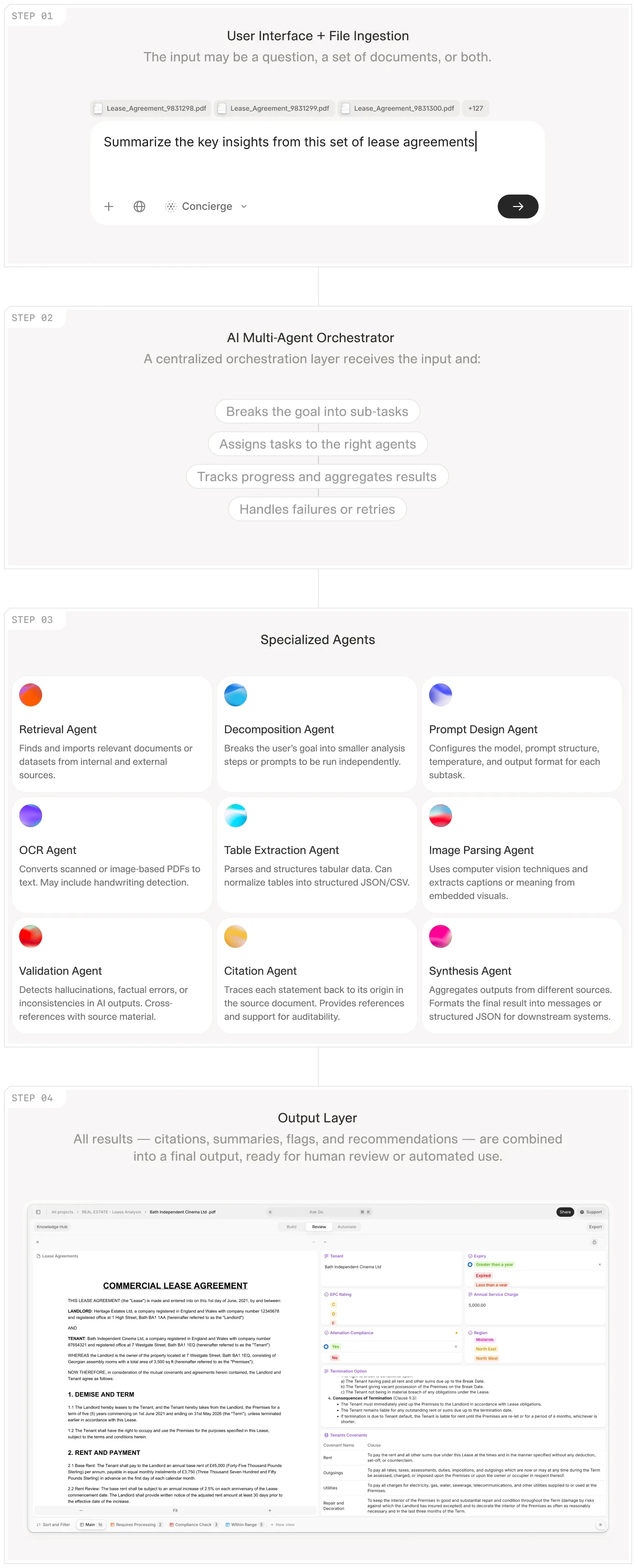
A lease request split into defined steps shows the configurable form of review, where the firm sets each check and its order.
1. V7 Go: best for cross-document exceptions routed to a named owner before closing
V7 Go runs diligence review as a defined workflow that a lender or buyer writes once and reuses on every file. For the loan in the opening, the inputs are the title commitment, ALTA survey, Phase I, property condition assessment, rent roll, leases, estoppels and loan term sheet. They can be uploaded or pulled from SharePoint or Google Drive.
The first step checks those files against the closing checklist and lists what is missing. The next step extracts every Schedule B-1 requirement and B-2 exception, each tied to the sentence in the commitment that states it. Python then runs the comparisons that should never wait for someone to find a free afternoon. Each easement plotted on the survey is matched to a B-2 item, and each report date is measured against the scheduled closing date. Each estoppel’s commencement date, base rent and square footage is compared with its rent roll row.
Every mismatch becomes an exception with an owner. Title gaps go to closing counsel, stale environmental dates go to credit, and rent variances go to the deal team. A named reviewer approves the issues list before it leaves the workflow, and the approved list moves on through an integration, the API or V7 Go’s MCP server.

The title and survey check follows this route, from deal files through extraction and Python comparison to a typed exception list.
Credit policy sits inside the steps. A rule such as sending any DSCR below 1.25x to a senior underwriter is written into the workflow. The model used for extraction is one setting within its step.
The firm’s record of earlier approvals earns its place on refinances. When the collateral or sponsor has been through the lender’s diligence before, earlier survey findings, cleared title exceptions and approved sponsor records come back as cited context. The reviewer starts the new file from those decisions.

This demo uses a fund fact sheet, and a B-2 exception list works the same way, with every output field declared before the run starts.
For buyers, V7 Go suits mid-market acquisitions teams that want estoppel, rent roll and PSA deliverable checks run through the same steps on every deal. For lenders, it is our pick for debt funds and banks that need credit policy held as rules. Our page for real estate credit and lending teams shows those workflows. V7 solutions engineers build the first workflow with the team on one of its own past closings.
2. DDee.ai: best for small acquisitions teams that want one packaged report per deal
DDee.ai takes the packaged route. A team uploads the deal documents and the platform classifies them. Nine vendor-built modules then run across the set, covering lease abstraction, financial review, tenant credit scoring, legal screening, CapEx analysis and red-flag detection. DDee.ai says the output is a cited report delivered in under one hour. It also claims 96% extraction accuracy across more than 1,000 deals, a figure we have not seen independently verified. The vendor’s homepage lists an individual plan at $300 per month, with team pricing on request.
The limit follows from the design. DDee.ai defines the modules. Its public material does not describe a way for a firm to add its own checks, such as a survey Table A test or a date rule tied to its closing calendar. Lender workflow depth is not publicly documented either.
A small buyer closing a handful of deals a year gets a cited first read of each data room from a single upload, so the buyer verdict is strong. A lender should see it run on a loan file before treating it as a credit tool.











Tools that order, store and track the deliverables
The collection layer records whether each deliverable has arrived, whether it is still current and who holds it. Reading the contents against the rest of the room is left to the review layer. A firm that lost a closing to a late appraisal needs one of these three tools first. A firm that lost a closing to an unread commitment already has this layer and needs the one above it.
3. CREtelligent RADIUS: best for ordering and tracking third-party reports
RADIUS is where the reports get bought. Buyers and lenders use it to quote, order, track, receive and archive Phase I ESAs, property condition assessments, ALTA surveys, zoning reports and appraisals from one dashboard. CREtelligent sells it as a tiered subscription, says a free tier is available and quotes list pricing on request.
The delivery date RADIUS tracks is where the lender’s problem starts. A Phase I that arrived on time can still age out before a slipped closing. RADIUS does not read the report or check it against the survey, the PCA or the loan terms. Our article on Phase I environmental site assessment review covers what that read involves.
Buyers ordering reports for several properties at once get the clearest benefit. Community bank lenders get a second benefit. Under SBA SOP 50 10 8, environmental reports from a Transaction Screen through a Phase II must be dated within one year of SBA loan number issuance, per Partner ESI’s summary. An ordering archive with every report date in one place makes that rule easy to test before the package goes to SBA.
4. Datasite: best for controlled data rooms in multi-party deals
Datasite is the room itself. It handles granular permissions, Q&A workflows, audit trails, redaction, bulk upload and full-text search. It is built for investment sales brokers, private equity real estate teams and institutional lenders running multi-bidder or syndicated processes. Per-deal and enterprise pricing are quoted on request. Intralinks covers similar ground for cross-border deals, and our comparison of virtual data room providers sets the options side by side.
Extraction, cross-checks and exception flags sit outside its role. The title commitment from the opening would have waited there with a complete access log and no reader assigned to it.
Buyers and lenders also organize rooms differently. A buyer indexes by diligence category, while a lender indexes by document type and loan category. A single room serving both needs separate indexes, or both teams lose time hunting for files. For buyers, Datasite is a sound default in competitive sales. For lenders, it suits syndicated loans where several credit teams need controlled access to the same file.
5. Dealpath: best for pipeline tracking and approval routing across equity and debt
Dealpath tracks a deal from sourcing through investment committee, and its lending product adds loan pipeline tracking with DSCR, LTV and debt yield dashboards plus credit memo routing. In October 2025 the company introduced AI Studio for data ingestion, announced in a Dealpath release on BusinessWire. Enterprise pricing is quoted on request.
It suits mid-market and institutional teams with several approvers on every deal. Dealpath holds the deal and its approvals, and reading one document against another stays with the team or with a review layer.
Regulated lenders should put one question to any pipeline tool, Dealpath included. When an approver overrides a credit-policy flag, does the system require a written rationale, and where is that rationale stored? A lender has to show credit-policy adherence in an exam, and an override with no recorded reason is hard to defend. For buyers, Dealpath is the strongest option here for IC routing. For lenders, it gives the clearest pipeline view, provided a review layer feeds it checked numbers.
Specialist readers for title and leases
Title and lease tools read one document family in depth, and each stops at the edge of that family. Orbital compares a commitment with a survey, and Prophia follows a lease through its amendments. Neither vendor describes its product as tying estoppels to the rent roll or the survey to the loan commitment. The firm has to name the layer that owns those cross-checks before the deal starts.
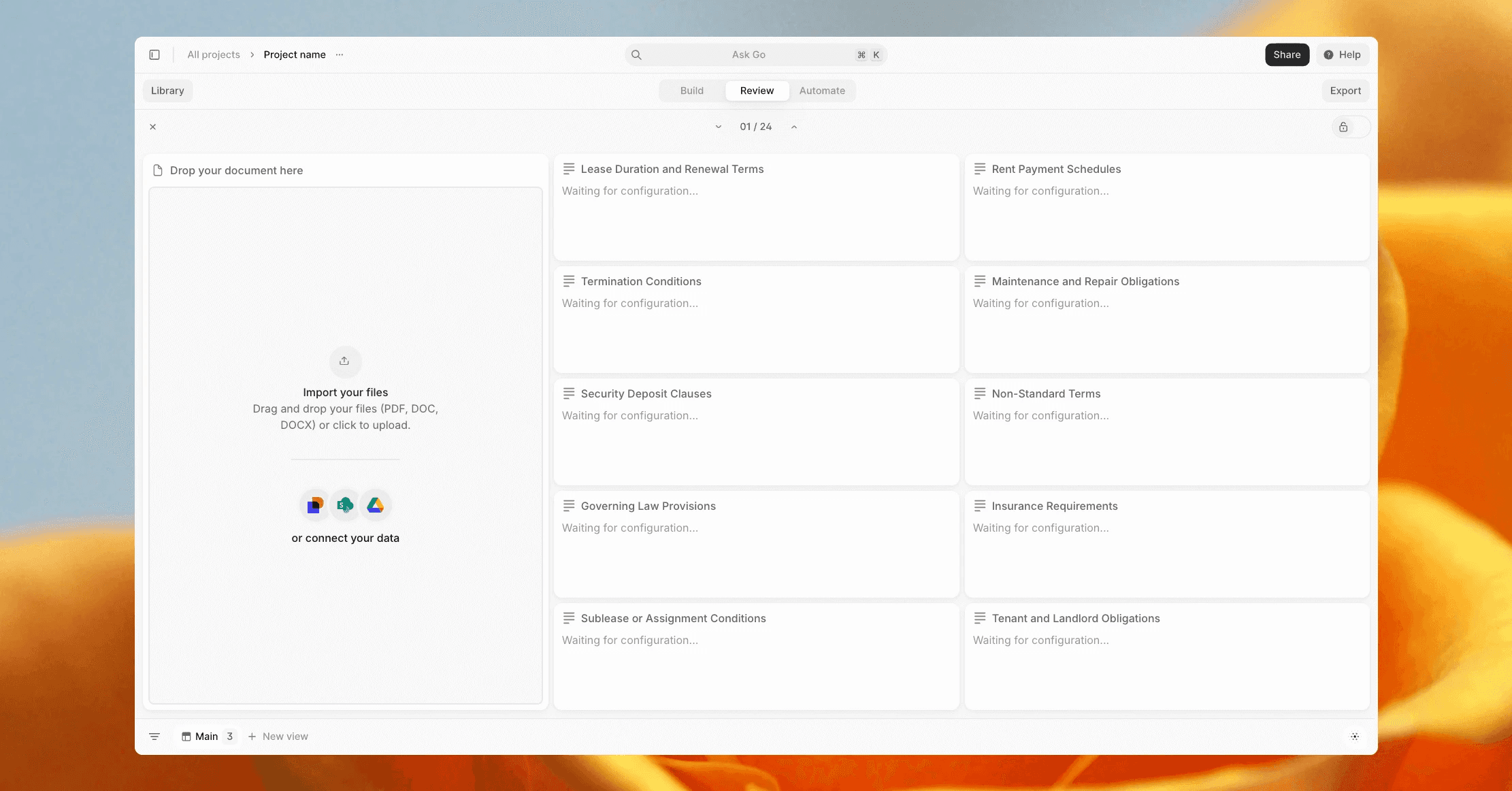
The lease file enters more than one layer of the stack, so decide up front which layer owns the estoppel and rent roll tie-out.
6. Orbital: best for title, survey and legal review by real estate counsel
Orbital is built for the lawyers on the deal. According to Orbital’s US product page, it reviews title commitments, linked exception documents, surveys, leases, CC&Rs and PSAs together and compares legal descriptions. It then drafts issues lists and objection letters for attorney review, with each finding linked to its source. Orbital says the work runs up to 70% faster, and it does not publish a price list.
Surveys give it plenty to check. The 2026 ALTA/NSPS standards, effective Feb 23, 2026, replaced the 2021 version and expanded Table A from 19 to 20 optional items. The new Item 20 asks the surveyor for a table of observed encroachments and of access between parcels with no access easement. That is the exact condition behind the unplotted easement in the opening case. Our guide to title commitment and ALTA survey review walks through the B-1 and B-2 read in detail.
Buyer counsel and lender counsel both get a faster, sourced title read. The limit is scope, since Orbital works on the legal file and does not reach the credit memo, the rent roll or report dates measured against a closing calendar. In the hypothetical, it could only have helped if counsel had the survey in hand on day 11.
7. Prophia: best for lease abstraction that feeds portfolio analytics
Prophia pairs AI extraction with expert review across more than 215 CRE lease fields, links each value to its lease page and tracks amendment chains. On top of the abstracts it builds stacking plans plus WALT, NER and encumbrance analytics, and Prophia says it reconciles abstracts against Yardi and MRI data. A third-party review on bestcre.com reports pay-per-use pricing of $20 per lease, with portfolio plans on request.
Prophia is strongest for asset managers and acquisitions teams with multi-tenant portfolios, where the abstract keeps working after closing. Title, environmental and financial cross-checks are outside its design, so the estoppel tie-out needs an owner elsewhere. If a lease tool is the purchase, our guide to choosing lease abstraction software ranks the options by the job the abstract does next.
Buyers with office and industrial portfolios and long amendment histories get the most from it. Lenders get a supporting tool for large multi-tenant collateral, where tenant concentration and WALT feed the credit view.
Lender layer tools for origination, spreading and covenants
Lender platforms run the loan, and the volume they carry is rising. The MBA’s February 2026 CREF forecast puts total commercial mortgage originations at $805.5 billion in 2026, up 27% from $633.7 billion in 2025. Each of those loans brings a commitment, a survey and a Phase I to date against a closing.
Much of the volume is repeat collateral. MBA counts $875 billion, or 17% of outstanding commercial mortgages, maturing in 2026. Debt that refinances returns with a survey, a title policy and a Phase I already on file, and each needs a bring-down against the new closing date. That bring-down is a review-layer job that sits beside the origination platform.
8. Blooma: best for CRE lenders automating origination and underwriting
Blooma is built for lenders, from community banks to institutional debt platforms. It automates deal origination and financial spreading and scores risk on a configurable model that Blooma says draws on more than 1,000 parameters. It also calculates DSCR, debt yield and LTV, adds real-time market data and monitors the portfolio with covenant alerts. Pricing is quoted on request.
Covenant alerts depend on thresholds written into each loan agreement, not drawn from a standard schedule. A lender gets the most from Blooma when those thresholds come from a cited read of the executed agreement. That read is where the review layer hands over to the underwriting platform.
Acquisitions teams can pass on Blooma, since it has no equity, data room or report-ordering role. For lenders, it is a strong underwriting core for teams that want origination and monitoring in one system.
9. nCino: best for banks running CRE lending end to end
nCino is a bank’s system for commercial real estate lending. It covers loan origination, automated spreading, credit memo generation, approval routing, covenant tracking, sensitivity analysis and portfolio analytics. Its users are banks, credit unions, CMBS lenders and debt platforms working at scale. For construction loans, nCino partners with Built Technologies on draw management, inspections and compliance, as described on Built’s nCino partnership page. Pricing is quoted on request.
Implementation is an enterprise project, and the product does not suit single-asset buyers. nCino holds the loan file and its approvals and is not positioned as a diligence document analysis tool. The B-2 versus survey check from the opening still needs a reader before the file reaches it.
The equity verdict is n/a. For a bank lender, nCino is the system of record where the approved issues list and the credit memo should end up.
Two-layer stacks by firm type
Pick the collection tool the deal team already works in, then choose the review layer that can send a cited exception to a named owner before the closing date. Each pairing runs as two separate products, with no connector assumed between them.
Firm type | Collection layer | Review layer | The check the pairing protects |
|---|---|---|---|
Community bank lender | nCino for the loan file, RADIUS for reports | V7 Go | SBA one-year environmental dating and B-2 against the survey before funding |
Debt fund or non-bank lender | Dealpath or Blooma for the pipeline, Datasite for syndicated deals | V7 Go | Credit-policy thresholds and report currency at the scheduled closing |
Mid-market equity buyer | Datasite or Dealpath | V7 Go | Estoppels against the rent roll and PSA deliverables against the diligence deadline |
Small acquisitions team | RADIUS | DDee.ai, or V7 Go once the checks need to be the firm’s own | One cited first read per deal before the deposit goes hard |
Legal or ops-led evaluation | Datasite | Orbital for title, V7 Go for the cross-check to credit and the rent roll | Title objections tied back to the financial file |
If a firm can fund only one purchase this year, the deciding fact is where its last slipped closing came from. A report that arrived late points to the collection layer. A report that arrived on time and was read too late points to the review layer, and that was the failure in the hypothetical.
A five-question demo script for your own data room
Run these five requests on the file from your last slipped or closed loan, with the vendor driving and your diligence lead watching the screen.
Load the title commitment and the ALTA survey. Ask for every Schedule B-2 exception with no plotted easement and every plotted easement with no B-2 item, each cited to both documents. A pass puts a page reference on every line, which tests traceability and cross-document checks together.
Move the scheduled closing date 14 days later and ask which reports now fall outside their currency window, including any Phase I component older than 180 days. A pass recalculates every report date without manual input, which tests document coverage and configurable controls.
Change one credit-policy threshold live, such as raising the DSCR floor, and watch which exceptions reroute to a different reviewer. A pass shows the change take effect without a vendor ticket.
Create an exception that matches no routing rule and ask where it goes. A pass names a default owner and a deadline tied to the closing date.
Approve the issues list and ask where it lands and what gets logged. A pass shows the approver’s name, the time, the citations behind each issue and the system that received the list.
What is the difference between CRE due diligence software and a virtual data room?
A virtual data room is one part of CRE due diligence software, the part that stores documents, controls who sees them and logs every view and download. Datasite and Intralinks are examples. The wider category also includes tools that order third-party reports, track the deal and its approvals, read title or leases in depth, run lender underwriting and review documents against each other. The practical difference shows up when two documents disagree. A data room holds both and records who opened them. A review tool compares them, cites the conflicting sentences and assigns the mismatch to someone with a deadline. Most firms already pay for a room, so the buying decision is usually about which review layer reads from it, and who owns what that review turns up before the PSA or loan closing date.
+
Do CRE lenders need different due diligence software from equity buyers?
They read many of the same documents, so there is overlap, but the checks differ enough that the stack usually differs too. An equity buyer tests the rent roll against leases and estoppels, tracks PSA deliverables against the diligence deadline and feeds the IC memo and the model. A lender tests whether reports are current at the scheduled closing, whether the survey meets the Table A items in the loan commitment, whether DSCR, debt yield and LTV clear credit policy, and whether covenant thresholds are captured from the executed loan agreement. Lenders also run origination platforms such as Blooma or nCino that buyers never touch. The two audiences can share a review layer, provided it lets each firm define its own checks, owners and approval steps instead of accepting a fixed report.
+
Which third-party reports should a lender's diligence software track, and how long does each stay current?
At minimum, the Phase I environmental site assessment, the property condition assessment, the ALTA/NSPS land title survey, the zoning report, the appraisal and the title commitment with its bring-down. Currency rules differ by report. Under ASTM E1527-21, which EPA recognizes for All Appropriate Inquiries, the time-sensitive Phase I components must fall within 180 days of the acquisition date, and the report as a whole is generally treated as viable for one year. For SBA loans, SOP 50 10 8 requires environmental reports, from a Transaction Screen or RSRA through a Phase I or Phase II, to be dated within one year of SBA loan number issuance. Surveys ordered since Feb 23, 2026 generally follow the 2026 ALTA/NSPS standards. The software should measure every date against the scheduled closing date and recalculate when that date moves, because a two-week slip can push a Phase I component past its window.
+
Can one platform cover the whole CRE diligence stack?
None of the nine tools in this comparison covers all seven diligence jobs on its own. Ordering platforms buy and archive reports, data rooms hold and permission files, pipeline tools route approvals, specialist readers go deep on title or leases, and lender platforms run origination and covenants. Each is built around its own record. A configurable review layer reaches furthest across the room because it reads from wherever documents already live, but it still relies on the room, the ordering platform and the loan system to do their own jobs. The workable answer for most firms is two layers chosen deliberately, one that collects and one that reviews, with a named owner for every cross-check that falls between them. A third tool makes sense when one document family, usually title or leases, needs a specialist reader with deeper legal or portfolio features.
+
Who signs off on an exception that diligence software flags?
Public pricing is rare in this category. DDee.ai lists an individual plan at $300 per month on its homepage, with team pricing on request. A third-party review on bestcre.com reports Prophia's pay-per-use pricing at $20 per lease, with portfolio plans on request. CREtelligent says RADIUS is sold as a tiered subscription with a free tier and quotes list pricing on request. Datasite, Dealpath, Orbital, Blooma and nCino do not publish list prices, and data room pricing is often set per deal or under an enterprise agreement. V7 Go plans are described on V7's pricing page. When comparing quotes, price the review layer against one slipped closing on your own book, such as forgone interest on the loan amount over the delay and the borrower's rate-lock extension, since that event is what the purchase is meant to prevent.
+
What does CRE due diligence software cost?
Go is more accurate and robust than calling a model provider directly. By breaking down complex tasks into reasoning steps with Index Knowledge, Go enables LLMs to query your data more accurately than an out of the box API call. Combining this with conditional logic, which can route high sensitivity data to a human review, Go builds robustness into your AI powered workflows.
