17 min read
—


Five adjustment types, one office property and a register where every normalized line carries its source and its signer.

Casimir Rajnerowicz
Content Creator
V7 Go
A smarter way to manage due diligence and underwriting
The seller's repairs-and-maintenance line reads $141,600 for the trailing twelve months. The prior-year statement for the same suburban office shows $236,000, so the building spent 40% less on repairs while getting a year older. The general ledger detail explains why. In month 7 the seller booked a $186,000 roof replacement to capital. The same invoice batch carried rooftop unit service, drain clearing and ceiling tiles replaced after leaks.
Those smaller items are ordinary repairs. Coded with the roof, they left the opex total, so the T-12 analysis starts from a statement that looks lean because of one coding decision.
Every adjustment the analyst makes from here is a claim about how the building will run next year. A $38,500 move back into repairs says the property will keep needing that work. A termination fee taken out of income says the tenant will not pay it again. Credit officers and investment committees review those claims in the register, read beside the statement. Each row carries Seller Actual, Adjustment and Normalized values, the reason, the source page and the reviewer who signed it.
On an office deal, a properly evidenced register often lowers NOI. The capital coding that takes a roof out of opex can carry ordinary repairs out with it.
T-12 analysis starts with the statement date and the chart of accounts
Two things get fixed before any line moves, and both are written at the top of the register. The first is the period. A trailing 12-month real estate statement has a start month, an end month and an accounting basis, and each one changes what the numbers mean. The rent roll carries its own as-of date. The gap between that date and the T-12 end month decides whether occupancy in the two documents can be compared. On the example property, the period lock looks like this.
Field | Value on this deal |
|---|---|
Statement period | September 2025 to August 2026, 12 months actual |
Basis | Cash, per the seller’s cover letter |
Rent roll as-of date | September 30, 2026, one month after the T-12 ends |
The second is the chart of accounts. Seller line names rarely match the categories in your model. Each line gets mapped before any analysis starts, with a note wherever the mapping involves judgment.
Seller GL line | Model category | Mapping note |
|---|---|---|
Repairs - Roofing | Repairs and maintenance, review for capital | Month 7 batch mixes roof scope and service calls |
Contract Svcs - HVAC | Contract services | Annual contract, paid twice inside the window |
Leasing Costs | Below NOI, TI/LC | Tenant improvements and commissions are capital in underwriting |
Mgmt Fee - Affiliate | Management fee | Related-party rate, test against market |
Other Income - Lease Term | Non-recurring income | One-time payment from the Suite 300 tenant |
Utilities - Common/Vacant | Utilities | Landlord-paid, includes vacant floors |
The mapping also decides which benchmark comparisons are fair. IREM’s Income/Expense IQ national summary for 2024 puts office operating expenses at $10.33 per square foot against gross rents of $22.22. IREM’s total includes leasing costs and management fees. Strip TI/LC out of the seller’s opex, compare the remainder to that $10.33, and you are setting two differently built totals side by side. The NOI arithmetic sits in our walkthrough of NOI calculation for commercial property, and none of it holds until the mapping does.
Five adjustment types, each one a row in the register
Every row in the register carries eight fields. Seller Actual, Adjustment and Normalized hold the numbers. Type, a one-clause reason, the source page, the reviewer and the date the evidence was checked record why the number moved. Some adjustments depend on others being made first.
Non-recurring income and expense
The seller’s other income includes an $85,000 payment from the Suite 300 tenant for ending its lease early. It will not recur, so it leaves effective gross income in full, and the register row cites section 3 of the termination agreement. Insurance proceeds booked as other income, litigation settlements and sale-related legal fees get the same test, each backed by its agreement, order or invoice.
The fee also says something about next year’s income, because Suite 300 is vacant or about to be. The unit-by-unit proof belongs to rent roll reconciliation against leases and estoppels, and the register only cross-references that check. The row reads $85,000 seller actual, an adjustment of -$85,000 and a normalized value of zero, signed by the analyst.
Capital versus operating expense, starting with the roof
The $186,000 roof replacement is a genuine capital item. The problem sits in the rest of the month 7 batch. Invoices coded to the roof include rooftop unit service, roof drain clearing and ceiling tile replacement after leaks. Together that is $38,500 of work that recurs on any building of this age, so it moves back to repairs and maintenance. The line goes from $141,600 to $180,100.
Ask for the seller’s written capitalization policy before classifying anything.
The IRS tangible property regulations allow a de minimis safe harbor of $2,500 per item, or $5,000 for a taxpayer with an applicable financial statement. That is a tax election. The seller’s book policy can set a different threshold, and it is the book policy that explains how the month 7 batch got coded. If no written policy exists, the request goes on the question list and the firm’s own threshold governs.
The seller’s coding errors run in both directions. The seller also booked $64,000 of tenant improvements and leasing commissions as operating expense. Those are capital costs of leasing space, so the row moves them below NOI, which raises normalized NOI by the same amount.
Normalized R&M now sits at $3.08 per square foot, against $2.42 as stated and $4.04 in the prior year. The remaining $55,900 gap gets no adjustment. The analyst requests two years of work orders and the property condition assessment, and the register carries an open row with the analyst as owner. One-off leak repairs in the prior year would close the gap on evidence, and deferred work would move into the PCA capex budget.
Period misalignment and cash-basis timing
The HVAC service contract costs $24,000 a year, billed annually in advance. On a cash basis, the seller paid the September 2025 invoice in the first month of the window. It paid the 2026 renewal early, in August, so the trailing statement shows $48,000. The adjustment is -$24,000, evidenced by the vendor contract and the two check dates in the check register.
The one-month gap to the rent roll is recorded on the register header with no adjustment, unless income moved in September. A falling T-3 against the T-12 average goes on the question list until someone explains the cause. Agency multifamily practice is more conservative. The Fannie Mae Multifamily Guide directs underwriters to use the highest of the trailing 3-, 6- and 12-month figures for each expense, excluding non-recurring items. On an office loan, the lender’s credit policy decides whether that method applies.
Management fee at market, not at the affiliate’s rate
The seller’s affiliate charges 2% of effective gross income, or $29,438 on seller EGI of $1,471,900. This example assumes a market fee of 4% for a third-party manager on a building this size. The fee is calculated on normalized EGI, so the termination fee has to leave income first. Four percent of $1,386,900 is $55,476, and the adjustment is +$26,038. Run the steps in the wrong order and the fee comes out $3,400 too high, enough to break the register foot.
Freddie Mac’s CREFC desk reference describes the servicing convention of using the higher of the borrower’s actual fee or the underwritten fee. This row moves the same way. The VP signs it because the 4% is an assumption.
Taxes and insurance reset to the buyer’s year
The $182,000 tax line reflects the assessment set before the sale. In this example’s jurisdiction, a sale triggers reassessment at the purchase price. A $9.6 million price at a 2.35% effective rate produces a $225,600 bill and an adjustment of +$43,600. The source is the county rate sheet and the PSA. Baker Tilly reports that one Pennsylvania county’s 2024 reassessment raised market values by 28%, a figure that describes that county alone.
The seller’s $61,000 insurance premium comes from a policy bound 18 months before the statement ends. A broker indication for the buyer’s coverage comes in at $78,500, so the adjustment is +$17,500 and the indication date goes in the source column. Brookings reports that commercial property insurance premiums grew nearly 30% in 2023. A premium bound a year and a half ago rarely survives the reset.
Office operating costs as a whole have moved as well. IREM’s commentary on its earlier national sample found office operating expenses climbed 7% in 2023 to $11.15 per square foot, 27% above 2015. For both rows, the effective date of the quote or rate sheet is the evidence.
The register for a 58,400 SF suburban office, footed
The property, its $9.6 million price and every figure in the register are hypothetical. The three-column layout comes from loan servicing. Freddie Mac’s securitized multifamily servicing uses Borrower Actual, Adjustments and Normalized columns. The CREFC Investor Reporting Package, written for CMBS, describes the worksheet as prepared “to normalize a borrower’s actual operating statement,” and the format suits office acquisitions.
Line | Type | Seller Actual | Adjustment | Normalized | Reason | Source | Reviewer | Status |
|---|---|---|---|---|---|---|---|---|
Lease termination fee | Non-recurring | $85,000 | -$85,000 | $0 | One-time payment | Termination agreement, section 3 | Analyst | Signed |
Repairs and maintenance | Capital vs opex | $141,600 | +$38,500 | $180,100 | Service calls coded to roof | GL detail page 14, month 7 | Analyst | Signed |
Leasing costs (TI/LC) | Capital vs opex | $64,000 | -$64,000 | $0, below NOI | Capital cost of leasing | GL detail page 9 | Analyst | Signed |
HVAC service contract | Period | $48,000 | -$24,000 | $24,000 | Two annual payments in window | Vendor contract, check register | Analyst | Signed |
Management fee | Fee | $29,438 | +$26,038 | $55,476 | Market 4% of normalized EGI | Affiliate agreement, 4% assumption | VP | Signed |
Real estate taxes | Reset | $182,000 | +$43,600 | $225,600 | Reassessed at price | County rate sheet, PSA | VP | Signed |
Insurance | Reset | $61,000 | +$17,500 | $78,500 | Repriced to buyer’s cover | Broker indication, dated | Analyst | Signed |
R&M gap vs prior year | Open question | n/a | None | n/a | $55,900 below prior year | Work orders, PCA requested | Analyst, owner | Open |
Expense reimbursements | Open question | $142,000 | None | $142,000 | Base-year recoveries untested | CAM reconciliations requested | Analyst, owner | Open |
NOI | $642,862 | -$122,638 | $520,224 | VP or credit officer | Signed |
The seven adjustments sum to -$122,638, which equals normalized NOI of $520,224 minus seller NOI of $642,862, so the register foots. Opex rises from $829,038 to $866,676. At the $9.6 million price, the cap rate drops from 6.70% to 5.42%. The seller’s own 6.70% applied to normalized NOI implies a price of about $7.77 million.
The two open rows carry an owner and a request, with no adjustment pending evidence. If invoices show the whole month 7 batch was roof scope, that row goes to zero and normalized NOI rises by $38,500.
Building the register in V7 Go, one cited row at a time
V7 Go builds the register as a defined workflow with the same steps on every deal. The next office building’s register gets built the way this one was. The inputs are the seller’s T-12 in PDF or Excel, the GL detail and the prior-year statement. Supporting files are the invoices, leases, tax bill, insurance indication and bank statements. The steps run in a fixed order.
A model reads each seller line, maps it to the firm’s chart of accounts and proposes candidate adjustments with their type.
Python runs the arithmetic. That covers monthly cross-foots, month-against-average variance flags, the period window test, the fee recalculation on normalized EGI and the final register foot.
Each proposed adjustment carries a citation that opens its source, such as section 3 of the termination agreement or GL detail page 14.
The analyst accepts, edits or rejects each row and signs it, and the VP or credit officer signs normalized NOI.

This demo maps a fund fact sheet, and a T-12 workflow uses the same pattern to turn seller lines into typed register columns.
When a check fails, the workflow stops on that row. A monthly column that does not foot to the annual total goes to the analyst as an exception. The figures and the source passage travel with it. So does a fee computed before the termination payment left income. The register cannot be signed while an exception is open, and the resolution note stays in the row’s history.
The output is a reviewed register inside V7 Go, with every row typed and sourced. The team can export it or pass it on through the route it already uses for model inputs. A general assistant re-solves the statement each time someone asks. The workflow runs the steps the team defined, in order, and keeps the call on each row with the analyst. The same property operating statement extraction sits inside V7’s wider workflows for real estate operations, including rent rolls and loan documents.

A reviewer signs a register row only after seeing which file a value came from, and this view shows that label on every figure.
V7 Go then keeps the signed register linked to the property record, so the asset manager can retrieve the approved version after close.











Testing the seller's income against deposits, tax returns and the rent roll
The register tests expenses, and property operating statement analysis also has to test whether the stated income reached a bank account. Four stated-versus-actual checks cover most office deals. Each one needs its pass condition written down before anyone runs it.
Test | Documents | What a pass looks like | What a fail triggers |
|---|---|---|---|
Deposits against reported income | 12 months of operating account statements, T-12 income by month | Monthly deposits tie to reported income, with timing differences explained | A question to the seller listing the months that do not tie |
Tax return against the T-12 | Entity return for the matching period, depreciation schedule | Income and expenses agree after documented book-to-tax differences | A request for the book-to-tax reconciliation |
Rent roll against T-12 income | Rent roll as of September 30, 2026, base rent by month | In-place rent explains trailing base rent once the Suite 300 exit is dated | A unit-level tie-out on the affected suites |
Reimbursements against recoverable expense | Leases with base-year stops, prior-year CAM reconciliations, normalized opex | Reimbursements do not exceed recoverable growth over each tenant’s base year | An open register row and a request for reconciliations |
The deposit test fails for ordinary reasons more often than for bad ones. Security deposits, a loan draw or a tenant paying two months at once all land in the operating account without being income. The analyst lists the months that do not tie and asks for the explanation, and the finding stays a question until the seller answers.
The rent roll test catches the Suite 300 exit from the other side. Trailing base rent of $1,226,400 includes months when Suite 300 still paid, while the September 30 rent roll may already show the suite empty. The two documents agree once the move-out lands in the right month. The lost rent becomes a vacancy assumption in the model, and the T-12 itself does not change.
The tax return check is weaker on income and stronger on capital. The depreciation schedule shows what the seller has capitalized over the years, which gives a second view of the capitalization policy the register already requested. A roof placed in service in month 7 at a cost near $186,000 supports the capital row.
Reimbursement income is where office T-12s differ most from multifamily. Under base-year stops, a tenant pays its share of operating expense growth above the level in its base year. When the register raises taxes, insurance and recoverable repairs, the buyer’s reimbursement income may come in above the seller’s $142,000. The answer depends on each lease’s base year, its expense definitions and its exclusions, so the row stays open until the prior-year reconciliations arrive. Our guide to CAM reconciliation for commercial leases covers that tie-out in detail.
Reconciling the register to the story in the offering memorandum
The offering memorandum tells a story about the building, and each register row either supports that story, explains it or turns it into a question. Four claims typical of a suburban office OM show the pattern.
OM claim | Register row it touches | Status |
|---|---|---|
New roof, no near-term capital needs | R&M reclass, R&M gap vs prior year | Supported for the roof, open on other systems until the PCA arrives |
Expenses reduced through operating efficiencies | R&M reclass, HVAC period row | Adjusted, because $38,500 of the drop was coding |
Below-market management in place | Management fee | Adjusted from 2% to a 4% market fee |
Strong tenant retention | Lease termination fee | Open question, since Suite 300 paid to leave |
The efficiencies claim deserves the closest reading. Repairs fell by $94,400 year over year, and the register attributes $38,500 of that to coding.
The other $55,900 stays unexplained until the work orders arrive. It could reflect one-off repairs in the prior year or work the seller stopped doing.
The management claim reads as a selling point and works against the seller in the register. A below-market affiliate fee flatters seller NOI by $26,038 in this example, so the item the OM advertises is one the register normalizes. A buyer who plans to keep a related manager after closing can argue for a lower fee. That argument needs a signed contract behind it, and a sentence in a marketing document does not qualify.
When the seller cannot produce a document, the item goes on the question list with an owner and a due date. An absent invoice does not prove deferred maintenance, and a missing CAM reconciliation does not prove that tenants were overbilled. Each item stays open until a document closes it or the deal team decides to price the uncertainty.
The register records which of the two happened. Documents that never reached the data room go back to the seller against the PSA deliverables schedule, under the same owner and due date.
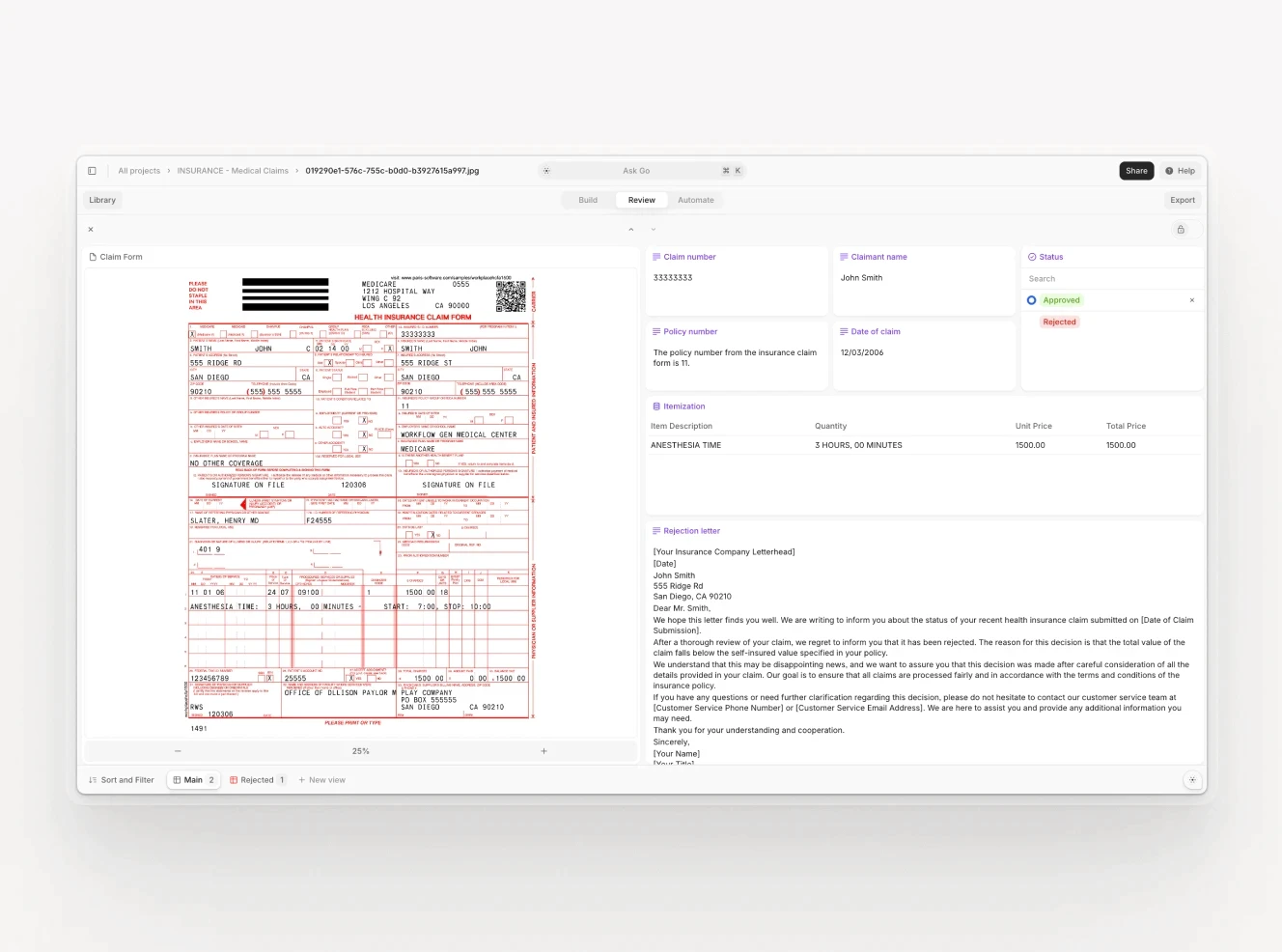
This sample is an insurance claim form. A T-12 review uses the same layout, with each extracted field next to the page a reviewer is judging.
Carrying the signed register into the model and into year-one variance
Normalized values feed the underwriting model’s input tab, and each one keeps its source and effective date when it arrives. The insurance figure carries the date of the broker indication. The tax figure carries the rate sheet and the PSA price, and the management fee carries the 4% assumption with the VP’s sign-off. Where normalized NOI meets debt sizing, our guide to AI in commercial loan underwriting picks up from there.
The open rows travel too. The input tab carries the $55,900 R&M gap and the untested reimbursements as flagged assumptions with an owner. The model then shows which numbers are still provisional on the day IC votes.
After closing, the register becomes the baseline the asset manager reports against. Month-one actuals run line by line against the normalized figures, and the seller’s figures drop out of the comparison.
Line | Normalized annual | Monthly baseline | What the asset manager tracks |
|---|---|---|---|
Repairs and maintenance | $180,100 | $15,008 | Run-rate against baseline, and the PCA question closed with work orders |
Insurance | $78,500 | $6,542 | Bound premium against the broker indication |
Real estate taxes | $225,600 | $18,800 | First post-sale bill against the reassessment estimate |
Management fee | $55,476 | 4% of collected EGI | Contract rate against the underwritten assumption |
Versions matter from here on. If the seller produces the work orders after IC, the register gets a new version and the model input updates from it. The IC memo records which version the approval relied on. An asset manager reading the file a year later can see what was known at signing and what arrived afterward.
NOI is one output of this record. After IC, the register becomes the property’s performance history, with each variance traceable to the row and source that set the expectation. When first-year R&M lands at $172,000 or $205,000, the asset manager can say which assumption missed and which document set it.

Once signed, the register moves on as structured data to its next use, whether that is the model’s input tab or the monthly variance report.
Row by row, what a lender signs and what an equity committee signs
Lender credit and an equity IC read the same register and sign different rows. The OCC Comptroller’s Handbook on commercial real estate lending expects banks to obtain and review operating statements and rent rolls. The lender column reflects that discipline. Underwritten net cash flow on the lender side also deducts reserves below NOI, so some rows that both sides accept still produce different numbers. The positions in the table are V7’s view of common practice, and each firm’s own credit policy governs.
Register line | Lender credit | Equity IC |
|---|---|---|
Lease termination fee | Accepts removal as non-recurring income | Accepts removal and models the Suite 300 vacancy |
R&M reclass, +$38,500 | Accepts, and questions whether more of the batch was repair | Accepts and checks it against the PCA |
TI/LC out of opex | Accepts, then reserves for TI/LC below NOI in underwritten cash flow | Accepts and budgets leasing costs by rollover |
HVAC timing | Accepts with check dates | Accepts |
Management fee at 4% | Uses the higher of actual or underwritten | Uses its own manager’s contract rate |
Real estate taxes | Accepts the reassessment and rejects appeal upside | Accepts, and may carry appeal upside as a scenario |
Insurance | Accepts a dated indication, may want a bound quote before funding | Accepts the indication |
R&M gap vs prior year | Questions it and may size a reserve | Prices it through the PCA capex budget |
Expense reimbursements | Questions until reconciliations arrive | Questions, and models base-year resets on rollover |
Below-market rent mark-to-market | Rejects and stays at in-place rent | May model it on rollover |
The open rows are where the two sides part most. A lender that cannot close the $55,900 R&M gap before funding can size a reserve for it. An equity buyer in the same position can lower its bid by whatever the PCA capex budget assigns to the gap.
Should T-12 adjustments be made on cash-basis or accrual-basis figures?
Work from whichever basis the seller's statement uses, record it on the register header and adjust for timing wherever the basis distorts the 12-month window. Cash-basis statements are common among smaller owners. They record an expense when the check clears, so an annual contract can land twice in the window or not at all. Accrual statements match each expense to its service period and sit closer to how a lender underwrites. When the seller provides only cash-basis figures, test the large annual items first, which usually means insurance premiums, service contracts, tax installments and prepaid amounts. Each one gets a period adjustment backed by the invoice and the payment date. Converting the whole statement to accrual is rarely worth the effort on a small office deal. What matters is that each normalized figure represents twelve months of cost and that the register shows how the analyst got there.
+
Can a T-6 or a partial operating year be annualized for underwriting?
It can, but the result is a weaker input and the register should say so. Multiply the partial-period total by 12 divided by the months covered, then test every line for seasonality. Office expenses are lumpy. Snow removal, HVAC contracts, tax installments and insurance renewals do not fall evenly across the year, so a straight annualization of a spring-to-summer T-6 understates some lines and overstates others. Build the normalized figure line by line from contracts and bills where they exist, and annualize only the lines that genuinely run evenly, such as janitorial or base rent from a stable rent roll. Agency multifamily lenders compare trailing 3-, 6- and 12-month figures and take the highest expense, which is a useful discipline even outside that market. Credit committees will ask how many months are actual, so put that count on the register header next to the accounting basis.
+
How do base-year expense stops on office leases change reimbursement income when expenses are normalized?
Base-year stops tie reimbursement income to expense growth above each tenant's base year, so normalizing expenses can change income as well. When the register raises taxes, insurance or recoverable repairs, the amount a tenant owes above its stop may rise in the buyer's first year. When it removes a cost that tenants never reimbursed, such as leasing commissions, reimbursements should not move. The real answer depends on each lease's base year, its expense definitions and exclusions, any gross-up provision for occupancy and any cap on controllable expenses. That is why reimbursement income usually stays an open row until the prior-year reconciliations and lease abstracts are in hand. A sound working method is to recompute reimbursements tenant by tenant from the normalized recoverable pool and compare the total with the seller's figure. A large gap points to billing errors, a base year set unusually high or recoverable costs coded to the wrong line.
+
Does a newly replaced roof justify a lower repairs-and-maintenance line going forward?
Partly, and only for roof-related costs. A new roof should cut leak calls, roof patching and interior damage repairs for several years, and the register can reflect that when the evidence supports it. It has no effect on HVAC service, plumbing, elevator maintenance or the other categories that make up most of an office repairs line. The more common error runs the other way, where the replacement year looks cheap because roof-related service calls were coded to the capital project. Separate the invoices first, move the ordinary repairs back to opex and only then decide whether any forward reduction is justified. If the analyst wants to carry a lower roof-related repair figure, the row needs the roof warranty, the scope of work and prior-year work orders showing how much of the old repair spend was roof-related. Without them, normalize to the building's recent run-rate and let the PCA capex budget carry the remaining risk.
+
What management fee goes in the register when the seller self-manages through an affiliate?
The deal team owns the register until IC or credit approval, and the asset manager owns it after closing. The handoff should be explicit, with open rows transferred by name and due date. In the first year, the asset manager compares monthly actuals with the normalized figures and closes open questions as documents arrive, such as the PCA follow-up or the prior-year CAM reconciliations. Every change becomes a new version with its source and signer, and the signed acquisition version stays frozen so the committee's basis can always be reconstructed. Lenders often ask for a comparable record at annual review, because servicing worksheets normalize the borrower's statement in the same three-column format. When the register lives with the property record and not in a closed deal folder, the next refinance or sale starts from reviewed history and not from another seller-prepared statement.
+
Who owns and updates the signed T-12 register after closing?
Go is more accurate and robust than calling a model provider directly. By breaking down complex tasks into reasoning steps with Index Knowledge, Go enables LLMs to query your data more accurately than an out of the box API call. Combining this with conditional logic, which can route high sensitivity data to a human review, Go builds robustness into your AI powered workflows.
