15 min read
—


An eight-column input tab, an input contract for each of the seven model blocks and a priced sensitivity that shows what one unsourced assumption costs.

Casimir Rajnerowicz
Content Creator
V7 Go
A smarter way to manage due diligence and underwriting
Twenty minutes into the investment committee meeting, the chair put a finger on one cell in the value-add industrial model. Where did the 3.5% annual rent growth come from? The associate presenting had inherited the model six weeks earlier from a colleague who has since left the firm. Nobody in the room could source the number.
The problem sat on the input tab, the part of real estate financial modeling a committee can actually question. The 3.5% row had no source document, no period, no effective date and no reviewer. Every block downstream inherited that gap. The rent line compounded it for five years and the Year-6 NOI behind the exit price carried it. The levered IRR on the cover page then reported it to one decimal place.
Somebody guessed the broker’s offering memorandum. Nobody could say which page, or whether the figure described the submarket or the broker’s hopes for it. The associate could have walked the committee through every formula in the workbook, and none of that would have answered the chair.
The fix is an order of work. Build the input tab first, with a source, page, period, effective date, reviewer and status on every assumption. Then build the seven blocks so that each one reads only from rows a named person has reviewed.
Real estate financial modeling starts with an eight-column input tab
A committee can audit the input tab row by row, which makes it the part of a CRE model that has to carry the evidence. Each assumption gets eight fields, matching the columns below. Two of them carry dates, the period the evidence covers and the date the value takes effect in the model. The hypothetical tab below is built from the inherited deal, a 180,000 SF multi-tenant industrial asset under contract at $25,000,000. Later tables use the same deal.
Assumption | Value | Source document | Page | Period | Effective date | Reviewer | Status |
|---|---|---|---|---|---|---|---|
R01 Purchase price | $25,000,000 | PSA, Section 2.1 | p.4 | n/a | 2026-12-15 | J. Ortiz | Approved |
R02 Closing costs | 1.5% | Title and escrow estimate | p.1 | Dated 2026-09-12 | 2026-12-15 | J. Ortiz | Reviewed |
R03 Year-1 NOI, in place | $1,350,000 | T-12 adjustment register | Line 41 | 12 mo. to 2026-08-31 | 2027-01-01 | M. Chen | Reviewed |
R04 Market rent growth | 3.5% a year | OM, broker pro forma | p.14 | Not stated | 2027-01-01 | (blank) | Draft |
R05 Mark-to-market | +$150,000, Years 2 and 3 | Lease abstracts, Suites 104 and 110 | p.2 | Expiries 2027-12 and 2028-12 | 2028-01-01, 2029-01-01 | M. Chen | Reviewed |
R06 Real estate taxes | $176,400 | County tax bill, reassessed | p.1 | Tax year 2026 | 2027-01-01 | J. Ortiz | Reviewed |
R07 Value-add capex | $1,080,000 | PCR and roof bid | p.22, p.2 | Site visit 2026-07-30 | 2026-12-15 | M. Chen | Approved |
R08 Senior loan | $15,000,000, 6.00%, 5 yrs IO, 1% fee | Lender term sheet | pp.1-2 | Expired 2026-08-02 | 2026-12-15 | M. Chen | Stale |
R09 Exit cap rate | 5.90% | Going-in plus 50 bps, comp memo | p.3 | Comp sale 2026-05 | 2031-12-31 | J. Ortiz | Reviewed |
R10 Selling costs | 1.5% | Firm underwriting policy | Sec. 4 | Policy 2026-01 | 2031-12-31 | J. Ortiz | Approved |
Two rows would stop this pack at the door. R04 is the chair’s question written as a row, sourced to the seller’s broker, with a blank period and no reviewer. R08 looks complete until you read the period column. The term sheet expired in August, so the 6.00% rate is a quote the lender no longer has to honor.
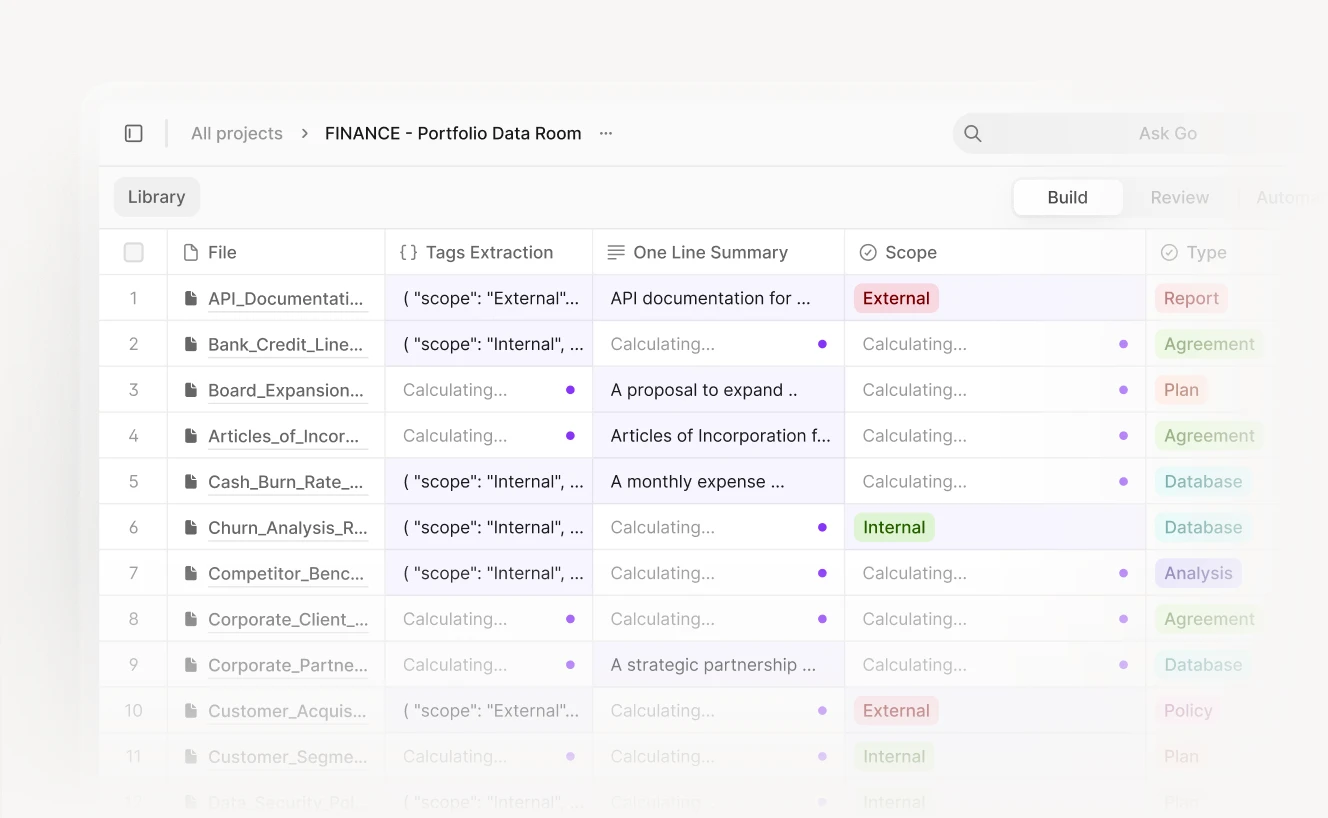
An illustrative portfolio tool, where one changed input moves every dependent figure, which is why R04 needed a source first.
Period and effective date are separate columns
The period says when the evidence was true, and the effective date says when the model starts relying on it. The T-12 shows insurance of $54,000 for the 12 months ended August 31, 2026. The buyer’s binder, effective at closing on December 15, 2026, quotes $63,000. A tab with one date column records “2026” and lets Year 1 carry $54,000 for a policy the buyer will never hold. With two columns, the binder becomes the source of record and the T-12 figure stays beside it as a cross-check. Leases split the same way, since a signed lease can sit on the rent roll for months before it commences.
Draft, Reviewed, Approved, Stale
Each status has a trigger, and the trigger is what the next reviewer checks.
Draft means the row has a value and a candidate source that nobody has checked against the page.
Reviewed means a named person has opened the page and confirmed the value, period and effective date.
Approved means the deal lead has accepted the row, which matters most for rent growth and exit cap.
Stale means the source is over 12 months old, superseded or past its own expiry date, which is where R08 sits.
A committee pack should hold no Stale row without a written disposition beside it, such as a lender re-quote requested on a stated date. The reviewer field takes a name, because a title tells the chair whom to ask and nothing about who opened the page.
What each model block reads from the input tab
Each of the seven blocks signs a contract with the tab. The contract names the rows the block may read, the document behind each row and the date trap that most often corrupts it.
Blocks read only rows at Reviewed or Approved. The table below doubles as the data-room map.
Block | Rows it reads | Source document | Date trap |
|---|---|---|---|
Transaction | R01, R02, credits | PSA, credits exhibit, title estimate, loan commitment | Prorations set before closing moved |
Revenue | R03 to R05, suite rents and steps | Leases, amendments, estoppels, reconciled rent roll | Roll as-of date read as commencement |
Operating expenses | R03 expense lines, R06 | T-12 register, tax bill, binder, management agreement | Tax on the seller’s assessed value |
Capex and leasing | R07, TI, free rent, commissions | PCR, bids, lease TI clauses | PCR costs priced at the site visit |
Debt | R08, rate cap | Term sheet, commitment letter | Quote or cap expiry |
Exit | R09, R10 | Named comp or appraisal, policy | Comp older than 12 months |
Returns | The six blocks above | The tab itself | In-place and stabilized NOI mixed |
Transaction: price, credits and sources and uses
The price row cites the PSA section and page and changes only by amendment. Seller credits come from the credits and prorations exhibit, one row per credit. That keeps the headline price and the cash due at closing visibly different. Sources must equal uses to the dollar, and the debt line must match the commitment letter. In the hypothetical deal that leaves equity of $11,605,000 after $375,000 of closing costs, $1,080,000 of capex and a $150,000 loan fee.
Revenue: the executed lease as the source of record
Revenue rows come from executed leases and amendments, read against estoppels. Each suite needs commencement, expiry, base rent, the exact step schedule, options, termination rights, TI and LC obligations and recoveries. The rows inherit the reconciled rent roll, whose unit-by-unit proof is the subject of our rent roll analysis guide.
The classic contract error here is a fixed-dollar step entered as a percentage. A hypothetical 24,000 SF suite at $9.00/SF with $0.25/SF annual steps earns $240,000 in Year 5. At 3.5% growth the model shows $247,865, overstating that year by $7,865 and the five years by $18,293. Firms that abstract hundreds of leases a year should judge lease abstraction tools on whether the abstract still ties to the roll after amendments.

A termination right can pull a suite’s expiry into the hold, so the clause and its page belong on a revenue row.
Operating expenses: tax bill and binder over the T-12 line
Operating expense rows start from the T-12 adjustment register, which our T-12 analysis guide covers. Three lines then move to better documents. Taxes come from the county bill, adjusted for reassessment on sale. Insurance comes from the binder or a broker quote, and the management fee comes from the management agreement. Each replaced line keeps its T-12 figure as a cross-check, and the rows roll up through a standard NOI calculation.
Capex, reserves and leasing costs
Capex rows cite the property condition report page and the contractor bid. R07 ties $1,080,000, or $6/SF, to PCR page 22 and a roof bid. TI, free rent and leasing commissions each get their own row and source. Reserves appear only as a tab value tied to the PCR cost table, with the firm’s basis written down. The date trap in this block is classification. A roof or HVAC replacement coded as opex depresses NOI in its year. If that year is Year 6, the exit price capitalizes the error.
Debt: the term sheet carries a date
Debt rows come from the term sheet or commitment letter. They cover the loan amount and sizing test, rate, IO period, amortization, fees and rate-cap expiry. All of these terms move with the cycle. Banks tightened standards on all CRE loan categories, according to the April 2024 Senior Loan Officer Opinion Survey. Every surveyed term moved with them: maximum loan size, LTV, DSCR and interest-only period. In the July 2026 survey, a moderate net share of banks eased standards on nonfarm nonresidential loans, the category that holds industrial. A debt row copied from a 2024 model is therefore Stale. The deal’s 60% LTV, 1.50x DSCR and 9.0% debt yield hold only until the lender re-quotes R08.
Loan-to-value terms also move by vintage. Trepp’s review of CRE CLO issuance puts the median CRE CLO loan LTV at 66.30% in 2021 and 62.25% in 2025. An LTV copied from an older deal needs the same dating as the rate.
Exit: a named comp and a stated spread
The exit cap row needs a named sale or appraisal, the date of that evidence and the spread over the going-in cap. R09 is the 5.40% going-in cap plus 50 bps, and it cites a comp memo for a submarket sale that closed in May 2026. The spread is the firm’s assumption, approved by the deal lead. Each comp should resolve to one property and one transaction, which our real estate comps analysis guide covers.
Returns: name the NOI behind each metric
The returns block reads the blocks above it, and its only contract is a label naming the NOI behind each metric. The 1.50x DSCR and 9.0% debt yield use in-place NOI of $1,350,000, while the exit price uses Year-6 NOI of $1,941,813.
A lender sizes against in-place income. An equity buyer prices the gap to stabilized NOI. Our real estate underwriting guide covers which test binds. The cash flows themselves are worked in a DCF model built from an offering memorandum.
From data room page to reviewed row: the V7 Go input-tab workflow
V7 Go work on a CRE model starts with the firm’s own workbook. A V7 solutions engineer reads the input tab, with its row IDs, naming and units. Each row is then mapped to a declared output schema. After that, R08 in the firm’s model and the debt row in the workflow output describe the same field. The first proof of concept runs on a deal the firm has already closed. Its approved model gives the reviewer a known answer for every row.
From there the route follows the contract table. Inputs are the PSA, leases and amendments, estoppels, the T-12 register, tax bill, binder, PCR, term sheet and comp memo. Each document type has its own defined step with instructions and a typed output.
Python computes per-SF rent, step schedules, date windows, the sources-and-uses tie and DSCR, so the reviewer checks arithmetic that ran in code.

The diagram shows private-markets documents, and a CRE data room takes the same path through defined steps before any row reaches the tab.
Each row carries a citation that opens the exact sentence in the PDF or the cell in the spreadsheet behind the value. The status stays Draft until a named reviewer opens that source and changes it. The output is the reviewed eight-column table, which reaches the analyst’s model through one of four delivery routes.
On a re-trade or a refinance of the same building, V7 Go retrieves earlier approved rows and tenant facts with their dates. The reviewer starts from what the firm already signed and checks what changed. The same pattern runs across other real estate operations on V7 Go, such as rent roll review and lender reporting. The rows inform the deal team, and the investment decision stays with that team and the committee.

This example is a fund fact sheet, and a term sheet feeding R08 follows the same declared-schema pattern for rate, IO period, fees and expiry.











What the 3.5% is worth: an exit cap sensitivity from the input tab
When R04 drops from the broker’s 3.5% to 2.5%, levered IRR falls by about 1.9 points at every exit cap in the grid. The 2.5% column stands for a hypothetical dated submarket source found after the meeting. Everything else holds its tab value. NOI otherwise grows at the rent-growth rate, a simplification of a real lease-by-lease roll.
Exit cap (R09) | IRR / EM, R04 at 3.5% | IRR / EM, R04 at 2.5% | Sale price, R04 at 3.5% | Sale price, R04 at 2.5% |
|---|---|---|---|---|
5.40% | 17.1% / 2.09x | 15.2% / 1.94x | $35.96M | $34.34M |
5.65% | 15.5% / 1.96x | 13.6% / 1.81x | $34.37M | $32.82M |
5.90% (base) | 13.9% / 1.83x | 12.0% / 1.69x | $32.91M | $31.43M |
6.15% | 12.4% / 1.72x | 10.5% / 1.58x | $31.57M | $30.15M |
6.40% | 10.9% / 1.61x | 9.0% / 1.48x | $30.34M | $28.98M |
The grid uses the transaction and debt rows from the tab and sells at the end of Year 5 on Year-6 NOI. It deducts the 1.5% selling costs in R10. At the base 5.90% cap, the 3.5% case returns 13.9% and the 2.5% case returns 12.0%. Through the exit row alone, the 3.5% case reaches 12.0% only if the cap widens by roughly 30 bps, to about 6.21%.
The same gap shows up in dollars. At the base cap, gross sale price moves from $32.91M to $31.43M, and total profit on $11,605,000 of equity falls from about $9.65M to $8.04M. That $1.61M difference traces back to one number on page 14 of the OM, entered by someone who is no longer at the firm.
The exit row gets the strictest sourcing on the tab because appreciation, which the exit cap drives, can outweigh years of income. For calendar 2024, the NCREIF NFI-ODCE index returned -1.43% gross of fees, with an income return of 4.13% and an appreciation return of -5.39%. The fourth quarter alone showed a 1.16% total return, made up of 1.02% from income and 0.14% from appreciation. Those figures describe core open-end funds, a different risk profile from a value-add industrial deal. They still show a year of price movement erasing a year of income. On this tab that argues for R09 at Approved, signed by name, with comp evidence dated inside 12 months.
Downside cases as changes to named rows
A downside case can be audited only when it names the rows it changes and the values it puts in them. The scenario table uses the same hypothetical tab, and every case points at a row ID.
Scenario | Rows changed | New values | Result |
|---|---|---|---|
Base | None | R04 at 3.5%, R09 at 5.90% | 13.9% IRR, 1.83x |
Sourced growth | R04 | 2.5% | 12.0% IRR, 1.69x |
Rollover delay | R05 | Steps move to Years 3 and 4 | 13.2% IRR, 1.79x |
IC downside | R04, R09 | 2.5% and 6.40% | 9.0% IRR, 1.48x |
Lender case, NOI -10% | R03 | $1,215,000 | DSCR 1.35x, debt yield 8.1% |
Lender case, NOI -20% | R03 | $1,080,000 | DSCR 1.20x, debt yield 7.2% |
A case labeled “conservative” with no row IDs is a guess somebody typed into a cell. The next associate to inherit the model has no way to rebuild it. The row-ID format also lets a reviewer check that each changed value has its own source. The rollover delay, for example, should cite the lease abstracts for Suites 104 and 110 and a leasing broker’s view on downtime. In the IC downside, the 6.40% exit cap still needs a source. If that source is the firm’s own policy of testing a 100 bps expansion over the going-in cap, the row cites the policy.
Lenders will recognize the structure. The CRE Finance Council’s Underwriting Principles organize loan underwriting around four areas. These are market strength, the property’s cash flow and competitive position, the borrower’s or sponsor’s equity and expertise, and the structure of the loan. Each lender-case row maps to one of them. R03 is property cash flow, R08 is loan structure, and R04 and R09 belong to the market.
The review pass before committee, and what the memo inherits
A model goes to committee only after a second person has walked the tab against a short list of conditions. Any one of them sends it back. Associates inherit models and deal leads approve them, so the list has to be mechanical enough for either one to run.
A judgment row, such as rent growth, market rent or exit cap, whose only source is the OM or the broker’s pro forma.
A Stale row with no written disposition beside it.
A reviewer field that holds a title, the initials of someone who has left the firm or nothing at all.
A period wider than the window the row claims to describe, such as a 24-month comp series supporting a Year-1 market rent.
A value changed after a re-trade without a new source, period and reviewer stamp.
A scenario defined in words with no row IDs.
An NOI-based metric with no label for the NOI it uses.
The hypothetical tab fails the first two conditions on R04 and R08. The inherited original would have failed the third on nearly every row, because its reviewer column did not exist.
The investment memo’s assumptions appendix is built from Approved rows only. Each assumption carries its source, page and effective date into the memo. A chair who asks about rent growth finds a document name, a date and a reviewer on the page. An investment committee memo agent can draft the appendix and the risk section from those rows, with each figure linked back to its row ID. The tab, the model and the memo are decision support. Whether to buy the building at $25,000,000 on a 12.0% base case is a judgment the deal team brings and the committee makes.
Four delivery routes from reviewed inputs to your model
Reviewed rows still have to reach the workbook the committee sees, and the four routes differ mainly in what they ask of the firm. Direct population of a bespoke Excel model or an Argus file depends on model scoping, mappings, controls and validation. Each one is set up per workbook.
Route | What arrives | What the firm provides | Control that validates it | Deal profile it fits |
|---|---|---|---|---|
Reviewed input table | The eight-column table with a citation on every row, inside V7 Go | A defined extraction workflow and a named reviewer per block | No Draft or Stale row at IC | Any deal, and the first deal on a new asset type |
Excel export | The same reviewed table as a workbook | The above, plus an agreed column layout for Excel exports | Row count and totals tie back to the reviewed table | Teams that paste or link inputs into their own model |
Generated workbook | A new workbook built from the reviewed schema | A workbook template and a schema mapping | Template formulas tested on a closed deal | Standard deal types with a house template |
Scoped integration | Reviewed inputs written into the firm’s existing Excel or Argus model | Model scoping, row-level mappings, change controls and validation | Parallel run against approved models before live use | High deal volume on a stable model, with a baseline measured before the pilot |
Altus describes ARGUS Enterprise as commercial property valuation and DCF software. A firm that runs its cash flows there needs the same scoping as for a bespoke Excel file. The scope covers which inputs the reviewed rows feed, who approves a change to a mapping and how the parallel run is checked.
The parallel run decides whether the scoped route goes live. A mapping is accepted only after it reproduces, row by row, the approved inputs on deals the firm has already closed. A named reviewer has to explain every difference.
What columns should a CRE model input tab have?
Eight columns cover what a committee needs to audit an assumption. Assumption names the row and gives it a stable ID, such as R04, that scenarios and memos can point to. Value holds the number in the units the model uses. Source document and page identify exactly where the figure came from, down to the PSA section, lease page or term sheet page. Period records the window the evidence describes, such as a T-12 ending on a given date. Effective date records when the model starts relying on the value, which is often months after the period ends. Reviewer holds the name of the person who opened the source and confirmed the value. Status shows whether the row is Draft, Reviewed, Approved or Stale. Firms often add a cross-check column for the figure the row replaced, such as the T-12 tax line kept beside the reassessed county bill. A disposition column for any Stale row that still has to go to committee is the other common addition.
+
What is the difference between the period of a source and the effective date of an assumption?
The period is the stretch of time the evidence describes. The effective date is the day the model begins using the value. A trailing 12-month statement ending August 31, 2026 has a period of September 2025 through August 2026. If the deal closes in December 2026, the operating expense rows built from it take effect at closing. A single date column blurs the two and makes old evidence look current. The split matters most for items that reset on a transfer or a renewal. Property taxes are reassessed after a sale in many jurisdictions, and insurance is repriced when the buyer places a new policy. A signed lease may not commence until well after the rent roll's as-of date. In each case the reviewer needs both dates on the row to judge whether the evidence actually supports the value for the year the model is projecting.
+
When should a model assumption be marked stale?
A row becomes Stale when any one of three triggers applies. The source is more than 12 months old, a newer document has superseded it, or the source has passed its own expiry date. Term sheets and rate quotes usually carry an expiry, so a debt row can go stale within weeks even when the rest of the tab is fresh. A comp sale older than 12 months makes an exit cap row stale, and a new estoppel that contradicts a lease abstract makes the revenue row it feeds stale. Stale is a status, so the row keeps its value and history until someone acts on it. A committee pack can still include a Stale row if a written disposition sits beside it, stating what was requested, from whom and on what date, and what the model holds in the meantime. Without that note, the row should keep the model out of committee.
+
How should rent growth be sourced in a value-add industrial model?
Rent growth is a judgment row, so it needs dated, submarket-specific evidence and a named approver. The offering memorandum's pro forma figure is the seller's position and can sit in a cross-check column, but it should never be the source of record. Better sources include the firm's own recent leasing on comparable buildings and signed submarket leases from the past 12 months. An appraisal or a third-party market report also works when its date and geography match the asset. The row should state the period the evidence covers, such as leases signed in the trailing four quarters, and the effective date, usually the first year of the hold. Keep market rent growth separate from contractual steps, which belong to individual leases. In the hypothetical deal, moving from an unsourced 3.5% to a sourced 2.5% cut levered IRR by about 1.9 points, so the row deserves Approved status from the deal lead.
+
Can AI populate an existing Excel or Argus model directly?
Every row the re-trade touches needs a new source, a new period where relevant, a new effective date and a fresh reviewer stamp. The purchase price row moves to the PSA amendment and its page. New seller credits get their own rows, sourced to the amended credits exhibit. Some re-trades follow a diligence finding, such as a roof condition flagged in the PCR or a tenant estoppel that contradicted the rent roll. The rows built from those documents need re-review as well. Debt rows often go stale at the same time, because lenders re-size or re-price after a change in price or NOI. The old values should stay in the row history so the committee can see what changed and why. A re-trade value typed over the original with the old reviewer's name still attached is one of the conditions that should send a model back before committee.
+
What has to change on the input tab after a re-trade?
Go is more accurate and robust than calling a model provider directly. By breaking down complex tasks into reasoning steps with Index Knowledge, Go enables LLMs to query your data more accurately than an out of the box API call. Combining this with conditional logic, which can route high sensitivity data to a human review, Go builds robustness into your AI powered workflows.
