10 min read
—



Casimir Rajnerowicz
Content Creator
V7 Go
A smarter way to manage due diligence and underwriting
At least four different kinds of product are sold as insurance automation software, and the two that matter most are not substitutes for each other. That is the single most expensive thing to get wrong in this category, and the category name actively hides it.
A carrier that buys robotic process automation because the demo showed a claim moving through three systems will discover that it still needs a person to read the loss run first. A broker that buys document AI expecting it to update the agency management system will find it extracts beautifully and pushes nothing anywhere. Both bought working products. Both bought the wrong half.
This guide sorts the category into its four parts and sets out where insurance automation actually pays inside an operation. It then explains why process automation and document AI fail in opposite directions, and gives a sequence for deciding what to automate first. It also covers the conditions under which the answer is not yet.
What insurance automation software actually means
Four categories, four different buyers, four different failure modes. Almost every insurance operation ends up running at least two of them, and the useful question at evaluation is not which product is best but which category is short-staffed.
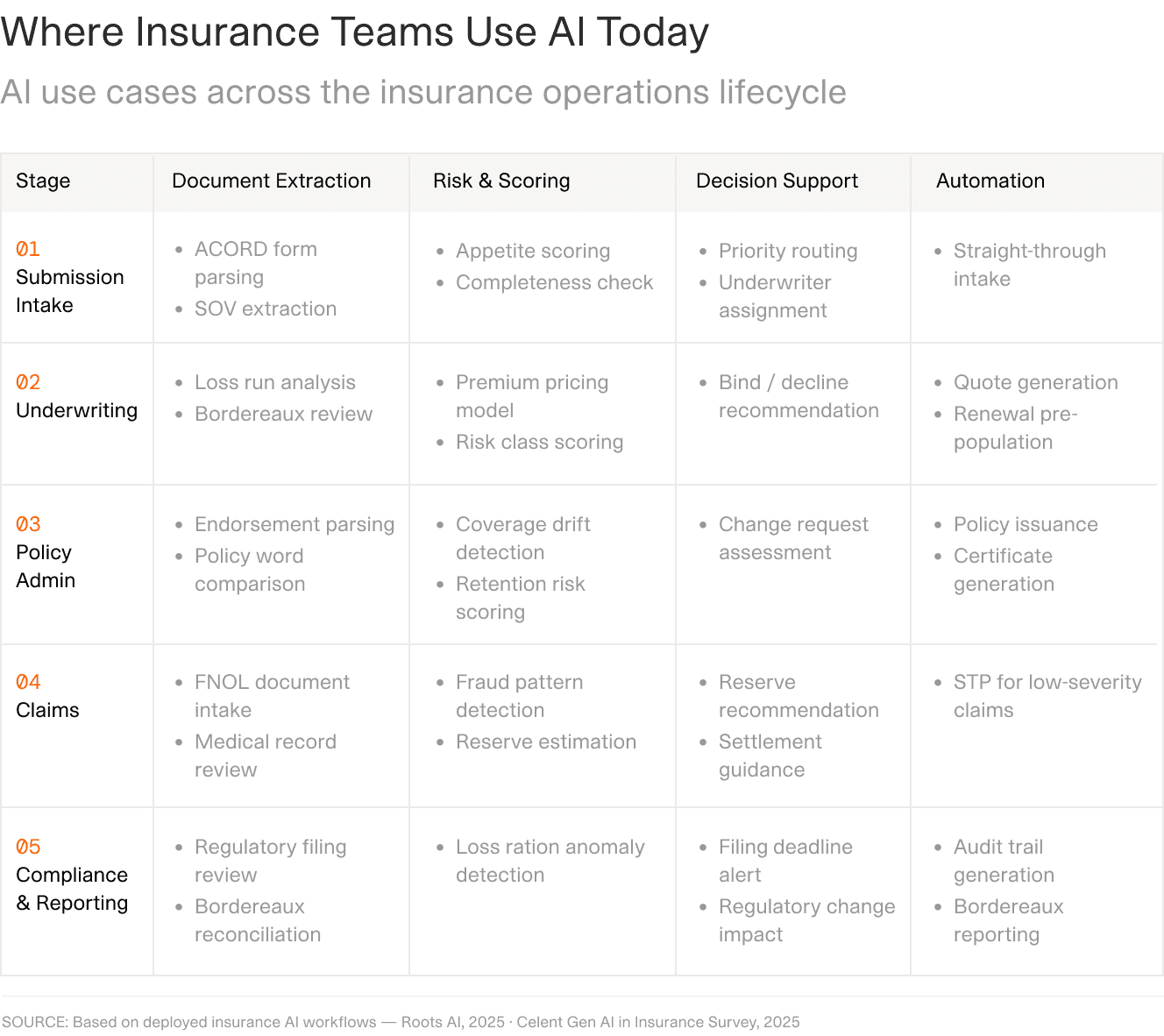
The same word covers very different work. Sorting the category is the first thing a buyer has to do, and no vendor will do it for you.
Category | What it does | What it cannot do | Typical buyer |
|---|---|---|---|
Robotic process automation | Moves structured data between systems along a fixed path, replicating what a person clicks | Read anything unstructured. Cope when a screen or a form layout changes | Operations and IT, targeting a known repetitive process |
Document AI | Reads what arrives, extracts structured values, cites the source line | Move the result into your systems on its own | The team drowning in inbound paper: claims, underwriting, compliance |
Core systems | Hold the record: policy administration, claims platforms, agency management | Read the input. They receive results, they do not produce them | The carrier or brokerage as an enterprise decision |
Point solutions | One workflow end to end, such as certificate tracking or subrogation | Anything outside their workflow | The function that owns that one process |
The distinction that costs money is the first two. Process automation is excellent at the parts of insurance that are already structured and repetitive, and genuinely poor at the parts that arrive as documents. Document AI is the reverse. A submission arriving as a scanned PDF attachment is invisible to a process robot and trivial for a document reader; a rating calculation that has to run identically ten thousand times is the opposite.
How to tell which category you actually need
The diagnostic takes an afternoon and is more reliable than any vendor shortlist. Follow one real piece of work from arrival to resolution, and note where it waits.
It waits because somebody has to read something. A submission, a loss run, a medical report. That is a document AI problem, and no amount of process automation touches it.
It waits because somebody has to retype or re-key data that already exists. Moving values from one screen to another. That is process automation or an integration.
It waits because the system of record cannot represent what you need. That is a core-system problem, and it is the expensive one. Confirm it before accepting it.
It waits for a person to decide. That is not an automation problem at all. Compressing the work either side of the decision is the available win.
Most operations find the first and second in the same workflow, in that order, which is why the two categories belong in sequence. The fourth is worth naming explicitly because it is where automation projects quietly overreach: a decision that requires judgment does not become faster by removing the person making it.
Core systems confuse the picture because they are the most expensive purchase and therefore the most discussed. They are systems of record. A policy administration system holds the policy; it does not read the broker's email that requested the endorsement. Replacing one because intake is slow is the most expensive way to solve the wrong problem.
Where automation in insurance actually pays
Adoption is uneven across the operation, and the unevenness is informative. The workflows with the highest adoption are the ones with the most repetition. The ones lagging behind are the ones where the input is unstructured.
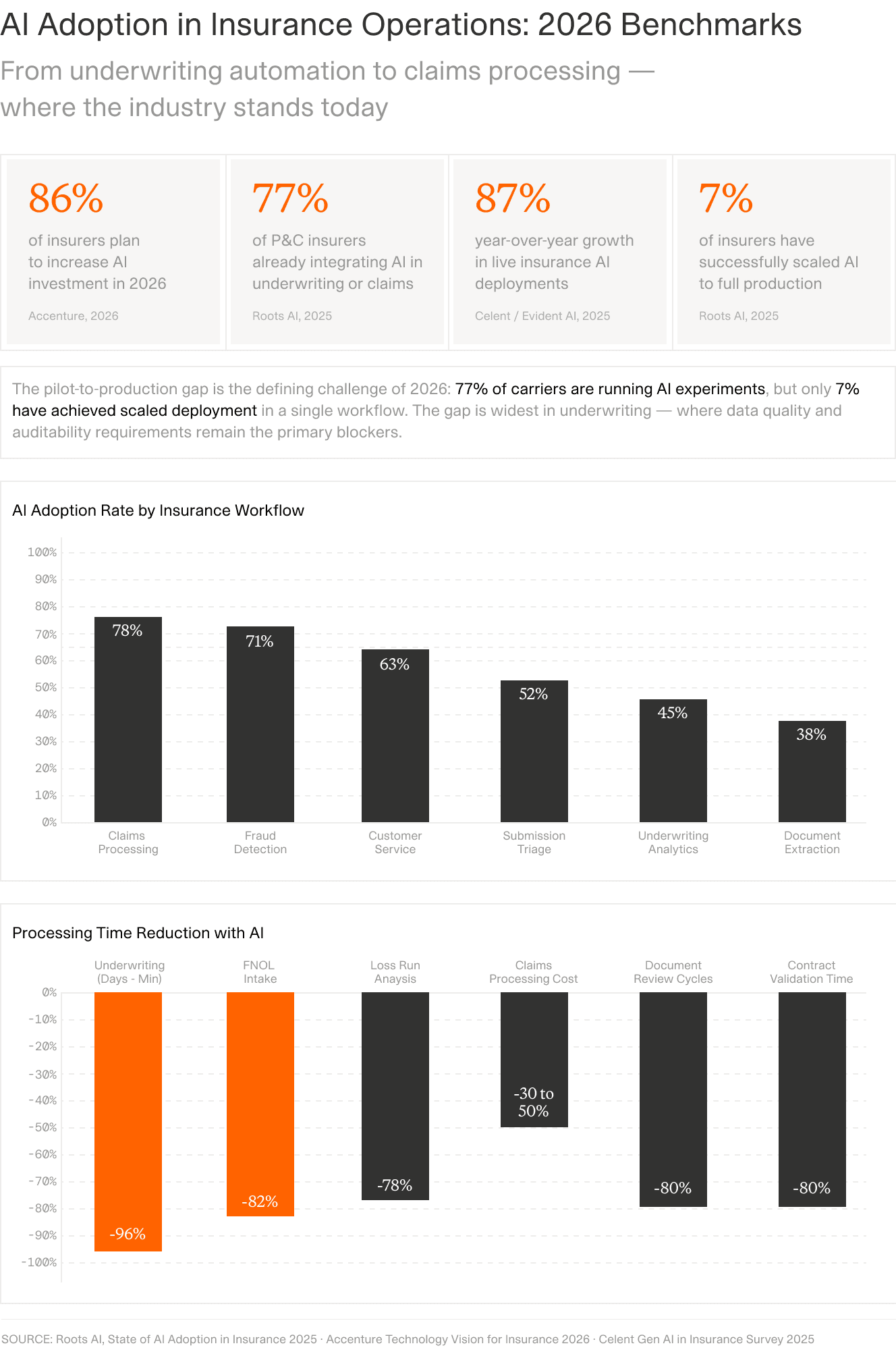
Adoption and reported time reduction across insurance workflows. The gap between the two charts is where the remaining work sits.
Claims processing leads adoption at 78%, while document extraction, which feeds it, sits at 38%. That gap is the whole story of this category. Teams have automated the handling of claims without automating the reading of what arrives with them. That is why so many deployments report a faster process that still needs the same number of people at the front.
Workflow | What arrives | Which category helps | Why |
|---|---|---|---|
Submission intake | Broker emails, ACORD forms, schedules of values | Document AI | The input is unstructured and formats vary by broker |
Claims first notice | FNOL forms, photographs, police reports | Document AI, then process automation | Read first, then route |
Rating and quoting | Structured data already in a system | Process automation or core system | Repetitive, rules-based, no reading required |
Loss run analysis | Prior-carrier PDFs in a hundred layouts | Document AI | Every carrier formats differently |
Compliance review | Policy wordings, regulatory filings | Document AI with review gates | Judgment-heavy, and the audit trail matters |
Renewals and endorsements | A mix of both | Both, in sequence | Reading the request, then executing the change |
Reading the table by column rather than by row is the more useful exercise. Everywhere the input column says something arrives from outside the organisation, in a format somebody else chose, the answer is document AI and nothing else will do. Everywhere it says the data is already in a system, process automation is the cheaper and more reliable choice. Very few workflows are purely one or the other, which is why the sequencing question matters more than the vendor question.
There is a second pattern worth noticing. The workflows where adoption is highest are the ones closest to a decision that has already been made, and the ones lagging are the ones closest to the point where information enters the business. That is backwards from where the value sits. An error introduced at intake propagates through every downstream step; an inefficiency at the end of the process only costs what it costs. Automating from the outside in tends to produce better returns than automating from the inside out, and it is the less popular direction precisely because intake is the messier problem.
Two of those have dedicated guides worth reading alongside this one: submission triage for the intake end, and loss run analysis for the case where the documents are the whole problem.











Process automation and document AI fail in opposite directions
This is the section worth arguing with, because getting it wrong is what produces a stalled project rather than a slow one.
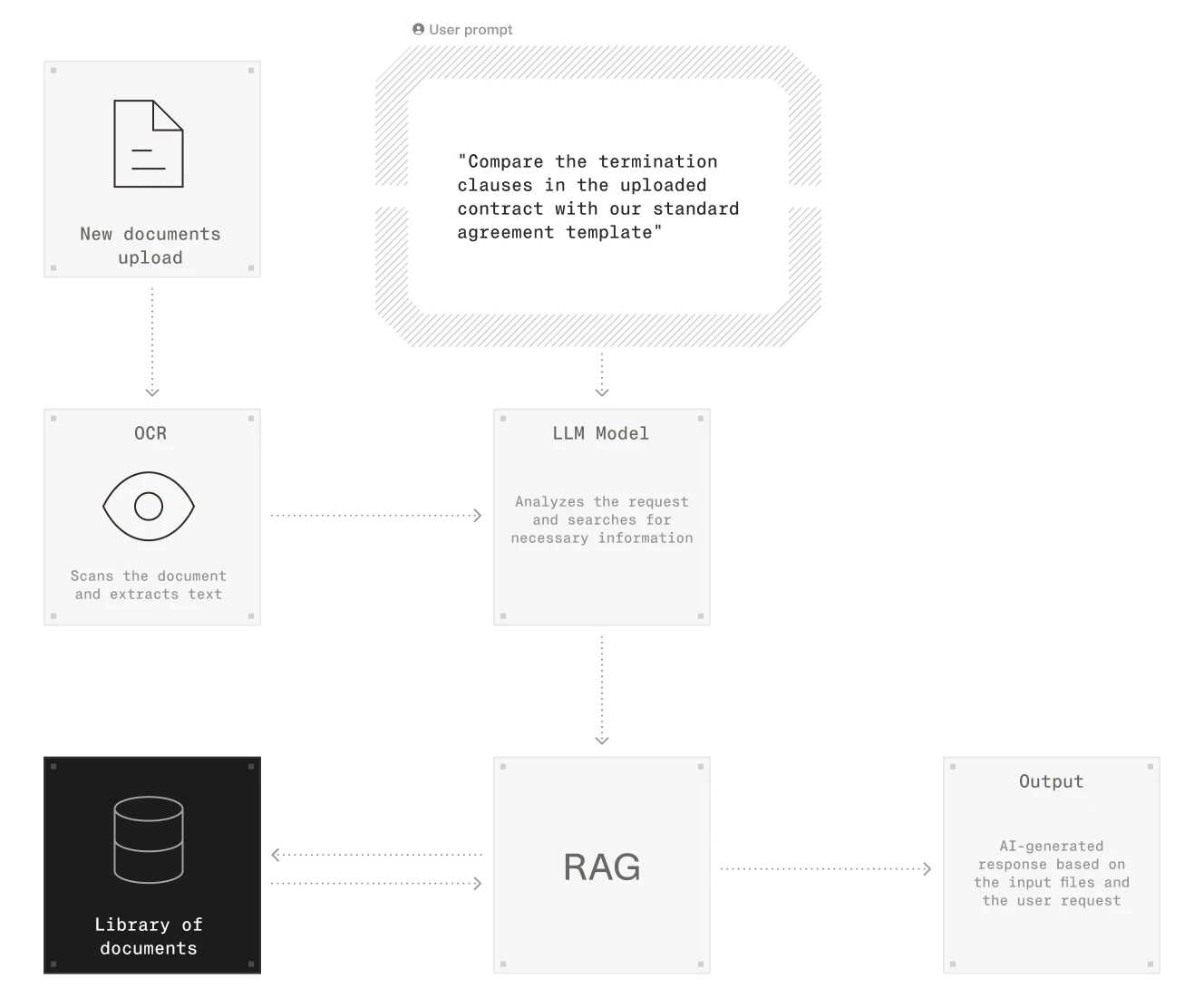
Many inbound formats, one internal shape. The conversion step is where the two categories divide.
Robotic process automation works by replicating a sequence of interface actions. Given a consistent input and a consistent screen, it is fast, cheap and completely reliable. Its failure mode is brittleness: change the form layout, add a field, upgrade the underlying system, and the robot breaks in a way that is obvious and immediate. That is not a criticism. It is a well-understood property, and the vendors in this space are honest about it.
Document AI works by reading unstructured input and returning structured values. Given a document it has never seen in a layout that does not exist anywhere else, it will usually still produce the right answer. Its failure mode is the opposite of brittle: it is quiet. A wrong value looks exactly like a right one until somebody checks it. Source citation and review gates are not optional extras in this category; they are what makes it usable at all.
Process automation | Document AI | |
|---|---|---|
Best input | Structured, consistent, already in a system | Unstructured, variable, arriving from outside |
Failure mode | Brittle and loud. It stops | Quiet. It returns something plausible |
What it needs to be safe | Monitoring and exception alerts | Source citation and a review gate |
Cost behaviour | Flat per run once built | Scales with document volume and length |
What breaks it | A layout or system change | Nothing visibly. That is the problem |
A worked example makes the difference concrete. A commercial submission arrives as an email with three attachments. There is a completed application, a schedule of values in a spreadsheet built to the broker's own template, and a five-year loss run from the prior carrier as a scanned PDF. The underwriting workbench needs about forty values from those three files.
A process robot cannot start. There is nothing structured to move and no consistent screen to read from; the scanned loss run in particular is just an image as far as it is concerned. A document reader handles all three, returns forty structured values with a citation on each, and then stops, because pushing those values into the workbench is not what it does. Run them in sequence and the submission is in the workbench in minutes. Buy either alone and it is not.
This is also why insurance process automation is usually quoted as cheaper than it turns out to be. The per-run cost genuinely is low. The cost that gets missed sits upstream, in the person still preparing the input so the robot has something consistent to act on.
The practical consequence is that they belong in sequence rather than in competition. Document AI turns what arrived into structured values; process automation, or a direct integration, moves those values into the system of record. An operation that has one and not the other has automated half a workflow and will feel it at the seam.
Intelligent automation in insurance, without the category noise
Intelligent automation is the industry's term for combining the two. It is a useful idea buried under a great deal of vocabulary. The useful version of it is narrower than the marketing suggests: each step of a workflow should use the tool the work actually requires.
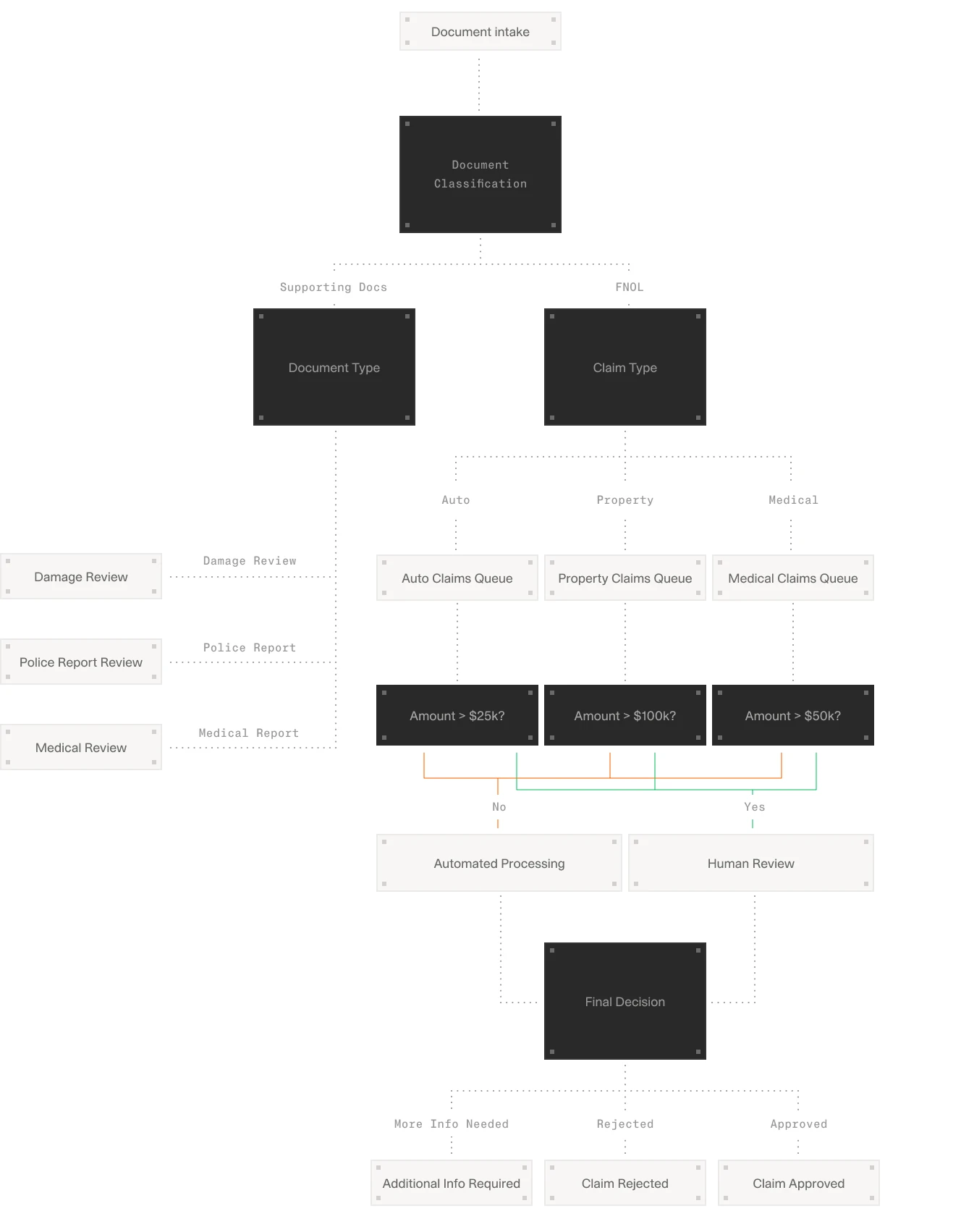
Tool selection per step. Reading, arithmetic and integration are different problems and should not be handed to the same component.
In practice that means a defined sequence. A named model handles the step that needs judgment. Code handles the step that is arithmetic or a date format. An integration handles the step where the data lives in another system, and a person handles the step where the decision carries consequence. Nothing is re-planned at runtime, so the five hundredth run takes the same route as the first.
That last property is what separates this from asking an assistant to do the same job. An assistant is genuinely capable and re-solves the problem each time you ask, which is fine for one submission and unworkable across a book. The output shape changes, and anything downstream that expected a fixed structure has to be reconciled by hand.
This is the layer V7 Go occupies. It is AI infrastructure for document-heavy workflows. You define the steps once, and each step uses the tool the work requires. Every extracted value opens the exact line in the source document it came from, so verification is a glance rather than a search. **It is not robotic process automation, not a CRM, not a policy administration system and not a claims platform.** It reads what arrives and hands structured, cited output to whichever of those you already run. The claims processing and underwriting guides cover the two workflows where insurers usually start.
Security belongs in this conversation rather than after it. Roughly a quarter of the buying conversations we have raise sub-processors, data residency and retention before anyone has looked at a price. The NIST AI Risk Management Framework is a reasonable structure for the questions, and asking them early is what keeps a deal on its original timeline.
How to evaluate a vendor in this category
Feature lists do not separate vendors here, because every vendor has every feature. Five questions do, and all five are answerable with your own material in a day.
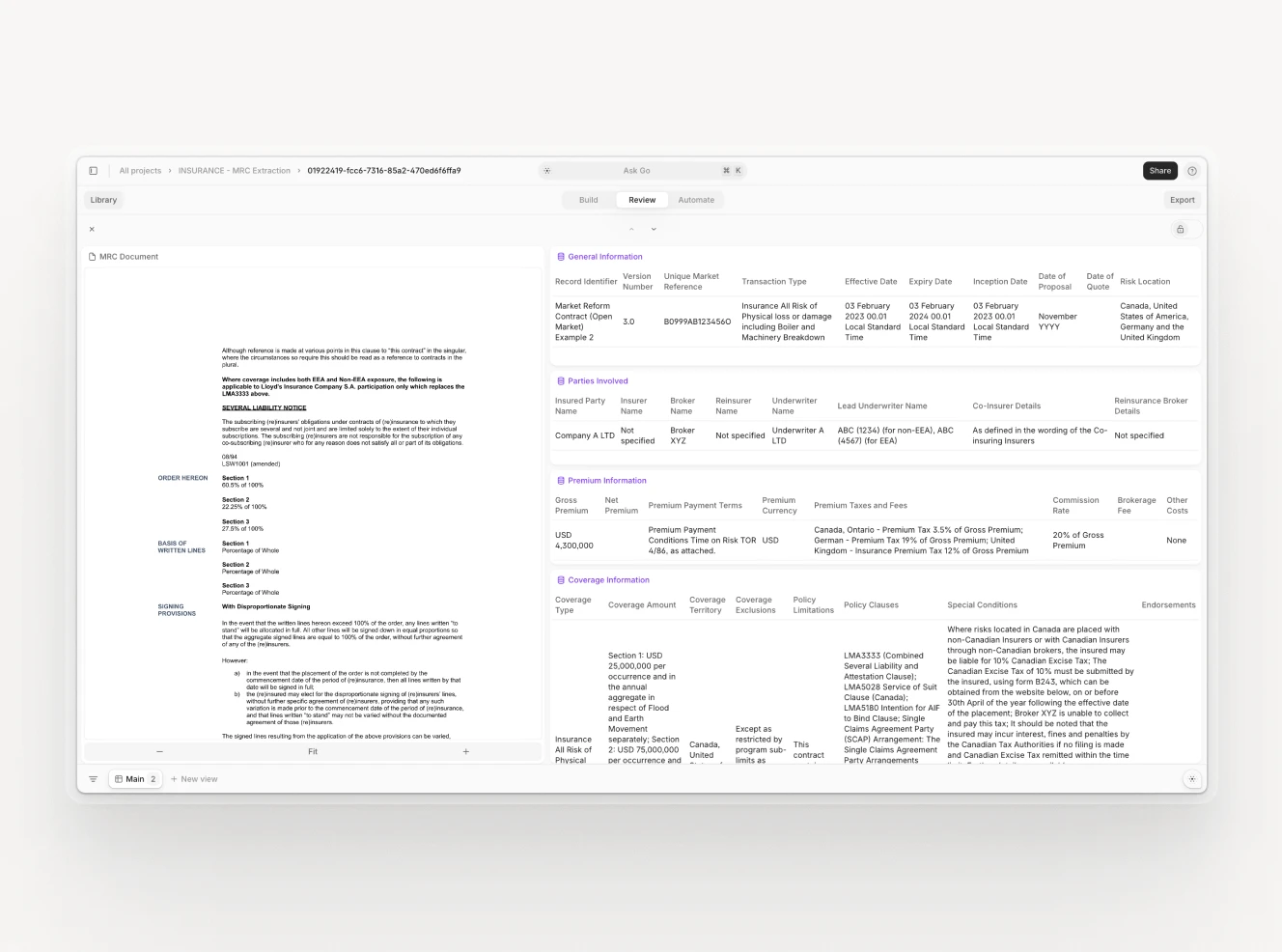
Integration and model choices checked against your own stack, not against a reference architecture.
Run your worst documents, not their best. Give each vendor ten real files from your least cooperative broker or carrier, unedited. How much comes back correct, and how long does fixing the rest take?
Ask what happens at your volume, not at demo volume. A system comfortable with fifty submissions a month may not be comfortable with five thousand, and the cost curve matters as much as the accuracy.
Check that every value opens its source. If an auditor or a regulator asks where a figure came from, the answer should be a click. This decides your review cost more than accuracy does.
Confirm the output shape is stable. Two people running the same workflow on the same documents should get the same structure, or nothing downstream can consume it.
Establish who reconfigures when a form changes. Templates move. Ask whether it is billed, who does it, and how long it takes.
If the constraint is | The category to buy | The question that settles it |
|---|---|---|
Somebody has to read what arrives | Document AI | Does every extracted value open its source line? |
Data exists but sits in the wrong system | Process automation or integration | What breaks when the screen changes? |
The record cannot represent the product | Core system | Is this genuinely the record, or the intake? |
One workflow is uniquely painful | Point solution | What happens to the next workflow? |
What to automate first
Sequence beats scope. The operations that get value quickly pick one workflow with a clear owner and a repeating cycle, and finish it before starting another.
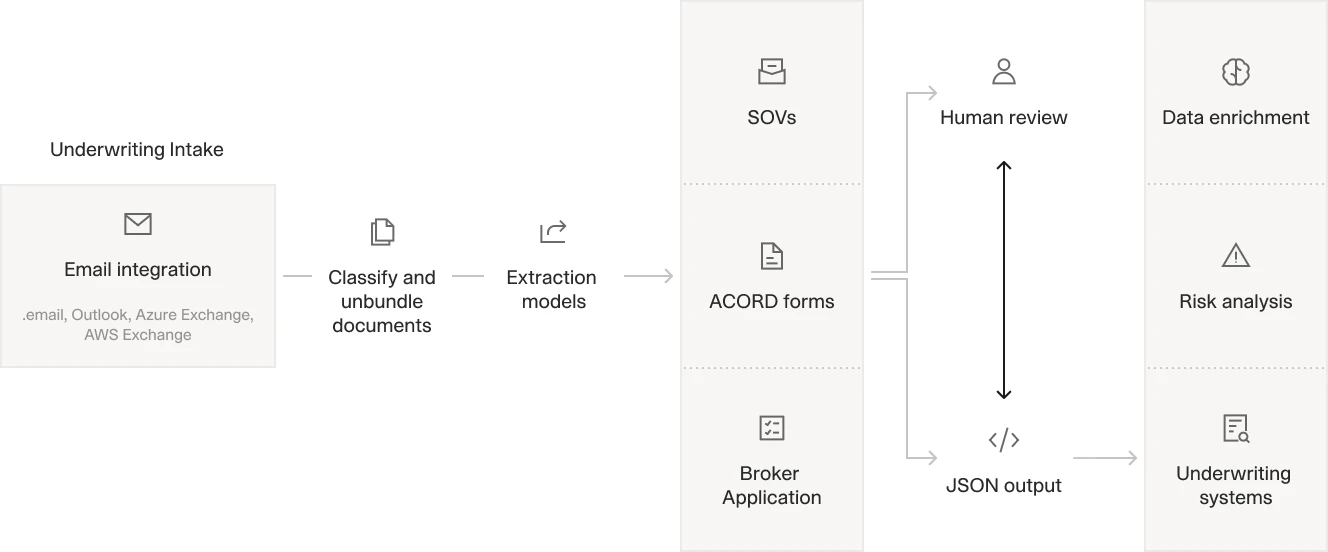
One document type, one workflow, one full cycle. Breadth comes after the first one works end to end.
Count what arrives. Documents per month by type and by sender. Most teams have never counted, and the number is reliably larger than the estimate.
Pick the workflow with the highest volume of the most consistent document type. Not the most painful one. The most repetitive one, because that is where a first success is cheapest to reach.
Time the current process honestly, including the chasing and the second pass when a figure looks wrong. Without this there is no baseline and no way to prove anything later.
Classify before extracting. Different document types need different handling. One schema across all of them produces a low accuracy figure that is really a routing failure.
Decide the review policy before go-live. What gets checked, by whom, and what threshold routes an exception. Retrofitting this is how projects lose their audit trail.
Integrate to one system, last. Push structured output into the record you already keep rather than building a parallel one.
Two things are worth saying about that order. The second step is the one teams most often get wrong, because the instinct is to start with whatever hurts most. The most painful workflow is usually painful precisely because it is the least consistent, which makes it the hardest place to demonstrate a win and the easiest place to conclude the technology does not work. Start where the documents are boring and the volume is high.
The third step is the one that gets skipped under time pressure and then cannot be recovered. Once a new process is live, the old timings are gone, and any claim about improvement becomes an argument rather than a measurement. Half a day spent timing the current process before anything changes is the cheapest insurance available on the whole project.
Steps four and five are where most of the return sits, and both are properties of the software rather than of the model. The wider question of how documents get into any of this is covered in insurance document automation, and the bordereaux guide covers the delegated-authority case where the reporting formats are somebody else's decision entirely.
On measurement, McKinsey's work on measuring AI value makes the point that matters here: track total cost of ownership in the same ledger as the benefit, or the case will not survive scrutiny. It also names the failure everybody recognises, the pilot trap, where an organisation releases pilot after pilot without ever scaling one because nobody agreed in advance what would count as success.
Where the case does not work
Four situations where the arithmetic fails. Recognising them early is worth more than a business case rejected in month three.
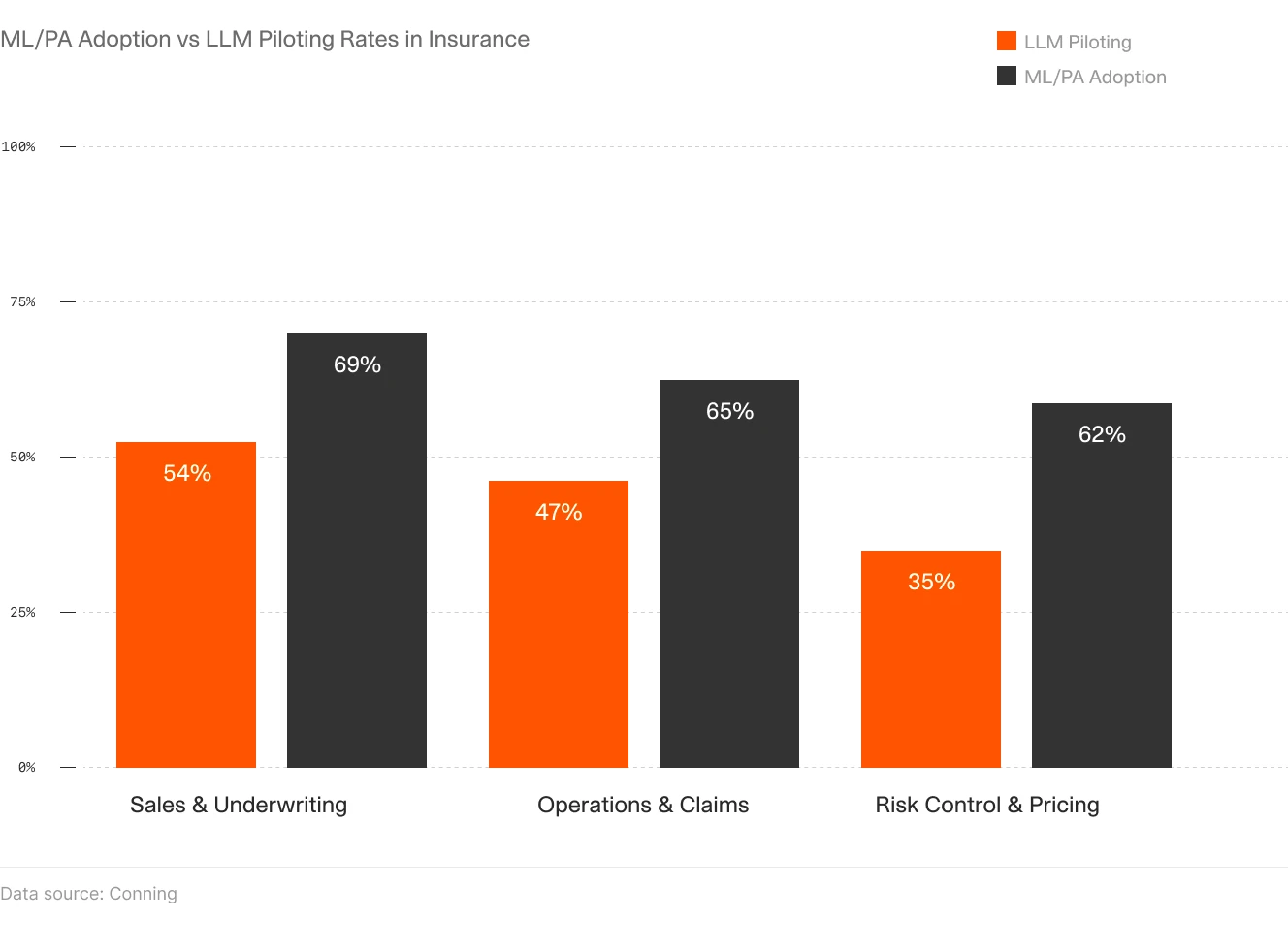
Integration reality, checked before purchase rather than after. Most stalled projects failed here rather than on accuracy.
Low volume. Below a few hundred documents a month through one repeating workflow, the configuration cost dominates and never amortises. A small brokerage is better served by using an assistant well than by buying infrastructure.
No clean baseline. If three people handle the same work three different ways and nobody has timed it, a saving cannot be proved because there is nothing to prove it against. Fixing the process description first is often the more valuable project.
Formats that change every quarter. Configuration cost recurs whenever a carrier template or a regulatory form moves. Stable workflows amortise it; unstable ones pay it repeatedly.
A saving nobody will bank. If the recovered hours will not become more submissions quoted, a deferred hire or a retired spend line, the return is real for the people doing the work and invisible to the firm. McKinsey's State of AI survey puts numbers on exactly this gap: 80% of respondents report improved individual productivity, while only 37% can attribute any EBIT impact at all. That is a legitimate reason to buy, and it is worth being clear that it is the reason.
Where it does work, it tends to work decisively rather than marginally. An underwriting team that moves from reading a sample of a submission to reading all of it has not improved a metric by fifteen percent. It has changed what the underwriter knows before pricing the risk, which is the argument worth making internally. The same logic runs through compliance and regulatory document review, where the cost of missing something is not measured in hours at all.
What is automation in insurance?
Automation in insurance covers any software that reduces manual handling across the policy lifecycle, and in practice it splits into four categories that are often confused. Robotic process automation moves structured data between systems along a fixed path. Document AI reads unstructured input such as submissions, loss runs and claim files, and returns structured values. Core systems, meaning policy administration, claims platforms and agency management systems, hold the record rather than producing it. Point solutions handle one workflow end to end. The categories are not substitutes, and most operations need at least two. The most common expensive mistake is buying one when the constraint sat in another.
+
What software do insurance companies use?
Most carriers run a core system of record such as a policy administration or claims platform, a rating engine, and increasingly some form of intake automation feeding both. Brokers and agencies run an agency management system and a CRM instead, which is a different stack solving a different problem. Layered across those, teams add document AI for the material arriving from outside, and process automation for repetitive movements between systems. There is no single answer because the stack depends on whether you carry risk or place it. The useful question is narrower: which part of your workflow is slow because a person has to read something first.
+
Which AI tool is best for insurance?
It depends entirely on which category of problem you have, which is why comparison articles that rank tools across categories tend to mislead. If your constraint is that submissions arrive as unstructured documents and somebody has to key them in, you need document AI and the deciding feature is whether every extracted value opens its source line. If the constraint is that data already exists in one system and has to reach another, process automation or a direct integration is the right category. Diagnose the constraint before shortlisting anything, and be sceptical of any evaluation run on the vendor's sample data rather than your own documents.
+
What is intelligent automation in insurance?
Intelligent automation is the industry term for combining document AI with process automation so that a workflow can both read what arrived and act on it. The useful version is narrower than the marketing. Each step of a defined sequence uses the tool the work actually requires. That means a named model where the judgment is real, code where the answer is arithmetic, an integration where the data sits elsewhere, and a person where the decision carries consequence. The property that matters is repeatability. Nothing is re-planned at runtime, so the five hundredth run takes the same route as the first and downstream systems can rely on the shape of the output.
+
How is insurance automation software different from RPA?
For a single well-chosen workflow, expect the first deployment to run on a scale of weeks to a few months. Most of the elapsed time goes to scoping, integration and agreeing the review policy rather than to configuring extraction. The second and third workflows are materially cheaper if the intake layer is treated as shared infrastructure rather than as a project-specific build. Pilot on one document type for one full cycle before committing the operation, because the failure modes appear at close rather than at kick-off. Define in advance the volume, accuracy and review time the pilot has to clear, and the date on which the decision gets made either way.
+
How long does an insurance automation project take?
Go is more accurate and robust than calling a model provider directly. By breaking down complex tasks into reasoning steps with Index Knowledge, Go enables LLMs to query your data more accurately than an out of the box API call. Combining this with conditional logic, which can route high sensitivity data to a human review, Go builds robustness into your AI powered workflows.
