11 min read
—


V7 Go
A smarter way to manage due diligence and underwriting
A broker emails an underwriting team three loss run reports from three different carriers, all attached to one submission, all needed in the system by end of day. One is a clean PDF, one is a scanned table, one is pasted into the body of the email. No two are laid out the same way. Keyed in by hand, that stack is most of an afternoon; read by an AI agent, it is a few minutes. That gap is what this article is about.
A loss run report is one of the most important documents in commercial insurance and one of the most tedious to process. For the business requesting one, it is a record to be obtained. For the underwriter receiving one, it is raw material that has to be extracted, standardised, and turned into a risk decision, over and over, across every submission that comes in. Almost everything written about loss runs speaks to the first reader and ignores the second. This guide covers both, but it is written mainly for the team on the receiving end.
It explains what a loss run report is and what it contains, how underwriters actually read one, why processing them at scale is so painful, and how AI now takes the manual extraction off the critical path. If you already know what a loss run is, skip to why the processing is hard. For the wider picture, our overview of insurance document automation sets the context, and the Insurance Information Institute keeps a plain-language reference for the requesting side.
In this article:
What a loss run report is, and the fields it contains.
How to read one, including the ratios underwriters calculate from it.
Why processing loss runs at scale is so difficult, and where the time goes.
How AI automates loss run data extraction, and the tools that do it.
What a loss run report is
A loss run report is a document issued by an insurance carrier that summarises a business's claims history over a set period, usually the past three to five years. It lists each claim against the policy, when it happened, what was paid, what is still reserved for open claims, and whether the claim is open or closed. Underwriters use it to assess risk, set premiums, and decide whether to offer cover at all. It is, in effect, the commercial equivalent of a credit check: a record of past behaviour used to price future risk.
Loss runs are issued by the current or a prior carrier on written request, and they exist because no underwriter will price a risk blind. Before writing new business or a renewal, a carrier wants to see how the applicant has actually behaved as an insured, and the loss run is the evidence. Many states require a carrier to provide one within roughly ten to fifteen business days of a request, though in practice a week to ten days is common.
What information a loss run report includes
There is no industry-standard format, but a typical loss run carries the same set of fields. The policy period and policy number identify the coverage. Each claim then has a claim number, a date of loss, the line of coverage it falls under, and a short loss description. The money is split into the amount paid, meaning the indemnity settled to date, and the loss adjustment expenses (LAE), the legal, investigation, and handling costs attached to the claim. Reserves show what the carrier has set aside for claims that are still open, and the status marks each claim open or closed. Some loss runs also summarise a loss ratio.
One field deserves an underwriter's particular attention: reserves on open claims. A reserve is the carrier's estimate of what an unresolved claim will ultimately cost, and it can move in either direction before it settles. An open claim carrying a reserve well above what similar claims have historically settled for is a signal that total incurred losses may still climb, and it warrants a closer look before the risk is priced.
Which lines of insurance use loss runs
Loss runs are standard across commercial lines. The common ones are workers' compensation, general liability, commercial property, and commercial auto, and they are equally relevant to professional liability, directors and officers cover, and a packaged business owner's policy. Any line where past claims predict future ones relies on them, which is to say nearly all of them.
How to read a loss run report
Reading a loss run is less about the individual claims and more about the pattern they form. For the business requesting its own record, the task is simply to obtain it: a written request to the current or prior carrier, quoting the policy number and the period needed, with each prior carrier asked separately. For the underwriter, the work starts once the document is in hand, and it is analytical rather than clerical.
An underwriter checks that the report is current, usually within twelve months, then looks past the totals to the shape of the claims: how often they happen, how large they are, and whether they are getting worse. Three simple calculations do most of the work. The loss ratio, total incurred losses divided by earned premium and expressed as a percentage, shows whether the account has paid its way. Frequency, total claims divided by the policy years covered, shows how often losses occur. Severity, total incurred losses divided by the number of claims, shows how big they tend to be. A rising loss ratio, a cluster of claims in one coverage type, or reserves running well above prior settlements are the patterns that move a risk from routine to referral.
The same report also reads differently depending on the moment. For new business, the loss run is the main evidence a carrier has about an unfamiliar risk, so a short or thin history carries more weight and any gap invites questions. At renewal, it is read against what the account did last year, and the question shifts from whether to write the risk at all to whether the price still fits the trend. The fields are the same; the emphasis is not, which is worth remembering when volume tempts a desk into reading every loss run the same way.











Why loss run processing is hard at scale
The difficulty with loss runs is not reading one, it is reading hundreds of them, each formatted differently, under a renewal-season clock. A single loss run is a five-minute job for an experienced underwriter. A queue of them, arriving as a mix of PDFs, scans, spreadsheets, and email text from dozens of carriers, is where the workflow breaks down, and it is why the manual approach stops scaling exactly when volume is highest. An underwriting desk handling a couple of hundred submissions in a busy month is not reading two hundred identical documents; it is reading two hundred different ones, and the reading is the cheap part next to the retyping.
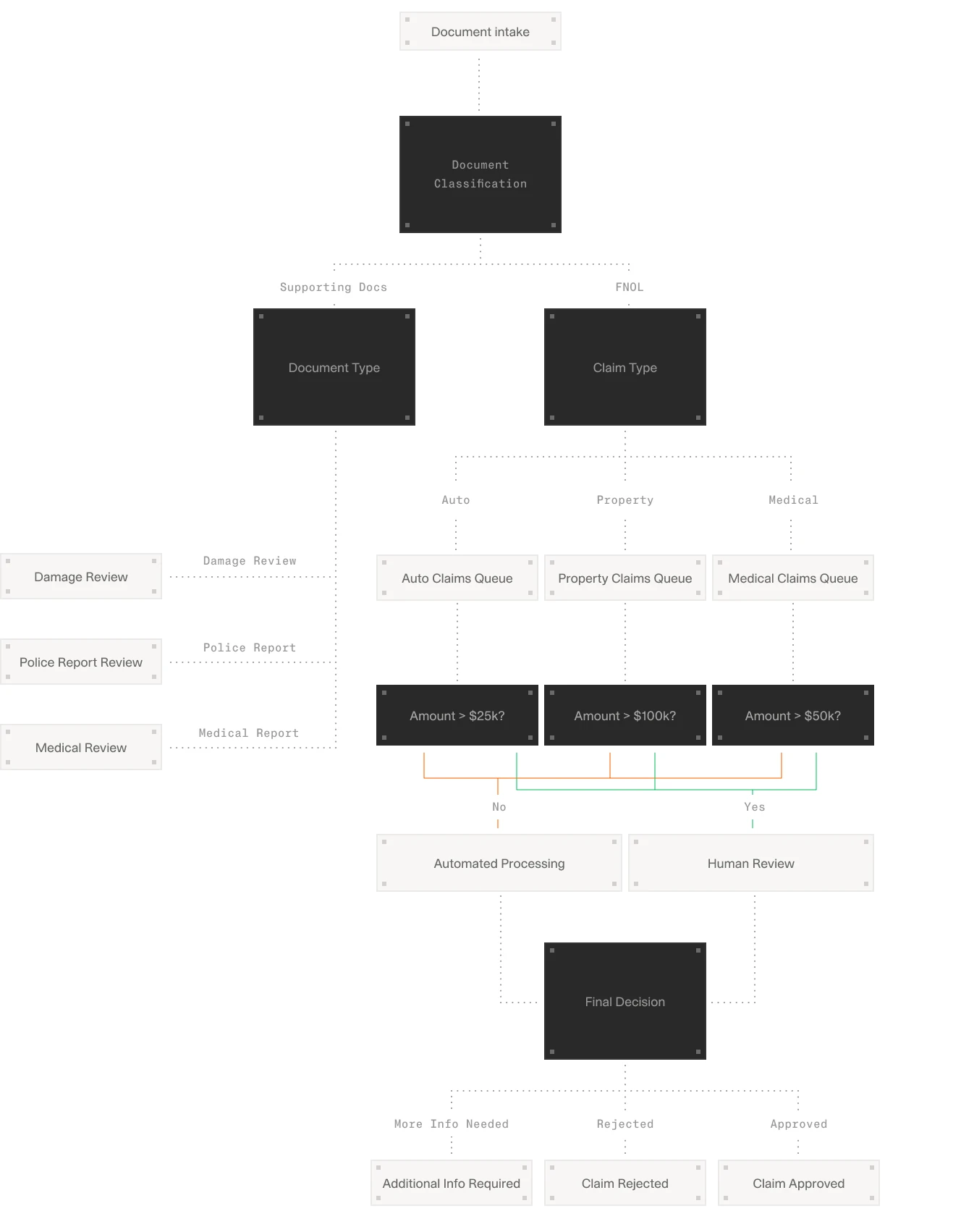
Loss runs enter the same intake-and-routing workflow as other claims documents, and the bottleneck is the same: getting unstructured documents into a structured form a system can act on.
Three problems compound. The first is format: every carrier uses its own layout, so a loss run from one insurer looks nothing like a loss run from another, and a field called amount paid on one is indemnity paid on the next. The second is volume: manually keying a single loss run takes the better part of an hour, and a renewal cycle with dozens of them turns into days of data entry before any underwriting judgement is applied. The third is accuracy: manual transcription introduces errors, and a miskeyed reserve or a wrong claim status flows straight into the quote and can misprice the risk. Outsourcing the keying to a business process outsourcer (BPO) moves the work but adds a turnaround of a day or two per document, and the cost grows with the volume. The net effect is that a large share of skilled underwriting time goes to administrative intake rather than the risk judgement it should be spent on.
How AI automates loss run data extraction
AI removes the manual keying from loss run processing by reading the document the way an underwriter would, then handing back structured data instead of a PDF. The point is not that a machine types faster; it is that it understands the document by meaning rather than position, so it copes with the format chaos that defeats a template.
The workflow is straightforward. A loss run is ingested in whatever form it arrived, PDF, scan, image, or spreadsheet. The system extracts the fields by what they mean, so amount paid from one carrier and indemnity paid from another resolve to the same output field, using optical character recognition (OCR) for scans and natural language processing (NLP) for the layout. The values are mapped into a single standard schema: claim number, date of loss, coverage line, amount paid, LAE, reserves, and status. A human-in-the-loop step lets an underwriter review the output and correct exceptions before anything is trusted. The structured data then flows into the agency management system (AMS) or rating engine through an API, and once several loss runs are in a common format, loss ratios, frequency, and severity can be calculated across them in minutes.
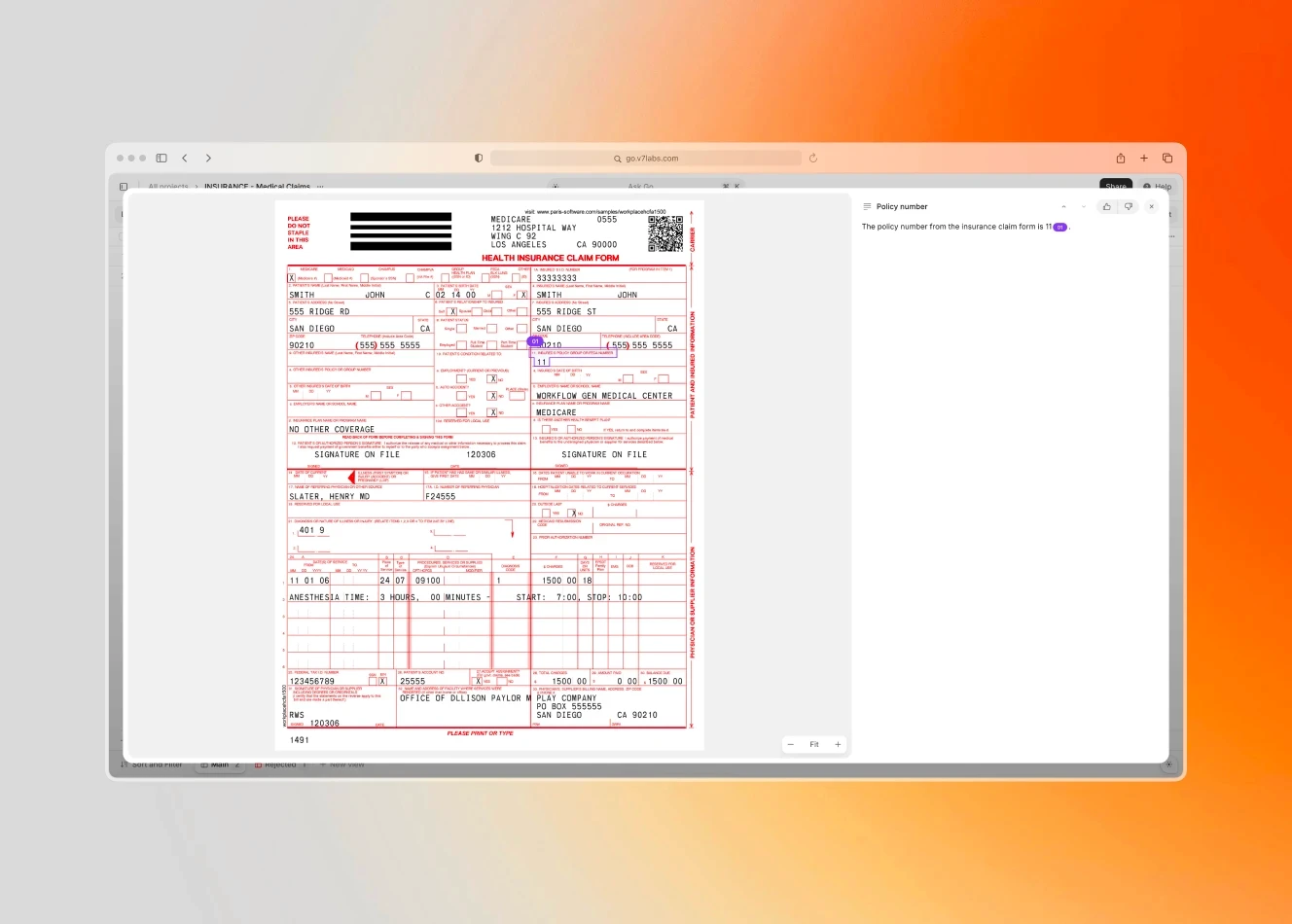
The extraction stays tied to the source: each captured field points back to where it appeared in the original document, so an underwriter validates the figure rather than re-keying it.
Done well, this changes the economics of intake. Any carrier's format is handled without building a template for each one; scanned and image-based loss runs are read rather than retyped; every extracted value keeps a link to its place in the source document, which matters as insurance regulators increasingly expect documented governance over automated decisions; and structured loss data arrives in minutes rather than hours or days. It is the same document AI that underpins FNOL automation and the wider insurance AI use cases, pointed at the loss run.
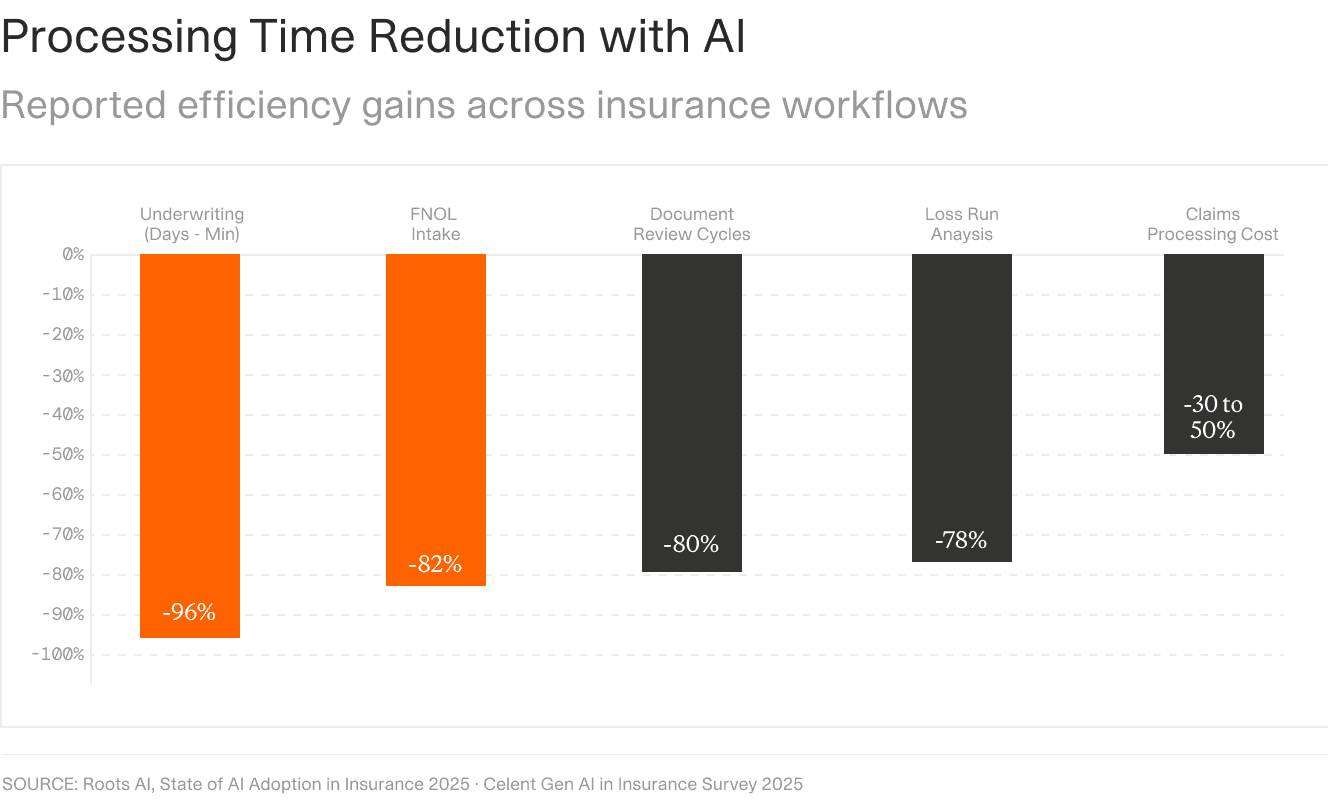
Loss run analysis sits alongside underwriting turnaround and FNOL intake as one of the workflows where AI cuts processing time most, close to four fifths faster in reported figures. Source: Roots AI, State of AI Adoption in Insurance 2025; Celent Gen AI in Insurance Survey 2025.
The gain compounds the more submissions a desk runs through the same workflow. Every loss run extracted this way, across every carrier and every renewal, becomes part of a firm's Context Graph: a relationship graph connecting each insured, its policies, and its claims history over time, rather than a folder of PDFs nobody revisits until the next renewal lands. Ask which accounts in a book have shown a rising loss ratio over the last three renewal cycles, and the answer comes back tied to the specific loss run each figure was pulled from, not a summary an underwriter half remembers from last year. That is what turns loss run extraction from a per-submission chore into a standing view of the book.
Loss run processing tools for MGAs and carriers
The market for loss run automation is young but real, and the tools differ less on whether they extract data than on how they fit an underwriting operation. The capabilities worth comparing are the ones that decide whether a tool survives contact with a real queue: whether it handles any carrier format without per-carrier templates, whether it keeps a human in the loop, how traceable its output is back to source, how it integrates with the agency management system, and how it holds up under a renewal-season surge. For the broader stack, our guide to the best AI tools for commercial lines underwriting covers where loss run processing sits.
Tool | Best for | Where it is strongest |
|---|---|---|
V7 Go | MGAs and carriers needing document AI with a full audit trail | Any-format extraction with every field traceable to its source, and API integration into underwriting systems |
SortSpoke | Teams wanting AI extraction with underwriter validation control | Human-in-the-loop review and policy-administration integration |
Pibit.ai | Commercial teams wanting analytics beyond extraction | Turning extracted loss data into frequency and severity insight |
Roots.ai | Teams replacing a BPO service | Pre-built carrier-format models aimed at speed |
CogniSure | Teams needing trend dashboards | Frequency-versus-severity views and outlier flags |
BPO services | Teams wanting to outsource entirely | A hands-off managed service with no internal technology to run |
A note on transparency: V7 Go, which sits at the top of that table, is made by the team behind this article, so treat its row as a disclosed interest rather than an independent verdict. What is genuinely distinctive about it for loss run work is the combination the underwriting side cares about: it reads any carrier's format without a template for each, standardises the fields into one schema, and keeps every extracted value linked back to the exact line in the source document, which is what makes an automated extraction defensible when a risk decision is questioned later. It calculates loss ratios by coverage line and period from the extracted data, keeps a human in the loop for exceptions, and pushes the structured result into the systems underwriters already use through the same document ingestion workflow.
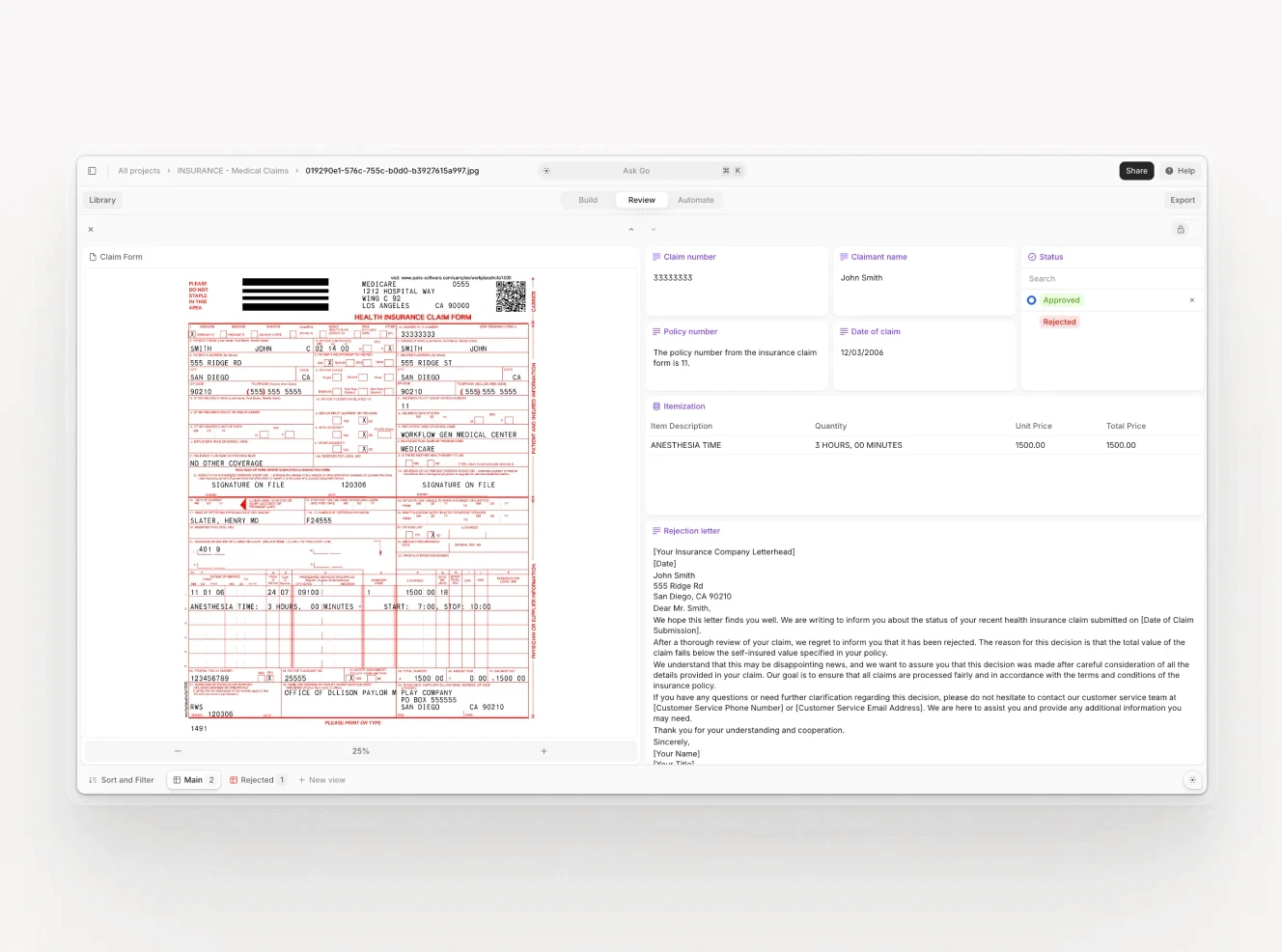
The extracted loss run becomes structured, reviewable data inside the platform, with each field available for an underwriter to check against the source before it feeds a quote.
The honest summary is that a loss run report is not hard to understand, it is hard to process at volume, and those are different problems. Any underwriter can read one. No underwriting team can key hundreds of them by hand during renewal season without either slowing the quote or trusting data nobody had time to check. That is the constraint AI actually removes: not the judgement, which stays with the underwriter, but the hours of retyping that stand between the broker's email and the risk decision.
For an MGA or carrier, the payoff is concrete. It is quoting faster because the loss data is in the system in minutes, catching the risk signals a tired reviewer might miss, and spending scarce underwriting time on pricing rather than data entry. Start with the highest-volume line, prove it on a renewal cycle of real submissions, and widen from there rather than automating everything at once.
If you want to see loss run extraction run against your own carrier formats, V7 runs a working session built around your submissions and your underwriting stack. That is the concrete next step, and it takes about the length of a renewal review. You can also see the workflow on the loss run report analysis page.
What is included in a loss run report?
A loss run report includes, for each claim made against a policy, the information an underwriter needs to assess past risk. The core fields are the policy number and coverage period, a claim number, the date of loss, the line of coverage affected, and a short description of what happened. The financial detail is split into the amount paid, which is the indemnity settled so far, and the loss adjustment expenses, the legal and handling costs attached to the claim. Reserves show what the carrier has set aside for claims that are still open, and a status field marks each claim as open or closed. Some loss runs also summarise a loss ratio for the period. There is no industry-standard format, so the exact layout and field names vary from carrier to carrier, which is one of the reasons loss runs are awkward to process in bulk. Most carriers provide between three and five years of history.
+
How long does it take to receive a loss run report?
In most jurisdictions, insurance regulations require a carrier to provide a loss run report within roughly ten to fifteen business days of receiving a written request, and in practice many carriers turn them around within about a week to ten days. Some carriers offer portal or broker-platform access that makes delivery faster. The timing can stretch if the request is incomplete, if it covers several policy periods, or if prior carriers have to be approached separately, since each carrier only holds the history for the policies it wrote. If a business needs several years of history across more than one insurer, it usually has to request a loss run from each of them individually and allow time for the slowest to respond. When a carrier fails to provide a loss run within the required window, the policyholder can generally escalate to the state insurance regulator, which can prompt the carrier to comply.
+
How many years of loss run history do insurers require?
Most insurers ask for three to five years of loss run history when writing a new commercial policy, because that range is long enough to reveal a pattern of claims without being so long that old, resolved incidents distort the picture. For higher-risk industries, larger limits, or lines where claims can take years to develop, a carrier may ask for five to seven years. If a business has been operating for fewer years than the standard requirement, it is expected to provide loss runs covering its full period of operation, and a genuinely clean but short history is treated differently from a gap in the record. The reason for the multi-year view is that a single year can be misleading: one bad year among several good ones tells a different story than a steady upward trend in claims, and underwriters price the trend, not the snapshot. Gathering several years across multiple prior carriers is also part of what makes assembling a complete claims history time-consuming.
+
What is loss run automation?
Loss run automation is the use of AI to extract structured data from loss run reports without manual keying. It combines optical character recognition, which reads text from scans and images, with natural language processing, which interprets a document's layout by meaning rather than fixed position. That combination lets a single system handle any carrier's format, so a field labelled amount paid on one loss run and indemnity paid on another are recognised as the same thing and mapped into one standardised schema of claim number, date of loss, coverage line, amount paid, expenses, reserves, and status. The extracted data can then flow directly into an agency management system or rating engine through an integration, and figures like loss ratios and claim frequency can be calculated across many loss runs at once. The better implementations keep a human in the loop, so an underwriter reviews and corrects exceptions rather than trusting the output blindly, and they preserve a link from every extracted value back to its place in the source document for auditability.
+
How do you read a loss run report?
Reserves on a loss run report are the amounts a carrier has set aside for open claims, representing its current estimate of what those unresolved claims will ultimately cost. They are estimates, not settled figures, so the final cost of a claim can end up higher or lower than the reserve once it closes. For an underwriter assessing a risk, reserves matter because they signal where total incurred losses may still be heading. An open claim carrying a reserve well above what similar claims have historically settled for suggests the carrier expects a large payout, and it should prompt questions about the nature of that claim before the risk is priced. Conversely, a book of claims that are mostly closed, with modest reserves on the few that remain open, points to a more predictable loss history. Because reserves move over the life of a claim, an underwriter reads them alongside the paid amounts and the claim status rather than in isolation, treating a high reserve on an open claim as a caution flag rather than a settled fact.
+
What do reserve funds mean on a loss run report?
Go is more accurate and robust than calling a model provider directly. By breaking down complex tasks into reasoning steps with Index Knowledge, Go enables LLMs to query your data more accurately than an out of the box API call. Combining this with conditional logic, which can route high sensitivity data to a human review, Go builds robustness into your AI powered workflows.
+
John Somerset-Irving has spent 17 years in and around the London specialty insurance market, including stints underwriting, and on the client side. For the last 10 years he has worked in insurance technology and has seen the drive for digital transformation and the rise of AI first hand.