11 min read
—



V7 Go
A smarter way to manage due diligence and underwriting
It is Monday morning at a commercial lines Managing General Agent (MGA), and three underwriters open an inbox holding sixty new submissions. Most will never get a proper look. The team works top to bottom, quotes what it can reach, and the rest age quietly until a broker calls to ask why. Somewhere in that pile is the account that would have bound at a healthy rate. Nobody got to it in time. This is the problem insurance submission triage is supposed to solve, and the reason so many underwriting teams are now looking hard at AI to do it.
Triage is not a new idea. Underwriters have always sorted the inbox by hand, deciding what is in appetite, what is complete, and what is worth the first hour of the day. What has changed is the volume and the format. A single submission now arrives as a broker email with an ACORD form attached, a Statement of Values in Excel, a loss run as a scanned PDF, and three supplemental applications, and a lean team simply cannot read all of it fast enough. The Insurance Information Institute's commercial lines figures show how much premium moves through this funnel, and how much of it turns on getting to the right submission first.
This guide is written for the head of underwriting operations who owns quote turnaround and submission throughput. It covers what submission triage actually is, why the manual version breaks down for MGAs specifically, how AI changes each stage of the workflow, and what to look for if you are evaluating software. If you want the wider view first, our overview of AI use cases in insurance sets the context.
In this article:
What insurance submission triage is, and the two stages inside it.
Why manual triage fails MGAs in particular, and what it costs.
How AI automates each stage, from multi-format intake to appetite scoring and routing.
The five capabilities to check before you buy submission triage software.
What insurance submission triage is
Insurance submission triage is the process of sorting incoming broker submissions by appetite, completeness, and priority so underwriters spend their time on the risks worth quoting. It is the filter between a full inbox and a working queue, and it happens before any real underwriting begins.
It helps to see triage as two stages, because AI treats them differently. The first is submit-to-triage: receiving the submission, reading what is in it, and clearing it for a queue. The second is triage-to-quote: judging whether the risk fits appetite, how complete it is, and how it ranks against everything else waiting. A submission package usually carries the same cast of documents: ACORD forms (the standardised application forms from the Association for Cooperative Operations Research and Development), a loss run report, a Statement of Values (SOV), supplemental applications, and financials. The triage decisions on top of them are simple to state and hard to do at volume: in appetite or out, new business or renewal, complete or missing information, priority or standard.
How submission triage differs from claims triage
The two get confused, so it is worth one line of clarity. Submission triage happens before a policy exists, sorting broker submissions on the way into underwriting. Claims triage happens after a loss, sorting reported claims on the way into the claims team. Different documents, different teams, different moment in the policy lifecycle. Our guide to automated claims processing for insurance covers the second one.
Why manual submission triage fails MGAs
Manual triage does not fail because underwriters are slow. It fails because the arithmetic does not work. An MGA running three to five underwriters against fifty or more submissions a day cannot give each one a considered read, so it falls back on first in, first out, which is the one ordering guaranteed to be wrong. A high-value, in-appetite account that landed at 4pm waits behind a stack of low-fit submissions that arrived earlier and should have been declined in seconds.
The cost shows up in three places. Premium leaks, because the accounts most likely to bind are the ones aging unseen at the bottom of the queue. Broker relationships erode, because a broker who waits a week for a quote takes the next risk to a carrier that answers in a day, and broker loyalty is the MGA's whole distribution model. And underwriter time drains into administration, sorting, chasing missing documents, re-keying data, rather than the risk judgment they are paid for. Deloitte's insurance industry outlook keeps returning to the same theme: the constraint on underwriting capacity is rarely the underwriting itself.
Renewal season makes it sharper. Volumes spike exactly when the team is already committed to existing accounts, and a submission that would have earned a proper read in a quiet week gets thirty seconds in a busy one. Brokers notice the unevenness: quick in the first quarter, slow in the fourth, and inconsistent in a way that quietly costs renewals the following year.
None of this is solved by hiring one more underwriter. The volume grows with distribution, and the manual process scales linearly with headcount you do not have. That is the gap AI is meant to close.











How AI automates insurance submission processing
AI changes submission triage by doing the reading, the extraction, and the first-pass sorting before an underwriter opens anything, so the human starts from a structured, ranked queue rather than a raw inbox. The workflow breaks into four stages, and it is worth walking each one, because the difference between a real system and a glorified inbox rule lives in the details.

Submission triage already sits in the middle of the pack for AI deployment, ahead of underwriting analytics and document extraction, which is exactly why the workflow below is worth doing properly rather than bolting on. Source: Roots AI, State of AI Adoption in Insurance 2025; Celent Gen AI in Insurance Survey 2025.
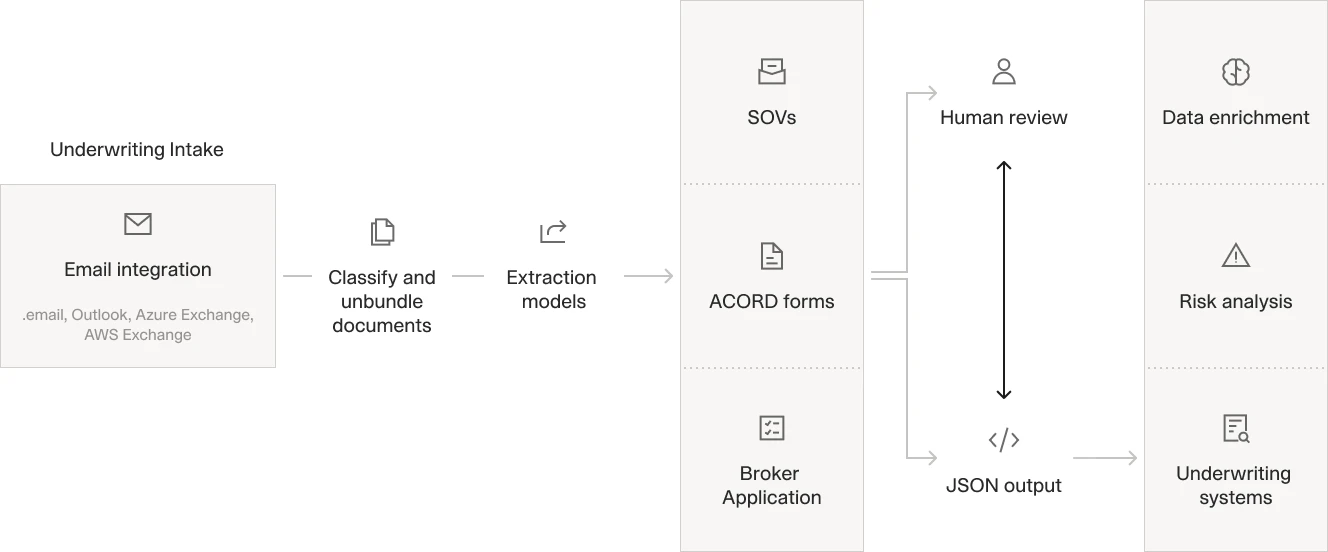
The submission workflow in one view: intake and classification, then extraction, then a structured output routed on for review and underwriting. Each stage is where the manual hours disappear.
Stage one: multi-channel intake and classification
Submissions arrive through dedicated inboxes, broker portals, SFTP drops, and API feeds, and the first job is to catch them all and work out what each one contains. This is the multimodal problem, and it is the part legacy optical character recognition (OCR) never handled. A single packet mixes a typed ACORD PDF, an Excel SOV, plain text in the email body, and a scanned loss run that someone photographed on a phone. The system has to recognise each document type inside that mess before it can read any of it. ACORD forms are the easy part. The rest is where most tools quietly fail.
Stage two: data extraction and clearance
Once the documents are classified, the system extracts the fields underwriting actually needs: named insured, addresses, class of business codes, coverage limits, deductibles, effective dates, and loss history. On the ACORD side that means reading the 125, 126, 130, and 140 variants, including handwritten entries. Alongside extraction sits clearance: checking for duplicate submissions of the same risk, catching broker of record (BOR) conflicts, and confirming broker accreditation. Every extracted value carries a confidence score, so the clean ones move on and the uncertain ones are flagged for a human rather than passed downstream as fact. That last point matters more than any accuracy headline, because an extraction error that nobody catches becomes a mispriced policy.
Stage three: appetite scoring and prioritisation
Now the risk gets judged against the firm's own written appetite: class of business, geography, revenue band, and loss thresholds. The system applies those rules automatically and ranks each submission, so obvious declines refer or drop out, edge cases route to an underwriter, and clean in-appetite risks rise to the top of the queue. Good tools go a step further and surface winnability rather than fit alone, weighing renewal proximity and broker history so the queue ranks what is likely to bind above what merely fits the rules.
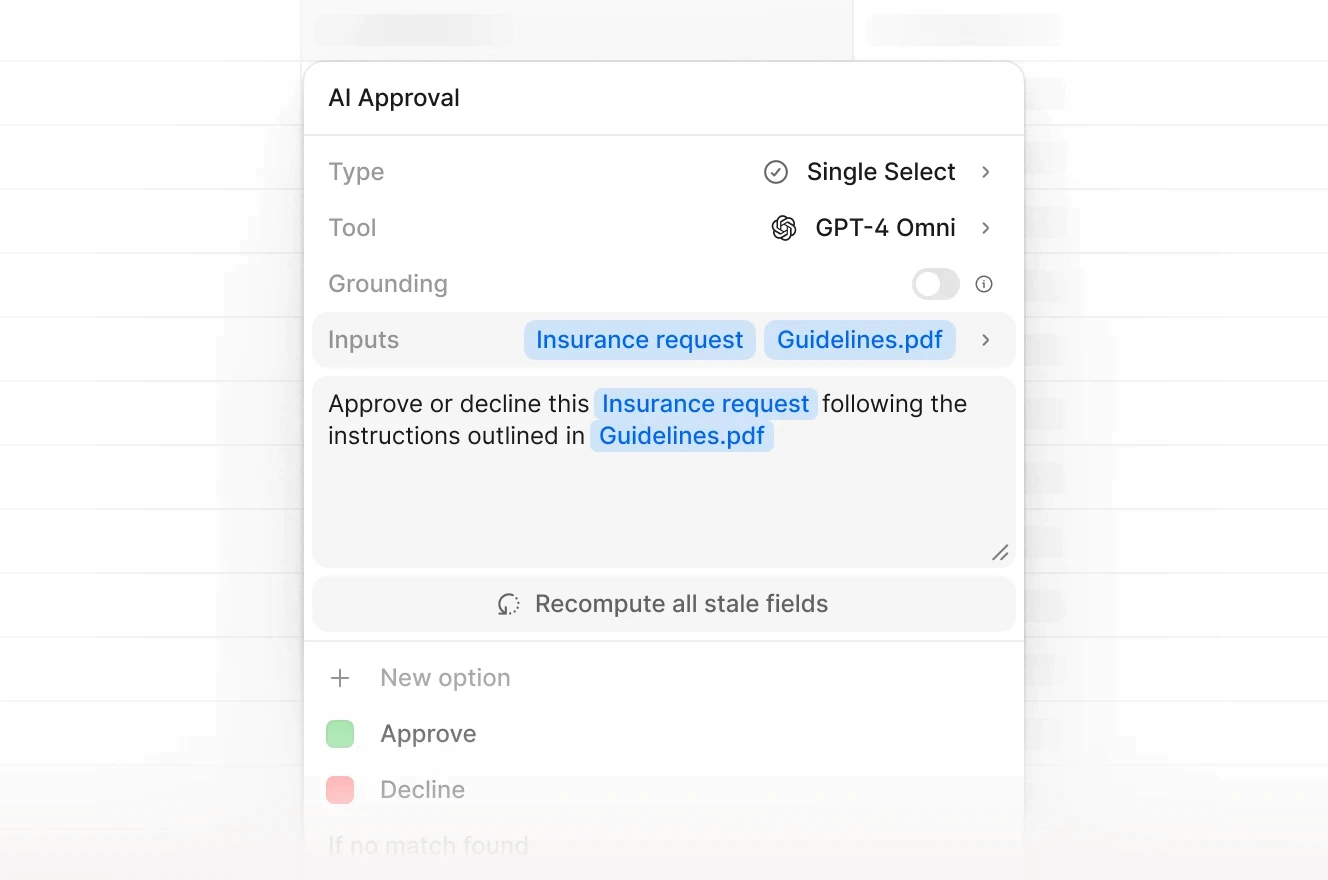
Appetite scoring checks a submission against the firm's own written guidelines and shows which rule drove the decision, rather than returning an unexplained number.
Stage four: routing, clearance, and straight-through processing
The last stage puts each submission where it belongs. Rules route by line of business, geography, team capacity, and underwriter specialism. The simple, in-appetite, complete submissions can be handled by straight-through processing (STP), quoted with no human touch, while the complex ones escalate to an underwriter who receives a pre-structured summary instead of a raw packet. All of it flows into the policy administration system (PAS), whether that is Guidewire, Duck Creek, or another platform, through an API rather than a manual re-key. A sensible deployment does not try to auto-quote everything. It reserves straight-through processing for the clean, in-appetite, complete submissions and sends anything ambiguous to a person, because an MGA's reputation survives a slow quote far better than a wrong one.
What to look for in AI submission triage software
Once you accept the workflow, the buying decision comes down to five capabilities. Everything else on a vendor's slide is secondary to these.
First, multimodal document handling: confirm the platform reads PDF, Excel, email body, and images in a single packet without a manual pre-processing step, because that mixed packet is your reality, not the clean ACORD form in the demo. Second, configurable appetite rules your own team can change: appetite shifts through the year, and a system where updating a rule needs an engineering ticket will be out of date by renewal season. Third, confidence scoring with a human in the loop: a tool that hides its own uncertainty is not saving you work, it is deferring an error. Fourth, integration depth: native API connectors into your PAS beat file-based exports, and real-time beats overnight batch. Fifth, an audit trail: every extraction should log the source document, the field location, the value, the confidence score, and any human override.
That last one is now a compliance matter, not a nicety. More than half of US states have adopted the NAIC Model Bulletin on the use of AI by insurers, which expects documented governance over automated decisions. A triage system that scores and routes risk without a defensible record of how it decided is a regulatory exposure waiting to be examined. For the wider tooling comparison, our guide to the best AI insurance underwriting software goes broader than triage alone.
One clarification worth making, because the marketing blurs it. OCR reads characters. Robotic process automation (RPA) follows fixed rules and breaks the moment a document deviates from the template it was mapped to. An AI agent reads a document in context and handles a format it has not seen before, which is the whole point when every broker sends submissions differently. Confusing the three is how firms buy a rules engine and expect judgment.
How V7 Go automates insurance submission processing
V7 Go runs the full submission workflow as configurable AI agents rather than a fixed rules engine, which is what lets it handle the packet that does not match any template. It is an AI agent platform, and for an underwriting team that means an agent reads the entire submission, ACORD forms, loss runs, SOVs, and the broker email, in whatever formats they arrive, and produces a structured, scored result.
The agent extracts the fields underwriting needs and attaches a confidence score to each, flagging the uncertain ones for review rather than burying them. It applies your written appetite rules, ranks and routes each submission, and records every step: the source document, the field it came from, the value, and the confidence, which is the audit trail a regulator now expects. Because it reasons about document context rather than matching a template, a broker's novel format is a Tuesday, not an exception that halts the queue, and accuracy holds across a long submission the same as a short one. The scale of the saving is real: in V7 Go's insurance walkthrough, an international reinsurer cut submission processing from thirty minutes to thirty seconds, roughly sixty times faster, with the underwriter reviewing a structured summary instead of assembling one.
The output is not a spreadsheet the team then has to process. V7 Go is the operational layer where the review happens, with ingested submission data flowing into the policy administration system through an API, and the same workflow reads a loss run report as part of the packet rather than as a separate task. Every submission also feeds the firm's Context Graph, so the next time a broker sends a risk the team has seen before, that history is already there instead of lost in an old inbox. That is a knowledge graph in the general sense, entities such as accounts, brokers, and prior submissions held as connected records rather than rows in a spreadsheet, and Context Graph is V7's own product built to do it: point it at a book of business and it resolves the same insured appearing under slightly different names across three submissions into one account, so a question like which accounts in this broker's book have we declined twice before comes back grounded in the specific submissions it was drawn from, not an underwriter's memory of a name that sounded familiar. The walkthrough below shows the insurance workflows end to end.
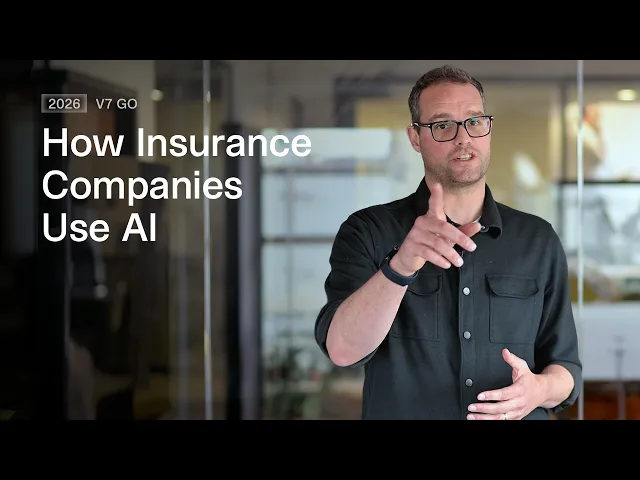
How V7 Go handles insurance operations, from submission processing and SOV reconciliation to claims file triage, with every extraction traceable to its source.
The honest summary is that submission triage was never the hard part of underwriting. Reading fast enough to get to the right submission was. That is the constraint AI actually removes: not the judgment, which stays with the underwriter, but the hours of sorting and re-keying that stood between the inbox and the judgment.
For an MGA, the payoff is not abstract. It is quoting the account that used to age out, answering the broker in a day instead of a week, and adding distribution without adding headcount you cannot justify. Start with the stage that hurts most, usually intake and extraction, prove it on a fortnight of real submissions, and expand from there rather than buying the whole platform on a promise.
If you want to see the workflow run against your own submission packets, V7 runs a working session built around your appetite rules and your document mix. That is the concrete next step, and it takes about the length of a renewal meeting.
What is insurance submission triage?
Insurance submission triage is the process of sorting incoming broker submissions by appetite, completeness, and priority, so underwriters spend their time on the risks worth quoting rather than working through the inbox in the order it arrived. It sits before underwriting proper and usually breaks into two stages: submit-to-triage, which is receiving a submission, reading its documents, and clearing it into a queue, and triage-to-quote, which is judging whether the risk fits the firm's appetite and how it ranks against everything else waiting. A typical submission package includes ACORD application forms, a loss run report, a Statement of Values, supplemental applications, and financials. The core triage decisions are whether a risk is in appetite or out, new business or renewal, complete or missing information, and priority or standard. Done well, triage turns a raw inbox into a ranked working queue.
+
How does AI automate insurance submission processing?
AI automates submission processing by doing the reading, extraction, and first-pass sorting before an underwriter opens anything. The workflow runs in four stages. First, multi-channel intake captures submissions from inboxes, broker portals, and feeds, and classifies the mix of documents inside each packet. Second, the system extracts the fields underwriting needs, named insured, coverage limits, class of business, loss history, from ACORD forms, spreadsheets, and scanned files, attaching a confidence score to each so uncertain values are flagged rather than trusted blindly. Third, it scores each submission against the firm's written appetite rules and ranks the queue by fit and winnability. Fourth, it routes each submission to the right underwriter or queue, sends the simple in-appetite ones through straight-through processing, and pushes the structured data into the policy administration system through an API. The underwriter starts from a scored summary instead of a raw inbox, which is where the time saving comes from.
+
What documents are included in an insurance submission package?
A commercial insurance submission package typically arrives as a mix of documents in different formats. The core items are ACORD forms, the standardised application forms used across the industry, which include variants such as the 125, 126, 130, and 140 depending on the line of business. Alongside them are a loss run report showing the account's claims history, a Statement of Values listing insured property and values, one or more supplemental applications specific to the class of risk, and financial statements. In practice these come through together as a broker email, often with the ACORD form as a typed PDF, the Statement of Values as an Excel spreadsheet, the loss run as a scanned or photographed document, and key context sitting in the body of the email itself. Handling that mix, rather than any single clean form, is the real challenge of submission intake, and the main reason older document tools struggle where newer AI systems can cope.
+
What is the difference between submission intake and submission triage?
Submission intake and submission triage are adjacent stages that are easy to blur. Intake is the receiving step: capturing a submission from whatever channel it arrived through, identifying the documents inside the packet, and extracting the data from them. It answers the question of what has just landed. Triage is the judgment step that follows: deciding whether the risk fits the firm's appetite, whether the submission is complete, and how it ranks in priority against everything else in the queue. It answers the question of what to do with what landed. In a manual process the two blur together because the same underwriter does both while reading an email. In an automated workflow they separate cleanly: intake produces structured, scored data, and triage applies appetite rules and prioritisation on top of it. Understanding the split matters when buying software, because some tools handle intake well but leave the triage logic thin, or vice versa.
+
What is a submit-to-quote ratio and why does it matter?
Managing General Agents face acute submission pressure because they run lean underwriting teams against high inbound volume from many broker relationships. Traditionally they have coped with a mix of manual sorting, first-in-first-out processing, and occasionally outsourced data entry, all of which struggle as volume grows. The more effective approach now is to automate the intake and triage stages: an AI system reads every submission as it arrives, extracts the data across mixed formats, scores each risk against the firm's written appetite rules, and presents underwriters with a ranked queue rather than a raw inbox. That lets a small team focus its judgment on the risks most likely to bind while low-fit submissions are cleared quickly, and it adds capacity without adding headcount. The key for an MGA is that appetite rules stay under the underwriting team's control and that every automated decision is logged, so the speed does not come at the cost of governance or broker service.
+
How do MGAs handle high volumes of broker submissions?
Go is more accurate and robust than calling a model provider directly. By breaking down complex tasks into reasoning steps with Index Knowledge, Go enables LLMs to query your data more accurately than an out of the box API call. Combining this with conditional logic, which can route high sensitivity data to a human review, Go builds robustness into your AI powered workflows.
+
John Somerset-Irving has spent 17 years in and around the London specialty insurance market, including stints underwriting, and on the client side. For the last 10 years he has worked in insurance technology and has seen the drive for digital transformation and the rise of AI first hand.