18 min read
—



Imogen Jones
Content Writer
V7 Go
A smarter way to manage due diligence and underwriting
According to research from Bain and Company, for every 100 targets that enter a fund's pipeline, only one or two close. The constraint is how quickly the deal team can evaluate each opportunity, reach a credible go or no-go decision, and advance on the deals worth winning before a competitor does.
This article covers the deal sourcing process from end to end, including the deal origination strategies top-performing GPs use, the difference between proprietary and intermediated deal flow, and where AI is changing what is possible in deal screening.
For a deeper look at what happens once a deal passes first-pass screening, our guide to AI in due diligence covers the full evaluation chain.
In this article:
What deal sourcing is, and how it relates to deal origination
The five-stage deal sourcing process in private equity
Proprietary vs. intermediated deal flow: what the distinction actually means
Deal origination strategies: five channels top GPs run in parallel
Why screening speed is the competitive advantage most PE firms underinvest in
How AI agents are changing deal screening in practice
What deal sourcing means, and how it differs from deal origination
Deal sourcing and deal origination describe the same activity. Both terms refer to the process by which PE firms identify potential investment targets and qualify them before a formal transaction process begins. "Origination" tends to appear in LP documentation and investment mandates. "Deal sourcing" is how deal teams refer to it internally. The vocabulary difference does not matter.
What matters is how the deal arrived.
A deal that comes via banker teaser is intermediated: the seller has engaged an advisor, a structured process is underway, and the fund is one of potentially fifteen buyers reviewing the same information at the same time. A deal the fund found through direct management contact, before any advisor was mandated, is proprietary. The difference in outcome potential is real. Proprietary deals come without an auction premium, without a banker-managed timeline, and with a management team that chose to engage this specific fund, not whoever wrote the largest check in a controlled process.
PE firms generally track both channels, but the boundary between them is not as clean as the vocabulary implies. What most funds label proprietary deal flow is often lightly intermediated: situations where a prior relationship with the banker produced an early call, rather than situations where no advisor was in the picture at all. That distinction matters when you evaluate your sourcing strategy honestly.
The deal sourcing process in private equity
The private equity deal sourcing process follows five stages, and the handoff between each stage is where competitive advantages are built or lost. The timelines vary significantly by deal type. A proprietary deal might spend 18 months in stages one through three before management is ready to discuss terms. An intermediated deal from a controlled banker process can move from stage three to stage five in six weeks. Knowing where each opportunity sits in this progression is the core operational challenge of running a deal origination function.
Stage 1: Target identification and thesis alignment
Investment theses narrow the universe. A fund targeting healthcare services businesses with $15 to $50 million in EBITDA, founder-owned, in the Southeast United States, is looking at a fundamentally different set of companies than a buyout firm pursuing platform acquisitions in industrial distribution at $100 million or more in enterprise value. Before any outreach begins, the deal team needs agreement on what they are actually looking for, described precisely enough that any analyst on the team would screen the same company the same way.
Most funds map the investment thesis to a target list using commercial databases (S&P Capital IQ, PitchBook, FactSet), sector conference attendance, and relationships with industry consultants who know competitive dynamics in a given market. The list is not static. It updates based on which deals are closing in the sector, what multiples the market is paying, and which management teams are starting to think about succession or a liquidity event.
Stage 2: Initial outreach and relationship initiation
Cold outreach in PE rarely works on its own. The initial contact almost always comes through a warm introduction: a portfolio company CEO knows a management team, an operating advisor has a sector relationship, a junior associate went to business school with a CFO. The quality of the first contact frequently determines whether stage three ever happens.
The goal at this stage is not to pitch the fund. It is to establish credibility, demonstrate sector knowledge in specific terms, and begin a conversation that might take two or three years to convert into a transaction. Many of the deals that close in a fund's fourth year originated as introductions made in year one.
Stage 3: Relationship cultivation and monitoring
This is the stage most deal sourcing frameworks describe inadequately. Building a relationship with a management team that is not ready to sell requires sustained, low-pressure contact over months or years: genuine sector conversations, operational advice, and demonstrating through repeated contact that you understand their business specifically, not generically.
The PE firms with the strongest proprietary pipelines tend to have systematic approaches to this stage. Defined contact cadences. Notes on what matters to each management team professionally and personally. Clear tracking of which relationships are warm versus which are on the radar but not yet active. Most generic CRM tools are not designed for the kind of longitudinal relationship tracking that effective deal origination requires at scale.
Stage 4: Initial screening and investment thesis validation
When a deal enters the formal evaluation stage, whether via a CIM from a banker or a direct approach from management, the deal team needs to assess quickly whether it fits the investment thesis well enough to justify spending serious time on it.
The typical first-pass evaluation involves reviewing a confidential information memorandum, conducting initial market research, running preliminary financial analysis, and checking the deal against portfolio construction constraints. For a 200-page CIM, this takes an experienced analyst two to three full working days done properly. For a fund evaluating 100 deals per year with two analysts responsible for deal work, that is 200 to 300 analyst days per year in first-pass screening alone, before live deal diligence and portfolio monitoring compete for the same calendar.
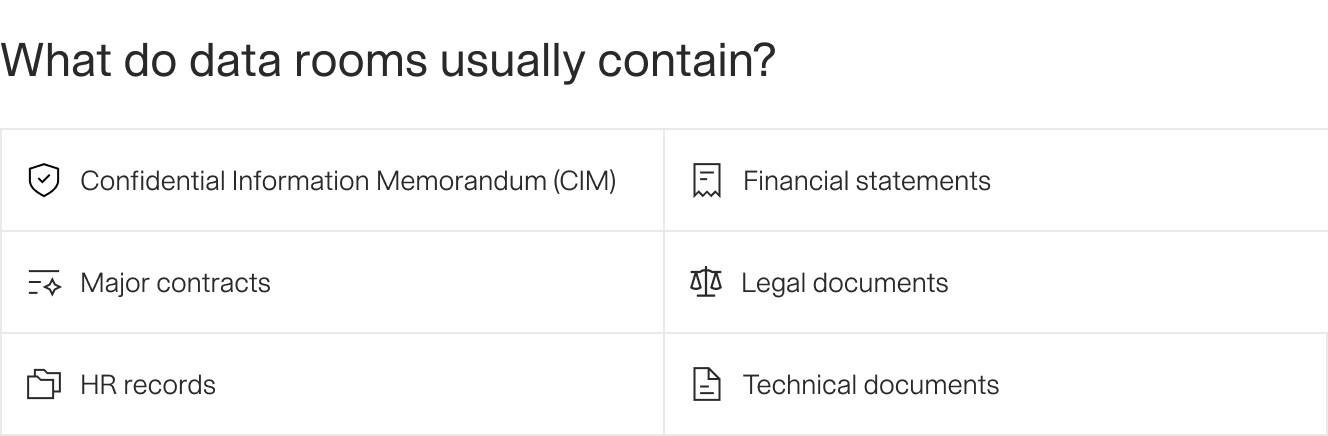
A PE deal evaluation package spans financial statements, legal documents, management presentations, and operational records. Each requires structured review against investment thesis criteria before the team can form a credible preliminary view.
Stage 5: Letter of intent and exclusivity
If the deal passes screening, the fund moves to an IOI or LOI, negotiating preliminary terms and seeking exclusivity before committing full diligence resources. Speed matters significantly here. A fund that takes two weeks to respond to a banker's IOI deadline while a competitor responds in four days loses that process on execution grounds, not investment grounds. From a banker's perspective, buyers who are slow in controlled processes create timeline management problems and get deprioritized on the next relevant deal.
For a detailed look at what the formal diligence process involves once exclusivity is secured, our guide to M&A due diligence covers each stage and the documents it requires.
Proprietary vs. intermediated deal flow
Most PE firms describe their pipeline as predominantly proprietary. Most pipelines are predominantly intermediated. This discrepancy is not dishonesty; it is a definitional problem. Funds tend to categorize any deal where they had a prior relationship as proprietary, even when a banker was already mandated. The category that actually fits the description is narrower than the usage implies.
True proprietary origination, where no advisor or banker has been engaged by the seller at any stage, is rare and difficult to build. It requires years of consistent sector coverage and relationship maintenance. The payoff, when it works, is structural: fewer competing buyers, genuine leverage on terms, and management teams who chose this fund rather than accepting the best check from a structured auction process. As the economics of proprietary deal flow in PE demonstrate, even a modest reduction in entry multiple from avoiding auction dynamics compounds significantly in fund returns over a ten-year cycle.
Intermediated deal flow is not second-tier. The strongest investments in any given vintage were frequently auctioned competitively. The question is whether the team can evaluate them fast enough and commit with enough conviction to win on execution, not just price. Bain's research found that PE firms see only approximately 18% of the intermediated deals relevant to their pipeline. The access problem and the speed problem are different problems; both need to be solved.
For most funds, the practical target is a pipeline that is 30 to 40% genuinely proprietary and 60 to 70% intermediated, with a competitive advantage in the intermediated tier from strong banker relationships and fast-moving diligence teams. Building toward more proprietary flow is a long-term project. Competing better in the intermediated tier is achievable now.
The access problem and the speed problem are distinct. Bain's research found that PE firms see only around 18% of the intermediated deals relevant to their pipeline, suggesting the access gap is a real and persistent constraint. But seeing more deals and evaluating them better are separate capabilities that require separate investments. Most funds underfund the second relative to the first, which is why the screening bottleneck remains the most common failure mode in deal origination programs.
Deal origination strategies: how top PE firms build a sustainable pipeline
The funds with the strongest deal origination pipelines run five or six overlapping sourcing channels simultaneously. Each has a different return timeline, requires different maintenance, and produces a different type of deal flow. Building a durable pipeline means running all of them with intentionality, not treating any single channel as sufficient on its own.
Industry specialist coverage teams
Hire team members whose entire mandate is to cover one sector in depth. Their job is not closing deals immediately. It is knowing every company in their sector at $20 million or more in EBITDA, meeting management teams at industry events, and tracking which owners are approaching the career stage where a transition makes sense. Coverage specialists typically take 12 to 18 months to build the relationships that produce proprietary conversations. The payoff is a pipeline of companies that never appear in a banker-run process because the relationship was established before anyone was mandated.
Operating advisor and portfolio company networks
PE-backed companies generate deal flow. A portfolio company CEO who has worked well with the fund will introduce acquisition targets, facilitate management introductions, and open doors that no cold outreach could replicate. Operating advisors and senior industry advisors on the fund's advisory board serve the same function. These relationships carry a credibility signal that no marketing material can substitute, because the introduction comes from someone the management team already trusts.
Investment banker relationship management
Despite the tension between proprietary and intermediated sourcing, banker relationships remain critical. Being on a banker's first call list for a relevant transaction means seeing the deal before it goes to full distribution, often at a stage where price and process are still negotiable. These relationships require active maintenance: consistent deal flow updates to bankers in relevant sectors, honest feedback on why specific processes were passed, and avoiding the low-ball bidding that damages long-term credibility. The fund that gives a banker honest, prompt feedback on a deal it declined will get a call on the next one before the fund that went quiet.
Direct market mapping and systematic outreach
Commercial database screening followed by direct outreach to identified targets. This approach works best in fragmented sectors where hundreds of potential targets exist and management teams are relatively accessible. In concentrated sectors where every PE fund already knows every relevant management team, it adds limited marginal value. The key differentiator is whether the fund has genuine sector knowledge to demonstrate in an initial conversation, not just a pitch deck.
AI-assisted prospecting and signal detection
The most recent addition to the deal origination toolkit is AI-assisted signal detection: using data intelligence tools to identify companies showing signals of exit readiness before they engage a banker. These signals include ownership structure changes, management team transitions, capex cycles suggesting business maturity, and financial profile shifts that match typical pre-transaction patterns. Rather than reaching out to 500 targets in a sector, a fund can prioritize the 40 most statistically likely to transact in the next 18 months.
The relationship still needs to be built. The signal tells you where to invest the relationship-building effort. For a look at how machine learning is being applied to deal identification at the data layer, our guide to machine learning in private equity covers the technical foundations in detail.
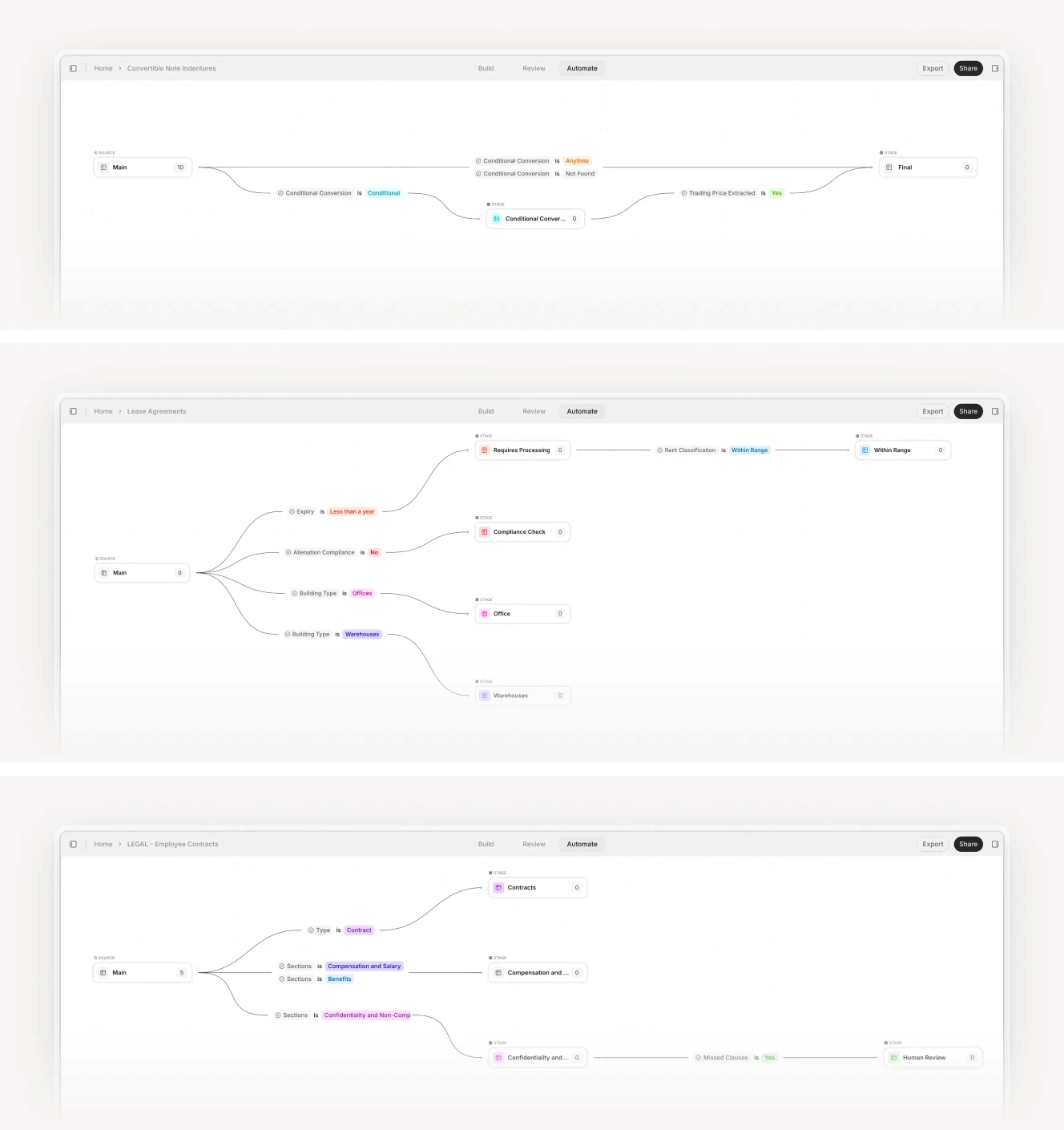
A robust deal origination program runs multiple sourcing channels in parallel, each with different lead times and pipeline characteristics. No single channel is sufficient on its own.











Why screening speed matters more than deal flow volume
This is the part most deal sourcing guides miss entirely.
Every PE fund wants more deals. The instinct is to build wider sourcing networks, attend more conferences, hire more origination staff. This instinct is not wrong — more quality deal flow is always better. But the constraint for most mid-market funds is not insufficient pipeline volume.
Wrong. The constraint is insufficient capacity to evaluate the pipeline that already exists.
The math makes this concrete. A fund evaluating 100 to 120 opportunities per year, with two or three analysts responsible for deal work, has roughly 200 to 250 analyst days available for first-pass screening — after accounting for live deal diligence, portfolio monitoring, and quarterly reporting obligations. A thorough CIM review takes two to three full days. Run the numbers and you have capacity for 70 to 100 first-pass reviews before everything else starts competing for the same calendar.
The result is a well-documented outcome: good deals get passed on not because they failed the investment thesis, but because the team ran out of hours to look properly. The most common phrase in post-mortem reviews of missed deals is some version of "we just didn't have bandwidth."
The right question is not "how do we see more deals?" It is "how do we screen the deals we already see faster, without compromising the judgment quality that determines whether a term sheet is worth making?"
How AI changes the deal sourcing and screening equation
AI's primary role in PE deal sourcing is not finding deals. It is compressing the time between receiving a document package and making a credible go or no-go decision.
Two distinct use cases have emerged. The first is deal identification: using AI to scan commercial databases, news sources, and alternative data signals to surface companies that match the investment thesis before they enter a formal sales process. The second is deal screening: using AI agents to extract and structure the data from a CIM or preliminary financial package before an analyst has spent a day on it manually. S&P Global Market Intelligence research on deal sourcing demonstrates the statistical validity of using financial characteristics to predict acquisition likelihood, an approach now embedded in AI-native prospecting tools.
The first use case is commercially available and useful for pipeline prioritization. The differentiation comes from the workflow after the signal, not the signal itself. The second use case is where the productivity gain is concrete and measurable.
What AI-assisted CIM screening looks like in practice
A standard CIM runs 50 to 200 pages. It contains revenue by product line, management team backgrounds, customer concentration data, EBITDA bridge, market size assumptions, competitive positioning, and four to seven years of financial history. An analyst reviewing it for investment thesis fit needs to extract roughly 20 to 40 specific data points, cross-reference them against the fund's model, and flag inconsistencies before the investment team makes a preliminary judgment call.
Done manually: two to three full working days. An AI agent configured for CIM screening extracts the same structured fields in under an hour, flags the sections with incomplete or inconsistent disclosure, and produces a preliminary scorecard against the investment thesis criteria before the analyst opens the document.
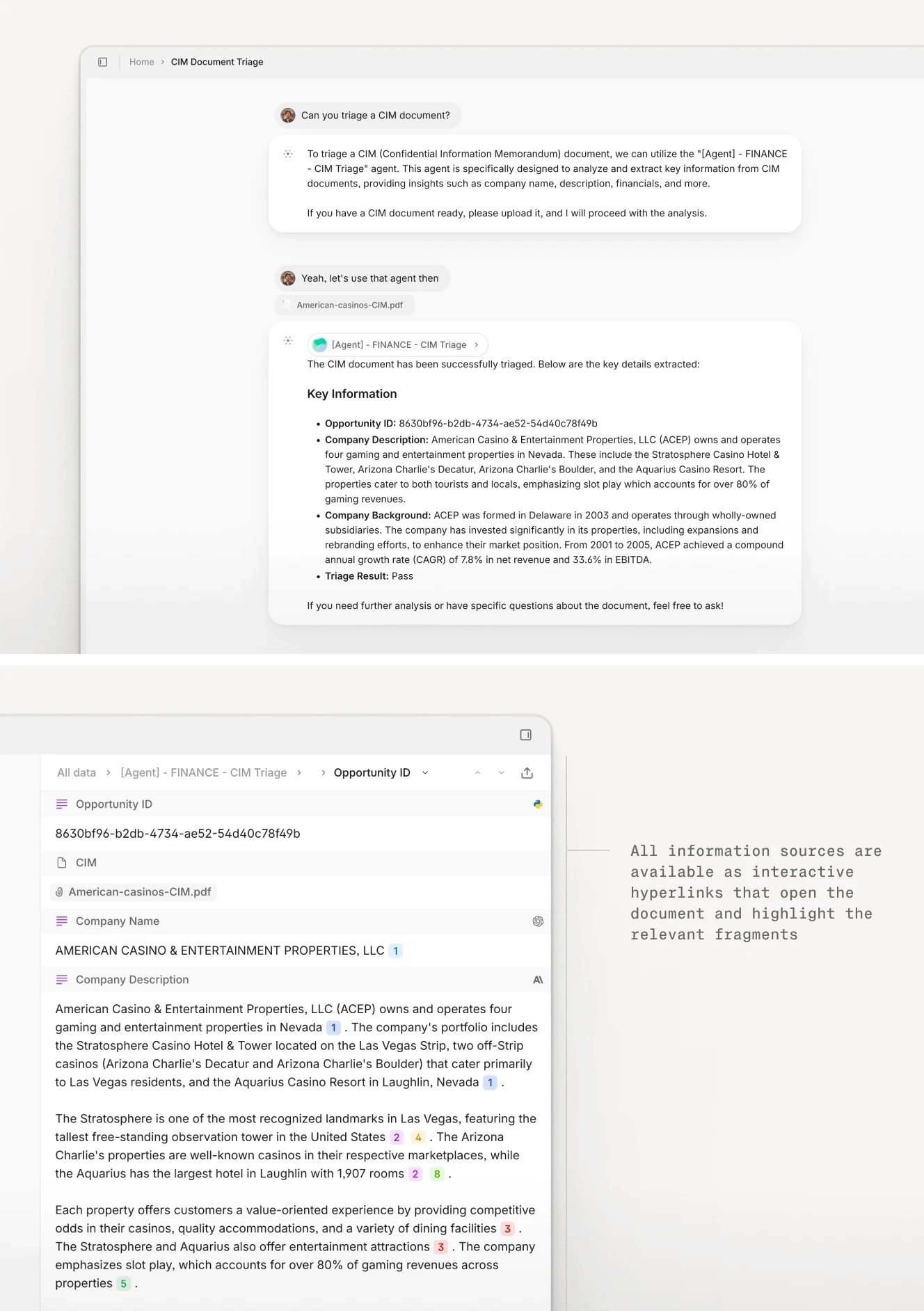
An AI agent configured for CIM review extracts key investment data and scores the deal against defined criteria before an analyst opens the document — shifting the analyst's time from extraction to judgment.
The analyst's job does not disappear. The two to three days shifts to two to three hours of focused work: reviewing the agent's extractions, investigating flagged inconsistencies, and forming the judgment on whether the deal merits advancing. The extraction phase, which is administrative, is automated. The judgment phase remains human.
This is the workflow V7 Go supports for PE deal teams. You define the fields your investment committee cares about: revenue growth rate, gross margin trajectory, customer concentration, key person risk, net revenue retention, and management team tenure. The agent extracts them from every incoming CIM with direct citations to the source page in the original document. The output flows into a structured review environment where the analyst works alongside the extracted data and the original source simultaneously. The CIM review automation is the starting point for most PE teams building this workflow.
Investment thesis scoring and automated deal triage
Beyond field extraction, AI agents can score deals against defined investment criteria before a human reviews them. A fund with a clear thesis — EBITDA in the $10 to $50 million range, revenue growth above 15% CAGR over three years, gross margin above 40%, no single customer representing more than 20% of revenue — can configure an agent that screens every incoming CIM against those criteria and flags pass or fail on each dimension before the analyst opens the document.
This is not automated decision-making. The investment committee still decides. What it produces is automated triage: the analyst starts with a pre-filtered dataset and a summary of where the deal fits and where it does not, rather than starting from a blank page with a 180-page document.
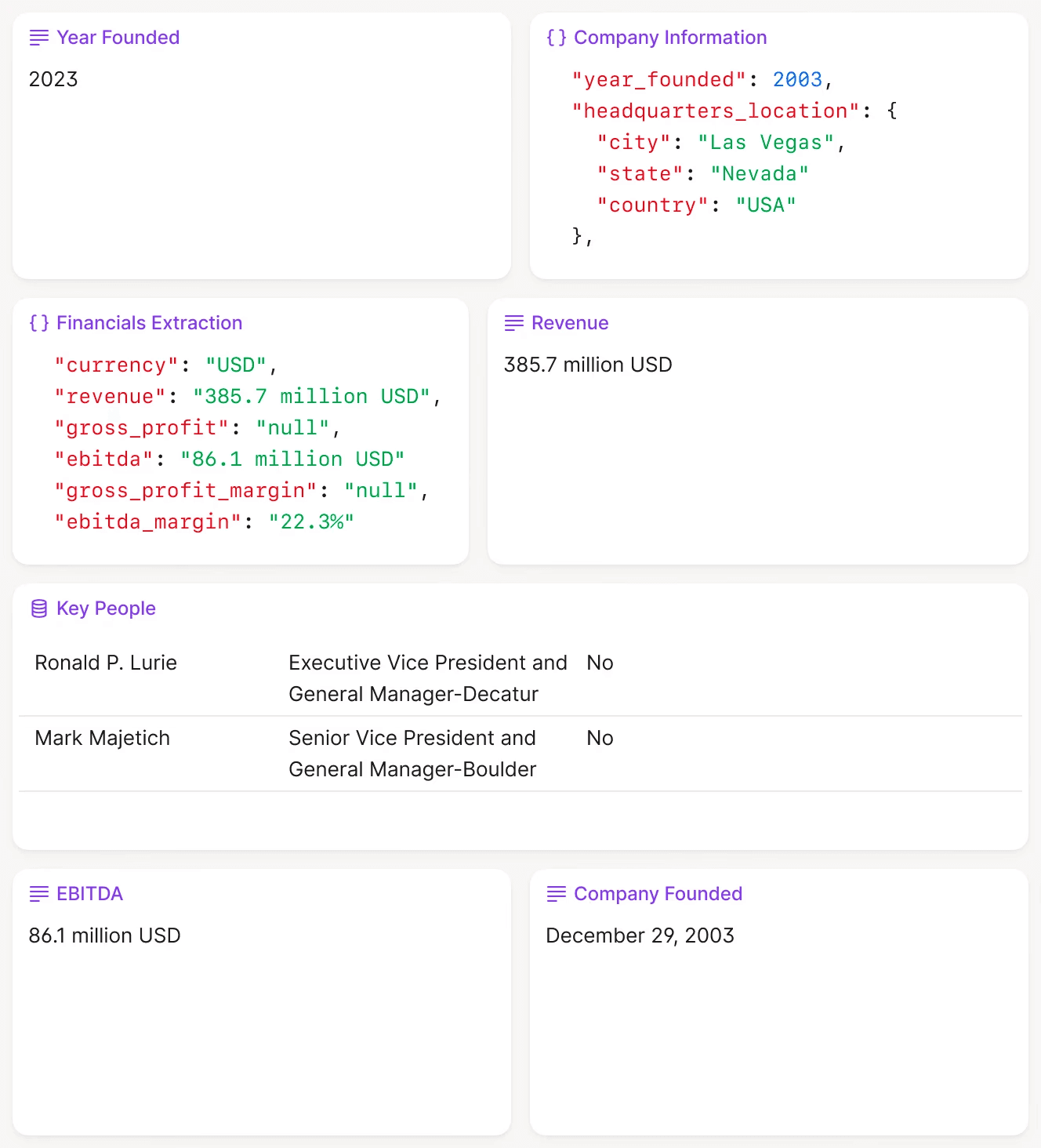
AI extraction structures the key investment fields from a CIM into reviewable data before the analyst engages manually, cutting first-pass review time significantly and redirecting analyst hours toward judgment rather than data entry.
The document chain beyond the CIM
CIM review is one step in a broader screening workflow. A full deal evaluation also involves management presentations, preliminary quality of earnings summaries, legal documents, and data room materials arriving asynchronously across a four to six week period. AI agents that work across document bundles can cross-reference claims in a management presentation against figures in the financial model, flag discrepancies between the CIM's market size assumptions and available industry data, and surface the key diligence questions before the first management call.
The questions you ask in the management presentation determine how much information you extract before advancing to a term sheet. Analysts who start that meeting with pre-identified inconsistencies from AI-assisted document cross-referencing ask sharper questions and make better use of the access. For a detailed look at AI-assisted data room analysis in competitive deal processes, our guide to AI for virtual data rooms covers the approach in detail.
The AI due diligence agent in V7 Go handles this multi-document analysis layer: ingesting the full document bundle, cross-referencing across sources, and extracting structured findings with full citations back to their source pages. The visual grounding capability links every extracted claim to its location in the original document, which matters when an investment committee needs to verify an assumption before committing to a term sheet.
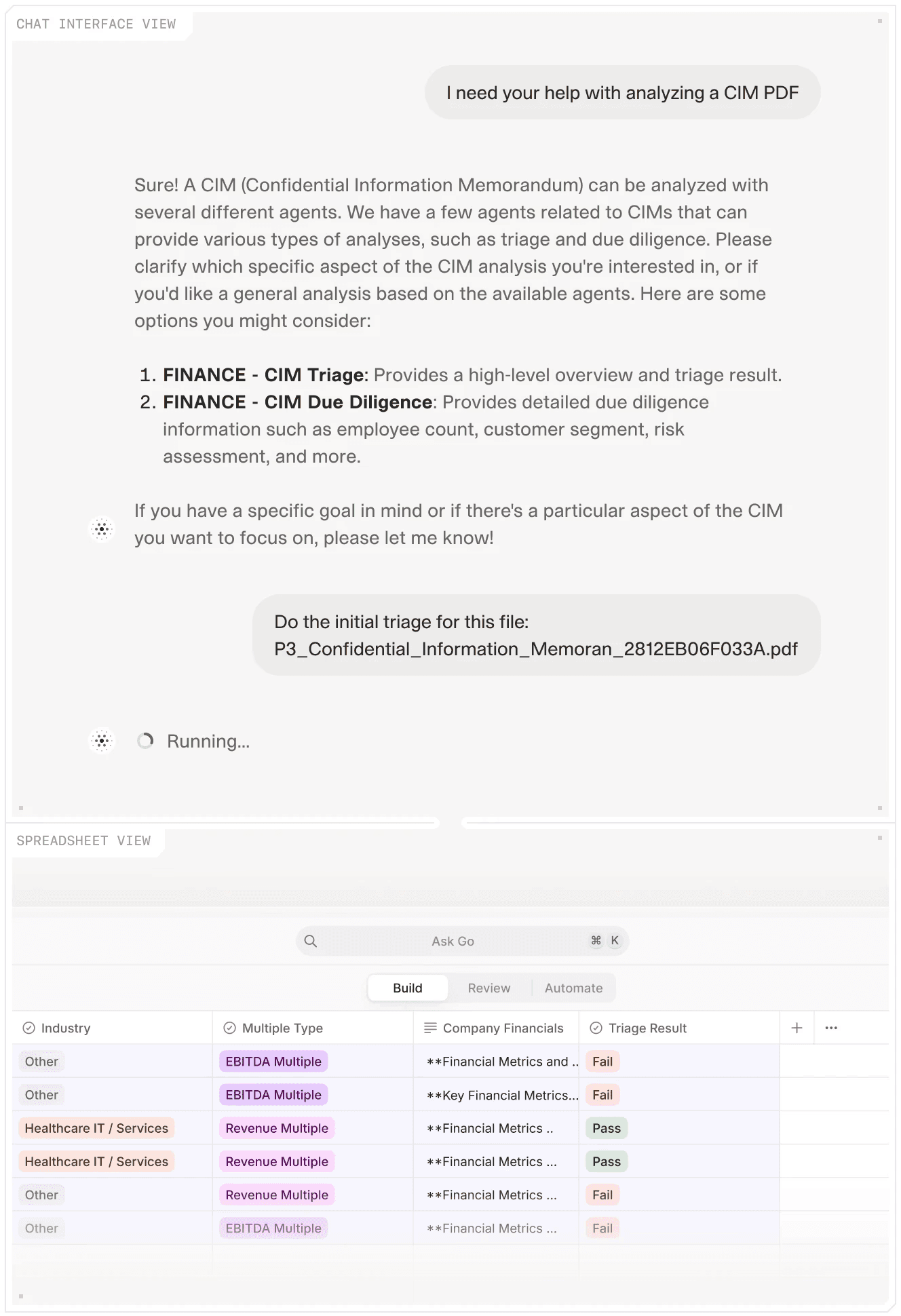
V7 Go's multi-agent approach to deal analysis: a triage agent for initial screening, a diligence agent for deeper extraction, and a structured review environment where the team works alongside the source documents.
Building a deal sourcing process that compounds over time
The strongest PE deal sourcing machines are not built on a single channel or a single technology. They are built on three layers: data infrastructure, relationship capital, and screening speed.
The infrastructure question comes first. Most PE funds track deal flow in a generic CRM, a spreadsheet, or a combination of both. This works until the pipeline exceeds roughly 80 to 100 active relationships, at which point the volume of contact cadences, follow-up commitments, and evaluation stages becomes difficult to manage without a system that surfaces the right priorities automatically.
The relationship layer requires consistency over years. Regular sector coverage conversations with management teams who are not ready to sell. Quarterly contact with bankers in relevant sectors to maintain first-call status. Honest feedback on passed processes that preserves credibility for the next one. According to Bain's Global Private Equity Report 2026, deal and exit values surged in 2025 as the market recovered from two years of contraction, intensifying competition among funds for quality assets. In a recovering market, the funds with established origination infrastructure have a head start that takes years to close.
The speed layer is where technology investment has the most immediate and measurable impact. Screening volume increases. Analyst time spent on administrative extraction decreases. The hours saved redirect to judgment: qualitative assessment of management quality, sector dynamics, and competitive positioning that separates a deal worth bidding on from a deal worth winning in competition.
The outcome funds with all three layers consistently report is the same. They do not necessarily see more deals than their competitors. They see the same deals and make better, faster decisions. That consistency, compounded across a fund cycle, shows up in vintage returns.
What this means for how you build the deal sourcing infrastructure
The deal sourcing process does not end when you find an opportunity worth pursuing. The decisions that differentiate PE returns happen in the screening stage and the early months of diligence: which questions you ask, how quickly you identify the real risks, whether you can build conviction fast enough to commit to a term sheet in a competitive process before a slower-moving competitor takes your place in the banker's ranking.
The teams building that conviction faster are the ones investing in the screening infrastructure: AI agents that handle structured extraction from CIMs and data room documents, review workflows that keep the diligence chain organized when a deal is moving fast, and processes that ensure nothing material falls through when the team is stretched across multiple live situations simultaneously.
The practical starting point is not the most comprehensive system available. It is the most time-intensive stage in your current process. For most PE deal teams, that is first-pass CIM screening. Build an agent for that workflow, validate its extractions against your investment thesis, measure the time-to-decision change, and expand from there once the baseline is set. That is a more direct path to competitive advantage than deploying a full-stack sourcing platform on day one.
The infrastructure gap between PE firms that have built AI screening workflows and those still doing it entirely manually is widening. The 100-to-1 funnel does not change. What changes is whether you can run it twice as fast with the same team, and whether the quality of the preliminary analysis you take into a management meeting is better than what your competitors bring. In a market where deal and exit values are recovering and competition for quality assets is intensifying, the sourcing infrastructure you build today determines the pipeline you have three years from now.
What is the difference between deal sourcing and deal origination in private equity?
Deal sourcing and deal origination describe the same activity in private equity: the process of identifying and qualifying potential investment targets before a formal transaction process begins. Deal origination tends to appear in LP documentation and investment mandates, while deal sourcing is the term deal teams use internally. The practical distinction that matters more than the label is how the opportunity arrived. A deal you found through your own network or direct outreach before any advisor was mandated is proprietary deal flow. A deal that arrived via banker teaser in a structured process is intermediated deal flow. Proprietary deals typically come with better price and terms because there is no auction dynamic. Both channels contribute to a healthy pipeline, but the funds with the strongest long-term track records treat deal origination as a core competency and build infrastructure around it, rather than treating it as an incidental sourcing function that happens when a banker calls.
+
How many deals does a PE firm need to review to close one investment?
According to Bain and Company, for every 100 potential targets that enter a PE fund's pipeline, only one or two result in a closed investment. The funnel conversion rate is approximately 1 to 2 percent. The exact ratio varies by fund strategy and market conditions. Buyout funds operating in the middle market with precise entry criteria may screen out fewer deals earlier in the process, improving the downstream ratio. Growth equity and venture funds screening early-stage companies typically see higher rejection rates because more companies lack the financial maturity required. The important operational implication of this funnel math is that screening efficiency matters as much as sourcing volume. A fund that can thoroughly evaluate 120 opportunities per year with the same analyst team as one that can only evaluate 80 has a structural advantage in deal flow processing, all else equal. This is why AI-assisted CIM screening, which compresses first-pass review from days to hours, is increasingly relevant to how PE deal teams think about their infrastructure investment.
+
What is proprietary deal flow in private equity?
Proprietary deal flow refers to investment opportunities that a PE firm identifies before any investment banker or M&A advisor has been engaged by the seller. The defining characteristic is that the fund is the only buyer, or one of very few, which provides leverage on price, structure, and timing. Building genuine proprietary deal flow requires years of consistent sector coverage, sustained relationship maintenance with management teams in target industries, and a reputation as a value-added partner that founders and operators want to work with. Most PE firms claim a higher percentage of proprietary deal flow than they actually have. True proprietary origination, where no banker or advisor is involved at any stage, is rare. More common is a relationship advantage in an intermediated process: being on the banker's first call list, or having a prior relationship with the management team before the formal process begins. That is valuable but structurally different from genuinely proprietary origination.
+
What are the main stages of the private equity deal sourcing process?
The private equity deal sourcing process follows five sequential stages. Stage one is target identification and thesis alignment, where the deal team maps its investment criteria to a specific universe of companies using commercial databases and sector research. Stage two is initial outreach and relationship initiation, typically through warm introductions from portfolio companies, operating advisors, or industry contacts. Stage three is relationship cultivation and monitoring, which can span months to years before a management team is ready to discuss an exit. Stage four is initial screening and investment thesis validation, where the team reviews a CIM or information package against the fund's criteria and runs preliminary financial analysis. Stage five is the letter of intent and exclusivity negotiation, where the fund makes a formal offer and seeks exclusivity before committing full diligence resources. The speed and quality of the handoff between stages four and five is where most competitive deals are won or lost.
+
How is AI being used in private equity deal sourcing?
A strong PE deal origination strategy combines five capabilities working in parallel. First, a clearly defined investment thesis that narrows the target universe and gives every team member the same filtering criteria. Second, sector-specific coverage that keeps someone in regular contact with every relevant management team in the target industries. Third, systematic relationship management with defined contact cadences and records of what matters to each relationship over time. Fourth, strong investment banker relationships that ensure the fund sees quality intermediated deals before they go to full auction distribution. Fifth, screening infrastructure that can process the volume of opportunities the sourcing channels generate without creating an analyst bottleneck at the evaluation stage. The funds that consistently source and win the best deals are not necessarily the ones with the most relationships or the highest deal flow volume. They are the ones where every layer of the sourcing process is intentional and where the time from initial contact to a credible investment decision is fast enough to compete in any process.
+
What makes a strong deal origination strategy in private equity?
Go is more accurate and robust than calling a model provider directly. By breaking down complex tasks into reasoning steps with Index Knowledge, Go enables LLMs to query your data more accurately than an out of the box API call. Combining this with conditional logic, which can route high sensitivity data to a human review, Go builds robustness into your AI powered workflows.
