18 min read
—



Casimir Rajnerowicz
Content Creator
V7 Go
A smarter way to manage due diligence and underwriting
Take a family office running a $1.5 billion alternatives programme. Over a year it receives marketing material from several hundred fund managers, takes meetings with a few dozen, runs full diligence on perhaps a dozen, and makes new commitments to four or five. The exact numbers vary by programme and nobody publishes them, but every allocator reading this will recognise the shape.
And the shape is not the problem. Selectivity is the job. The problem is what happens between the second and third numbers.
Ask an investment team why they diligenced twelve managers rather than twenty, and the answer is almost never that the other eight were obviously weak. It is that there were not enough hours. Every manager who reaches serious evaluation arrives with a document package: a due diligence questionnaire that can run past two hundred questions, a private placement memorandum, a limited partnership agreement, four quarters of reports on the predecessor fund, audited financials, a track record file, an operational questionnaire, and a stack of service provider confirmations. Reading that package properly takes an analyst somewhere between two and five days.
Multiply by twenty and you have a headcount decision, not a scheduling problem.
This is the part of investment manager selection that rarely gets discussed, because it is unglamorous and because it looks like a resourcing complaint rather than an investment one. It is an investment one. A programme that can only diligence twelve managers a year is making its selection decision at the screening stage, on marketing materials, before anyone has read a document that the manager did not choose to lead with.
This guide covers how institutional allocators actually run manager selection, stage by stage, and where the document load sits in each one. It is written for the allocator side of the table: family offices, endowments, foundations, pension plans, funds of funds, and outsourced CIOs. If you send DDQs rather than answer them, this is for you.
In this article:
What investment manager selection covers, and how it differs from manager due diligence.
The six stages of the selection lifecycle, from universe construction to ongoing monitoring.
What investment diligence and operational diligence each actually examine.
The document inventory per manager, and the arithmetic that follows from it.
Where AI compresses the reading stage, and where judgment has to stay human.
What investment manager selection means
Investment manager selection and investment manager due diligence are often used interchangeably. They describe different scopes of work.
Selection is the full lifecycle: building the universe of candidate managers, narrowing it, investigating the survivors, deciding, negotiating, and then living with the decision for a decade. Due diligence is one phase inside that. It is the investigation phase, and it is the phase that consumes the most analyst time, which is probably why its name has drifted to cover the whole process.
The distinction matters operationally. A team that treats selection as a synonym for diligence tends to under-invest in the two stages either side of it. Universe construction determines what you ever get to choose between. Monitoring determines whether you find out early when a manager drifts from the strategy you underwrote. Both are document-heavy. Neither gets the attention that the diligence phase does.
Investment manager selection is the end-to-end process by which an allocator identifies, evaluates, appoints and monitors an external manager. Due diligence is the investigation phase within it.
Stage one and two: building the universe and screening it
The universe is every manager you could plausibly commit to, and most allocators build it from four sources: existing relationships and re-ups, placement agent introductions, consultant or database screens, and peer referrals from other LPs.
Those four sources are not equally represented. Re-ups arrive automatically and carry institutional memory. Placement agents push whoever they are mandated on. Database screens are only as good as the coverage of the database, which for first-time funds and smaller regional managers is thin. Peer referral is the highest-signal source and the least systematic. A programme that does not track where its committed managers originally came from usually cannot say which of the four is actually working.
Screening then cuts that universe down using criteria that are mostly mechanical. Strategy fit against the policy portfolio. Fund size against your target cheque and concentration limits. Vintage year and pacing. Geography. Sector focus. Whether the team has invested together before, and through what. Most of these are answerable from a deck and a track record summary, which is why screening is cheap and diligence is not.
The failure mode at this stage is quiet. When capacity is tight, screening criteria get stricter, and they get stricter along whichever axis is easiest to measure. Fund size and headline IRR are easy. Strategy drift and team stability are not. Teams end up filtering on the metrics that filter fastest rather than the ones that predict best.
Stage three: investment due diligence
Investment due diligence, or IDD, asks whether this manager can repeat what they have done. It covers strategy and how consistently it has been applied, the sourcing model, the investment process and who actually holds decision rights, team composition and stability, and the track record broken down far enough to be meaningful.
Track record analysis is where the reading load first becomes serious. Headline fund IRR is close to useless on its own. What the analyst needs is performance attributed by deal, by partner, by vintage, by holding period and by value creation driver, so they can separate multiple expansion from operational improvement from leverage. That means going into the quarterly reports of the predecessor funds deal by deal, not reading the summary page.
Our guide to private equity fund due diligence covers the investment side of this in more depth than fits here.
What the DDQ does and does not settle
The due diligence questionnaire is the backbone of this stage and the most misunderstood document in the package. Standardisation has helped enormously: since ILPA published its second version, most institutional allocators work from a common question set, which means manager responses can be compared without first being translated. Invest Europe's mapping of industry frameworks tracks how widely it has been adopted across European allocators.
What standardisation has not solved is the answer format. Managers respond in their own templates, at their own length, with cross-references to appendices and prior-fund materials. Two managers answering the same ILPA question on valuation policy will produce a two-line answer and a four-page one, and the four-page one is not necessarily more forthcoming.
The DDQ also settles less than allocators sometimes assume. It records what the manager says about themselves. Its value comes from being checked against the documents that were not written for you: the audited financials, the LPA, the quarterly reports to existing LPs. A DDQ read in isolation is a marketing document with a standardised table of contents. Read against the rest of the package, it becomes a set of testable claims. More on the mechanics in our guide to DDQ automation.
Stage four: operational due diligence
Operational due diligence, or ODD, asks a different question: can this firm be trusted to hold the money. It looks at legal structure and ownership, the compliance function and who the chief compliance officer reports to, valuation policy and whether an independent party is involved, the fund administrator and auditor, cash controls and authorisation limits, cybersecurity, business continuity, key personnel provisions, and any regulatory or disciplinary history.
ODD is frequently outsourced or run by a separate team, and it carries an unusual property: it produces very few positive signals and a small number of decisive negative ones. Nobody commits to a fund because the ODD was excellent. They decline because a valuation committee turned out to be two people from the deal team. That asymmetry is worth remembering when deciding how much of the process to compress. See operational due diligence in private equity for the full checklist.
One practical note on sequencing. Allocators who run ODD last, after months of investment work, occasionally discover a disqualifying operational fact and write off the whole effort. Running a short operational screen early costs a day and prevents that. It is not the fashionable part of the process, but it is the part that most reliably saves time.
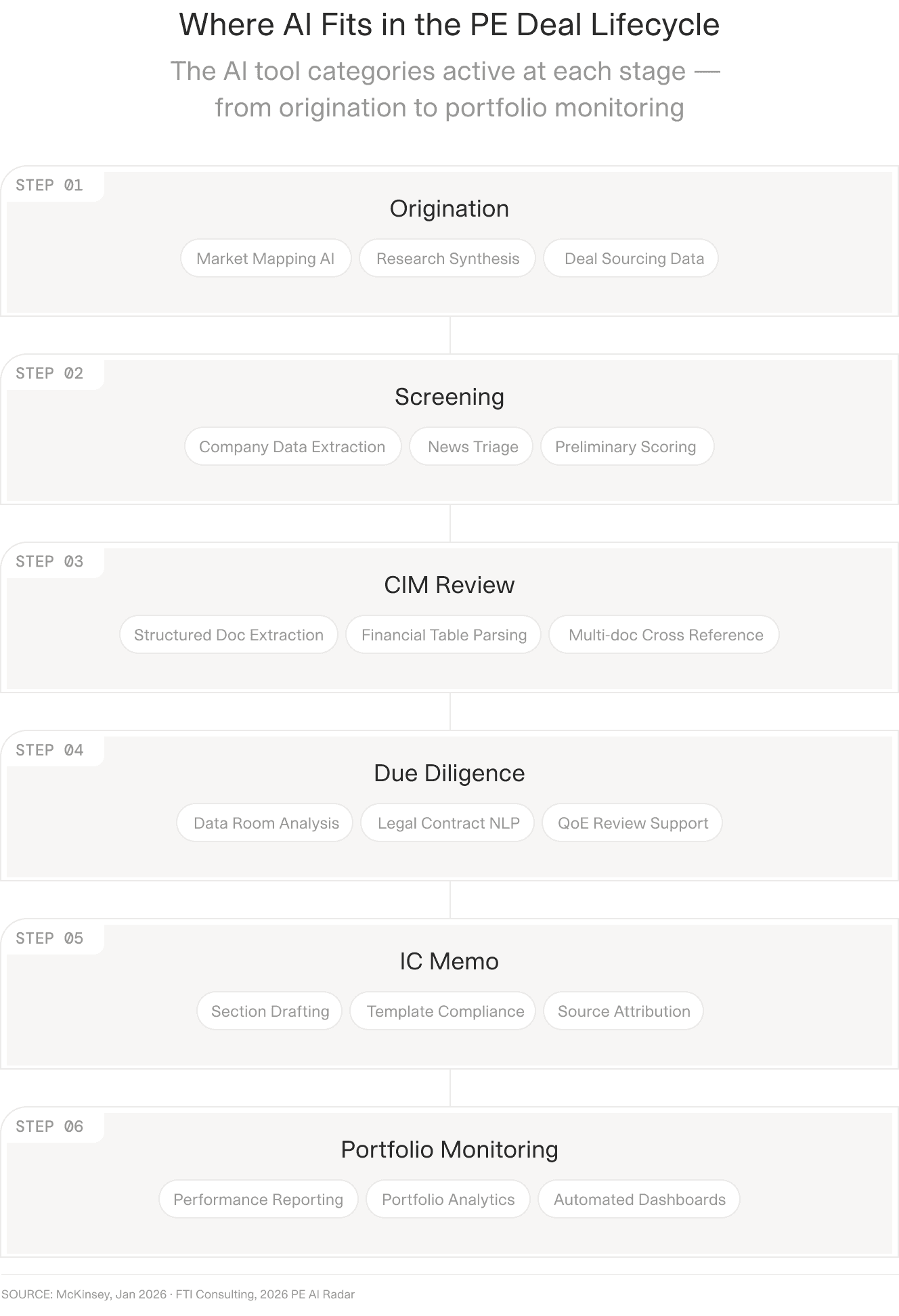
The allocator's version of this runs one level up: not deals inside a fund, but funds inside a programme.
The last two stages, and why they get shortchanged
Stages five and six carry most of the long-term risk in a manager relationship and almost none of the attention.
Stage five: committee approval and terms
The investment committee memo has to compress months of work into something a committee can act on, which means the diligence findings need to be comparable across managers. If one analyst wrote up fees as a paragraph and another built a table, the committee is comparing prose to numbers.
Terms negotiation runs in parallel. Management fee and offsets, carried interest and whether it is deal-by-deal or whole-fund, the preferred return and catch-up, key person provisions, no-fault divorce thresholds, GP commitment, and the side letter. The ILPA templates and standards give allocators a common reference for much of this, which is precisely why the standardised DDQ has been adopted so widely: it makes manager responses comparable without renegotiating the format each time.
Stage six: monitoring, which is selection you already made
Monitoring is where the allocator finds out whether the underwriting held. Quarterly capital account statements, LP letters, capital calls and distribution notices, annual audited financials, and the annual meeting materials arrive from every manager in the programme, in every manager's own format, forever.
A programme with 40 active relationships receives at least 160 quarterly reports a year before anything else. Normalising those into a single comparable set is the work that most often gets deferred, and deferring it is how a strategy drift goes unnoticed for three quarters.
Monitoring also feeds directly back into selection. The re-up decision on a manager's next fund is the single most common allocation an institutional programme makes, and it is made largely on what the monitoring data says. A team that has been normalising reports quarterly has a defensible answer when the successor fund launches. A team that has been filing them has to reconstruct four years of history in the six weeks before the first close. Our guide to portfolio monitoring in private equity covers the mechanics.
There is a structural irony here. The stage with the most documents and the longest duration is the one allocators most often run on a spreadsheet maintained by whoever has capacity.











Why document volume is the real constraint in manager due diligence
The bottleneck in investment manager selection is not usually analytical judgment. It is document capacity.
This is worth stating plainly because it is easy to mistake for a complaint about resourcing. It is not. It is a claim about where the binding constraint sits, and if the claim is right it changes what an allocator should do about it.
The arithmetic
Take a single manager who has cleared screening. The package that arrives looks roughly like this:
A due diligence questionnaire. The ILPA DDQ 2.0 runs to several hundred questions across firm, strategy, team, track record, ESG and operations. Many managers answer it in their own format anyway.
A private placement memorandum, typically 80 to 150 pages.
A limited partnership agreement, often longer, and the subscription documents.
Four quarterly reports on the predecessor fund, plus the annual report and audited financials.
A track record file, usually a spreadsheet, deal by deal, with realised and unrealised marks.
An operational due diligence questionnaire and the service provider confirmations behind it.
Reference call notes, once those are done.
An analyst reading that package carefully, extracting what the IC memo needs, and cross-checking the numbers against each other spends two to five days on it. Call it three.
Now scale it. Twelve managers is 36 analyst days, or roughly two months of one person's year spent reading. Twenty managers is 60 days. Thirty is 90, which is most of a quarter, and no allocator has one analyst doing nothing but reading. They are also monitoring 40 existing relationships, preparing IC materials, and covering their own asset class research.
The number of managers a programme can properly diligence is therefore set by reading capacity, and it sits well below the number the team could form a useful view on.
Where the hours actually go
Very little of that time is judgment. Break down three days of DDQ and report review and most of it is location, transcription and reconciliation.
Locating: finding where in 400 pages the manager stated their valuation policy, their GP commitment, or the departure of a partner in 2023. Transcribing: pulling fee terms, fund size, vintage, sector exposure and deal-level marks into whatever comparison structure the team uses. Reconciling: checking that the track record spreadsheet agrees with the quarterly reports, that the DDQ answer on AUM matches the audited financials, and that the strategy described in the PPM matches the deals actually done.
That last one is where the real findings come from, and it is the step most often skipped when time runs short. Reconciliation is the part of diligence that catches things, and it is the part that gets cut.
Judgment work is different. Deciding whether a team's sourcing edge is durable, whether a succession plan is credible, whether the culture will survive a fund that is twice the size of the last one. That work is fast once the inputs are in front of you. It is slow only because assembling the inputs is slow.
Track record analysis is the clearest example
Nowhere is the split between assembly and judgment sharper than in performance attribution, which is why it is worth walking through in detail.
A manager presents a net IRR and a multiple for the predecessor fund. Both numbers are true and neither is informative. What the allocator needs to know is which deals produced the return, whether the partners responsible for those deals are still at the firm, how much of the value creation came from earnings growth as against multiple expansion or debt paydown, how the realised deals compare to the ones still held at cost, and what the marks on unrealised positions assume.
Answering that means building a deal-level table from the quarterly reports: entry date, entry multiple, exit or current mark, holding period, deal partner, revenue and margin at entry and exit, and the capital structure. For a fund with 18 portfolio companies across five years of reports, that is several hundred data points scattered across a dozen documents, many of them in tables that changed format when the manager switched fund administrators.
Assembling that table is a day. Reading it is twenty minutes, and the twenty minutes is where the investment insight happens. A team that spends its diligence budget on assembly is buying the least valuable hour of the process at the highest price. The performance attribution agent exists for exactly this shape of problem.
The 80 percent problem
There is a second-order effect that matters more than the first.
When capacity binds, teams do not diligence fewer managers at the same depth. They diligence the same number at less depth, and they choose which manager to look at using the cheapest available signal. Prior relationship. Brand. Whichever placement agent got a meeting. Fundraising conditions make this worse: Preqin's 2026 private equity outlook describes capital concentrating heavily in larger, established managers, which is exactly what you would expect a capacity-constrained selection process to produce at the industry level.
Some of that concentration is a genuine flight to quality. Some of it is a reading budget.
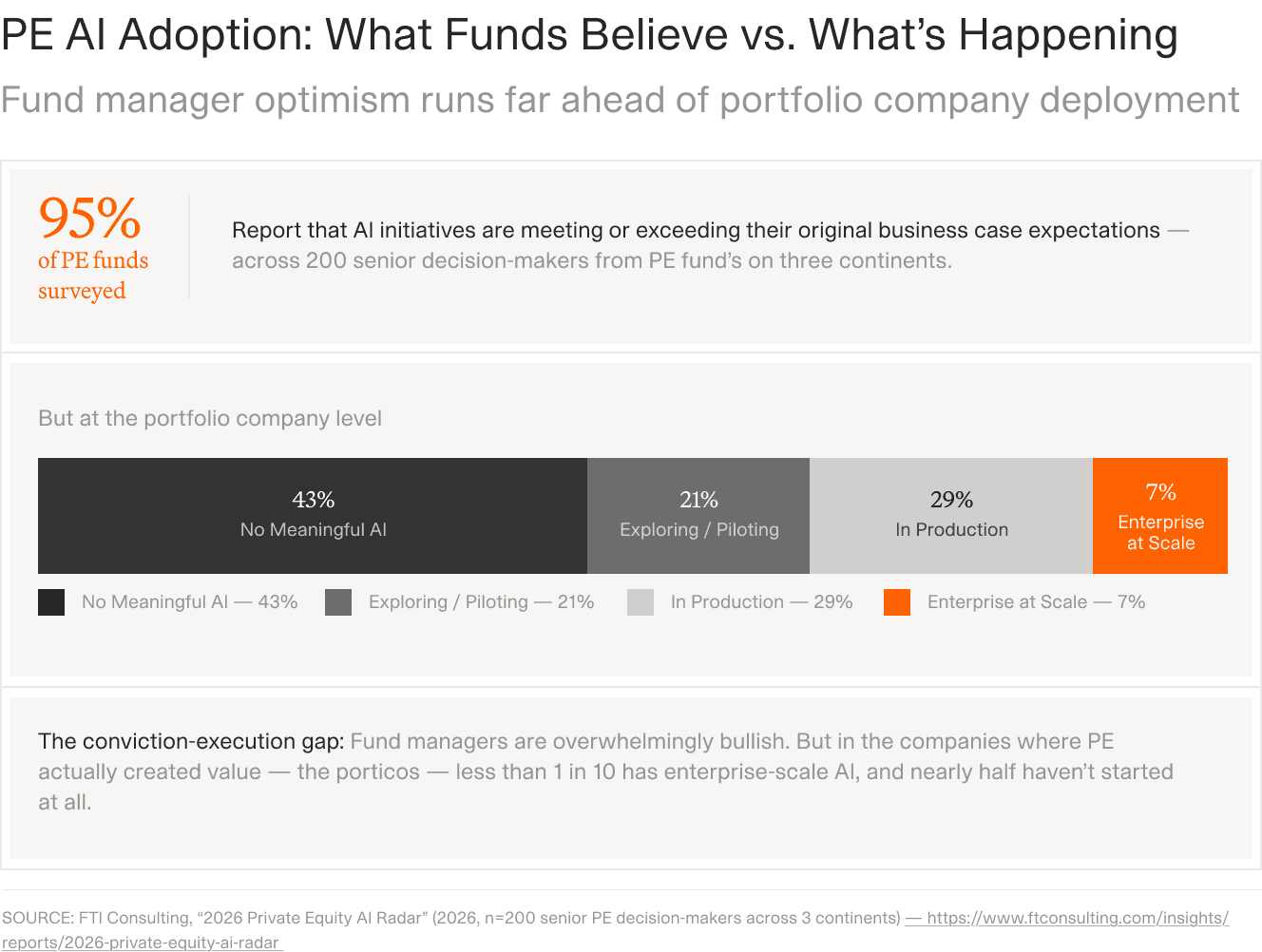
The same gap shows up on the allocator side of the table. Conviction that AI helps is close to universal. Deployment against the document workload is not. Source: FTI Consulting, 2026 Private Equity AI Radar.
What changes when the reading stage is compressed
If location, transcription and reconciliation are the bulk of the work, they are also the part a configured workflow handles well. Not the judgment, and not the decision. The retrieval.
The pattern that works for allocators is a fixed schema applied to every manager package. You define once what the IC memo needs: fund size, target and hard cap, GP commitment percentage, management fee and offset treatment, carry structure and whether it is deal-by-deal, preferred return, key person triggers, valuation policy and independence, auditor and administrator, team departures in the last three years, and deal-level performance attributed by partner. Every manager gets run against that same schema, so the fifteenth candidate is described in exactly the same terms as the first.
This is exactly the kind of workflow V7 Go was built for. The LP diligence agent reads the full package, populates the fields you defined, and links every extracted value back to the page and sentence it came from, so an analyst verifying a fee term opens the LPA at the clause rather than searching for it. Where the check is arithmetic rather than interpretation, such as confirming that the track record file foots to the quarterly reports, that step runs as code and returns the same answer every time.
Three consequences are worth being specific about.
Comparability. Managers described against one schema can be ranked, filtered and compared. Managers described in fifteen analysts' prose cannot. This is the benefit allocators underrate before they have it and rely on afterwards.
Reconciliation stops being optional. Cross-checking the DDQ against the audited financials against the track record file is tedious and mechanical, which is why it gets dropped. Mechanical work is what a defined workflow is for. The exceptions surface as flags rather than as something an analyst has to go looking for.
The funnel widens. If the per-manager reading cost falls, the number of managers a programme can properly evaluate rises. That is the actual return here. Not hours saved, but candidates seen.
The same applies to the monitoring stage, where the volume is larger and the work is more repetitive. Quarterly reports from 40 managers in 40 formats, normalised to one comparable set, with variances against the prior quarter flagged for the person who needs to look at them. V7's due diligence automation workflows cover both ends of that lifecycle.
What the allocator keeps
One clarification, because it is the objection that comes up first and it deserves a direct answer.
A workflow that reads a DDQ does not form a view on the manager. It populates the fields you told it to populate and shows you where each value came from. Whether a 2.5x gross multiple on a deal led by a partner who left in 2024 is a good sign or a bad one is not a question a document pipeline can answer, and it is not a question anyone should want it to answer.
The review gate is a design feature rather than a limitation. Every extraction lands in front of an analyst with its source attached, and the analyst confirms or corrects it. What changes is that the analyst spends their attention on the twelve values flagged as uncertain rather than on locating two hundred values that were never in doubt. Our companion guide on LP due diligence and GP evaluation goes further into where the judgment calls actually sit.
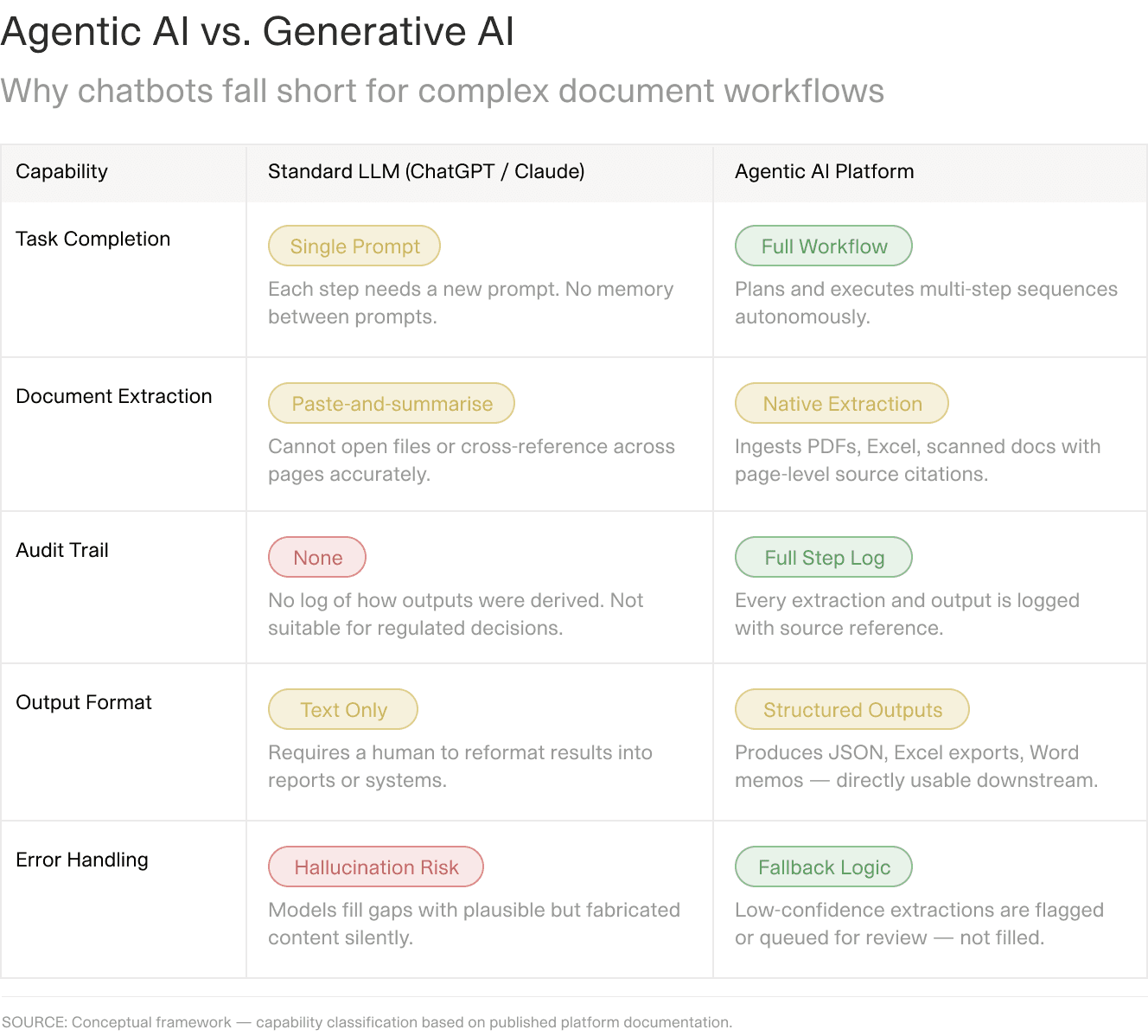
The distinction that matters for diligence is the audit trail column. An extraction you cannot trace back to a page is one an analyst has to redo.
That last point is not a technicality for allocators. A fiduciary who commits $50 million on the strength of a diligence file needs that file to show its working, and increasingly needs it to show its working to an investment committee, a board, or a regulator years after the analyst who built it has moved on. A summary that cannot be traced to a source document is an opinion. A field that opens the LPA at the governing clause is a record.
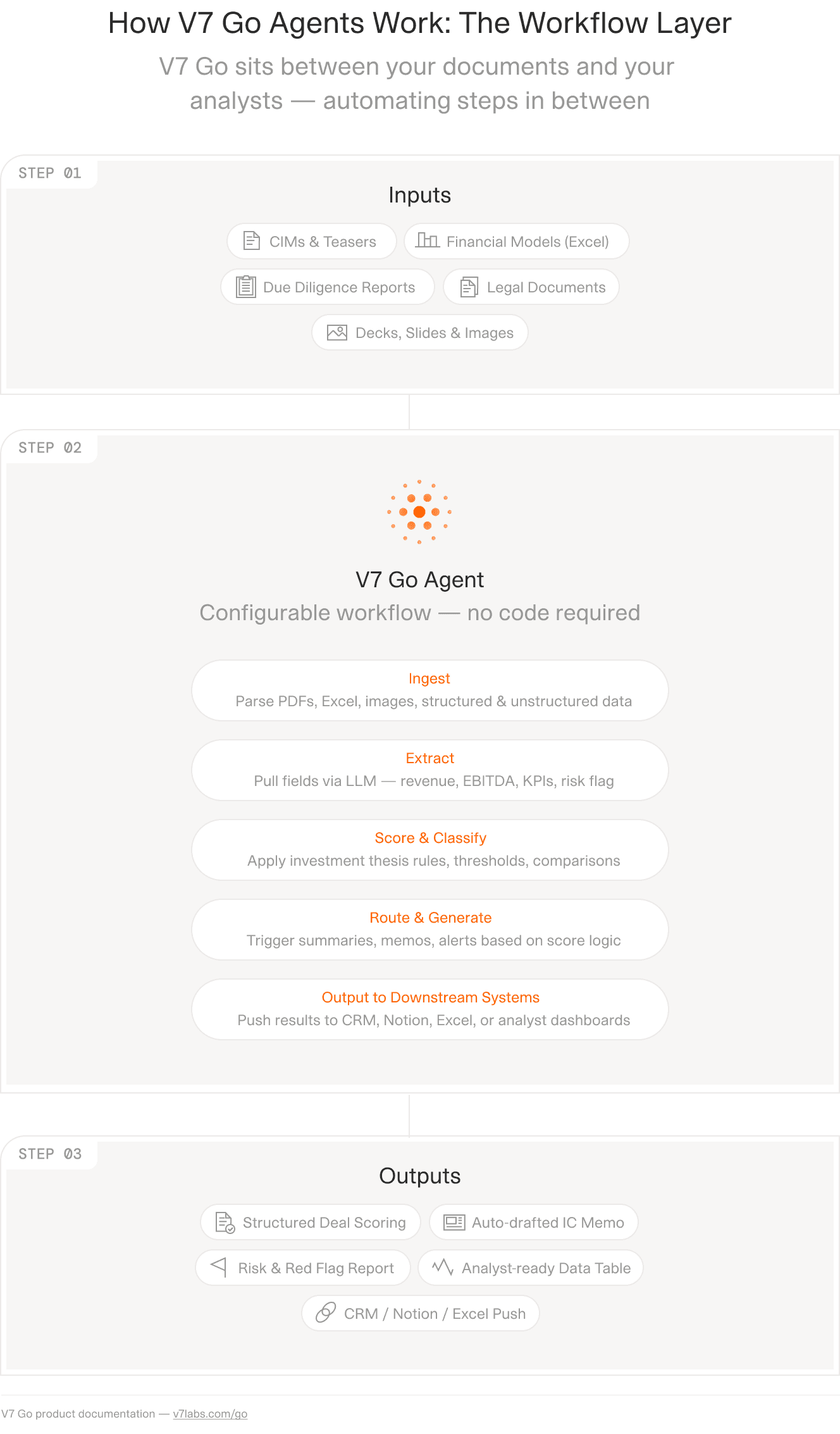
Documents in, a defined sequence of steps, structured fields out. The sequence is the part you specify.
Where this does not help
Worth being clear about the limits, because overselling this is how allocators end up disappointed.
Reference calls are the highest-signal part of manager diligence and none of this touches them. What a former portfolio company CEO says about how a GP behaved in a difficult quarter is not in the document package, and it is often the finding that changes the decision.
Nor does it help with the qualitative judgments that decide most allocations: whether a team that has worked together for eight years will survive a generational transition, whether an edge is structural or a run of luck, whether a manager doubling fund size can still execute the strategy that produced the track record. Those are the questions the IC exists to answer.
And a programme committing to three managers a year does not need any of this. The reading cost is real but it is three packages. Configuration only pays back on volume.
From document volume to investment decision
Investment manager selection has always been a judgment-intensive process. That has not changed. What is changing is the distance between receiving a document package from a manager and being ready to apply judgment to it.
For most of the last two decades that distance was measured in analyst days, and it acted as a tax on breadth. Every additional manager you wanted to look at properly cost three days that had to come from somewhere. Programmes responded the way any capacity-constrained operation does: by narrowing the funnel earlier, and by leaning on signals that are cheap to evaluate.
The practical effect of compressing the reading stage is not that diligence becomes faster. It is that it becomes wider.
A team that could properly evaluate twelve managers can properly evaluate twenty-five, and the eight or nine additional candidates are the ones that would previously have been cut on brand or relationship rather than on analysis. Occasionally one of them is a first-time fund with a genuinely differentiated sourcing model that would never have survived a capacity-driven screen.
That is the argument for doing this, and it is an investment argument rather than an efficiency one.
What to do about it
Three things, in order of how quickly they pay back.
Start by writing down the schema. Not software, just the list: every field the IC memo needs from every manager, agreed across the team. Most allocators discover during this exercise that two analysts have been capturing fee terms differently for years. The list is useful on its own and it is the prerequisite for everything else.
Then pick the stage that costs the most hours. For most programmes that is monitoring rather than diligence, because it recurs four times a year against every relationship rather than once against a candidate. Monitoring is also the easier place to start, since the documents are more predictable and the failure modes are less consequential.
Finally, keep the reference calls and the committee discussion exactly where they are. The reading is the part to compress. The judgment is the part you are protecting time for, and the entire point of the exercise is to have more of it available for the managers that deserve it.
If it would help to see this run against your own manager packages rather than a demo set, V7's solutions engineers build a working version before any commitment. Book a working session and bring a DDQ and a quarterly report from a manager you are actually looking at.
What is investment manager selection?
Investment manager selection is the structured process institutional allocators, including family offices, endowments, foundations, pension funds, and funds-of-funds, use to identify, evaluate, and appoint external fund managers. The process typically spans six stages: universe construction, quantitative screening, initial qualitative review, full due diligence (including a Due Diligence Questionnaire), operational due diligence, and an investment committee decision. Each stage narrows a broad universe of candidate managers to the final appointment. The process differs from ongoing manager monitoring, which involves evaluating existing relationships for re-up decisions, allocation changes, or exits. Selection is resource-intensive at initiation; monitoring is a continuous lower-intensity process that most LP teams underinvest in relative to its importance. Done well, investment manager selection is the primary analytical activity that determines alternatives portfolio performance, in many contexts, more consequential than the asset allocation decision itself.
+
What is a DDQ in private equity?
A DDQ, Due Diligence Questionnaire, is a structured document that institutional investors (LPs) send to fund managers (GPs) as part of the investment manager selection process. The ILPA DDQ 2.0, maintained by the Institutional Limited Partners Association, is the most widely adopted standardized version in private markets. It covers more than 100 topics across firm and fund history, team composition, investment process, performance attribution, compliance and regulatory status, fee structure, and fund governance. A manager's DDQ response typically runs 40 to 80 pages. LPs use DDQ responses as the primary structured input for qualitative due diligence, alongside audited financials, LPA review, reference calls, and on-site visits. The DDQ does not replace investment judgment, it is the document structure within which that judgment gets applied.
+
What is the difference between investment due diligence and operational due diligence?
Investment due diligence (IDD) evaluates the manager's investment strategy: process, team, historical performance, attribution, and competitive positioning. Operational due diligence (ODD) evaluates the manager's infrastructure: fund administration, compliance function, regulatory standing, key person provisions, cybersecurity, back-office capabilities, and the LP-facing terms embedded in the LPA. Both are required components of serious investment manager selection. IDD typically receives more attention, but ODD failures are responsible for a disproportionate share of post-commitment manager relationship terminations. A fund with a strong track record and a compliance function that missed a material disclosure represents a risk the track record alone will not surface. Sophisticated LPs run IDD and ODD in parallel, with separate reviewers, and treat ODD findings as equally capable of stopping a selection decision.
+
How long does investment manager due diligence take?
The timeline for investment manager due diligence varies significantly by institution, asset class, and the manager's responsiveness. A full cycle, from DDQ issuance to investment committee decision, typically takes 3 to 6 months for a private equity fund. Hedge fund due diligence can move faster, often 4 to 8 weeks for managers with comprehensive documentation already prepared. The bottleneck is usually not the analytical judgment itself, but the document processing phase: reading and structuring DDQ responses, verifying claims against audited financials and fund legal documents, and compiling findings for committee review. Configured document extraction can compress this phase significantly, reducing the time between receiving materials and being ready for substantive analytical review from days to hours, without changing the timeline for reference calls, site visits, or committee deliberation.
+
How do institutional investors monitor fund managers after selection?
No, and the framing misses what AI actually does in this context. Investment manager selection requires judgment about whether a team's culture matches what is described in the DDQ, whether the investment thesis is genuinely differentiated, and whether the edge claim will survive the next market cycle. AI does not make those calls. What AI does is compress the document processing work that currently occupies most of the time between receiving a manager's materials and being ready to apply judgment to them. Extracting 30 structured fields from a 60-page DDQ, cross-referencing them against audited financials and LPA terms, and producing a structured comparison matrix, that work currently takes a senior analyst 2 to 3 days per manager. An AI agent completes it in under 2 hours, with citations to every source page. The analyst's time shifts from extraction to evaluation. The decision stays human.
+
Can AI replace the investment analyst in fund manager evaluation?
Go is more accurate and robust than calling a model provider directly. By breaking down complex tasks into reasoning steps with Index Knowledge, Go enables LLMs to query your data more accurately than an out of the box API call. Combining this with conditional logic, which can route high sensitivity data to a human review, Go builds robustness into your AI powered workflows.
