11 min read
—


Casimir Rajnerowicz
Content Creator
V7 Go
A smarter way to manage due diligence and underwriting
Someone on your team has already asked it. Possibly your CFO, possibly the person who owns the software budget: we pay for ChatGPT already, so why are we buying a document platform?
It is a fair question and it deserves a real answer rather than a vendor's answer.
Here is the short version. ChatGPT is a conversational assistant. It is genuinely good at reading a document and telling you what is in it. Agentic AI platforms are built to run the same operation across hundreds of documents, return the same fields every time in a fixed structure, and show you where each value came from. Those are different products solving different problems, and the gap between them only becomes visible at volume.
If you are reviewing eight contracts, ChatGPT is the right tool and buying anything else is a waste of money. If you are reviewing eight hundred, the chat interface is the constraint, and no amount of prompt engineering fixes it.
This article works through where that line sits and why, using the specific case of enterprise document analysis rather than general capability claims. It is intended to be honest about what ChatGPT does well, because an argument that pretends otherwise is not useful to anyone actually making the decision.
What ChatGPT was designed for, what its current limits actually are in 2026, and which of the commonly cited limits are out of date.
The four capabilities that separate an agentic document pipeline from a chat interface: batch scale, schema enforcement, source attribution and repeatability.
A side-by-side comparison of the two workflows on one concrete task, with the arithmetic.
Where the gap is widest, covering insurance bordereaux, investment memos and regulated reporting.
Why "just use Claude" is a different objection, and why it does not change the answer.
What ChatGPT Was Designed to Do
ChatGPT is a conversational generative AI assistant. Give it a document and ask a question, and it will summarise, explain, compare against something else you paste in, draft a response, or pull out a figure you describe in plain language. For that work it is excellent, and the honest position is that a large share of document tasks inside any company are exactly that shape.
The design constraint is not intelligence. It is that a conversation is the interface.
Everything follows from that. A conversation has one participant driving it, a finite amount of material it can hold in mind at once, and no memory of the format it used last Tuesday. Those properties are correct for an assistant. They are the wrong properties for a production pipeline.
The limits people quote are usually out of date
Most comparison articles in this category still cite a 10-file upload cap. That figure is stale. Since an OpenAI update on 13 February 2026, ChatGPT accepts up to 20 files in a single message on the web, Team and Enterprise plans allow roughly 160 files per three hours, individual files can reach 512MB, and text-heavy files are bounded by a 2 million token ceiling rather than a page count.
Those are considerably better numbers than the ones circulating in most vendor comparisons, and any argument built on the old limits collapses the moment a prospect checks. So build the argument somewhere else.
Because the file cap was never the real problem.
The four things a conversation cannot give you
Upload capacity is a number, and numbers improve with every release. The structural gaps do not, because they follow from what a chat interface is.
Repeatability. Run the same prompt against the same 40 documents on Monday and again on Thursday and you will get answers that agree in substance and differ in shape. One run labels a field "Termination Date", the next says "Expiry", a third returns a sentence instead of a date. For a human reading the output that is fine. For a column in a spreadsheet feeding a model, it is a defect.
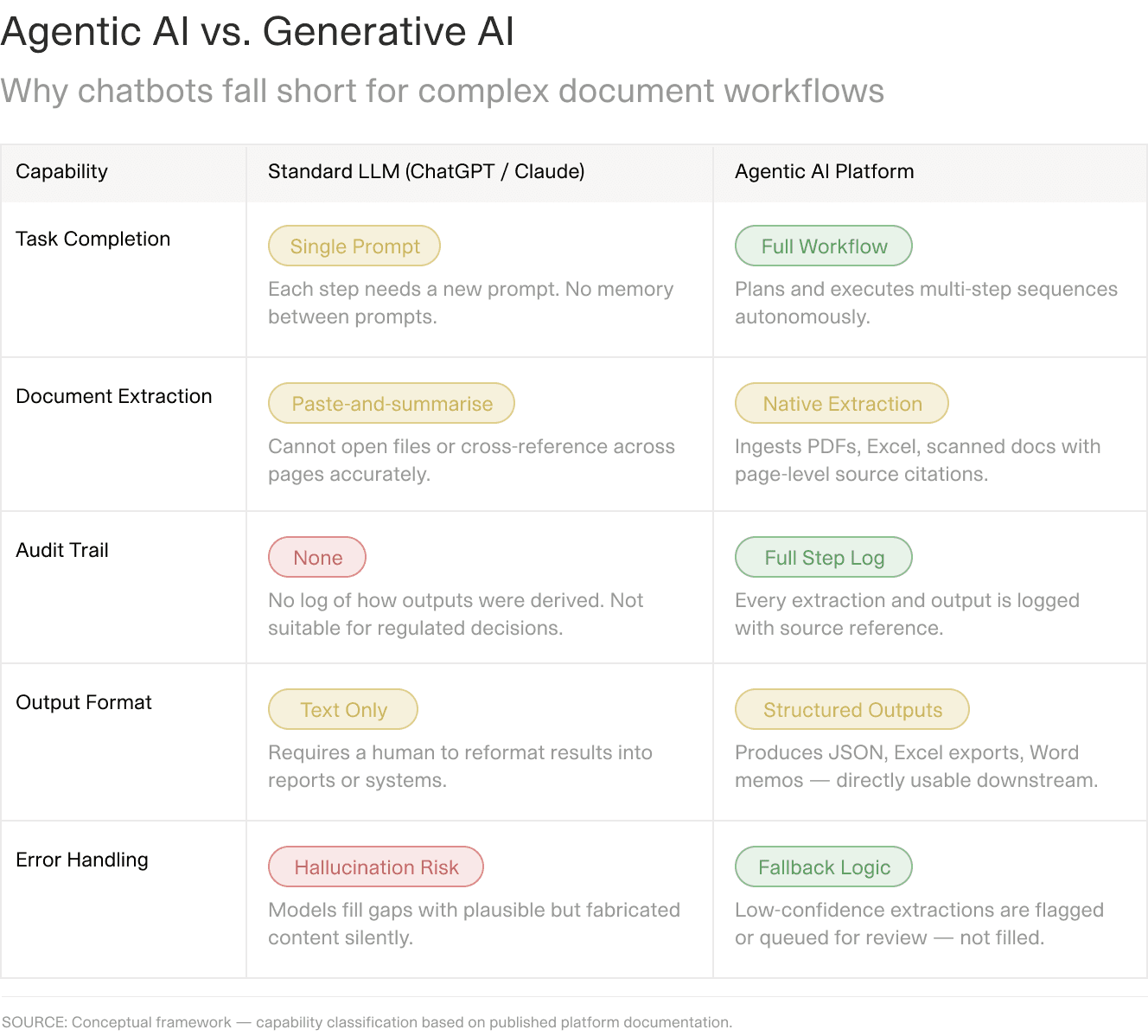
The four gaps as a table. Read the audit trail and output format rows first: those are the two a better model does not close.
Schema enforcement. An agentic platform defines the output structure before it processes anything: 27 fields, these types, these permitted values, and a flagged exception when a document does not yield one of them. Chat tools have structured output modes, and they work reasonably well on a single call. Holding the same structure across 800 calls without drift is a different engineering problem.
Source attribution. When ChatGPT reports that a policy limit is $2 million, the answer is text. There is no anchor to page 34, paragraph 3 of the source PDF. In insurance, legal and financial workflows, an extracted figure that cannot be traced to its origin is a figure that has to be checked manually, which returns you to the labour the tool was bought to remove.
Exception handling. A pipeline processes 800 documents and surfaces the 31 that failed validation. A conversation processes what you paste and tells you what it found, with no notion of a run, a failure rate, or which documents deserve a second look. You discover the problems by reading everything, which is the original job.
Notice that none of these is a complaint about model quality. Give ChatGPT one contract and a specific question and the answer will frequently be better written and better reasoned than what a junior analyst produces. The gap is not in the reading. It is in everything that surrounds the reading when the reading has to happen 800 times and the result has to be defensible.
Accuracy, with the actual numbers
The accuracy comparison in this category is usually made badly, with round numbers and no source. The honest version is more interesting and less dramatic.
On OmniDocBench, a document parsing benchmark that includes tables, the open-source vision model PaddleOCR-VL scores 92.86 against GPT-4o's 85.80. General models have closed most of the gap on straightforward text and now beat traditional optical character recognition (OCR) on table-heavy documents outright. The remaining spread is real but modest.
Seven points sounds survivable. Apply it to a batch.
At 85.80% field-level accuracy, a run over 1,000 documents extracting 20 fields each produces roughly 2,840 incorrect values. At 92.86% it produces about 1,428. Both numbers are too large to accept blind, which is the actual conclusion: the difference that matters is not the accuracy percentage but whether the system tells you which values to check. A platform that returns 1,428 errors with confidence scores and source links is usable. A chat transcript that returns 2,840 errors indistinguishable from the correct ones is not, and the gap between those two situations is not something a better model fixes.
This is also why enterprise trust has lagged capability. In Gartner's 2025 survey of IT application leaders, only 13% strongly agreed their organisation had the governance structures needed to manage AI agents, and just 19% of respondents reported high or complete trust in their vendor's hallucination protection. The technology got good. The verification layer did not arrive at the same time.











What an Agentic Document Pipeline Does Instead
The conceptual distinction between generative and agentic AI is covered properly in our guide to agentic AI vs. generative AI, so this section stays on the operational question: what changes in the work.
An agentic document workflow is configured once and then run. Configuration means declaring the document type, the fields to extract, the validation rules each field must satisfy, and what should happen when a document fails one. Running means pointing it at a folder.
Between those two steps there is no human, which is the entire point, and also the thing that makes people nervous. So it is worth being precise about where the human goes: not between every document and the next, but at the exception queue and the sign-off. The reviewer stops reading 800 documents and starts reviewing 31 flagged fields. The judgment is unchanged. The volume of material that judgment has to pass over drops by an order of magnitude.
The same task, both ways
Take one concrete job: 400 commercial insurance policy documents, extract eight fields from each, produce a clean table for the underwriting team.
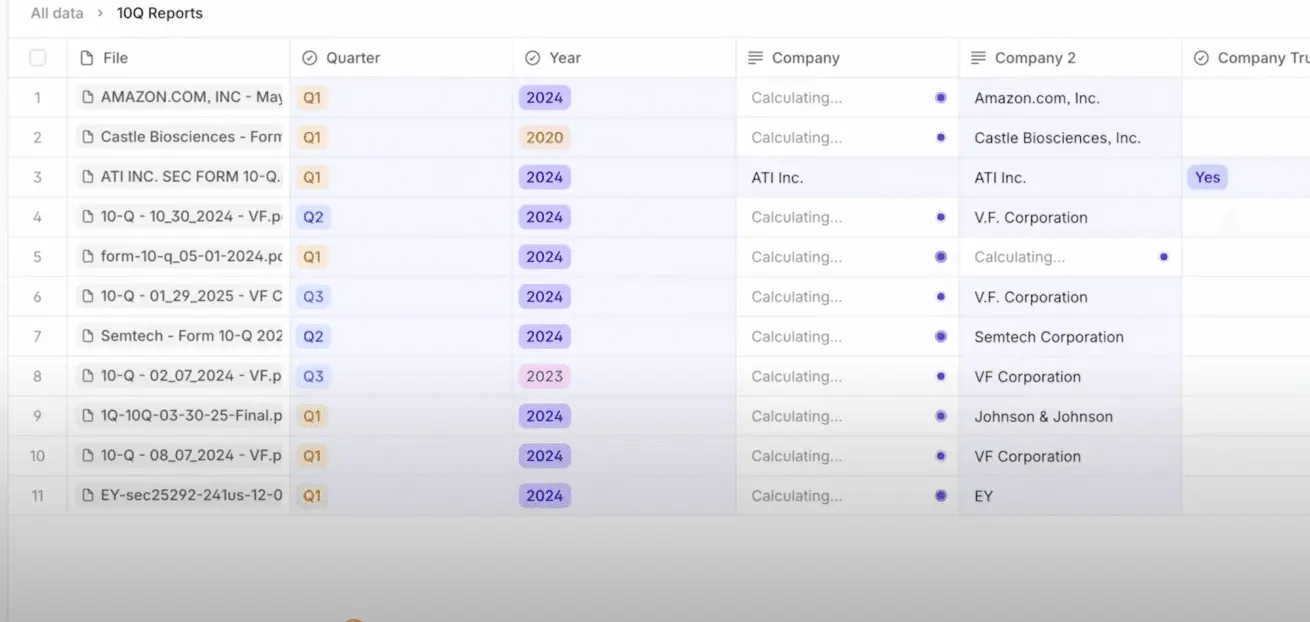
The row that decides this is not the processing row. It is the last one.
A one-off review of 400 documents is a project, and a project can absorb a clumsy method. A quarterly review of 400 documents is a process, and the setup cost amortises across every subsequent run while the manual cost does not. That is why the honest recommendation flips based on frequency rather than volume alone: a single 400-document exercise you will never repeat is often faster in a chat window, and anyone who tells you otherwise is selling something.
Where the setup cost is not worth it
Be direct about this, because a purchase made on the wrong reasoning fails in month three and poisons the next three proposals.
A configured pipeline is not worth building when the document set is small, when it is genuinely one-off, when the fields you need change every time you look, or when the output is going into a memo a person will write anyway rather than a system. In all four cases the setup cost exceeds the manual cost, and the chat interface is the correct tool.
It becomes worth building when the same document type arrives repeatedly, when the output has to be structured to be useful, when someone downstream needs to know where a number came from, or when the volume exceeds what a person can attend to properly. Most enterprises have both kinds of work, which is why the realistic end state for nearly every team is both tools rather than one.
Where the Gap Is Widest
The abstract argument only becomes convincing against a specific workflow, so here are three where the distinction stops being theoretical.
Insurance bordereaux
A managing general agent receives bordereaux from coverholders every quarter: spreadsheets of risks and claims in formats that differ by coverholder and drift over time. The work is normalising them into one reporting structure, and it repeats forever. Field names vary, columns move, one coverholder reports premium gross and another net. Our guide to bordereaux processing covers the mechanics in detail. It is close to the canonical case for a configured pipeline: high repetition, fixed output schema, regulated reporting on the other end.
Investment memos and deal documents
A private equity team screening confidential information memoranda needs the same 30 data points from every one, in the same shape, so that deals can be compared to each other rather than read one at a time. The comparison is the product. Extraction that returns a well-written paragraph per deal defeats it. We cover this workflow in detail in our guide to turning a CIM into an investment memo.
Regulated reporting
Where an extracted figure ends up in a regulatory submission, the requirement is not accuracy alone but demonstrable provenance. A compliance officer signing a filing needs to show where each number originated. A conversational output cannot carry that, not because the model is unreliable, but because the format has nowhere to put the citation.
Notice the common thread. In all three cases the deciding factor is not that ChatGPT reads the documents worse. It is that the output has to survive contact with a downstream system, a comparison table or an auditor, and free text does not.
What About Claude, Gemini and Copilot?
This is the second objection, and it usually arrives about ninety seconds after the first.
Claude has a longer context window and handles long single documents better than most alternatives. Gemini is deeply wired into Google Workspace. Copilot sits inside the Microsoft stack where a lot of enterprise documents already live. All three are strong products and the choice between them is a real decision.
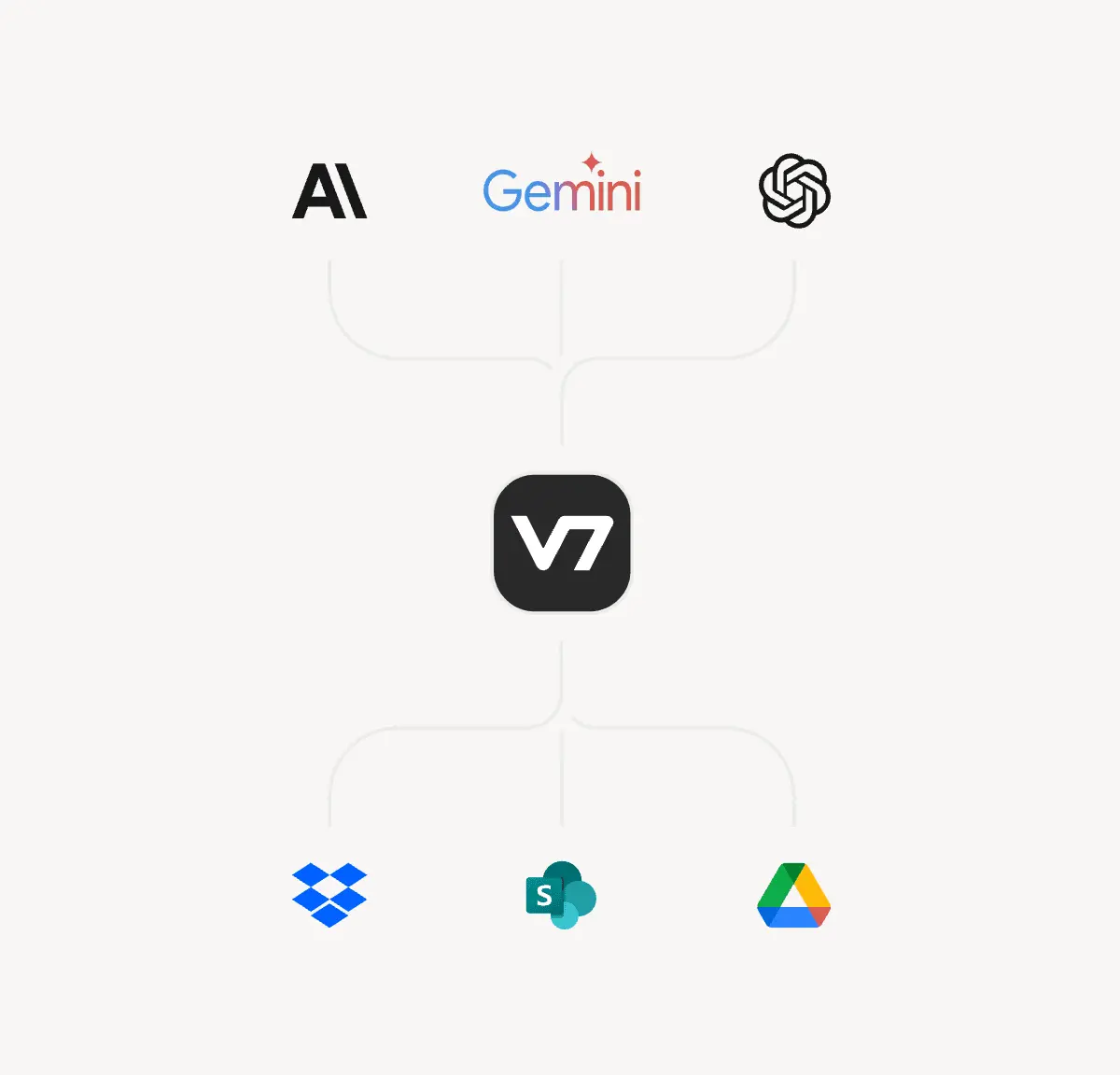
The assistants sit on one side of the line and the document sources on the other. A pipeline is the thing that has to reach both, which is why the choice between assistants does not settle the question.
It is also the wrong axis for this question. Every one of them is a conversational interface, which means every one of them has the same four structural gaps: no repeatability guarantee across runs, no enforced output schema across a batch, no field-level source anchoring, and no exception queue. A better model improves the quality of each individual answer. It does not turn a conversation into a pipeline.
The distinction is not which assistant is smartest. It is assistant versus pipeline, and every general-purpose chat tool sits firmly on one side of it.
If your evaluation is genuinely between chat tools, our roundup of ChatGPT alternatives compares them properly, including the platforms that are not chat tools at all.
How V7 Go Handles the Four Gaps
V7 Go is a document automation platform. It is not a chat product with a larger upload limit, and it is not an OCR engine. It runs configured agents against document sets and returns structured, traceable output, which maps onto the four gaps directly.
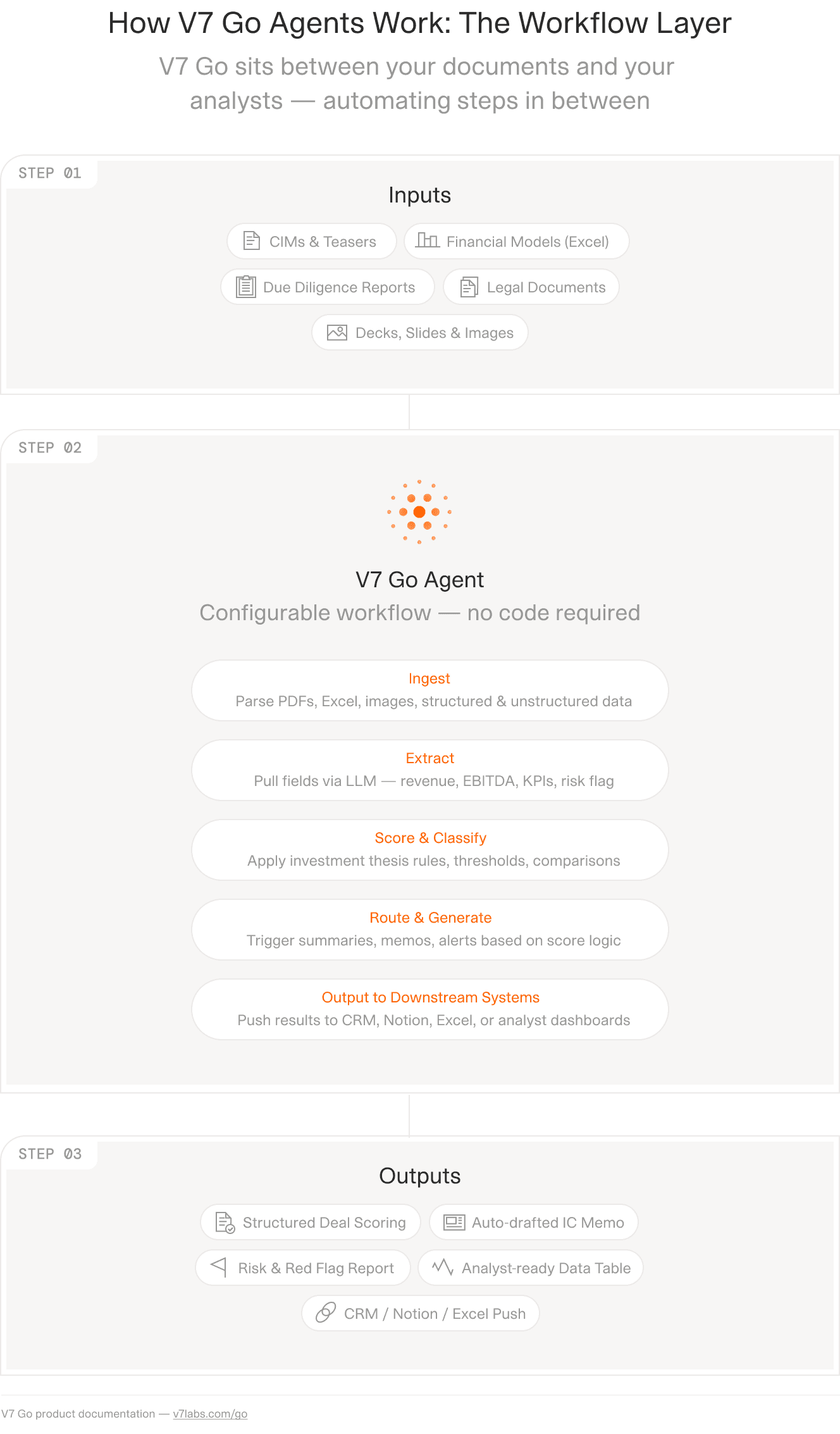
Documents in, a defined sequence of steps, typed fields out. The sequence is declared before the run rather than chosen during it.
Repeatability. An agent is a saved configuration, not a prompt written fresh each time. The same agent run in November returns the same fields in the same shape as it did in August.
Schema enforcement. The output structure is declared before processing. Every document returns the same fields with the same types, and a document that cannot supply one produces a flagged exception rather than a plausible guess.
Source attribution. Every extracted value links to its location in the source file. A reviewer checking a policy limit opens the page it came from rather than searching for it.
Exception handling. Validation rules run at extraction time. Multiple models can process the same field and disagreement between them is surfaced rather than averaged away, which concentrates human attention on exactly the values most likely to be wrong.
The workflow that results is unglamorous and that is the point. Documents go in, structured data comes out, a queue of exceptions goes to a person, and the person applies the judgment they were always applying, to a much smaller pile.
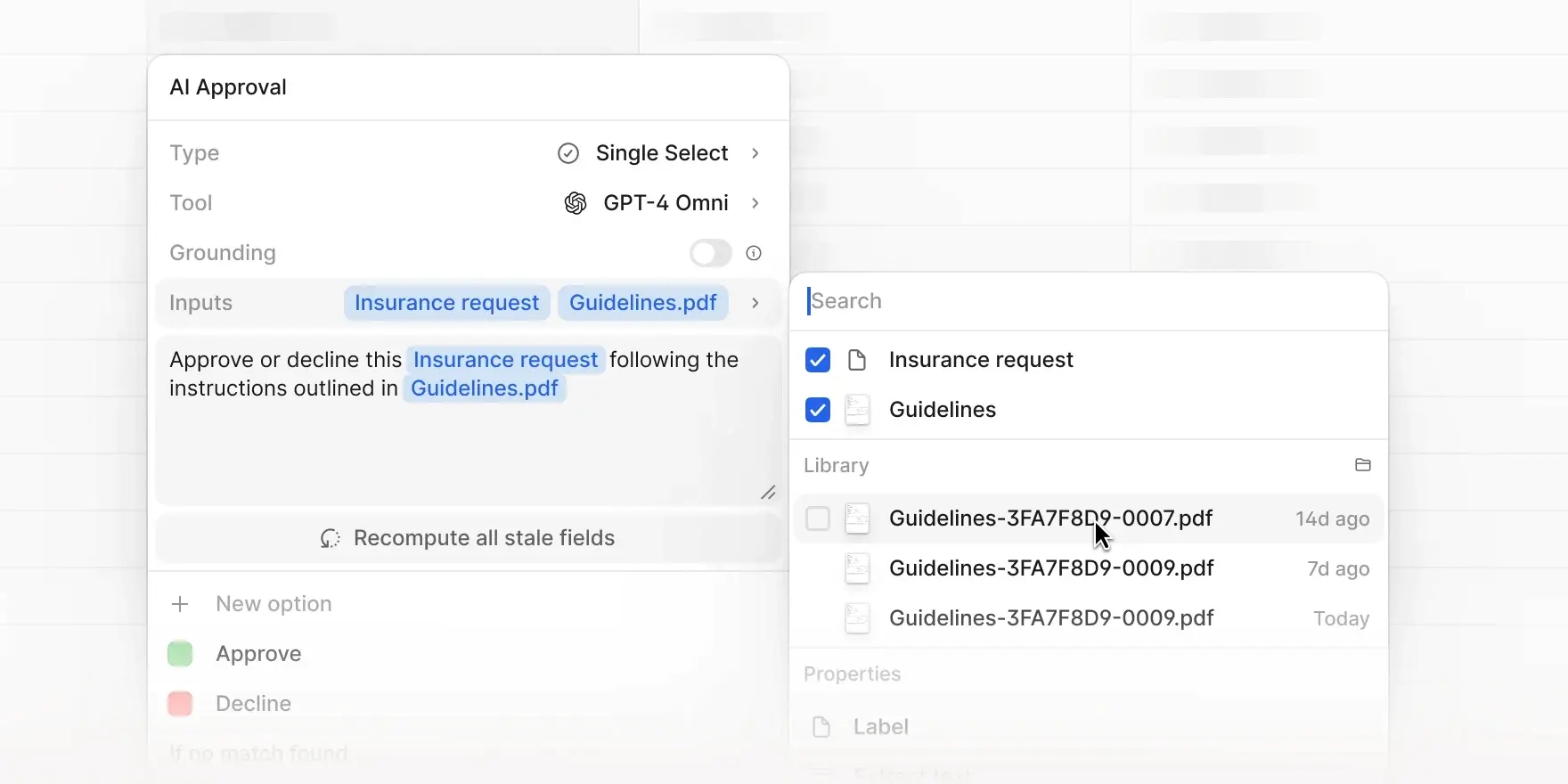
Where the person goes. Not between every document and the next, but at the approval step, holding the queue of fields the run could not clear on its own.
The part that is easy to oversell
Configuration is real work. Defining 27 fields and their validation rules against a messy document population takes someone who understands both the documents and the downstream use, and that person is usually not available. Any platform in this category that suggests otherwise is describing a demo rather than a deployment.
The return arrives on the second run, and every one after it.
So What Should You Tell Your CFO?
Something close to this.
The ChatGPT subscription is not wasted and should not be cancelled. It is the right tool for drafting, for reading a single document closely, for the hundred small analytical tasks that arrive without warning and never repeat. Roughly nobody in the company should stop using it.
The document platform addresses a different line item: the recurring, structured, high-volume extraction work where output has to be consistent, traceable and machine-readable. Those workflows are identifiable. They have a document type, a cadence, a fixed set of fields and someone downstream who consumes the result. If your organisation has three or four of them, the arithmetic is usually straightforward. If it has none, do not buy anything.
That framing also survives the follow-up question, which is why enterprises that already have AI keep buying more of it. Gartner reports that 80% of enterprise applications shipped or updated in the first quarter of 2026 embed at least one AI agent, up from 33% in 2024. The direction is not in dispute. What separates the deployments that survive from the 40% of agentic projects Gartner expects to be cancelled by the end of 2027 is almost never model capability. It is whether the output could be verified, and whether anyone could tell when it was wrong.
Which brings the argument back to where it started. The question was never whether ChatGPT is any good.
It is whether a conversation is the right container for work that has to be defended.
Can ChatGPT analyse documents accurately?
For reading a single document and answering questions about it, yes. Accuracy on structured extraction across a batch is a different measure. On OmniDocBench, a document parsing benchmark that includes tables, GPT-4o scores 85.80 while the specialised vision model PaddleOCR-VL scores 92.86. Applied to 1,000 documents with 20 fields each, that difference is roughly 2,840 incorrect values versus 1,428. Both are too many to accept without checking, which is the practical point: the deciding factor is not the headline accuracy figure but whether the system flags which values need review and links each one to its source. A chat transcript gives you neither, so every value carries the same uncertainty.
+
What is the difference between ChatGPT and an AI agent?
ChatGPT is a conversational assistant. A human drives each step, reads each response and decides what happens next. An AI agent is a saved configuration that runs a defined sequence over a document set without a person between each step, applying validation rules and surfacing exceptions rather than returning prose. The practical difference shows up in repeatability and structure. Ask ChatGPT the same question about the same 40 documents twice and you will get answers that agree in substance but differ in shape and field naming. An agent returns the same fields in the same format on every run, which matters when the output feeds a spreadsheet, a model or a reporting system rather than a person.
+
Is ChatGPT good for enterprise document processing?
It depends entirely on whether the work repeats. For ad-hoc analysis, drafting, summarising and close reading of individual documents, ChatGPT is well suited and most organisations should keep using it for exactly that. For recurring extraction where the same document type arrives on a cadence and the output must be structured, consistent and traceable, a conversational interface becomes the constraint. The honest test is frequency rather than volume alone. A single review of 400 documents you will never repeat is often faster in a chat window. A quarterly review of the same 400 justifies a configured pipeline, because the setup cost amortises and the manual cost does not.
+
What are the main limitations of ChatGPT for document review?
Four structural ones, none of which are about model quality. Repeatability: output format drifts between runs, so field names and value formats vary across a batch. Schema enforcement: holding a fixed output structure across hundreds of calls is unreliable, even with structured output modes. Source attribution: an extracted figure arrives as text with no anchor to the page and paragraph it came from, so verifying it means opening the original. Exception handling: there is no concept of a run or a failure rate, so identifying which documents went wrong means reading all of them. Upload caps are often cited too, but those limits have risen substantially and are no longer the binding constraint.
+
How many files can ChatGPT process at once in 2026?
Because the output has to survive contact with something other than a reader. When extracted data feeds a spreadsheet, a model, a reporting system or a regulatory filing, it needs a fixed schema, consistent field naming across every document, and a traceable link back to the source for each value. Those requirements come from the downstream consumer, not from the reading task itself. A purpose-built platform is configured once and rerun, surfacing exceptions rather than prose. If your document work is occasional, unstructured and consumed by a person who will write it up anyway, that machinery is unnecessary overhead and a chat tool is the better choice.
+
Why use a purpose-built document AI instead of ChatGPT?
Go is more accurate and robust than calling a model provider directly. By breaking down complex tasks into reasoning steps with Index Knowledge, Go enables LLMs to query your data more accurately than an out of the box API call. Combining this with conditional logic, which can route high sensitivity data to a human review, Go builds robustness into your AI powered workflows.
