14 min read
—



V7 Go
A smarter way to manage due diligence and underwriting
Generative AI is reactive; agentic AI is proactive. That distinction determines whether you are deploying a tool that assists a human or a system that acts on behalf of one, and it has direct consequences for how you design enterprise automation.
Most organisations have already deployed some form of generative artificial intelligence (AI): a writing assistant, a code completion tool, or a document chatbot. These systems excel at producing content in response to a prompt. A legal team uses one to draft contract clauses. A finance team uses one to summarise a financial statement. An operations team uses one to generate a response to a client query. The content is useful; the process still requires a human to direct each step.
Agentic AI operates on a different principle. Given a goal, it determines what steps are required, calls the tools needed to execute them, observes the results, and adapts without waiting for human direction at each transition. An agentic system can receive a document, classify it, extract structured data, validate it against business rules, route it to the correct workflow, write outputs to downstream systems, and log the full audit trail, all without prompting after the initial objective is set. This is why agentic AI is the natural choice for intelligent document processing at scale.
The two paradigms are not in competition. Most agentic systems use a generative AI model as their reasoning engine; the LLM handles individual reasoning steps while the agentic system manages the overall workflow. Understanding how they differ, and how they work together, is now a practical prerequisite for any enterprise evaluating AI for operational automation.
In this article:
How generative AI works and where it reaches its limits
How agentic AI extends beyond content generation to autonomous action
Five key differences between the two, with a comparison table
Enterprise use cases, including document-intensive workflows no competitor covers
A threshold-based decision framework for choosing between the two
Governance and risk requirements that differ between the two
What Is Generative AI?
Generative artificial intelligence (AI) describes systems trained on large datasets to generate new content (text, images, code, or audio) that conforms to the statistical patterns in that training data. Given a prompt, a generative AI model runs a single inference pass: it interprets the input, produces an output, and stops. According to IBM's overview of large language models, these systems learn to predict the most probable next token given a sequence of inputs, a mechanism that produces coherent, contextually relevant content but has no concept of goals, steps, or actions beyond the current output.
The canonical examples are ChatGPT, Midjourney, GitHub Copilot, and Gemini. Each responds to a prompt with a bounded, single-pass output. The human then decides what to do with the result.
This architecture has a defining constraint: generative AI cannot manage a process. It can draft a contract clause, but it cannot read the original contract, identify which clause needs updating, validate the change against the negotiation playbook, and route it for review, without a human directing each of those transitions. Content creation is generative AI's domain; process management is not.
What Is Agentic AI?
Agentic AI builds on generative AI's foundations. It uses large language models (LLMs) as a reasoning engine but extends beyond content generation to goal-directed action. Given an objective, an agentic system determines the sequence of steps required to achieve it, executes them, and adapts based on what it observes.
Generative AI answers the question "What should I create?" Agentic AI answers "What should I do next, and how do I get there?" That difference in framing captures the essential architectural distinction.
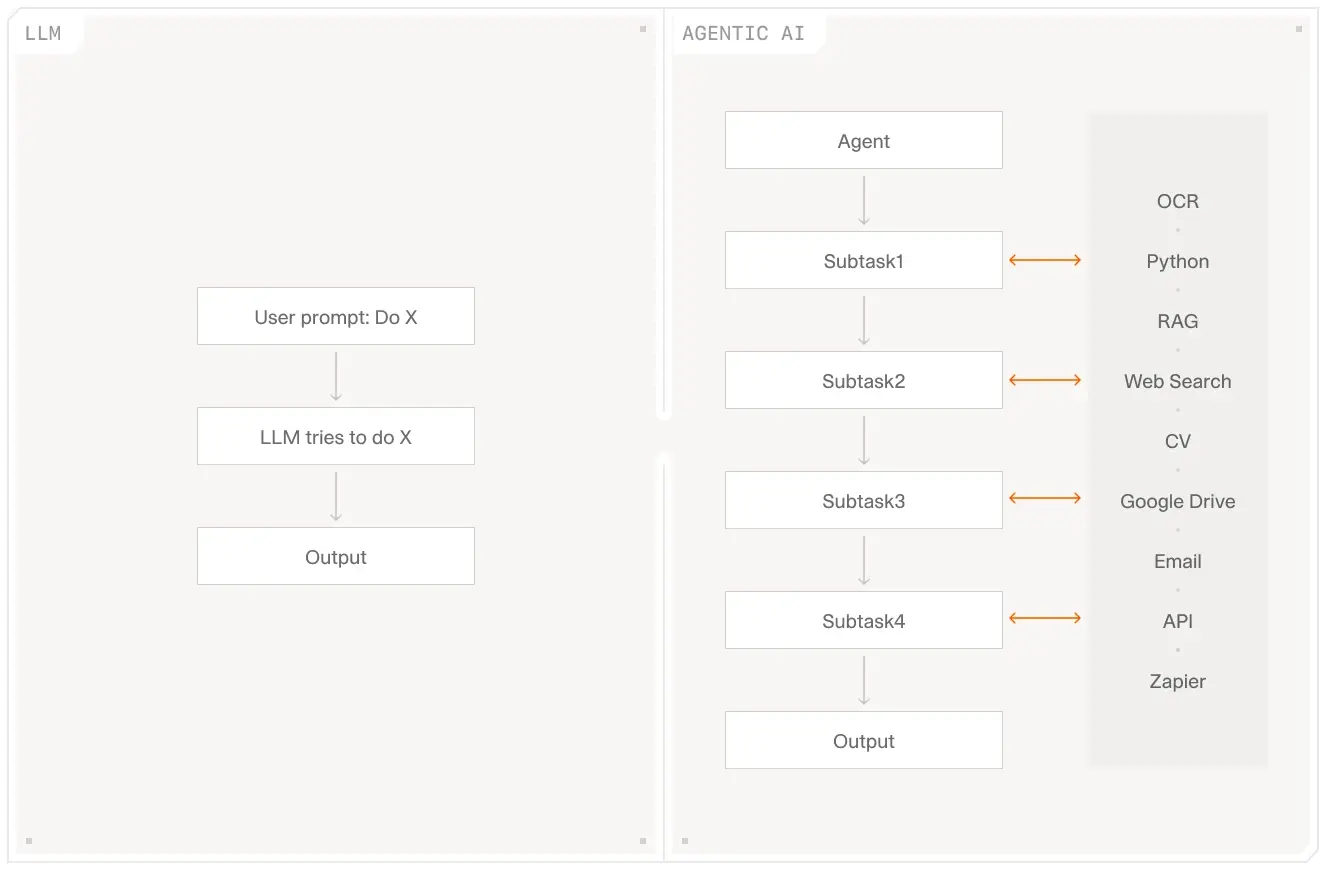
A single-step LLM workflow versus an agentic AI architecture: the agent breaks the goal into steps, calls external tools, and adapts based on what it observes at each stage.
Four capabilities distinguish an agentic system from a purely generative one:
Tool use: an agentic system calls external APIs, databases, code interpreters, and other software as part of its workflow. It does not generate text describing what a tool might do; it calls the tool and acts on the result.
Memory: agentic systems maintain short-term context within a task and long-term state across sessions. A system processing 500 invoices can recall what it extracted from invoice 50 when processing invoice 450, enabling consistency checks and cross-document validation that a stateless generative model cannot perform.
Decision-making: the system evaluates conditions and selects the next action without waiting for a human prompt at each step. If extraction confidence is below 80 per cent, it flags for review; otherwise it proceeds to validation. That decision executes autonomously, at scale, consistently.
Iteration: the plan-act-observe-adapt loop means the system can retry a failed step, adjust its approach based on what it finds, and handle unexpected inputs within defined operating boundaries.
The agent is not just the model. The LLM provides reasoning; additional components handle tool orchestration, memory retrieval, and state management. A chatbot that responds to individual prompts is generative AI. The same system with computer use or code execution enabled begins to behave agentically, because it can take actions across steps rather than produce text in response to each prompt.
Agentic AI vs. Generative AI: Five Key Differences
The table below captures the five dimensions where the two paradigms diverge. The sections that follow expand each dimension.
Dimension | Generative AI | Agentic AI |
|---|---|---|
Mode | Reactive: responds to prompts | Proactive: pursues goals autonomously |
Scope | Single-step: one prompt, one output | Multi-step: plans and executes a sequence |
Output | Content: text, images, code, audio | Actions: API calls, file writes, decisions |
Human involvement | Continuous: human directs each step | Minimal: human sets the goal; agent manages execution |
Memory | Context window only: resets each session | Short-term and long-term: persists across steps and sessions |
Risk profile | Informational: hallucinations, bias in content | Operational: autonomous actions on live systems |
Mode is the most visible difference. A generative AI model waits to be asked. An agentic system monitors for triggers such as an incoming document, a scheduled event, or an API notification, and initiates a workflow in response. The human sets the objective once; the agent manages execution from there.
Scope determines what class of task each can handle. Generative AI handles tasks that fit within a single prompt-and-response exchange. Agentic AI handles tasks that require multiple steps, external data sources, and conditional routing: the kind of work that currently requires a human coordinator.
Output determines what happens after the system runs. A generative AI system produces content for a human to act upon. An agentic system produces actions: a record is updated, a document is routed, a form is submitted, a decision is logged with its reasoning. The action is the output, not the content that describes it.
Human involvement is the operational consequence of the above. Generative AI requires a human at each step to review the output and decide what to do next. Agentic AI requires a human to define the goal and the operating boundaries, then shifts the human role from directing each transition to monitoring the system and handling exceptions.
Memory determines the system's capacity for context-dependent decision-making across a series of related tasks. An agentic system processing a batch of related documents maintains a working record of what it has extracted, what decisions it has made, and what anomalies it has flagged, enabling cumulative pattern detection that a stateless generative model cannot perform.
Risk profile is the governance implication, and it is the most consequential difference for regulated industries. Generative AI's risks are informational: the output may be wrong or biased, but a human reads it before acting. Agentic AI's risks are operational: the system takes actions on live data and live systems, and errors may propagate before they are visible. This drives entirely different governance requirements, covered in the final section.











How Generative AI and Agentic AI Work Together
Agentic AI and generative AI are not alternatives. The correct model is orchestration plus execution: the agentic system manages the overall workflow and calls a generative AI model at the steps that require natural language reasoning or content generation.
A contract review workflow illustrates this. An AI agent receives a PDF contract, extracts the text using a document tool, calls an LLM to classify clauses and compare them against the negotiation playbook, logs flagged deviations in a database, routes the document for human review if confidence falls below a defined threshold, and produces a summary report using the LLM. In that pipeline, the LLM is a sub-tool. The agent is the manager.
This distinction matters for both architecture and governance. Guardrails are required at the LLM layer (output quality, grounding) and at the agent layer (action scope, escalation paths, audit requirements). Designing one without the other leaves gaps that only become visible when the system encounters an edge case at scale.
The practical implication: if you are evaluating generative AI and agentic AI as alternatives, you are framing the decision incorrectly. The question is not which to use, but where in the workflow each belongs. Generative AI handles the reasoning steps; agentic AI handles the orchestration around them.
Enterprise Agentic AI Use Cases
Agentic AI is most valuable in workflows that are high-volume, multi-step, and require consistent decision-making across systems. Three categories illustrate where it is already deployed.
Customer and Operations Workflows
An IT incident response agent receives an alert, queries the monitoring system, diagnoses the root cause against a known issue database, applies the relevant remediation playbook, and escalates if the issue falls outside defined parameters. A customer service agent checks order status, reviews account history, and resolves common queries without human intervention, escalating only the cases that require judgement.
What characterises both examples: the workflow spans multiple steps and systems; the routing logic executes consistently at scale; and human involvement is concentrated at the edges (goal definition and exception handling) rather than distributed across every step.
Data and Analytics Workflows
Data pipeline management agents monitor data quality metrics, detect anomalies, investigate upstream sources, and trigger remediation workflows. Research and synthesis agents query multiple data sources, reconcile conflicting information, and produce structured outputs. In both cases, the system must make decisions mid-process without waiting for a human response at each branch: is this anomaly within tolerance? Does this data point override the prior value or flag for review?
Document-Intensive Workflows
Documents represent an ideal agentic AI use case. A document workflow is inherently multi-step, context-dependent, and requires decision-making at each stage. Processing a single document using generative AI is useful; processing thousands of documents consistently, with routing logic, validation rules, and downstream system writes, requires an agentic system.
The document processing loop illustrates why. A document arrives by email, upload, or API. The agent classifies the document type, extracts structured fields using a document model, validates the extracted data against business rules, routes to the appropriate workflow (approve, escalate, request more information, or reject), writes outputs to downstream systems, and logs the full audit trail. Each stage involves a decision. Generative AI can perform any individual stage. Only an agentic system can execute all stages consistently, at volume, without a human directing each transition.
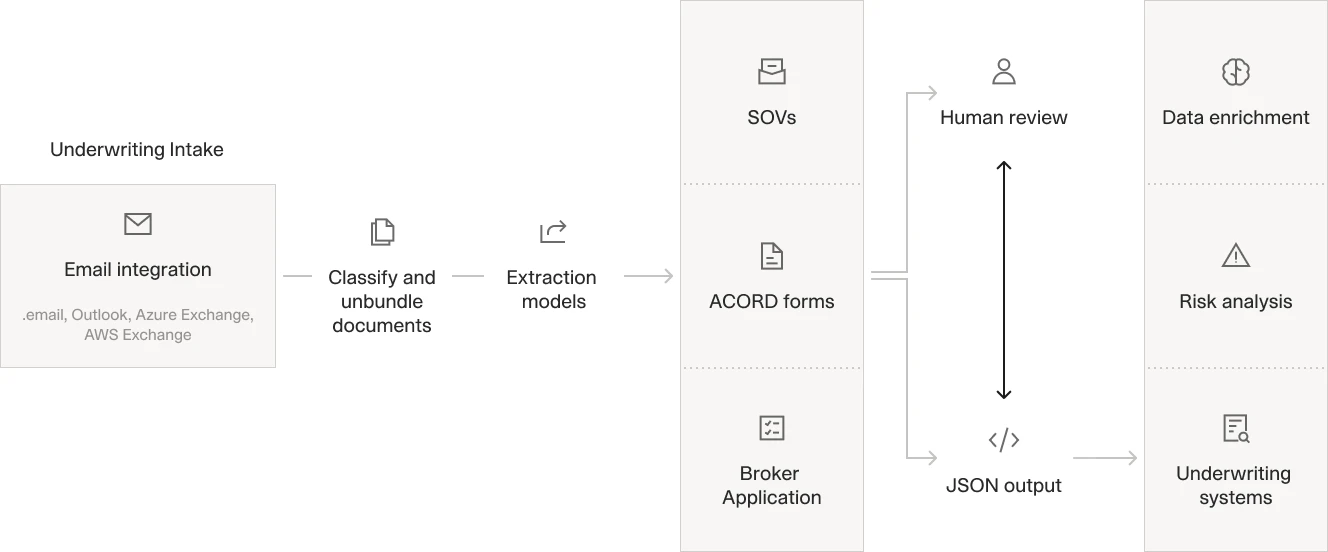
An agentic document processing pipeline: from document receipt through extraction, validation, routing, and audit logging, executed without human direction at each step.
Vertical examples:
Legal: An agentic system reviews incoming contracts, uses an AI policy analysis agent to flag non-standard clauses, compares them against the negotiation playbook, and produces a redline summary for the lawyer, who reviews only the flagged deviations rather than the full document.
Insurance: An AI insurance document ingestion workflow processes incoming loss run reports, extracts claims data across multiple PDFs, normalises fields, calculates loss ratios, and flags accounts that exceed underwriting thresholds for underwriter attention.
Finance: An agent ingests invoices across multiple formats, extracts line items, matches them against purchase orders, routes matched invoices for auto-approval, and routes mismatched invoices for human review with a structured exception summary.
Compliance: An agent monitors regulatory update feeds, maps changes to affected policy documents, and flags sections requiring redrafting, assigning them to the appropriate team with a summary of what changed and why it is relevant.
V7 Go is built for document-intensive agentic workflows. From AI for insurance underwriting to legal contract review and financial data extraction, the platform orchestrates multi-step document pipelines with citation-level audit trails at each decision point.
The video below shows a V7 Go agent processing financial documents autonomously across multiple steps.
V7 Go orchestrating a multi-step document workflow: ingestion, extraction, validation, and routing, executed autonomously with a full audit trail.
When to Use Generative AI — and When You Need Agentic AI
The choice between generative AI and agentic AI is not primarily a question of capability. It is a question of workflow design. The following framework treats it as a threshold decision.
Use generative AI when:
A human is directing each step and reviewing each output before the next step begins
The task produces a single bounded output: a draft, a summary, an analysis, or a piece of code
The output is informational and a human decides what to do with it
The error cost is low: a wrong output can be corrected before it causes downstream consequences
The task is self-contained within one data source or document
You need agentic AI when:
The workflow spans more than two or three steps and multiple systems
The system must make routing or approval decisions mid-workflow without human input at each step
The output is an action: something happens in an external system as a result
Volume makes continuous human-in-the-loop direction impractical: 100 or more documents per day, 1,000 or more transactions per week
The workflow requires persistent memory across sessions or across a series of related documents
Audit trail and reproducibility requirements mean every automated decision must be logged and traceable
Practical test: if the workflow requires conditional logic across any step, and that logic must execute consistently at scale without a human making the routing decision at each branch, you need agentic AI, not generative.
Governance: How the Risk Profiles Differ
Generative AI and agentic AI pose fundamentally different governance challenges, and conflating them leads to either under-governing agentic deployments or over-engineering generative AI guardrails.
Generative AI poses informational risk: the system produces content that may be incorrect, biased, or misleading. A human reads the output before acting, which means there is a natural review step between the model's output and its consequences. Mitigation focuses on output quality: retrieval-augmented generation (RAG), citation requirements, and fact-checking workflows.
Agentic AI poses operational risk: the system takes actions on live data and live systems. There is no automatic human review step between the agent's decision and its action unless one is deliberately designed in. An error that deletes a record, submits a form with wrong data, or routes a document incorrectly may not be visible until after it has caused downstream consequences, some of which may be difficult to reverse.
The NIST AI Risk Management Framework provides a structured approach to AI risk. For agentic deployments specifically, the following must be defined before the system goes live:
Decision boundaries: which decisions can the agent make autonomously, and which must escalate to a human?
Confidence thresholds: at what confidence level does the agent act versus flag for review? A common pattern: above 95 per cent, auto-process; between 75 and 95 per cent, route to a human review queue; below 75 per cent, reject and request more information.
Tool access scope: which APIs and systems can the agent call? The least-privilege principle applies: access only to what the task requires, nothing more.
Escalation paths: when something unexpected occurs, who does the agent notify, through which channel, and within what time frame?
Audit trail requirements: every decision the agent makes should be logged with the inputs received, the model output, and the action taken.
Human-in-the-loop gates: specific steps where a human must approve before the agent proceeds, regardless of confidence score.
In regulated industries — financial services, insurance, healthcare, legal — audit trail and confidence thresholds are not optional. Regulators expect you to explain why an automated system made a specific decision on a specific document. Design the audit trail first; build the agent second.
For enterprises operating under the EU AI Act, high-risk AI systems, including automated decision-making in employment, credit, and insurance underwriting contexts, are subject to conformity assessments and ongoing documentation requirements. The distinction between an agentic system taking autonomous decisions and a generative AI tool assisting a human decision-maker is material to classification under that framework. Organisations should review their planned deployments against the Act's risk categories before going live.
What is the main difference between agentic AI and generative AI?
Generative AI creates content in response to a prompt: reactive, single-step, bounded. Agentic AI autonomously pursues goals across multiple steps, using tools, memory, and decision-making to act on external systems without continuous human direction. Generative AI produces outputs for a human to act upon; agentic AI takes the actions itself. The two are not alternatives: most agentic systems use a generative AI model as their reasoning engine. The correct model is orchestration plus execution: the agentic system manages the workflow and calls the generative model where natural language reasoning is required.
+
What are examples of agentic AI?
An AI system that monitors incoming insurance claims, extracts data from documents, validates against policy rules, and either auto-approves or escalates for human review, without prompting at each step, is agentic AI. Other examples include automated contract review pipelines that flag clause deviations and route documents for legal review; IT incident response agents that diagnose and remediate without human prompting at each step; and financial document processing agents that extract line items, match against purchase orders, and route exceptions for human approval. What all examples share: multi-step execution across systems with conditional routing logic that runs without human direction at each branch.
+
Is ChatGPT generative AI or agentic AI?
ChatGPT in standard mode is generative AI: it responds to individual prompts and produces content. ChatGPT with tools enabled (code execution, web search, computer use) begins to behave agentically because it can take actions across multiple steps. The distinction is not the underlying model but the system around it: whether the system can act autonomously across steps and systems, or only respond to each prompt in isolation. A chatbot that answers questions is generative; the same system that reads a file, executes code, and writes back results based on what it finds is exhibiting agentic behaviour.
+
What are the risks of agentic AI compared to generative AI?
Generative AI poses informational risk: incorrect content that a human can catch before acting on it. Agentic AI poses operational risk: the system takes actions on live systems, and errors may propagate before they are visible. A wrong clause in a generated contract is caught in review; an agentic system that routes a claim incorrectly or submits a form with errors may cause consequences that are difficult to reverse. Agentic deployments require explicit governance designed from the start: decision boundaries, confidence thresholds, audit trails, tool access scope, escalation paths, and human-in-the-loop gates at defined workflow steps.
+
When should a business use agentic AI instead of generative AI?
Yes, and in most enterprise agentic deployments, they do. Most agentic systems use a generative AI model as their reasoning engine. The LLM handles natural language understanding, content generation, and decision-making at specific steps; the agentic system orchestrates the overall workflow, calls external tools, maintains memory across steps, and manages routing logic. The agent is the manager; the generative model is one of its tools. Improving the underlying model improves the agent's reasoning quality. Improving the agentic orchestration improves what that reasoning can accomplish across a full workflow.
+
Can agentic AI and generative AI work together?
Go is more accurate and robust than calling a model provider directly. By breaking down complex tasks into reasoning steps with Index Knowledge, Go enables LLMs to query your data more accurately than an out of the box API call. Combining this with conditional logic, which can route high sensitivity data to a human review, Go builds robustness into your AI powered workflows.
+
Casimir is a seasoned tech journalist and content creator specializing in AI implementation and new technologies. His expertise lies in LLM orchestration, chatbots, generative AI applications, and computer vision.