11 min read
—


V7 Go
A smarter way to manage due diligence and underwriting
In 2023, Samsung engineers pasted proprietary source code into ChatGPT to debug it faster. Within weeks the company had banned the tool outright. The lesson was not that the engineers were careless; it was that the data left the building the moment they hit enter, and no amount of caution afterwards could pull it back. For a private equity firm, the data at stake is more sensitive than source code, and the legal exposure is sharper, which is why ChatGPT data privacy has quietly become one of the more serious governance questions a fund faces.
The problem is specific. A deal team's raw material, confidential information memorandum (CIM) packs, financial models, portfolio company KPI reports, limited-partner agreements, is protected by non-disclosure agreements (NDAs) and, in places, by trade secret law. An analyst pasting a clause into a consumer chat tool to get a quick summary is not thinking about any of that. They are thinking about the summary. But the act of uploading may itself be a breach of the NDA that governs the deal, before the tool does anything with the text at all.
This guide is not an argument against AI. It is an argument for using it in a way that survives a compliance review. It covers what actually happens to deal data once it enters ChatGPT, the specific NDA and trade secret exposures a fund creates, a practical framework for deciding what can go into which tool, and the purpose-built alternative that exists precisely because consumer chat products were never designed for confidential deal data. For the wider tooling picture, our roundup of ChatGPT alternatives is a useful companion.
In this article:
What PE deal data is actually at risk, and why a breach matters beyond a fine.
What happens to your prompts inside ChatGPT, on the free tier and the enterprise tier.
Whether uploading deal data breaches your NDA, and the clauses that decide it.
A practical framework, and the secure alternative built for confidential deal data.
What PE deal data is actually at risk
A private equity firm runs on information that competitors, counterparties, and regulators are specifically not allowed to see, and almost all of it is confidential by contract. The risk is not abstract. It is a short list of document types that pass through a deal team every week, each carrying an NDA obligation and, often, trade secret sensitivity.
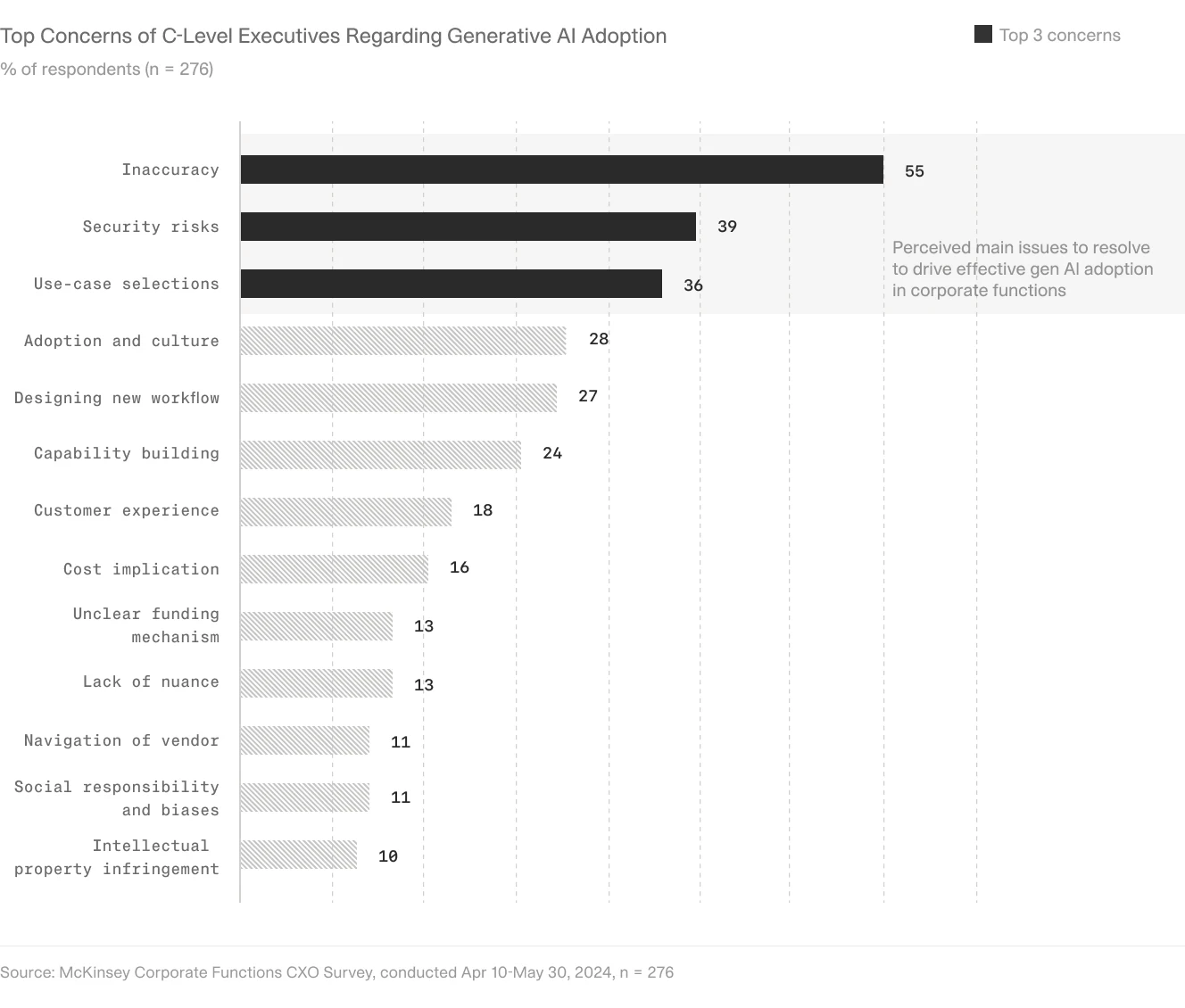
Security is not a fringe worry about AI; it sits at the top of the list of executive concerns, alongside accuracy. For a fund handling confidential deal data, it is the concern that carries legal weight.
Data type | Examples | NDA-protected | Sensitivity |
|---|---|---|---|
CIM materials | Management presentations, financial models | Always | High |
Deal thesis and IC notes | Investment thesis, underwriting logic | Always | High |
Portfolio company KPI packs | Monthly operating metrics, churn, customer economics | Usually | High |
LP agreements and side letters | Fee terms, carry, MFN clauses | Always | High |
Legal and regulatory documents | Contracts, disputes, IP, compliance files | Always | High |
Due diligence materials | DDQ responses, third-party reports | Usually | Medium |
Sanitised public data | Public filings, news, market reports | No | Low |
The reason this matters runs past legal liability. A confidentiality breach in the middle of a competitive process can cost a firm the deal itself, sour an LP relationship built over years, or hand a rival the very thesis that justified the price. The downside is rarely a tidy fine; it is the loss of the trust and the edge the whole business depends on.
ChatGPT data privacy: what happens to your prompts
The instinct is to assume a prompt vanishes once you have your answer. It does not, and the difference between the consumer and enterprise tiers of ChatGPT is the difference between a real exposure and a managed one.
The consumer tier
The path a prompt takes is worth making visible, because it is invisible in the moment. On the free and Plus tiers, the text you enter travels to OpenAI's servers, is stored in your conversation history, may pass through a queue where staff can review it to monitor for misuse, and, unless you turn it off, is used to improve OpenAI's models. Even with that setting disabled, the content is retained for a period and the review exposure remains. Turning off model training is worth doing, but it is not the same as making the data private; retention and the possibility of human review remain. And OpenAI's terms grant it a licence to use the content you submit, which is exactly the kind of onward permission a well-drafted NDA is written to prohibit.
The enterprise tier
ChatGPT Enterprise is a different proposition, and an honest article has to say so. On the enterprise tier, business data is not used to train OpenAI's models, and the product adds single sign-on, role-based access, and audit logging. That closes the biggest gap. What it does not do is make the data yours alone: it is still a third-party cloud service with its own sub-processors, hosting arrangements, and retention settings, and honouring an NDA's return-and-destruction obligation still means coordinating with the vendor rather than deleting a file. Enterprise is the floor for using AI on business data, not the ceiling for confidential deal data.
There is a regulatory dimension too, and it bites hardest for funds with European exposure. Portfolio company financial data and limited-partner records often contain personal data of identifiable people, which brings the whole exercise under the General Data Protection Regulation (GDPR). Feeding that data into a consumer tool, with its retention and onward-use terms, is precisely the kind of processing GDPR was written to control, and the exposure sits with the firm doing the uploading, not the vendor. This is a large part of why the market response has been governance rather than a shrug, and our overview of generative AI in finance covers where the productivity and the risk meet.











Does uploading deal data to ChatGPT breach your NDA?
The uncomfortable answer is that it can, and often the breach is complete the instant the prompt is sent, regardless of what the tool then does with it. The question is not whether the analyst meant any harm; it is whether the upload fits the plain terms of the NDA that governs the deal. Four clauses do most of the work, and none of them was written with a chat product in mind. None of this is legal advice, and whether a given upload breaches a specific agreement turns on that agreement's exact wording, so the practical move is to involve your counsel rather than your intuition.
The first is the authorised representatives clause. Most PE NDAs permit disclosure only to a defined list, employees, officers, fund counsel, named advisers, and an AI platform provider is not on it. Sending a CIM to a consumer chat tool can therefore be an unauthorised disclosure the moment it happens. The second is the permitted-use restriction, which limits use of the information to evaluating the transaction; if the vendor's terms grant a licence to use submitted content to improve a service, the information has arguably been used for a purpose the NDA never allowed. The third is the return-and-destruction obligation that nearly every PE NDA carries: if confidential material is sitting in a vendor's logs, the receiving party cannot simply destroy it on request, which turns a routine clause into a structural problem. The fourth is trade secret protection, which depends on maintaining reasonable safeguards; pasting pricing logic or proprietary customer economics into a consumer tool can be argued to show a failure of exactly those safeguards, and in a competitive auction that can put a portfolio company's own protections at risk.
A practical framework for AI on deal data
The answer is not to ban AI, which only pushes it into the shadows where an associate uses a personal account and nobody has a record of it. The answer is a simple classification everyone can apply without a lawyer in the room, backed by a policy that names which tools are approved for which data.
Banning it outright is the tempting mistake, because a ban does not stop the behaviour, it just hides it. The shadow use in a fund is easy to picture: an analyst pastes a clause from a CIM into a personal account to get a fast summary before a call; an associate drops a portfolio company's KPI pack in to draft a board update; the tidy output then circulates internally as a clean summary, and the confidential source has quietly reproduced itself in a place the firm cannot see, delete, or audit. None of those people set out to breach anything. They set out to save twenty minutes, and the only reliable way to stop it is to give them a sanctioned tool that does the same job safely.
Zone | Data | Rule |
|---|---|---|
Green | Public and non-confidential: news, public filings, market reports, benchmarks | Any AI tool is fine |
Amber | Sanitised or redacted: anonymised excerpts, non-sensitive summaries | Enterprise AI only, never consumer ChatGPT |
Red | NDA-protected and deal-specific: CIMs, models, KPI packs, LP agreements, legal files | Purpose-built AI with privacy guarantees only |
Underneath the zones sits a habit worth building: before anyone pastes anything into any AI tool, a handful of questions settle it. Is this covered by an NDA or a confidentiality agreement? Could it be a trade secret? Does my NDA's definition of authorised representatives cover this tool? What does the tool's policy say about training, retention, and human review? Has my firm approved this tool for this class of data? And if I were asked to destroy this information tomorrow, could I? A no, or a not sure, to any of those means the data does not go in.

For red-zone data, the relevant question is not whether a tool is clever but whether it is certified and controlled: the difference between a consumer product and one built to hold confidential information.
The wider market has already moved. Samsung, and several major banks, restricted or banned employee use of consumer ChatGPT once the exposure became clear, and regulators have followed: European authorities have taken enforcement action against OpenAI over its data practices, and the EU AI Act places governance obligations on how firms deploy AI. In parallel, transaction counsel have started writing AI directly into NDAs, in three broad shapes: a blanket prohibition on uploading confidential information to any AI tool, a controlled carve-out that allows only enterprise-grade tools with no training and proper logging, and a redaction pathway that permits AI on sanitised extracts only. The direction of travel is clear. The firms that win trust are not the ones that ban AI, but the ones that can prove they use it safely.
The secure alternative: AI built for confidential deal data
If consumer ChatGPT is the wrong home for red-zone data, the answer is not to go back to reading CIMs by hand; it is to use a platform built for confidential deal work in the first place. The distinction is governance, not cleverness, and it shows up in a direct comparison.
Feature | ChatGPT Free / Plus | ChatGPT Enterprise | V7 Go |
|---|---|---|---|
Inputs used to train models | Yes, unless opted out | No | No |
Document-level access controls | No | Limited | Yes, by document, project, and user |
Audit trail of every query and output | No | Basic | Yes, each output cited to its source |
Built for confidential deal workflows | No | Partly | Yes |
PE document workflows (CIM, portfolio, DDQ) | No | No | Yes |
V7 Go is an enterprise platform built for the document work that defines a deal team's week: reading CIM packs and management presentations, normalising portfolio company reporting, running document-heavy due diligence. It does not train on client data, it enforces access at the level of the individual document and user, and every output is grounded in a citation back to the source it came from, so an analyst can verify a figure and a compliance officer can audit how it was produced.
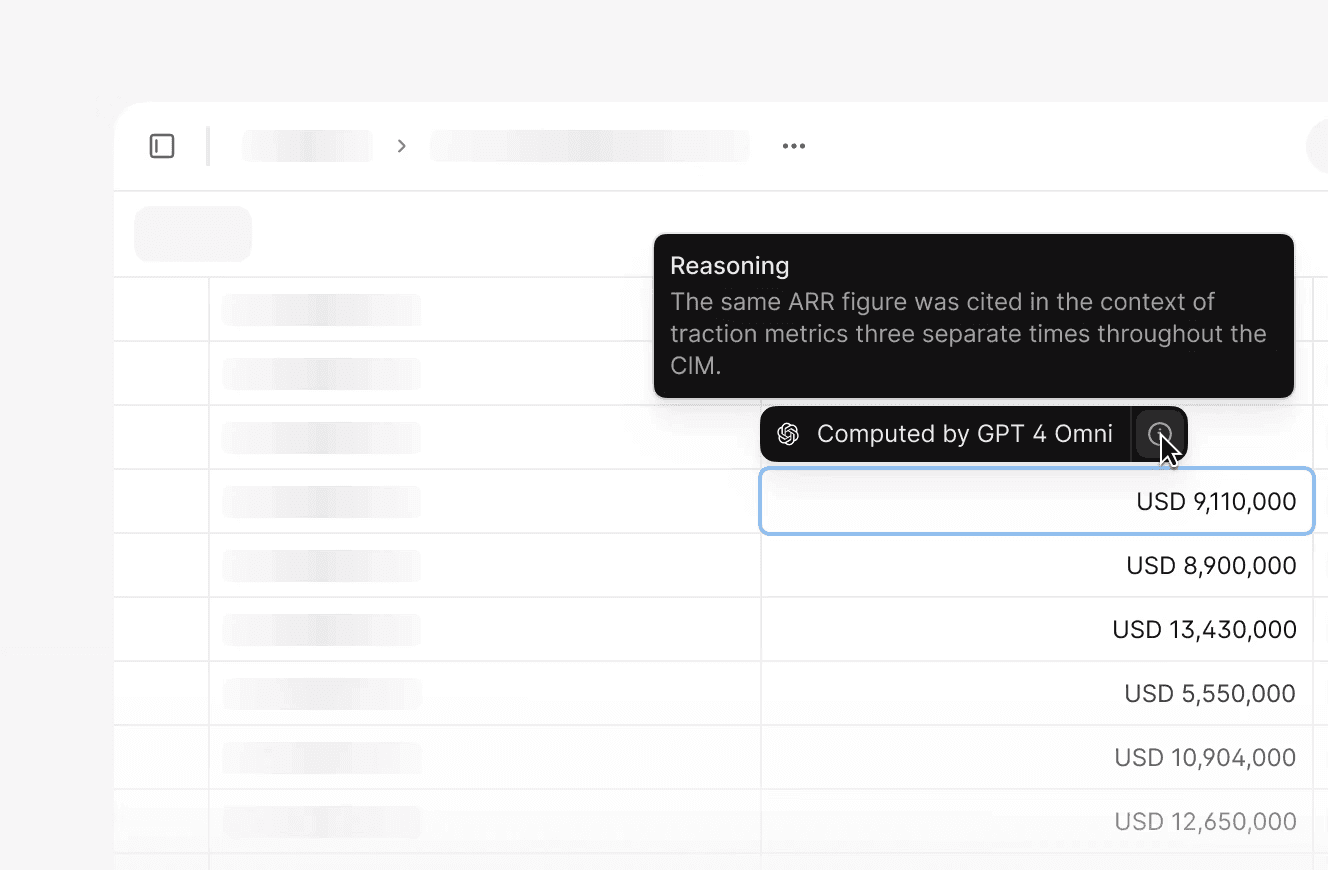
Every figure the platform returns is traceable to the line in the source it came from.
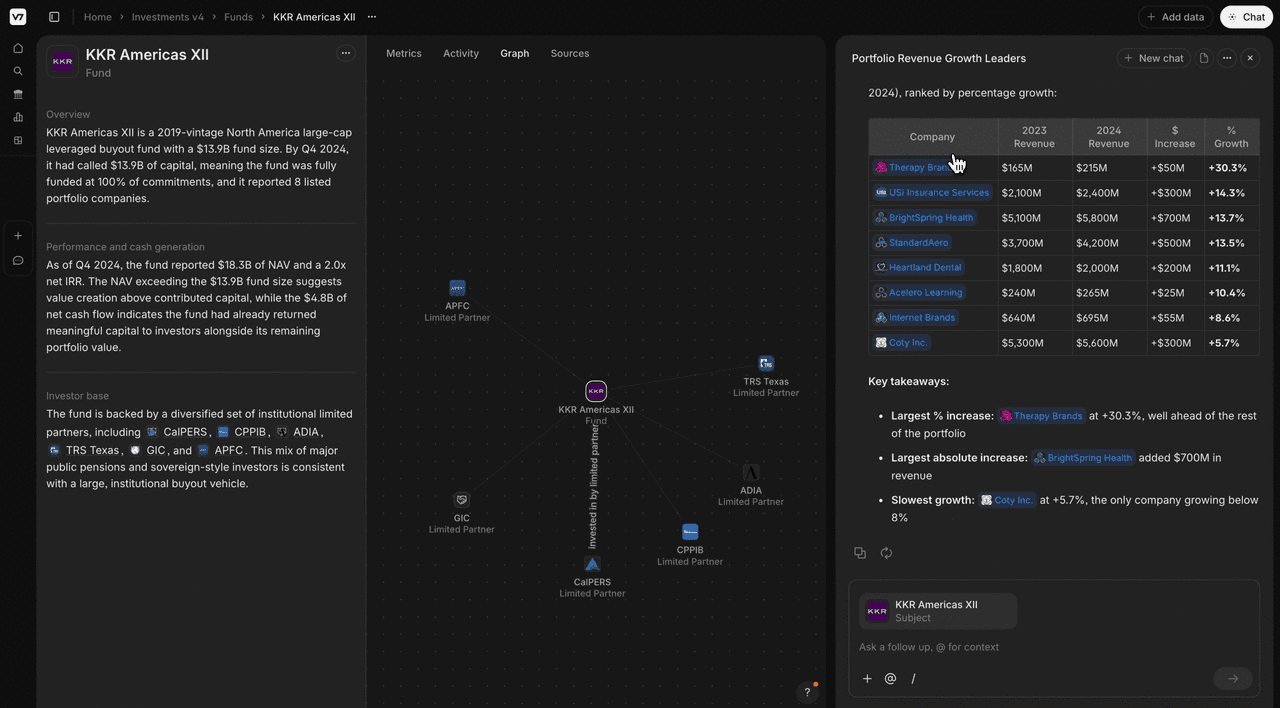
The same kind of question an analyst might otherwise paste into a consumer chatbot, answered inside a governed platform instead: the table and the takeaways stay inside the firm's own environment, tied to the fund data behind them, rather than logged on a third party's servers.
The deeper shift is where a firm's knowledge lives. When analysts paste deal data into personal chat accounts, the firm's memory scatters into places it cannot see or control. A Context Graph keeps that knowledge inside a governed layer instead, so the institutional memory of every company evaluated and every deal considered stays in the firm rather than in a consumer product's logs. For where this fits against the wider toolset, our guides to the private equity analysis tools, the broader applications of AI in private equity and venture capital, and the private equity due diligence process go further. It is also the practical difference between a general-purpose assistant and a platform built as AI for private equity from the ground up: one treats your deal data as a prompt to answer and forget, the other treats it as a firm asset to keep, cite, and build on.
The honest reframing is that this was never a question about whether AI belongs in a deal process. It plainly does; the productivity is real and the firms that refuse it will fall behind the ones that do not. The question is narrower and more answerable: which data goes into which tool, and can you prove it afterwards.
Get that right and the fear dissolves into a policy. Classify the data, approve the tools that match each class, keep the red-zone work on a platform built to hold it, and give your team a rule they can apply in the ten seconds before they paste. The goal is not to slow anyone down. It is to make the fast path and the safe path the same path.
If you want to see how AI handles confidential deal documents without the exposure of a consumer tool, V7 runs a working session built around your own materials and your firm's controls. That is the concrete next step, and it takes about the length of an internal AI-policy meeting.
Does ChatGPT use your data for training?
On the free and Plus consumer tiers, ChatGPT uses the content you enter to help improve OpenAI's models by default, unless you turn this off in the data controls settings. Even after you disable model training, the content is still retained for a period and can be reviewed by OpenAI staff to monitor for misuse, so switching off training reduces the exposure but does not make your prompts private. The enterprise and team tiers work differently: OpenAI states that business data on those plans is not used to train its models. The practical takeaway for anyone handling confidential information is that the default behaviour of the consumer product is not compatible with data governed by a non-disclosure agreement, and that the setting most people rely on, the training toggle, addresses only one of several ways the data is exposed. Retention, human review, and the licence granted in the terms of use all remain, which is why the tier and the settings matter as much as the tool itself.
+
Is it safe to use ChatGPT with confidential business information?
The consumer tiers of ChatGPT are not designed for confidential business information, and using them that way carries real risk. When you enter text on the free or Plus tier, it is stored, may be used to improve OpenAI's models unless you opt out, and can be reviewed by staff, and OpenAI's terms grant it a licence to use the content you submit. For information covered by a non-disclosure agreement or protected as a trade secret, each of those handling practices can create a problem. The enterprise tier improves the position substantially, because business data is not used for training and the product adds access controls and audit logging, but it remains a third-party cloud service with its own retention and sub-processor arrangements. The safest position for highly sensitive material, such as deal documents in private equity, is a platform purpose-built for confidential workflows, with no training on your data, document-level access controls, and a full audit trail. As a rule, match the sensitivity of the information to the governance of the tool rather than assuming any single tool is safe for everything.
+
Does sharing information with ChatGPT violate an NDA?
It can, depending on the terms of the specific non-disclosure agreement, and in many cases the breach would be complete the moment the information is uploaded. Most private equity NDAs restrict disclosure of confidential information to a defined set of authorised representatives, typically employees, officers, fund counsel, and named advisers, and an AI platform provider is not usually among them, so sending protected material to a consumer chat tool can amount to an unauthorised disclosure. NDAs also limit the use of confidential information to a specific purpose, such as evaluating a transaction, and if the tool's terms grant the vendor a licence to use submitted content, the information may have been used beyond the permitted purpose. A further complication is the return-and-destruction clause common to these agreements, which is difficult to honour once data is held in a vendor's logs. Because the answer depends entirely on the wording of the agreement, this is a question for your firm's counsel rather than a general rule, but the safe assumption is that uploading NDA-protected deal data to a consumer AI tool is a risk worth avoiding.
+
What is the difference between ChatGPT and ChatGPT Enterprise for data privacy?
The central difference is how your data is used and controlled. On the consumer free and Plus tiers, the content you enter can be used to improve OpenAI's models unless you opt out, is retained for a period, and may be reviewed by staff. On ChatGPT Enterprise, OpenAI states that business data is not used to train its models, and the product adds enterprise controls such as single sign-on, role-based access, and audit logging. That makes the enterprise tier a meaningfully safer environment for business data. It is not, however, a complete answer for the most sensitive material. Enterprise ChatGPT remains a general-purpose third-party cloud service, with its own sub-processors, hosting locations, and retention settings, and it is not built around the specific document workflows and confidentiality obligations of, say, a private equity deal team. For that reason, firms handling deal documents under strict NDAs often use the enterprise tier as a baseline for general work while reserving their most sensitive, deal-specific documents for a platform purpose-built for confidential workflows.
+
How do you prevent employees from sharing deal data with ChatGPT?
OpenAI provides ways to delete conversations and to request deletion of personal data under its privacy policy, but the process is more involved than clicking delete, and it does not offer an instant, guaranteed removal from every system. Deleting a conversation removes it from your visible history, but content may persist for a period in backups and logs within OpenAI's retention window before it is fully purged, and formal data deletion requests require going through OpenAI's process rather than acting unilaterally. For an individual this is usually adequate. For a firm operating under a non-disclosure agreement, it is a problem, because these agreements typically require the receiving party to return or destroy all confidential information on request or when a deal ends, and a party cannot directly destroy data held in a third party's systems. Meeting that obligation therefore depends on the vendor's cooperation and timelines rather than the firm's own action, which is one of the practical reasons confidential deal data is better kept out of consumer AI tools in the first place.
+
Can you ask ChatGPT to delete your data?
Go is more accurate and robust than calling a model provider directly. By breaking down complex tasks into reasoning steps with Index Knowledge, Go enables LLMs to query your data more accurately than an out of the box API call. Combining this with conditional logic, which can route high sensitivity data to a human review, Go builds robustness into your AI powered workflows.
+
Casimir is a seasoned tech journalist and content creator specializing in AI implementation and new technologies. His expertise lies in LLM orchestration, chatbots, generative AI applications, and computer vision.