22 min read
—


Casimir Rajnerowicz
Content Creator
V7 Go
A smarter way to manage due diligence and underwriting
The vendor demo went well. Your team asked good questions, the platform did what the sales engineer promised, and two people on the investment side came out of it genuinely enthusiastic. Six weeks later the deal is dead, killed in a compliance review by a question nobody in the room could answer: where does our deal data actually go, and can you prove it.
AI vendor evaluation in financial services fails at a different point than it does anywhere else. It rarely fails on features. It fails on evidence.
The frameworks available to help are written for a different buyer. Search for AI vendor selection criteria and you will find competent, thorough guides aimed at a technology lead buying software for a retail business or a logistics company. Check integration capabilities. Assess vendor stability. Ask about SOC 2. All of it correct. None of it sufficient at a regulated investment firm, where the questions that end vendor selections are different ones: model risk documentation, data residency, and whether anyone can reconstruct how a number reached an investment committee memo eighteen months later.
This guide is written for the technology, operations, and compliance leads running that evaluation at a private equity or venture firm, an asset manager, or a fund administrator. It assumes you have bought enterprise software before and do not need AI explained to you. What it offers is the part generic guides leave out. The filters that disqualify a vendor before you compare features. A way to weight those filters that survives a procurement committee. A pilot design that produces evidence rather than enthusiasm.
One framing note before the framework. Nothing here assumes you are removing people from the process. The criteria below assume a person still signs off on the output. That is how investment work is governed, and vendors who promise otherwise tend to fail the first compliance question anyway.
In this article:
Why generic AI vendor evaluation frameworks break at an investment firm.
Six hard filters to apply before any feature comparison.
A weighted scoring rubric you can take to a procurement committee.
Total cost of ownership, and why per-token comparisons mislead.
How to design a pilot that produces evidence, plus a twelve-question vendor due diligence checklist.
Which layer you are actually buying, and why a model provider and a workflow platform are separate line items.
How V7 Go scores against the same rubric.
Why standard AI vendor evaluation falls short for financial services
Generic evaluation frameworks assume the buyer's main risk is buying software that does not work. At an investment firm the larger risk is buying software that works and cannot be defended.
Three dimensions separate investment-side AI evaluation from ordinary enterprise procurement, and none of them appear in the standard guides.
The first is regulatory. Several obligations that apply to your firm translate directly into required software behaviour rather than required paperwork alone. If a supervisor can ask how an output was produced, the platform has to be able to answer, and that is a product requirement rather than a policy one.
The second is confidentiality of a specific kind. Generic data privacy is about personal data. Your problem is a confidential information memorandum covering a live process, limited partner correspondence carrying material non-public information, and portfolio company financials that three of your other holdings would like to read. The controls that matter are isolation and retention, not consent banners.
The third is the accuracy bar, which is not a single bar. An AI that drafts a first-pass summary of a market report can be wrong occasionally and cost nothing. An AI that pulls the fee terms out of a limited partnership agreement and gets one wrong has created a problem that surfaces years later, in a dispute, with your name on it.
Hold those three in mind and most of the standard advice reorders itself. That reordering is the framework.
The six hard filters to apply before any feature comparison
These are disqualifying criteria rather than scoring criteria. A vendor either clears them or leaves the shortlist, and running them first saves the weeks that go into evaluating a platform legal was always going to reject.
Run all six as document requests rather than as conversation. Each should produce an artefact you can put in front of your own compliance function, which is also what turns this exercise into an AI vendor risk assessment your risk committee will accept rather than a procurement opinion.
1. Compliance framework alignment
So you start by asking whether the vendor has SOC 2?
Wrong again. Every serious vendor has SOC 2, which makes it useless as a discriminator. The useful questions are which type, what scope, and how recently.
A SOC 2 Type I report says a set of controls was designed appropriately on one particular day. Type II says an auditor watched those controls operate across a period, usually six or twelve months. Type I is a photograph. Type II is a film. For a multi-year commitment involving deal data, Type II is the floor. The scope section then matters more than the certificate. A report covering the vendor's corporate IT but not the product you are buying is a report about the wrong thing.
Beyond SOC 2, the applicable stack depends on where you and your investors sit. EU financial entities and their critical ICT providers fall under the Digital Operational Resilience Act (DORA), which puts contractual and register-keeping obligations on third-party technology arrangements. New York licensed institutions work under the New York Department of Financial Services Part 500 cybersecurity regulation, which carries explicit third-party service provider requirements. Banks and other regulated entities apply the Federal Reserve's Supervisory Guidance on Model Risk Management, SR 11-7, to models used in decision-making. Many firms also map their controls to the NIST AI Risk Management Framework, which is voluntary but has become the common vocabulary between technology teams and risk committees.
One correction worth making, because it comes up in almost every evaluation and is usually wrong in the vendor's favour and occasionally in yours. Firms often assume the EU AI Act designates their use case as high-risk and that this settles the matter. Read Annex III before assuming. The financial services entries there concern creditworthiness assessment and credit scoring of natural persons, and life and health insurance pricing. Extracting fee terms from a fund document or summarising a data room is not on that list. This cuts both ways. Do not let a vendor claim high-risk compliance credit for a use case that is not high-risk. Do not build an eighteen-month approval process around an obligation you do not have.
Disqualifier: a vendor who will not provide the SOC 2 Type II report, the scope statement, and a written summary of incident response procedures under NDA.
2. Model explainability and model risk
Model risk is a regulated concept, not a general worry about AI being wrong. Where SR 11-7 applies, it carries expectations about validation, documentation, ongoing performance monitoring, and change control. Even where it does not formally apply, and for most private funds it does not, examiners and limited partners have started asking questions shaped by it.
The practical test for a document platform is narrower than the regulatory literature suggests, and you can run it in a demo.
Ask the vendor to produce an output, then ask the platform to show you the sentence in the source document that produced each field. Not the document. The sentence.
A platform that can do this has solved the reviewability problem, because your analyst can check twenty extracted figures in the time it would take to find one manually. A platform that cannot is asking your investment committee to trust an assertion with no provenance, and no amount of stated accuracy makes up for that. It is also where firms most often stall when scaling up from a chat assistant. That will give you a number and a confident paragraph of explanation, with nothing underneath it.
Ask also for model validation artefacts, the evaluation methodology, a change log mapped to who approved each update, and the bias mitigation approach. On change control, ask what notice you get before a model changes underneath a workflow you have already validated. A silent upgrade mid-mandate is a model risk event whether or not anyone calls it one.
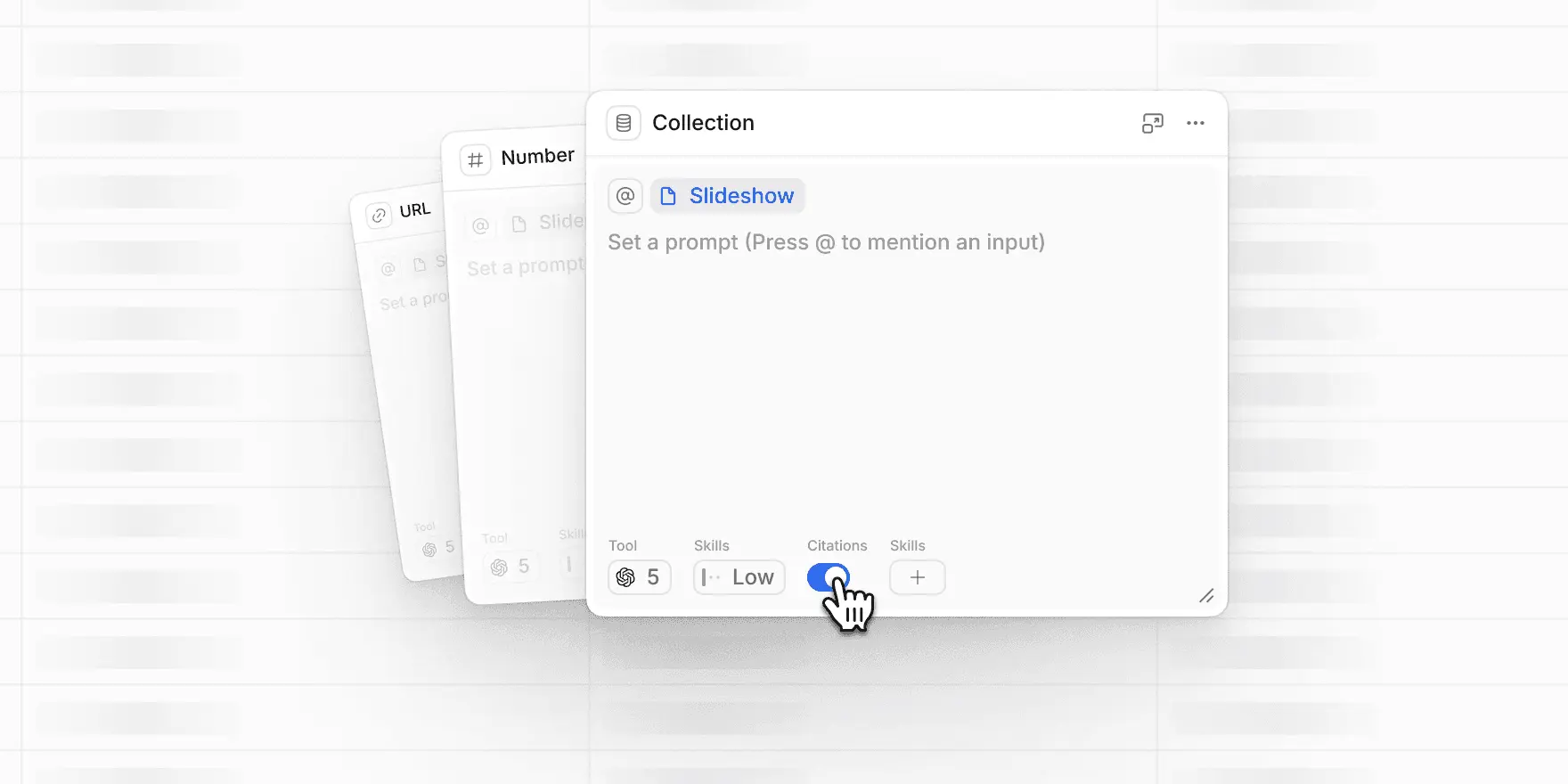
The test in one control. Either an extracted field can open the sentence it came from, or your analyst re-reads the document to check it, which is the cost the platform was bought to remove.
Disqualifier: a vendor who cannot show field-level provenance from output back to source, or who cannot say what happens when the underlying model changes.
3. Data residency and deployment architecture
Hosted multi-tenant platforms and single-tenant or private deployments are not two points on a scale. They are different products, and comparing their prices as though they were equivalent is the most common analytical error in this category.
Establish four things in writing: where your data is processed, where it is stored, whether those can differ, and what happens to it between sessions. For deal-level work the requirement is usually per-client isolation with no persistent retention of document content beyond the workflow. On some mandates an in-region or single-tenant deployment is a contractual condition rather than a preference.
Ask specifically about subprocessors, because this is where the answer usually gets complicated. Most AI platforms route inference through foundation model providers. That is not automatically a problem. A vendor with a published subprocessor list, executed data processing agreements, and a clear statement of what leaves their infrastructure is in a far stronger position than one that avoids the question. A vendor who cannot tell you which third parties touch your documents has not thought about your risk profile, and your own DORA register will need that information regardless.
Disqualifier: no published subprocessor list, or an inability to commit contractually to a processing region.
4. Audit trail and recordkeeping
Recordkeeping obligations differ by registration type, and getting this wrong in either direction is expensive. Broker-dealers work under SEC Rule 17a-4. Registered investment advisers, which is what most private fund managers actually are, work under Advisers Act Rule 204-2, with its own retention periods and its own requirement that records be produced promptly on request. Confirm with your compliance function which regime applies to your firm before you write requirements around either.
Whichever applies, the platform-level requirement is the same. Every AI-assisted step that contributes to a record needs to be reconstructable: the input documents, the instruction, the model version, the output, any human edit, and who made it. The log has to be tamper-evident and exportable in a format your compliance team can hand to someone else.
The test that separates real audit trails from logging is simple. Pick an output from three months ago and ask the vendor to show you how it was produced. If the answer requires a support ticket, it is not an audit trail.
Disqualifier: logs that are not exportable, not tamper-evident, or not accessible to your own administrators without vendor assistance.
5. Vendor financial stability
You are signing a multi-year dependency in a category that is consolidating quickly. Conduct due diligence on each shortlisted vendor with the same seriousness you would apply to a small platform investment, because functionally that is the exposure.
Ask for funding history and runway, revenue growth direction, customer retention, and concentration. Then ask the question that actually matters and that most evaluations skip: what happens to our data, our configurations, and our contracted terms if you are acquired. Get the answer in the contract rather than in an email.
Related, and worth pricing early: exit cost. Can you export your configurations, your extracted data, and your audit logs in a documented, non-proprietary format, on demand, without a professional services engagement? A vendor confident in their product will say yes without much hesitation. The hesitation is the signal.
6. Training data governance
This is the filter most likely to be answered with reassuring ambiguity, and the one where ambiguity is least acceptable.
There are two distinct questions and vendors routinely answer the easier one. First: is our data used to train or fine-tune your models? Second: is our data used to train or fine-tune anyone else's models, including those of the foundation model providers you route through? A vendor can honestly say they do not train on your data while sending it to an inference provider under terms that permit exactly that.
Require the answer to both in writing, with the contractual clause referenced rather than described. For an investment firm the stakes are concrete rather than theoretical: a CIM for a live process, a portfolio company's unaudited monthly management accounts, an LP side letter. None of these should ever become training data for a model that another firm queries.
Ask about provenance in the other direction too, which almost nobody does. What was the vendor's own model trained on, and can they document it? This matters less for a platform routing to established foundation models. Where a vendor claims a proprietary model, the documentation should exist.
Disqualifier: any answer on training data that is not reducible to a contract clause.











Building a weighted scoring rubric
Once the shortlist clears the filters, weight the remaining criteria rather than scoring them equally. The question-checklist format used by most evaluation guides treats integration parity and audit trail capability as equivalent line items, which is how a platform with excellent connectors and no provenance ends up winning on points.
Weight by regulatory exposure and workflow criticality. The distribution below is a starting position for an investment firm rather than a universal answer, and the act of arguing your committee into different weights is itself useful.
Criterion | Weight | Why it carries this weight |
|---|---|---|
Compliance framework alignment | 25% | A failure here is not a performance problem, it is a regulatory one. Highest downside. |
Model explainability and provenance | 20% | Determines whether outputs are reviewable at all, and therefore whether the platform is usable for committee-facing work. |
Data residency and deployment | 20% | Deal data confidentiality and portfolio company isolation. Often a contractual condition rather than a preference. |
Integration depth | 15% | Connectivity to where documents actually live: data rooms, shared drives, email, the CRM. |
Total cost of ownership | 10% | Matters, but a cheaper platform that fails a compliance review costs more than the difference. |
Vendor stability and exit terms | 10% | Multi-year dependency in a consolidating market. |
Score each vendor one to five against each criterion, multiply by the weight, and total. The value is less in the arithmetic than in what it forces. You end up with a documented rationale for identifying the right vendor, which is what a procurement committee or an internal audit will ask you to produce later.
One discipline worth imposing: score from evidence, not from demos. If a criterion cannot be scored from a document the vendor supplied or a test you ran, it is not scored yet.
Total cost of ownership, and why per-token comparisons mislead
Vendors invite comparison on unit price because that is where the differences look smallest. It is also the cost you can predict least well, since it moves with document volume, model selection, and whatever the underlying providers do to their pricing next quarter.
A three-year cost model has five components. Processing is one of them.
Cost component | What it covers | Who usually owns it |
|---|---|---|
Platform and processing | Licence plus per-document or per-token consumption | Vendor invoice |
Workflow configuration | Designing and testing extraction logic for your document types | Split between vendor services and your team |
Compliance validation | Legal and compliance review of outputs, audit trail setup, policy updates | Internal, and routinely underestimated |
Integration build | Connecting the platform to data rooms, storage, and downstream systems | Internal IT or vendor services |
Ongoing revalidation | Re-testing workflows after model updates or document format changes | Internal, recurring |
Two of those five are internal costs that never appear on a vendor quote, which is why the platform that wins the pricing comparison sometimes loses the cost comparison. Require a three-year model from each vendor covering all five lines, and require them to state what happens to your unit pricing if their upstream provider costs change.
On the return side, the honest calculation is narrower than most business cases. Do not model the value of the whole workflow. Model the manual stage the platform compresses, at your loaded cost per hour, on your real volume. If an analyst spends two days a month rekeying fund report figures and that becomes two hours, you can work out for yourself whether the licence pays for itself before the pilot ends.
Designing a financial-services-grade pilot
The standard advice is a thirty-day proof of concept with your own data. That is the right shape and about a third of the specification.
A pilot that produces usable evidence has five properties. It runs on real documents from a closed process rather than synthetic samples, because vendor demo data is always clean and your scanned side letters are not. It operates under production security controls from day one, not a promise to add them before go-live. It includes an examination rehearsal: someone outside the project picks an output at random and reconstructs how it was produced using only the platform's logs. It defines success numerically before it starts. And it includes live reference conversations with three firms of comparable size and regulatory profile.
Set the success criteria in the form your investment team will actually judge it by. Something like: first-pass extraction of twenty-two fields across forty fund reports, every field traceable to a source page, with an analyst confirming or correcting each one in under fifteen minutes per report. That is a testable claim. "Improves efficiency" is not.
One expectation to set internally: financial services procurement has a reputation for eighteen-month cycles, and much of that is sequencing rather than substance. Running the security review, the reference calls, and the technical pilot in parallel rather than in series is the largest lever on timeline, and it is entirely within your control.
A twelve-question vendor due diligence checklist
Send these in writing and require written answers. The format matters: a vendor who will discuss any of these on a call but not commit to them on paper has given you the answer.
What is the scope and date of your most recent SOC 2 Type II report, and will you share it under NDA?
In which jurisdictions is our data processed, and in which is it stored? Can we contractually fix both?
How is our data isolated from other customers' data, technically rather than by policy?
Is our data used to train or fine-tune your models, or any third party's models? Which clause says so?
Who are your subprocessors, and where is that list published?
What is your retention policy for uploaded documents and for outputs, and is it configurable?
How do we receive notice of model changes, and can we pin a workflow to a validated version?
Can you show field-level provenance from any output back to the source document?
What does your audit log contain, in what format can we export it, and can our administrators retrieve historic runs without your help?
What are your funding position and revenue trajectory, and what happens to our data and terms on a change of control?
What commitments can you make on pricing stability over the contract term?
Can you provide three reference customers in investment management at comparable scale?
Evaluation criteria mapped to investment workflows
Different workflows load the criteria differently, and a platform that is right for one may be indifferent for another. No generic framework covers this, and it usually decides whether an evaluation produces a tool people use or a licence people forget.
Workflow | Criteria that dominate | Accuracy bar |
|---|---|---|
Deal screening and sourcing | Integration depth, throughput | Moderate. A human reviews the shortlist, so false positives are cheap. |
Data room review and IC memo preparation | Provenance, audit trail, configurability | Very high. Output goes to committee under someone's name. |
LPA and side letter review | Provenance, compliance framework | Very high. Errors surface years later in a dispute. |
DDQ completion | Configurability, integration, consistency | High. Answers are contractual representations. |
LP and portfolio reporting | Audit trail, integration, repeatability | High. Outputs may be examined. |
Read down the accuracy column and the pattern is clear enough. The workflows where AI is easiest to justify commercially are not the ones where it is easiest to govern, and the two lists barely overlap. Pick your first workflow accordingly: something with real volume, a tolerant accuracy profile, and a human review step already in place. If you are still choosing between configuring a platform, buying a point solution, and building in-house, that decision sits upstream of this one. We have covered it separately in build versus buy for LLM agent platforms in private markets.
The question the shortlist usually skips: which layer are you buying
Halfway through most evaluations someone senior asks a version of this. We already pay for Claude, and the deal team likes it. What exactly is the second line item for?
It is a fair question and the framework above does not answer it, because the six filters assume you already know what kind of thing you are comparing. Two different products get called AI platforms in these conversations. One is a frontier model provider. The other is the engineered workflow around a model. They sit at different layers of the same stack and a firm buying seriously usually ends up with both.
The distinction is not about capability. Claude reads a limited partnership agreement well, and an analyst working through a data room with it is doing better work than the analyst who is not. The distinction is that an assistant re-solves the problem each time it is asked. The twentieth document takes a different route through the reasoning than the first, and the answer arrives in a different shape. That is the correct behaviour for an assistant and a disqualifying property for anything feeding an investment committee memo, a ledger or a regulatory filing, where the requirement is that the run repeats identically and every value opens its source. We have written about what changes when a finance team moves from one to the other in Claude for finance.
This matters for procurement in a specific way. If the platform you are evaluating routes to a frontier model, then the model provider is a subprocessor and belongs in your register under filter three, and the platform is what your audit trail, your schema and your review gates actually live in. Ask a vendor which layer they occupy. A vendor who answers cleanly has thought about your stack. A vendor who claims both usually owns neither.
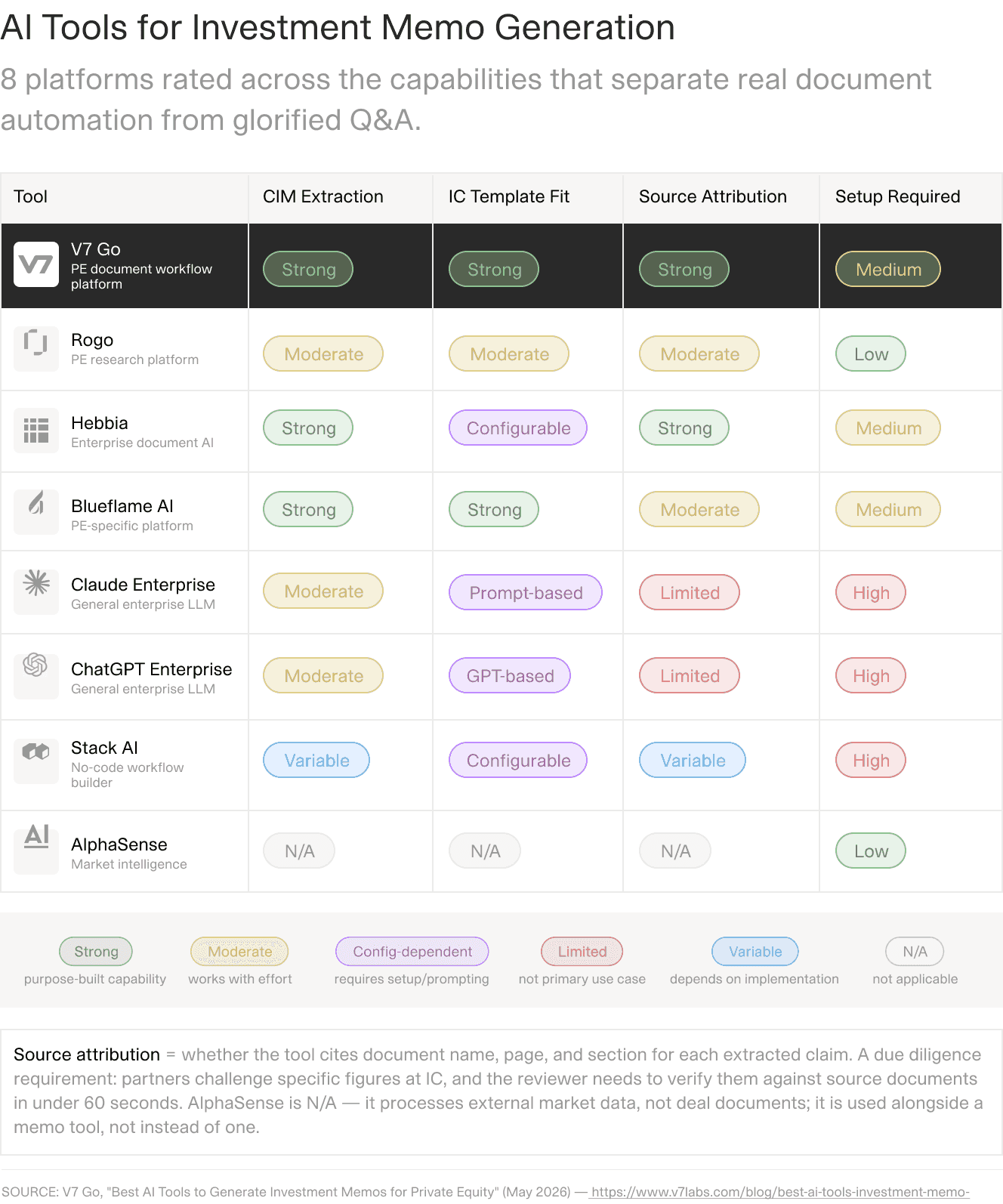
A worked example of the comparison, scored on one workflow. Source: V7 Go, “Best AI Tools to Generate Investment Memos for Private Equity”, May 2026. Note that the columns are the filters from this article rather than feature counts.
Read the source attribution column first. It is the one that separates platforms a compliance function will sign off from platforms it will not, and it is the column vendors are least likely to lead with in a demo. A matrix like this is worth building for your own shortlist and your own workflow, with your weights from the rubric above rather than someone else's, because the scoring is where a procurement committee either agrees or discovers it never did.
How V7 Go scores against the same rubric
Applying the framework to ourselves is more useful than a feature list, and it is what you should demand from every vendor on your shortlist. Where the honest answer is "ask us for the document", that is what it says.
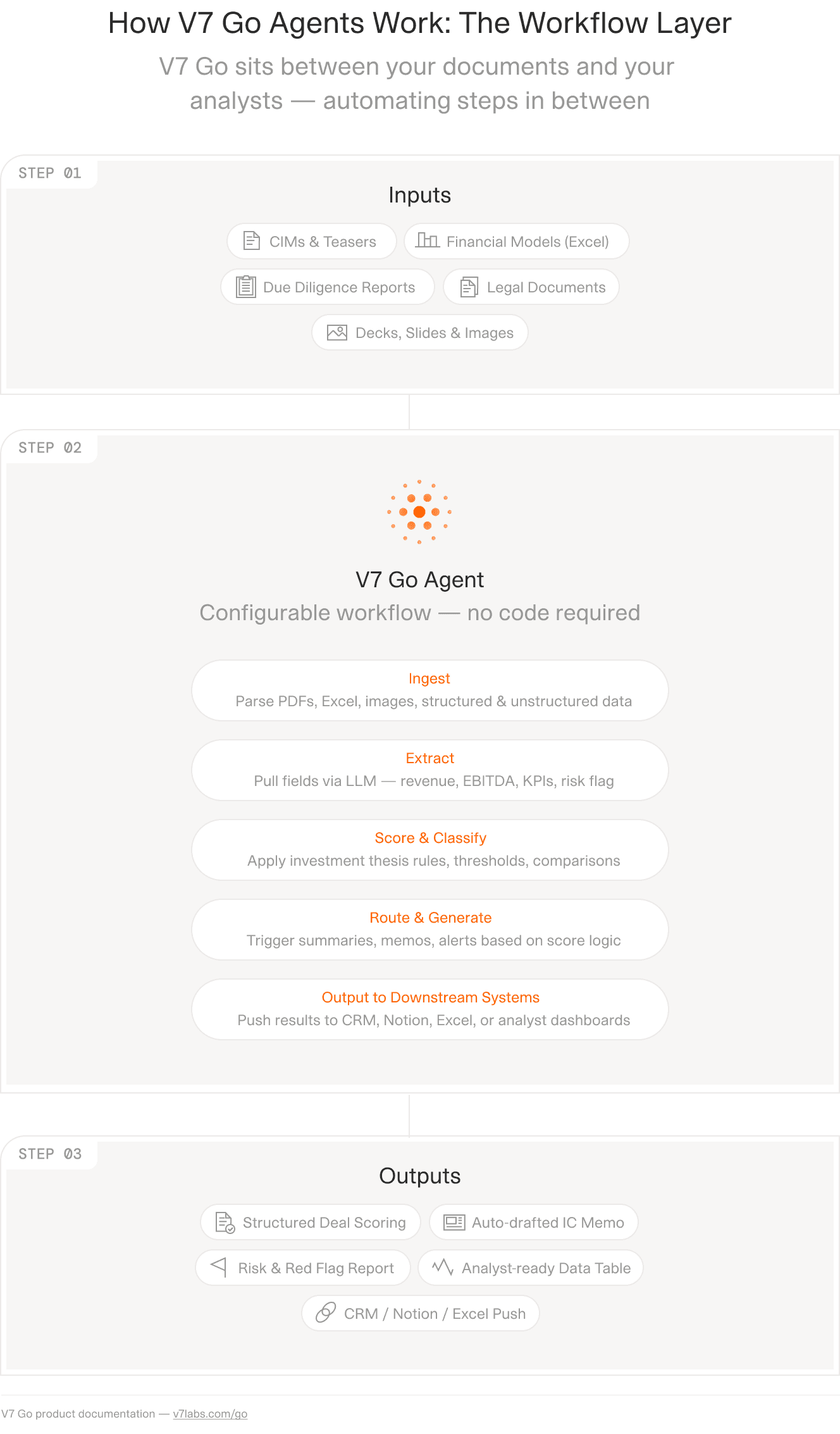
The workflow layer is what makes the audit trail possible: each step is a discrete, logged operation rather than a single opaque prompt.
Compliance framework. V7 is SOC 2 Type II audited and ISO 27001:2022 certified, with GDPR and HIPAA compliance, annual third-party penetration testing, and continuous control monitoring. The attestation letter, the SOC 2 report, the ISO certificate, and the penetration test reports are available on request through the V7 Trust Center. Request the scope section as well as the certificate.
Model explainability. Every extracted field links back to the source document and location that produced it, which is the reviewability test above. Where an answer needs more confidence, the same task can be run across multiple models to surface disagreement rather than average it away. Both are properties of the workflow layer rather than of any one model.
Data residency. V7 Go stores customer data in Google Cloud infrastructure located in Belgium, and V7 does not move stored data outside the EU. The full subprocessor list, including which foundation model providers may process data and under which agreements, is published on the security page rather than supplied on request.
Audit trail. Each workflow step is a discrete logged operation with its inputs, instruction, and output recorded, which is what makes historic runs reconstructable without a support request.
Training data governance. This is the filter where the two-question test above matters, so here is the answer to both. Customer data is not used to train or improve V7's models. Where a workflow routes to a foundation model provider, that transfer covers processing the requested task only. It is not used for training, improving, or developing generalised models, and each provider is governed by its own data processing agreement. The contractual position is that the customer owns their data and V7 will not access or use it except as necessary to deliver the service.
Integration. The question is whether the platform reaches documents where they already sit and returns structured output into systems your team already uses. Two workflows worth pilot-testing because they load different criteria: data room to IC memo, which loads provenance hardest, and DDQ completion, which loads consistency.
Pricing. Since evaluation teams reasonably want this before a call: pricing is packaged rather than purely metered, which is what makes a three-year model possible at all. Ask for the model across all five cost lines above, including the configuration effort, because that is the line most likely to be underestimated.
On the layer question above: V7 Go runs on frontier models rather than competing with them, and it also runs as an MCP server, so a team that works in Claude can drive a configured workflow from there instead of leaving it. A firm already hitting a ceiling on repeatability and provenance is in the strongest possible starting position, because the gap it has found is the one this framework tests for. We have written about where that ceiling sits in financial AI tools for investment teams and about the specific confidentiality question in ChatGPT data privacy for PE firms.
What to do on Monday
The framework above is long because vendor evaluation is genuinely detailed work. Starting it is not.
Take your current shortlist and send the twelve questions to every vendor on it this week, before any further demos. You will lose one or two vendors immediately, which is the point: the responses sort the shortlist faster and more honestly than another round of product walkthroughs, and they cost you an email.
Then agree the weights with your compliance and technology leads before you score anything. Weights argued after the scores are in are indistinguishable from justification, and any procurement committee worth the name will notice.
Choose one workflow for the pilot. One. Something with genuine monthly volume, an accuracy profile that tolerates a first pass, and a review step your team already performs. Define what success looks like numerically, run the examination rehearsal even though it will feel excessive, and let the evidence decide.
One last thing, and it is the part most evaluations get wrong. The purpose of this exercise is not to find the platform with the most capability. It is to find the one whose behaviour you can still explain to a regulator, a limited partner, and your own investment committee eighteen months from now, when whoever ran the evaluation has moved on and all that remains is the documentation.
If you would like to run the framework against V7 Go with your own documents rather than a demo dataset, our solutions engineers will build a working pilot on your files before any commitment. Book a working session and bring the workflow that is costing your team the most hours.
What are the most important AI vendor evaluation criteria for financial services firms?
Six criteria function as hard filters before any feature comparison: compliance framework alignment, model explainability and provenance, data residency and deployment architecture, audit trail and recordkeeping, vendor financial stability, and training data governance. Treat them as disqualifying rather than scoring criteria, because a vendor that fails any one of them will not survive a compliance review regardless of how well it demonstrates. Once a shortlist clears the filters, weight the remaining criteria by regulatory exposure and workflow criticality rather than scoring them equally. Equal weighting is how a platform with excellent connectors and no field-level provenance ends up winning on points. A reasonable starting distribution for an investment firm is 25 percent compliance, 20 percent explainability, 20 percent data residency, 15 percent integration depth, 10 percent total cost of ownership, and 10 percent vendor stability. Argue the weights with your compliance and technology leads before scoring anything, not after.
+
What is the difference between SOC 2 Type I and SOC 2 Type II?
A SOC 2 Type I report confirms that a vendor's controls were designed appropriately as at one specific date. A Type II report confirms that an auditor observed those controls operating effectively across a period, usually six or twelve months. Type I is a photograph. Type II is a film. For a multi-year commitment involving deal documents, Type II is the minimum acceptable standard, and Type I should be treated as evidence that a vendor has started the process rather than finished it. The more useful question, once you have established the report is Type II, concerns scope. A SOC 2 report covering a vendor's corporate IT environment but excluding the product you are actually buying tells you very little about the risk you are taking on. Always request the scope section alongside the certificate, and check the report date, because an attestation more than a year old is stale.
+
What is model risk and why does it matter when evaluating AI vendors?
Model risk is the risk of adverse consequences from decisions based on model outputs that are incorrect, misused, or poorly understood. It is a regulated concept rather than a general concern about AI accuracy. The Federal Reserve's Supervisory Guidance on Model Risk Management, known as SR 11-7, sets expectations for banks and other regulated entities covering model validation, documentation, ongoing performance monitoring, and change control. Most private fund managers are not directly subject to SR 11-7, but examiners and limited partners increasingly ask questions shaped by it. For a document platform the practical test is narrower than the regulatory literature suggests. Ask the vendor to produce an output, then ask the platform to show the specific sentence in the source document that produced each field. A platform that can do this has made its outputs reviewable. A platform that cannot is asking your investment committee to trust an assertion with no provenance behind it.
+
How long does AI vendor evaluation take at a financial services firm?
Enterprise procurement in financial services has a reputation for cycles running eighteen months or longer, and a significant part of that duration is sequencing rather than substance. Firms commonly run the security review, then the reference calls, then the technical pilot, each waiting on the last to finish. Running those three workstreams in parallel is the single largest lever on timeline and it sits entirely within your control. Sending the written due diligence questions to every shortlisted vendor at the start, before any further demonstrations, compresses the process further, because the responses sort the shortlist faster than another round of product walkthroughs and cost you an email. A structured evaluation with a thirty to forty-five day pilot, written vendor responses, and parallel reference conversations can reasonably complete in a quarter. What extends timelines is discovering a disqualifying compliance issue in month five that a document request would have surfaced in week one.
+
How do I calculate the total cost of ownership for an AI platform?
A pilot that produces evidence rather than enthusiasm has five properties. It runs on real documents from a closed process rather than synthetic samples, because vendor demonstration data is always clean and your scanned side letters are not. It operates under production security controls from the first day rather than a commitment to add them before go-live. It includes an examination rehearsal, where someone outside the project picks an output at random and attempts to reconstruct how it was produced using only the platform's own logs. It defines success numerically before it starts, in terms your investment team would recognise: a stated accuracy threshold on a named document type, a specific field count, a specific turnaround per document. And it includes live reference conversations with three firms of comparable size and regulatory profile, rather than curated testimonials. Choose one workflow with genuine monthly volume and an existing human review step.
+
What should a vendor pilot include for a financial services use case?
Go is more accurate and robust than calling a model provider directly. By breaking down complex tasks into reasoning steps with Index Knowledge, Go enables LLMs to query your data more accurately than an out of the box API call. Combining this with conditional logic, which can route high sensitivity data to a human review, Go builds robustness into your AI powered workflows.
