15 min read
—


Seven AI tools compared across investment banking workflows, firm sizes, and budget tiers.

Casimir Rajnerowicz
Content Creator
V7 Go
A smarter way to manage due diligence and underwriting
Rogo AI has raised $310M in total funding, including a $160M Series D led by Kleiner Perkins, and is deployed at Lazard, Nomura, and Jefferies. For investment banks and advisory firms, that level of institutional backing signals a serious platform. It also signals seven-figure enterprise contracts and a product built around specific sell-side assumptions that do not fit every team.
Three reasons investment banking teams look for Rogo alternatives: pricing that does not fit smaller firms; a sell-side orientation that leaves buy-side workflows underserved; and limited room to configure the product around a firm's proprietary processes. This guide evaluates seven alternatives, mapped to specific AI tools for investment banking workflows rather than generic feature checklists.
In this article:
What Rogo AI is and where it fits in the investment banking AI market
Four scenarios where a Rogo alternative makes more sense than Rogo itself
Seven Rogo AI alternatives with workflow-specific comparisons: Hebbia, AlphaSense, F2 AI, V7 Go, S&P Capital IQ Pro, FactSet, and Bloomberg Terminal with AskB
An IB workflow decision matrix and six evaluation criteria for choosing the right tool
What Is Rogo AI? A Brief Overview
Rogo was founded in 2021 by former investment bankers and is purpose-built for sell-side investment banking workflows. The platform automates standardized IB research outputs: peer comp analyses, company profiles, confidential information memoranda (CIMs), pitch deck preparation, and industry research. Its $310M total funding has supported a data partnership network that includes LSEG (Workspace), FactSet, S&P Global, PitchBook, Preqin, Third Bridge, and Crunchbase — the broadest in the IB AI category. Rogo also acquired Subset to bring Excel automation directly into its workflow, and offers single-tenant deployment designed for the security requirements of global banks.
These pillars explain both why bulge-bracket institutions adopt Rogo and why it may not be the right fit for every team. A tool built around premium external data partnerships and standardized IB deliverables is not the same as a tool built around a firm's own internal documents, bespoke processes, or buy-side investment workflows.
Rogo AI Pros
IB-specific outputs tuned for sell-side deliverables: peer comps, CIMs, pitches, company profiles
Broadest data partnership network in the IB AI category: LSEG, FactSet, S&P Global, PitchBook, Preqin, Third Bridge, Crunchbase
Excel automation via Subset acquisition for spreadsheet-integrated outputs
Single-tenant deployment and a security advisory board designed for global bank compliance standards
Rogo AI Limitations
Enterprise pricing with minimum contracts reportedly in the seven-figure range for large institutional deployments
Sell-side orientation — less suited for buy-side underwriting, PE due diligence, or fund-level portfolio monitoring
Limited customization for non-standard or bespoke investment banking workflows that do not fit the platform's fixed-feature design
Context window constraints reduce accuracy across very large unstructured document sets, such as full virtual data rooms (VDRs) with thousands of files
When Should You Look for a Rogo Alternative?
Rogo is a strong product in its lane. The question is whether your team's work is in that lane.
You are on the buy side, not the sell side. Rogo was designed for IB research, pitch generation, and company profiling — not for buy-side credit underwriting, PE due diligence, or fund-level portfolio monitoring. Buy-side teams will find the tool's default assumptions tuned for sell-side outputs rather than the IC audit trails and borrower analysis workflows that private credit and PE require.
Your firm size does not justify Rogo's pricing tier. Enterprise contracts in the seven-figure range make sense for a bulge-bracket bank running the platform for 500+ analysts. For a 15-person boutique advisory or a $300M PE fund, the unit economics do not hold. Mid-market alternatives exist and are well-suited to smaller team sizes and more targeted use cases.
You need to work across your firm's proprietary documents, not just public data. Rogo is strongest when connected to its partner data sources. For firms whose primary need is processing internal documents — deal memos, LP reports, portfolio company financials, management presentations — other tools are better suited to that document-first workflow than a platform built around premium external data access.
You need custom AI workflows, not a fixed-feature product. Rogo's interface is purpose-built for standardized IB tasks. If your team's processes are non-standard, highly firm-specific, or likely to evolve significantly over the next two years, a configurable platform will serve you better than a vertical SaaS product that improves on the vendor's roadmap schedule rather than your own.
The Best Rogo AI Alternatives for Investment Banking Research
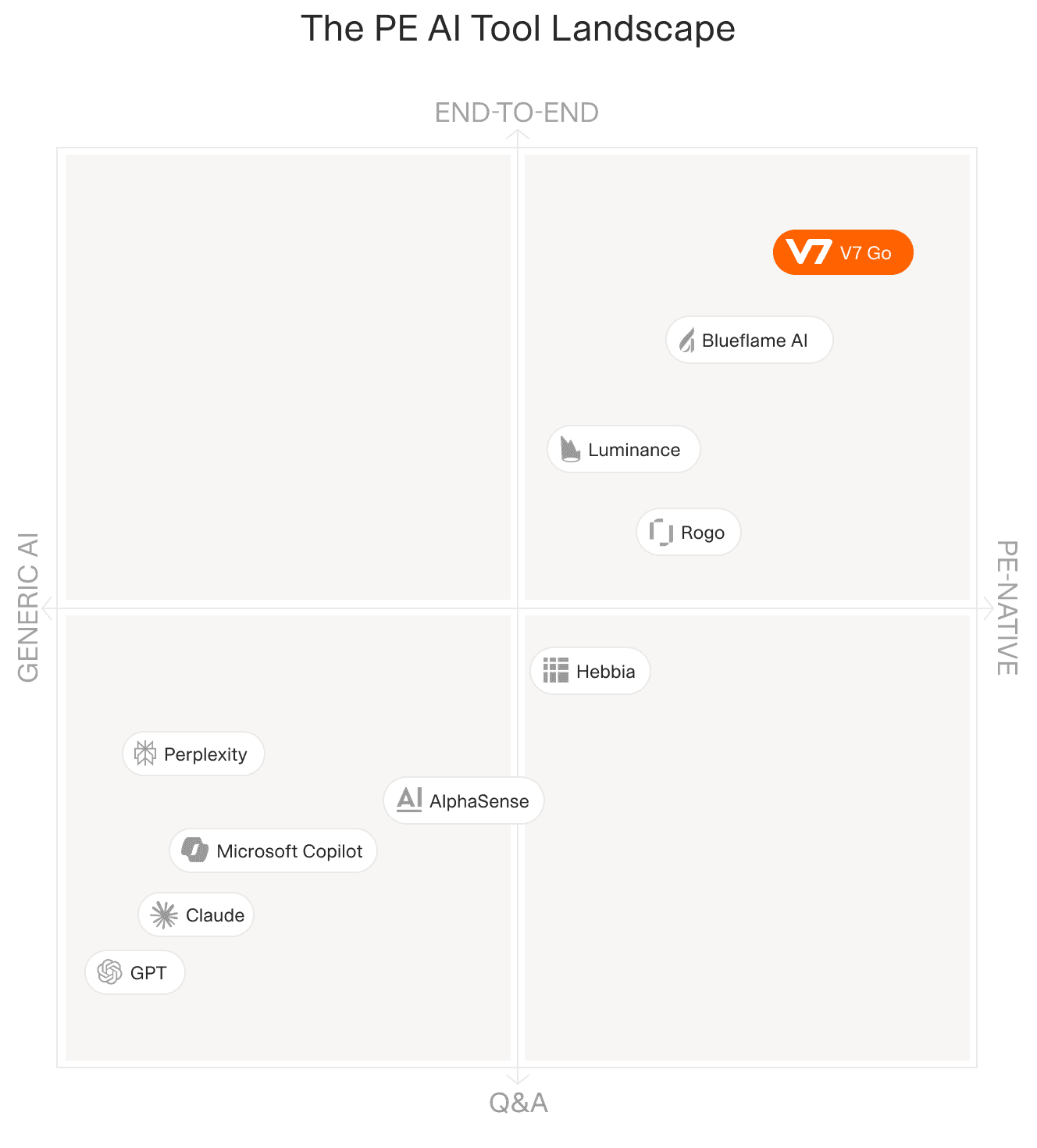
Rogo AI alternatives fall into three broad categories: agentic workflow platforms that process documents and generate finished deliverables; data repository platforms that provide premium external content with AI-powered search and synthesis; and precision vertical tools built for specific deal types and workflow outputs. A fourth category — configurable AI platforms — is where V7 Go fits. No single alternative matches Rogo on every dimension; the right choice depends on your team's primary workflow bottleneck and the type of data you actually work with.
1. Hebbia — Best for Large-Scale Document Analysis and Data Room Research
Best for: PE deal teams, credit funds, and M&A advisory teams working across large VDRs.
Hebbia's Matrix grid is built for volume: it processes thousands of unstructured documents simultaneously using Iterative Source Decomposition (ISD) technology, which extracts answers with sentence-level citations traceable to specific source documents. For teams whose work centers on reading and synthesizing thousands of pages across a data room, Hebbia is purpose-built for that task in a way Rogo is not.
The comparison to Rogo is instructive. Rogo excels at standardized sell-side outputs generated from premium external data partnerships — LSEG, FactSet, S&P. Hebbia excels at custom queries across proprietary document sets: deal memos, data room files, internal research materials, management presentations. Hebbia does not have native connections to Rogo's data partners; users upload their own third-party data alongside proprietary documents. Cross-deal team collaboration is managed through a Projects workspace, and FlashDocs (an Hebbia acquisition) enables slide deck generation directly from processed documents.
Who should consider it: PE funds conducting due diligence across large AI virtual data rooms; M&A advisory teams with complex proprietary document sets; legal-intensive transaction teams doing document review at scale across multiple simultaneous processes.
2. AlphaSense — Best for Market Intelligence and Premium External Content
Best for: Research analysts, sell-side teams, corporate strategy, and buy-side portfolio managers tracking public markets.
AlphaSense is not a workflow automation tool — it is a premium content library with AI search layered on top. It indexes more than 10,000 premium sources, including over 1,000 Wall Street broker research sources, 240,000+ expert call transcripts, SEC filings, and earnings transcripts. Where Rogo automates IB deliverable generation, AlphaSense provides the raw market intelligence to inform those deliverables. Its Generative Grid feature applies multiple analytical prompts across many documents simultaneously, which fits research-intensive workflows.
AlphaSense wins on content breadth and depth of premium external research; Rogo wins on structured IB output generation. Many investment teams use both for different workflow stages rather than treating them as substitutes. AlphaSense is less effective for private company research where public filings are limited, and it does not automate deliverable generation the way Rogo does. For sell-side and corporate strategy teams whose core bottleneck is intelligence synthesis rather than deliverable production, AlphaSense is often the stronger fit.
3. F2 AI — Best for Buy-Side Underwriting and Excel-Native Modeling
Best for: Private credit underwriters, commercial banks, and PE firms spreading financials and producing IC memos.
F2 AI and Rogo are arguably the most directly comparable vertical tools in finance — but they serve opposite sides of the deal. Rogo is sell-side (IB research, pitch preparation, CIM drafting); F2 is buy-side (private credit underwriting, CIM analysis, borrower model review). F2's LLMExcel engine computes within existing Excel workbooks deterministically, achieving a 95.25% score on the SpreadsheetBench Verified benchmark. Every output traces to a live formula and source document — the IC audit trail that buy-side investment committees require before approving a credit or equity decision.
For buy-side teams auditing banker-prepared financial models and producing their own underwriting outputs, F2's deterministic approach is more reliable than Rogo's output generation for that specific task. F2's scope is narrower than Rogo's: no external content library, focused specifically on private markets deal execution. Teams running financial statement spreading and IC memo generation in private credit will find F2 fits that workflow more precisely than any sell-side product.











4. V7 Go — Best for Configurable AI Workflows and Proprietary Document Processing
Best for: PE and VC operations teams, boutique IB firms, fund administrators, and investment teams whose workflows do not fit a standard off-the-shelf product.
Rogo is a fixed-feature IB product with standardized outputs. V7 Go is a platform on which investment banking and private equity teams build their own AI workflows — agents that process any combination of proprietary documents, apply custom logic, and generate firm-specific deliverables. There is no Rogo-equivalent "out of the box" starting point, and no Rogo-equivalent ceiling on what can be configured once a firm defines its processes.
Where Rogo assumes your workflows fit its IB template, V7 Go assumes they do not — and builds from there. Teams configure multi-step AI agents to process LP reports, portfolio company materials, deal memos, and due diligence documents through automated pipelines with full auditability. The AI due diligence agent, for example, is a pre-built starting point that firms modify to reflect their own IC criteria, document structures, and approval workflows. Agents are not static; they expand as a team's AI use cases evolve, without waiting on a vendor's product roadmap.
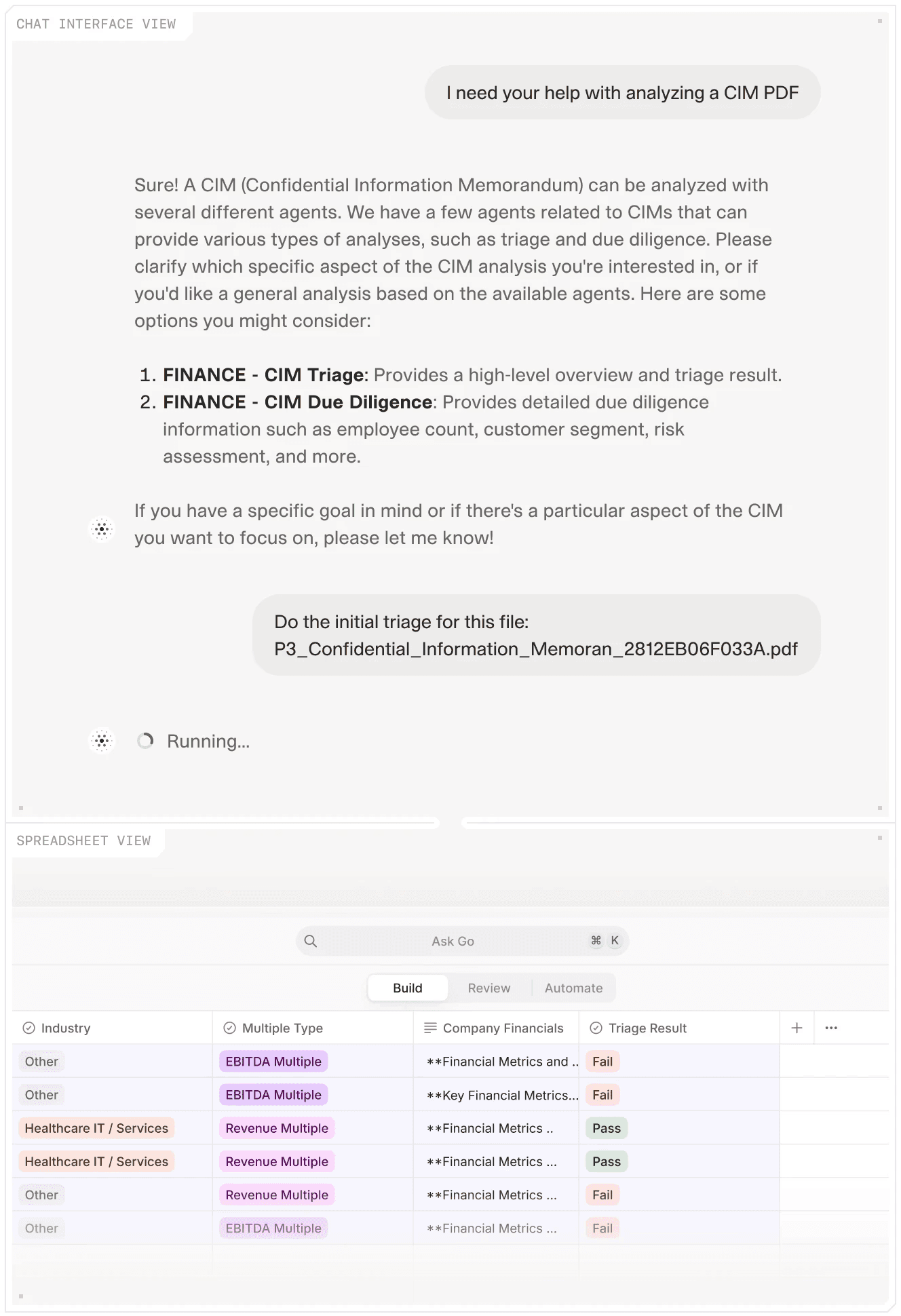
V7 Go makes sense over Rogo when a firm's workflows are non-standard or highly bespoke; when the primary AI need is processing large volumes of internal documents rather than connecting to premium external data sources; when team size or budget does not fit Rogo's enterprise pricing; or when a team wants to build new workflow automations incrementally rather than committing to a fixed-feature product's scope. Investment teams running CIM review or producing AI investment memos can configure agents that adapt to their firm's document formats and evaluation criteria, rather than adapting their processes to a vendor's template.
5. S&P Capital IQ Pro — Best for Structured Financial Data and Comp Screening
Best for: M&A analysts, equity research teams, and corporate finance departments.
Capital IQ Pro is a structured data platform, not an AI workflow automation tool. It provides access to more than 450 million data points on public and private companies, a decades-long track record of data accuracy, and an industry-standard Excel plug-in with live, formula-driven financial data. Recent AI enhancements — including Document Intelligence 2.0 — have improved document analysis capability, but the platform's core strength remains structured financial data and screening functionality rather than deliverable generation.
For teams whose primary bottleneck is data access and comp screening, Capital IQ Pro is the established standard. For teams whose bottleneck is generating finished work products from that data, it requires users to bridge the gap themselves; it does not automate IB deliverable generation the way Rogo does. Capital IQ Pro is most valuable as a data layer that complements workflow automation tools rather than replacing them. Its interface is noted as dated in comparison to newer AI-native platforms, and its AI capabilities feel like additions to a legacy data product rather than foundational design decisions.
6. FactSet — Best for Buy-Side Portfolio Analytics and Multi-Asset Research
Best for: Buy-side portfolio managers, quantitative teams, and multi-asset investment research.
FactSet integrates more than 800 data sources for portfolio construction, risk modeling, and multi-asset research — a fundamentally different use case from Rogo's IB workflow automation. Its conversational AI addition, the Mercury engine, and its Pitch Creator for Bankers module are layered onto a data infrastructure product rather than purpose-built for IB deliverable generation. For teams doing portfolio attribution, factor analysis, or quantitative strategies, FactSet has no comparable rival in this guide. For IB workflow automation specifically, it operates in a different category.
Investment teams that already have FactSet for portfolio analytics are not replacing it with Rogo — they may add Rogo or a Rogo alternative for workflow-specific tasks that FactSet does not address. The two tools serve different primary functions and are typically used together at larger institutions rather than as substitutes for each other.
7. Bloomberg Terminal with AskB — Best for Real-Time Market Data and Trading Workflows
Best for: Sales and trading desks, market surveillance, fixed income and equities teams.
Bloomberg Terminal is the default infrastructure of global trading floors, not a Rogo competitor in the IB research workflow sense. AskB, Bloomberg's conversational AI interface, is a newer addition layered onto a legacy command-driven terminal. For real-time market data, fixed income analytics, and trading floor operations, Bloomberg has no peer in this guide. For IB research workflow automation — comp tables, CIM drafting, pitch preparation — it is a different category with different economics. Bloomberg Terminal pricing typically runs approximately $25,000–$30,000 per terminal per year; most IB teams have it already and use it alongside, not instead of, research workflow tools. AskB is a useful addition for terminal users but does not position Bloomberg as a Rogo replacement.
Which Rogo AI Alternative Is Right for Your Team?
The following matrix maps specific investment banking workflows to the tool best positioned to handle them. Primary recommendations reflect each tool's core design purpose; alternatives indicate where a second option is competitive for that specific workflow.
IB Workflow | Primary Tool | Alternative |
|---|---|---|
CIM / Information Memorandum drafting | Rogo | V7 Go (custom format) |
Peer comp / trading comparable analysis | Rogo, S&P Capital IQ Pro | AlphaSense |
Pitch book creation | Rogo, Hebbia (FlashDocs) | V7 Go |
Due diligence / VDR document review | Hebbia | V7 Go |
IC memo preparation (buy-side) | F2 AI | V7 Go |
Financial model analysis (buy-side) | F2 AI | — |
Market and sector research | AlphaSense | Rogo |
Portfolio monitoring and attribution | FactSet | — |
Real-time market data | Bloomberg | — |
Custom AI workflows for proprietary documents | V7 Go | Hebbia |
The following pricing overview is based on publicly available information. Enterprise vendors do not publish per-seat pricing; figures marked as approximate reflect reported market data.
Tool | Pricing model | Indicative tier |
|---|---|---|
Rogo | Enterprise — contact for pricing | Seven-figure minimums for large deployments |
AlphaSense | Enterprise — contact for pricing | Enterprise tier; individual plans available |
Hebbia | Enterprise — contact for pricing | Enterprise tier |
F2 AI | Enterprise — contact for pricing | Buy-side enterprise focus |
S&P Capital IQ Pro | Annual subscription | Institutional per-seat pricing |
FactSet | Annual subscription | Institutional per-seat pricing |
Bloomberg Terminal | Annual subscription | ~$25,000–$30,000 per terminal per year |
V7 Go | Tiered; scalable | More accessible entry points; contact for pricing |
Rogo AI Alternatives for Boutique Investment Banks and Smaller PE Funds
Enterprise AI tools such as Rogo, Hebbia, and AlphaSense are built and priced for bulge-bracket deployments. A boutique advisory firm or a smaller PE fund has real AI workflow needs — and the "wait until you can afford Rogo" approach is not a competitive strategy when counterparties and competitors are already automating comp analysis, CIM review, and due diligence summarization.
For a 10-analyst boutique IB firm, Rogo's pricing represents a fundamentally different budget decision than it does for a 500-analyst global bank. The unit economics do not hold at smaller scale. Mid-market options address this gap directly: V7 Go's configurable agent platform scales with team size and expands as AI use cases grow; F2 AI focuses on private credit workflows without requiring large seat counts; and general-purpose AI tools with finance-specific agent design can handle targeted workflow tasks at accessible price points for smaller teams.
The right approach is to size your AI stack to your actual workflows. Identifying the specific investment banking task that costs your team the most time — CIM review, financial statement spreading, comp analysis, IC memo preparation — and solving that one problem with a fit-for-purpose tool is a more effective strategy than acquiring enterprise infrastructure designed for scale you do not yet have.
What to Look for When Evaluating a Rogo Alternative
These six criteria apply across all the tools in this guide. Use them as a framework for your own evaluation rather than relying on vendor-produced comparison tables, which are structurally biased toward the vendor's own strengths.
Data access model. Does the tool bring its own data — like Rogo with LSEG, FactSet, and S&P, or AlphaSense with its premium content library — or does it process your proprietary documents, like Hebbia or V7 Go? Mismatching data model to actual workflow need is the most common cause of tool disappointment six months after procurement. Identify which type of data your team actually works with before requesting a demo.
Buy-side or sell-side orientation. Most tools in this category are designed for one or the other. Rogo and AlphaSense are built around sell-side research assumptions. F2 AI is explicitly buy-side. Hebbia spans both but is most commonly deployed in buy-side due diligence. Mismatching tool orientation to team workflow creates friction that no amount of configuration resolves.
Output type. Research summaries (AlphaSense) differ from structured comp tables (Capital IQ Pro, Rogo), full workflow automation (V7 Go, Hebbia), and deterministic Excel modeling (F2 AI). Match the output format to what your team actually produces and delivers to clients or investment committees — not to the outputs the vendor demo highlights.
Customization ceiling. Fixed-feature SaaS tools improve on the vendor's product roadmap schedule. Configurable platforms improve on your own schedule and priorities. For teams with stable, standard workflows, a fixed-feature product is efficient. For teams with bespoke processes or AI use cases likely to expand significantly over two to three years, the customization ceiling matters more than the initial feature set.
Data sovereignty. Where does your deal data go after you upload it? For MNPI-sensitive information, CIM data, and LP-confidential materials, single-tenant deployment or on-premises options are compliance requirements, not preferences. Rogo offers single-tenant deployment; verify the equivalent for any alternative under consideration. The AI due diligence evaluation framework provides a broader lens for assessing AI tools in regulated investment environments.
Total cost at your actual scale. Calculate cost per analyst per year at your firm's real headcount — not demo pricing, not the tier described in an initial sales conversation. For smaller teams, per-seat costs on enterprise tools frequently exceed budget. For large teams, flat enterprise licensing can be very efficient. Run the numbers before the procurement process, not during it, and include implementation and training costs in the total.
Rogo AI is a well-funded, purpose-built platform for sell-side investment banking workflows. For bulge-bracket institutions with standardized IB processes and budget to match, it earns its position. For teams that fall outside those parameters — by workflow type, firm size, or the need for configurable automation across proprietary documents — the seven alternatives in this guide each serve a defined set of use cases better than Rogo does.
The workflow decision matrix is the most practical entry point: identify the specific task that costs your team the most time and attention, match it to the tool designed for that output type and data model, and run a focused evaluation against that use case. Broad platform evaluations without a specific workflow anchor rarely produce good procurement decisions.
For investment teams whose primary AI need is processing their own deal documents and building firm-specific workflows, V7 Go's configurable agent platform offers a starting point that adapts to how your team actually works — not the other way around.
What is Rogo AI used for?
Rogo AI is used by investment banks and advisory firms to automate research and content creation workflows: generating peer comp analyses, company profiles, confidential information memoranda (CIMs), and pitch materials. It connects directly to premium financial data sources including LSEG, FactSet, S&P Global, PitchBook, and Preqin, and is deployed at institutions including Lazard, Nomura, and Jefferies. Rogo is primarily a sell-side tool; its default outputs and interface are optimized for investment banking research workflows and standardized IB deliverables rather than buy-side underwriting or portfolio monitoring.
+
Who are Rogo's main competitors?
Rogo's main competitors include Hebbia (document analysis at scale for data-intensive due diligence), AlphaSense (market intelligence and premium external content), F2 AI (buy-side Excel modeling and private credit underwriting), S&P Capital IQ Pro (structured financial data and comp screening), FactSet (multi-asset portfolio analytics), and V7 Go (configurable AI workflows for investment teams with bespoke processes). The right alternative depends on whether a team's primary need is external data access, internal document processing, or custom workflow automation specific to their firm's investment process.
+
What is the difference between Rogo and AlphaSense?
Rogo is a workflow automation tool that generates IB deliverables — memos, comp tables, pitch decks — from connected premium data sources including LSEG, FactSet, and PitchBook. AlphaSense is a research intelligence platform for searching and synthesizing external content: broker research, expert call transcripts, and SEC filings. AlphaSense wins on content breadth and depth of premium external research sources; Rogo wins on structured IB output generation from those sources. Many investment teams use both tools for different stages of the same workflow — AlphaSense for intelligence gathering, Rogo for deliverable production — rather than treating them as direct substitutes.
+
What is the difference between Rogo and Hebbia?
Rogo is optimized for standardized sell-side IB workflows using premium external data partnerships. Hebbia is optimized for processing large, unstructured proprietary document sets — data rooms, deal memos, internal research — with sentence-level citations using its Iterative Source Decomposition (ISD) technology. Rogo is the better choice when you need standard IB outputs generated quickly from public and premium data sources. Hebbia is the better choice when the work requires reading and synthesizing thousands of pages of deal-specific documents simultaneously, with full auditability back to the source sentence in each document.
+
How much does Rogo AI cost?
Investment bankers at major institutions commonly use Rogo for IB workflow automation, AlphaSense for market intelligence, Bloomberg Terminal for real-time market data, and S&P Capital IQ Pro for financial data and comp screening. Hebbia is increasingly used for document-intensive due diligence at PE firms and M&A advisory teams. At boutique firms and smaller PE funds, F2 AI, V7 Go, and general-purpose AI tools with finance-specific workflow configurations are common choices. The specific stack varies significantly by firm size, buy-side versus sell-side orientation, and the team's specific workflow bottlenecks.
+
What AI tools do investment bankers actually use?
Go is more accurate and robust than calling a model provider directly. By breaking down complex tasks into reasoning steps with Index Knowledge, Go enables LLMs to query your data more accurately than an out of the box API call. Combining this with conditional logic, which can route high sensitivity data to a human review, Go builds robustness into your AI powered workflows.
