14 min read
—


How investment teams use AI to screen, triage, and analyse inbound pitch decks, with tool comparisons and a six-step workflow.

V7 Go
A smarter way to manage due diligence and underwriting
A mid-size venture capital (VC) firm with a generalist thesis receives somewhere between 200 and 500 pitch decks a year. A fund running a sector-specific strategy during a hot market cycle can see that number double. Each deck takes a skilled analyst 30 to 60 minutes to read properly: triangulating the team's background, checking market size assumptions, and sanity-testing the financial projections. That math does not work at scale.
Pitch deck analysis has a well-documented problem: search for it and you find dozens of tools promising to help, but almost all are built for founders who want feedback on narrative and slide design. This guide is for the other side of the table: the investment associate, analyst, or VP receiving hundreds of decks a year who needs to process them faster without lowering the quality of the filter.
According to Capitaly's analysis of AI adoption in institutional VC, fewer than 12% of institutional VC funds have functional AI-assisted triage in production. The rest are still doing it manually. This guide covers what the 12% are doing: what AI can reliably extract, where human judgment remains irreplaceable, which tools work for investor-side workflows, and how to build a screening pipeline from inbox to first-pass investment memo.
In this article:
What pitch deck analysis means for an investment team (not a founder)
What AI can and cannot do reliably with a pitch deck
A 2026 tool comparison for investor-side deal screening
A six-step workflow from deck intake to first-pass investment memo
What pitch deck analysis means for an investment team
Pitch deck analysis, for an investor, is a structured data extraction and scoring exercise. Its purpose is to determine whether a company clears the bar for a first call — not whether the storytelling is compelling, and not whether the slides are well-designed. Those are the founder's concerns. The investment team's concern is criterion matching.
This distinction matters because most of the AI tools that come up in a search are built for founders. They critique narrative structure, score investor-readiness, suggest slide improvements. Those products are useful for the founder preparing the deck. They are the wrong tool for the analyst reading it. The V7 Go pitch deck analysis automation is one of the few tools explicitly designed for investor-side extraction rather than founder-side feedback.
Investor-side pitch deck analysis involves answering five questions from a single document:
Is this company in our investment thesis (right sector, stage, and geography)?
Does the founding team have the domain experience and execution track record we require?
Are the TAM, SAM, and SOM claims (total addressable market, serviceable addressable market, serviceable obtainable market) backed by a defensible methodology?
Do the financial projections hold up under basic scrutiny, or are they aspirational without basis?
Does the ask (amount, valuation, use of funds) fit our check size and stage mandate?
None of these are aesthetic questions. All of them are scoreable against predefined criteria. That is what makes pitch deck analysis a viable target for AI assistance: it is primarily a data extraction and matching problem, not a reading comprehension exercise.
It also sits at the top of the deal flow funnel. For a fund receiving 200 inbound decks a month, systematic pitch deck analysis is the layer that reduces that number to the 6–15 worth an analyst's full attention, and the 3–8 worth a first call. The analyst who spends 45 minutes on every deck in the inbox is the analyst who cannot do the deeper work that moves deals forward.
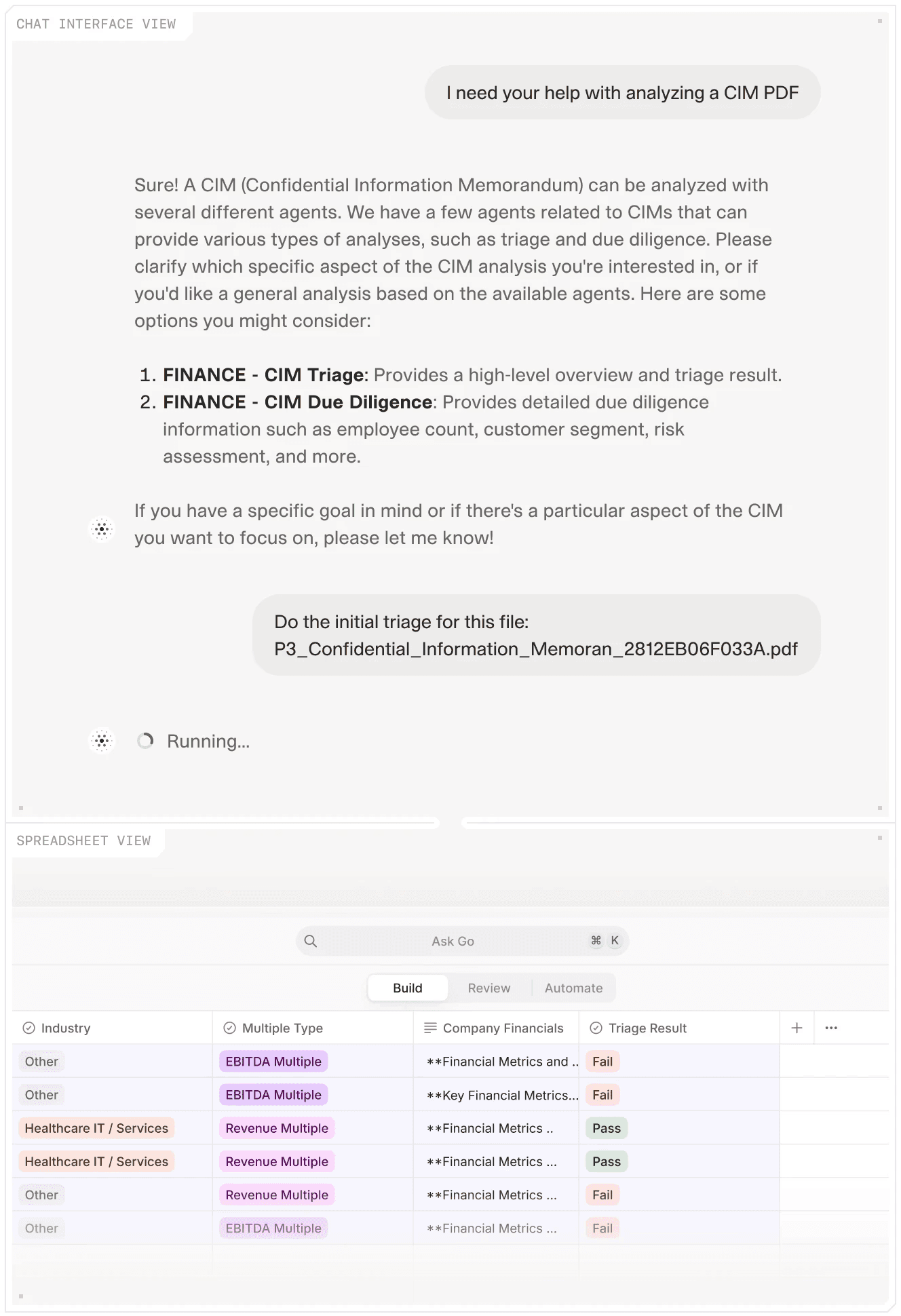
AI pitch deck and CIM analysis tools output structured data: company name, revenue, EBITDA, and a pass or fail per criterion, rather than narrative feedback.
What AI can and cannot do with a pitch deck
AI handles the extractable information in a pitch deck reliably. It cannot replace the qualitative judgment that investment decisions actually hinge on. The investment teams that get the most from AI-assisted pitch deck analysis understand this boundary and build their workflow around it.
What AI does reliably
Across current pitch deck analysis tools, these capabilities are consistent:
Structured text extraction: Company name, founders, founding year, headquarters, sector, stage, total funding raised.
Chart and table reading: Financial projections in pitch decks are almost always embedded as chart graphics, not editable text. Tools that process visual elements, not just optical character recognition (OCR) text, extract revenue forecasts, growth rates, and unit economics from the slides themselves. Tools that read only text miss this data entirely, which is the most common and consequential gap in generic AI tools applied to pitch decks.
Missing slide detection: An AI agent flags when a deck has no competitive landscape slide, no team slide, or no use-of-funds breakdown. A missing section that a rushed analyst overlooks after reading 40 decks in a day is a signal the agent catches consistently.
Criterion matching: Given the fund's investment mandate (sector, stage, geography, minimum revenue), AI scores each deck against the criteria and outputs a structured Pass, Fail, or Needs Human Review classification.
First-pass memo drafting: For decks that pass the threshold, AI generates a structured deal memo outline with extracted data pre-populated, so the analyst does not start from a blank page.
What AI cannot replace
None of what AI extracts tells you whether the founder can execute. How a founder responds to pushback, whether they have the self-awareness to pivot when wrong, whether they are someone a board can work with: none of this is in a slide deck. Nor is relationship data: "who do we know who knows this team?" is often the deciding signal at the first-pass stage, and it lives in the investor's network, not in the document. Experienced sector investors also catch flaws in market size claims that no AI will flag, because the flaw requires knowing what is not in the deck.
Capitaly's research on VC AI adoption notes that VC profits from information asymmetry: knowing something the market does not. Fully automated rejection pipelines remain off the table not just for liability reasons, but because a founder who receives a bot rejection is a founder whose relationship with the fund is permanently damaged. AI functions as a copilot for the first skim, not a replacement for the decision-maker.
The realistic operational model is three-way triage: Pass, Fail, and Needs Human Review. Fail decks go to archive. Pass decks move to claim validation and memo drafting. Needs Human Review — typically 15–25% of inbound — goes to an analyst for a 10-minute read before the classification is finalised.
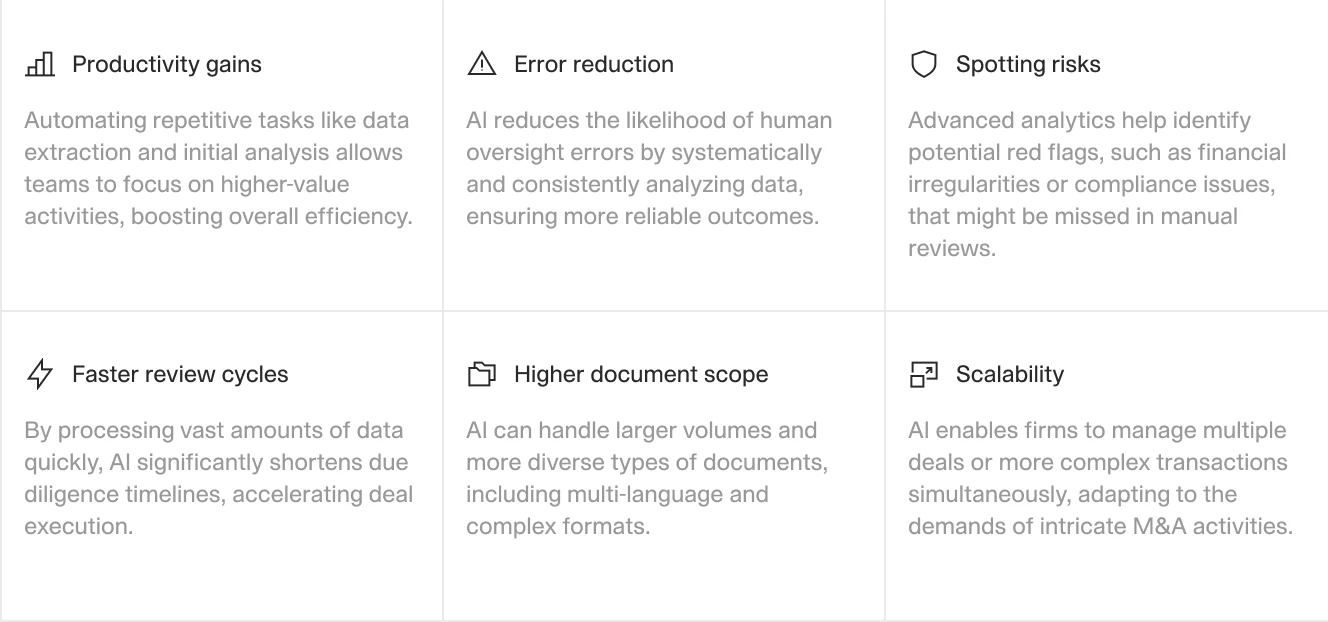
Analyst time shifts from data extraction to judgment. Judgment is the only stage in the process that requires a human.
What data AI should extract from a pitch deck
Before deploying any tool, investment teams should define their extraction schema: which fields matter to their fund's decision process, and in what format. Without a schema, analysis output varies across decks, cannot be compared across deals, and accumulates noise the analyst still has to sort manually.
The eight core sections of a pitch deck each contain distinct extractable fields:
Pitch deck section | Key fields to extract | What investors use it for |
|---|---|---|
Team slide | Founder names, roles, prior companies, domain experience, education | Assess founder-market fit; flag serial entrepreneurs; check for relevant operator experience |
Market opportunity | TAM, SAM, SOM, methodology (bottom-up vs. top-down), sources cited | Validate market size claims; check whether assumptions are defensible or inflated |
Problem / solution | Problem statement, proposed solution, differentiation claims | Assess product-market clarity; flag if the problem is not clearly articulated |
Business model | Revenue model, customer acquisition cost (CAC), lifetime value (LTV), payback period, pricing | Evaluate commercial viability; flag missing unit economics as a risk signal |
Traction | ARR, MRR, month-on-month or year-on-year growth (MoM/YoY), customer count, retention, churn, key logos | Signal-check early traction; distinguish genuine product-market fit from inflated numbers |
Competitive landscape | Named competitors, positioning claims, moat | Identify competitive risks; flag if significant competitors are absent from the landscape slide |
Financial projections | Revenue and EBITDA projections, runway, burn rate, path to profitability | Model-check projections; flag aggressive assumptions; verify runway against stated burn |
The ask | Amount raised, valuation or cap table, use of funds, timeline | Assess if terms fit the fund's check size, stage, and ownership criteria |
Annual recurring revenue (ARR) and monthly recurring revenue (MRR) aside, the most commonly missed data category is financial projections. Projections in pitch decks are almost always presented as bar or line charts, not as extractable text. A tool that reads only text will return nothing for a company's five-year revenue forecast if that forecast is displayed as a slide graphic. This is the clearest reason to evaluate tools that process visual elements before committing to any workflow configuration.
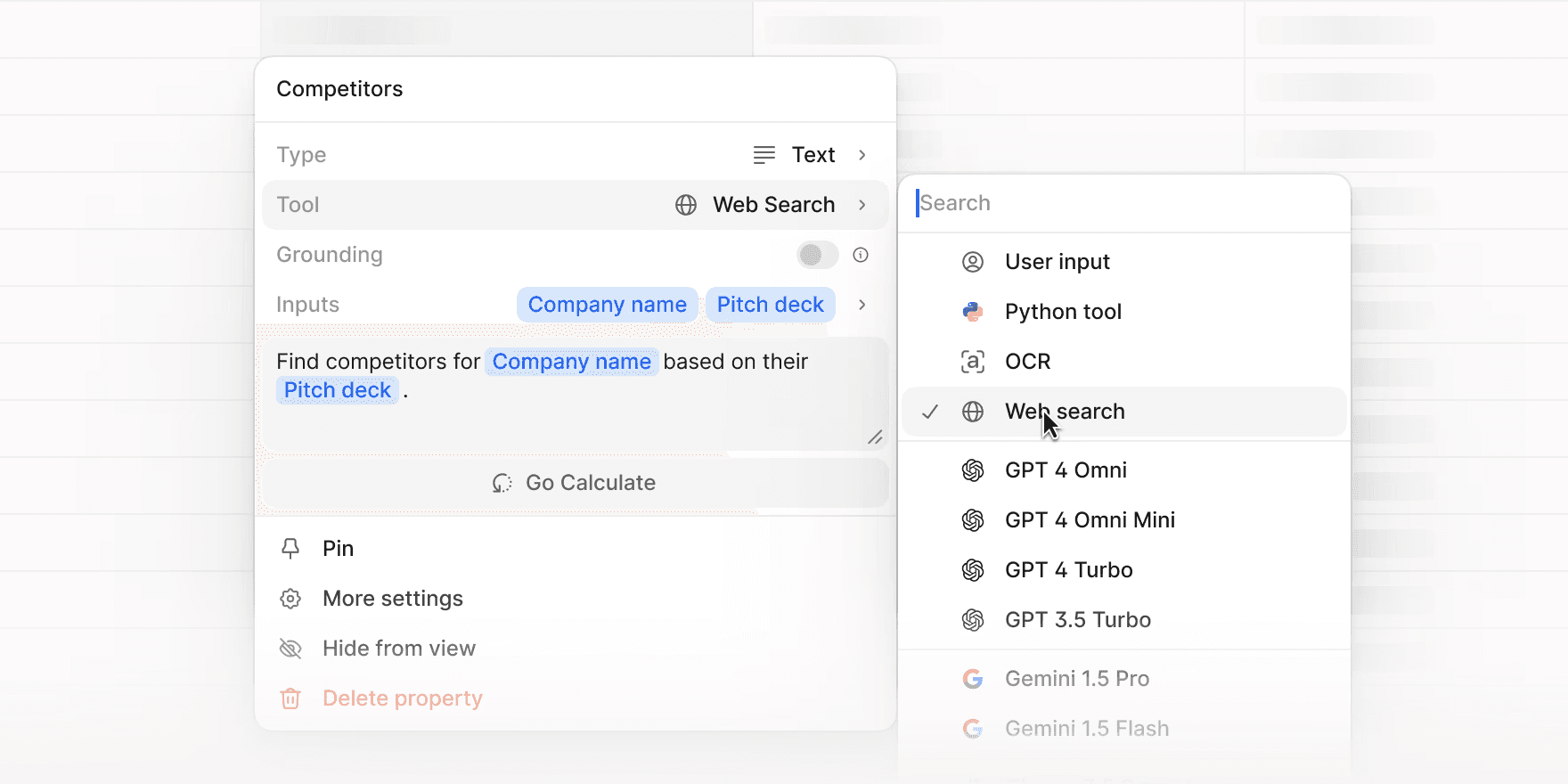
A well-configured extraction agent pulls structured data from every section of the deck, including visual elements like charts and competitor positioning maps.











AI tools for pitch deck analysis: what investment teams use in 2026
Two categories of tools exist for investor-side pitch deck analysis: purpose-built deal screening platforms, and general-purpose large language models (LLMs) adapted for deck review. The right choice depends on deal volume, CRM integration requirements, and how much configurability the fund needs in its extraction criteria.
Before committing to a tool, investment teams should assess five dimensions: extraction accuracy across formats (including visual elements), supported file types (PDF, PowerPoint, Google Slides, DocSend, Pitch.com), integration with the deal flow CRM, data security and access controls, and output format (whether the tool produces structured data, a prose memo draft, or both).
Tool | Category | Format support | Key capability | Integrates with | Best for |
|---|---|---|---|---|---|
V7 Go | Purpose-built document AI | PDF, PPT, Google Slides, DocSend | Visual and text extraction; chart and table reading; agent-based deal screening pipeline with Pass/Fail/Needs Review triage | Affinity, Carta, PitchBook | VC and growth equity firms wanting a full pipeline from deck intake to structured memo |
DeckMatch | Purpose-built pitch deck tool | PDF, Pitch.com, DocSend, Google Docs, company websites | Deck-to-memo using multiple AI models; external data enrichment; thesis matching | Deal flow CRM enrichment | Early-stage VCs and emerging managers ($10M–$100M assets under management) handling high-volume inbound |
Kruncher | Private market AI assistant | PDF, documents | Screening, memo drafting, and portfolio monitoring in one platform | CRM integrations | Firms wanting screening and ongoing portfolio work without switching tools |
Affinity File Analyzer | CRM-native | PDF, documents | Drop the deck into an Affinity deal record; extract key details without leaving the CRM | Native Affinity CRM | Teams already on Affinity who want basic extraction with no additional tooling |
Claude (API or Projects) | General-purpose LLM | PDF via API, Google Docs | Long context window processes an entire deck in one prompt; flexible custom analysis templates | Custom integrations | Investment teams building bespoke workflows; funds piloting AI before committing to a dedicated tool |
Evalyze | Investor matching and scoring | Investor readiness score; slide-by-slide feedback | N/A | Primarily founder-facing; limited utility for investor-side extraction | |
Research and fact-checking | Web-based | Real-time validation of market size claims and competitive landscape assertions | N/A | Supplementary claim validation tool; not a standalone pitch deck analysis solution |
For funds receiving more than 100 inbound decks a month, purpose-built tools are the practical choice: DeckMatch for early-stage, V7 Go for full-pipeline workflows that extend from deck to CIM to first-pass memo. Lower-volume funds or those in a pilot phase will find Claude's API or Affinity's native analyser a lower-commitment starting point. Funds that want a single agent covering deal intake, triage, and memo generation without adding another tool to the stack can use V7 Go's Deal Screening and Triage Agent, which covers each stage in one configured workflow.
V7 Go's Deal Screening and Triage Agent reads every incoming CIM or pitch deck, extracts key metrics, scores the opportunity against your investment playbook, and flags borderline deals for partner review. See the agent →
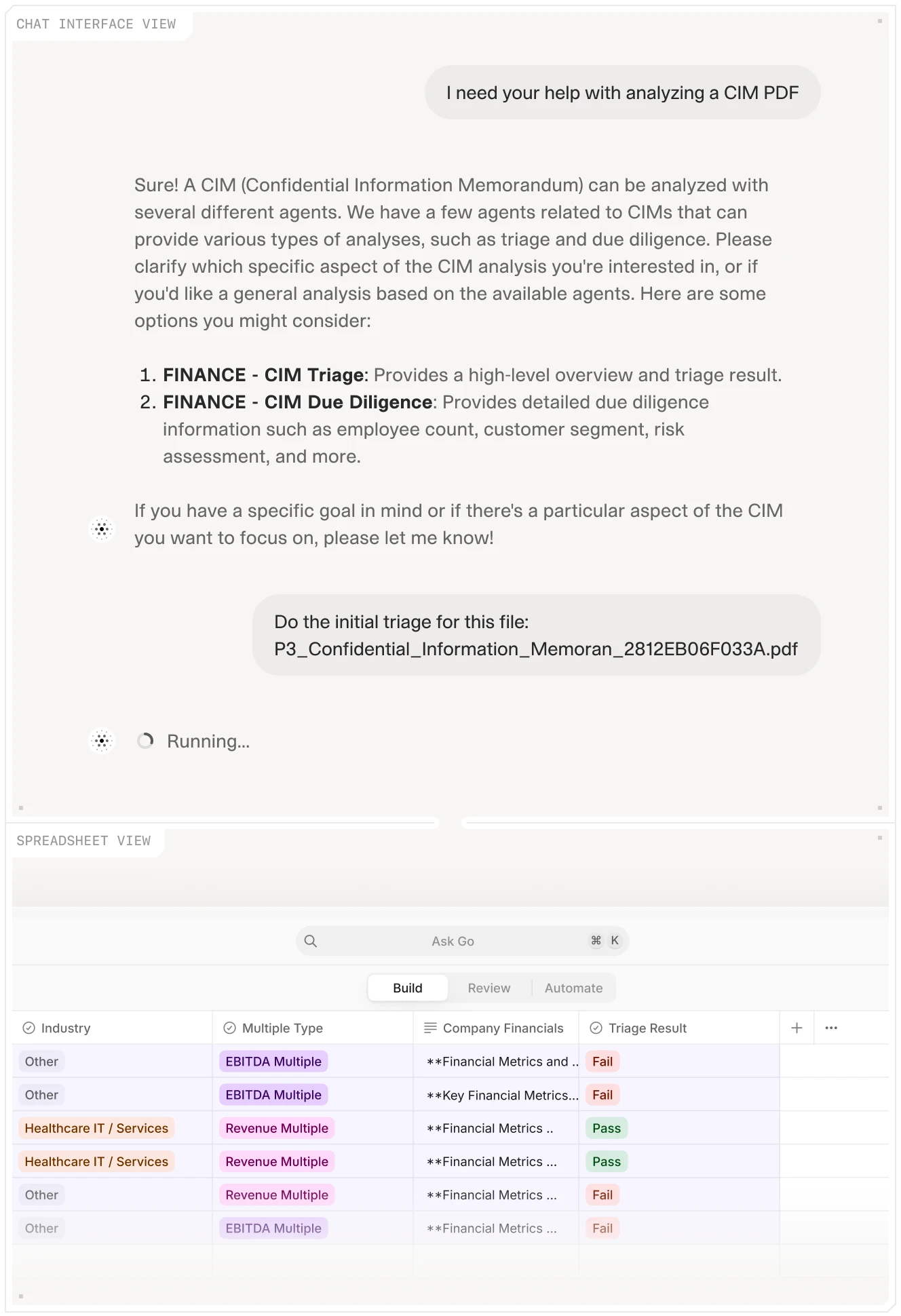
V7 Go presents extraction results in a structured table. Each metric is scored against the fund's investment criteria.
How to build a pitch deck screening workflow
A six-step workflow reduces the manual load at each stage without removing human judgment from the decisions that require it. The specific tool configuration will differ by fund, but the structural logic holds regardless of volume or stage focus.
Step 1: Intake standardisation. Route all inbound pitch decks to a single destination: a shared email alias, a Notion form, or a direct upload link. Decks that arrive via LinkedIn, Twitter, or WhatsApp should be forwarded to the same channel before processing begins. Without this step, no workflow runs reliably.
Step 2: Initial extraction. Run each incoming deck through the extraction agent. For V7 Go or DeckMatch, this takes 2–5 minutes per deck. The output is a structured data record across the eight field categories from the taxonomy above, populated from slide content, including charts and tables. A 50-deck inbox that arrived over a weekend is processed before the Monday stand-up.
Step 3: Thesis matching. Compare the extracted fields against the fund's investment criteria: sector alignment, stage, geography, minimum traction thresholds, check size. Output is a three-way classification: Pass, Fail, or Needs Human Review. For most funds, Fail represents 80–85% of inbound. Pass is typically 3–8%. Needs Human Review catches borderline cases where a judgment call is required on a specific dimension.
Step 4: Claim validation. For Pass and Needs Human Review decks, run a targeted check on the market size claims and competitive landscape assertions. A market size figure that cannot be independently verified in two minutes is worth flagging before the analyst invests more time. Perplexity's real-time web search handles this quickly. This step adds 5–10 minutes per qualifying deck.
Step 5: First-pass memo generation. For decks that clear claim validation, use V7 Go's Investment Memo Generation automation to draft a structured deal memo with extracted data pre-populated. The analyst starts from a document that already contains the company overview, market opportunity, team summary, and financial snapshot. Their work is to add judgment, not to transcribe data from the slides.
Step 6: Partner review. AI has filtered from 100% to approximately 5% of inbound and pre-populated a memo for each qualifying deck. Partner time goes to the judgment and relationship work that determines whether a deal moves forward. The first call becomes a substantive conversation instead of the first reading of the deck.
In brief: inbound deck → AI extraction → thesis match → Fail (archive) | Pass (validate and draft memo) | Needs Human Review (analyst, 10 min) → partner decision → first call.
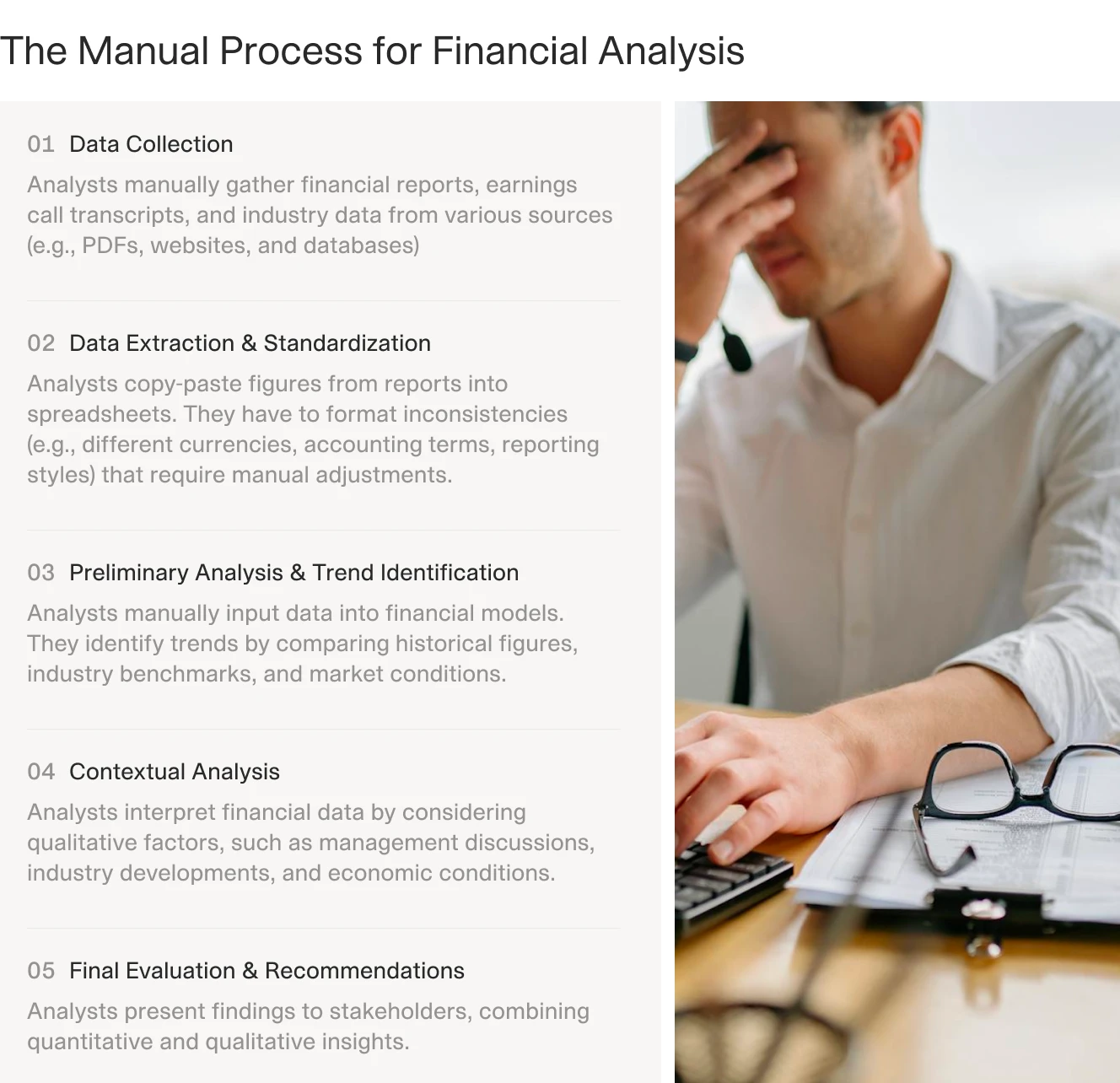
Without a structured screening workflow, analyst time disappears into reading decks that should have been filtered at intake.
How extraction criteria differ for VC and growth equity teams
Early-stage VC and growth equity firms need different extraction templates. Generic pitch deck analysis tools that apply the same criteria to every fund produce outputs that do not map to the actual decision criteria for either fund type. The analyst ends up manually re-sorting data that should have been structured correctly from the start.
At early-stage VC (pre-seed through Series A), the extraction template should prioritise team credentials, market size and methodology, product differentiation, and early traction signals: monthly recurring revenue (MRR), customer count, and month-on-month growth rate. Financial projections at this stage are aspirational. What matters is whether the assumptions behind them are coherent, not whether the numbers are precise.
At growth equity (Series C and beyond), the template shifts materially. Revenue quality, net revenue retention, LTV to CAC ratio, EBITDA or a clear path to profitability, and management track record replace the early-stage signals. A three-year projection in a growth equity deck is a business commitment, not a vision. The extraction agent should be configured to flag aggressive assumptions precisely, not treat them as placeholders to be revised later.
This is where configurability separates tools. Many purpose-built pitch deck platforms use fixed extraction templates designed for generic use. V7 Go's agent-based approach allows a fund to define its own extraction criteria and scoring rubric. A pre-seed fund and a growth equity fund can each run a separate agent configured to their exact mandate, on the same platform, with no overlap in their evaluation criteria.
Growth equity teams also evaluate confidential information memoranda (CIMs) alongside pitch decks. In a typical growth equity process, the pitch deck is the first document; the CIM follows after a mutual NDA is signed. Tools that handle both document types in a single workflow are meaningfully more useful than tools optimised for pitch decks alone. The AI private equity due diligence agent extends coverage further into the deal process, from initial screening through to due diligence.
For a broader view of how AI applies across the deal lifecycle, from initial screening to portfolio monitoring, the V7 Go venture capital page covers the full workflow in detail.
How are VC firms using AI for pitch deck analysis?
VC firms use AI to automate the first-pass screening of inbound pitch decks. Instead of having analysts read every deck manually, a configured AI agent extracts structured data from each document: founder backgrounds, market size claims, traction metrics, financial projections, and the terms of the ask. The output is a structured data record for each company, scored against the fund's investment criteria. The typical workflow is three-way triage: decks that clearly do not fit the fund's mandate are archived automatically. Decks that meet the criteria move to a second stage where an analyst validates the main claims and a first-pass deal memo is drafted. Borderline decks, typically 15-25% of inbound, receive a short analyst review before classification. This approach means a fund receiving 200 pitch decks a month can have every deck extracted, scored, and sorted before the analyst opens their inbox on Monday. Human time is allocated to the deals that warrant it, not to reading decks that should have been filtered at intake. The analyst's judgment is preserved for the decisions where it actually matters.
+
Can AI fully replace human pitch deck review?
No, and the investment teams that understand this boundary are the ones that get the most from AI-assisted screening. AI handles extractable information reliably: structured data, chart and table reading, missing slide detection, and criterion matching. It cannot assess the factors that most influence investment decisions. Whether a founder can execute under pressure, how they respond to pushback, their judgment in ambiguous situations - none of this is in the slide deck. Neither is relationship context: who do we know who knows this team is often the deciding signal at the first-pass stage, and that lives in the investor's network, not in the document. Experienced investors also catch flaws in market size claims that AI will miss, because the flaw requires knowing what is not in the deck: sector-specific knowledge accumulated over years of pattern recognition in a specific market. The realistic operational model keeps humans in the decision loop at two stages: the judgment calls on borderline decks, and the first call itself. AI reduces the work before those stages. It does not replace them.
+
How long does AI pitch deck analysis take?
For a purpose-built AI pitch deck analysis tool, extraction from a standard 20-30 slide pitch deck takes between 2 and 5 minutes per deck. This includes text extraction, chart and table reading, criterion matching against the fund's investment thesis, and generating a structured output record. For comparison, a skilled analyst reading the same deck for a first-pass assessment typically spends 30 to 60 minutes: reading, taking notes, cross-referencing claims, and summarising findings. For a fund receiving 200 inbound decks a month, the analyst time difference is approximately 100 hours per month if every deck is reviewed manually versus less than 20 hours if AI handles the extraction and the analyst reviews only the results. In practice, AI handles the full extraction in a batch that runs overnight or in real time as decks arrive. A 50-deck inbox that accumulated over a weekend is processed before the team's Monday stand-up. First-pass memo drafting for qualifying decks adds a further few minutes per document.
+
What data can AI extract from a pitch deck?
A well-configured AI agent extracts structured data across eight core sections of a pitch deck: team information (founder names, roles, prior companies, domain experience), market opportunity (TAM, SAM, SOM and the methodology behind the figures), problem and solution description, business model details (revenue model, CAC, LTV, pricing), traction metrics (ARR, MRR, growth rate, customer count, churn), competitive landscape (named competitors, moat claims), financial projections (revenue and EBITDA forecasts, runway, burn rate), and the terms of the ask (amount, valuation, use of funds). Financial projections deserve specific attention because they are almost always presented as charts in pitch decks, not as editable text. A tool that reads only text will return nothing for a company's five-year revenue forecast if that forecast is displayed as a slide graphic. This is the most consequential difference between tools that process visual elements and tools that apply only optical character recognition. Beyond extraction, a configured agent also flags missing slides: no competitive landscape slide, no team slide, no use-of-funds breakdown. A missing section that a rushed analyst overlooks is a signal the agent catches every time.
+
What AI tools integrate with venture capital CRM systems?
The tools are solving entirely different problems, and applying the wrong category produces poor results. Founder-facing AI pitch deck tools help with narrative structure, slide design feedback, investor readiness scoring, and presentation coaching. They evaluate whether a deck tells a compelling story, whether it follows investor conventions, and whether it addresses the questions a sceptical investor will ask. They are designed to help a founder improve a document before sending it. Investor-facing AI pitch deck tools do the opposite: they take a deck as-is and extract structured data from it. The investor wants to know whether the company meets the fund's investment criteria, which fields are missing or unclear, and what the extracted data looks like in a format comparable across all decks received that month. Most tools that appear in a search for AI pitch deck analysis are founder-facing. The majority of purpose-built platforms in this space were built to help founders prepare decks, not to help investors review them. Before selecting any tool for investor-side use, the key question is: does it produce structured extraction output, or does it produce narrative feedback?
+
What is the difference between AI for founders building decks versus investors reviewing them?
Go is more accurate and robust than calling a model provider directly. By breaking down complex tasks into reasoning steps with Index Knowledge, Go enables LLMs to query your data more accurately than an out of the box API call. Combining this with conditional logic, which can route high sensitivity data to a human review, Go builds robustness into your AI powered workflows.
+
Casimir is a seasoned tech journalist and content creator specializing in AI implementation and new technologies. His expertise lies in LLM orchestration, chatbots, generative AI applications, and computer vision.