15 min read
—



Casimir Rajnerowicz
Content Creator
V7 Go
A smarter way to manage due diligence and underwriting
Your acquisition has a folder full of signed documents. The lender has sent its payoff letter, the seller has delivered a closing certificate, and the team has marked most of the checklist green. Then the closing date moves. The payoff amount changes, the certificate refers to the old date, and nobody can tell which version of the funds flow the signatories approved.
An M&A closing checklist should make those dependencies visible. It records what the transaction requires, who must deliver it, what evidence supports completion, and who can confirm the next step. For a private equity deal team, that means connecting the legal closing process to financing, treasury and the people taking responsibility for the acquired business.
A useful checklist distinguishes a condition precedent from a document that evidences it and a task that helps fulfil it. Receiving a PDF can complete the delivery task while leaving the underlying condition open. A signature page can be available while its release remains unauthorized. Those distinctions determine what the team needs to resolve before closing.
This guide provides a starting checklist for a US private-company acquisition, then shows how to turn it into a working review process. The definitive agreements, transaction structure and applicable law determine the actual requirements. Counsel should adapt the list for the deal, including any sector-specific approvals, cross-border steps or financing requirements.
The checklist also needs to survive the handoff. A portfolio company finance lead should be able to find the final documents, see which obligations continue after closing, and understand the dates and notices attached to them. Build that record as the transaction progresses.
Build the checklist from source clauses, with a named owner, evidence link and reviewer for every applicable requirement.
Reopen affected rows when dates, amounts or execution versions change, even if the earlier document was reviewed.
Use AI to prepare cited requirements and exception reports, with legal decisions and payment approvals assigned to authorized people.
The starting point is the transition from M&A due diligence to execution. Diligence may identify an assignment restriction in a customer agreement. The closing checklist should show what the parties agreed to do about it, the evidence required, and whether an unresolved item prevents closing. That connection gives the investment team a clearer account of readiness than a percentage-complete dashboard.
M&A closing checklist: the requirements to track
Start with a register of the transaction's requirements, then connect the documents and actions needed to meet them. The table below is a reusable starting point. Its categories are prompts for review; they do not make every listed item mandatory for every acquisition.
A condition precedent is a requirement that must be satisfied or validly waived before the relevant party is obliged to close. A deliverable is an item to be provided under the transaction documents. A task is the action needed to prepare, review or deliver that item. Link these records when they concern the same requirement.
Workstream | Check where applicable | Evidence to record | Suggested coordinator |
|---|---|---|---|
Transaction authority | Required corporate and investor approvals; authority of each signing entity | Resolutions, consents and authority documents identified by counsel | Transaction counsel |
Closing conditions | Contractual conditions, required certificates and any permitted waivers | Controlling clause, supporting evidence and counsel's recorded conclusion | Transaction counsel |
Regulatory requirements | Applicable filings, approvals and waiting periods | Filing receipts, decisions and specialist confirmation of closing readiness | Regulatory counsel |
Third-party consents | Assignment or change-of-control requirements under relevant contracts | Executed consent, applicable contract and any qualifications | Seller's designated lead |
Price and funds flow | Estimated consideration, adjustments, recipients, deductions and reserves | Approved calculation and version of the funds-flow statement | Finance lead |
Debt and acquisition financing | Payoff requirements, release arrangements and funding conditions | Current payoff letters, financing deliverables and lender confirmations | Finance counsel |
Transfer and ancillary documents | Documents needed for the agreed transaction structure | Approved execution copies, schedules and signature records | Transaction counsel |
People and operations | Agreed employment, insurance, service-transition and access arrangements | Required agreements or confirmations, with effective dates | Deal-team workstream lead |
Closing record and follow-up | Released documents, required filings and surviving obligations | Binder index, delivery record and assigned post-closing calendar | Closing coordinator |
Add the source clause, deadline, owner, reviewer, status and evidence link to each applicable row. Split a category into separate rows when different entities, documents or deadlines are involved. Three landlord consents should have three identifiers if each can arrive, change or remain outstanding independently.
Choose one coordinator for the master register and one accountable person for each row. A team name such as "legal" leaves the next action ambiguous. The owner chases or prepares the deliverable; the reviewer decides whether the evidence answers the requirement within their authority. One person may hold both roles, but the checklist should make that choice explicit.
For example, a PE sponsor acquiring shares in a holding company should identify the actual signing entities and the contracts affected by a change of control. An asset acquisition may require different transfer instruments and assignment consents. Reusing the prior deal's checklist without reviewing those differences can preserve rows that no longer apply and omit requirements that do.
Start from the transaction's actual agreements. This catalogue illustration shows a merger agreement in document review.
Turn the agreement into reviewable checklist rows
Give each checklist row enough source context for another reviewer to reconstruct the requirement. A label such as "payoff letter" loses the delivery timing, recipient, form requirements and relationship to the closing payment.
Use the definitive agreement and its amendments as the contractual starting point. Earlier term sheet review helps explain the deal's development, but a negotiated term may have changed before signing. Record the document version and clause reference, including any schedule or exhibit incorporated into the requirement.
A published agreement demonstrates why this matters. Section 3.2 of the July 22, 2026 Progress Software and Domo asset purchase agreement specifies seller wire instructions at least three Business Days before closing. It separately requires draft payoff letters at least five Business Days before closing and executed payoff letters at least two Business Days before closing. These are deadlines from that agreement, not standard deadlines for M&A.
That example generates separate delivery rows. Each needs its own due date and evidence. The draft-letter row can be complete while the executed-letter row remains open. A single checkbox would hide that distinction.
A practical row format
Use a stable identifier, then record the following fields in the team's existing spreadsheet or closing software:
Requirement: the action or condition, with the responsible entity and intended recipient.
Source: agreement, version, clause and any linked exhibit or amendment.
Timing: contractual deadline, internal target, relevant calendar and time zone.
Responsibility: delivery owner, reviewer and escalation contact.
Evidence: current document, date, execution status and link to the retained file.
Decision: review status, outstanding question, next action and any authorized waiver record.
Dependencies: related rows and the event that would trigger another review.
Keep a contractual deadline separate from an internal target. Asking for a document earlier gives reviewers time to respond; it does not amend the agreement. If the definition of Business Day depends on specified locations or bank holidays, use that definition when calculating the deadline.
In an agreement analysis workflow, extraction should propose these fields and cite their source. Missing timing should remain an open question. Filling an empty date with a plausible convention makes the register look complete while changing the obligation.
Separate document receipt from condition satisfaction
Track document progress and condition review separately. "Received" describes an event. "Reviewed and accepted" records a conclusion by an authorized person about a particular requirement and version.
For deliverables, a practical sequence is requested, received, under review, revision needed, approved for execution, executed and delivered. Conditions need their own states, such as open, evidence under review, confirmed satisfied, or waived where permitted. A row marked not applicable should retain the reason and reviewer rather than disappear from the register.
Take a hypothetical landlord consent. The seller uploads a signed letter, but it names the wrong acquiring entity. The delivery row can record that a document arrived. The reviewer should keep the consent issue open, identify the mismatch and assign the correction. A green file-receipt indicator should not flow automatically into a green closing-condition indicator.
Preserve qualifications as well. A consent limited to one premises or one transfer may leave another requirement unresolved. Review the applicable contract and transaction structure with the letter. The document's title alone cannot answer whether the required consent has been obtained.
Record the decision and its authority
If the team proposes proceeding with an outstanding item, identify the legal and commercial decision separately from the follow-up task. Counsel should determine whether waiver is available, who can give it, and what form the agreement requires. The checklist should link to the resulting record and any conditions attached to it.
A buyer's willingness to accept commercial risk does not remove an applicable legal filing or waiting-period requirement. Nor should the coordinator infer a waiver from silence on a status call. Escalate the unresolved point to the person authorized to decide it, with the relevant source and current evidence.
A structured contract review process turns an unclear status into a specific question. Instead of "consent pending," write "seller to obtain consent naming AcquisitionCo; buyer counsel to confirm scope after receipt." The next review then has a clear purpose.
Diligence findings can change the decision to proceed after an LOI has been signed. Axial's breakdown of unsuccessful transactions illustrates why the checklist needs to retain unresolved commercial and legal issues alongside the document-delivery record.
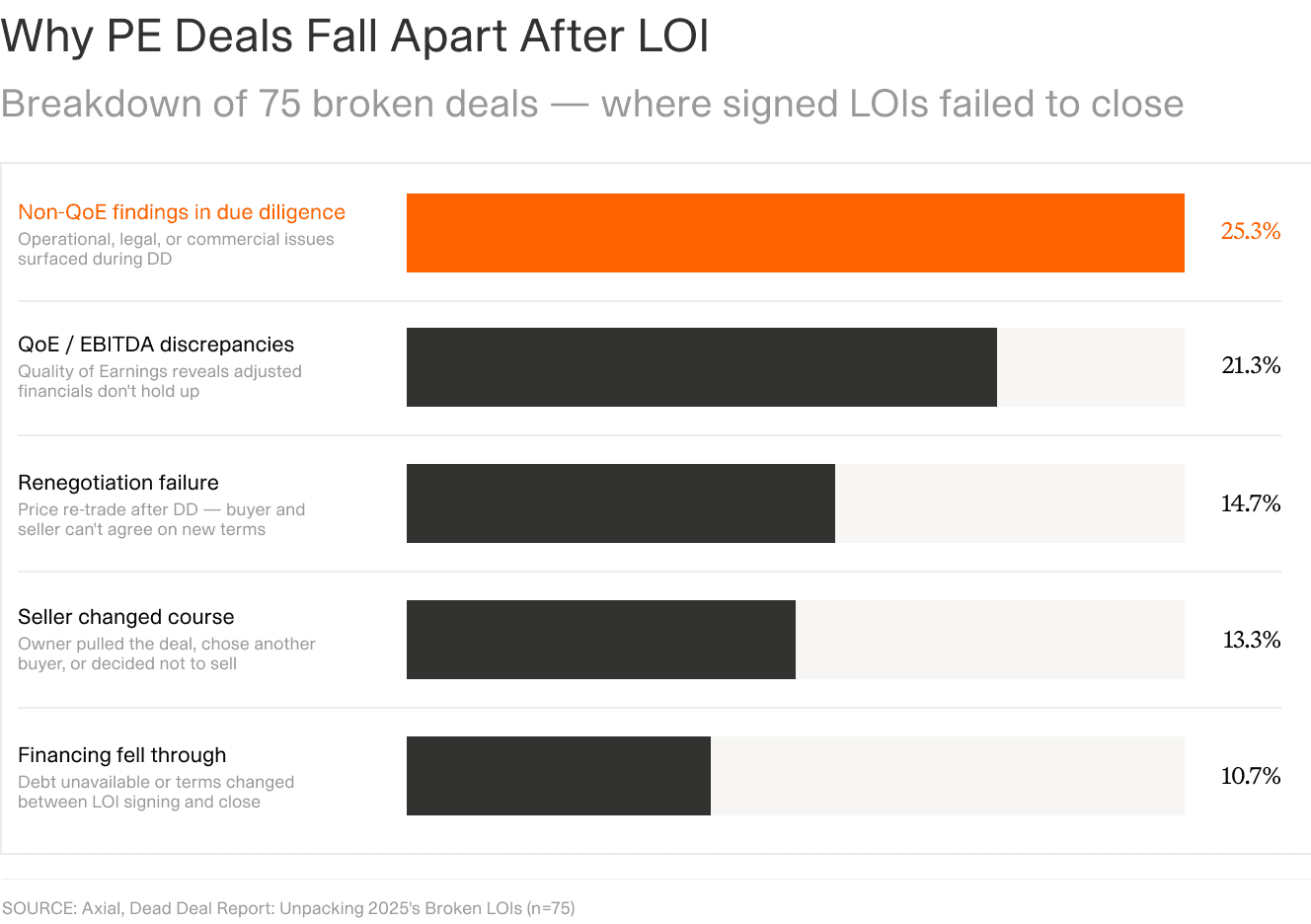
Source: Axial, Dead Deal Report: Unpacking 2025's Broken LOIs (2026). Selected reasons among 75 unsuccessful transactions across eight buyer types; these percentages describe the failed-deal sample.











Recheck dependencies when the closing date moves
A changed closing date should trigger a review of affected evidence, amounts and deadlines. Retain the earlier review record, identify what changed, and reopen the rows whose assumptions no longer hold.
Consider a hypothetical PE acquisition originally scheduled for Tuesday, September 15, 2026, and moved to Friday, September 18. Assume the relevant payoff letter expressly permits payment through September 18 using a stated daily accrual, and all other inputs remain unchanged. These are invented terms for the example, not terms from the Progress/Domo agreement.
The letter states a payoff of $12,000,000 on September 15, plus $2,500 for each later calendar day through its permitted payment date. The revised amount is $12,007,500: three additional days multiplied by $2,500, added to the original amount. Finance must check that this calculation follows the actual letter, including its treatment of payment timing.
If the real letter instead expires on September 15 or requires a replacement quote, the team needs updated evidence. A spreadsheet formula cannot extend the lender's offer or establish that a release will occur.
Affected item | Review after the date change | Evidence needed to close the row again |
|---|---|---|
Payoff amount | Confirm the permitted payment date and accrual basis | Current letter and reviewed calculation |
Funds flow | Update debt payment and any affected recipient amounts | Reconciled, approved replacement version |
Closing certificate | Check the date and matters it certifies | Appropriate current certificate confirmed by counsel |
Funding request | Check lender notice timing and availability | Finance counsel or lender confirmation for the revised plan |
Signature release | Check whether authority covers changed documents and timing | Confirmation under the agreed release process |
Operational handoff | Review effective dates for coverage, services and access | Confirmation from the responsible workstream owners |
The extra debt payment also needs an identified source. Depending on the agreed transaction mechanics, it might affect seller proceeds, another adjustment or required funding. Do not increase one payment in isolation and assume the sources still equal the uses.
Acquisition financing has its own requirements. Link the relevant credit agreement and funding checklist to the acquisition closing register, with an owner responsible for reconciling the two. A complete purchase-agreement checklist does not establish that funding conditions have been met.
Finally, preserve the change history: old date, revised date, affected rows, refreshed evidence and reviewers. Unaffected rows can retain their status after the responsible reviewer confirms that their basis still holds. The objective is a focused recheck of dependencies, with an explanation of why each reopened item is ready again.
Control execution versions, signatures and funds flow
Make the approved document version and the authority to release it explicit before the closing call. A file name containing "final" does not establish either point.
The ABA's MAC Digital Documentation Protocol describes practices for electronic M&A signings and closings: provide complete documents to signatories, confirm their review, arrange lawful execution, and establish effective delivery and release. It is a best-practice framework rather than a substitute for the legal requirements of the transaction.
Apply that discipline to the register. Record which execution copy each signature belongs to, whether the required schedules are included, who holds the signature, and what release remains necessary. If a document changes after signature collection, counsel should resolve what further approval or execution is required before the team uses it.
For example, an updated transition services schedule may change the obligations attached to an already collected signature. The coordinator should flag the replacement version and obtain the required confirmation. Combining an old signature page with a revised document without resolving that issue obscures what was authorized.
Keep funds held in escrow and signature pages held pending release as separate entries. Both may involve release instructions, but the assets, parties and arrangements differ. Record the applicable process rather than assuming one status controls both.
The funds-flow reviewer should reconcile approved inputs, amounts and recipients before authorized treasury staff initiate payments. Arithmetic checks can detect an imbalance or a duplicated amount; they cannot prove that bank details belong to the intended recipient.
The FBI's business email compromise guidance recommends verifying changes to payment instructions and contacting the person through independently obtained details. Build that check into the team's existing treasury process, especially when bank instructions change near closing. An email thread or extracted account number should not bypass it.
At the closing call, use the register to identify outstanding decisions, confirm the agreed sequence and retain the resulting release and delivery record. Update completion statuses from confirmed events rather than expected timing.
Build the closing binder and post-closing handoff
Preserve the closing record while the people and evidence are still available. The binder should let a later reviewer find the executed documents and understand what was delivered, released or left for follow-up.
Index the agreed final documents against the checklist identifiers. Include the relevant amendments, schedules, consents, certificates, waivers and closing confirmations. Identify the controlling version and preserve earlier versions separately where the firm's retention policy requires them. The master index should not send a portfolio finance lead to an unsigned draft.
Give surviving obligations their own handoff register. Purchase-price adjustment submissions, escrow releases, deferred deliveries and transition-service deadlines may continue after closing under the actual agreements. Record the responsible person, trigger, due-date rule, recipient and supporting clause. A generic "post-close" label is too broad to manage a notice deadline.
Suppose a hypothetical acquisition requires a statement within 60 days after closing. The finance owner needs the contractual counting rule, the information required to prepare it, the delivery method and the recipient. Counsel should confirm the interpretation before a calendar reminder becomes the team's working deadline.
The handoff should also identify decisions already made. If the parties agreed to obtain a particular document after closing, retain the agreement supporting that treatment and assign the follow-up. Moving a row to another tab does not itself permit deferral.
Connect operational actions to the add-on integration plan. Access provisioning, transition arrangements and reporting responsibilities need owners who will remain involved after the deal team moves on. Keep the legal closing record available to those owners through appropriate access controls.
The lifecycle map ends with portfolio monitoring. The closing binder supplies that work with executed agreements, continuing obligations and records of decisions that the portfolio team must be able to retrieve.
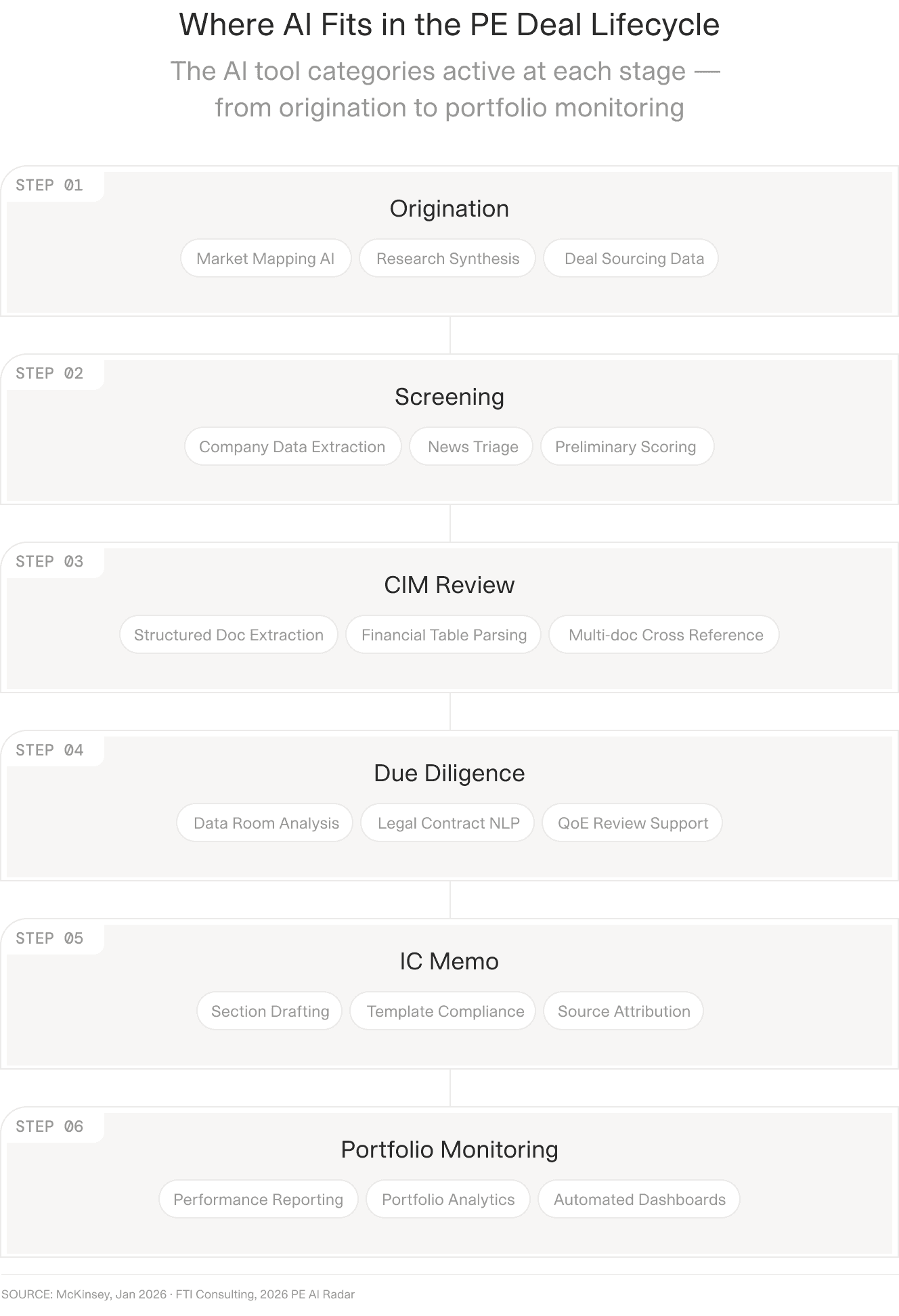
V7's PE lifecycle map connects diligence and investment committee work to portfolio monitoring. Sources: McKinsey, January 2026; FTI Consulting, 2026 Private Equity AI Radar.
Use AI to prepare a source-linked closing review
AI can help turn agreements and closing evidence into a structured review queue. The useful output is a proposed checklist, cited exceptions and a change report that the responsible people can inspect.
V7 Go provides AI infrastructure for private markets. Its Context Graph can connect authorized firm context, such as prior transaction records and approved review standards, to the current work. In a closing workflow, that context helps the team apply its own conventions while keeping each requirement tied to the current deal's documents.
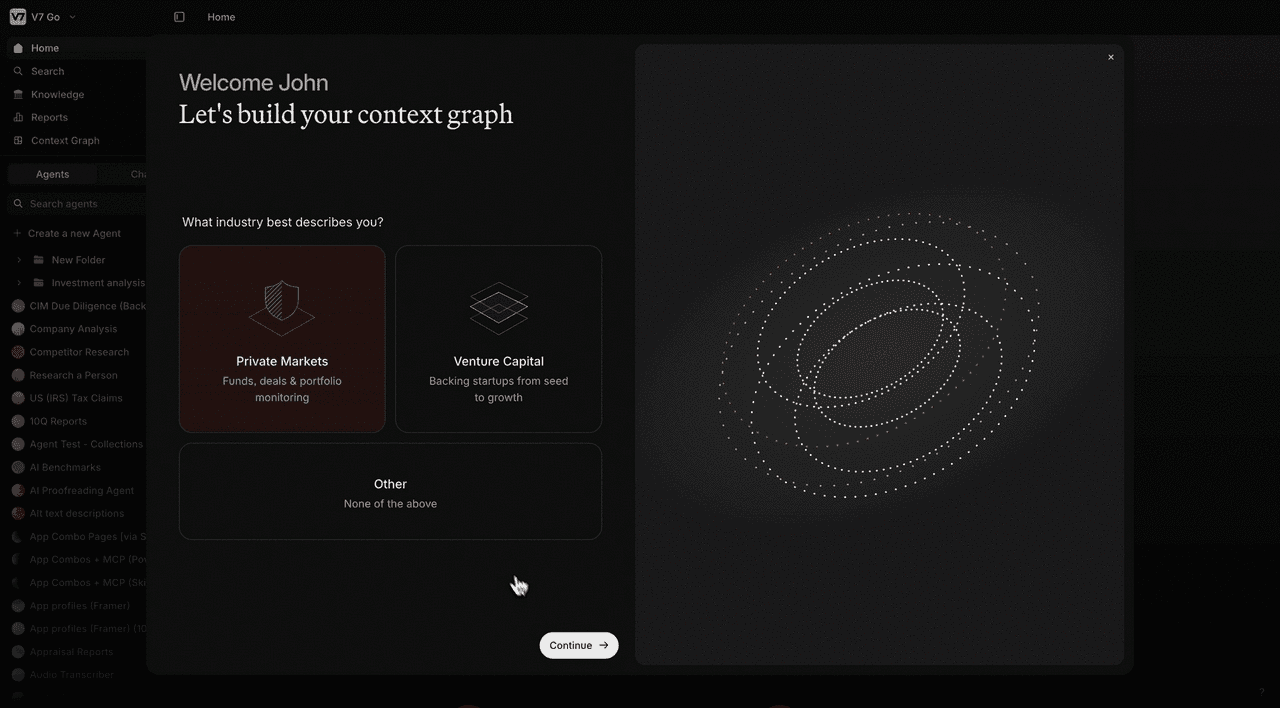
V7 Go introduces Context Graph setup by selecting the firm's industry.
Define the workflow in stages. First identify the controlling agreements and versions. Next extract proposed requirements, parties, timing and source references. Compare incoming evidence with those reviewed requirements. Route unresolved differences to the designated reviewer, then prepare the team's preferred checklist or status report.
Use the appropriate tool for each step. A language model can propose an interpretation of a clause. Python can calculate dates or reconcile approved numbers using explicit rules. The reviewer must confirm the interpretation and inputs. A repeatable calculation is useful only when it represents the right obligation.
For the date-change example, the workflow could identify the payoff letter, extract its permitted dates and daily accrual, calculate the revised amount, and flag the related funds-flow row. It should retain the source references and request review where the letter is unclear. That is a proposed configuration to build and validate with the team.
V7's solutions engineers work with customers to configure these steps around their documents and outputs. Keep signature collection, legal sign-off and payment execution in the systems and processes responsible for them. A generated checklist should enter the review process with its evidence attached.
Evaluate the workflow on completed transactions that were not used to configure it. Compare proposed rows with counsel-reviewed requirements. Inspect missed obligations, unsupported additions, incorrect dates and failures to detect changed evidence. Include amended agreements, incomplete schedules and conflicting versions in the evaluation set.
Measure whether the review package is useful: how much correction it needs, whether citations support the proposed requirements, and whether material exceptions reach the right person. The team can then decide which steps are reliable enough to adopt and where closer review remains necessary.
A closing checklist earns its place when someone can open an unresolved row and see the requirement, current evidence, decision owner and next action. After closing, the same record should explain what happened and what remains to be done.
To scope a V7 Go closing-review workflow, bring one completed transaction's agreements, checklist and final binder, using materials your team is authorized to share. Work through how the requirements were identified, where evidence changed, and which decisions required review. Those concrete examples provide a basis for building and evaluating a workflow around the firm's actual closing process.
What should an M&A closing checklist include?
An M&A closing checklist should identify the requirements that apply to the transaction, the evidence needed to address them, and the people responsible for delivery and review. Typical workstreams include corporate approvals, closing conditions, regulatory requirements, third-party consents, consideration and funds flow, financing, transfer documents, and post-closing obligations. The definitive agreements and applicable law determine which items belong on the actual list. For each row, record the source clause, deadline, current evidence, owner, reviewer and next action. Include dependencies so a changed date or document prompts the appropriate recheck. Treat a generic checklist as a starting point for counsel and the deal team to adapt, rather than as confirmation that the transaction is ready to close.
+
Who prepares and maintains the closing checklist?
The parties should agree who coordinates the master closing checklist, with transaction counsel commonly playing a central role in translating the agreements into requirements. The coordinator maintains the register and follows up on open items, while designated workstream owners prepare or obtain their deliverables. Finance, treasury, regulatory advisers and operational leads may each have separate responsibilities. Record a named reviewer for requirements that need specialist or commercial judgement. Maintaining the spreadsheet does not give the coordinator authority to waive conditions, approve legal conclusions or release funds. Agree a process for updates, version control and escalation at the outset, including who confirms that evidence is sufficient and who records the final closing and handoff status.
+
How does a closing checklist differ from a due diligence checklist?
A due diligence checklist organizes the information and investigation needed to assess a proposed acquisition. A closing checklist organizes the requirements and actions needed to complete the transaction on its agreed terms. The two should connect where diligence findings produce contractual obligations or unresolved execution issues. For example, diligence might identify a customer contract with a change-of-control provision. The closing register should then identify the applicable requirement, the consent or other treatment agreed for the deal, and the person reviewing the evidence. Avoid carrying every diligence request into the closing register without checking its purpose. A missing diligence document and an unsatisfied closing condition can have different consequences, which counsel and the deal team need to distinguish.
+
When should the team start the closing checklist?
Begin preparing the checklist while the transaction documents are taking shape, then reconcile it to the signed definitive agreements, schedules and amendments. This lets the team identify work that needs lead time, such as third-party consents, financing notices or specialist approvals. Internal planning can begin before a requirement becomes final, provided the register distinguishes provisional assumptions from agreed obligations. There is no universal number of days before closing that fits every acquisition. Use the actual contractual deadlines and applicable legal requirements, and give reviewers internal targets that leave time for corrections. Continue updating the checklist through execution and the post-closing handoff. When the closing date changes, review affected deadlines, evidence, calculations and release arrangements.
+
Can an outstanding closing condition be waived?
AI can assist with preparing and maintaining the information used in a closing checklist. A configured workflow can propose requirements from agreements, attach source references, compare incoming evidence, flag changed dates or versions, and prepare an exception report for review. The team should validate those outputs against representative transactions and inspect omissions as well as incorrect additions. Legal interpretations, condition satisfaction, waiver decisions, signature release and payment authorization remain assigned to the responsible people and processes. For calculations, use explicit approved rules and inputs rather than treating a generated number as verified. The practical objective is a review package that is easier to inspect and update, with a clear record of the evidence behind each proposed action.
+
Can AI manage an M&A closing checklist?
Go is more accurate and robust than calling a model provider directly. By breaking down complex tasks into reasoning steps with Index Knowledge, Go enables LLMs to query your data more accurately than an out of the box API call. Combining this with conditional logic, which can route high sensitivity data to a human review, Go builds robustness into your AI powered workflows.
