8 min read
—



V7 Go
A smarter way to manage due diligence and underwriting
A single manager's Form ADV filing can run to well over a hundred pages, and an allocator tracking fifty or a hundred managers has to read a fresh one for each of them, mostly in the same few weeks every spring. The filing is dense by design: it is where an investment adviser discloses its business, its owners, its fees, its conflicts, and any disciplinary history, in a format built for regulators rather than readers. Most teams cope by skimming, which is exactly how a new disclosure or a quiet change in strategy slips through.
AI changes the economics of that review. Instead of reading every page of every filing, an allocator can have the disclosures that carry signal pulled out, the year-on-year changes flagged, and the whole thing turned into a short executive memo, with every figure traceable back to the page it came from. The reading does not disappear, but it moves to the handful of things that actually warrant a human's attention.
This article is about that shift. It covers what a Form ADV filing actually contains and which parts matter most for an investment decision, what a good executive memo should hold, the red flags worth surfacing automatically, and where a purpose-built tool fits into an allocator's diligence and monitoring. It is written for the people who read these filings for a living, not for the compliance teams who prepare them.
In this article:
What a Form ADV filing discloses, and why it is hard to read at scale.
The sections that carry the most signal for an allocator.
What a Form ADV executive memo should contain, and the red flags to surface.
How AI turns a stack of filings into review-ready memos, at portfolio scale.
What a Form ADV filing actually discloses
Form ADV is the registration and disclosure document every investment adviser files with the US Securities and Exchange Commission and state regulators, and it comes in several parts that do different jobs. Part 1A is the structured, check-the-box section: the adviser's business, ownership, clients, employees, regulatory assets under management (RAUM), affiliations, and, on its Disclosure Reporting Pages, any legal or disciplinary events. Part 2A is the firm brochure, eighteen narrative items written in plain English covering fees, services, strategies, methods of analysis, and conflicts of interest. Part 2B, the brochure supplement, covers the individuals who actually advise the client. Part 3, the Form CRS relationship summary, is a short plain-language document aimed at retail investors. The full form and its instructions sit on the SEC's own Form ADV page, and every adviser's filing is public on the Investment Adviser Public Disclosure system.
The problem is not access, since all of it is free to pull. The problem is volume and timing. Advisers must file an annual updating amendment within ninety days of their fiscal year end, and because most use a December year end, a large share of the market refiles in a single window that closes at the end of March, as the SEC's Form ADV FAQ sets out. On top of that, advisers must amend promptly during the year whenever certain information becomes materially inaccurate, so filings change without warning. An allocator with a large manager roster is therefore reading hundreds of pages against the clock, and then doing it again for the off-cycle amendments.
The bottleneck is rarely any single filing; it is the roster. Reading one Form ADV closely is manageable, reading a hundred of them in the same three weeks is where teams start to skim.
The sections that carry the most signal
Not every part of a filing deserves equal attention. Three areas do most of the work for an investment decision. The first is the Disclosure Reporting Pages in Part 1: any regulatory, civil, or criminal matter involving the firm or its people, where what matters most is whether anything is new since the last filing. The second is the conflicts of interest disclosure in Part 2A, Item 10 and its neighbours, covering compensation arrangements, proprietary products, and third-party payments; it is the most nuanced section and the one most often misread at a glance. The third is year-over-year material changes across both parts, where a manager quietly adding a new strategy, new leverage language, or a change of chief compliance officer tells you more than any single static disclosure. Read well, those three answer most of the questions an allocator brings to a filing.











What a Form ADV executive memo should contain
The output of all that reading should be a short, consistent memo, not a marked-up PDF. This is the part almost no published guide defines, so it is worth being concrete. A useful Form ADV executive memo has six parts. A firm overview: RAUM, client types, headline strategy, year founded, and the named chief compliance officer. A risk profile: the status of the Disclosure Reporting Pages, a summary of the conflicts of interest, and a count of any regulatory flags. Material changes since the last filing: what moved in Part 1, what shifted in the Part 2A narrative, and any personnel changes. A service-provider summary: custodian, prime broker, auditor, and administrator, with any change flagged. Key data points: the fee structure, leverage disclosure, and separately managed account exposure. And a recommended action: continue, flag for deeper review, or escalate to the investment committee.
The value of a fixed structure is comparability. When every manager's filing is reduced to the same six-part shape, an analyst can read across the roster instead of down a single document, and the memo becomes something an investment committee can act on rather than a research artefact. The point is a decision, not a summary.
Red flags worth surfacing automatically
Some Form ADV signals are worth pulling to the top of a memo every time, because they are the ones that reward a second look. None is damning on its own; each is a prompt to ask a question.
Red flag | Where in Form ADV | Why it is worth a look |
|---|---|---|
New or updated Disclosure Reporting Pages | Part 1, Schedule D | Fresh regulatory, civil, or criminal exposure |
Chief compliance officer paid by a third party | Part 1, Item 1.J | Potential gap in the compliance function |
Late or stale filing | Filing date metadata | A signal about operational control |
Sudden drop in reported RAUM | Part 1, Item 5 | Redemptions, a lost mandate, or a strategy in trouble |
New custodian, prime broker, or auditor | Part 1, Schedule D | Operational change; an auditor swap mid-cycle warrants a why |
New strategy or leverage language | Part 2A, Item 8 | Scope creep or drift from the mandate you underwrote |
New third-party compensation | Part 2A, Item 10 | A new conflict of interest |
The reason a machine helps here is boring and decisive: consistency. A human reviewer flags these reliably on the first ten filings and less reliably on the fiftieth, late on a Friday in March. A tool applies the same checks to the hundredth filing as to the first, which is the whole point of doing it this way.
From a stack of filings to review-ready memos
Turning filings into memos at portfolio scale is a document problem before it is an analytical one, and that is where a purpose-built platform earns its place. The analytical judgement, whether a disclosed conflict actually matters for your mandate, stays with the analyst. What the tool removes is the part that does not need judgement: locating the RAUM figure, reading eighteen brochure items, comparing this year's Part 2A to last year's line by line, and copying it all into a consistent shape.

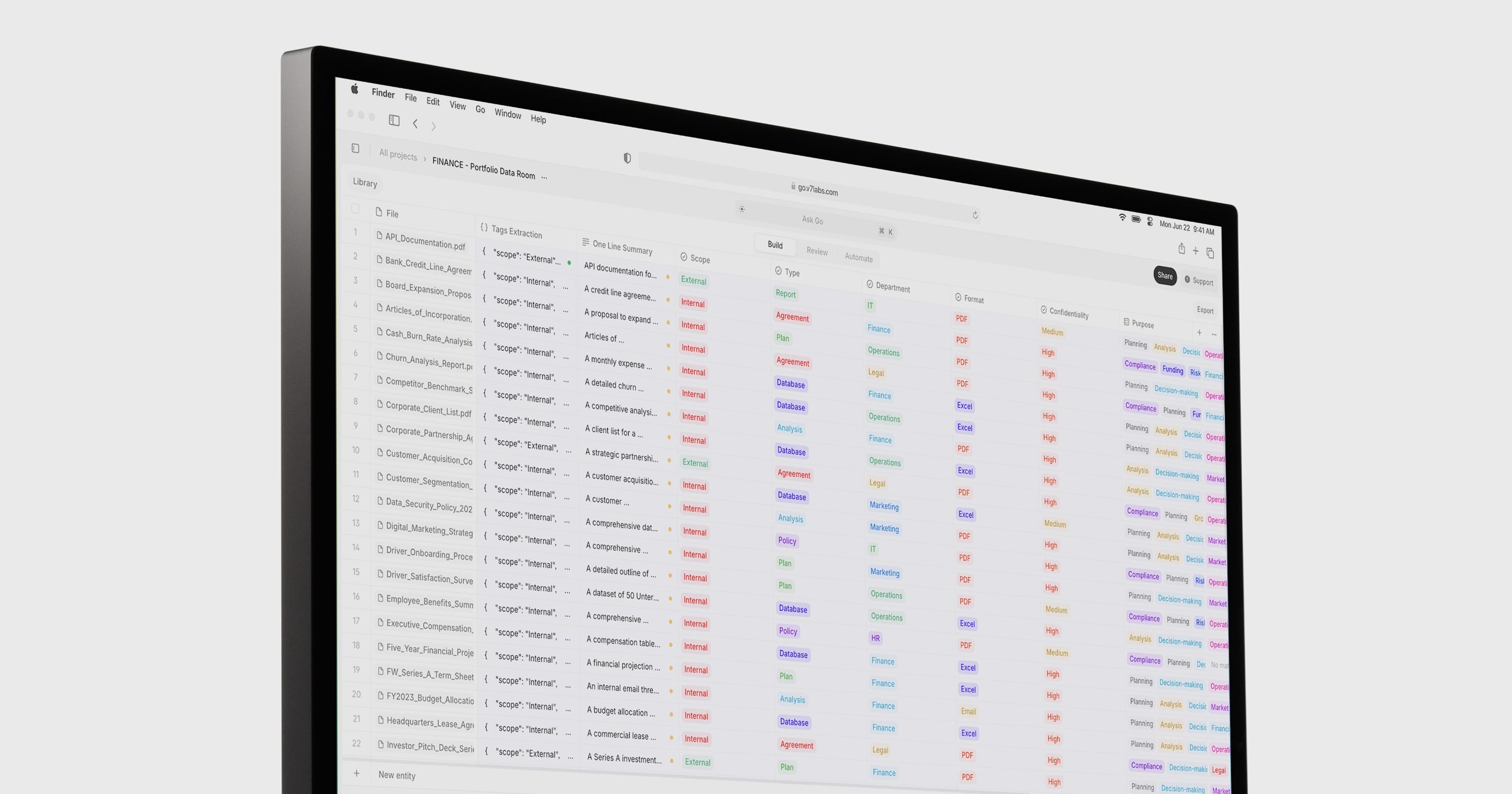
Structured extraction turns the narrative filing into fielded data, which is what makes a consistent memo, and a portfolio-level comparison, possible in the first place.
What makes this usable rather than a novelty is traceability. In a tool such as V7 Go, every figure in the memo stays linked to the exact passage in the filing it was drawn from, so an analyst can verify a flag in one click rather than re-reading the source, and an investment committee can trust the memo without taking it on faith. The same extraction runs across the whole roster at once, which turns the annual March scramble into a monitoring process that can also catch the off-cycle amendments as they land. V7 Go approaches SEC forms through its registration statement automation, uses a document comparison agent for the year-over-year diff that manual review handles worst, and shares a lineage with the 10-K disclosure analysis agent; our guide to reading a 10-K with AI covers the same discipline for a different filing. Form ADV analysis sits upstream of the wider private equity fund due diligence process and the broader use of AI across private equity and venture capital.
The value compounds across review cycles too. Every filing a team runs through this workflow becomes part of a firm's Context Graph, a relationship graph connecting each manager, its service providers, its disclosed conflicts, and every prior year's memo, so a new amendment lands against a record of what the firm already knows rather than a blank read. Ask which managers on the roster changed auditor in the last two years, or which ones have added leverage language since their last fundraise, and the answer comes back grounded in the specific filing each fact was drawn from, not an analyst's memory of a filing read eleven months ago. That is what turns Form ADV review from an annual scramble into a standing view of the roster, and it is a large part of what separates how AI for private equity allocators use for manager monitoring from a search tool pointed at a folder of PDFs.
The case for automating Form ADV review is not that reading filings is beneath an analyst. It is that the reading, as currently done, spends expensive judgement on cheap work: finding the RAUM figure, re-reading a brochure that barely changed, and hoping the one line that did change does not get skimmed past. Move the extraction and the year-on-year comparison to a tool, and the analyst's time lands on the disclosures that actually carry a decision.
Done at portfolio scale, the same shift turns an annual reading marathon into continuous monitoring: a new Disclosure Reporting Page or a mid-year strategy change surfaces when it is filed, not the following spring. The output is a consistent memo an investment committee can act on, with every figure traceable to its source, which is what separates a useful summary from one nobody quite trusts.
If you want to see what that looks like on your own managers, V7 runs a working session built around a handful of real Form ADV filings from your roster, ending in a memo you can put in front of a committee. It takes about the length of a manager screening call.
What information is disclosed in Form ADV Part 2?
Form ADV Part 2 is the adviser's narrative disclosure, and it has two sub-parts. Part 2A is the firm brochure, written in plain English across eighteen items that cover the adviser's advisory business, fees and compensation, the types of clients it serves, its methods of analysis and investment strategies, disciplinary information, and, importantly, its conflicts of interest and how it addresses them. Part 2B is the brochure supplement, which covers the specific individuals who provide advice to a given client, including their education, business experience, and any disciplinary history. Together, Part 2 is where the qualitative story of a firm lives, as opposed to the check-the-box data in Part 1. For an allocator, Item 10 and the surrounding conflicts disclosures in Part 2A tend to carry the most signal, because they describe compensation arrangements, proprietary products, and third-party payments that a manager has a strong incentive to describe in the most favourable light.
+
How do you analyse Form ADV filings?
A disciplined analysis of a Form ADV filing focuses on a few high-signal areas rather than reading every page equally. Start with the Disclosure Reporting Pages in Part 1 to check for any new legal, regulatory, or disciplinary matters since the previous filing. Read the conflicts of interest disclosures in Part 2A, especially Item 10, to understand how the adviser is compensated and where its incentives sit. Compare the current filing to the prior year to catch material changes, such as a new strategy, new leverage language, a change of chief compliance officer, or a swing in regulatory assets under management. Note the service providers, the custodian, auditor, and prime broker, and flag any changes. The output should be a short, consistent memo rather than a marked-up document. Increasingly, allocators use AI tools to extract the structured data, summarise the narrative sections, and detect year-over-year changes automatically, so that the analyst's time goes to judgement rather than to locating and copying information.
+
What are the key sections to review in a Form ADV filing?
Three areas do most of the work. The first is the Disclosure Reporting Pages in Part 1, which capture any legal, regulatory, or disciplinary events involving the firm or its personnel; the most useful question is whether anything is new since the last filing. The second is the conflicts of interest disclosure in Part 2A, principally Item 10, covering compensation arrangements, proprietary products, and third-party payments, which is the most nuanced part of the filing and the easiest to misread quickly. The third is year-over-year material changes across both Part 1 and Part 2, where a quiet addition of a new strategy, new leverage, or a change in the chief compliance officer often tells you more than any single static disclosure. Beyond those, it is worth noting the reported assets under management for trend, the fee structure, and the roster of service providers, since a change of auditor or custodian can be an early operational signal.
+
How often do investment advisers update Form ADV?
Every registered investment adviser must file an annual updating amendment to its Form ADV within ninety days of the end of its fiscal year. Because the great majority of advisers use a 31 December fiscal year end, that deadline falls at the end of March, which is why a large share of the market refiles in the same short window each spring. Beyond the annual amendment, advisers are also required to file other-than-annual amendments promptly during the year whenever certain information in the form becomes materially inaccurate, for example a new disciplinary event, a change in ownership, or a material change to the business. That means a filing an allocator read in April can change in July without any prompt, which is the practical argument for continuous monitoring rather than a once-a-year read. The filing history and dates are all visible on the SEC's public disclosure system, so it is possible to see exactly when a manager last amended its form.
+
What is the difference between Form ADV Part 1 and Part 2?
A Form ADV executive memo should reduce a long filing to a short, consistent, decision-oriented document. A practical structure has six parts. First, a firm overview: regulatory assets under management, client types, headline strategy, year founded, and the named chief compliance officer. Second, a risk profile: the status of the Disclosure Reporting Pages, a summary of the conflicts of interest, and a count of any regulatory flags. Third, material changes since the last filing, covering both the Part 1 data and the Part 2A narrative, plus any personnel changes. Fourth, a service-provider summary listing the custodian, prime broker, auditor, and administrator, with any change highlighted. Fifth, the key data points, such as the fee structure, leverage disclosure, and separately managed account exposure. Sixth, a recommended action: continue, flag for deeper review, or escalate to the investment committee. The value of holding every manager to the same structure is comparability, which lets an analyst read across a whole roster and gives a committee something it can act on.
+
What should a Form ADV executive memo contain?
Go is more accurate and robust than calling a model provider directly. By breaking down complex tasks into reasoning steps with Index Knowledge, Go enables LLMs to query your data more accurately than an out of the box API call. Combining this with conditional logic, which can route high sensitivity data to a human review, Go builds robustness into your AI powered workflows.
+
Casimir is a seasoned tech journalist and content creator specializing in AI implementation and new technologies. His expertise lies in LLM orchestration, chatbots, generative AI applications, and computer vision.