21 min read
—
A comprehensive guide to modern deal management platforms for private equity, venture capital, and asset management. We evaluate leading solutions and show how AI agents are finally solving the data ingestion bottleneck.

Casimir Rajnerowicz
Content Creator
V7 Go
A smarter way to manage due diligence and underwriting
If you ask a Managing Director at a mid-market private equity firm how they track their deal pipeline, they will point to a sophisticated CRM platform. Salesforce, DealCloud, or a custom-built solution.
But if you ask the Vice President of Business Development where the actual deal data lives, the data used to answer an urgent IC question at 9:00 PM on a Thursday, they will almost always point to Microsoft Excel.
This is the uncomfortable reality of deal management in 2025: despite billions spent on enterprise software, the industry's operational backbone remains a fragile network of spreadsheets, email threads, and manual data entry.
The core problem is not the CRM itself. The problem is the data ingestion layer. Every deal generates dozens of documents: NDAs, term sheets, CIMs, compliance certificates, board resolutions. These documents contain the critical data points that drive pipeline forecasting, risk assessment, and investment decisions. Getting that data into the CRM requires someone to read each document, extract the relevant fields, and manually key them into the system.
This bottleneck creates three cascading failures: deals move slower than they should, forecasting accuracy suffers because data is stale, and senior professionals waste time on administrative work instead of strategic analysis.
In this article:
The Architecture of Modern Deal Management: Understanding the critical split between the CRM layer and the ingestion layer.
Software Deep Dives: Detailed analysis of Salesforce, DealCloud, Clarify, Nektar, and legacy incumbents.
NDA Automation: How investment firms are automating contract review from email to signature.
Solving the Data Gap: How AI agents are finally automating the extraction of deal data from unstructured documents.
Implementation Playbooks: What to expect when migrating from spreadsheets to a modern stack.
The Core Challenge: Why Deal Management Software Fails
Before you select a platform, you need to understand why so many implementations fail. The core issue is a fundamental misunderstanding of what a deal management system is designed to do versus what the day-to-day workflow of an investment team actually requires.
The "System of Record" vs. "System of Engagement"
Most traditional CRM platforms are designed as Systems of Record. Their primary job is to be an immutable database of contacts, companies, and deal stages. They excel at storing structured data: company names, contact information, deal values, close dates.
However, the daily workflow of a deal team is fundamentally unstructured. They deal with messy, incoming data streams. A founder sends over a pitch deck at midnight. A compliance team flags a regulatory issue in an NDA. A portfolio company restates its revenue guidance mid-quarter.
The gap between these two realities creates operational friction. Consider a Vice President who receives a 47-page CIM via email. They need to extract the company name, sector, revenue, EBITDA, key risks, and management team. In a traditional workflow, this means:
Opening the PDF and manually reading through it
Copying relevant data points into a Word document or notepad
Logging into the CRM
Creating a new deal record
Manually typing each field
Attaching the original PDF
Sending a summary email to the investment committee
This process takes 20-30 minutes per deal. For a firm reviewing 200 opportunities per quarter, that is 100+ hours of manual data entry.
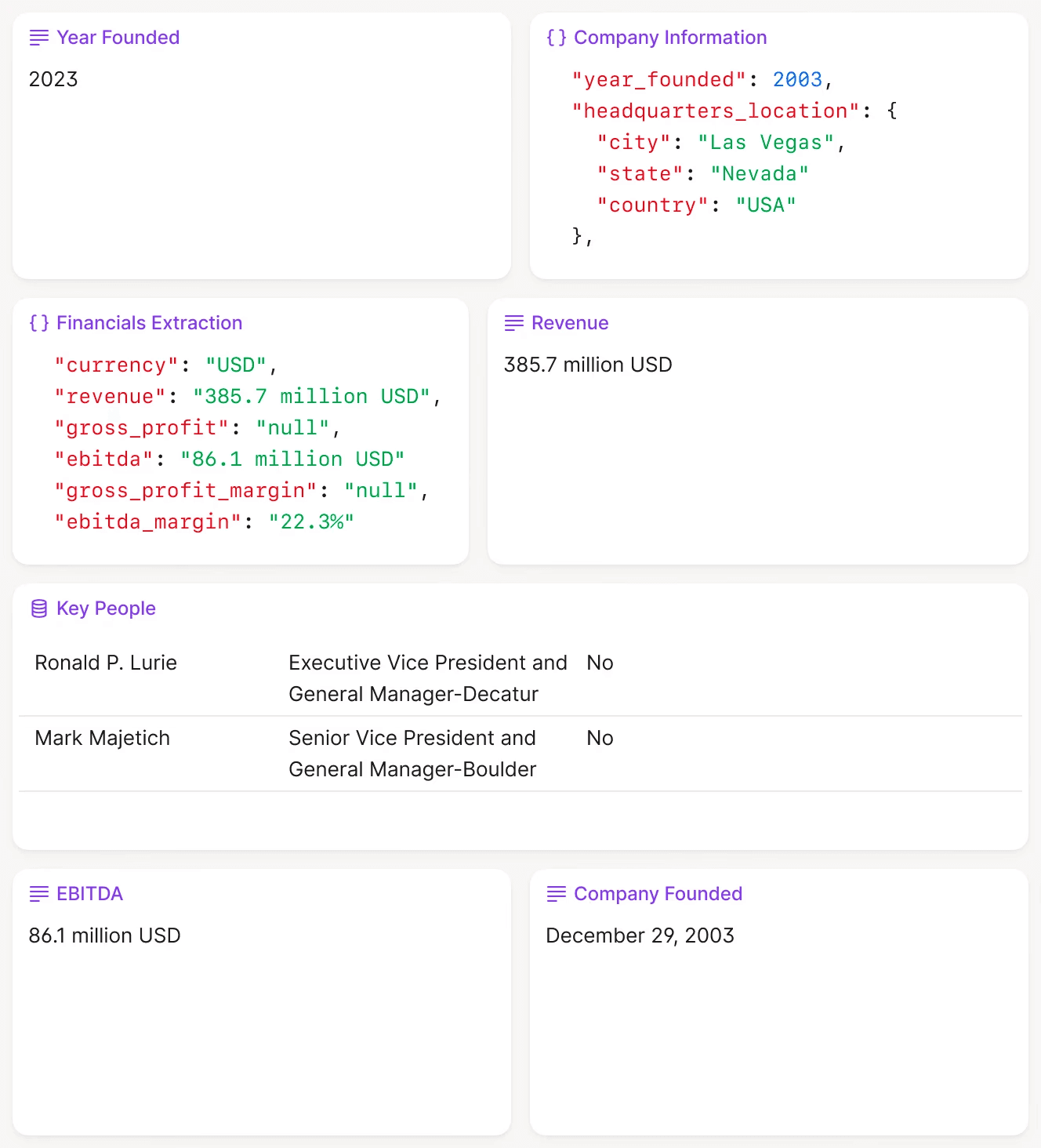
V7 Go extracting structured company data from unstructured CIM documents.
The Modern Solution: A Modular Stack
Leading firms in 2025 are moving away from the all-in-one monoliths. Instead, they build composable tech stacks that separate concerns:
The Intelligence Layer (Ingestion): Tools like V7 Go that sit at the top of the funnel. They read emails and PDFs, extract data using AI, visually verify it, and structure it into a clean format.
The CRM Layer (System of Record): Robust platforms like Salesforce or DealCloud that receive the clean data and handle relationship management, pipeline tracking, and reporting.
The Analytics Layer (Business Intelligence): Tools like Tableau, PowerBI, or specialized dashboards that present the final data to stakeholders.
This separation allows each layer to do what it does best. The CRM does not need to become an AI platform. The AI layer does not need to become a full CRM. They integrate via API, and the result is a system that is both powerful and maintainable.
V7 Go's agent library showing pre-built workflows for document processing, OCR extraction, and batch analysis.
The Data Ingestion Bottleneck
The single biggest operational bottleneck in deal management is not the CRM. It is the process of getting data into the CRM.
Consider a typical private equity deal flow:
An investment banker sends a teaser via email
The team requests a CIM
The CIM arrives as a 200-page PDF with embedded charts, tables, and footnotes
Someone needs to extract: company name, sector, geography, revenue, EBITDA, growth rate, key risks, management bios, cap table, use of proceeds
This data needs to populate the CRM deal record
The same data needs to populate an internal IC memo template
The same data needs to populate a pipeline tracking spreadsheet
In a traditional workflow, this is three separate manual processes. The same person reads the same document three times and re-keys the same data into three different systems.
According to recent industry data, companies noted up to a 60% reduction in manual administrative tasks through integrated deal management systems. But this statistic hides a critical nuance: most of that reduction comes from eliminating duplicate data entry, not from eliminating the initial extraction.
The initial extraction, reading the CIM, understanding the business model, identifying the key metrics, still requires a human. Or at least, it did until recently.
The AI Extraction Opportunity
Modern intelligent document processing platforms can now handle the initial extraction with high accuracy. An AI due diligence agent can:
Receive the CIM via email or API
Parse the document structure (sections, tables, charts)
Extract the key fields using a combination of OCR and LLM analysis
Cross-reference extracted data against the source pages (visual grounding)
Output structured JSON that can be pushed directly into the CRM
This is not theoretical. Firms deploy these workflows today. The result is a 90% reduction in manual data entry time and a corresponding increase in data accuracy.
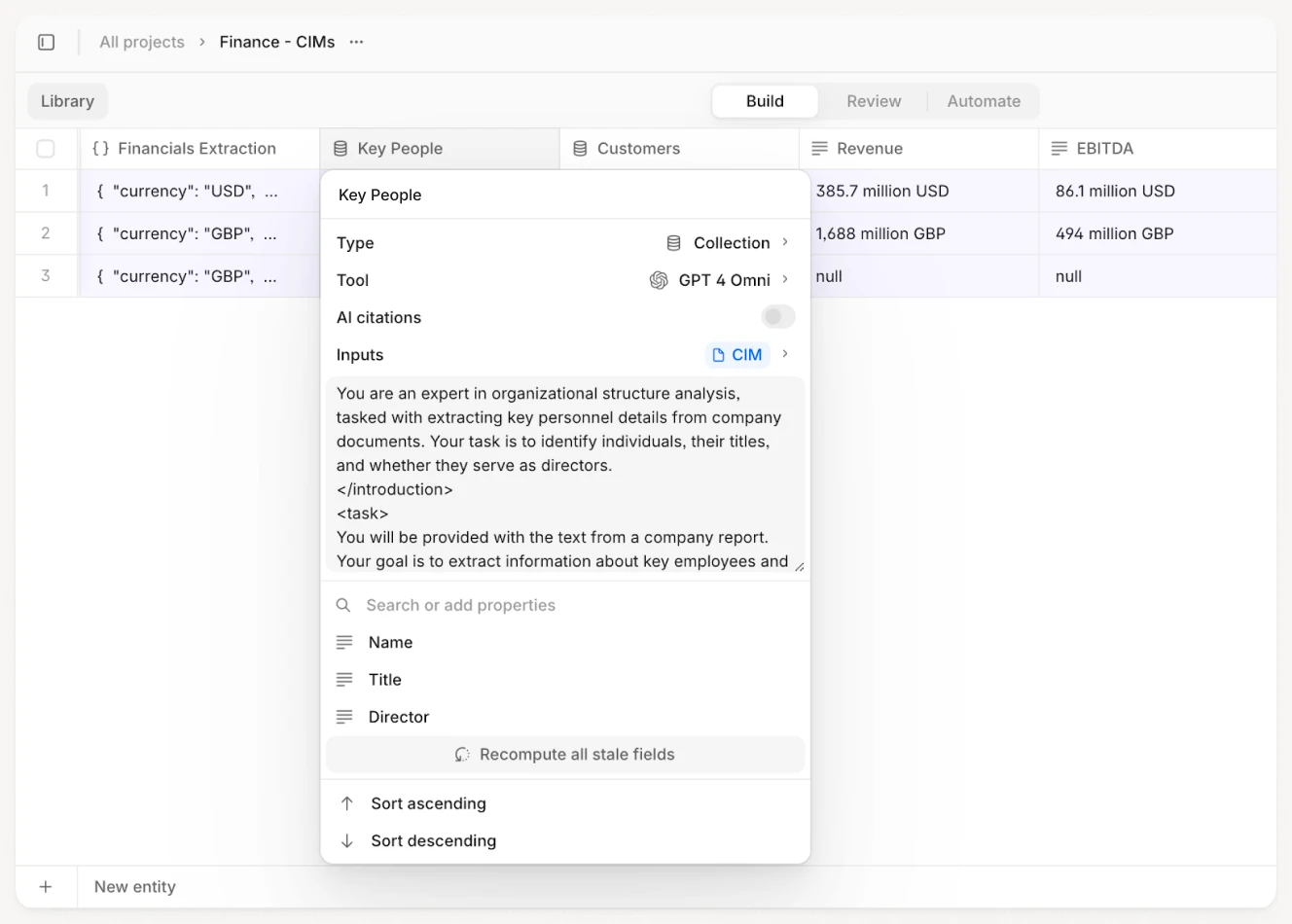
AI extracting management team data from a CIM with source-linked verification.
NDA Automation: A Deal Intake Case Study
To understand how AI changes deal management in practice, consider the NDA review workflow. This is often the first document a firm processes when engaging with a new counterparty, making it the gateway to the entire deal pipeline.
A mid-market asset management firm processes 15-20 NDAs per week. Their traditional workflow looks like this:
Credit analyst receives NDA from potential information provider
Analyst forwards to distribution list: compliance, external counsel, general counsel
Compliance checks counterparty name for conflicts (1-2 hours)
External counsel reviews NDA against internal guidelines (same day, 2-4 hours)
External counsel sends redlined version back via email
Internal GC reviews redlines and decides whether to negotiate or sign (30 minutes)
If acceptable: GC signs, scans, emails back
Assistant manually logs NDA details into Excel spreadsheet: date signed, counterparty, subject company, governing law, term, unique tracking number
Signed PDF stored in cloud folder
Total elapsed time: 1-3 days. Total labor cost per NDA: $400-$800 when accounting for paralegal and attorney time.
The firm's internal NDA guidelines are simple: five or six non-negotiable points (no indemnities, no contractual penalties, 3-5 year maximum term, mutual obligations preferred) and a preference to use LMA standard language where possible. Despite this simplicity, the process remains manual, expensive, and slow.
The Automated NDA Workflow with V7 Go
Here is how the same firm now processes NDAs using V7 Go's NDA Processing Agent:
Credit analyst receives NDA via email
Analyst forwards email to
ndas@v7concierge.comV7 Concierge receives the email, detects the NDA attachment, and routes it to the NDA Processing Agent
Agent extracts the full text and identifies key clauses: confidentiality obligations, term, governing law, indemnification, dispute resolution, termination rights
Agent compares each clause against the firm's internal guidelines (stored in a V7 Knowledge Hub)
Agent flags discrepancies: 'Governing law: Delaware (Guideline requires: New York or England),' 'Term: 7 years (Guideline maximum: 5 years),' 'Indemnification clause present (Guideline: prohibited)'
Agent generates a redlined version with suggested changes and a summary email listing all flagged issues
Summary and redlined NDA arrive in GC's inbox within 3 minutes
GC reviews flagged issues in the V7 Go Cases interface, where each flagged clause shows the exact source paragraph with visual grounding
GC approves or modifies the redlines
Upon approval, the agent automatically extracts metadata: counterparty name, subject company, governing law, term, signature date
Agent pushes metadata to the firm's Google Sheet via API, assigns the next available tracking number, and stores the signed PDF in the designated cloud folder
Total elapsed time: 5-10 minutes of human review. Total labor cost per NDA: $50-$100.
V7 Go's NDA review agent flagging governing law and term violations, with suggested redlines.
Generating Guidelines from Historical Data
One challenge firms face is that their internal guidelines often exist only as institutional knowledge or as thin bullet-point lists emailed to external counsel. V7 Go solves this with a guideline generation workflow.
The firm provided V7 with 50 executed NDAs: the original inbound version and the final signed version. V7 Go's guideline generation agent analyzed the differences between each pair of documents and synthesized a comprehensive 20-page guideline document. This document captured:
Standard acceptable language for each clause type
Specific prohibited terms and phrases
Preferred fallback positions when counterparty resists changes
Jurisdiction-specific variations (UK vs. US)
The GC reviewed the generated guidelines, made minor edits, and uploaded the final version to the V7 Knowledge Hub. Now every NDA review references this comprehensive guideline set, creating consistency that was impossible when relying on ad hoc email instructions.











Deep Dive: Comparing Deal Management Platforms
To select the right platform, you need to evaluate how each handles the data ingestion problem. This is where the most operational friction occurs. We will examine each platform through the lens of a specific question: how does CIM data get from a PDF attachment into a structured deal record?
Modern AI Challengers
Clarify
Clarify positions itself as an AI-native deal management platform. The core value proposition is that AI is not bolted on but baked into the foundation.
Ingestion Approach: Clarify includes basic document upload and OCR extraction. You can upload a CIM, and it will extract text. However, the extraction is limited to simple field mapping. Complex documents with tables, charts, and footnotes require manual review. There is no visual grounding, so you cannot trace extracted figures back to source pages.
Top Features:
AI-powered lead scoring: The platform analyzes historical deal data to predict which opportunities are most likely to close. This requires a critical mass of historical data (at least 100 deals) to be accurate. Early-stage firms will not see value here.
Workflow triggers tied to stage changes: Clarify can trigger actions based on deal stage changes. Auto-email when a deal moves to 'Due Diligence,' create a task when a document is uploaded.
Real-time analytics dashboard: The dashboard provides a live view of pipeline health, conversion rates, and bottleneck identification.
Pricing: Custom/Enterprise. Expect $50,000+ annually for a mid-sized team.
Real User Feedback: Users praise the AI integration and intuitive interface. The main complaint is the steep learning curve and limited integration with older systems. If your firm is still using on-premise software, Clarify may not fit.
Nektar
Nektar focuses on predictive analytics. The platform ingests data from your CRM, email, and calendar to build a probabilistic model of deal outcomes.
Ingestion Approach: Nektar does not extract data from documents. It relies on your existing CRM as the source of truth and enriches that data with communication metadata. If your CRM has incomplete or stale data because document extraction is manual, Nektar will not solve that problem. It will simply analyze the incomplete data you already have.
Top Features:
Predictive scoring based on comms patterns and meeting cadence: Nektar analyzes email frequency, meeting attendance, and stakeholder engagement to predict close probability. Accuracy depends on historical volume and data hygiene. Validate on your last two quarters before rollout.
Visual pipeline management: The interface uses a Kanban-style board with drag-and-drop deal cards. This is familiar to users coming from tools like Trello or Asana.
Seamless CRM integration: Nektar integrates with Salesforce, HubSpot, and Pipedrive via native connectors.
Pricing: Custom/Enterprise. Industry sources suggest $40,000-$80,000 annually depending on seat count.
Real User Feedback: Users appreciate the forecasting insights and responsive support. The main criticism is customization challenges. Nektar works best when you adopt its opinionated workflow. If you need deep customization, you may hit limitations.
Freshsales (Freddy AI)
Freshsales is the CRM offering from Freshworks. Freddy AI is the embedded AI assistant that handles lead scoring, email follow-ups, and pipeline insights.
Ingestion Approach: Freshsales has no document extraction capability. You must manually enter all deal data or integrate with a third-party extraction tool. This makes it suitable for firms with simple workflows (contact management, email tracking) but inadequate for firms processing hundreds of documents per quarter.
Top Features:
Freddy AI lead scoring: The AI analyzes lead behavior (email opens, website visits, form submissions) to assign a score. This helps prioritize outreach.
Automated email follow-ups: Freddy can send personalized follow-up emails based on triggers (no response in 3 days).
Intuitive pipeline tracking: The pipeline view is clean and easy to navigate, with customizable stages and filters.
Pricing: Starts at $15/user/month with a free tier available. This makes it accessible for smaller teams.
Real User Feedback: Users love the easy setup and affordable pricing. The main complaint is limited advanced customization and occasional performance lags when handling large datasets.
DealRoom
DealRoom is designed for M&A and private equity deal teams. It combines deal management with secure document exchange and e-signature capabilities.
Ingestion Approach: DealRoom includes a virtual data room (VDR) with folder-based organization. Documents are uploaded to the VDR, and you can assign tasks for review. However, there is no automated extraction. Analysts must still open each document, read it, and manually enter data into deal records. The VDR provides structure and auditability but does not eliminate the manual bottleneck.
Top Features:
Robust document management with e-signatures: DealRoom includes a built-in VDR with granular permission controls and audit trails.
Real-time collaboration: Multiple users can work on the same deal simultaneously, with live updates and commenting.
Secure data archival: All documents are encrypted at rest and in transit, with SOC 2 Type II certification.
Pricing: Custom/Enterprise. Expect $60,000+ annually for a mid-sized team.
Real User Feedback: Users praise the document security and collaboration features. The main criticism is the high cost and steep implementation curve. DealRoom is overkill for simple deal tracking. It shines when you need a full M&A workflow platform with auditability and secure data rooms.
V7 Go's Cases interface showing CIM due diligence workflow with extracted company data and entity analysis.
Legacy Incumbents
Salesforce
Salesforce is the 800-pound gorilla of CRM. It is the most widely deployed platform in the world, with a massive ecosystem of integrations, consultants, and third-party apps.
Ingestion Approach: Salesforce has no native document extraction. You upload documents as attachments, and they sit as files. To get data into deal records, you need to integrate a third-party tool or build custom Apex code to call an external API. This integration work is non-trivial. Expect 4-8 weeks of development time and ongoing maintenance.
Top Features:
Extensive integrations: Salesforce integrates with virtually every business tool: email, calendar, accounting, marketing automation, data warehouses.
Customizable sales pipeline: You can configure custom deal stages, fields, and workflows to match your firm's process.
Advanced analytics: Salesforce includes robust reporting and dashboard capabilities, with the option to upgrade to Tableau for deeper analysis.
Pricing: Starts at $25/user/month for the basic tier. Enterprise plans with advanced features run $150-$300/user/month.
Real User Feedback: Users appreciate the flexibility and broad integration ecosystem. The main complaints are the high cost and complex setup. Salesforce is a powerful platform, but it requires significant configuration and ongoing maintenance. Many firms hire dedicated Salesforce admins to manage the system.
SAP
SAP is the enterprise-grade solution for firms that need deep ERP integration. If your firm uses SAP for accounting, procurement, and HR, the SAP CRM module provides a unified data model.
Ingestion Approach: SAP relies on structured data imports. Documents are typically stored in a separate document management system (SAP DMS), and metadata is manually entered into SAP CRM. There is no automated extraction from PDFs. The assumption is that data entry happens upstream (via forms or EDI) or is performed by dedicated data entry staff.
Top Features:
End-to-end process automation: SAP can automate workflows across the entire deal lifecycle, from initial contact to post-close integration.
Robust reporting and analytics: SAP includes powerful BI tools with drill-down capabilities and custom report builders.
Scalable infrastructure: SAP is designed for global enterprises with thousands of users and millions of records.
Pricing: Custom/Enterprise. Expect $100,000+ annually for a mid-sized deployment.
Real User Feedback: Users praise the reliability and deep ERP integration. The main criticisms are the high cost and complex implementation process. SAP is not a quick win. It is a multi-year strategic investment.
Oracle CRM (Oracle Sales Cloud)
Oracle CRM is similar to SAP in positioning. It is designed for large enterprises that need a unified data platform across sales, marketing, and service.
Ingestion Approach: Oracle CRM treats documents as attachments. Extraction requires custom development or integration with Oracle's document management suite. Like SAP, the focus is on structured data entry rather than unstructured document processing.
Top Features:
Advanced analytics: Oracle includes predictive analytics and AI-driven insights powered by Oracle AI.
Flexible customization: The platform supports custom objects, fields, and workflows to match your firm's process.
Multi-channel integration: Oracle integrates with email, phone, chat, and social media to provide a unified view of customer interactions.
Pricing: Custom/Enterprise. Pricing is similar to SAP. Expect $100,000+ annually.
Real User Feedback: Users appreciate the strong data analysis capabilities and consistent performance. The main criticisms are the high implementation costs and steep learning curve.
DealCloud
DealCloud is a specialized solution for private equity, venture capital, and investment banking. It is designed specifically for deal teams, not general sales teams.
Ingestion Approach: DealCloud includes a feature called 'DealCloud Capture' that can extract some fields from emails (company names, contacts). However, PDF extraction is limited. The platform assumes you will manually review documents and enter key data. The benefit of DealCloud is not automated ingestion but rather a purpose-built data model for PE workflows (fund structures, portfolio companies, investor relationships).
Top Features:
Workflow automation: DealCloud includes pre-built workflows for common deal processes: sourcing, due diligence, portfolio monitoring.
Extensive data integration: The platform integrates with PitchBook, CapIQ, Bloomberg, and other financial data providers.
Compliance tracking: DealCloud includes built-in compliance workflows for regulatory reporting and audit trails.
Pricing: Custom/Enterprise. Expect $80,000-$150,000 annually depending on firm size.
Real User Feedback: Users praise the tailored workflows and robust reporting features. The main criticisms are the rigid user interface and high cost for smaller firms.

AI extracting financial metrics from deal documents with traceable source citations.
The AI Ingestion Layer: V7 Go
The platforms above are all strong CRM solutions. But they all share the same weakness: they assume clean, structured data is already available. They do not solve the ingestion problem.
This is where V7 Go fits into the stack. V7 Go is not a CRM. It is an AI workflow automation platform that sits upstream of the CRM and handles the messy work of extracting data from unstructured documents.
How It Works
A typical V7 Go workflow for deal management looks like this:
Document Arrival: A CIM arrives via email. The email is forwarded to a V7 Go inbox (e.g.,
deals@v7concierge.com).Agent Selection: The V7 Concierge analyzes the email and selects the appropriate agent. In this case, the CIM Extraction Agent.
Data Extraction: The agent parses the PDF, extracts key fields (company name, sector, revenue, EBITDA, management team), and cross-references each field against the source pages.
Validation: The extracted data is displayed in a structured form within V7 Go Cases. Each field shows the exact page and paragraph where it was found. This visual grounding allows the reviewer to verify accuracy without re-reading the entire document.
Output: The validated data is pushed to the CRM via API (Salesforce, DealCloud, etc.) and also exported to a Google Sheet for pipeline tracking.
This workflow reduces the manual data entry time from 20-30 minutes per deal to under 2 minutes. The human role shifts from data entry to data validation: reviewing the extracted fields and confirming accuracy.
V7 Go's Deep Investment Research agent analyzing data room documents and generating structured reports.
Using Knowledge Hubs for Context
One common challenge is that CIMs vary widely in structure. A tech company's CIM looks different from a manufacturing company's CIM. To handle this variation, V7 Go uses Knowledge Hubs.
A Knowledge Hub is a document memory bank where you store reference materials: past CIMs, internal deal memos, sector research reports. When the CIM Extraction Agent processes a new document, it can query the Knowledge Hub for context. For example, if it encounters an unfamiliar accounting treatment, it can retrieve a similar example from a past CIM and apply the same extraction logic.
This is not the same as training a model on your data. V7 Go uses retrieval-augmented generation (RAG) to reference your documents at inference time. The base models remain unchanged. Your documents are simply made available as searchable context.
Real-World Impact
A mid-market private equity firm implemented V7 Go for CIM processing. Before implementation, their deal team spent an average of 25 minutes per CIM manually extracting data. They reviewed approximately 180 CIMs per quarter.
After implementation:
Extraction time dropped to 3 minutes per CIM (88% reduction)
Data accuracy improved from 92% to 98% (fewer typos and transcription errors)
The team reclaimed 66 hours per quarter, which they redirected to deeper due diligence on high-priority deals
The ROI was clear: the time savings alone justified the cost within the first quarter. But the bigger impact was strategic. The team could now review more deals without adding headcount.
Implementation Playbook
Implementing a modern deal management stack is not a weekend project. It requires careful planning, stakeholder alignment, and phased rollout. Here is a practical playbook based on successful implementations.
Phase 1: Audit Your Current State (2-4 Weeks)
Before you select a platform, you need to understand your current workflow in detail. Map out:
Document Sources: Where do deals come from? Email, web forms, referrals, events?
Data Fields: What information do you track for each deal? Company name, sector, revenue, EBITDA, key risks, management team?
Stakeholders: Who needs access to deal data? Investment team, compliance, finance, legal?
Integrations: What other systems need to connect to the CRM? Email, calendar, accounting, data providers?
This audit will reveal your requirements and help you avoid selecting a platform that does not fit your workflow.
Phase 2: Select Your Stack (4-6 Weeks)
Based on your audit, select your CRM and ingestion layer. For most firms, the optimal stack is:
CRM Layer: Salesforce (if you need flexibility) or DealCloud (if you need pre-built PE workflows)
Ingestion Layer: V7 Go for automated document extraction
Analytics Layer: PowerBI or Tableau for custom dashboards
Run a pilot with 2-3 vendors before committing. Most vendors offer a 30-day trial or proof-of-concept engagement.
Phase 3: Configure and Integrate (8-12 Weeks)
This is the heavy lifting phase. You will need to:
Configure the CRM fields, stages, and workflows
Build the V7 Go agents for your specific document types (CIMs, NDAs, term sheets)
Set up API integrations between V7 Go and the CRM
Migrate historical data from spreadsheets to the CRM
Train users on the new system
Expect this phase to take 2-3 months for a mid-sized firm. Larger firms with complex workflows may need 6+ months.
Phase 4: Define Acceptance Criteria and QA (Ongoing)
Before going live, establish clear acceptance criteria for your AI agents. Define:
Precision and Recall Targets: For each extracted field, what is the acceptable error rate? Most firms target 95%+ precision (few false positives) and 90%+ recall (few missed fields).
Sampling Plan: How many documents will you review manually to validate agent performance? A common approach is to review 100% of documents for the first two weeks, then shift to a 10% random sample.
Escalation Rules: When should the agent escalate to a human? Define confidence thresholds. For example, if the agent extracts an EBITDA figure but the confidence score is below 85%, flag it for human review.
PII and GDPR Compliance: Ensure your agent workflows comply with data protection regulations. V7 Go is GDPR-compliant and offers EU-based hosting.
Integration Rollback Procedures: If an API integration fails, what is the fallback? Define manual processes to ensure business continuity.
Phase 5: Rollout and Iteration (Ongoing)
Launch the system with a small pilot group first. Collect feedback, fix issues, and iterate. Once the pilot group is comfortable, roll out to the full team.
Plan for ongoing iteration. Your workflow will evolve as you learn what works and what does not. The best platforms are flexible enough to adapt.
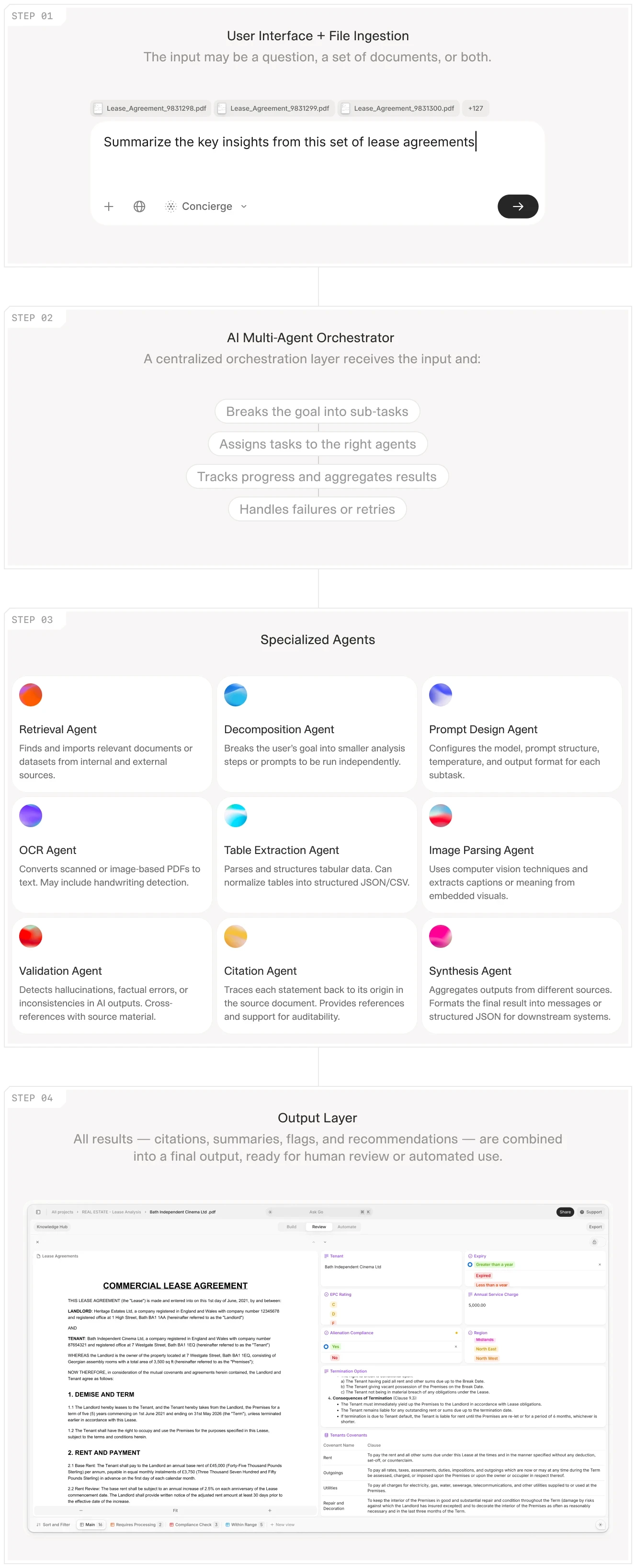
V7 Go's workflow orchestration showing multi-step agent processing for complex documents.
The Future of Deal Management: Modular and Connected
The era of the all-in-one monolithic deal management system is fading. The future belongs to modular, interconnected ecosystems where the best-in-class CRM (like Salesforce or DealCloud) connects seamlessly with the best-in-class ingestion layer (like V7 Go) and the best analytics layer (like PowerBI).
This approach reduces vendor lock-in and allows you to swap out components as technology improves. The critical glue holding this stack together is clean, structured data. By automating the ingestion layer, you ensure that every downstream system, from your CRM to your investor portal, is fed with accurate, timely information.
What Changes on Monday Morning
For a Vice President of Business Development, the change is immediate and tangible:
Before: Receive a CIM via email. Open the PDF. Manually read through 200 pages. Copy key data points into a Word document. Log into the CRM. Create a new deal record. Manually type each field. Attach the PDF. Send a summary email to the IC. Total time: 30 minutes.
After: Receive a CIM via email. Forward to V7 Go. Review the extracted data in the validation interface within Cases. Confirm accuracy. Click 'Approve.' The data is automatically pushed to the CRM and the IC memo template is pre-populated. Total time: 3 minutes.
The time savings are significant. But the bigger impact is strategic. The team can now review 5x more deals without adding headcount. They can respond to opportunities faster. They can spend more time on deep due diligence and less time on data entry.
For investment firms, the competitive advantage will not come from having the same CRM as everyone else. It will come from information advantage: the ability to ingest, synthesize, and act on unstructured market data faster and more accurately than the competition.
To see how you can automate the ingestion of your deal data, from CIMs to term sheets to compliance certificates, book a demo with V7 Go.
What is the difference between a CRM and a deal management system?
A CRM (Customer Relationship Management) system tracks all customer interactions: emails, calls, meetings, support tickets. A deal management system is a specialized CRM focused specifically on tracking sales opportunities through a defined pipeline. Most modern CRMs (like Salesforce) include deal management features, but dedicated deal management platforms (like DealCloud) are optimized for investment workflows.
+
Can AI fully automate deal management?
No, and you should be skeptical of anyone claiming it can. AI automates the data gathering, extraction, and reporting components. It removes the manual friction of getting data into the system. However, the strategic decisions, which deals to pursue, how to structure terms, when to walk away, remain human tasks. AI is a tool that amplifies human judgment, not a replacement for it.
+
Is it safe to put sensitive deal data into cloud-based AI software?
Yes, provided the vendor meets strict enterprise security standards. Look for SOC 2 Type II certification, ISO 27001 certification, GDPR/CCPA compliance, and encryption in transit and at rest. Enterprise-grade platforms like V7 Go include these protections by default. You should also review the vendor's data retention and deletion policies to ensure they align with your firm's compliance requirements.
+
How long does it take to implement deal management software?
It varies by complexity. A simple CRM for a small team might take 4-8 weeks. A complex private equity implementation with DealCloud or Salesforce often takes 6-12 months due to historical data migration, custom workflow configuration, and user training. Deploying a specialized AI ingestion layer like V7 Go is much faster, often live in days or weeks.
+
What is the ROI of automating deal data extraction?
Pricing varies widely. Entry-level CRMs like Freshsales start at $15/user/month. Mid-tier platforms like Salesforce run $25-$150/user/month. Enterprise platforms like DealCloud or SAP are custom-priced, often $80,000-$150,000+ annually for mid-sized firms. AI ingestion tools like V7 Go are typically priced on usage (volume of documents processed), offering a more scalable entry point.
+
How much does deal management software cost?
Go is more accurate and robust than calling a model provider directly. By breaking down complex tasks into reasoning steps with Index Knowledge, Go enables LLMs to query your data more accurately than an out of the box API call. Combining this with conditional logic, which can route high sensitivity data to a human review, Go builds robustness into your AI powered workflows.