11 min read
—



V7 Go
A smarter way to manage due diligence and underwriting
In July 2025, Datasite acquired BlueFlame AI—folding it into an ecosystem that already included Grata's company intelligence database and Sourcescrub's deal-sourcing data. The combined platform now covers a wide swath of the deal sourcing-to-close workflow. For firms already running transactions on Datasite virtual data rooms (VDRs), that depth of integration may be exactly what they wanted. For everyone else, it raises a straightforward question: should we still be evaluating this tool?
If you're considering BlueFlame for the first time, reconsidering after the acquisition, or assembling a shortlist of BlueFlame AI alternatives for a private equity document workflows project, this article is for you. We have evaluated six alternatives across three categories: PE-native diligence platforms, document research tools, and configurable AI platforms. Each is assessed on consistent criteria: document coverage, financial reasoning capability, source traceability, CRM integration, and pricing accessibility.
V7 Go is one of the six. We have included it because it addresses the document automation use cases in question, and we have evaluated it on the same criteria as every other tool in this list.
In this article:
What BlueFlame AI does and what the Datasite acquisition changed
Six conditions that make a BlueFlame AI alternative the stronger choice
Profiles of Transacted, Hebbia, F2 AI, AlphaSense, Rogo, and V7 Go
A decision matrix matching each tool to its strongest use case
What Is BlueFlame AI and What Changed After the Datasite Acquisition
BlueFlame AI was founded in 2023 by Raj Bakhru and Henry Lindemann, both veterans of the alternative investments industry. The company raised a $5M Series A and built a platform for private markets document workflows: confidential information memorandum (CIM) summarisation, board deck analysis, limited partnership agreement (LPA) and NDA extraction, due diligence questionnaire (DDQ) management, investment committee memo (IC memo) drafting, and LP update generation. Native integrations covered Microsoft Outlook, Salesforce, and DealCloud—the CRM stack common across mid-market and large PE houses.
The Datasite acquisition closed June 20, 2025, and was publicly announced July 23, 2025. Datasite is a virtual data room provider operating inside an ecosystem that now includes Grata, a company intelligence database covering more than 19 million private companies, and Sourcescrub, a deal-sourcing platform. BlueFlame now sits inside a larger enterprise sales motion.
For firms evaluating BlueFlame today, four things have changed:
Roadmap governance. Feature priorities now align with Datasite's product strategy and its majority owner, CapVest Partners. Firms with specific needs outside the Datasite deal flow should verify those use cases remain prioritised.
VDR integration depth. Firms running deals on Datasite VDRs gain tighter workflow continuity. Firms not in that ecosystem may find the product over-built for their actual needs.
Grata now bundled. Access to the 19 million-plus company database is a meaningful addition for deal sourcing teams. Less relevant for firms focused on buy-side underwriting or fund operations.
Pricing trajectory. Enterprise acquisitions rarely reduce product costs. Mid-market managers and emerging managers should model the full-year cost before committing.
BlueFlame remains the right choice for one specific scenario: firms running deals on Datasite VDRs who need document analysis and IC output generation connected directly to their VDR infrastructure. Outside that context, evaluating alternatives is a reasonable decision, not a sign that BlueFlame failed.
When to Look for a BlueFlame AI Alternative
Six conditions make a BlueFlame AI alternative worth a serious look:
You are not a Datasite VDR customer. If your data room infrastructure runs on SharePoint, Intralinks, Ansarada, or a proprietary solution, the deepest BlueFlame integrations do not apply. The acquisition-era value proposition is weighted heavily toward firms already inside the Datasite ecosystem.
Your team is Excel-heavy. BlueFlame handles document extraction and deal lifecycle management. It is not designed to reason inside spreadsheets, build financial models, or produce auditable .xlsx output from financial data. If 70% of your analysts' time is inside Excel, a different tool addresses the actual bottleneck.
Your primary use case is buy-side underwriting. Deal sourcing and CRM workflows are where BlueFlame's integrations are strongest. Firms whose constraint is financial analysis of target companies—producing line-item underwriting models—need a platform built for that output, not document extraction.
You need coverage across multiple departments. BlueFlame is built for investment teams. If legal operations, fund administration, and compliance also need document automation, a single-team tool creates duplication costs across the firm. You end up buying separate tools for each function.
You are a mid-market or emerging manager. Post-acquisition enterprise pricing may not fit teams under 15 investment professionals. Proof-of-concept economics matter before signing a multi-year platform contract.
Source traceability is a compliance requirement. Some audit and LP reporting workflows require every data extraction to link back to the exact page, table row, or clause in the source document. Verify that BlueFlame's export format satisfies your specific requirement before committing.
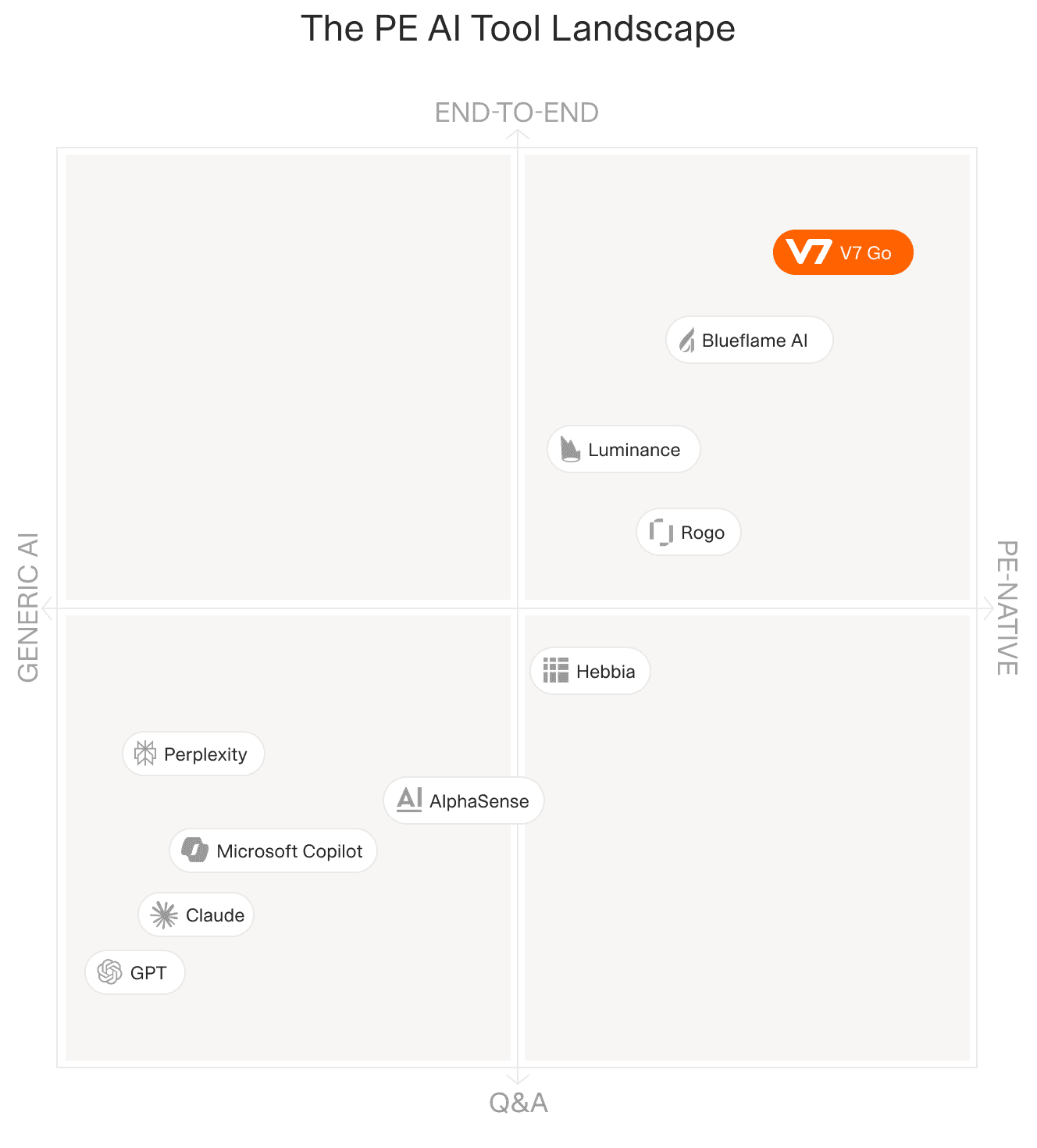
The 6 Best BlueFlame AI Alternatives for PE Document Workflows
The alternatives below fall into three categories: a PE-native diligence platform (Transacted), document research and intelligence tools (Hebbia, F2 AI, AlphaSense, Rogo), and a configurable AI platform (V7 Go). They are not ranked. The right choice depends on where your team's workflow breaks down in practice.
1. Transacted
Best for: Late-stage buyout diligence, complex financial analyses, deck-ready IC memos.
Transacted is purpose-built for private equity due diligence. It ingests data rooms, runs complex analyses across financial statements and operating data, and produces outputs formatted for investment committee review, including PowerPoint-ready IC memos. Source traceability is a core product feature: every claim in the output links back to the originating document and passage.
The gap is scope.
Transacted does not offer CRM integration, deal sourcing, or DDQ management. It is a diligence and output platform, not a deal lifecycle product. Firms expecting broader workflow coverage will need a second tool.
Pricing: Enterprise; contact sales.
Best fit: Firms whose primary bottleneck is IC memo production and complex financial analyses across large data rooms.
2. Hebbia
Best for: Document-heavy diligence, large-corpus research, workflows at the law firm-PE intersection.
Hebbia's 2025 architecture redesign introduced specialised sub-agents that handle different document types within a single workflow run. Its cited data grid links every output cell to its source passage in the original document, which is practically useful when analysts need to know exactly where a claim originated. Cross-corpus search across hundreds of documents performs well on large data rooms and complex multi-party transaction structures where documents arrive from multiple counterparties.
Hebbia does not integrate with CRM or deal sourcing systems. It is a document research platform.
Pricing: Enterprise; contact sales.
Best fit: Firms running massive data rooms, legal document review, or multi-corpus research across portfolio companies.
3. F2 AI
Best for: Private credit, buy-side PE underwriting, financial model analysis.
F2 AI is built around a proprietary Excel engine. The company's own benchmarking puts it at a 95.25% score on SpreadsheetBench, a standardised spreadsheet reasoning evaluation. Autonomous runs last up to 60 minutes; output is an auditable databook in .xlsx format, with a per-cell audit trail logging how each figure was derived from the source documents.
If 70%+ of your team's time is in Excel, choose F2.
That framing is F2's own, and its specificity is honest. It also marks the product's boundary precisely. F2 does not address deal sourcing, VDR workflows, CRM integration, or DDQ management. It solves one problem very well.
Pricing: Enterprise; contact sales.
Best fit: Private credit and buy-side PE teams whose primary deliverable is a financial model, not a document extract.











4. AlphaSense
Best for: Market research, competitive intelligence, investment research synthesis.
AlphaSense is a market intelligence platform. According to the company's own figures, 80% of top PE and VC firms use it. Its search engine covers more than 10,000 data sources: earnings call transcripts, SEC filings, analyst reports, broker research, and news, with semantic search that surfaces relevant content without requiring precise keyword formulation. Proactive monitoring alerts teams when signals appear across their tracked topics.
The important distinction: AlphaSense is a research and intelligence layer, not a document processing or workflow automation platform. It does not extract structured data from your proprietary deal materials, manage DDQs, or produce IC memos. It answers "what is happening in this market" rather than "what is in this data room." These are different problems.
Pricing: Enterprise; free trial available.
Best fit: Firms needing market sizing, competitive intelligence, and research synthesis. Not document extraction from proprietary deal materials.
5. Rogo
Best for: Investment banking, sell-side research, analyst productivity workflows.
Rogo's 2025 acquisition of Subset added a spreadsheet agent to a previously chat-first interface. A partnership with LSEG provides access to real-time financial data within the platform. The product is designed for investment banking and financial institutions: drafting research summaries, synthesising market data, accelerating analyst output on public-market materials.
Rogo is not designed for PE-native private markets document workflows. DDQ management, LP document handling, and data room analysis are outside its core. Contract minimums are structured for large financial institutions, not PE buy-side teams.
Pricing: Large-enterprise minimum contracts.
Best fit: Investment banks and large financial institutions. Not PE buy-side document workflow teams.
6. V7 Go
Best for: PE firms that need document automation across investment, legal, compliance, and fund operations, not just the deal team.
Most AI tools for private equity are configured by the vendor, pre-built for a specific workflow, and constrained by what the vendor anticipated you would need. V7 Go inverts that model. It is a configurable AI agent platform: teams build agents around their actual document types and output requirements, without writing code. An AI due diligence agent can extract financial metrics, flag covenant issues, and produce structured output in the format the IC uses. An investment memo agent can turn a data room into a draft IC memo. An LPA analysis agent pulls key provisions from limited partnership agreements and flags deviations from your standard terms.
What differentiates V7 Go for PE workflows is visual grounding: every data extraction links to the exact location in the source document, including page number, table row, and specific clause. The dataroom-to-IC memo and DDQ completion workflows are live patterns built on this approach. Confidence thresholds flag extractions where model certainty falls below a level you define, routing those to a human reviewer rather than passing them silently into the output. For regulated environments where "the AI said so" is insufficient for an LP report or a compliance review, that audit trail matters.
The gap: V7 Go does not offer native CRM integration with DealCloud or Salesforce, and it is not pre-configured for the PE deal lifecycle the way BlueFlame was designed to be. Teams need to build their agents. That configuration work is real. It is also what enables the multi-department value: the same platform can handle investment team diligence, legal document review, fund operations, and compliance workflows without buying a separate tool for each function.
Pricing: Contact V7 Go; evaluation paths available below the Datasite enterprise bundle price point.
Best fit: Mid-to-large PE firms bottlenecked by document volume across multiple teams. See how V7 Go compares to BlueFlame AI.
How to Choose a BlueFlame AI Alternative: PE Workflow Decision Matrix
Most teams start their AI tool evaluation by asking which platform has the most impressive feature list. That is the wrong starting point. The better question: which tool will your team actually use on real documents, at production volume, six months after go-live?
Use this matrix to match your primary use case to its strongest platform:
Primary use case | Best fit | Why |
|---|---|---|
IC memo production and rigorous financial diligence | Transacted | PE-native; deck-ready IC outputs; source traceability built in |
Excel financial modelling and buy-side underwriting | F2 AI | Proprietary Excel engine; auditable .xlsx output; per-cell audit trail |
Large data room research synthesis | Hebbia | Sub-agent architecture; cited data grid; cross-corpus search |
Market intelligence and competitive research | AlphaSense | 10,000-plus data sources; semantic search; proactive monitoring |
Finance research and analyst productivity | Rogo | LSEG real-time data; spreadsheet agent; chat-first interface |
Cross-departmental document automation with full audit trail | V7 Go | Configurable agents; visual grounding; confidence thresholds; multi-team value |
Full Datasite VDR ecosystem integration | BlueFlame (Datasite) | Native VDR plus Grata plus Sourcescrub integration; PE deal lifecycle native |
A Note for Mid-Market and Emerging Managers
AlphaSense offers a free trial, making it the easiest platform in this list to evaluate without a procurement cycle. V7 Go's pricing structure sits below the Datasite enterprise bundle. For any platform here, the strongest commercial argument is a proof-of-concept on one specific document type, using real materials from your own deal flow, before signing an annual contract. The deal lifecycle has sufficient document volume that a proof of concept predicts production performance reliably. Skip evaluations that use the vendor's sample documents, which are optimised for demos, not for your documents.
The evaluation question most teams get wrong is asking which AI platform is most capable in a demo. The right question is which platform will solve the specific workflow that costs your team the most time each week. A firm whose analysts spend 40% of their week on DDQ responses has a different problem from a firm whose IC process stalls waiting for financial analysis of a 300-document data room. Those are different tools.
Match the tool to the problem. Transacted for IC memo production. F2 AI when the primary output is a financial model. Hebbia for large-corpus research synthesis. AlphaSense for market and competitive intelligence. Rogo for analyst productivity in investment banking workflows. V7 Go when the bottleneck spans multiple teams and a full audit trail is non-negotiable.
BlueFlame AI, post-acquisition, is the right answer for firms running their deal lifecycle on Datasite VDRs. For everyone else, the alternatives in this article offer cleaner fits at more accessible price points.
If cross-departmental document automation with complete source traceability is the requirement, see how V7 Go compares to BlueFlame AI in detail, including a side-by-side of use cases, audit trail capabilities, and configurability.
What is BlueFlame AI used for in private equity?
BlueFlame AI is designed for private equity and alternative investment document workflows. Its core use cases include summarising confidential information memoranda (CIMs), analysing board decks, extracting key provisions from limited partnership agreements (LPAs) and NDAs, managing due diligence questionnaires (DDQs), drafting investment committee memos, and generating LP update documents. The platform integrates natively with Microsoft Outlook, Salesforce, and DealCloud, making it well-suited to firms already using those tools for deal management. After Datasite's acquisition in 2025, BlueFlame gained tighter integration with Datasite virtual data rooms and access to Grata's company intelligence database, which covers more than 19 million private companies. It is primarily a deal team tool, built for investment professionals evaluating, executing, and managing transactions. It does not cover legal operations, fund administration, or compliance workflows at the same depth as a multi-department platform.
+
Did Datasite acquire BlueFlame AI?
Yes. The acquisition closed June 20, 2025, and was publicly announced July 23, 2025. Datasite is a virtual data room provider used widely in M&A and private equity transactions. The acquisition brought BlueFlame into a broader ecosystem that already included Grata, a company intelligence database covering more than 19 million private companies, and Sourcescrub, a deal-sourcing platform. For existing BlueFlame customers, the acquisition deepens integration with Datasite VDRs and adds access to Grata's database. It also means BlueFlame's product roadmap is now governed by Datasite and its majority owner CapVest Partners rather than the original founding team, which may shift feature priorities and pricing over time. Firms not currently using Datasite VDRs should evaluate whether the acquisition-era product still fits their workflow, or whether an alternative offers a cleaner match at a better price point.
+
What are the best BlueFlame AI alternatives for PE due diligence?
The strongest alternatives for private equity due diligence depend on the specific bottleneck. For IC memo production and complex financial analysis from data rooms, Transacted is purpose-built for that workflow. For large-corpus document research with cited output, Hebbia's sub-agent architecture and cited data grid handle large data rooms and complex transaction structures well. For Excel-heavy underwriting where the primary deliverable is a financial model, F2 AI's proprietary spreadsheet engine and auditable .xlsx output fill a gap the other platforms do not cover. For cross-departmental document automation with a full audit trail, V7 Go provides configurable agents for due diligence, DDQ completion, CIM review, and LPA analysis, with every extraction linked to its exact source location. The right choice depends on whether the bottleneck is IC output production, financial modelling, document research, or multi-team document processing.
+
Is BlueFlame AI good for smaller PE firms?
BlueFlame AI was initially positioned for mid-market PE firms and alternative investment managers. Post-acquisition by Datasite, the pricing and packaging are likely to shift toward Datasite's existing enterprise customer base. For smaller PE firms, emerging managers, or sector-focused funds under 15 investment professionals, the cost-to-value equation is worth scrutinising carefully before committing. The Grata and Sourcescrub components bundled into the Datasite ecosystem are most valuable for deal sourcing at scale. Smaller firms focused on buy-side underwriting of specific deals may not need that capability at that price point. Alternatives like V7 Go and AlphaSense offer evaluation paths that do not require a full enterprise procurement cycle, which may be the more practical starting point for firms testing AI document automation on a single document type before signing an annual platform contract.
+
What happened to BlueFlame AI after the Datasite acquisition?
The most reliable evaluation method is a proof of concept on one specific document type using real materials from your own deal flow. Choose the document category that costs the most analyst hours: a standard CIM, a 200-page data room package, or a DDQ from a major LP. Run it through the shortlisted platform and evaluate three things: accuracy of extraction against a manual review, whether the audit trail is sufficient for your compliance or LP reporting requirements, and whether the output format integrates into your existing workflow without manual reformatting. Avoid evaluations that use the vendor's sample documents, which are optimised for demo performance rather than your specific materials. Most platforms in this category, including V7 Go and AlphaSense, offer evaluation periods. Use them on your actual documents. A single real-world document test predicts production performance more reliably than any sales demonstration.
+
How should I evaluate BlueFlame AI alternatives before signing an enterprise contract?
Go is more accurate and robust than calling a model provider directly. By breaking down complex tasks into reasoning steps with Index Knowledge, Go enables LLMs to query your data more accurately than an out of the box API call. Combining this with conditional logic, which can route high sensitivity data to a human review, Go builds robustness into your AI powered workflows.
+
Casimir is a seasoned tech journalist and content creator specializing in AI implementation and new technologies. His expertise lies in LLM orchestration, chatbots, generative AI applications, and computer vision.