21 min read
—


How AI platforms are transforming investment analysis, CIM triage, and financial due diligence through automated workflows that replace manual Excel extraction.

Casimir Rajnerowicz
Content Creator
V7 Go
A smarter way to manage due diligence and underwriting
If you ask a Vice President of Finance at a mid-sized private equity firm where their deal data actually lives, they will point to Microsoft Excel. Not the CRM. Not the deal management system. Excel.
This is the uncomfortable reality of modern finance. Despite $35 billion spent on AI projects in financial services in 2023, the industry's operational backbone remains a fragile mesh of spreadsheet workbooks, manual data entry, and offshore BPO teams re-keying figures from scanned PDFs.
The bottleneck is not technology availability. It is the gap between what AI platforms promise and what financial workflows actually require. Most teams do not need another chatbot that can answer questions about documents. They need an intelligence layer that can extract covenant terms from a 200-page credit agreement, reconcile EBITDA figures across three quarterly reports, and flag cap table inconsistencies. All while providing auditable citations back to source pages.
In this article:
The Architecture Problem: Why traditional document processing fails for financial workflows and what modern AI platforms do differently.
Platform Comparison: Deep dives into V7 Go, Nanonets, Hyperscience, and legacy incumbents like SAP and Oracle.
Real-World Use Cases: How investment teams use AI for CIM triage, financial statement analysis, and compliance review.
Implementation Roadmap: What to expect when deploying an AI platform, from pilot to production scale.
The Core Problem: Why Financial Document Processing Is Different
Financial services firms process documents that are fundamentally different from the invoices and receipts that most document AI platforms are designed to handle. A commercial lease is not a form with fields to extract. It is a legal instrument with nested clauses, cross-references, and conditional logic that determines whether a tenant can exit early or if rent escalates based on CPI.
The challenge is not OCR accuracy. Modern OCR engines read scanned text at 99.9% character-level precision. The challenge is understanding what the text means in context. When a CIM states "EBITDA of $12.3M," an AI platform needs to know whether that figure is historical, projected, adjusted, or pro forma. It needs to trace that number back to the specific page and paragraph where it appears, because your IC memo will be questioned if the source is unclear.
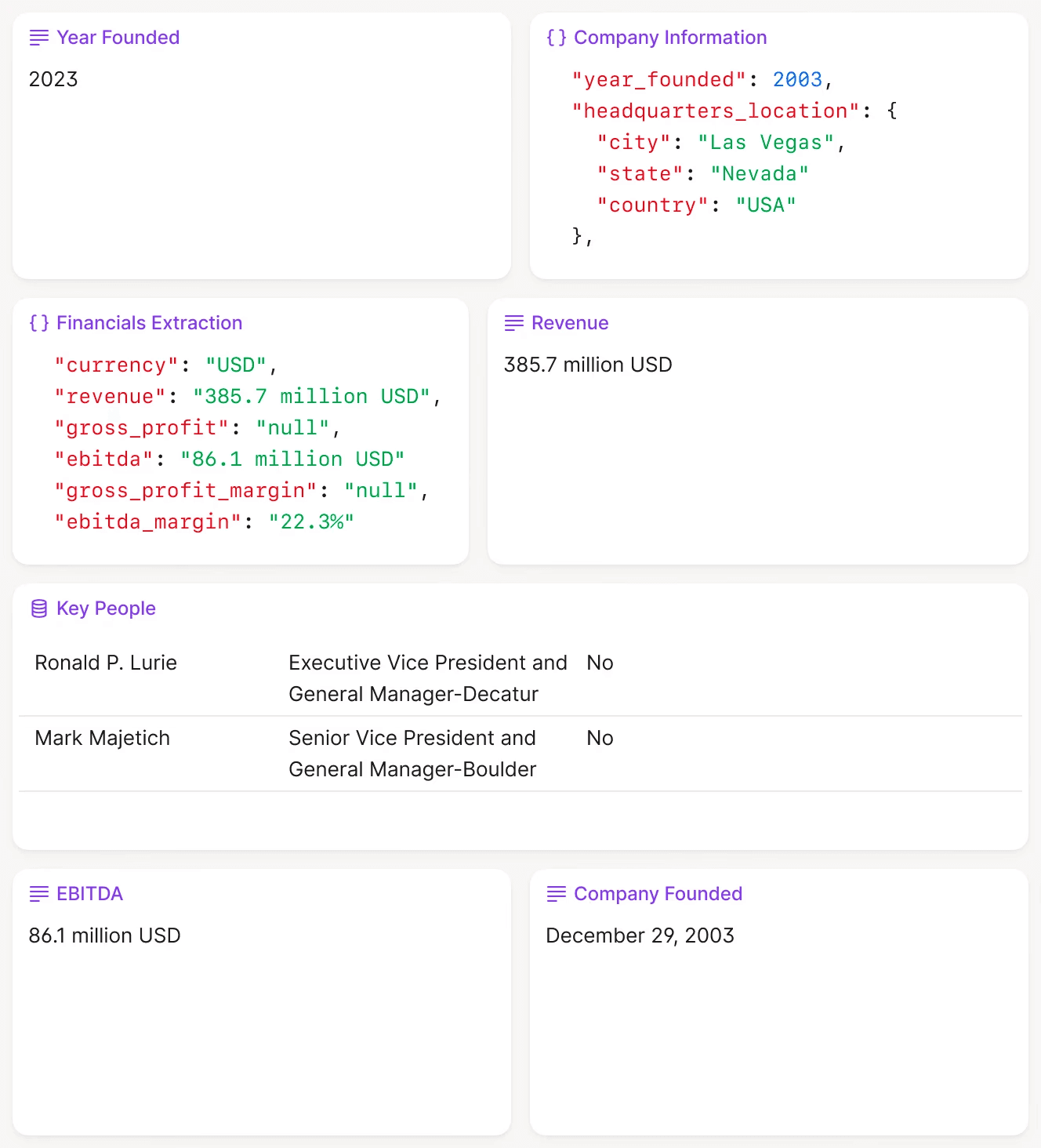
V7 Go extracts structured company data from confidential information memorandums with full source traceability.
The Three Layers of Financial Document Intelligence
Modern AI platforms for finance operate across three distinct layers. Each solves a different part of the workflow problem.
Layer 1: Document Ingestion and OCR
This is table stakes. The platform must handle scanned PDFs, native digital documents, Excel files with 40+ tabs, and handwritten notes from site visits. It must preserve table structures, extract data from charts, and maintain formatting that carries semantic meaning. The indentation in financial statements indicates sub-totals. If the platform flattens that structure, it produces garbage outputs.
Most legacy systems fail here because they treat documents as flat text. A 10-K filing has a hierarchical structure where footnotes reference specific line items, and those line items roll up into summary tables. Preserving this structure is non-negotiable.
Layer 2: Contextual Extraction and Classification
This is where large language models become essential. The platform must understand that "Net Revenue" and "Total Revenue" are different concepts, that "Adjusted EBITDA" requires finding the reconciliation table, and that "Management Projections" should be flagged separately from "Historical Performance."
V7 Go handles this through specialized agents. An AI Investment Analysis Agent is a workflow designed specifically to extract investment metrics, identify risk factors, and cross-reference claims across multiple documents in a data room. It knows what to look for because it was built for this specific job.
CIM due diligence workflow in V7 Go: Cases interface with extracted fields, entity analysis, and source citations.
Layer 3: Validation and Integration
This is where most AI platforms fail in production. Extraction alone is not enough. The platform must validate that extracted figures reconcile across documents, flag anomalies like revenue growing 300% with no explanation, and integrate cleanly into downstream systems.
This requires programmatic validation rules. If you extract "Total Debt" from a balance sheet, the platform should verify that it equals the sum of "Short-Term Debt" and "Long-Term Debt." If the figures do not match, the discrepancy gets flagged for human review rather than silently passed through.
Why Traditional Approaches Break Down
The typical finance team's current workflow looks like this: A junior analyst receives a 200-page CIM. They open it in Adobe, manually scroll to find the financial summary, copy figures into Excel, then cross-reference those figures against the detailed financials in Appendix C. If the numbers do not match, they email the sell-side advisor and wait 48 hours for clarification.
This process is slow and fragile. The analyst might miss a footnote that says "excludes one-time charges." They might copy the wrong year's figures. They might not notice that the EBITDA margin calculation uses a different revenue base than the one stated on page 12.
AI platforms solve this by making the entire document machine-readable and queryable. Instead of manually hunting for figures, the analyst asks: "What was adjusted EBITDA for the last three years, and where is it disclosed?" The platform returns the figures, the source pages, and any reconciliation notes in seconds.
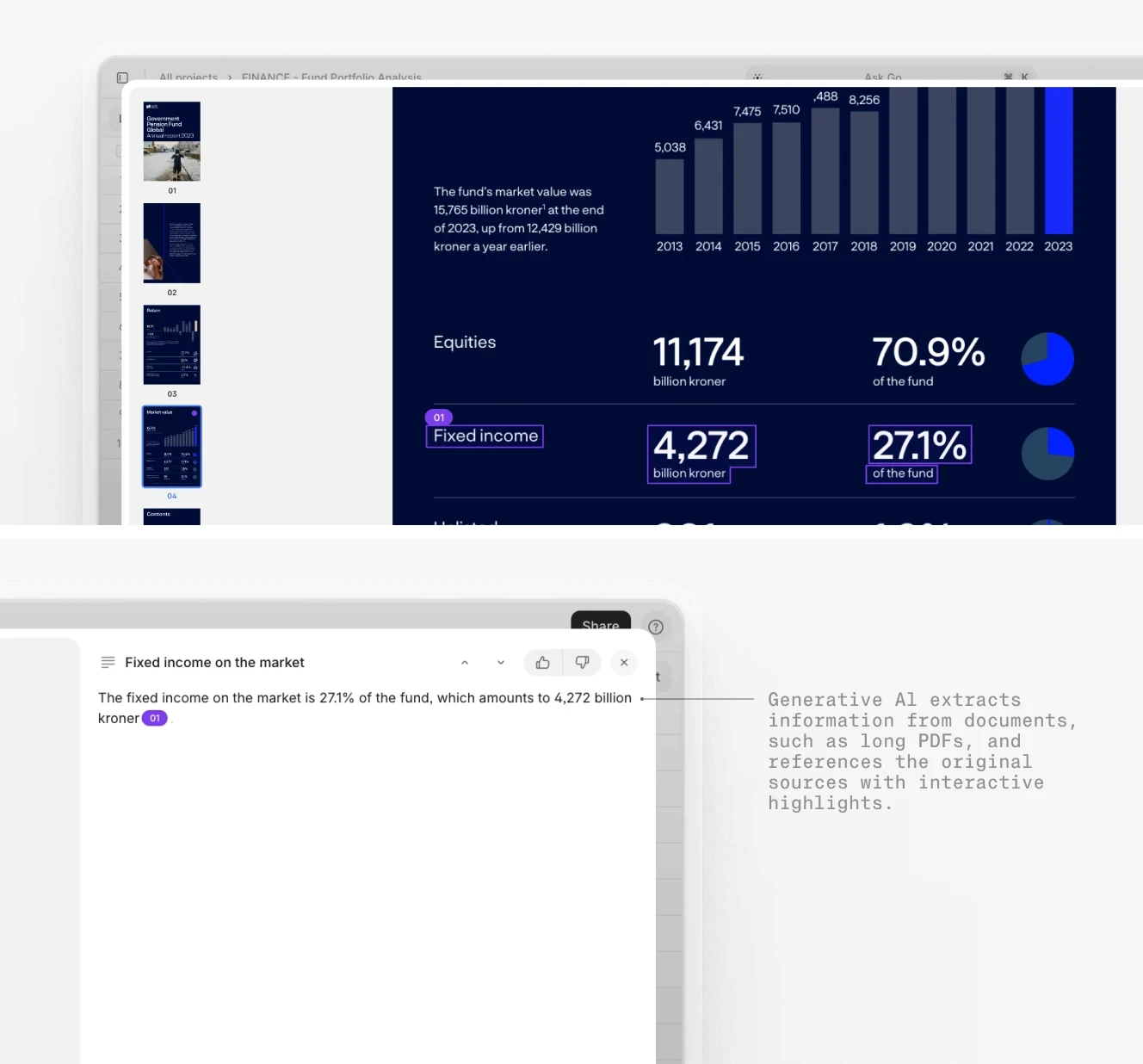
AI-powered fund analysis dashboard supports natural language queries across portfolio documents.
The Market Landscape: Modern AI vs. Legacy Systems
The previous section explained why financial document processing is uniquely challenging. The question now becomes which platforms actually solve these problems, and how they differ in approach.
The AI platform market for finance is bifurcating. On one side, you have legacy enterprise software vendors (SAP, Oracle, IBM) that have bolted AI features onto existing document management systems. On the other side, you have modern AI-native platforms (V7 Go, Nanonets, Hyperscience) built from the ground up for intelligent document processing.
The difference is architectural. Legacy systems treat AI as a feature, an OCR upgrade or a chatbot add-on. Modern platforms treat AI as the core intelligence layer that orchestrates the entire workflow.
The Modern AI Stack
A modern AI platform for finance is a composable stack with distinct components.
Document Intelligence Engine: This combines OCR, computer vision, and natural language processing to understand document structure and content. V7 Go's engine can process everything from scanned handwritten loan applications to complex Excel models with nested formulas.
Agent Orchestration Layer: This is where workflows are defined. Instead of writing code, you configure agents that perform specific tasks. An AI Due Diligence Agent might classify document type, extract key metrics, cross-reference against other documents in the data room, flag inconsistencies, and generate a summary report.
Knowledge Hub: This is the platform's memory. It stores processed documents, extracted data, and the relationships between them. When you ask a question, the platform searches the Knowledge Hub using advanced retrieval techniques to find relevant information across thousands of documents.
Integration Layer: This connects the AI platform to your existing tools. V7 Go integrates with deal management systems, financial modeling tools, and data warehouses through APIs. Extracted data flows directly into your IC memo template or portfolio monitoring dashboard without manual copy-paste.
V7 Go agent library: pre-built workflows for invoice processing, OCR extraction, and batch document analysis.
What Sets V7 Go Apart
V7 Go is purpose-built for knowledge work automation in finance. Unlike general-purpose document AI platforms, it understands the specific artifacts that financial professionals work with: confidential information memorandums, 10-K filings, lease agreements, and credit agreements.
The platform's visual grounding capability is critical for finance. When V7 Go extracts a figure like "Total Debt: $45.2M," it highlights the exact location in the source document where that figure appears, shows the surrounding context, and links to any footnotes or reconciliation tables. This level of traceability is non-negotiable for investment committees and regulatory reviews.
Another differentiator is V7 Go's approach to customization. Financial workflows vary significantly. A real estate fund analyzing offering memorandums has different requirements than a venture capital firm screening pitch decks. V7 Go allows you to configure agents with custom extraction rules, validation logic, and output formats without writing code.
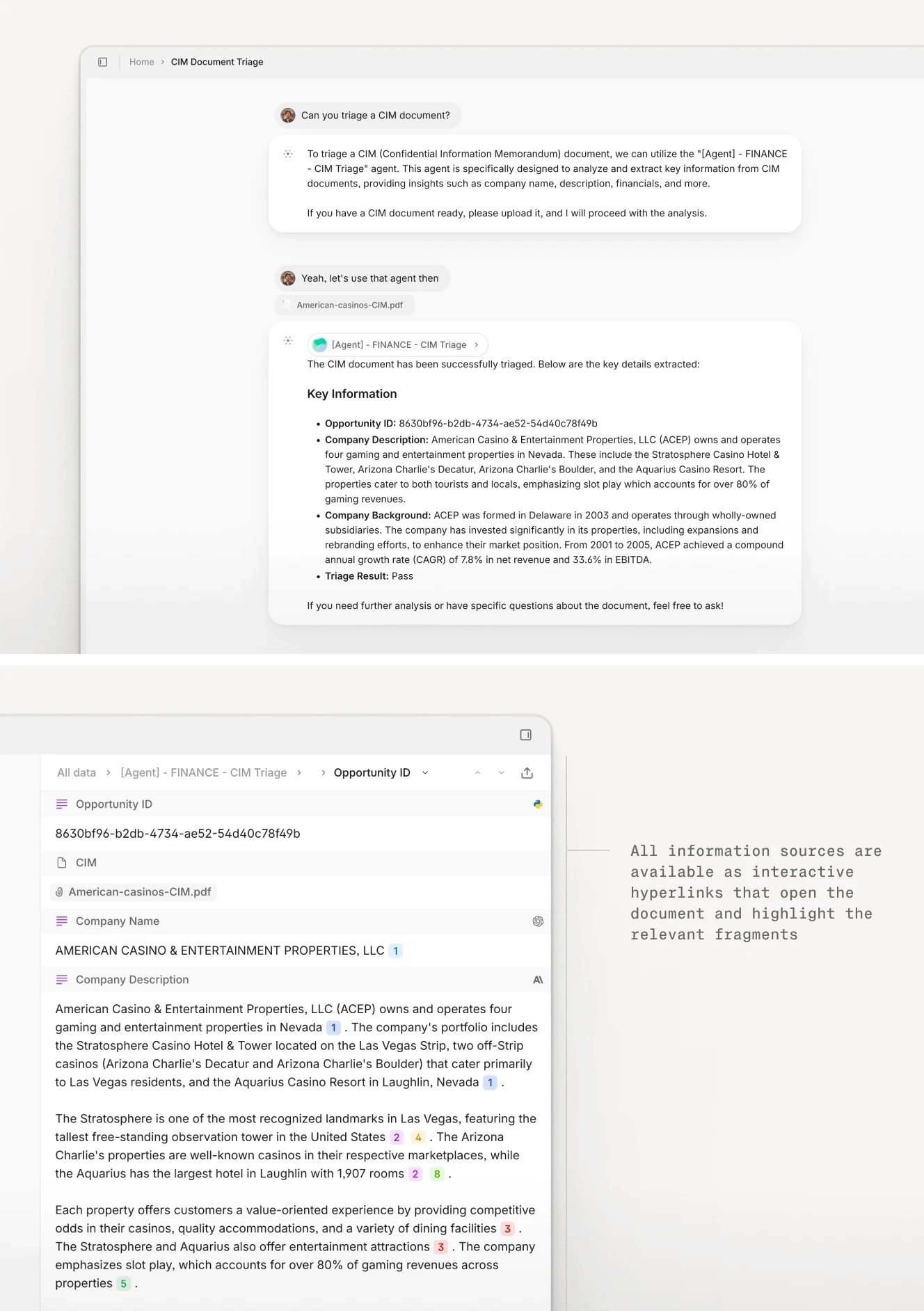
CIM triage workflow automatically extracts company profile, financials, and investment highlights.











Platform Comparison: Capabilities and Trade-offs
The market landscape overview established the architectural differences between modern and legacy platforms. This section examines specific platforms in detail, focusing on how their capabilities map to actual financial workflows.
Choosing an AI platform for finance requires understanding how features translate to your actual workflows. A platform that excels at invoice processing may struggle with complex financial models. A platform optimized for regulatory compliance may lack the flexibility needed for deal screening.
V7 Go: The Agentic AI Approach
Core Positioning: V7 Go automates complex, multi-step financial workflows rather than simple data extraction from forms. This is the platform you choose when your bottleneck is analyzing 50 CIMs per week, not processing 5,000 invoices per month.
Key Capabilities:
The platform's agent-based architecture means you can build workflows that mirror how your team actually works. A typical CIM analysis workflow involves document classification (is this a CIM, teaser, or management presentation?), company profile extraction (industry, revenue, employee count), financial metrics extraction (revenue, EBITDA, margins for last 3 years), risk factor identification (customer concentration, regulatory issues), and competitive landscape analysis.
V7 Go handles all of this in a single automated workflow. The agent processes the document, extracts structured data, cross-references claims such as checking if stated revenue growth matches the figures in the financial tables, and generates a summary report with citations back to source pages.
The Knowledge Hub feature is particularly powerful for due diligence. You can upload an entire data room containing hundreds of documents including financials, contracts, legal opinions, and operational reports. The AI indexes everything. Then you can ask questions like "What are the key customer contracts and when do they expire?" or "Are there any pending litigation matters?" The platform searches across all documents and returns answers with specific page references.
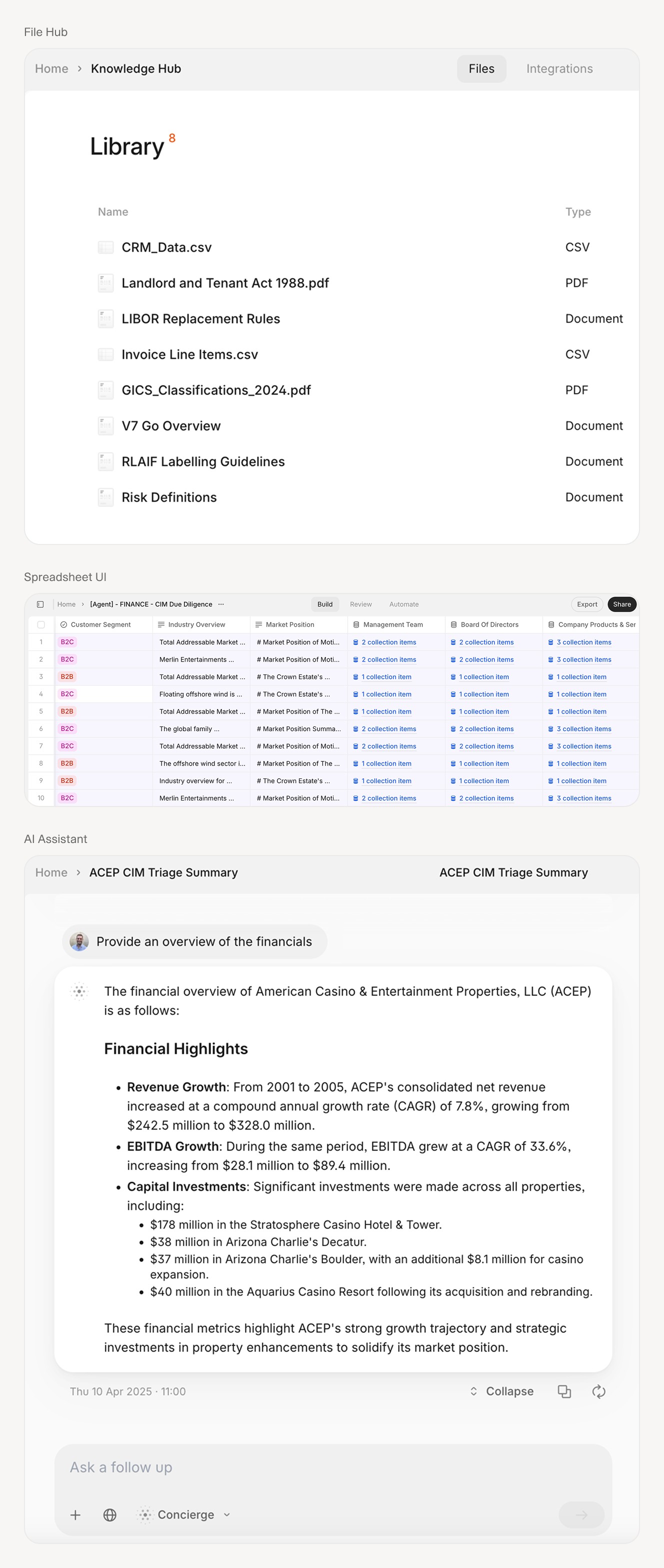
AI-enhanced data room supports intelligent search and cross-document analysis for due diligence teams.
Pricing and Deployment:
V7 Go uses a user-based pricing model. Builder licenses for team members who configure agents and workflows cost approximately $1,200 per month. Doer licenses for team members who run agents but do not configure them cost around $600 per month. A typical mid-sized PE firm might have 1-2 builders and 5-8 doers, putting annual costs in the $40,000-$60,000 range.
Deployment is fast compared to legacy systems. Most teams run pilot workflows within 2-3 weeks. The platform is cloud-native, so there is no infrastructure to provision. Integration with existing systems like your deal management CRM or document repository happens through standard APIs.
Real-World Strengths:
Teams using V7 Go report that the biggest value comes from eliminating the data entry phase of deal analysis. Instead of spending 4-6 hours manually extracting figures from a CIM into Excel, an analyst spends 30 minutes reviewing the AI-extracted data and investigating the 2-3 anomalies the system flagged. This shifts analyst time from low-value data entry to high-value judgment calls.
The visual grounding feature also reduces back-and-forth with deal teams. When an IC member questions a figure in your memo, you can instantly show them the exact page and paragraph where it came from, along with any relevant footnotes. This level of transparency builds trust in the AI-extracted data.
Limitations:
V7 Go requires upfront investment to configure agents for your specific workflows. If your documents follow highly standardized formats like regulatory filings, configuration is straightforward. If your documents are highly variable like early-stage startup pitch decks, you will need to iterate on your extraction rules.
The platform also requires technical literacy. You do not need to write code, but you need to understand concepts like extraction rules, validation logic, and API integrations. Smaller teams without dedicated operations or technology staff may find the learning curve steep.
Nanonets: Rapid Deployment for Standard Documents
Core Positioning: Nanonets processes high volumes of standardized financial documents such as invoices, receipts, bank statements, and tax forms. Speed of deployment matters more than workflow customization.
Key Capabilities:
Nanonets excels at out-of-the-box document processing. The platform comes with pre-trained models for common financial document types including invoices (detecting vendor, line items, totals, payment terms), bank statements (transaction dates, amounts, running balances), W-9 and 1099 forms (TIN, name, address fields), and receipts (merchant, date, itemized charges).
You can start processing within hours. Upload sample documents, the platform automatically identifies fields to extract, and you adjust the extraction rules through a visual interface. There is no need to write code or configure complex workflows.
Pricing and Deployment:
Nanonets uses tiered pricing based on document volume. Typical mid-market deployments range from $15,000-$40,000 annually depending on volume. Deployment is fast. Most teams process documents in production within 1-2 weeks.
Real-World Strengths:
Teams using Nanonets report that the platform works reliably for standard document types. If you are processing hundreds of invoices per month, Nanonets automates 90%+ of the extraction with minimal configuration. The platform integrates well with accounting systems and ERPs, making it easy to push extracted data downstream.
Limitations:
Nanonets struggles with complex, non-standard documents. A 200-page credit agreement with nested clauses and cross-references is not in its wheelhouse. The platform is optimized for form-like documents with predictable structures.
Customization is also limited. You can adjust extraction rules for specific fields, but you cannot build complex multi-step workflows or implement custom validation logic. If your workflow requires more than "extract fields and export to CSV," you will hit limitations quickly.
Hyperscience: Enterprise-Grade Document Processing
Core Positioning: Hyperscience is designed for large financial institutions that process millions of documents per year with high accuracy and strong compliance controls. Regulatory requirements and audit trails are paramount.
Key Capabilities:
Hyperscience combines machine learning with human-in-the-loop validation. The platform automatically classifies documents, extracts data, and routes exceptions to human reviewers. This hybrid approach ensures high accuracy while maintaining processing speed.
The platform's strength is handling document variability at scale. It can process mortgage applications that come in dozens of different formats, including varying page orders, different form versions across states, handwritten fields mixed with typed text, and attachments like pay stubs and W-2s. The system learns from corrections made by human reviewers and continuously improves extraction accuracy over time.
Pricing and Deployment:
Hyperscience is enterprise software with enterprise pricing. Typical deployments start at $100,000+ annually and can reach seven figures for large-scale implementations. Deployment timelines are measured in months due to the complexity of integrating with legacy systems and configuring compliance controls.
Real-World Strengths:
Large banks and insurance companies use Hyperscience to process loan applications, claims forms, and regulatory filings. The platform handles the scale and complexity that smaller solutions cannot match. The audit trail and compliance features meet the stringent requirements of regulated financial institutions.
Limitations:
Hyperscience is overkill for smaller teams. If you are processing hundreds of documents per month rather than millions, the platform's complexity and cost are not justified. The implementation process also requires significant IT resources and change management effort.
Legacy Systems: SAP, Oracle, and IBM
The legacy enterprise software vendors have added AI capabilities to their existing platforms, but these additions often feel bolted-on rather than native.
SAP: SAP's document processing features are part of the broader ERP suite. You get document AI, but you also get the complexity of an enterprise ERP system. Configuration requires engaging SAP professional services. Adding a new document type might involve ABAP development and Basis team involvement. Typical implementation timeline for a new document workflow is 8-12 weeks.
Oracle: Oracle Financial Services Analytical Applications (OFSAA) provides end-to-end analytics for large financial institutions. The document processing capabilities integrate with Oracle's database infrastructure. The challenge is that ACL (Access Control List) configuration for the content server is notoriously complex, and integrating non-Oracle data sources often requires custom middleware development.
IBM Datacap: IBM's document capture solution integrates with the broader IBM automation suite. Performance is reliable, but the user interface feels dated. Configuration requires specialized knowledge of IBM's workflow engine, and the learning curve is steep for teams without IBM experience.
When Legacy Makes Sense:
If you already have significant investment in SAP or Oracle infrastructure, and your document processing needs are relatively simple, using the vendor's AI features can make sense. The integration is direct since everything is in the same ecosystem, and you avoid adding another vendor to manage.
Legacy systems also excel at compliance and audit requirements. They have decades of experience in regulated industries, and their security, access controls, and audit logging are battle-tested.
When Legacy Fails:
Legacy systems struggle with flexibility and speed. Configuring a new document workflow in SAP might require engaging professional services and waiting weeks for implementation. The AI capabilities are typically less advanced than modern platforms because legacy vendors are integrating third-party AI models rather than building their own.
Implementation: From Pilot to Production
Platform selection is only half the equation. The rollout determines whether AI becomes a competitive advantage or an expensive experiment. Deploying an AI platform for finance is a workflow transformation project, not a technology project. The technology is the easy part. The hard part is changing how your team works and building trust in automated outputs.
Phase 1: Pilot (Weeks 1-4)
Start with a narrow, high-value use case. Do not try to automate your entire deal process in the first pilot. Pick one specific workflow that is painful today and has clear success criteria.
Good pilot candidates:
CIM triage: Extract key metrics (revenue, EBITDA, industry, geography) from incoming CIMs to populate your deal pipeline.
Financial statement spreading: Extract income statement and balance sheet line items from portfolio company financials.
Lease abstraction: Extract key terms (rent, escalations, renewal options, termination rights) from commercial leases.
The pilot should process real documents, not sanitized test cases. Use 20-30 actual documents from recent deals. This will surface edge cases and document variations that you need to handle.
Define success metrics upfront. For example: "The AI should correctly extract revenue, EBITDA, and industry for 90% of CIMs, with extraction time under 5 minutes per document." Having clear metrics prevents endless debates about whether the AI is "good enough."
Acceptance Criteria Examples:
Extraction precision: 95%+ for core financial fields (revenue, EBITDA, total debt)
Recall: 90%+ for all defined fields across document types
Processing SLA: Under 5 minutes per 50-page document
Exception rate: Under 15% of documents routed to human review
Reviewer time: Under 10 minutes to validate and correct flagged extractions
Batch processing workflow: drag-and-drop document upload with Concierge routing to appropriate analysis agents.
Phase 2: Refinement (Weeks 5-8)
The first pilot will reveal gaps. Maybe the AI struggles with certain document formats. Maybe it misclassifies adjusted EBITDA as reported EBITDA. Maybe it cannot handle documents where financials are presented in tables versus paragraphs.
This phase is about iterating on extraction rules and validation logic. With V7 Go, this means refining your agent configurations. You might add rules like:
"If EBITDA is stated as a percentage, convert it to dollars using the revenue figure"
"If a document mentions 'pro forma' or 'adjusted,' flag the EBITDA figure for human review"
"Verify that Total Debt equals Short-Term Debt plus Long-Term Debt; flag if discrepancy exceeds 1%"
"Cross-reference revenue in executive summary against revenue in detailed financials; flag if delta exceeds 5%"
You should also start building your Knowledge Hub during this phase. Upload historical deal documents, IC memos, and research reports. The more context the AI has, the better it can understand new documents.
Phase 3: Scaling (Weeks 9-16)
Once your pilot workflow performs well, you can scale in two dimensions: more document types and more users.
Adding document types means configuring new agents. If you started with CIM triage, you might add agents for financial statement analysis, contract review, or insurance policy analysis. Each new document type requires its own extraction rules and validation logic, but you can reuse components like the financial metrics extraction module across multiple agents.
Adding users means training your team on how to work with AI-extracted data. Analysts need to learn to trust the AI for routine extraction while staying vigilant for edge cases. They need to understand when to accept AI outputs and when to dig deeper.
A common progression:
Human-in-the-loop: Every AI extraction is reviewed by an analyst.
Exception-based review: Only flagged items are reviewed.
Audit-based review: Outputs are spot-checked rather than reviewed individually.
Phase 4: Integration (Weeks 17-24)
The final phase is integrating the AI platform into your broader technology stack. This means connecting V7 Go to your deal management system, financial modeling tools, and reporting dashboards.
When V7 Go extracts key metrics from a CIM, those metrics should automatically populate fields in your CRM. When it processes quarterly financials from a portfolio company, the data should flow into your portfolio monitoring dashboard. When it flags a covenant breach in a credit agreement, it should create a task in your workflow management system.
These integrations happen through APIs. V7 Go provides webhooks that trigger when an agent completes processing a document. You can use these webhooks to push data to downstream systems or trigger follow-up workflows.
Advanced Use Cases: Beyond Basic Extraction
Once you have mastered basic document extraction, AI platforms enable more sophisticated workflows that were previously impossible or prohibitively expensive.
Cross-Document Analysis and Reconciliation
One of the most powerful capabilities of modern AI platforms is the ability to analyze multiple documents together and identify inconsistencies.
In a due diligence process, you might receive a CIM that states "Revenue: $50M" and a separate financial statement that shows "Total Revenue: $48M." A human analyst might miss this discrepancy, especially if the documents are hundreds of pages long. An AI platform automatically flags it.
V7 Go's Knowledge Hub makes this possible. When you upload multiple documents to a Case, the platform indexes all of them and can answer queries that span documents. You can ask: "Does the revenue stated in the CIM match the revenue in the audited financials?" The platform extracts both figures, compares them, and flags any discrepancies.
Covenant Monitoring in Private Credit
Private credit funds face a unique challenge: monitoring compliance with loan covenants across dozens or hundreds of borrowers. Each loan has its own covenant package with financial ratios that must be maintained, restrictions on additional debt, and requirements for insurance coverage.
Monitoring these covenants manually is a nightmare. You receive quarterly compliance certificates from borrowers and need to check each certificate against the original credit agreement to verify compliance. If a borrower's debt-to-EBITDA ratio exceeds the covenant threshold, you need to flag it immediately.
An AI platform automates this entire workflow. V7 Go ingests compliance certificates, extracts reported financial ratios, compares them against covenant thresholds stored in the Knowledge Hub, and flags potential breaches. The platform generates exception reports showing which borrowers are approaching covenant limits, allowing proactive risk management.
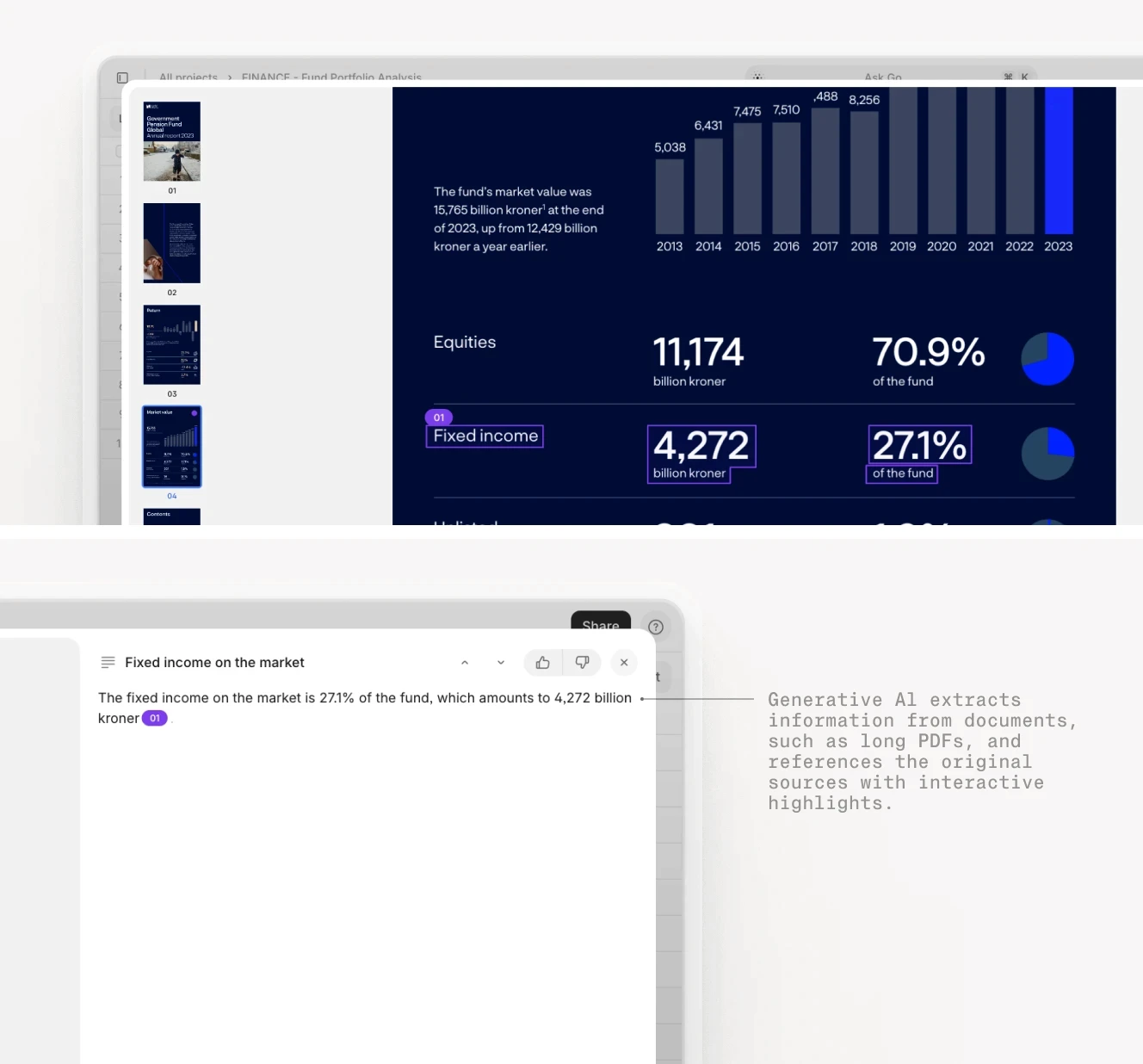
AI extraction with visual grounding displays the source location for every extracted financial metric.
Portfolio Company Monitoring and Reporting
Private equity and venture capital firms need to monitor the performance of their portfolio companies. This typically involves collecting quarterly financial reports, board decks, and operational metrics from each company, then aggregating this data for LP reporting.
The challenge is that every portfolio company reports differently. One company sends a detailed financial package with variance analysis. Another sends a one-page summary. A third sends an Excel file with 20 tabs of raw data. Normalizing all of this into a consistent format for LP reporting is a major operational burden.
AI platforms automate much of this normalization. V7 Go processes each company's reporting package, extracts key metrics (revenue, EBITDA, headcount, customer count), and populates a standardized template. The platform handles different reporting formats and flags when a company's reporting is incomplete or inconsistent with prior periods.
This automation saves time and improves data quality. When extraction is manual, errors creep in. A figure gets copied to the wrong cell. A percentage is entered as a decimal. A negative number loses its sign. Automated extraction eliminates these errors.
Deep dive into why traditional RAG fails for financial documents and how V7 Go's Knowledge Hubs solve the problem.
Making the Decision: Which Platform Is Right for You?
Choosing an AI platform for finance comes down to three factors: workflow complexity, document volume, and technical resources.
If your workflows are complex and variable: You need a platform like V7 Go that allows deep customization. If you are analyzing CIMs, credit agreements, and offering memorandums, documents that require contextual understanding and cross-referencing, you need agent-based workflows and Knowledge Hubs.
If your workflows are simple and high-volume: You can use a platform like Nanonets that optimizes for speed and ease of deployment. If you are processing thousands of invoices or bank statements per month, you do not need complex workflows. You need fast, accurate extraction with minimal configuration.
If you are a large institution with regulatory requirements: You may need an enterprise platform like Hyperscience that provides the scale, compliance controls, and audit trails that regulated institutions require. The higher cost and longer deployment time are justified by the risk mitigation.
If you are already invested in legacy systems: You might extend your existing SAP or Oracle deployment with their AI features. This makes sense if your document processing needs are modest and you want to avoid adding another vendor. But be prepared for limitations in flexibility and performance.
The most important factor is how well the platform fits your actual workflows. Do not choose based on feature lists or vendor presentations. Run a pilot with your real documents and your real workflows. Measure the results against clear success criteria. Only then can you make an informed decision.
The Competitive Advantage: Information Velocity
The firms that win in the next decade will not be the ones with the most capital or the best deal flow. They will be the ones with the fastest information velocity: the ability to ingest, analyze, and act on unstructured data faster than their competitors.
This advantage compounds. If you can analyze a CIM in 30 minutes instead of 4 hours, you can look at more deals. If you can complete due diligence in 2 weeks instead of 6 weeks, you can close deals faster and win competitive processes. If you can monitor your portfolio in real-time instead of quarterly, you can identify problems earlier and create more value.
AI platforms are the enabler of information velocity. They remove the bottleneck of manual document processing and free your team to focus on judgment, relationships, and strategy.
What Changes Monday Morning
If you take nothing else from this guide, take this checklist for getting started this week:
Pick 20 real CIMs from recent deals. Not sanitized test documents. Real ones with all their messiness.
Define 6 extraction fields. Start narrow: company name, industry, revenue, EBITDA, employee count, and year founded.
Write 3 validation rules. Revenue must be positive. EBITDA margin must be between -50% and +80%. Employee count must be an integer.
Connect your document source. Whether it is SharePoint, Google Drive, or email, set up the ingestion pipeline.
Set up an exception review queue. Define which extractions get routed to a human and who reviews them.
Establish success thresholds. 90% extraction accuracy for core fields. Under 15% exception rate. Under 10 minutes average review time per document.
Run the pilot for two weeks. Measure against your thresholds. Iterate on the extraction rules based on what fails. After 30 days, you will know whether AI document processing fits your workflow and exactly how much time it saves.
The firms deploying AI platforms today are not doing it to cut costs, though that is a benefit. They are building the capability to process more information, faster, with higher accuracy than their competitors. That capability will be the defining competitive advantage in finance over the next decade.
To see how V7 Go can transform your financial workflows, from CIM triage to portfolio monitoring, book a demo and bring your most challenging documents. We will show you what modern AI can do.
What is the difference between document AI and traditional OCR?
Traditional OCR converts images of text into machine-readable text. It can read a scanned document and give you the words, but it does not understand what those words mean or how they relate to each other. Document AI goes further by understanding document structure, extracting specific data points, and applying business logic. For example, OCR can read "EBITDA: $12.3M" from a page. Document AI can identify that this is an EBITDA figure, determine whether it is historical or projected, trace it back to the source calculation, and flag if it does not reconcile with other figures in the document.
+
How accurate is AI extraction for financial documents?
Accuracy depends on document quality and complexity. For clean, structured documents like standard invoices or bank statements, modern AI platforms achieve 95-99% accuracy. For complex documents like CIMs or credit agreements, accuracy is lower, typically 85-95%, because these documents require contextual understanding. The key is building workflows that catch and correct errors. V7 Go does this through validation rules, visual grounding for human review, and confidence scoring that flags low-confidence extractions for manual verification.
+
Can AI platforms integrate with existing financial systems?
Yes, modern AI platforms are designed for integration. V7 Go provides REST APIs and webhooks that allow you to connect to deal management systems, CRMs, financial modeling tools, and data warehouses. The platform can receive documents from your existing document repositories like SharePoint or Google Drive and push extracted data to downstream systems automatically. Integration complexity depends on your existing systems. Cloud-native systems with modern APIs are straightforward, while legacy on-premise systems may require custom middleware.
+
What happens when the AI makes a mistake?
AI mistakes fall into two categories: extraction errors (wrong data) and classification errors (wrong interpretation). Modern platforms handle both through human-in-the-loop workflows. V7 Go flags low-confidence extractions for human review and provides visual grounding so reviewers can quickly verify data against source documents. When a reviewer corrects an error, that correction feeds back into the system to improve future extractions. The goal is to catch errors before they propagate downstream and to learn from them to reduce future errors.
+
How long does it take to implement an AI platform?
Security is a valid concern, and modern AI platforms are designed for enterprise security requirements. V7 Go is SOC 2 Type II certified, which means it has undergone rigorous third-party audits of its security controls. The platform encrypts data in transit and at rest, provides role-based access controls, maintains detailed audit logs, and allows you to control data retention policies. For organizations with specific deployment requirements, V7 Go offers enterprise deployment options. Contact V7 directly to discuss your security and compliance needs. The security risk of using a modern AI platform is typically lower than the risk of manual processes involving email attachments, shared drives, and spreadsheets with no access controls.
+
How do AI platforms handle sensitive financial data?
Go is more accurate and robust than calling a model provider directly. By breaking down complex tasks into reasoning steps with Index Knowledge, Go enables LLMs to query your data more accurately than an out of the box API call. Combining this with conditional logic, which can route high sensitivity data to a human review, Go builds robustness into your AI powered workflows.
