24 min read
—


A practitioner's guide to deploying AI agents that deliver measurable cost reductions in document-heavy workflows.

Casimir Rajnerowicz
Content Creator
V7 Go
A smarter way to manage due diligence and underwriting
The CFO of a mid-sized private equity firm recently shared that their team spends 120 hours per month manually extracting data from CIMs, quarterly reports, and compliance certificates. At a fully loaded cost of 85 USD per hour for junior analysts, that amounts to over 120,000 USD annually spent on copy-paste work.
This is not an outlier. According to McKinsey research, organizations deploying AI agents report a 34% improvement in operational efficiency, with Deloitte finding that 49% achieve significant labor cost reductions. The difference between firms seeing these gains and those still drowning in manual work comes down to one thing: deploying AI agents for specific, high-volume workflows instead of treating AI as a general-purpose chatbot.
This article is not about the theoretical promise of AI. It covers the specific workflows where AI agents deliver measurable cost reductions today, the artifacts they process, and the implementation patterns that separate successful deployments from expensive failures.
In this article:
The Cost Structure of Manual Work: Why traditional automation fails and where AI agents succeed
15 High-ROI Use Cases: Specific workflows across finance, legal, insurance, and real estate with cost breakdowns
Implementation Patterns: How to deploy agents without disrupting existing systems
Measuring Success: Metrics that matter beyond simple time savings
Why Traditional Automation Fails at Cost Reduction
Most organizations have already automated the easy stuff. Invoice processing, expense reporting, and basic data entry have been handled by RPA tools for years. The remaining manual work exists because it involves unstructured documents, judgment calls, and exceptions that break rigid automation rules.
Consider the monthly reconciliation process at a real estate investment firm. The workflow involves matching rent rolls against bank statements, flagging discrepancies, investigating variances, and updating the general ledger. An RPA bot can handle the matching step when formats are consistent. It fails the moment a property manager sends a PDF instead of a CSV, or when a tenant name appears differently across systems.
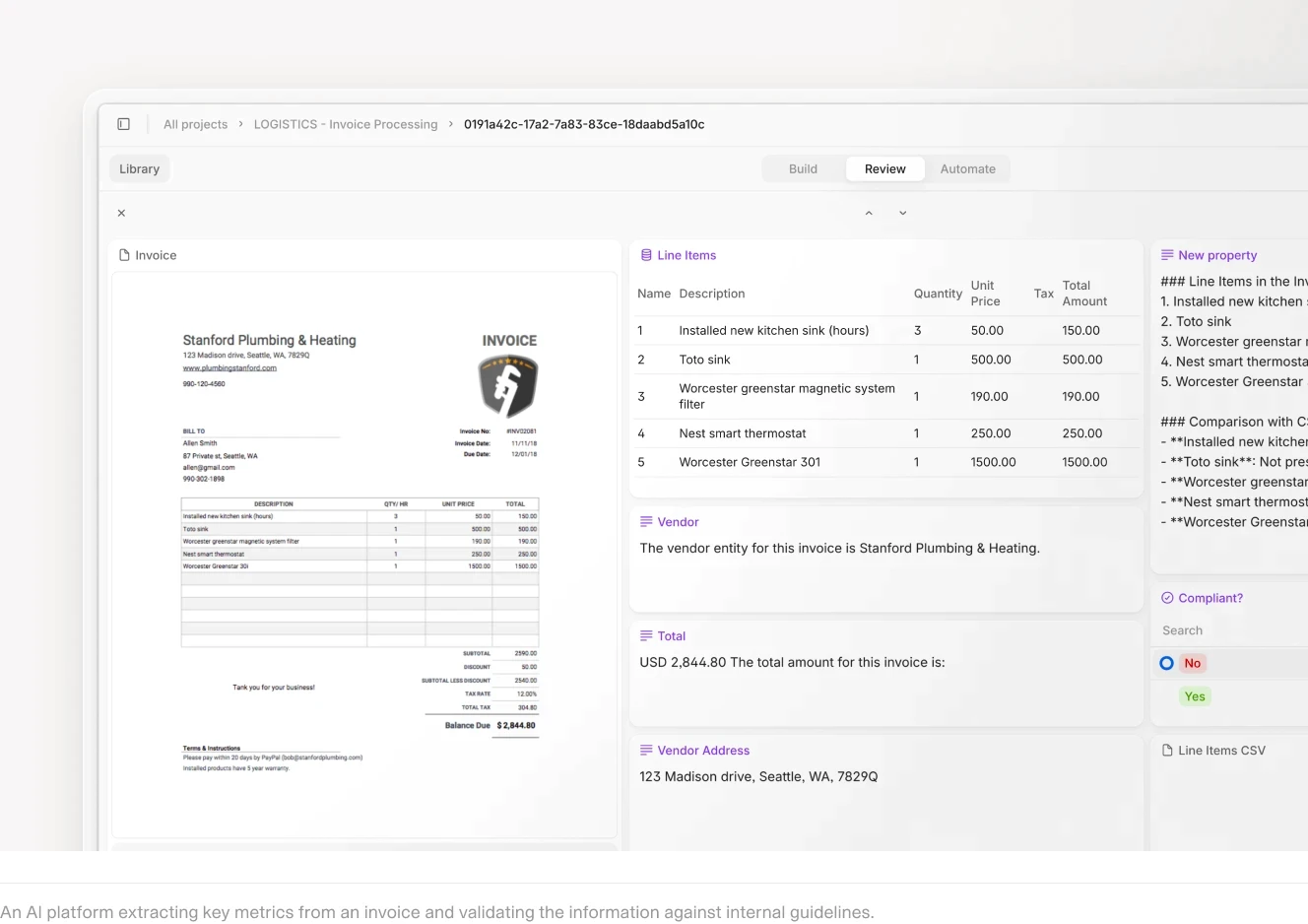
Traditional invoice processing requires perfect formatting. AI agents handle variations in layout, handwriting, and document quality.
The Three Layers of Operational Cost
Understanding where AI agents deliver value requires breaking down operational costs into three distinct layers:
Layer 1: Direct Labor Costs
The salaries and benefits of people performing manual tasks. This is the most visible cost and the easiest to measure. A junior analyst spending 20 hours per week on data entry represents 40,000 USD to 60,000 USD in annual direct costs.
Layer 2: Opportunity Costs
The strategic work not getting done because skilled professionals are stuck on manual tasks. When a senior underwriter spends three hours reviewing routine policy renewals instead of analyzing complex risks, the firm loses the value of their expertise on high-stakes decisions.
Layer 3: Error Costs
The downstream impact of manual mistakes. A single miskeyed figure in a financial model can cascade into incorrect valuations, flawed investment decisions, and regulatory issues. These costs are harder to quantify but often dwarf direct labor expenses.
AI agents address all three layers simultaneously. They eliminate the manual work (Layer 1), free experts for strategic tasks (Layer 2), and reduce error rates through consistent processing (Layer 3).
The following video demonstrates how V7 Go organizes batch document processing across multiple agent workflows. Notice how different document types route automatically to specialized agents.
V7 Go's agent library showing pre-built workflows for invoice processing, OCR extraction, and batch document analysis.
The AI Agent Advantage: Specificity Over Generality
The key difference between AI agents and general-purpose AI tools is specificity. A chatbot can answer questions about any topic but provides shallow responses. An AI valuation agent is designed for one job: extracting property values, comparable sales, and market assumptions from appraisal reports.
This specialization delivers three critical advantages:
Reliability: When an agent is built for a specific document type and workflow, it can be tested exhaustively. You know exactly what fields it will extract, what validation rules it applies, and what edge cases it handles. This predictability is essential for production deployment.
Integration: Specialized agents connect directly to the systems where their output is needed. A lease abstraction agent can populate fields in your property management system, trigger alerts for upcoming renewals, and update financial models without human intervention.
Auditability: General AI tools produce answers without showing their work. Agents built for regulated industries provide citations, highlight source text, and create audit trails. When an underwriter reviews an agent's risk assessment, they can see exactly which policy clauses and loss history drove each conclusion.
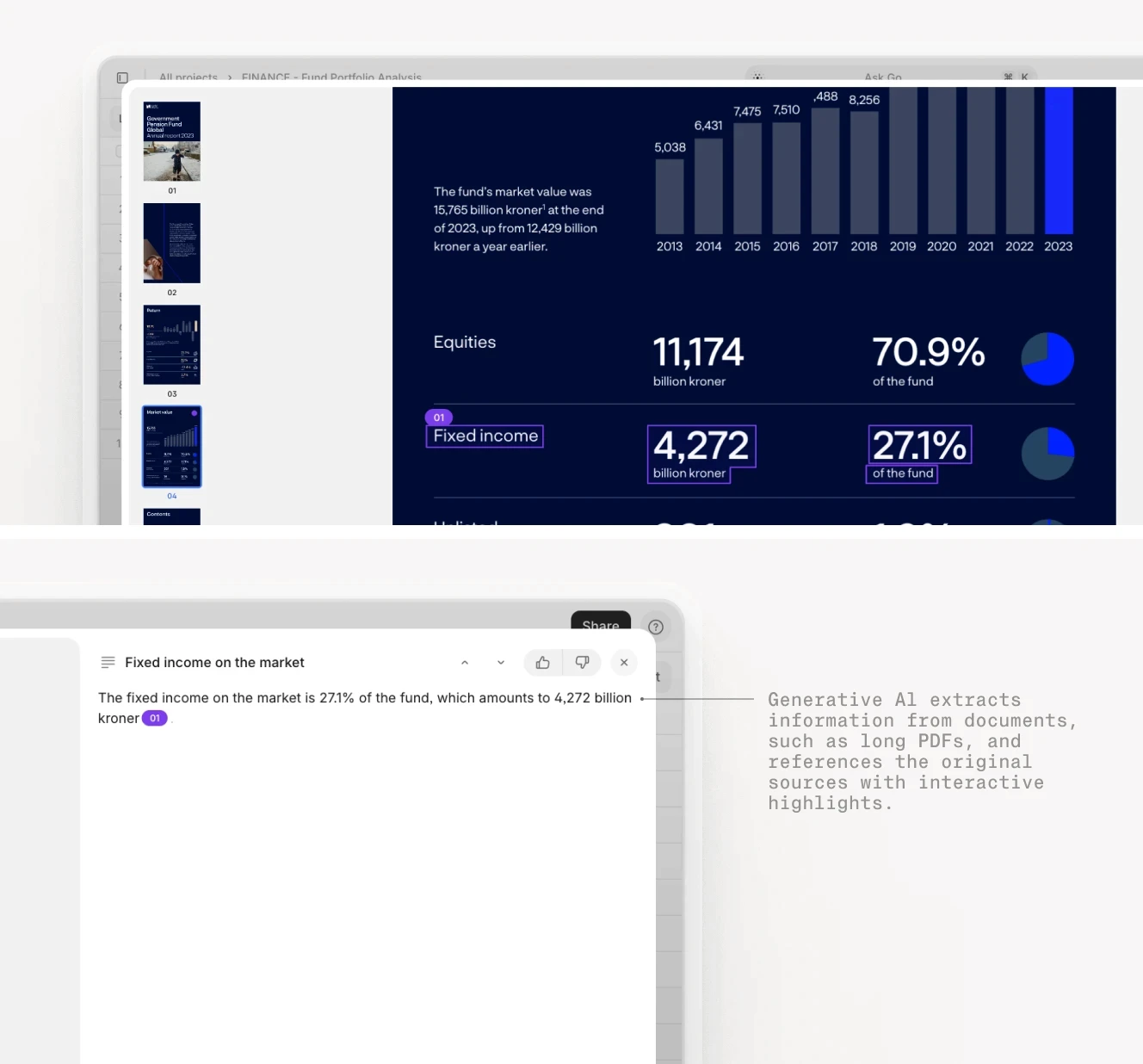
Visual grounding shows exactly where each extracted figure came from, enabling rapid verification and audit compliance.
The Build vs. Buy Decision
Organizations face a critical choice when deploying AI agents: build custom solutions in-house or adopt pre-built platforms. The economics heavily favor platforms for most use cases.
To build a production-grade AI agent you need data science expertise, deployment infrastructure, maintenance resources, and a plan to update it as document formats change. A single agent can easily consume six months of engineering time and 200,000 USD or more in development costs. Multiply that across the 10 to 15 high-value workflows in a typical enterprise, and internal development becomes prohibitively expensive.
Platforms like V7 Go provide pre-built agents for common workflows (invoice processing, contract review, due diligence) that can be deployed in days rather than months. The platform handles model updates, infrastructure scaling, and integration with existing systems. Organizations pay for usage rather than carrying fixed development costs.
The build approach makes sense only when the workflow is truly unique to your business and represents a competitive advantage. For standard back-office processes, platforms deliver faster time-to-value and lower total cost of ownership.
Cost Reduction Patterns Across Industries
While specific workflows vary by industry, successful AI agent deployments follow consistent patterns. Understanding these patterns helps identify high-ROI opportunities in your organization.
Pattern 1: High-Volume, Low-Complexity Tasks
Workflows where the same type of document appears repeatedly with minor variations. Examples include invoice processing, receipt reconciliation, and policy renewals. These deliver quick wins because the ROI is straightforward: multiply the time saved per document by monthly volume.
Pattern 2: Expert Bottlenecks
Tasks that require specialized knowledge but involve significant manual work. Examples include contract redlining, due diligence reviews, and underwriting assessments. AI agents handle the extraction and initial analysis, allowing experts to focus on judgment calls and exceptions.
Pattern 3: Multi-System Reconciliation
Processes that require pulling data from multiple sources, normalizing formats, and identifying discrepancies. Examples include financial close processes, compliance reporting, and portfolio monitoring. Agents eliminate the manual data gathering and formatting that consumes 70 to 80% of the total time.
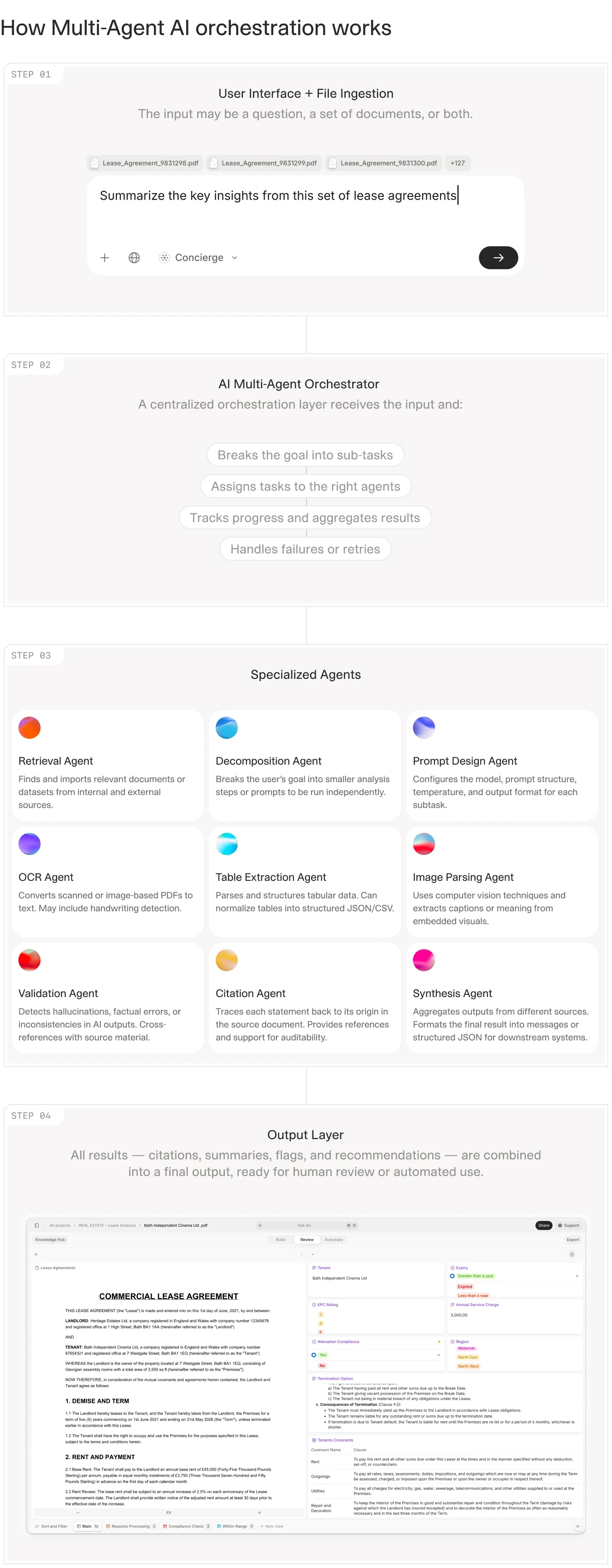
Complex workflows often require multiple specialized agents working in sequence, each handling a specific transformation step.











15 High-ROI Use Cases for AI Agents
The following use cases represent workflows where organizations have documented significant cost reductions through AI agent deployment. Each includes the specific artifacts processed, typical cost structure, and expected savings.
1. Property Valuation and Appraisal Review
The Manual Process: Real estate investment teams receive 50 to 200 appraisal reports per month. Each report spans 30 to 80 pages containing property details, comparable sales, income approaches, and market assumptions. Analysts manually extract key figures into spreadsheets for portfolio tracking and investment committee memos.
Time Investment: 45 to 60 minutes per appraisal for data extraction and verification. At 100 appraisals per month, this represents 75 to 100 hours of analyst time.
The AI Solution: An AI valuation agent reads the appraisal PDF, extracts property characteristics, comparable sales, valuation conclusions, and key assumptions. It populates standardized templates and flags outliers for human review.
Cost Impact: Reduces extraction time to 5 to 10 minutes per appraisal (primarily verification). At a fully loaded cost of 75 USD per hour for analysts, this saves 5,000 USD to 7,000 USD monthly or 60,000 USD to 84,000 USD annually. More importantly, it lets the team review 3 to 4 times more opportunities without adding headcount.
The following video shows how the CIM analysis agent structures extracted company information before valuation review. Notice the side-by-side view with source citations.
CIM due diligence workflow showing Cases interface with extracted company information, financial metrics, and entity analysis.
2. Insurance Policy Analysis and Underwriting
The Manual Process: Underwriters review policy applications, loss history, inspection reports, and supporting documentation to assess risk and determine pricing. A commercial property submission might include 15 to 30 documents totaling 200 or more pages.
Time Investment: 2 to 4 hours per submission for document review and data extraction. High-volume underwriters process 20 to 30 submissions weekly.
The AI Solution: An AI policy analysis agent extracts coverage details, identifies exclusions, flags risk factors, and compares terms against underwriting guidelines. It creates a structured summary with citations to source documents.
Cost Impact: Reduces review time to 30 to 45 minutes per submission. For an underwriter processing 25 submissions weekly, this saves 40 to 50 hours monthly. At 95 USD per hour for experienced underwriters, annual savings exceed 45,000 USD per underwriter. Firms with 10 to 15 underwriters see 450,000 USD to 675,000 USD in direct cost reduction.
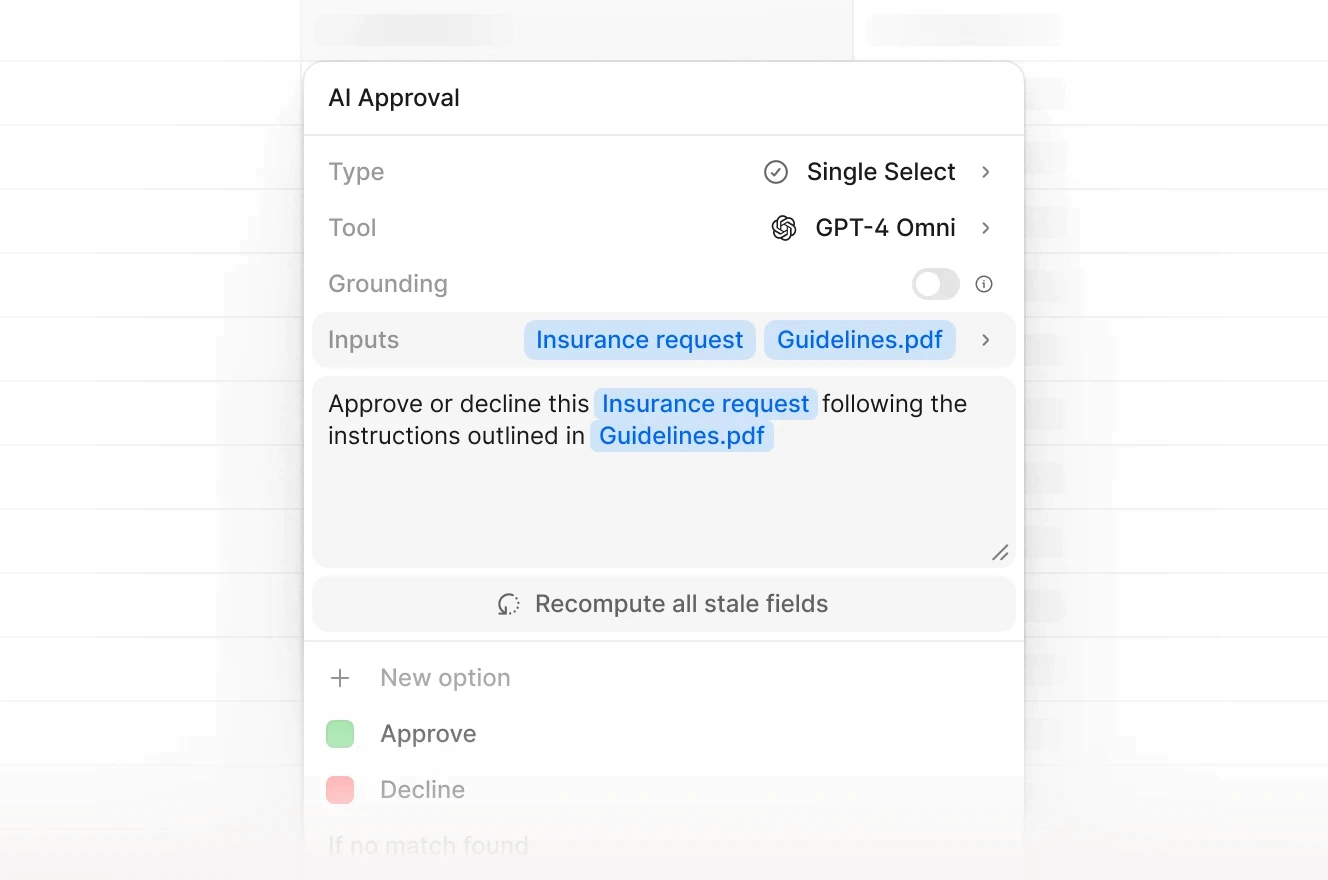
Underwriting agents extract risk factors, coverage terms, and loss history to accelerate approval decisions while maintaining accuracy.
3. Lease Abstraction and Portfolio Management
The Manual Process: Property managers and asset managers maintain lease abstracts for hundreds or thousands of commercial leases. Each lease requires extracting rent schedules, renewal options, tenant improvement allowances, operating expense provisions, and termination clauses.
Time Investment: 60 to 90 minutes per lease for initial abstraction. Portfolio acquisitions often involve 50 to 500 leases requiring immediate review.
The AI Solution: A lease abstraction agent reads lease agreements and extracts critical dates, financial terms, and special provisions into standardized formats. It identifies non-standard clauses and flags items requiring legal review.
Cost Impact: Reduces abstraction time to 10 to 15 minutes per lease. For a portfolio acquisition involving 200 leases, this cuts the timeline from 200 to 300 hours to 30 to 50 hours. At 65 USD per hour for lease administrators, this saves 11,000 USD to 16,000 USD per acquisition. Firms processing 5 to 10 acquisitions annually save 55,000 USD to 160,000 USD.
4. Financial Statement Analysis and Due Diligence
The Manual Process: Investment analysts review financial statements, management discussion, footnotes, and supplementary schedules to build financial models and assess investment opportunities. A typical CIM package includes 100 to 300 pages of financial documentation.
Time Investment: 3 to 5 hours per company for initial financial analysis and model population. Deal teams review 50 to 100 opportunities quarterly.
The AI Solution: An AI due diligence agent extracts revenue, EBITDA, working capital, debt schedules, and key metrics from financial statements. It identifies accounting policies, normalizing adjustments, and red flags requiring deeper investigation.
Cost Impact: Reduces initial analysis to 45 to 60 minutes per company. For a team reviewing 75 opportunities quarterly, this saves 180 to 240 hours per quarter or 720 to 960 hours annually. At 110 USD per hour for investment analysts, annual savings reach 79,000 USD to 106,000 USD. The larger benefit is the ability to evaluate more opportunities without expanding the team.
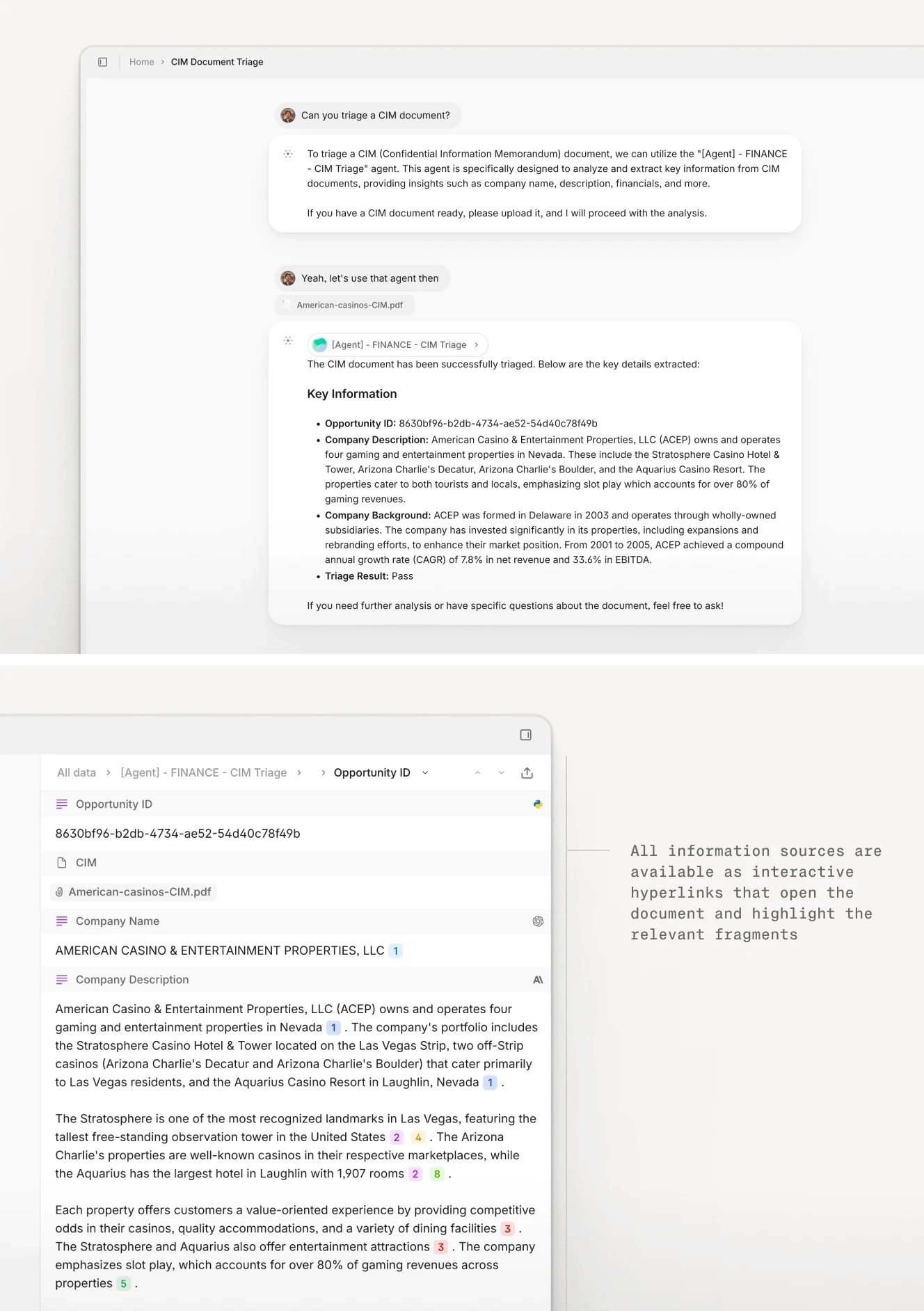
CIM triage agents classify investment opportunities and extract key metrics, enabling rapid screening of deal flow.
5. Contract Review and Redlining
The Manual Process: Legal teams review vendor contracts, NDAs, service agreements, and amendments to identify deviations from standard terms, assess risk, and propose redlines. A mid-sized company processes 200 to 400 contracts annually.
Time Investment: 60 to 120 minutes per contract depending on complexity. Routine NDAs take 30 to 45 minutes; complex service agreements require 2 to 3 hours.
The AI Solution: An AI contract review agent compares contracts against playbooks, identifies non-standard clauses, assesses risk levels, and generates redline suggestions. It flags items requiring attorney review.
Cost Impact: Reduces review time by 60 to 70% for routine contracts. For a legal team processing 300 contracts annually, this saves 200 to 300 hours. At 250 USD per hour for in-house counsel, annual savings reach 50,000 USD to 75,000 USD. The strategic benefit is faster contract turnaround, reducing deal friction and improving vendor relationships.
The following video shows the full NDA review workflow, from initial risk flagging through redline generation with source citations.
NDA review workflow showing automated risk flagging, governing law analysis, and redline suggestions with source citations.
6. Invoice Processing and Three-Way Matching
The Manual Process: Accounts payable teams match invoices against purchase orders and receiving documents, resolve discrepancies, and route for approval. High-volume organizations process 5,000 to 20,000 invoices monthly.
Time Investment: 5 to 10 minutes per invoice for standard processing; 20 to 30 minutes for exceptions. At 10,000 invoices monthly, this represents 800 to 1,500 hours of AP staff time.
The AI Solution: An accounts payable automation agent extracts invoice details, matches against POs and receipts, identifies discrepancies, and routes exceptions for human review. It handles variations in invoice formats and vendor naming.
Cost Impact: Reduces processing time to 1 to 2 minutes per invoice for standard items. At 10,000 invoices monthly with 70% automation rate, this saves 500 to 700 hours monthly or 6,000 to 8,400 hours annually. At 45 USD per hour for AP staff, annual savings reach 270,000 USD to 378,000 USD.
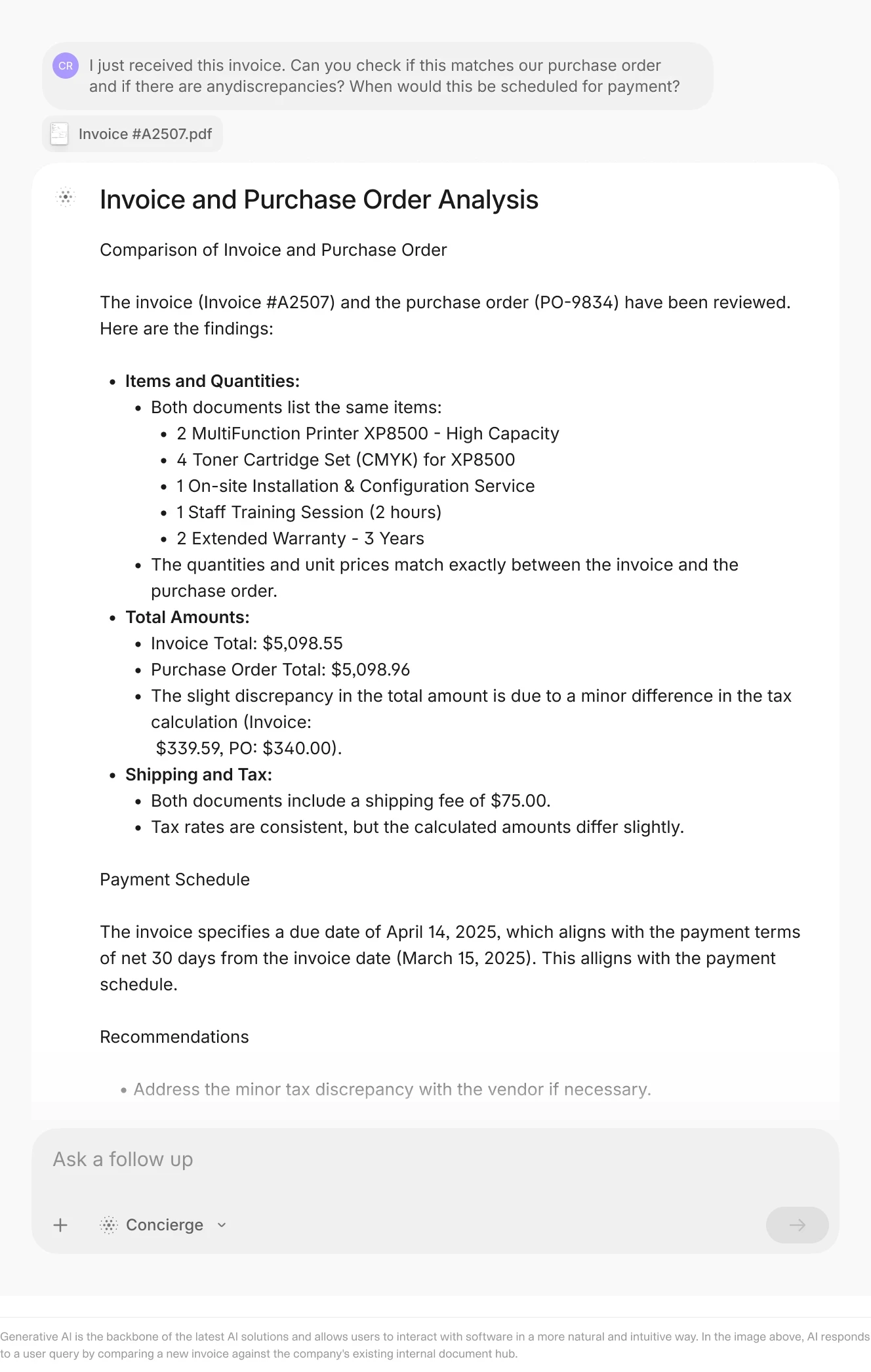
Three-way match agents compare invoices, purchase orders, and receiving documents to identify discrepancies automatically.
7. Claims Processing and Triage
The Manual Process: Insurance claims adjusters review claim submissions, supporting documentation, policy terms, and loss history to determine coverage and settlement amounts. Claims range from simple property damage to complex liability cases.
Time Investment: 30 to 90 minutes per claim for initial review and triage. High-volume carriers process 1,000 to 5,000 claims monthly.
The AI Solution: An AI claims processing agent extracts claim details, verifies coverage, identifies policy exclusions, and recommends triage categories. It flags claims requiring special investigation or legal review.
Cost Impact: Reduces triage time to 10 to 15 minutes per claim. At 2,000 claims monthly, this saves 600 to 900 hours monthly or 7,200 to 10,800 hours annually. At 55 USD per hour for claims staff, annual savings reach 396,000 USD to 594,000 USD. Faster triage also improves customer satisfaction and reduces loss adjustment expenses.
8. Regulatory Compliance Reporting
The Manual Process: Compliance teams gather data from multiple systems, normalize formats, validate accuracy, and prepare regulatory filings. Quarterly and annual reports require extensive documentation and cross-checking. A typical compliance report requires data from 8 to 12 source systems, including general ledgers, trading systems, risk databases, and counterparty records.
Time Investment: 40 to 80 hours per quarterly report depending on complexity. Annual reports can require 200 to 400 hours of preparation time. Much of this time goes to data gathering (30%), format normalization (25%), cross-validation (25%), and report assembly (20%).
The AI Solution: An AI SOX compliance agent extracts required data points from source systems, validates against regulatory requirements, identifies gaps, and populates report templates. It maintains audit trails for all data sources, including timestamps, version numbers, and transformation logic. The agent cross-references control IDs against regulation text and flags any missing attestations.
Key Fields Extracted: Control identifiers, test results, deficiency classifications, remediation status, management assertions, and supporting evidence references. For financial reporting, the agent also captures section mappings to specific regulation clauses (e.g., SOX Section 404 control points).
Cost Impact: Reduces report preparation time by 50 to 60%. For quarterly reports, this saves 20 to 40 hours per quarter or 80 to 160 hours annually. At 85 USD per hour for compliance analysts, annual savings reach 6,800 USD to 13,600 USD per report type. Organizations filing multiple report types (SOX, Basel III, Dodd-Frank) see proportionally larger savings. The consistency improvements also reduce regulatory examination findings and associated remediation costs.
9. Deed and Title Document Analysis
The Manual Process: Title companies and real estate attorneys review property deeds, title commitments, surveys, and encumbrance documents to identify ownership issues, liens, and title defects. Each transaction involves 10 to 30 documents.
Time Investment: 90 to 120 minutes per transaction for document review and title clearance. High-volume title companies process 200 to 500 transactions monthly.
The AI Solution: A deed analysis agent extracts property descriptions, ownership chains, encumbrances, and easements from title documents. It identifies potential title issues and flags items requiring attorney review.
Cost Impact: Reduces review time to 30 to 40 minutes per transaction. At 300 transactions monthly, this saves 250 to 375 hours monthly or 3,000 to 4,500 hours annually. At 75 USD per hour for title examiners, annual savings reach 225,000 USD to 337,500 USD.
10. Financial Reconciliation and Close Processes
The Manual Process: Accounting teams reconcile bank statements, credit card transactions, intercompany accounts, and subsidiary ledgers during monthly close. The process involves matching thousands of transactions and investigating variances.
Time Investment: 60 to 120 hours per month for a mid-sized organization. Complex enterprises can spend 300 to 500 hours on monthly close activities.
The AI Solution: A financial reconciliation agent matches transactions across systems, identifies discrepancies, categorizes variances, and routes exceptions for investigation. It uses your Knowledge Hub to reference historical reconciliation patterns and improve matching accuracy over time.
Cost Impact: Reduces reconciliation time by 40 to 50%. For an organization spending 100 hours monthly on reconciliation, this saves 40 to 50 hours monthly or 480 to 600 hours annually. At 65 USD per hour for accounting staff, annual savings reach 31,200 USD to 39,000 USD. The larger benefit is faster close cycles, enabling earlier financial reporting and decision-making.
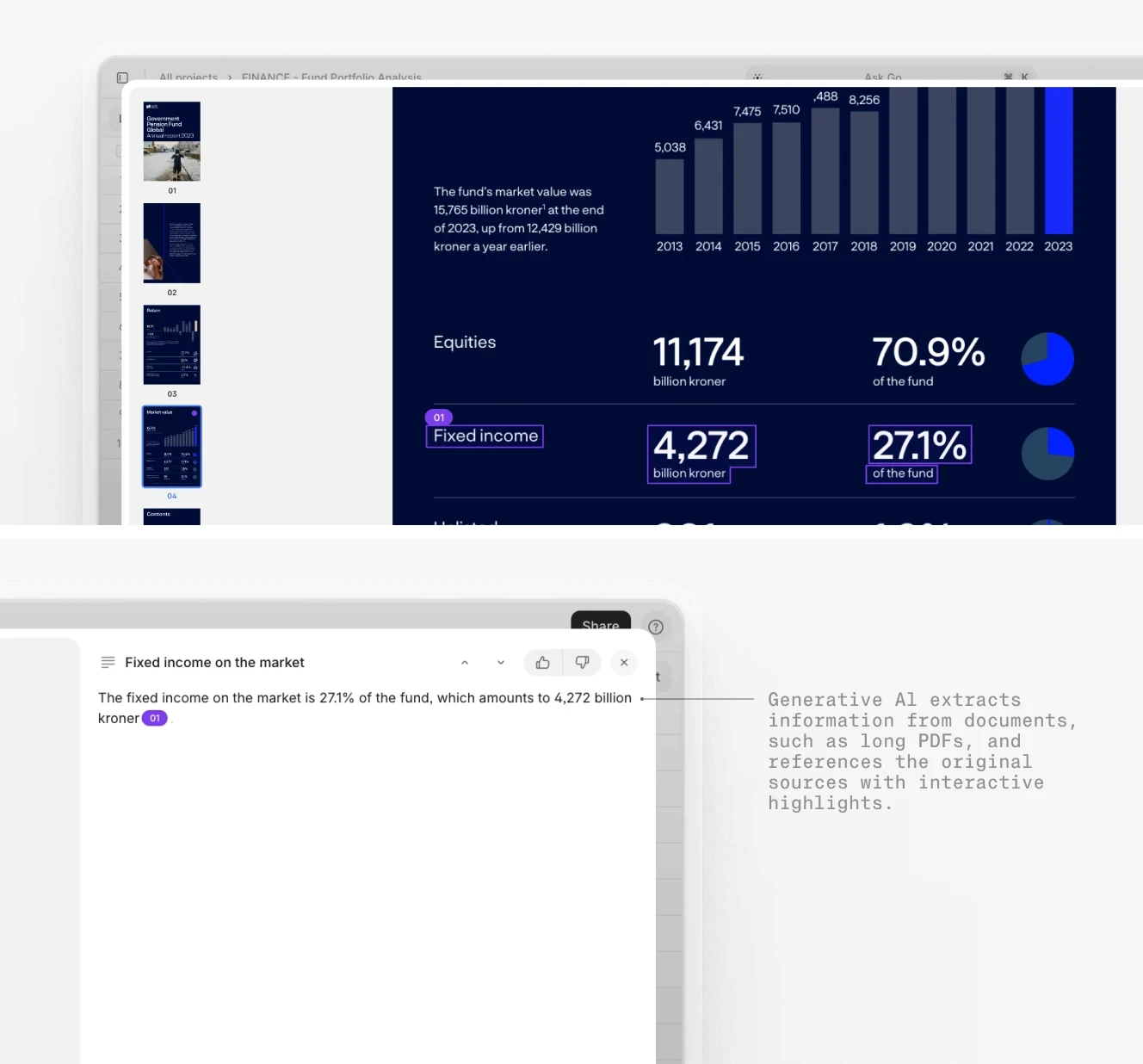
Reconciliation agents match transactions across systems and flag discrepancies for investigation, accelerating month-end close.
11. Market Research and Competitive Intelligence
The Manual Process: Strategy and business development teams monitor competitor announcements, industry reports, regulatory filings, and news sources to identify market trends and competitive threats. This requires daily scanning of dozens of sources.
Time Investment: 10 to 15 hours weekly for comprehensive market monitoring. Preparing quarterly competitive intelligence reports requires an additional 20 to 30 hours.
The AI Solution: A market intelligence agent monitors specified sources, extracts relevant information, categorizes by topic and competitor, and generates summary reports. It alerts teams to significant developments in real-time.
Cost Impact: Reduces monitoring time by 70 to 80%. For a team spending 15 hours weekly on market research, this saves 10 to 12 hours weekly or 520 to 624 hours annually. At 95 USD per hour for strategy analysts, annual savings reach 49,400 USD to 59,280 USD. The strategic value of faster competitive intelligence often exceeds the direct cost savings.
12. Vendor Due Diligence and Onboarding
The Manual Process: Procurement and compliance teams review vendor documentation including financial statements, insurance certificates, compliance attestations, and background checks before approving new vendors. Each vendor submission contains 5 to 15 documents across multiple formats: PDFs of audited financials, scanned certificates of insurance, W-9 forms, and compliance questionnaire responses.
Time Investment: 2 to 3 hours per vendor for document review and compliance verification. Organizations onboarding 50 to 100 vendors annually spend 100 to 300 hours on this process. The complexity increases when vendors operate in multiple jurisdictions with different certification requirements.
The AI Solution: A vendor due diligence agent extracts required information from vendor documents, verifies against compliance requirements, identifies missing items, and flags risk factors. It maintains a structured vendor database for ongoing monitoring and re-certification tracking.
Key Fields Extracted: Insurance policy numbers and coverage limits, expiration dates, named insured parties, certificate holder designations, financial ratios from audited statements, compliance attestation dates, and beneficial ownership information. The agent also cross-references certificates of insurance against COI compliance requirements for your specific contracts.
Validation Rules Applied: Coverage minimums matched against contract requirements, expiration dates checked against onboarding timeline, financial health thresholds verified, and required certifications confirmed present. Missing documents generate automated requests to the vendor contact.
Cost Impact: Reduces review time to 30 to 45 minutes per vendor. For 75 vendors annually, this saves 100 to 150 hours. At 75 USD per hour for procurement analysts, annual savings reach 7,500 USD to 11,250 USD. The larger benefit is faster vendor onboarding, reducing procurement cycle times from weeks to days and improving supplier relationships.
13. Tax Document Processing and Compliance
The Manual Process: Tax teams process W-2s, 1099s, K-1s, and supporting documentation for tax return preparation and compliance reporting. Large organizations handle thousands of tax documents annually across multiple entities and jurisdictions. A single K-1 package from a fund investment might include 15 to 40 pages of schedules, footnotes, and state apportionment data.
Time Investment: 5 to 15 minutes per document for data extraction and validation. At 5,000 documents annually, this represents 400 to 1,250 hours of tax staff time. The variance comes from document complexity: a standard W-2 takes 3 minutes while a complex K-1 with multiple state allocations can take 20 minutes.
The AI Solution: A tax compliance agent extracts data from tax documents, validates against IRS requirements, identifies discrepancies, and populates tax software. It handles variations in document formats and state-specific requirements.
Key Fields Extracted: For K-1s: partner capital account beginning and ending balances, ordinary income allocations, Section 199A deductions, foreign tax credits, state source income by jurisdiction, and UBTI components. For 1099s: gross proceeds, cost basis, holding period, wash sale adjustments, and market discount accruals. For W-2s: wages, federal withholding, state allocations, and retirement contributions.
Validation Checks: Partner capital account reconciliation against prior year, income allocation percentages summing to partnership total, state apportionment factors matching entity filings, and document type matching IRS form requirements. Discrepancies are flagged with specific line item citations.
Cost Impact: Reduces processing time to 1 to 2 minutes per document. At 5,000 documents annually, this saves 300 to 900 hours. At 85 USD per hour for tax professionals, annual savings reach 25,500 USD to 76,500 USD. The accuracy improvements also reduce amendment costs and audit risk, which can run 5,000 USD to 50,000 USD per adjustment.
14. Loan Document Analysis and Servicing
The Manual Process: Loan servicing teams review loan agreements, modification documents, payment histories, and collateral documentation to manage portfolios and respond to borrower inquiries. Each loan file contains 20 to 50 documents.
Time Investment: 45 to 60 minutes per loan for initial document review and data extraction. Portfolio acquisitions involving 500 to 2,000 loans require immediate analysis.
The AI Solution: A loan document analysis agent extracts loan terms, payment schedules, collateral descriptions, and covenant requirements. It identifies modification history and flags loans requiring special servicing.
Cost Impact: Reduces review time to 10 to 15 minutes per loan. For a portfolio acquisition of 1,000 loans, this cuts the timeline from 750 to 1,000 hours to 150 to 250 hours. At 65 USD per hour for loan servicing staff, this saves 39,000 USD to 48,750 USD per acquisition. Ongoing servicing efficiency gains compound these savings.
15. Board and Committee Materials Preparation
The Manual Process: Executive assistants and corporate secretaries compile board packages from multiple sources including financial reports, committee minutes, management presentations, and supporting documentation. Quarterly board meetings require 40 to 80 pages of materials spanning risk reports, financial summaries, strategic updates, and regulatory matters.
Time Investment: 15 to 25 hours per board meeting for document gathering, formatting, and quality control. Organizations with multiple committees (Audit, Compensation, Nominating, Risk) spend 60 to 100 hours quarterly on materials preparation. Much of this time is consumed by version control, cross-referencing prior meeting action items, and ensuring consistent formatting across submissions from different departments.
The AI Solution: A document automation agent extracts required information from source systems, populates board package templates, ensures consistent formatting, and generates table of contents and cross-references. It maintains version control and audit trails for all source documents.
Key Artifacts Processed: Draft financial statements from accounting, risk dashboards from the risk management system, prior meeting minutes requiring follow-up tracking, management presentations in various formats, and regulatory correspondence requiring board awareness. The agent also tracks open action items from prior meetings and flags overdue items for management attention.
Validation and Quality Checks: Page numbering consistency, cross-reference accuracy between narrative and supporting schedules, prior period comparability in financial exhibits, and completeness checks against required agenda items. The agent generates a preparation checklist showing which source documents have been incorporated and which remain outstanding.
Cost Impact: Reduces preparation time by 50 to 60%. For an organization spending 80 hours quarterly on board materials, this saves 40 to 48 hours quarterly or 160 to 192 hours annually. At 55 USD per hour for administrative staff, annual savings reach 8,800 USD to 10,560 USD. The larger benefit is improved accuracy and consistency in board communications, reduced risk of missing materials, and better audit trails for governance documentation.
Implementation Patterns for Maximum ROI
Successful AI agent deployments follow consistent implementation patterns that maximize ROI while minimizing disruption to existing operations.
Start with High-Volume, Low-Complexity Workflows
The fastest path to demonstrable ROI is deploying agents for high-volume workflows with clear success criteria. Invoice processing, receipt reconciliation, and policy renewals fit this pattern. These workflows have well-defined inputs, predictable outputs, and measurable time savings.
Organizations should target workflows processing at least 100 documents monthly. Below this threshold, the setup effort may exceed the savings. Above 500 documents monthly, the ROI becomes compelling even with modest time savings per document.
Build Knowledge Hubs Before Deploying Agents
AI agents perform best when they have access to organizational context through Knowledge Hubs. Before deploying a contract review agent, populate a Knowledge Hub with your contract playbooks, standard terms, and historical redlines. The agent uses this context to provide more accurate recommendations aligned with your specific requirements.
Knowledge Hubs also enable agents to improve through feedback. When a human reviewer adjusts an agent's output, that correction informs the context available for future extractions. This continuous refinement is only possible when agents have access to organizational knowledge through the Hub.
The following video demonstrates how Knowledge Hubs provide document context and enable citation-backed responses. Notice how the agent references specific sections when answering questions.
Knowledge Hubs provide agents with organizational context, enabling more accurate analysis and recommendations.
Implement Human-in-the-Loop Review Stages
Production AI agent deployments should include review stages where humans verify outputs before downstream systems consume them. This serves three purposes: quality assurance, continuous improvement, and regulatory compliance.
The review stage does not eliminate cost savings. An analyst can verify an agent's lease abstraction in 10 minutes versus 60 minutes to create it from scratch. The 50-minute savings compounds across hundreds of leases while maintaining accuracy.
Review stages also build trust. Teams are more willing to adopt AI agents when they can verify outputs before committing to decisions. As confidence grows, review can shift from 100% sampling to exception-based spot checks.
Measure Beyond Time Savings
While time savings drive initial ROI calculations, successful deployments track additional metrics:
Error Reduction: Compare error rates before and after agent deployment. A 50% reduction in invoice processing errors eliminates downstream costs from payment disputes and vendor relationship issues.
Cycle Time Improvement: Measure end-to-end process duration, not just individual task time. Faster contract review might reduce deal closing time by days, creating competitive advantages beyond direct cost savings.
Capacity Expansion: Track how many additional transactions the team can handle without adding headcount. A due diligence team that can evaluate 50% more opportunities without hiring creates strategic value that exceeds operational cost savings.
Quality Improvements: Monitor completeness and consistency of outputs. Agents that extract 100% of required fields versus 85% for manual processes reduce rework and improve downstream decision quality.
Common Implementation Pitfalls
Organizations deploying AI agents encounter predictable challenges. Understanding these pitfalls helps avoid expensive mistakes.
Pitfall 1: Treating Agents as General-Purpose Tools
The most common failure is deploying a general chatbot and expecting it to handle specialized workflows. A chatbot can answer questions about lease terms but cannot reliably extract rent schedules, renewal options, and operating expense provisions into structured formats.
Successful deployments use specialized agents built for specific document types and workflows. An AI lease analysis agent is designed specifically for commercial leases. It knows where to find critical clauses, how to handle variations in lease structure, and what fields matter for portfolio management.
Pitfall 2: Insufficient Training Data and Context
Agents perform poorly when deployed without adequate examples and organizational context. A contract review agent needs to see your standard terms, historical redlines, and risk tolerance to provide useful recommendations.
Organizations should plan to provide 20 to 50 example documents during initial setup. This sample set should include typical cases, edge cases, and examples of desired outputs. The investment in curating training examples pays dividends in accuracy and adoption.
Pitfall 3: Ignoring Change Management
Technical deployment is only half the challenge. Teams must understand what agents do, when to trust their outputs, and how to provide feedback for improvement. Without proper training and communication, agents sit unused while teams continue manual processes.
Successful deployments include hands-on training sessions, clear documentation of agent capabilities and limitations, and designated champions who can answer questions and troubleshoot issues. The goal is building confidence, not just deploying technology.
Pitfall 4: Inadequate Integration Planning
Agents that require manual data export and import create new bottlenecks instead of eliminating them. The value of automated extraction disappears if analysts must copy-paste results into downstream systems.
Production deployments should include API integrations, automated data flows, and exception handling. An invoice processing agent should populate your ERP system directly, not generate CSV files for manual upload. The integration effort is essential for realizing full ROI.
Building an AI Agent Strategy
Organizations that achieve sustained cost reductions through AI agents follow a deliberate strategy rather than pursuing one-off deployments. This strategy has four components: workflow prioritization, infrastructure development, team enablement, and continuous improvement.
Workflow Prioritization Framework
Not all workflows deliver equal ROI from AI agent deployment. The highest-value opportunities share three characteristics: high volume, clear success criteria, and significant manual effort.
Start by cataloging workflows that process at least 100 documents or transactions monthly. For each workflow, estimate current time investment, error rates, and downstream impact of delays or mistakes. This creates a prioritized list based on potential savings.
Next, assess technical feasibility. Workflows with standardized document formats and well-defined outputs are easier to automate than those requiring extensive judgment or handling highly variable inputs. Your first deployments should target high-volume, high-value workflows with moderate technical complexity.
Finally, consider organizational readiness. Teams that are already frustrated with manual processes and open to new approaches will adopt agents more readily than those satisfied with current methods. Early wins with receptive teams build momentum for broader deployment.
Infrastructure Development
Sustainable AI agent deployment requires infrastructure beyond individual agents. This includes Knowledge Hubs for organizational context, integration frameworks for connecting to existing systems, and monitoring capabilities for tracking performance.
Knowledge Hubs serve as the foundation. Before deploying agents, populate hubs with relevant documents, policies, and examples. A contract review agent needs access to your playbooks and standard terms. A due diligence agent benefits from historical deal memos and investment criteria.
Integration frameworks enable agents to consume data from source systems and deliver outputs to downstream applications. This might include API connections to your ERP, CRM, or document management system. The goal is eliminating manual data transfer between systems.
Monitoring capabilities track agent performance, identify drift, and flag issues requiring attention. This includes accuracy metrics, processing times, exception rates, and user feedback. Regular monitoring ensures agents maintain performance as document formats and business requirements evolve.
Team Enablement and Training
Technology deployment succeeds only when teams understand how to use it effectively. This requires training on agent capabilities, limitations, and best practices for review and feedback.
Training should be hands-on and workflow-specific. Show analysts how the lease abstraction agent handles their actual leases, not generic examples. Demonstrate the review interface, explain how to verify outputs, and practice providing feedback that improves future performance.
Designate agent champions within each team. These individuals become the go-to resources for questions, troubleshooting, and sharing best practices. They also serve as the feedback channel between users and the team managing agent deployment.
Create clear documentation covering common scenarios, edge cases, and escalation procedures. Teams should know exactly what to do when an agent produces unexpected results or encounters a document type it has not seen before.
Continuous Improvement Process
AI agents improve through feedback and refinement. Organizations that establish systematic improvement processes see accuracy and efficiency gains compound over time.
Implement regular review cycles where teams examine agent outputs, identify patterns in errors or exceptions, and feed corrections back through the Knowledge Hub. This might be weekly for new deployments, shifting to monthly as performance stabilizes.
Track improvement metrics over time. An agent that starts at 85% accuracy should reach 95% or better within 3 to 6 months as it gains access to more context in the Knowledge Hub and validation rules are refined based on reviewer feedback. If accuracy plateaus, investigate whether the agent needs additional context documents or whether the workflow requires human judgment that cannot be automated.
Expand agent capabilities incrementally. Once a lease abstraction agent reliably extracts basic terms, add more complex provisions like renewal options, tenant improvement allowances, or operating expense calculations. This gradual expansion maintains quality while increasing value.
What Changes Monday Morning
The organizations achieving average operational expense savings of 25% through AI agents share a common approach: they start small, measure rigorously, and scale systematically.
Your first deployment should target a single, high-volume workflow where success is easy to measure. Invoice processing, policy renewals, or lease abstraction are good candidates. Set clear success criteria: reduce processing time by 50%, maintain 95% or better accuracy, and achieve 80% or better user adoption within 90 days.
Measure actual results against these criteria. Track time savings, error rates, user satisfaction, and downstream impact. Use this data to refine the deployment and build the business case for expansion.
Once the first workflow succeeds, apply the same pattern to the next priority. Each deployment builds organizational capability, improves infrastructure, and strengthens the business case for continued investment.
The competitive advantage goes to organizations that can deploy agents faster and scale them more broadly than competitors. The cost savings are significant, but the strategic value of superior operational efficiency compounds over time.
To see how AI agents can reduce operational costs in your specific workflows, book a demo with V7 Go.
How much can AI agents realistically reduce operational costs?
Organizations typically see 25 to 40% reduction in operational costs for workflows where AI agents are deployed. The exact savings depend on the workflow's volume, complexity, and current manual effort. High-volume, repetitive tasks like invoice processing or policy renewals often achieve 50 to 70% time savings. More complex workflows like due diligence or contract review typically see 30 to 50% reductions. The key is measuring both direct labor savings and opportunity costs from freeing experts for higher-value work.
+
What is the typical ROI timeline for AI agent deployment?
Most organizations see positive ROI within 3 to 6 months for high-volume workflows. The timeline depends on deployment complexity and integration requirements. Simple workflows like receipt processing can show returns in 4 to 8 weeks. Complex deployments involving multiple systems and extensive training data might take 6 to 9 months to reach breakeven. The ROI accelerates as agents improve through feedback and as organizations deploy additional agents using established infrastructure.
+
Do AI agents eliminate jobs or just change how people work?
AI agents eliminate manual tasks, not jobs. Teams redirect time from data entry and document review to analysis, decision-making, and exception handling. A real estate analyst who previously spent 60% of their time extracting lease data now spends that time evaluating investment opportunities and negotiating terms. Organizations typically see headcount reductions through attrition rather than layoffs, as growing transaction volumes are handled by existing teams augmented with AI agents.
+
How do you measure success beyond simple time savings?
Comprehensive ROI measurement includes five metrics: direct time savings, error rate reduction, cycle time improvement, capacity expansion, and quality enhancement. Track how many additional transactions your team can handle without adding headcount. Measure error rates before and after deployment. Monitor end-to-end process duration, not just individual task time. Assess output completeness and consistency. These metrics capture the full value of AI agent deployment beyond simple labor cost reduction.
+
What happens when AI agents encounter documents they have not seen before?
Deployment timelines range from days to months depending on workflow complexity and integration requirements. Pre-built agents for common workflows like invoice processing or NDA review can be deployed in 1 to 2 weeks with minimal customization. Custom agents for specialized workflows require 4 to 8 weeks for training data preparation, model configuration, and testing. Complex deployments involving multiple systems and extensive integration can take 3 to 6 months. The infrastructure built for your first deployment significantly accelerates subsequent deployments.
+
How long does it take to deploy an AI agent for a new workflow?
Go is more accurate and robust than calling a model provider directly. By breaking down complex tasks into reasoning steps with Index Knowledge, Go enables LLMs to query your data more accurately than an out of the box API call. Combining this with conditional logic, which can route high sensitivity data to a human review, Go builds robustness into your AI powered workflows.
