14 min read
—


Casimir Rajnerowicz
Content Creator
V7 Go
A smarter way to manage due diligence and underwriting
A fund accountant opens a quarterly statement package from a general partner (GP), finds the net asset value (NAV) on page four, types it into a spreadsheet, finds the internal rate of return (IRR) in a different table on page eleven, types that in, then opens the next GP's package and starts again. The line items have different names. The tables are laid out differently. One reports carried interest as an accrual, the next as a distribution.
That is fund accounting automation's actual target: not the accounting, which is the part that requires judgement, but the two weeks of transcription that happen before any of it can start.
The numbers on how much of the quarter this consumes are better than they used to be. Dynamo Software's second annual Frontline Insight Report, surveying private equity and venture capital fund accountants in December 2025 and January 2026, found 66% naming manual data entry and reconciliation among their top challenges, up from 61% the year before. The same share named time-consuming reporting. And 78% now expect automation and artificial intelligence to play a major role in fund accounting, against 61% in 2025.
Read those together and the picture is specific. The pain is not falling. The expectation that software will fix it has jumped seventeen points in a year.
This guide covers what fund financial statements actually contain, why the metrics inside them resist extraction in ways corporate financial statements do not, how a configured extraction workflow handles the format variation, and what implementing one involves for a fund accounting team.
In this article:
The five documents in a fund financial statement package, and which figures live in each.
Why IRR, MOIC, DPI and TVPI are harder to extract than EBITDA.
The three structural reasons manual extraction stops working at volume.
How a configured extraction workflow reads statements it has never seen before.
A five-step implementation path, and the checks that make the output usable.
What a fund financial statement package actually contains
A fund financial statement package is five documents, and each one holds a different part of the answer. Knowing which figure sits where is the whole of the extraction problem, because a system that cannot tell a statement of operations from a partner capital statement will confidently pull the wrong number from the right-looking table.
The statement of assets and liabilities is the fund-level balance sheet. It carries NAV, portfolio holdings at fair value, accrued management fees and outstanding liabilities. The statement of operations carries management fees, interest and dividend income, realised and unrealised gains, and the carried interest allocation. The cash flow statement carries capital calls, distributions and operating expenses. The statement of changes in partners' capital, often issued to each limited partner (LP) as an individual partner capital statement, carries contributions, withdrawals and allocated profits and losses. And the schedule of investments, which has no corporate equivalent at all, lists every portfolio company holding with its acquisition cost, its current fair value and the ownership percentage behind it.
One accounting convention runs underneath all five and changes what every figure means. Fund financial statements value investments at fair value rather than historical cost, so a holding acquired for 40 million and marked at 62 million shows the mark, and the difference sits in the statement of operations as an unrealised gain. Corporate statements do not work this way. Any extraction logic calibrated on corporate filings will read the acquisition cost and treat it as the current position.
How fund statements differ from corporate financial statements
The difference is not presentational. It goes to what the documents are for.
A corporate income statement describes an operating business: revenue, cost of sales, EBITDA, net income, and the ratios a lender or an acquirer derives from them. Every figure describes something the company did during the period.

The corporate metric set. Every value here is an outcome of trading activity in a defined period, which is why period boundaries are enough to make the figures comparable.
A fund statement describes an investment vehicle. Its headline metrics are IRR, multiple on invested capital (MOIC), distributed to paid-in (DPI), total value to paid-in (TVPI) and NAV, and none of them are period outcomes. They are functions of cash flow timing, capital events and portfolio valuations accumulated since inception. IRR on a fund in its third year is not a third-year figure. It is every capital call and distribution since the first close, weighted by when each one happened.
So a generic financial statement extraction tool should handle both, given enough training data?
Wrong again. The failure is not one of coverage, it is one of target. A tool built for corporate filings is looking for a defined set of line items in a defined set of statements, and it can be very good at that while being unable to answer the question a fund accountant is asking, because the field it needs does not appear as a line item anywhere. TVPI is DPI plus residual value to paid-in (RVPI). Whether the document prints it or leaves the reader to add it is a formatting decision each GP makes independently.
The metrics fund accounting teams extract, and why each one resists
Six metrics carry most of the quarterly reporting load. Each one is difficult to extract for a different reason, which is why a single extraction rule does not cover them.
Metric | Full name | Where it sits | Why extraction is hard |
|---|---|---|---|
NAV | Net asset value | Statement of assets and liabilities | Revalued quarterly. A trend series needs the same definition pulled from every period, and GPs relabel it. |
IRR | Internal rate of return | Cash flow statement plus capital accounts | Depends on timing-weighted cash flows across every prior period, not a figure in one table. |
MOIC | Multiple on invested capital | Partner capital statement | Realised and unrealised components have to be reconciled before the multiple means anything. |
DPI | Distributed to paid-in | Distribution schedule | Governed by the distribution waterfall in the limited partnership agreement (LPA), which differs per fund. |
RVPI | Residual value to paid-in | Statement of assets and liabilities | Derived from fair value NAV, so it inherits every valuation judgement behind it. |
TVPI | Total value to paid-in | Partner capital statement | DPI plus RVPI. Frequently not printed at all, and error-prone when aggregated by hand. |
Two line items sit outside the table because they are not really extraction problems. Management fee and carried interest calculations are governed by LPA provisions: a hurdle rate, a catch-up, a European or American waterfall, fee offsets against transaction and monitoring income. The figure printed in the statement is the output of those provisions. Reading it is easy. Knowing whether it is right requires the agreement that produced it.
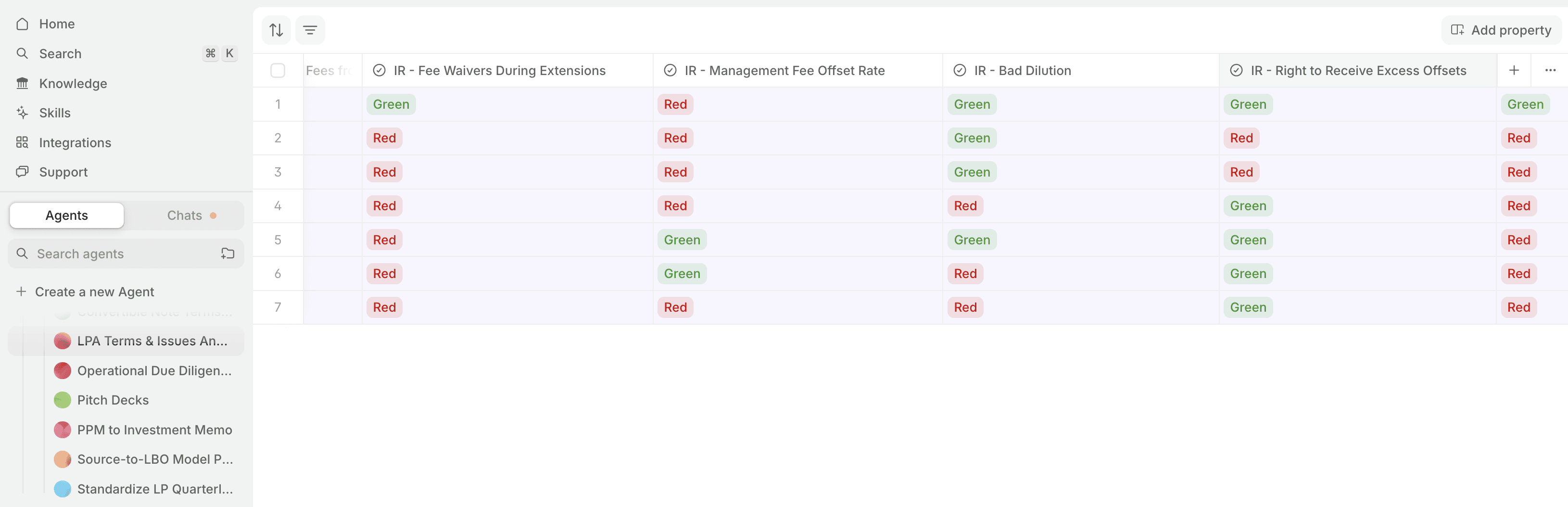
The document behind the number. Fee and carry figures in a quarterly statement are only checkable against the provisions in the partnership agreement that generated them.
The reporting standards are tightening around exactly these metrics, which raises the stakes on getting them out of documents reliably. The Institutional Limited Partners Association's Performance Template applies to funds commencing operations on or after 1 January 2026 and standardises how IRR, TVPI and MOIC are reported, including cash flow breakdowns with and without subscription facility impact. The updated Reporting Template arriving alongside it adds a gross-to-net management fee reconciliation and separates accrued, earned and paid carried interest, as BDO sets out in its implementation guidance.
Both are voluntary. Both are becoming what institutional investors expect. For a fund accounting team that means more fields per statement, arriving on the same deadline, from GPs at different stages of adopting the templates. The extraction problem is about to get wider before it gets narrower.











Why manual data extraction fails at volume
Manual extraction does not fail because fund accountants are slow. It fails for three structural reasons, and each one gets worse as the portfolio grows.
Every GP formats differently
There is no standard layout for a fund financial statement package. One GP labels the balance sheet figure "net asset value", the next "net assets attributable to partners", the third "fund NAV". One breaks out realised and unrealised gains as separate lines, another nets them. One puts the schedule of investments in the main document, another appends it as a separate file with its own pagination.
An LP monitoring twenty funds receives twenty differently structured packages every quarter, and the analyst has to re-learn each layout on arrival. That work does not compound into anything. It is repeated in full every cycle, and it is the specific problem that template-based extraction cannot solve, because a template encodes where a value sits rather than what it means.
Volume, and the errors that come with it
A fund administrator servicing fifty funds processes something in the order of two hundred financial statement documents per quarter. At even a handful of extracted fields per document, that is thousands of manual transcriptions in a compressed window.
The errors that result are rarely conceptual. Nobody mistakes a capital call for a distribution. They are transposition errors: 4,381 typed as 4,318 in an NAV field, which does not look wrong in isolation and does not surface until something downstream fails to reconcile. By then the figure has propagated into a performance dashboard, an investor report and a fund-level roll-up, and finding it means checking every cell against its source.
The window is fixed and it is short
GPs report on similar schedules, so packages arrive together. Quarter-end compresses extraction into days, and the deadline does not move when a portfolio grows from twenty positions to thirty-five. Something gives, and what usually gives is the reconciliation step, which is the step that catches things.
How fund accounting automation reads a statement it has not seen
A configured extraction workflow answers the format problem by working from meaning rather than position. Four stages, each doing a distinct job.
Ingestion and classification
Statement packages arrive as they arrive: PDFs from a GP portal, email attachments, scanned documents, a spreadsheet appendix. The workflow takes them unmodified and first identifies what each document is. A statement of assets and liabilities and a partner capital statement both contain a figure labelled as capital, and they mean different things. Classifying before extracting prevents an entire category of silent error, where the value is real, the field is wrong, and nothing downstream flags it because the number looks plausible.
Field extraction against a declared schema
The fields are defined before the run rather than discovered during it: NAV, unfunded commitment, contributions and distributions for the period, since-inception IRR, fee accruals, partner capital balances. Each returns as a typed value with a period label and a fund identifier attached, so a figure is never just a number floating free of what it describes.
This is where the label problem gets solved. "Net asset value", "net assets attributable to partners" and "fund NAV" resolve to one field because the workflow is looking for the concept, the way an analyst reading an unfamiliar package does.
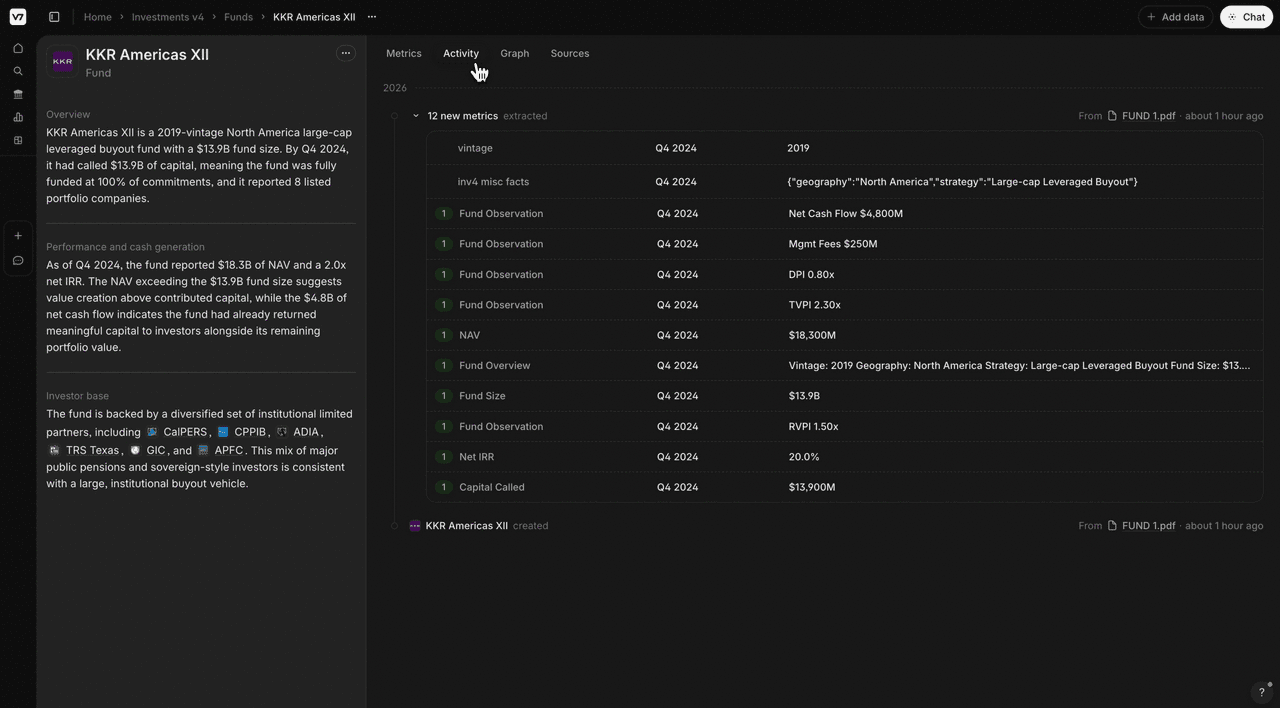
NAV, IRR, DPI and TVPI held as fields rather than as figures inside a PDF. The figures shown are from historical reporting data.
Validation, and what happens when a check fails
Some of the checks worth running are arithmetic rather than interpretation, which makes them a poor use of a language model and a good use of code. Whether DPI plus RVPI equals TVPI either holds or it does not. Whether the schedule of investments sums to the portfolio value on the balance sheet is a cross-foot. Whether this quarter's NAV sits within a plausible band of last quarter's is a threshold test. Running those deterministically means they return the same answer every time and cost nothing to repeat.
The behaviour on failure matters more than the check. A field the document does not contain should come back empty and flagged. A field that fails a consistency test should route to a reviewer with the source passage attached. What it must not do is return a plausible approximation that looks exactly like an extracted value, because that error is undetectable by inspection and it is the expensive one.
Human review sits inside the workflow rather than at the end of it, at the fields where the money is: NAV, carried interest allocations, anything feeding an investor report. Citations are what make that review fast. A reviewer who can open the statement at the page a figure came from clears or corrects it in seconds instead of reconstructing the extraction by hand.
Output and integration
Extracted data leaves in the shape the downstream system expects: a structured table for the fund accounting platform, an API payload for a portfolio management system, a normalised series for the performance dashboard. The destination does not change. What changes is that it stops being fed by keystrokes.
Implementing it: five steps
The sequence below is deliberately narrow at the start. Teams that begin by trying to extract everything from every GP tend to stall on the hardest format in the portfolio.
1. Write down the schema. Not software, just the list: every field the quarterly process actually needs, with its type and its source document. Most teams discover during this exercise that two analysts have been recording fee accruals differently for years, which is worth finding regardless of what happens next.
2. Catalogue the format variation. Pull one quarter of packages from every GP in the portfolio and note where each field sits and what it is called. This becomes the test set, and it tells you which formats are genuinely awkward rather than merely unfamiliar.
3. Configure the extraction and the validation together. Field definitions, the deterministic checks, the anomaly thresholds, and the rule for which fields require sign-off before anything downstream consumes them. Configuring extraction without validation produces output nobody will trust enough to use.
4. Run one quarter in parallel. Process the packages through the workflow alongside the existing manual process and compare the two outputs field by field. This answers the accuracy question with your documents rather than a vendor's sample pack, and it takes an afternoon of comparison rather than a pilot programme.
5. Connect the output and widen the coverage. Route structured results into the systems that consume them, keep the audit trail from figure to source page, and add GPs as their formats prove out.
Two things usually surface in step four. Extraction is more accurate than expected on the standard fields and less accurate than hoped on whichever field your particular portfolio presents unusually. And the manual spreadsheet contains two or three errors nobody had noticed.
Where V7 Go sits in a fund accounting stack
V7 Go is the extraction layer, not the ledger. It is not a fund accounting system, not a portfolio management system and not a fund administrator, and it does not calculate NAV. It reads the statement packages, produces typed fields against a schema the team defines, attaches a source reference to every value, and writes the result into whichever system already holds the books.

Documents in, a defined sequence of steps, typed fields out. The sequence is declared before the run rather than chosen during it, which is what makes the four hundredth statement behave like the first.
Three properties are worth testing in any tool considered for this job, including this one. Each step uses the tool the work requires, so a fair value figure is read by a model and a cross-foot is run as code that returns the same answer every time. Outputs are typed before the run rather than after it, so the same fields land in the same structure whichever GP the package came from. And every value opens the page it was read from, which is what makes a disputed figure resolvable by someone who was not on the deal.
For teams whose reporting extends past the accounting close, the same extraction feeds LP quarterly reporting and portfolio monitoring workflows, and quarterly fund report analysis covers the recurring cycle. For corporate rather than fund-level documents, our guide to AI financial statement analysis covers that side. This article covers the fund-level case, where the metrics and the document types are different.
There is a second thing that accumulates, and teams rarely buy for it. Once every statement has been read the same way against the same field set, the quarters become a series. Which GPs have drifted from their stated concentration limits, how a manager's fee accruals have moved across four quarters, which holdings appear in more than one fund: each of those is answerable from structured history and effectively unanswerable from a folder of PDFs. That layer is what the Context Graph maintains, with the objects and relationships chosen by the firm rather than fixed by the vendor.
What to do before the next quarter-end
Time the current process before changing it. Separate the minutes spent locating and typing from the minutes spent checking and judging. Most teams are surprised by the split, and the number is the business case.
Then pick one GP whose format is representative rather than one whose format is worst, and run a single quarter through an extraction workflow alongside the manual process. Compare the outputs before comparing either to the truth. Consistency fails before accuracy does, and it fails without any visible signal.
Keep the review gate exactly where it is. The reading and the retyping are the parts to compress. Whether a fee accrual is right, whether a valuation movement needs a question to the GP, whether a figure belongs in an investor report: those stay with the accountant, and the point of removing the transcription is to leave more room for them.
The reporting standards are moving in one direction, and it is toward more fields, more frequently, with more reconciliation attached. A team that has already stopped typing them by hand will find the ILPA templates an adjustment. A team that has not will find them a problem.
If it would help to see extraction run against your own statement packages rather than a sample set, V7's solutions engineers configure the field list with you before any commitment. Book a working session and bring last quarter's packages, including the GP whose format everyone complains about.
What is fund accounting automation?
Fund accounting automation uses configured extraction workflows to pull financial data out of fund statement packages, structure it, validate it and deliver it into the systems that consume it, replacing the manual process of reading GP-issued documents and typing figures into a spreadsheet. The target is the transcription work rather than the accounting judgement. A workflow ingests the statement package, classifies each document, extracts a declared set of fields such as net asset value, contributions, distributions and since-inception internal rate of return, runs deterministic checks on the results, and routes anything that fails a check to a reviewer. What it does not do is decide whether a valuation movement is reasonable or whether a fee accrual matches the partnership agreement. Those remain with the fund accounting team, which is where the value of the exercise sits.
+
How do you extract data from fund financial statements?
Through a defined sequence rather than a single pass. First the package is ingested as received, including scanned documents and spreadsheet appendices. Second, each document is classified, because a statement of assets and liabilities and a partner capital statement both contain figures labelled as capital and they mean different things. Third, fields are extracted against a schema declared before the run, so each value returns typed and carrying its period label and fund identifier. Fourth, validation runs: cross-foots, consistency tests such as whether distributed to paid-in plus residual value to paid-in equals total value to paid-in, and threshold checks on period-over-period movement. Fields that fail route to a reviewer with the source passage attached, and fields the document does not contain return empty and flagged rather than estimated.
+
What is the difference between fund accounting and corporate accounting?
Corporate accounting tracks the performance of an operating business, producing revenue, cost of sales, EBITDA and net income from trading activity in a defined period. Fund accounting tracks the performance of an investment vehicle, producing internal rate of return, multiple on invested capital, distributed to paid-in, total value to paid-in and net asset value from cash flow timing, capital events and portfolio valuations accumulated since inception. Two consequences follow. Fund statements use fair value accounting rather than historical cost, so a holding shows its current mark rather than what was paid for it. And the headline fund metrics are not period outcomes, so they cannot be read off a single table the way a corporate margin can. This is why extraction tools calibrated on corporate filings underperform on fund documents.
+
What metrics can be extracted automatically from fund financial statements?
The core set is net asset value, internal rate of return, multiple on invested capital, distributed to paid-in, residual value to paid-in and total value to paid-in, alongside partner capital balances, unfunded commitment, period contributions and distributions, management fee accruals, carried interest allocations, and realised and unrealised gains. The schedule of investments yields holding-level data: portfolio company name, acquisition cost, current fair value and ownership percentage. Two cautions apply. Total value to paid-in is frequently not printed at all, since it is the sum of the other two ratios, so a workflow has to either derive it or flag its absence rather than guess. And fee and carried interest figures are outputs of provisions in the limited partnership agreement, so extracting the number is straightforward while checking it requires the agreement.
+
How does AI handle non-standardised fund statement formats?
They widen it. The ILPA Performance Template applies to funds commencing operations on or after 1 January 2026 and standardises how internal rate of return, total value to paid-in and multiple on invested capital are reported, including cash flow breakdowns shown with and without subscription facility impact. The updated Reporting Template adds a gross-to-net reconciliation on management fees, separates accrued, earned and paid carried interest, and splits internal chargebacks from external partnership expenses. Both are voluntary and both are increasingly expected by institutional investors. For a fund accounting team the practical effect is more fields per statement, arriving on the same deadline, from a portfolio of GPs at different stages of adoption. Teams still extracting by hand will feel that as additional headcount.
+
Do the new ILPA templates change what fund accounting teams need to extract?
Go is more accurate and robust than calling a model provider directly. By breaking down complex tasks into reasoning steps with Index Knowledge, Go enables LLMs to query your data more accurately than an out of the box API call. Combining this with conditional logic, which can route high sensitivity data to a human review, Go builds robustness into your AI powered workflows.
