9 min read
—


From building new acquisition channels to shaping campaigns people actually remember, Christian Harinarain shares what growth marketing looks like at V7, why good marketers need taste, and where AI still needs a human touch.

V7 Team
V7 Go
A smarter way to manage due diligence and underwriting
At V7, growth marketing rarely means doing the same thing twice. As the company, product and AI market have evolved, so has the way we reach customers.
We sat down with Christian Harinarain, Growth Lead at V7, to talk about building channels from scratch, choosing quality over volume, learning from failed experiments, and why brand may be one of the last genuine competitive advantages.
You’ve worked across several areas of marketing during your time at V7. What has that journey looked like?
When I joined V7, the initial goal was to help scale the growth playbook, find new channels and prove which ones could reliably bring us the right customers.
The interesting thing about working here is that the product and the market around it have continued to evolve. As our ideal customer has become clearer, the channels and messages we use to reach them have had to evolve too.
That pushed me beyond a traditional growth marketing role. I joined as someone focused on finding channels, creating campaigns and improving conversion. Since then, I’ve developed much more experience in product marketing, particularly around positioning, communicating value and writing website copy that helps people understand exactly what we solve.
I’ve also built much of our lifecycle marketing from scratch. That means thinking about what happens after somebody first discovers V7. How do we keep that person engaged? How do we help them understand the product? How do we reconnect when the timing becomes right?
Then there are webinars, case studies, reports and other demand generation projects. V7 has often put me in situations where I’ve simply had to learn something new and get it done. That has made me a much more rounded marketer.

When you’re asked to build a growth channel from scratch, where do you begin?
The first thing is deciding what outcome you are actually trying to create.
It is very easy to optimise a channel for the number of meetings it generates. A dashboard goes up, everybody feels good and it looks as though the channel is working. But if those meetings are with companies that will never become successful customers, you are not creating meaningful growth.
As we have moved further into the enterprise market, my definition of a successful channel has changed. I care much more about the quality of the opportunity and whether we can solve something genuinely valuable for that customer.
You need a clear North Star metric, but you also need to be prepared to change other goals as the business develops. A metric that helped you at one stage can become a distraction at the next.
For me, the question is always: is this channel bringing us closer to sustainable revenue and customers who will really value the product?
Lots of marketing teams are busy. How do you distinguish activity from genuine growth?
Your pipeline always tells you the truth.
Marketing teams rarely create unnecessary work deliberately. It normally happens because they are being pulled in several directions at once. There will always be requests for more campaigns, more content, more events, more case studies and more of whatever appears important that week.
All of those things can be worthwhile, but they do not automatically produce growth.
A growth marketer needs to stay close to the entire customer journey. I review the inbound funnel regularly and look at where opportunities came from, what happened after the initial enquiry, where they progressed and where they stopped.
That context makes it easier to decide what the marketing team should do next. It also gives you the confidence to question work that might keep everyone busy without moving the business forward. It also gives you the conviction you need to make sure you don’t get pulled in the wrong directions.
Ultimately, growth is not about increasing the number of things in a dashboard. It is about finding the most efficient route to revenue with the time and budget you have.
How do you decide whether to keep investing in an experiment?
This is one of the hardest parts of growth marketing because once you have built something, you naturally want it to work.
The important thing is to align the experiment with the way your customers actually buy. In enterprise software, the buying process can take time. If you judge a campaign too early, you may reach completely the wrong conclusion.
I look for three things.
First, are there early signs of quality? Even if the campaign has not produced huge volume, is it attracting the sort of company or buyer we want to speak to?
Second, have we allowed enough time for those people to move through a realistic buying journey?
Third, have we looked closely at what happened inside the pipeline, rather than relying on the first number we see?
A campaign that produces fewer conversations can still be far more valuable if those conversations are with the right people. Equally, a campaign that creates lots of activity may not be working as well as it first appears.
You have to give an idea a fair chance without becoming emotionally attached to it.
You care a lot about taste in marketing. What does “good taste” mean to you?
Taste begins with having an opinion.
To develop taste, you have to care about why something looks, feels or sounds the way it does. You have to expose yourself to interesting work and decide what you think about it.
When I joined V7, I used part of my development budget to get access to museums, galleries and exhibitions. I try to see something most weekends. It is not always directly connected to a campaign I am working on. The point is to experience new ideas and practise forming an opinion about them.
That carries into marketing. Can you make something that produces a reaction? Can you create work that people notice, remember and talk about?
B2B brands can become too comfortable with neutrality. They want everybody to approve of the work, which often means sanding away anything distinctive. The result is something technically fine but completely forgettable.
That is particularly dangerous in AI, where so many companies use similar language, visual styles and promises. You do not want people to see your campaign and feel nothing.
Good taste does not mean everybody has to love everything you make. It means the work has a perspective.
What has a failed experiment taught you?
We once tested a direct mail campaign aimed at a carefully selected group of prospective customers. I believed in the audience, the use case and the creative, so I expected it to perform well.
It did not.
We tried several versions, but the response remained much lower than I expected. When I looked into it, I realised that some of my assumptions about how the audience received and handled physical mail were wrong. The registered address was not always where the intended person worked, and even when the mail arrived, it did not necessarily reach the right desk.
The idea looked great when viewed purely as a campaign. The problem was in the delivery mechanics and the behaviour of the buyer.
It reminded me that a high-quality list and a good piece of creative are not enough. You have to understand the full journey between sending something and the customer acting on it.
I would still try direct mail again in the right circumstances. A failed experiment should make your next attempt more intelligent, not make you frightened of the channel forever.
How do you market an AI product without contributing to the hype?
You have to be honest about the outcome you can create.
It is easy to generate awareness around an AI product. You can make an enormous promise, attract lots of interest and fill the top of the funnel. The more difficult question is whether those people have a real problem, the right data and the commitment required to solve it.
At V7, we are not trying to tell experienced professionals that we are going to reinvent everything they know about their industry. These are people who already create a huge amount of value and understand their work better than we ever could.
Our role is to help them perform that work faster and more efficiently. If we can return meaningful time to somebody every week, that is valuable. We do not need to pretend we are transforming their entire life.
The best kind of excitement comes after a customer has experienced that value. A trusted expert recommending V7 privately to another person in their industry is far more meaningful than a post receiving thousands of impressions from people who will never use the product.
Where do you use AI in your own work?
AI is very useful for finding signals in large amounts of information.
Marketing teams collect data from customer conversations, website activity, campaigns and CRM records. We can use AI to find patterns in that information much faster. It might help us identify language that appears frequently in successful conversations, understand what interested a particular account, or decide which messages are most relevant to a buyer.
It helps us make better-informed decisions without manually working through every individual piece of information.
Where I think AI is less convincing is in defining a brand’s creative direction. If every company uses the same tools, prompts and visual references, the output starts to look very similar.
We use AI to explore ideas and get part of the way towards an answer, but the final creative judgement is still human. Great designers bring experience, instinct and an understanding of what will make somebody feel something.
AI can help you execute more quickly. It cannot care on your behalf.
What is your biggest marketing belief right now?
AI is levelling the playing field when it comes to execution. Companies can build and ship products faster, and the general standard of software is improving.
As more products become easier to build, though, it also becomes harder to distinguish one from another. Features can be copied. Interfaces can converge. Everybody can claim to be faster or more efficient.
Brand and reputation are much harder to replicate.
The companies that stand out will be the ones people love, trust and talk about. That is exciting because it gives marketers more space to think creatively about how a company reaches its audience and becomes part of its culture.
It also means B2B marketing needs to move beyond the idea that buyers only care about a spreadsheet calculation. Of course return on investment matters, but buyers are still people. Trust, familiarity and emotion all influence which company they want to work with. I believe growth marketers should be getting more comfortable with channels beyond just paid and affiliates, but using out of home, physical and experiential activations. I was able to push V7 in that direction with our Free to Think campaign at London Liverpool Street Station earlier this year and other activations like video trucks and cafe take overs. Your ICP seeing and experiencing in real life can be more profitable than an email campaign.
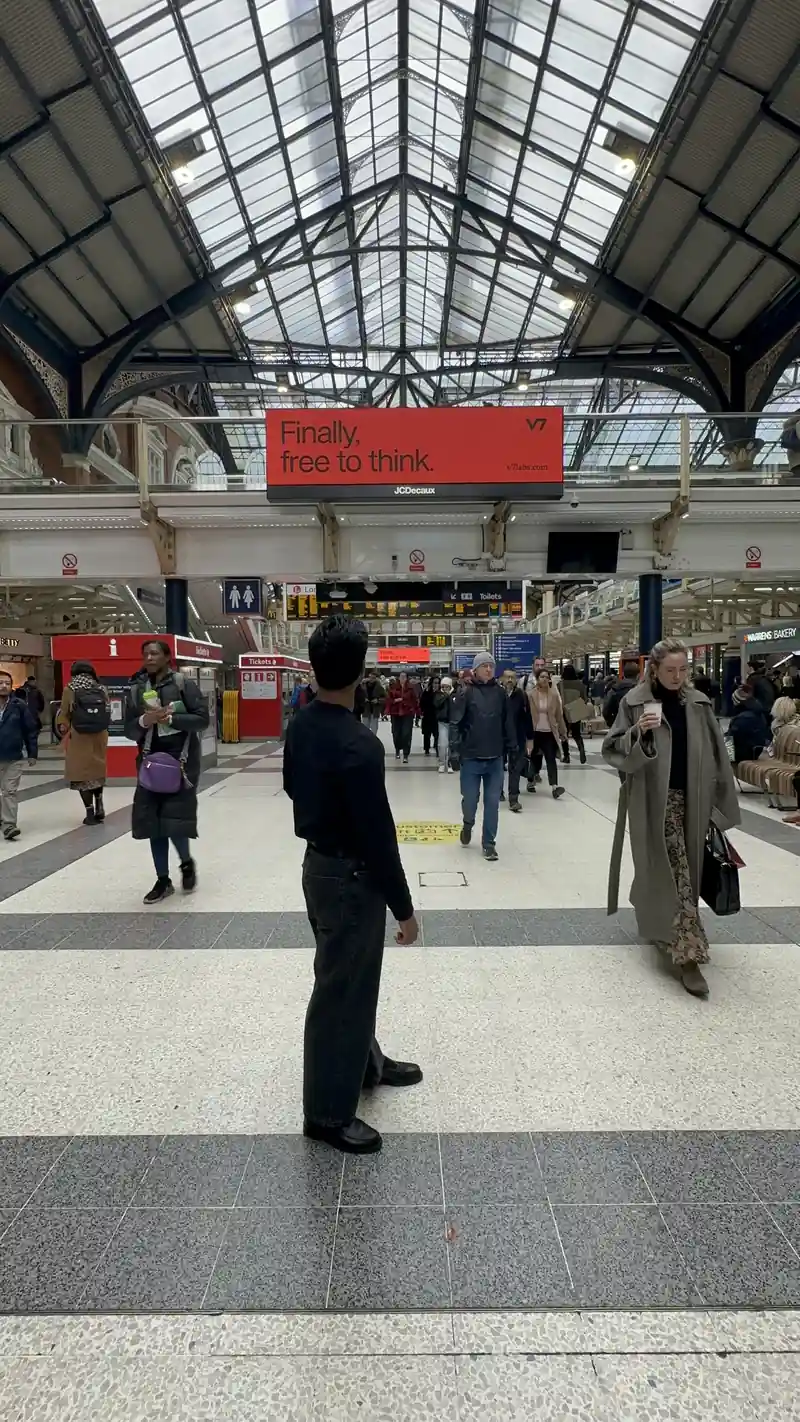
The most valuable marketers will be able to build a strong growth engine while also having the taste to create something distinctive. You need the analytical discipline to know what is working and the creative judgement to make people care.












V7 Team
We enable organizations to create specialized AI agents that analyze, review, and reason over data with transparency, control, and auditability at their core.
