7 min read
—


What tear sheets are, why building them manually doesn't scale, and how document AI generates them directly from source materials in a fraction of the time.

V7 Go
A smarter way to manage due diligence and underwriting
There's a moment every analyst knows well. It's 7 PM, the investment committee meets at 9 AM, and someone has just forwarded a CIM that landed in the inbox this afternoon. The document is 140 pages. You need a one-pager on the desk of three partners by morning. You open a blank template, fire up the financial model, pull up the CRM, and start copying numbers.
This is how tear sheets get made at most firms. And for all the sophistication of modern deal teams (the proprietary sourcing networks, the quantitative screening tools, the sector specialists) the document that actually gets read before a partner decides whether to spend real time on a deal is still assembled by hand, from scratch, under time pressure, by the most junior person on the team.
As deal volume grows and reporting requirements expand (more opportunities to screen, more portfolio companies to monitor, more LPs to keep informed), the manual workflow sitting at the center becomes a bigger bottleneck. The tear sheet is supposed to be a tool for faster decisions, but the process of creating it slows everything down. .
Document AI is changing that. Investment teams are now generating tear sheets directly from raw source documents in a fraction of the time it used to take, with greater consistency and a complete audit trail back to the source.
In this article, we'll cover:
What a tear sheet is and where investment teams use them
Why manual tear sheet creation creates a bottleneck as deal volume grows
How AI extracts and structures information from CIMs, data rooms, and financial models
What end-to-end automated tear sheet workflows look like in practice
What a Tear Sheet Actually Is
The name comes from a pre-digital era, when S&P stockbrokers would literally tear a page out of their summary books and hand it to a prospective investor. The practice survives; the tearing does not.
Today a tear sheet is a concise one- or two-page document that aggregates the essential information about a fund, investment opportunity, or portfolio company into a format that allows a reader to form a quick, informed view. You may also hear it referred to as a 'fact sheet.'
Unlike a prospectus, which is legally required and offers a detailed, comprehensive view of an investment, a tear sheet is meant only as a quick reference. While modern tear sheets have largely gone digital and remain useful marketing and summary tools, they shouldn't replace a full prospectus when making investment decisions.
The contents vary depending on the purpose, but the core structure is consistent across firms. A deal-screening tear sheet typically covers:
Company overview
Business model
Revenue and EBITDA
Growth trajectory
Market analysis
Ownership history
Deal terms
A portfolio monitoring tear sheet tracks:
The investment date
Current valuation
Unrealized return
Key operating metrics
Recent strategic developments
An LP-facing tear sheet covers:
Fund performance
Portfolio composition
Notable exits
Deployment pace
What all of these have in common is that they're designed to be read in under five minutes and answer a specific question: is this worth more of my time?
For investment committees, the tear sheet is how a partner pre-digests an opportunity before reading the full memo. For LPs, it's how they track a portfolio without scheduling a call for every company. For deal teams, it's how they triage inbound flow without getting buried in full diligence on every opportunity that comes in.
Because they serve so many different functions, most active firms produce hundreds of tear sheets per year. A mid-sized private equity firm running 30 active portfolio companies, reviewing 200+ deals annually, and communicating with a dozen LP relationships might be looking at 500 or more individual tear sheet documents in a given year.
That's a lot of manual effort applied to a document format that is, by design, supposed to be quick.
Why Manual Tear Sheet Generation Is a Bottleneck
The manual tear sheet process typically involves gathering information from multiple sources simultaneously:
The CIM or pitch deck (often 80–150 pages)
Internal financial models (Excel, with version control issues)
CRM entries (often incomplete or out of date)
Prior research notes or sector memos
Portfolio monitoring dashboards for follow-on or adjacent investments
The analyst's job is to read across all of these, extract the relevant data points, reconcile any discrepancies, and format everything into the standard template. At a firm with good tooling and disciplined data hygiene, this might take two hours per document. At a firm with fragmented systems and inconsistent CRM data, it can take most of a day.
The bottleneck also creates a sequencing problem. Partners can't review an opportunity until the tear sheet is ready. If the tear sheet takes 24 hours to produce after the CIM arrives, deals move more slowly at the top of the funnel. In competitive processes where speed matters, that lag has real consequences.
There's also a portfolio monitoring dimension that often gets overlooked. Quarterly reporting from portfolio companies arrives in inconsistent formats — one company sends a detailed financial package, another sends a brief email, a third sends a slide deck. Assembling these into comparable tear sheets for IC updates or LP reporting requires an analyst to touch every portfolio company document every quarter. That's a recurring cost, not a one-time effort.











AI for Tear Sheet Generation
The technology behind modern document AI has moved significantly beyond keyword extraction or template-matching. The combination of large language models and computer vision means that current systems can read a CIM the way an experienced analyst does, understanding context, navigating complex table structures, interpreting footnotes, and synthesizing information across sections.
The specific workflow for automated tear sheet generation typically runs as follows:
A document arrives, either uploaded manually or pulled automatically from a deal inbox or data room.
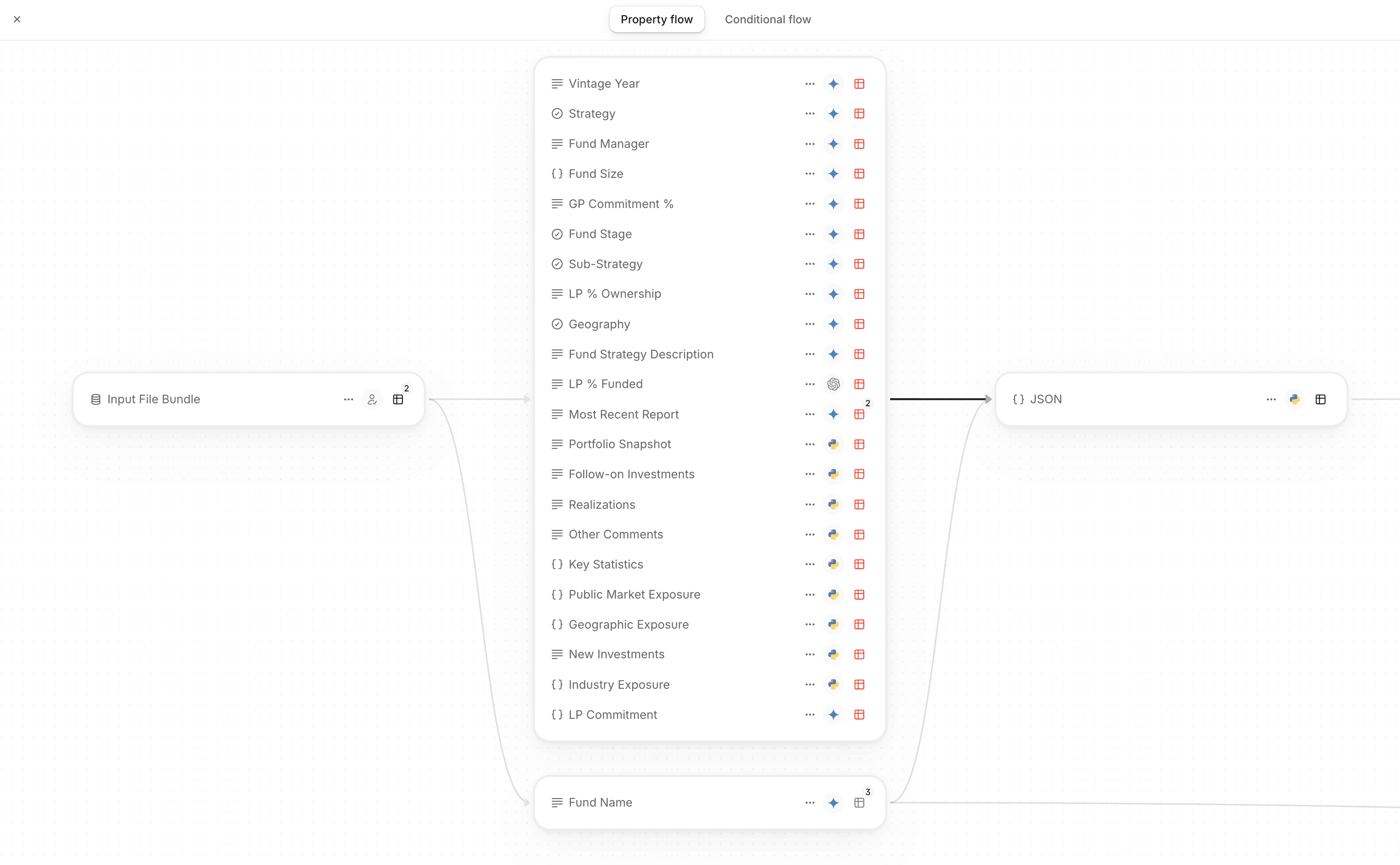
An AI agent reads the document, identifies relevant data points based on a predefined extraction schema, and flags anything anomalous or missing.
Extracted data is mapped to the firm's standard tear sheet template, with each figure linked back to its source location in the original document.
A populated first draft is delivered to the analyst for review (in minutes rather than hours!)
You can see an example AI tear sheet generation workflow below.
The more sophisticated implementations can automate the entire workflow from document arrival to distribution.
An AI agent operating on incoming deal flow can:
Monitor a shared inbox for new CIM attachments
Route documents to the extraction pipeline automatically
Apply the firm's investment criteria to flag whether the opportunity is in-scope
Generate a standardized tear sheet populated from the source document
Log the output to the CRM with relevant deal metadata
Notify the relevant analyst or deal lead with a summary
V7 Go: Agentic AI for Tear Sheet Generation
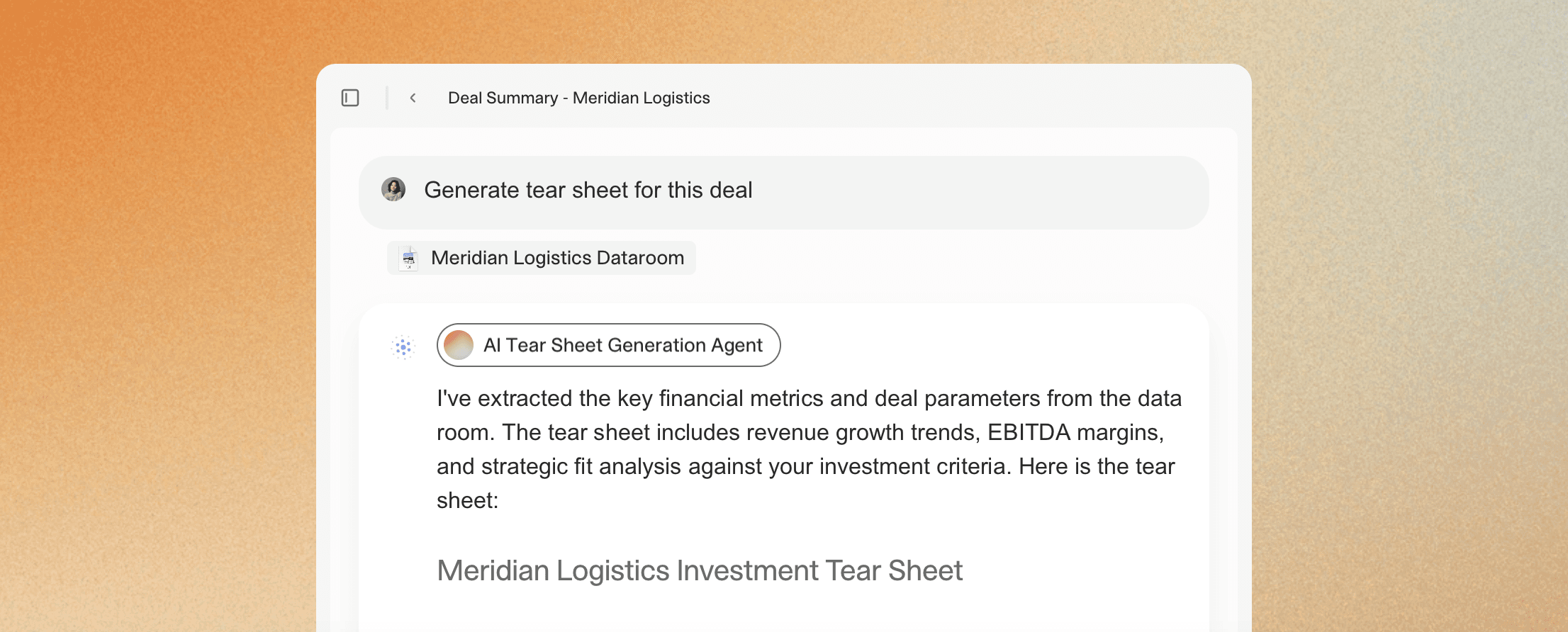
V7 Go is built around this kind of end-to-end document workflow. Deal teams can configure AI agents that ingest CIMs, pitch decks, and data room materials, extract structured financial and operational data, and populate firm-specific tear sheet templates, all without manual intervention between document arrival and first draft.
Each extracted data point is linked back to its source in the original document, so analysts reviewing the output can verify figures in seconds rather than hunting through 150 pages.
The platform handles the document types that actually show up in deal workflows: scanned PDFs, multi-tab Excel files, PowerPoint presentations with embedded charts, and mixed-format data rooms that no two companies package the same way.
Importantly, rather than replacing the analyst's judgment, V7 Go eliminates the assembly step that precedes it. The analyst's first interaction with a deal is reviewing a structured, sourced document rather than building one from scratch.
See the V7 Go Tear Sheet Generation Agent in action.
Learn more about AI applications in Private Markets in our blog, 5 Applications of AI in Venture Capital and Private Equity.
Automate Your Tear Sheet Generation
V7 Go offers fully customizable AI agents for CIM analysis, financial statement extraction, and tear sheet generation, with enterprise-grade security and integration with leading deal management platforms. Teams processing high volumes of inbound deal flow can go from document arrival to reviewed, committee-ready tear sheet in under an hour.
Book a demo to see how your team can reduce manual document work across the deal lifecycle.
What is a tear sheet in private equity?
A tear sheet is a concise one- or two-page summary of an investment opportunity, portfolio company, or fund. The name dates to a pre-digital era when brokers would literally tear a page from a summary book and hand it to a client. In private equity today, tear sheets are used at multiple points in the deal lifecycle — to summarize inbound opportunities before deeper screening, to brief investment committee members before a full memo review, to track portfolio company performance on a quarterly basis, and to communicate fund updates to LPs. The format varies by purpose, but the goal is always the same: give a reader everything they need to form a view in under five minutes.
+
What should a tear sheet include?
The contents depend on the use case, but a deal screening tear sheet typically covers company overview, business model, revenue and EBITDA, historical growth rates, ownership structure, and proposed deal terms. A portfolio monitoring tear sheet tracks investment date, entry multiple, current valuation, unrealized return, and key operating metrics. An LP-facing tear sheet summarizes fund performance, portfolio composition, deployment pace, and notable exits. Across all formats, the core requirements are accuracy, consistency, and completeness without running long.
+
What is automated tear sheet generation?
Automated tear sheet generation uses document AI to extract key information from source materials (CIMs, financial models, management presentations, data room packages) and populate a standardized tear sheet template without manual data entry. The system reads the source document, identifies relevant data points based on a predefined extraction schema, maps them to the template, and produces a populated draft with each figure linked back to its source location. The analyst's role shifts from assembling the document to reviewing it, which typically takes minutes rather than hours.
+
How does AI extract data from a CIM?
Modern document AI combines large language models with computer vision to read CIMs the way an experienced analyst would — understanding document structure, navigating financial tables, interpreting footnotes, and synthesizing information spread across multiple sections. The system is trained to recognize financial concepts in context, which means it can distinguish between revenue and net revenue, between reported EBITDA and adjusted EBITDA, and between LTM and NTM figures. It can also flag signals that manual reviewers sometimes miss under time pressure, such as customer concentration disclosures buried in footnotes or non-recurring cost adjustments that appear suspiciously recurring.
+
Can AI generate tear sheets from data rooms?
A tear sheet is a summary document designed for quick consumption — typically one to two pages, structured for a reader who has limited time and needs to decide whether to go deeper. An investment memo is a full analytical document that makes and supports an investment recommendation, typically running 10 to 30 pages or more and covering thesis, market analysis, financial model, management assessment, risk factors, and deal terms in detail.
+
What's the difference between a tear sheet and an investment memo?
Go is more accurate and robust than calling a model provider directly. By breaking down complex tasks into reasoning steps with Index Knowledge, Go enables LLMs to query your data more accurately than an out of the box API call. Combining this with conditional logic, which can route high sensitivity data to a human review, Go builds robustness into your AI powered workflows.
+
Imogen is an experienced content writer and marketer, specializing in B2B SaaS. She particularly enjoys writing about the impact of technology on sectors like law, finance, and insurance.