11 min read
—


Real estate is a relationship business, but real estate agents spend far too much of their time drowning in paperwork. This guide shows how AI agents automate your most time-consuming manual workflows, so you can focus on closing deals.

V7 Go
A smarter way to manage due diligence and underwriting
Real estate is a high-touch business. Success depends on relationships, market knowledge, and the ability to close deals under pressure. Yet if you ask most agents where they spend their time, the answer is depressing: paperwork, from transaction coordination to compliance checks.
This isn't a new problem, but the gap is widening. The 2025 NAR Technology Survey found that 68% of agents now use some form of AI tool, yet most of these tools are surface-level: ChatGPT for listing descriptions, Canva for social posts, or Midjourney for logo ideas. These are useful, but they don't touch the operational sludge that prevents agents from closing more deals.
The real opportunity is not writing faster emails. It is automating the back-office workflows that eat your calendar. The most forward-thinking real estate agents are embracing AI to execute multi-step processes and handle documents end-to-end.
In this article:
Why most agents are stuck in "low-touch" tasks despite working in a "high-touch" industry.
Transaction coordination, lease abstraction, CRM automation, and how AI can be used for each.
How to start small, measure results, and scale without disrupting your current deals.
Real Estate: High-Touch Industry, Low-Touch Work
Real estate is sold as a relationship business. Real estate agents are taught to build trust, understand client needs, and guide people through one of the biggest financial decisions of their lives. This is true. But it is also incomplete.
The reality is that most real estate agents a good portion of their time on tasks that have nothing to do with relationships. They are re-keying data from purchase agreements into their CRM, chasing down missing signatures on disclosure forms, or manually updating spreadsheets to track which leases are expiring in Q4.

These aren't high-value tasks, just operational necessities that exist because the real estate industry runs on documents. To make things more complex, most of those documents are unstructured PDFs, scanned images, or email attachments.
Document-Heavy Real Estate Workflows
Consider a typical residential transaction. From contract to close, an agent handles:
Purchase and Sale Agreement (P&S)
Inspection reports
Appraisal documents
Title commitments
Loan approval letters
Disclosure forms (lead paint, HOA, seller disclosures)
Closing statements
Each document contains critical dates, contingencies, and obligations. Missing a deadline, say, the inspection contingency expiration, can kill a deal. So agents build elaborate systems: color-coded calendars, email reminders, checklists in Google Sheets.
These systems work until they don't. When you are juggling 15 active transactions, a manual checklist is a liability. One missed email, one overlooked clause, and you are scrambling to salvage a closing.
Commercial real estate has the same problem at a larger scale. A property manager overseeing 200 leases needs to track renewal dates, rent escalations, maintenance obligations, and tenant improvement allowances. Doing this manually means reading 50-page lease documents and extracting key terms into a master spreadsheet. It is tedious, error-prone, and expensive.
The traditional answer to this problem is hiring. Larger brokerages employ transaction coordinators, dedicated staff who handle the paperwork so agents can focus on clients. This helps, but it doesn't scale. A transaction coordinator can handle 20–30 deals at a time. Beyond that, you need another hire.
For independent agents or small teams, hiring is not an option. They either do the work themselves or outsource to virtual assistants. Both approaches have the same flaw: they are still manual. A human is still reading the document, extracting the data, and updating the system. The process is just as slow and just as fragile.
There's a better way to work.
AI for Real Estate
Most real estate agents have experimented with AI by now, using ChatGPT to write listing descriptions, generate social media captions, or create marketing materials with AI image tools. These early use cases have been helpful, and they’ve sparked curiosity across the industry.
The potential is enormous. The McKinsey Global Institute estimates that AI could create $110 billion to $180 billion or more in value for the real estate industry.
And yet, as McKinsey notes:
For all the hype that gen AI has received to date, many real estate organizations are finding it difficult to implement and scale use cases, and thus have not yet seen the promised value creation.
It's fair to say that much of the low hanging fruit (social media caption drafting and the like) has already been plucked. For the most forward-looking real estate agents, the most promising AI applications in real estate are emerging back-office operations.
These are the complex, manual, error-prone workflows that humans find tedious but businesses cannot function without. And this is exactly where agentic AI enters the picture.
Real Estate Agents, Meet AI Agents
An AI agent doesn't just generate content, it executes a workflow. You give it a goal, and it figures out the steps required to achieve that goal. It can read documents, extract data, check for errors, and output structured results, without you micromanaging each step.
Agentic AI can sound complex or intimidating, but it doesn't have to be. Learn more about how simple creating, adapting and using AI agents can be in our blog: How to Create an AI Agent Without Code: A Practical Guide.
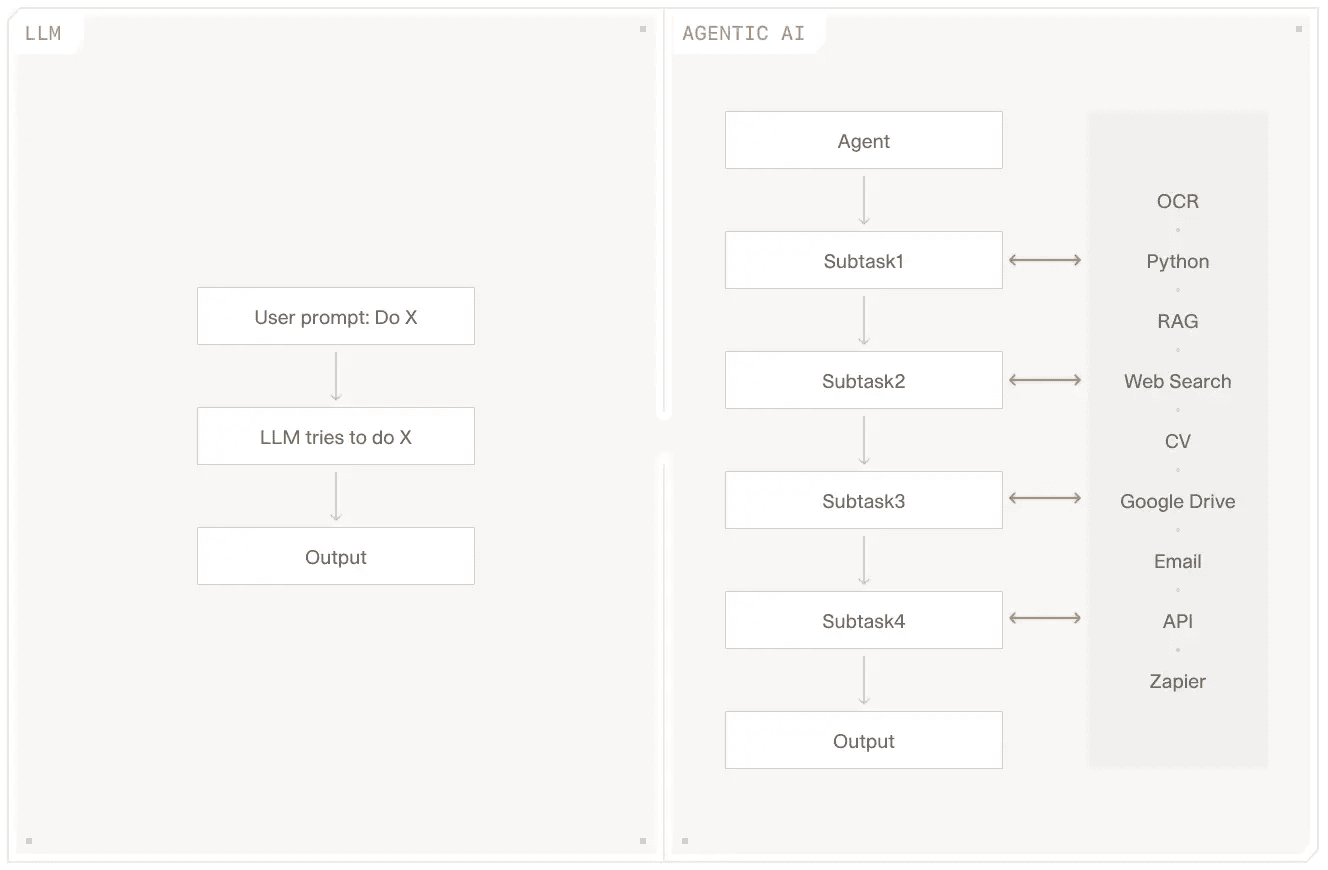
V7 Go: Agentic AI For Real Estate Agents
V7 Go is a document intelligence platform built for the complexity of real estate. It combines chain-of-thought reasoning to handle nuanced commercial terms with multimodal understanding that interprets both text and visual document structure.
What really sets V7 Go apart is its ability to automate entire end-to-end processes. Layered with enterprise-grade workflow orchestration, the platform can manage the full journey of a document, from review to decision-making.
This mirrors and accelerates the workflows that real estate agents, brokers, and transaction teams already use.
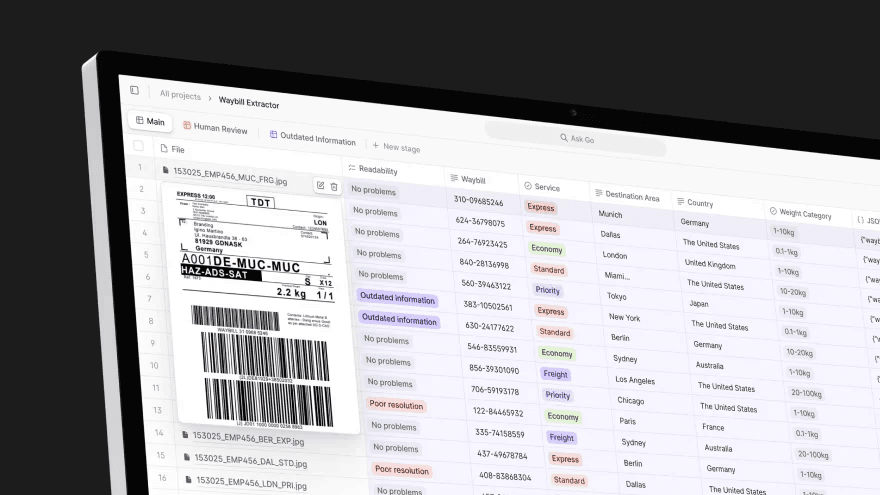
It's never been easier to get started. V7 has an extensive list of ready-to-go AI Agents for real estate, which you can browse here: AI Agent Library. From the Commercial Property Valuation to Commercial Lease Analysis, these agents can be tweaked to match your exact preferences and workflow. You can also create a completely bespoke agent tailored to the manual processes currently slowing your team down.
The V7 Go agent library includes pre-built agents for common real estate workflows, from lease abstraction to transaction coordination.
What makes V7 Go especially powerful is its deep understanding of context. When reviewing a property contract, for example, it can track how amendments modify master terms, calculate financial impacts, verify compliance requirements, all while providing citations back to the source documents.
To learn more about V7 Go, book a chat with our team.
Automating Three High-Impact Real Estate Workflows
Not every task is worth automating. Some workflows are too variable, too judgment-heavy, or too low-volume to justify the setup. The sweet spot for automating workflows is choosing tasks that are:
High-volume (you do them repeatedly)
Document-heavy (they involve reading and extracting data)
Rule-based (the logic is consistent, even if the documents vary)
For real estate agents, here are just three of the many workflows meet these criteria: transaction coordination, lease abstraction and CRM automation.
1. Transaction Coordination: From Contract to Close
The chaos of a real estate transaction is not the negotiation. It is the 30–60 days between contract signing and closing. During this period, agents juggle:
Inspection contingency deadlines
Loan commitment dates
Appraisal scheduling
Title work
Final walkthrough coordination
Each of these has a deadline. Miss one, and the deal can fall apart. The traditional solution is a checklist, either on paper, in a spreadsheet, or in a transaction management platform.
The problem with checklists is that they are static. You create them once, based on the contract terms, and then you manually update them as things change. If the buyer requests a deadline extension, you have to remember to update the checklist. If the lender asks for additional documentation, you have to add a new task.
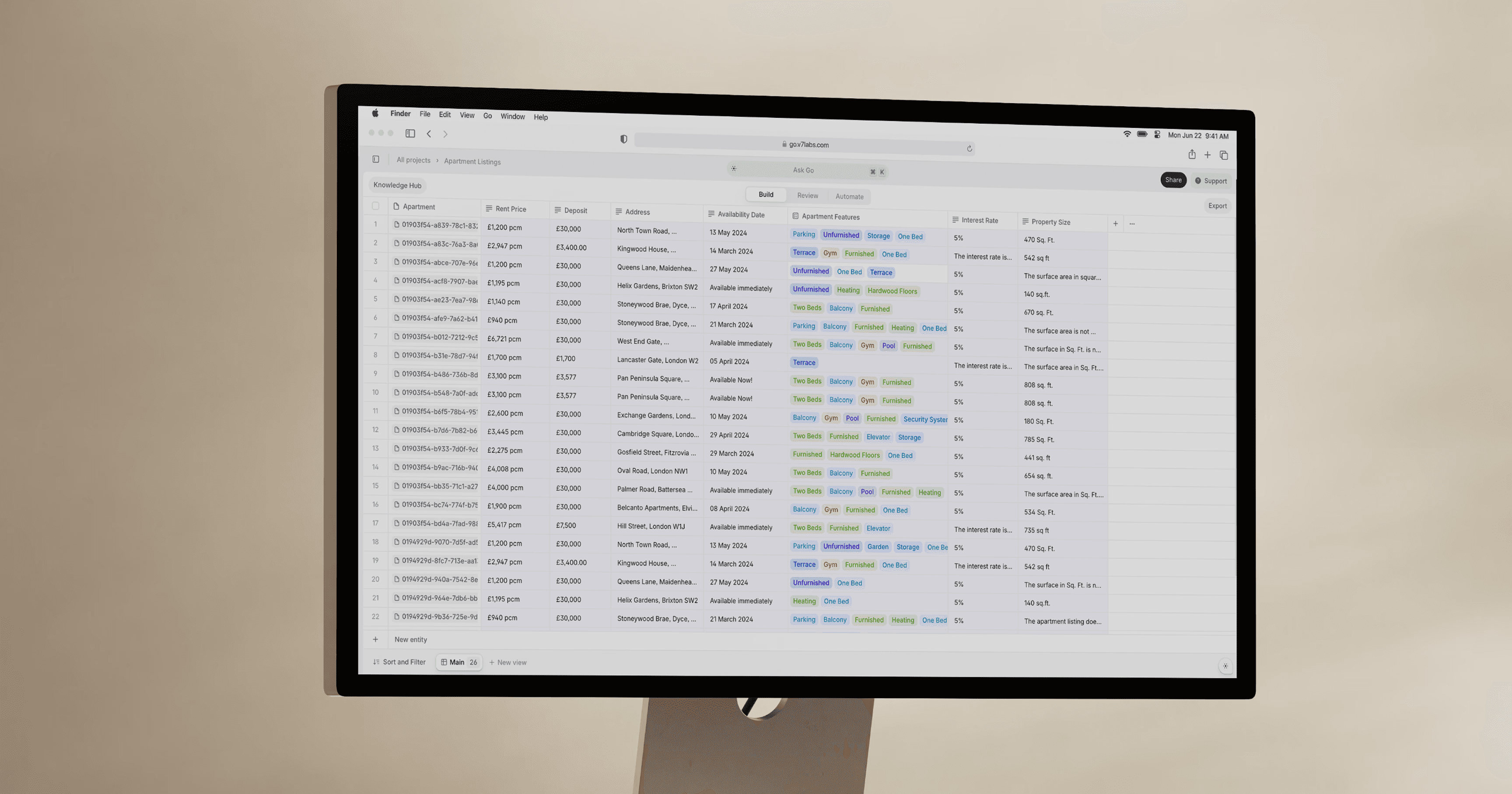
An AI agent can be used to automate this, reading the Purchase and Sale Agreement, extracting the critical dates, and populating your calendar and CRM automatically. If the contract is amended, the agent reads the amendment and updates the timeline. If a contingency is waived, the agent removes the associated tasks.
You review the output, make any necessary adjustments, and send. The entire process takes minutes instead of hours.
To see an example of how V7 can be used to automate real estate transactions, have a look at our case study: Relos streamlines $100M in real estate transactions with V7 Go contract intelligence.
2. Lease Abstraction: Turning 50-Page Leases into Structured Data
Commercial real estate agents and property managers deal with leases constantly. A typical commercial lease is 30–50 pages and contains dozens of critical terms:
Base rent and escalation clauses
Renewal options and termination rights
Maintenance and repair obligations
Tenant improvement allowances
Exclusivity and use restrictions
Reading one lease and extracting these terms takes 30–60 minutes. If you manage 100 properties, that is 50–100 hours of work. Many firms outsource this to paralegals or offshore teams. The cost is $50–$150 per lease, and the turnaround is 3–5 business days.
An AI lease analysis agent does this in minutes. It reads the lease, identifies the relevant clauses, and outputs a structured summary. You get an Excel file with columns for rent, escalation schedule, renewal dates, and termination rights, ready to import into your property management system.
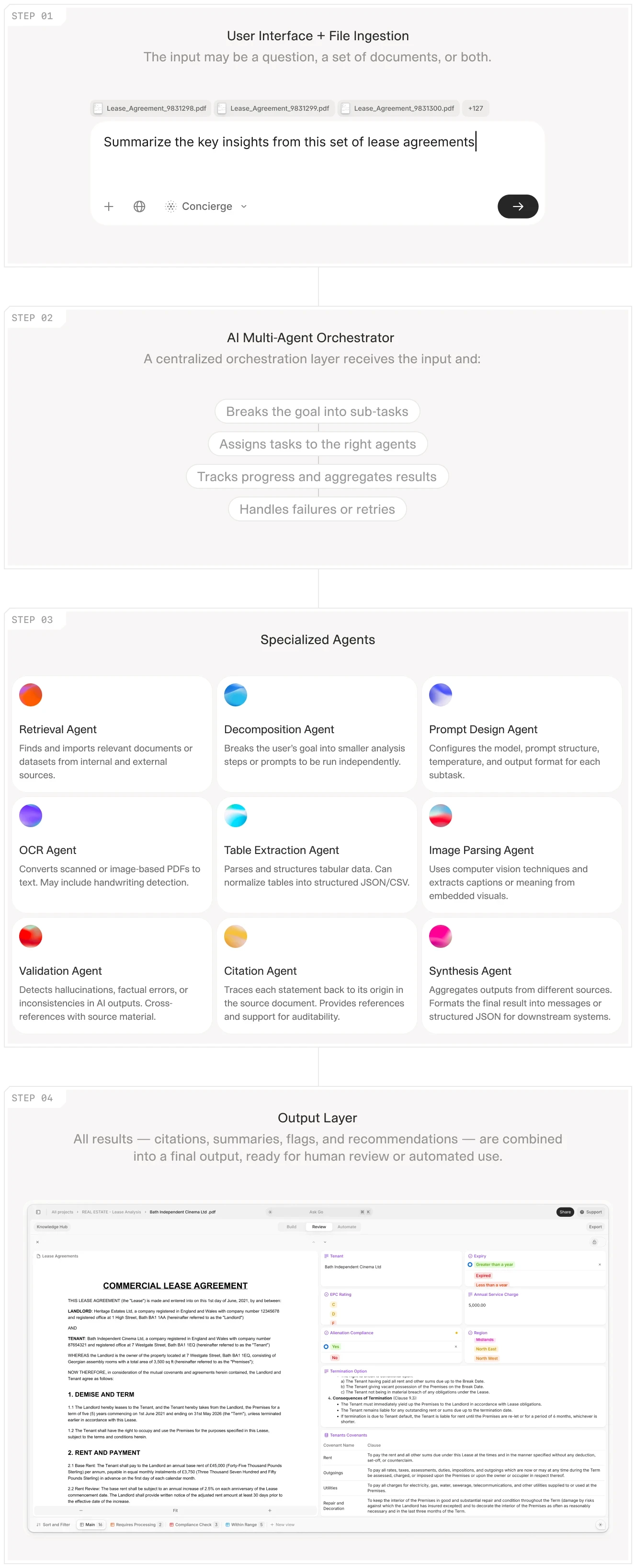
AI agents extract key lease terms and organize them into structured data, turning weeks of manual work into minutes of review.
Speed is always helpful, but consistency and thoroughness are even more important. A human reader might miss a clause buried in Section 12.4. An agent reads every word and cross-references terms across the document. If the lease says "Tenant may terminate with 90 days' notice" in one section and "Landlord must approve termination" in another, the agent flags the conflict.
3. The Smart CRM: Automated Data Entry and Follow-Up
CRMs promise structure and efficiency, but in most organizations they end up as sprawling data graveyards. Information becomes stale within days, and teams quietly fall back to spreadsheets, email threads, and ad-hoc notes.
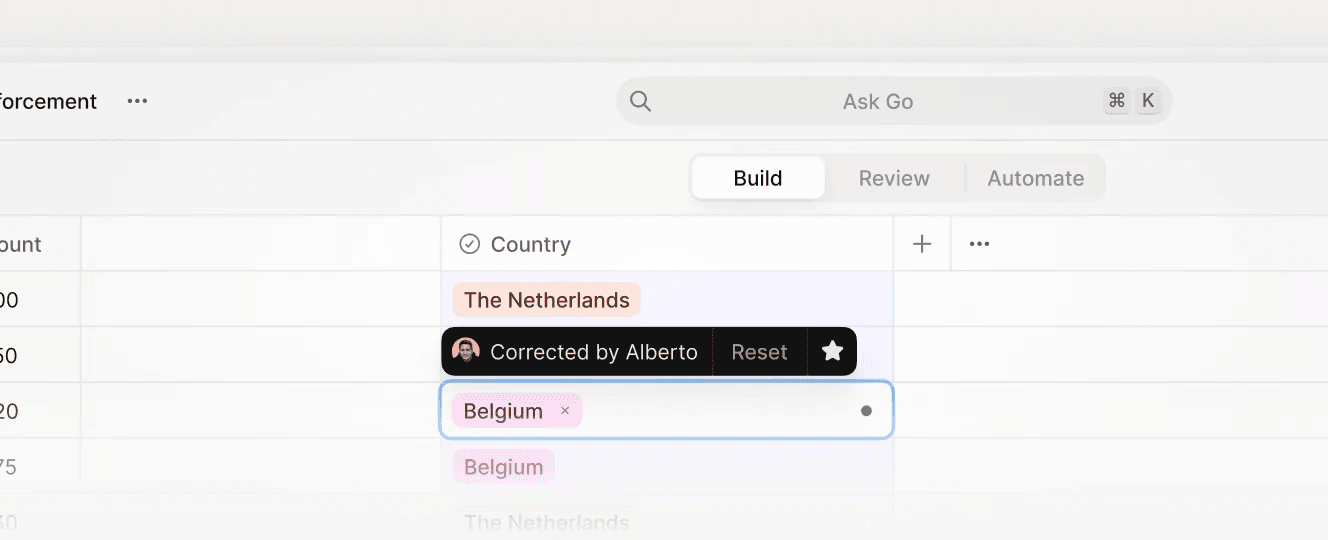
AI agents can replace this broken input method with automated intelligence. Instead of waiting for a human to type updates into a system, an agent can continuously consolidate customer data from every source (CRMs, spreadsheets, video call transcripts, databases, communication tools) and merge it into unified customer profiles. Once data is unified, AI standardizes field names, formats, and values across all systems, eliminating the inconsistencies that make reporting unreliable.
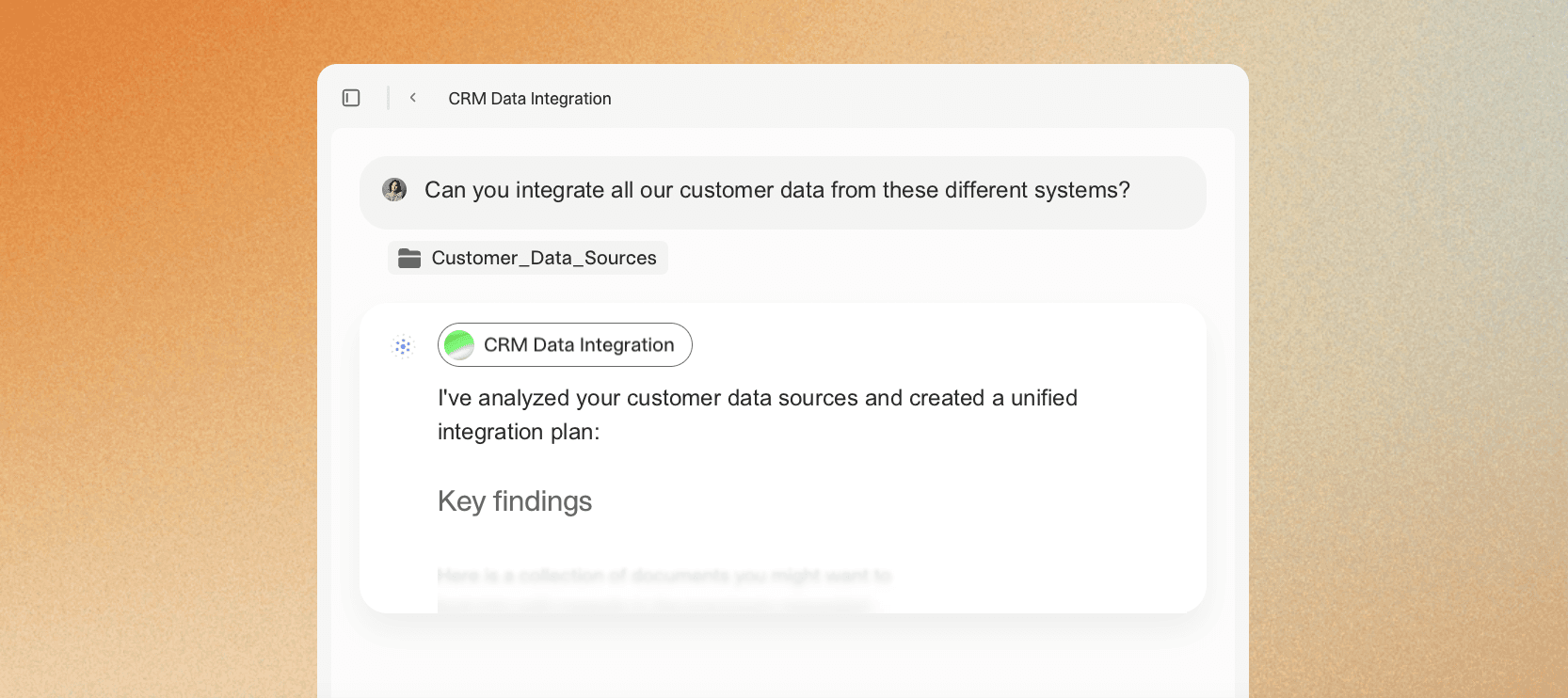
This turns the CRM from a static repository into a living, accurate reflection of customer reality.
A buyer mentioning their son graduates in May, concerns about school districts, or a preferred closing timeline; these details can be extracted, validated, and written directly into the customer profile.
Follow-up becomes smarter and more personal, with AI drafting context-aware outreach based on real conversation history rather than generic templates.
To see this in action, have a look at V7's AI CRM Data Integration agent.











Implementation: How to Start Small and Scale
The biggest mistake real estate professionals make with AI is trying to automate everything at once. They buy a platform, spend weeks configuring it, and then get frustrated when it does not work perfectly out of the box.
The better approach is to start with one workflow. Pick the task that is most painful, most repetitive, and most document-heavy. For most real estate agents, this is either transaction coordination or lease abstraction.
Phase 1: Pilot with One Workflow
Choose a single use case and run a pilot. If you are a residential agent, start with transaction coordination. If you manage commercial properties, start with lease agreement analysis. The goal is to prove that the agent works and delivers value before you expand.
During the pilot, track metrics:
Time saved per transaction
Error rate (how often the agent gets it wrong)
User satisfaction (do you trust the output?)
Phase 2: Refine and Expand
Once the pilot is successful, refine the workflow. Adjust the automated workflow based on what you learned. If it consistently misses a specific type of clause, add that to the training data. If it flags too many false positives, tighten the validation rules.
Then expand to a second workflow. If you started with transaction coordination, add CRM automation. If you started with lease abstraction, add compliance checks.
Phase 3: Integrate with Your Existing Tools
AI agents are most valuable when they connect to the tools you already use. If your CRM is in Salesforce, the agent should update Salesforce directly. If your calendar is in Google, the agent should create Google Calendar events.
This requires some technical setup, but most modern platforms offer pre-built integrations or APIs. V7 Go, for example, integrates with industry-standard tools like Salesforce, Slack, Zapier, and Microsoft 365.
Data Privacy: What Happens to Your Documents
Real estate documents contain sensitive information: client names, addresses, financial details, and transaction terms. You cannot afford to upload this data to a public AI model that might use it for training or expose it to other users.
When evaluating AI tools, ask about data privacy. Enterprise platforms like V7 Go offer strict data isolation. Your documents are processed in your private environment to provide context for the agents, but they are never used to train public models. Your data stays in your account, and you can delete it at any time.

To see how AI can automate your real estate workflows, from transaction coordination to lease abstraction, book a demo with V7 Go. We will show you how to turn your most time-consuming tasks into automated processes that run in the background while you focus on closing deals.
Can AI agents really handle complex real estate documents?
Yes, but with caveats. Modern AI agents can read and extract data from complex documents like purchase agreements, leases, and inspection reports. They handle variations in format, terminology, and structure far better than traditional OCR or template-based systems.
+
How much time can I realistically save with AI agents?
It depends on your current workflow and transaction volume. For transaction coordination, agents typically save 1–3 hours per deal by automating data entry, calendar updates, and email drafting. For lease abstraction, the savings are even larger—what used to take 30–60 minutes per lease now takes 5–10 minutes of review time. If you close 10 deals a month, that is 10–30 hours saved. If you manage 100 leases, that is 40–80 hours saved. The key is to start with your highest-volume, most repetitive workflow to maximize ROI.
+
Is my client data safe when using AI agents?
It depends on the platform. Public AI tools like ChatGPT are not designed for sensitive data—they may use your inputs for training or store them in shared systems. Enterprise platforms like V7 Go offer strict data isolation. Your documents are processed in your private environment, never used to train public models, and can be deleted at any time. When evaluating tools, ask about data residency, access controls, and whether your data is used for model training. Look for SOC 2 Type II certification and GDPR compliance as baseline security standards.
+
What happens if the AI agent makes a mistake?
Mistakes happen, which is why human review is essential. The agent flags uncertain extractions or ambiguous clauses, and you verify the output before it goes live. If the agent misreads a date or misses a clause, you catch it during review and correct it. Over time, you can refine the agent's configuration to reduce errors. The goal is not perfection—it is to shift your time from manual data entry to high-value review and decision-making.
+
Can AI agents replace transaction coordinators or assistants?
+
Imogen is an experienced content writer and marketer, specializing in B2B SaaS. She particularly enjoys writing about the impact of technology on sectors like law, finance, and insurance.